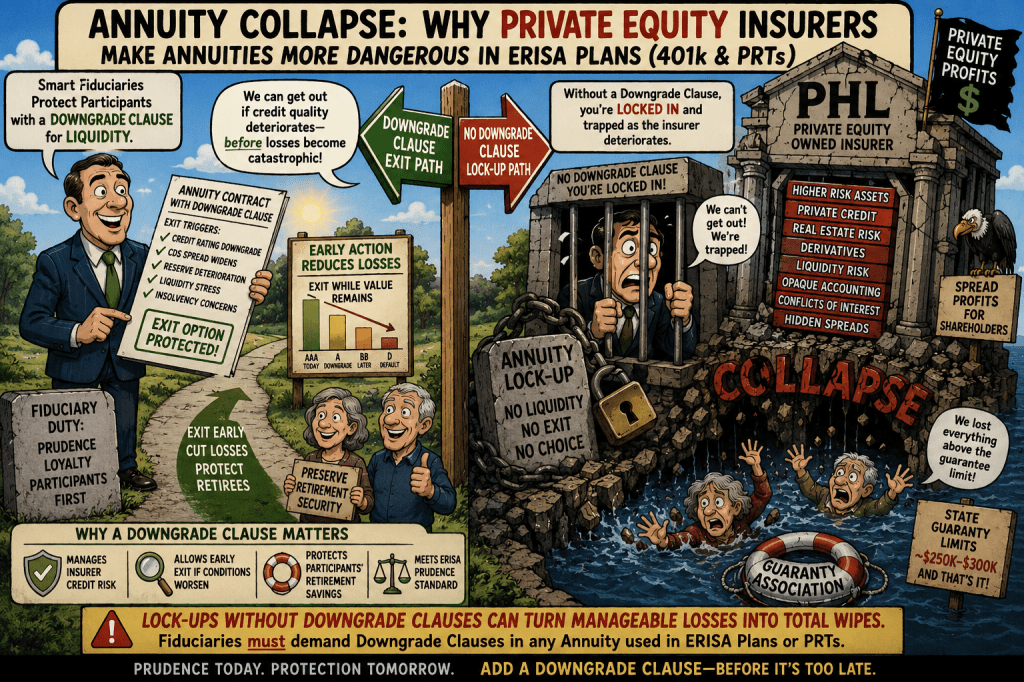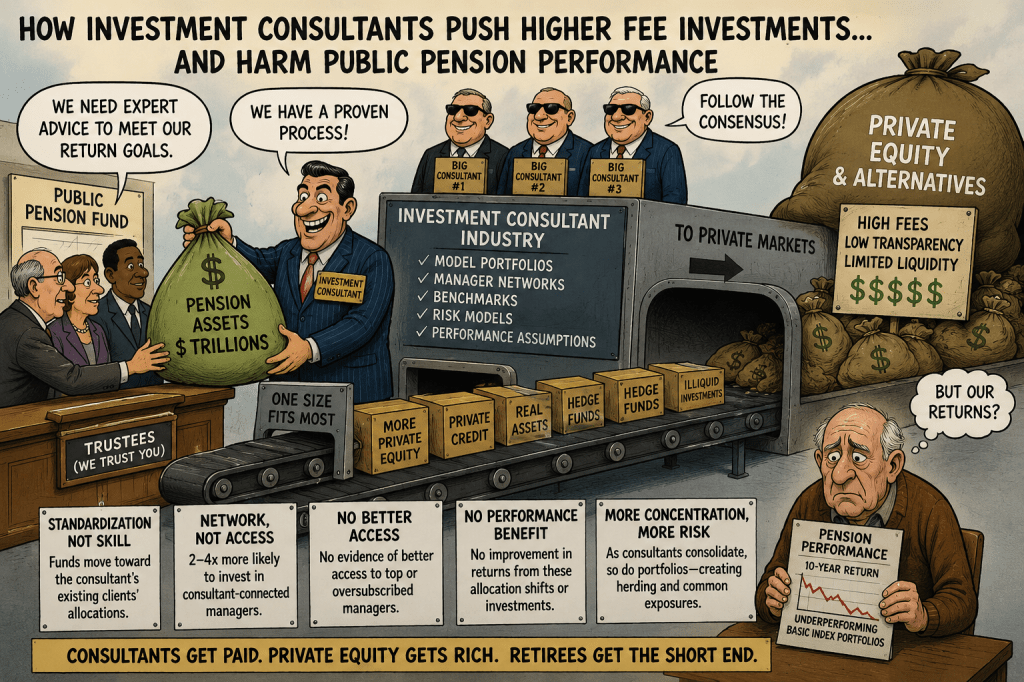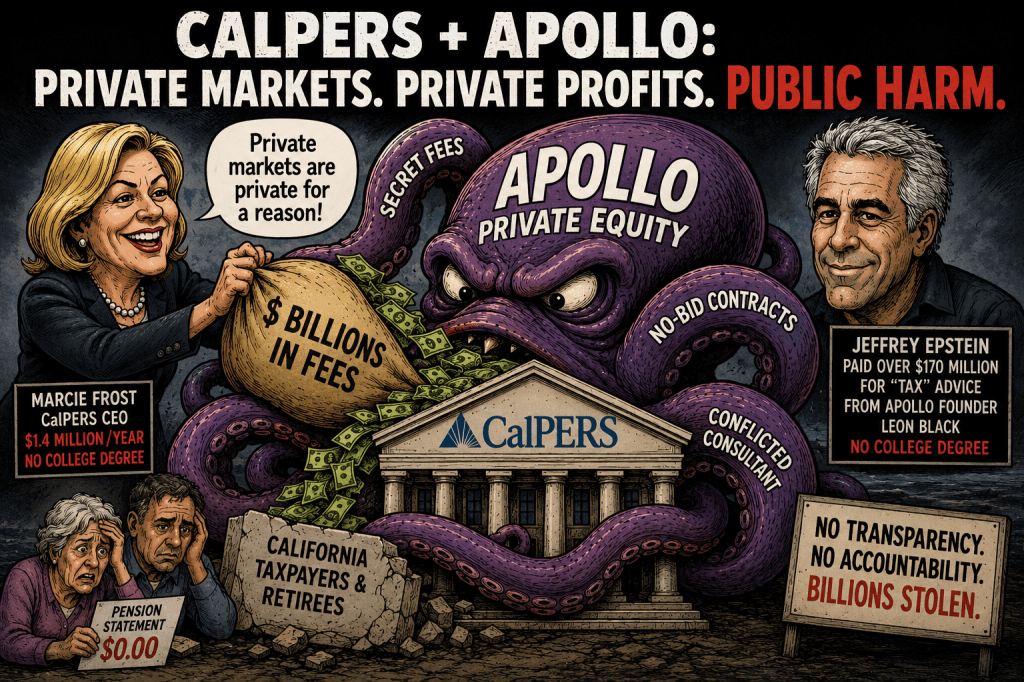
Our new 255 page Forensic investigation CalPERS: America’s Misled and Misleading Pension Leader captures the twisted relationship CALPERS has with Private Equity whose 4 leading players are Apollo, KKR, Blackstone & Carlyle where CALPERS invests billions. Private Equity extracts from CA Taxpayers over $5 billion a year in fees from secret no-bid contracts with CALPERS. https://www.rpea.com/view/download.php/news/calpers-investigation-report
In an 2025 interview with CNBC’s “Squawk on the Street”, CalPERS CEO Marcie Frost after smirking, gratuitously reassured her Private Equity Partners:
“Private markets are called private for a reason… CalPERS is not sharing the limited partnership agreements. CalPERS is not sharing any side letters… We are extremely transparent… But frankly, private markets are private for a reason…” https://www.cnbc.com/video/2025/08/07/calpers-ceo-on-expansion-into-private-markets.html
Frost refused to provide any unredacted Private Equity contract of over 400 from open records request for the Forensic Investigation in timely matter.
Frost is paid $1.4 million per year and like Jeffrey Epstein does not have a college degree.
Our report mostly covers the overall twisted relationship with Private Equity but I wanted to focus on the most sick relationship of all, Apollo. The report does break 3 major Apollo related stories.
1. CALPERS primary consultant of 30 years Wilshire was secretly bought by Apollo in 2021. This was covered in NBC story https://www.nbcnews.com/news/us-news/nations-largest-public-pension-fund-plagued-secrecy-underperformance-p-rcna346330
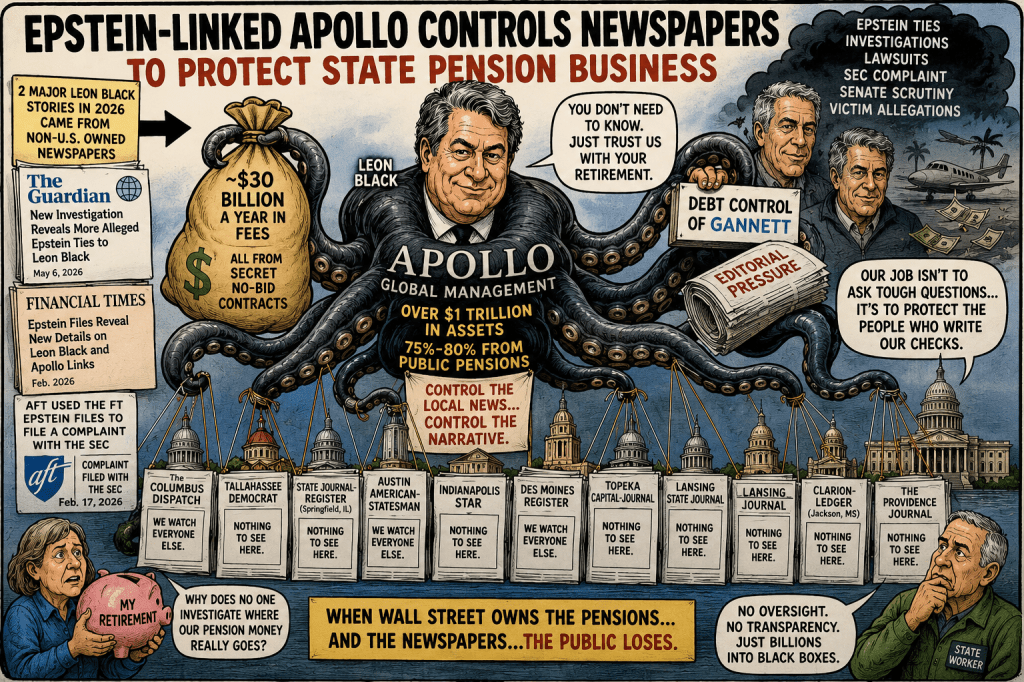
2. Apollo admits that 75-80% of its assets are from public pensions. CalPERS as major US pension leader has contributed $billions to Apollos profits.
3. Apollo total commissions to xCalpers Trustee Villabous – who committed suicide – were significantly higher $35mm vs. $22 mm in placement agent fees which was number most widely circulated. The SEC number did not include the $13.2 mm commission Villabous got from CALPERS purchasing an equity stake in Apollo stock. It cites and references the AFT and AFLCIO letters tying Apollo to Jeffrey Epstein. And the following table.
Apollo–CalPERS Investment Timeline
| Name of Fund / Transaction | 1st Year | CalPERS Commitment ($) | Commission Paid ($) |
| Apollo Investment Fund IV, L.P. | 1998 | 150,000,000 | — |
| Apollo Investment Fund V, L.P. | 2001 | 250,000,000 | — |
| Apollo Management VI, L.P. | 2005 | 650,000,000 | 3,864,734 |
| Apollo Investment Fund VI, L.P. | 2006 | 520,000,000 | — |
| Apollo Alternative Assets, L.P. | 2006 | 200,000,000 | 4,400,000 |
| Apollo Management VII, L.P. | 2007 | — | 3,500,000 |
| Apollo Equity Stake (Pre-IPO Private Exchange) | 2007 | 601,000,000 | 13,200,000 |
| Apollo European Principal Finance Fund, L.P. | 2008 | 82,991,535 | — |
| Apollo European Funds (multiple) | 2008 | — | 1,000,000 |
| Apollo Credit Opportunity Fund | 2008 | 1,000,000,000 | 9,070,833 |
| Apollo Investment Fund VIII, L.P. | 2013 | 350,000,000 | — |
| Apollo Investment Fund VIII (Credit Allocation) | 2013 | 800,000,000 | — |
| Apollo Investment Fund IX, L.P. | 2019 | 550,000,000 | — |
| Apollo Investment Fund X, L.P. | 2023 | 225,000,000 | — |
| Apollo S3 Equity & Hybrid Solutions Fund, L.P. | 2025 | 175,000,000 | — |
| TOTAL (Documented) | 6,553,991,535 | 35,035,560 |
Source of commissions Attorney General Complaint of May 2010 https://oag.ca.gov/news/press-releases/brown-files-suit-against-former-calpers-officials-and-freezes-assets-alfred? Source of commitments CALPERS June 25 Private Equity Report
CALPERS corruption was so broad that despite the Forensic Investigation being 255 pages only a few pages were dedicated to Apollo. So, I have put together a piece on a timeline that explores more issues in depth.
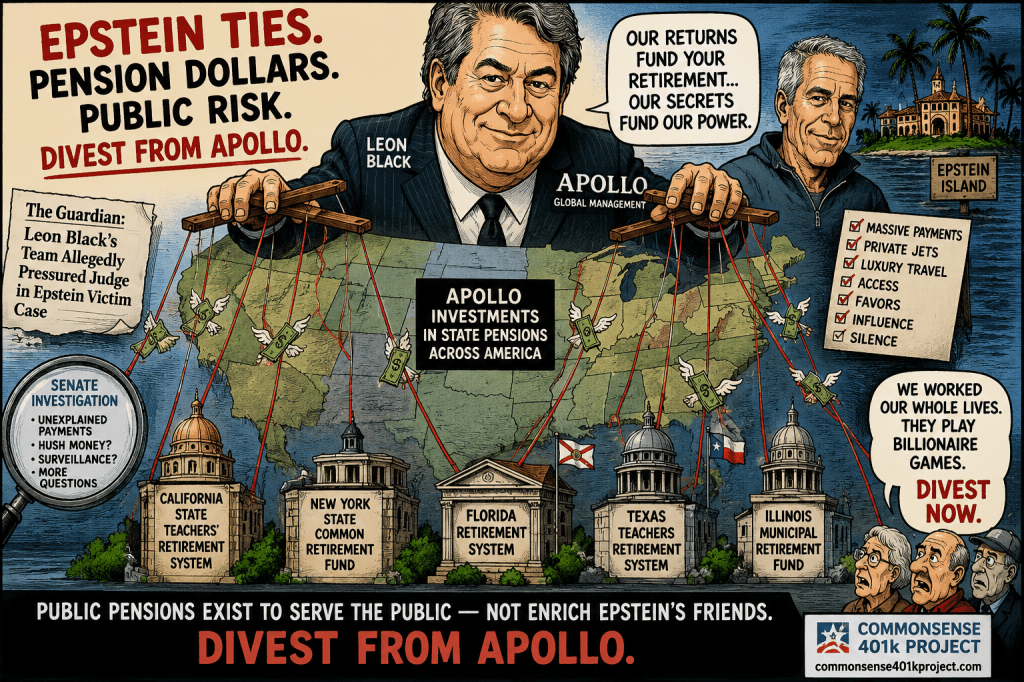
For years before the current Private Debt meltdown and the Jeffrey Epstein scandal CALPERS has been in a conflicted relationship with Apollo. Since 2000 it is estimated that CALPERS has paid $10 to $14 billion in fees to Apollo in secret no-bid contracts. In 2007 it actually purchased an ownership interest in Apollo. CALPERS supposed independent investment consultant Wilshire is secretly owned by Apollo. These conflicts continued for decades and are still going on. A former Trustee collected $35 million in secret commissions from Apollo but died from “suicide” before he could be put in prison. However, the CALPERS Executive Director did go to prison for 5 years on Apollo related transactions. This period in time overlaps the time (2005-2019) when Leon Black of Apollo was the largest funder of Jeffrey Epstein admitting to paying over $170 million to him for “tax” advice.
CalPERS in 1998 put $150 million in the Apollo Investment Fund IV, and in 2001 $250 million Apollo Investment Fund V. But in 2007 it went to a new level.
Alfred Villalobos served as and was on the CalPERS’ Board from 1992 to 1995. After leaving the CALPERS board he eventually in the early 2000s created his placement agent firms ARVCO and CF partners which received over 95% of its revenue strictly from Apollo. Charles “Chuck” Valdes served on the CalPERS board for 25 years and was Chair of the Investment Committee from 1988 to 1999 and again from 2005 to 2007. Federico Buenrostro was a Senior California state official before joining CALPERS as CEO in 2002.
Villalobos, via his placement agency ARVCO contracted with Apollo Management VI, L.P. on or about May 25, 2005, for a $650 million investment. Villalobos received $3,864,734 in commissions secretly from Apollo for this placement.
Villalobos successfully induced CalPERS to invest $200 million in Apollo Alternative Assets, L.P. on or about July 27, 2006, and received a $4.4 million commission from Apollo.
Villalobos, Valdes, and Buenrostro made a ten-day trip together in November of 2006, ostensibly to attend the two-day Capital Markets Conference in Dubai. They flew together from San Francisco to London on November 17,2006 and then from London to Dubai the next day. Then on to Hong Kong, where they were picked up by a limousine. They then took a 30-minute helicopter ride from Hong Kong to Macau, a famous gambling location. https://oag.ca.gov/news/press-releases/brown-files-suit-against-former-calpers-officials-and-freezes-assets-alfred?
In May of 2007 a senior CalPERS investment officer Leon Shahinian responsible for evaluating a multibillion-dollar Apollo Private Equity commitment was invited to a due diligence meeting with Leon Black at Apollo’s offices in New York prior to attending a black-tie event at the Museum of Modern Art (“MOMA”) honoring Apollo founder Leon Black. Shahinian made no effort to book a commercial flight to New York, choosing instead to accept former trustee now placement agent Alfred Villalobos’ offer to fly with him there by private jet.
Villalobos and ARVCO, his placement agent firm apparently paid for all the travel arrangements for the trip, and later billed Apollo over $8,000 for the suite and related hotel charges, over $1,500 in car service fees, and over $50,000 for the use of the private jet. Villalobos was later reimbursed for these costs by Apollo, including the jet.
One month after his trip to New York, Shahinian made a presentation to the Investment Committee of the Board chaired by Valdes regarding the proposed investment in Apollo Management VII, L.P and it was approved in July 2007. Villalobos received a secret $3.5 million commission from Apollo for this transaction.
In September 2007, CalPERS purchased a $601 million ownership stake (8.6%) in Apollo ahead of Apollo’s listing on Goldman Sachs’ private exchange. After the buy in, the relationship went to a higher level. Villalobos received a secret $13.2 million commission from Apollo for this transaction.
In early 2008 Villalobos placed several Apollo European funds and received $1 million in commissions. CalPERS invested $1 billion in Apollo Credit Opportunity on or about April 15, 2008, and as compensation, Villalobos received $9,070,833 in commissions from Apollo.
For nearly 2 years this scheme operated in silence until the SEC sent a formal inquiry to Villalobas firm ARVCO on July 17, 2009, and some stories around placement agents dribbled out in late 2009 by the Sacramento Bee. The scheme was not caught by any CALPERS internal controls, and many believe it was Buenrostro’s x-wife who was listed as providing testimony to the U.S. DOJ.
Quietly A CALPERS special review of this scandal was started in 2009 by law firm Steptoe & Johnson which Naked Capitalism called a Whitewash. https://www.nakedcapitalism.com/2019/08/calpers-in-bed-with-jeffrey-epstein-client-and-co-investor-apollos-leon-black-even-after-apollo-pay-to-play-scandal-led-to-conviction-and-jail-term-for-former-calpers-ceo.html
The Steptoe report focused on Villalobos and Buenrostro who were guilty but covered up many others who should have received more scrutiny especially Epstein linked Apollo. Philip S. Khinda (lead author of the review report) simultaneously negotiated and then memorialized in a “new strategic relationship agreement” with Apollo Global Management in a April 16, 2010 letter addressed to Leon D. Black, explicitly praising Apollo’s cooperation with the still-ongoing review. https://documents.latimes.com/calpers-special-review/?_gl=1*1pjpo7m*_gcl_au*NTcwOTU0NTEyLjE3NjkzNjUyNDk
So while Apollo paid the placement agent fees (kickbacks) over $35 million to Villalobos and made the $billions in excessive fees they escaped any accountability for this scandal. Coincidentally, Steptoe & Johnson were Epstein’s criminal attorneys when he died in prison in 2019.
The media attention did not break big until 2010 with articles in the Wall Street Journal and New York Times. The California Attorney General filed Civil Actions, and the FBI and other agencies opened criminal probes May-June 2010.
In April 2012, the SEC charged former CalPERS CEO Federico Buenrostro and his close associate/placement agent and former trustee Alfred Villalobos with falsifying investor disclosure letters to induce Apollo to pay placement-agent fees the SEC said Apollo supposedly would not otherwise have paid without those disclosure letters. In August 2014, the U.S. Attorney’s Office (NDCA) described a superseding indictment alleging Villalobos conspired with Buenrostro in connection with a $3 billion CalPERS investment into Apollo-managed funds, that Villalobos acted as Apollo’s placement agent through ARVCO, and that fraudulent investor disclosure letters were created after CalPERS offices declined to sign.
In January 2015, Villalobos died in what authorities described as an apparent suicide, just before trial in the CalPERS corruption case. Buenrostro was sentenced to 5 years in prison. Reporting at the time underscored that Apollo itself was not accused of wrongdoing in that episode (above the law)— that even though they benefited the most from the corruption they appeared to be immune from any accountability.
Apollo was rewarded with continuing exposure and significant growth. CalPERS’ Private Equity Program performance table lists Apollo Investment Fund VIII (2013)with a $350 million commitment. This is in addition to an additional $800 million commitment to Private Credit.
CALPERS is regularly referred to as “America’s top Pension fund” and is seen by other pensions as a first mover and policy setter. Apollo co-founder Joshua Harris admitted at a 2013 meeting of the Philadelphia Board of Pensions that the firm’s capital base was overwhelmingly dependent on public retirement systems. Asked directly whether Apollo had many public pension investors, Harris responded bluntly that “almost all” of Apollo’s capital came from public funds, estimating that roughly 75% to 80% of Apollo’s capital was supplied by public pension plans. Many other state pension plans invested $billions with Apollo based on CALPERS lead. https://www.phila.gov/pensions/PDF/IM_03_28_13_Investment_Minutes.pdf
While CALPERS has refused to disclose any of these Apollo contracts unredacted in our open records request, Pennsylvania accidently released their Apollo Investment Fund VIIIcontract, (which is the same one CalPERS has) and it is publicly available on the Naked Capitalism web site. https://trove.nakedcapitalism.com/LPAs/verified-as-LPAs/Apollo_Investment_Fund_VIII_LPA_S1.pdf Apollo agreements make use of offshore vehicles, parallel structures, and non-California governing law. The contracts embed the possibility of NAV smoothing, delayed recognition of impairment, and performance presentation that cannot be independently reconstructed. Each agreement centralizes valuation authority in the General Partner. Independent valuation is not mandated as binding. Audit rights are limited. Third-party valuation is discretionary. Apollo explicitly permitted affiliates to engage in other investment activities, to manage competing funds, to allocate opportunities among affiliated vehicles, and to pursue co-investment structures. In 2016 Apollo Private Equity was fined $52 million by the SEC for Investor Protection violations misleading fund investors about fees and excessive expenses and I could find no record of CALPERS addressing this.
In 2018 CEO Rowan immediately after meeting Jared Kushner in the Trump White House, Apollo offered his family real estate company a $180 million loan. https://prospect.org/2023/10/21/2023-10-21-moral-authority-of-marc-rowan/
In 2019 when Jeffrey Epstein was charged with sex trafficking, it was revealed that Apollo founder and CEO Leon Black had paid Epstein over $170 million for supposed tax advice from a college dropout. CALPERS Trustees were told (implicitly and explicitly) that governance risk was contained, that Apollo’s internal review had addressed the matter and they took no action. We now know that those narratives were materially deficient. https://www.nakedcapitalism.com/2019/08/calpers-in-bed-with-jeffrey-epstein-client-and-co-investor-apollos-leon-black-even-after-apollo-pay-to-play-scandal-led-to-conviction-and-jail-term-for-former-calpers-ceo.html
On Jan. 25, 2021, Apollo filed a SEC Form 8-K that included two exhibits: a letter from then-CEO Leon Black to Apollo’s limited partners, and an investigative report from the law firm of Dechert LLP. The Dechert report takes pains to minimize Epstein’s ties with other Apollo executives, including CEO Marc Rowan. https://www.sec.gov/Archives/edgar/data/1411494/000119312521016405/d118102d8k.htm
In 2021, Wilshire was acquired by private equity firms CC Capital Partner and Motive Partners. That same year, Apollo Global Management, Inc., acquired up to a 24.9 percent minority stake in Motive’s management company and Apollo and its affiliates became limited partners in Motive managed vehicles. To our knowledge this was not disclosed to board. Having you so-called independent consultant Wilshire owned by a manager Apollo that they are supposed to evaluate is an egregious conflict of interest.
The investments continued with the Apollo Investment Fund X (2023) with a $225 million commitment. There was Continued Epstein scandal around Leon Black into 2023. https://www.nakedcapitalism.com/2023/07/former-apollo-chief-leon-black-has-more-jeffrey-epstein-splaining-to-do-with-tax-evasion-alleged-rape-of-autistic-16-year-old.html Conflicts continue as Dana Hollinger, a CALPERS board member from 2014-2019 joined the board of Apollo Private Markets in 2025. https://www.linkedin.com/in/dana-hollinger-j-d-6a122611/
Performance losses based on Apollo’s own self-reported numbers are around $3 billion. Actual losses may be another $1billion or more if Apollo Private Credit and Private Equity were marked to market.
On February 1st 2026 the Financial Times of London story dropped a story based on a recent release of the Epstein files, https://www.ft.com/content/092d9e44-ec17-4da7-8b58-e43bf09113ab
that Apollo itself and CEO Marc Rowan had much deeper ties to Jeffery Epstein than previously disclosed in the 2001 SEC filing and that Apollo chief Marc Rowan consulted Epstein on firm’s tax affairs.
The February 2026 complaint filed with the U.S. Securities and Exchange Commission by the American Federation of Teachers and American Association of University Professors who both represent CALPERS members alleges that Apollo’s disclosures may have been materially incomplete or misleading.
The complaint goes into detail the contradiction of the 2021 SEC disclosures and the recently disclosed Epstein Files uncovered by the FT.
The unions asked the Commission to investigate whether Apollo’s prior disclosures about it and its executives’ ties to Jeffrey Epstein painted an “inaccurate and incomplete picture.” Their letter pointed to newly released Epstein documents referring to Marc Rowan, including meetings at Apollo’s offices, breakfasts involving Rowan, Leon Black, and Epstein, discussions of donor-advised funds, tax matters, a possible Apollo inversion, and other business-related contacts. The letter concluded that the 2021 disclosures may have offered “an inaccurate depiction of the extent of Apollo’s ties with Jeffrey Epstein” and said the SEC should investigate whether the statements were materially false or misleading.
Also, in early March 2026 securities lawyers filed stock-drop cases against Apollo claiming that they lied on disclosures about Epstein involvement causing the stock to drop around 35%. https://www.investmentnews.com/regulation-legal-compliance/legal-class-action-accuses-apollo-of-hiding-epstein-ties-in-sec-filings/265521
As almost every pension including CALPERS owns Apollo stock, it puts CALPERS in a strange position whether to join these class action cases.
In March 26 the AFL-CIO filed another complaint echoing the Epstein concerns of the AFT letter and adding some labor violations of Apollo portfolio companies. https://aflcio.org/sites/default/files/2026-03/Letter%20to%20Apollo%20Global%20Management’s%20Lead%20Independent%20Director%20Gary%20Cohn%203.11.2026.pdf
AFL-CIO is an umbrella organization for several unions affiliated with CALPERS including SEIU, AFSCME, AFT, IAFF, and IUPA.
More and more disturbing ties between Leon Black and Jeffrey Epstein continue to build as reported in March 2026 by the NY Times. https://www.virginislandsdailynews.com/ap/how-epstein-helped-solve-billionaire-leon-black-s-problems/article_1d867799-cac3-4a44-87b9-6adb001e2e4c.html
Apollos stock price drop has attracted lawsuits, which the Mississippi Public Plan has joined but CALPERS has shown no interest. https://commonsense401kproject.com/2026/04/11/state-pensions-notably-absent-from-apollo-stock-drop-cases/ CALPERS has twisted and violated its own ESG policies to accommodate Apollo. https://commonsense401kproject.com/2026/04/26/calpers-esg-failure/
Famous Oxford Professor Ludovic Phalippou publicly supports CA-SB 1319 Private Equity Sunshine Act for California Public Pensions, a modest transparency bill. https://www.linkedin.com/feed/update/urn:li:activity:7455913436183629824/
However, CalPERS has spent $millions in staff hours trying to block even this small amount of transparency. https://www.calpers.ca.gov/documents/202605-full-agenda-item08a-02-a/download?inline With the support of Private Equity industry CalPERS at this time seems to have killed this Private Equity transparency bill, denying it a hearing.
The conflicted CALPERS – Apollo relationship has cost participants and taxpayers $billions. Excessive fees as high as $14 billion. Additional performance drag of many more $billions.
With Apollos culture being exposed by the Epstein connections, it is way past time for CALPERS to part ways with this parasitic vendor.