Pension Risk Transfer Annuities should be Prohibited.  The Burden of proof is on plan sponsors to justify that they are prudent

By Christopher B. Tobe, CFA, CAIA

Pension Risk Transfer Annuities (PRT’s) replace a solid diversified defined benefit plan with federal (PBGC) insurance, with a high single entity risk annuity with higher risks and weak state regulation. 

Pension Risk Transfers (PRT’s) shift the risk off the plan sponsor onto the backs of the participants.   This allows plan sponsors to lower costs and insurance companies billions at the expense of participants and retirees.

It appears that large pension plans have been in a hurry to close Pension Risk Transfer deals, before their victims the participants wake up and see the raw deal they are getting.[i] Regulators, to my knowledge, have never tested this risk with actuarial analysis.  Under industry pressure they came up after the Executive Life defaults IB95-1 a weak rule to pick the “safest available annuity”.  I think the premise of a least risky annuity would is like a less risky plane crash.

However, plan sponsors are not off the hook, due to the ability of plaintiffs to recover these losses through litigation.   The Burden of proof is on plan sponsors that their plan PRT Annuity contract has low enough risk to be exempted from being a Prohibited Transaction and is at a reasonable cost.

Fiduciary Breaches of PRT Annuity Contracts

PRT Annuity Contracts are a Fiduciary Breach for 4 basic reasons.[ii] 

  1. Single Entity Credit Risk[iii]  
  2. Single Entity Liquidity Risk in illiquid investments [iv]   
  3. Hidden fees spread and expenses [v]  
  4. Structure -weak cherry-picked state regulated contracts, not securities and useless reserves [vi]    

These breaches make it impossible for most annuity products to qualify for exemptions to Prohibited Transactions.[vii]  

The Federal Reserve in 1992 exposed the weak state regulatory and reserve claims of Fixed annuities in retirement plans.[viii]   In 2008 Federal Reserve Chairman Ben Bernanke said about these annuity products “workers whose 401(k) plans had purchased $40 billion of insurance from AIG against the risk that their stable-value funds would decline in value would have seen that insurance disappear.”[ix]  In the major stable value annuity source book,  single annuity like PRTs are shown to have 10 times the risk of a diversified fixed portfolio. [x]

.

The Burden of proof is on plan sponsors that they have documented due diligence on these risk issues and that their PRT Annuity contract is exempted from being a Prohibited Transactions. [xi]  

Fiduciary Transparency Conflicts Tests – Loyalty Excessive Compensation

As a plan sponsor you should put all products through these fiduciary transparency tests, I contend that annuities almost always flunk this basic level of care.

Annuities avoid transparency with poor state regulated structures which allow them to hide excessive risks and fees.    Annuity providers fight hard to avoid any Federal Regulations usually favoring state regulation in their home states where they are major employers and have higher political influence. Even industry insiders admit hidden fees are problematic to adopting annuities.[xii]

After the 2008 financial crisis several Insurers were forced into Federal Regulation under SIFI (too big to fail) they did everything to get out of the higher transparency and higher capital requirements.[xiii] 

Annuity contracts have been characterized by retirement group NAGDCA as having serious fiduciary issues.  “Due to the fact that the plan sponsor does not own the underlying investments, the portfolio holdings, performance, risk, and management fees are generally not disclosed.

It also makes it nearly impossible for plan sponsors to know the fees (which can be increased without disclosure) paid by participants in these funds—a critical component of a fiduciary’s responsibility “  [xiv]

Plans need to put their Loyalty to plan participants first which is their fiduciary duty.   They do not have loyalty to vendors such as money managers and annuity providers.

Annuities have an Inherent conflict because investment dollars leave the ownership of the plan and participants and become part of the balance sheet of the insurance company.   

Annuity contracts are designed to avoid all fiduciary obligation with no loyalty to participants.   Most annuity providers refuse to sign a “Fiduciary Acknowledgement Disclosure.” 

DOL official Khawar said. “” Under the National Association of Insurance Commissioners’ model rule, for example, “compensation is not considered a conflict of interest,” [xv]

Annuities have a total lack of disclosure of profits, fees and compensation.  They have secret kickback commissions.    How can a plan claim any of the compensation annuity provider receives is reasonable if it is secret and not disclosed.

Current Cases – Worst of Worst Athene-Apollo

PRTs have been operating under a weak DOL rule to pick the “safest available annuity”.  Over decades traditional insurers have made millions.  While default risk is present with traditional insurers, they do want to sustain the business long-term and avoid default.  When Private Equity players got involved, with their short-term mentality, they are set to strip billions in profits, not afraid to bankrupt companies and “kill the Golden Goose” for the traditional part of the business.

With these significant differences in risks and profit for the private equity insurers, it has created measurable damages that has jump started litigation. 

From Piercy v. AT&T filed on 3/11/24 says, AT&T turned its back on its retired workers, choosing to put the pensions of almost 100,000 AT&T retirees in peril, to secure AT&T an enormous profit. AT&T stood to gain—and did gain—more than $360 million in profit from this scheme The only losers in the transaction were AT&T’s retirees, who face the danger—now and in the future—that their lifelong pensions will go unpaid while they have lost all the protections of federal law.

As pointed out above the standard PRT is at least 10 times that of a diversified portfolio, but that an even riskier single entity credit risk like private equity backed Athene could have 20 times the risk. [xvi]

Most of the current PRT cases are against Apollo owned Athene.   Apollo is infamous with over

684 regulatory violations. [xvii]  Fines range from the DOJ $210 million fine for accounting fraud, to $53 Million by the SEC for misleading investors on fees. [xviii]   Other claims against Apollo are around investor protection violations, consumer protection violations, and the false claims act.

In early 2021 Apollo founder & CEO Leon Black resigned after paying $158 million in “tax advice” to Jeffrey Epstein.[xix]   In 2015 Apollo was involved in a massive pay to play scheme involving a trustee and CEO of CALPERS the US largest public pension.  The CALPERS CEO Buenrostro was sent to prison and the trustee Villalobos committed suicide before serving his term.[xx] 

Conclusion

In a submitted academic paper on Annuity risks it touts the risks of PRT’s.   It states the “Emperor has no Clothes” as the life insurance industry has poured billions of dollars into advertising, lobbying, commissions & trade articles with misinformation on annuities with everyone afraid to call out the obvious.[xxi]

The ultimate responsibility and the burden of proof goes on to the plan sponsor to prove this annuity purchase was for the benefit of participants.  Those who have pulled the trigger on these questionable annuity deals will probably face litigation. 


[i] https://www.chicagofed.org/publications/economic-perspectives/2024/5   https://www.chicagofed.org/publications/chicago-fed-letter/2024/494

[ii] https://commonsense401kproject.com/2022/05/11/annuities-are-a-fiduciary-breach/   https://commonsense401kproject.com/2024/11/29/crypto-private-equity-annuity-contracts-are-impossible-to-benchmark/

[iii] https://commonsense401kproject.com/2024/03/26/just-how-safe-are-safe-annuity-retirement-products-new-paper-shows-annuity-risks-are-too-high-for-any-fiduciary/  https://www.thinkadvisor.com/2024/11/20/yes-life-and-annuity-issuers-can-suddenly-collapse-treasury-risk-tracker-warns/ 

[iv] https://www.chicagofed.org/publications/economic-perspectives/2024/5   https://www.chicagofed.org/publications/chicago-fed-letter/2024/494

[v] https://www.bloomberg.com/news/articles/2013-03-06/prudential-says-annuity-fees-would-make-bankers-dance?embedded-checkout=true   TIAA https://www.nbcnews.com/investigations/tiaa-pushes-costly-retirement-products-cover-losses-whistleblower-rcna161198

[vi] Federal Reserve Bank of Minneapolis Summer 1992  Todd, Wallace  SPDA’s and GIC’s http://www.minneapolisfed.org/research/QR/QR1631.pdf  https://www.chicagofed.org/publications/economic-perspectives/1993/13sepoct1993-part2-brewer 

[vii] https://commonsense401kproject.com/2024/10/10/annuities-exposed-as-prohibited-transaction-in-401k-plans/

[viii] Federal Reserve Bank of Minneapolis Summer 1992  Todd, Wallace  SPDA’s and GIC’s http://www.minneapolisfed.org/research/QR/QR1631.pdf

[ix] http://www.federalreserve.gov/newsevents/testimony/bernanke20090324a.htm

[x] The Handbook of Stable Value Investments 1st Edition by Frank J. Fabozzi 1998 Jacquelin Griffin Evaluating Wrap Provider Credit Risk in Synthetic GICs pg. 272  https://www.amazon.com/Handbook-Stable-Value-Investments/dp/1883249422

[xi] https://commonsense401kproject.com/2024/11/19/burden-of-proof-is-on-plan-sponsors-hoping-to-qualifyfor-annuity-prohibited-transactions-exemption/

[xii] https://riabiz.com/a/2024/5/11/fidelity-voya-and-boa-smooth-blackrocks-launch-of-guaranteed-paycheck-etfs-but-401k-plan-participants-may-yet-balk-at-high-unseeable-fees-and-intangibility-of-benefits

[xiii] https://www.stanfordlawreview.org/online/the-last-sifi-the-unwise-and-illegal-deregulation-of-prudential-financial/

[xiv] http://www.nagdca.org/documents/StableValueFunds.pdf_ The National Association of Government Defined Contribution Administrators, Inc. (NAGDCA) September 2010.

[xv] https://www.thinkadvisor.com/2024/10/07/top-dol-official-sees-a-nonsensical-reality-at-heart-of-fiduciary-fight/

[xvi] The Handbook of Stable Value Investments 1st Edition by Frank J. Fabozzi 1998 Jacquelin Griffin Evaluating Wrap Provider Credit Risk in Synthetic GICs pg. 272  https://www.amazon.com/Handbook-Stable-Value-Investments/dp/1883249422

[xvii] https://violationtracker.goodjobsfirst.org/?company=Apollo

[xviii] https://www.ai-cio.com/news/apollo-fined-53-million-over-fees/

[xix] https://www.nytimes.com/2021/01/26/business/jeffrey-epstein-leon-black-apollo.html

[xx] https://www.latimes.com/business/la-fi-villalobos-suicide-20150115-story.html 

[xxi] Lambert, Thomas E. and Tobe, Christopher B., “Safe” Annuity Retirement Products and a Possible US Retirement Crisis (March 18, 2024). Available at SSRN: https://ssrn.com/abstract=4763269


Burden of Proof is on Plan Sponsors Hoping to Qualify for Annuity Prohibited Transactions Exemption

By Christopher B. Tobe, CFA, CAIA

The burden of proof is on plan sponsors regarding their plan annuity qualifies for an exemption from being classified as a prohibited transaction.  Likewise, they are also liable for proving that any annuity option or investment option that contains annuities qualifies for a prohibited ransaction Exemption,

I believe that most annuities in 401(k) and other ERISA plans do not fully qualify for a prohibited transaction exemption. [i]  The primary basis for my opinion is that the single entity credit and liquidity risk in annuity contracts violates one of the most basic standards of care diversification.[ii]    CFA Investment Standards lay out specific standards for 401(k) and other defined contribution (D.C.) plans. Diversification—each investment option, as a standalone investment, must be sufficiently diversified that plan participants, if they chose only that option would not be at serious risk of unsustainable investment losses because of a relatively small segment of the capital markets experiencing distress [iii]

Assuming that as plan sponsor that you can get over the single entity credit and liquidity risk, how can you justify any connection to annuities.   Perhaps your advisors will talk you into smaller amounts buried and hidden in a target date fund or in a lifetime income option.  It is common term in the financial world that “Annuities are sold not bought”.

I contend that annuities violate fiduciary standards in so many ways that it is very difficult for a plan sponsor to prove that these contracts qualify for a prohibited transaction exemption.


Fiduciary Transparency Tests of Care

As a plan sponsor you should put all products through these fiduciary transparency tests, I contend that annuities almost always flunk this basic level of care.

Is the annuity in a well-regulated transparent structure like a SEC registered mutual fund?

Most likely the answer is “no,” as annuities, with their lack of transparency around fees, are typically not allowed in SEC registered mutual funds.  Many plans avoid this issue by using SEC registered mutual funds.   SEC registered mutual funds have transparent fees and performances, have uniform federal regulations and are the gold standard for the 401(k).  SEC registered mutual funds do not allow annuities for the same reasons that I think most annuities flunk prohibited transaction exemptions.

CFA Institute Global Investment Performance Standards (GIPS) also have transparency standards on performance and fees.[iv]  Annuities typically do not comply with CFA GIPS standards. [v]  

Another way for plans to have Transparency and fiduciary control are achieved in a plan by an Investment Policy Statement (IPS).  However, plans with annuities avoid an IPS because they usually cannot comply with one.  [vi]

Noted Morningstar analyst John Rekenthaler said in April 2022 that in selecting 401(k) investment options, “inappropriate are investments that don’t price daily.  Annuities typically do not price daily and do not provide valuation transparency.[vii]  

Annuities avoid transparency with poor state regulated structures which allow them to hide excessive risks and fees.    Annuity providers fight hard to avoid any federal regulations, especially those imposing on them any type of true fiduciary standard and/or transparency, usually favoring state regulation in their home states where they are major employers and have higher political influence. Even industry insiders admit hidden fees are problematic to adopting annuities.[viii]

After the 2008 financial crisis several insurers were forced into federal regulation under SIFI (too big to fail) they did everything to get out of the higher transparency and higher capital requirements.[ix] 

Fiduciary Conflicts Tests – Loyalty and Excessive Compensation

Plans need to put their loyalty to plan participants first, which is their fiduciary duty.   They do not have loyalty to vendors such as money managers and annuity providers.

Annuities have an inherent conflict because upon annuitization, a common prerequisite to receiving the alleged benefit – guaranteed stream of income for life – investment dollars leave the ownership of the plan and participants, and become part of the balance sheet of the insurance company.   

Annuity contracts are designed to avoid all fiduciary obligation with no loyalty to participants.   Most annuity providers refuse to sign a “Fiduciary Acknowledgement Disclosure.” 

DOL official Khawar said. “” Under the National Association of Insurance Commissioners’ model rule, for example, “compensation is not considered a conflict of interest,” [x]

Reasonable Compensation Limitation

Annuities have a total lack of disclosure of profits, fees and compensation.  They have secret kickback commissions.    How can a plan claim any of the compensation annuity provider receives is reasonable if it is secret and not disclosed?

Secret kickback and commissions place the financial interests of the insurers and their affiliates over those of retirement investors.[xi]  In summer 2024 the GAO report on Self-Dealing [xii],  and Senator Warrens reported on Annuity kickbacks.[xiii]

A number of lawsuits have settled with claims of excessive secret fees and spreads. An insurance executive bragged at a conference of secret fees r3agrding spreads of over 200 basis points (2%) in 2013. [xiv]   Most observers of 401(k) plans do not feel that 200 basis points of compensation is reasonable.

Fixed Annuity Applications

In 1992, The Federal Reserve exposed the weak state regulatory and reserve claims of fixed annuities in retirement plans.[xv]   In 2008, Federal Reserve Chairman Ben Bernanke said about these annuity products “workers whose 401(k) plans had purchased $40 billion of insurance from AIG against the risk that their stable-value funds would decline in value would have seen that insurance disappear.”[xvi]

The version of annuity that is most common in DC plans larger than $100mm in total assets or 1000 employees is the Immediate Participation Guarantee (IPG)  which is a group annuity contract (GAC) written to a group of investors in a defined contribution (DC) plan, not to individuals.[xvii]   The largest IPG is the TIAA Traditional Annuity with over $290 billion in assets, making it one of the largest options in DC plans in the United States. [xviii]

These IPG contracts have been characterized by DC plan group NAGDCA as having serious fiduciary issues.  “Due to the fact that the plan sponsor does not own the underlying investments, the portfolio holdings, performance, risk, and management fees are generally not disclosed. This limits the ability of plan sponsors to compare returns with other SVFs [stable-value funds]. It also makes it nearly impossible for plan sponsors to know the fees (which can be increased without disclosure) paid by participants in these funds—a critical component of a fiduciary’s responsibility “  [xix]

The industry defense on prohibited transactions is a bait and switch around a hyped politically popular concept of lifetime annuities which, in reality, do not hold material assets in DC plans.  The industry also uses language realtive to Pension Risk Transfers that apply to DB plans not DC plans.   

My estimates, based on looking at 100s of DC plans over $100mm in assets, is that overall around 12% of plans currently have any type of annuity. Of those with an annuity,  less than 1% is in lifetime annuities and variable annuities, 5% is in miscellaneous insurance company Separate Account products,  83% in Fixed Annuities IPG General account accumulation group annuity contracts, and 11%  in Fixed Annuities IPGs Separate account accumulation group annuity contracts

While I believe that lifetime income and pension risk transfers in DB plans have fiduciary issues,  plan sponsors do not really have any defense for the IPG type fixed annuities that make up the bulk of prohibited assets in larger Defined Contribution plans. https://www.metlife.com/retirement-and-income-solutions/insights/final-clarification-annuity-selection-safe-harbor/

Plan sponsors who choose to use IPG annuities in their 401(k) plans clearly need to document why they believe it deserves a prohibited transaction exemption.


[i] https://commonsense401kproject.com/2024/10/10/annuities-exposed-as-prohibited-transaction-in-401k-plans/

[ii] https://commonsense401kproject.com/2022/05/11/annuities-are-a-fiduciary-breach/

[iii] https://rpc.cfainstitute.org/-/media/documents/book/rf-publication/2017/rf-v2017-n3-1.pdf

[iv] https://www.cfainstitute.org/en/membership/professional-development/refresher-readings/gips-overview

[v] https://commonsense401kproject.com/2023/02/01/401k-plan-sponsors-should-look-to-cfa-code-for-investment-governance/

[vi] https://commonsense401kproject.com/2023/03/12/investment-policy-statements-crucial-to-fiduciary-duty/

[vii] https://www.morningstar.com/articles/1090732/what-belongs-in-401k-plans

[viii] https://riabiz.com/a/2024/5/11/fidelity-voya-and-boa-smooth-blackrocks-launch-of-guaranteed-paycheck-etfs-but-401k-plan-participants-may-yet-balk-at-high-unseeable-fees-and-intangibility-of-benefits

[ix] https://www.stanfordlawreview.org/online/the-last-sifi-the-unwise-and-illegal-deregulation-of-prudential-financial/

[x] https://www.thinkadvisor.com/2024/10/07/top-dol-official-sees-a-nonsensical-reality-at-heart-of-fiduciary-fight/

[xi] https://consumerfed.org/annuity-industry-kickbacks-cost-retirement-savers-billions/

[xii] https://www.gao.gov/products/gao-24-104632

[xiii] https://www.warren.senate.gov/imo/media/doc/senator_warrens_annuity_report_-_sept_2024.pdf    Secret kickback commissions

[xiv] https://www.bloomberg.com/news/articles/2013-03-06/prudential-says-annuity-fees-would-make-bankers-dance?embedded-checkout=true

[xv] Federal Reserve Bank of Minneapolis Summer 1992  Todd, Wallace  SPDA’s and GIC’s http://www.minneapolisfed.org/research/QR/QR1631.pdf

[xvi] http://www.federalreserve.gov/newsevents/testimony/bernanke20090324a.htm

[xvii] https://www.dfs.ny.gov › ipgdac_word_20121214  

[xviii] https://www.tiaa.org/public/plansponsors/investment-solutions/lifetime-income/tiaa-traditional-overview

https://www.nbcnews.com/investigations/tiaa-pushes-costly-retirement-products-cover-losses-whistleblower-rcna161198

[xix] http://www.nagdca.org/documents/StableValueFunds.pdf_ The National Association of Government Defined Contribution Administrators, Inc. (NAGDCA) September 2010.

Liability-Driven Designed 401(k)/403(b) Plans

Liability-driven investing is a common concept in connection with defined benefit plans. I first heard the term used in a article by Marcia Wagner of the Wagner Group. Liability-driven investing refers to the selection of investments that are best designed to help the plan secure the returns needed by the plan to fulfill their obligations under the terms of the plan.

It has always struck me that the liability-driven concept is equally applicable to designing defined contribution plans such as 401(k) and 403(b) plans. Better yet, by factoring in fiduciary risk management principles, defined contribution plans can create the best of both worlds, win-win plans that provide prudent investment options while minimizing or eliminating fiduciary risk.

Plan sponsors often unnecessarily expose themselves to fiduciary liability simply because they do not truly understand what their duties are under ERISA. One’s fiduciary duties under ERISA can be addressed by asking two simple questions.

1. Does Section 404(a) of ERISA explicity require that a plan offer the category of investments under consideration?
2. If so, could/would inclusion of the investment under consideeration result in uunecessary liability exposure for the plan?

As for the first question, Section 404(a)1 of ERISA does not explicity require that any specific category of investment be offered within a plan. As SCOTUS stated in the Hughes decision2, the only requirement under Section 404(a) is that each investment option offered within a plan be prudent under fiduciary law. Furthermore, as SCOTUS stated in its Tibble decision3, the Restatement of Trusts (Restatement) is a valuable resource in addressing and resolving fiduciary issues.

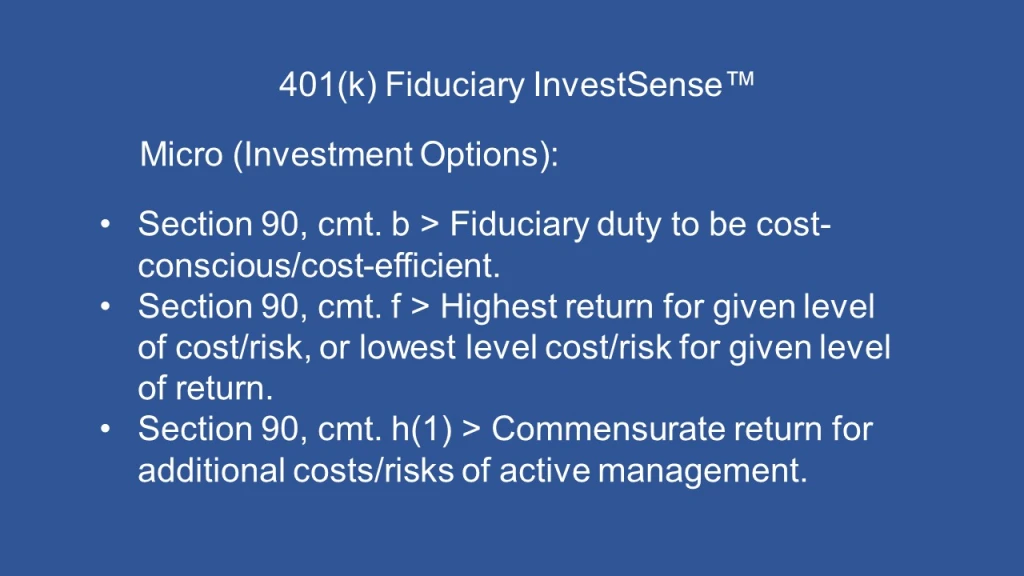
As for the second question, Section 90 of the Restatement, more commonly known as the “Prudent Investor Rule,” offers three fundamental guidelines addressing the importance of cost-consciousness/cost-efficiency of a plan’s investment options:

The last bullet point highlights a key aspect of 401(k)/403(b) fiduciary prudence and cost-efficiency – commensurate return for the additional costs and risks assumed by the plan participant. In terms of actively managed mutual funds, research has consistently and overwhelmingly shown that the majority of actively managed mutual funds are cost-inefficient:

  • 99 % of actively managed funds do not beat their index fund alternatives over the long term net of fees.4
  • Increasing numbers of clients will realize that in toe-to-toe competition versus near-equal competitiors, most active managers will not and cannot recover the costs and fees they charge.5
  • [T]here is strong evidence that the vast majority of active managers are uable to produce excess returns that cover their costs.6
  • [T]he investment costs of expense ratios, transaction costs and load fees all have a direct, negative impact on performance….[The study’s findings] suggest that mutual funds, on average, do not recoup their investment costs through higher returns.7  

The Active Management Value RatioTM (AMVR)
Several years ago I created a simple metric, the AMVR. The AMVR is based on the research of investment icons such as Nobel laureate Dr. William F. Sharpe, Charles D. Ellis, and Burton L. Malkiel. The AMVR allows plan sponsors, trustees, and other investment fiduciaries to quickly determine whether an actively managed fund is cost-efficient relative to a comparable index fund. The AMVR allows the user to assess the cost-efficiency of an actively managed fund from several perspecitives.

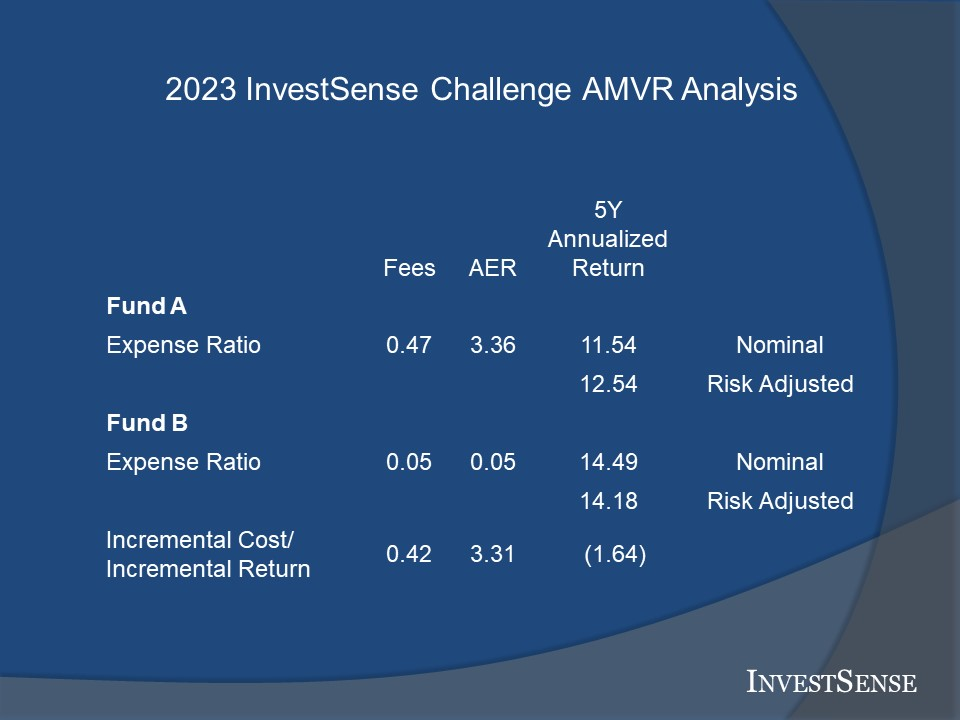
The slide below shows an AMVR analysis comparing the retirement shares of a popular actively managed fund, the Fidelity Contrafund Fund (FCNKX), and the retirement shares of Vanguard’s Large Cap Growth Index Fund (VIGAX). The analysis compares the two funds over a recent 5-year time period. When InvestSense provides forensic services, we provide both a five-year and ten-year analysis to determine the consistency of any cost-efficiency/cost-inefficiency trend.

An AMVR analysis can provide any amount of detail the user desires. On a basic level, the fact that the actively managed fund failed to outperform the comparable index fund benchmark immediately indicates that the actively managed fund is imprudent relative to the Vanguard fund.

Add to that the fact that the actively managed fund imposed an incremental, or additional, cost of 42 basis points without providing any corresponding benefit for the investor. A basis point is a term commonly used in the investment world. A basis point equals 1/100th of one percent (0.01). 100 basis points equals 1 percent.

So the bottom line is that the actively managed fund underperformed the benchmark Vanguard fund and imposed an additional charge without providing a commensurate return for the extra charge. A fiduciary’s actions that result in wasting a client’s or a beneficiary’s money is never prudent.8

If we treat the actively managed fund’s underpreformance as an opportunity cost, and combine that cost with the excess fee, we get a total cost of 2.06. The Department of Labor and the General Accountability Office have determined that over a twenty year time period, each additional 1 percent in costs reduces an investor’s end-return by approximately 17 percent.9 So, in our example, we could estimate that the combined costs would reduce an investor’s end-return by approximately 34 percent. This is not an example of effective wealth management.

The AMVR is calculated by dividing an actively managed fund’s incremental correlation-adjusted costs by the fund’s incremental risk-adjusted return. The goal is an AMVR score greater than zero, but equalt to or less than one, which indicates that costs did not exceed return. While the user can simply use the actively managed fund’s incremental cost and incremental returns based on the two funds’ nominal, or publicly reported, numbers, the value of such an AMVR calculation is very questionable.

A common saying in the investment industry is that return is a function of risk. In other words, as comment h(2) of Section 90 of the Restatement states, investors have a right to receive a return that compensates them for any additional costs and risks they assumed in investing in the investment. The Department of Labor has taken a similar stand in two interpretive bulletins.10 That is why a proper forensic analysis always uses a fund’s risk-adjusted returns.

While the concept of correlation-adjusted returns is relatively new, it arguably provides a better analysis of the alleged value-added benefits, if any, of active management. The basis premise behind correlation-adjusted costs is that passive management often provides all or most of the same return provided by a comparable actively managed fund. As a result, the argument can be made that the actively managed fund was imprudent since the same return could have been achieved by passive management alone, without the wasted excess costs of the actively managed fund.

Professor Ross Miller created a metric called the Active Expense Ratio (AER).11 Miller explained that actively managed funds often combine the costs of passive and active management in such a way that it is hard for investors to determine if they are receiving a commensurate return. The AER provides a method of separating the cost of active management from the costs of passive management.

The AER also calculates the implicit amount of active management provided by an actively managed fund, a term that Miller refers to as the actively managed fund’s “active weight.” Miller then divides the active fund’s incemental costs by the fund’s active weight to calculate the actively managed fund’s AER.

Miller found that an actively managed fund’s AER is often 400-500 percent higher than the actively managed fund’s stated expense ratio. In the AMVR example shown above, dividing the actively managed fund’s incremental correlation-adjusted costs by the fund’s active weight would result in an implicit expense ration approximately 700 percent higher than the fund’s publicly stated incremental cost (3.31 vs. 0.42). Based on the AER, these significantly higher costs would be incurred to receive just 12.5 percent of active management.

Using the same 1:17 percent analysis for each additional 1 percent in costs/fees, using the AER metric and the active fund’s underperformance would result in a projected loss of approximately 84 percent over twenty years. So much for “retirement readiness.”

Additional information on the AMVR can be found at my “The Prudent Investment Fiduciary Rules” blog and searching under “Active Management Value Ratio.”

Fiduciary Risk Management and Annuities
I have written numerous posts about annuities on both my “The Prudent Investment Fiduciary Rules” blog and my “CommonSense InvestSense” blog. Fortunately, the inherent fiduciary liability issues can be addressed by using the same two question fiduciary risk management approach that was mentioned earlier, with the answer to both questions being “yes.” Therefore, a liability-designed 401(k)/403(b) plan will totally avoid the inclusion of annuities, in any form, within the plan.

As a former securities compliance director, I am very familiar with the questionable marketing techniques used by some annuity companies, including the ongoing refusal to provide full transparency with regard to spreads and other financial information. Both ERISA and Department of Labor interpretive bulletions have stressed the importance of providing material information to plan sponsors and plan participants so that they can make informed decisions about including annuities within a plan and about whether to invest in annuities.

The two blogs provide analyses of various types of annuities, especially variable annuities and fixed indexed annuities. My basic advice to my fiduciary risk management clients is simple – “if you don’t have to go there…don’t!”

Annuities are complex and confusing investments, with numerous potential fiduciary liability “traps.” Annuity advocates often try to further confuse and intimidate plan sponsors by engaging in technical details. I strongly recommend adopting my response – stop them before they begin and simply explain that ERISA does not require that pension plans offer annuities within a plan. Therefore, from a fiduciary risk management standpoint, there is no reason to offer any type of annuity within the plan.

Going Forward
Three fiduciary risk management questions that I often ask both myself and my fiduciary clients:

  • Why is it that cost/benefit analysis is often used by businesses to determine the cost-efficiency of a proposed project, but yet cost-efficiency is rarely used by plan sponsors and other investment fiduciaries to determine the cost-efficiency of investments being considered by a pension plan or other fiduciary entity?
  • Why is it that plan sponsors will blindly accept conflicted advice from “advisers” without requiring that the adviser document the prudence of their recommendations througn prudence/breakeven analyses such as the AMVR or an annuity breakeven analysis?
  • Why do plan sponsors insist on making it so unnecessarily difficult and costly by refusing to see the simplicity, praticality, and prudence of the federal government’s Thrift Saving Plan?

The three bullet points remind me of one of my favorite quotes – “there are none so blind, as they who will not see.” I am not sure to whom it should be properly atttributed. The two most cited sources are the Bible and Jonathan Swift.

The point of this post is to emphasize that ERISA compliance is not that difficult to accomplish if a plan talks with the right people and approaches the compliance issues right from the start, when actually designing or re-designing the plan . If that is not possible, there are relatively simple ways to transaction into a liability-driven plan.

One of the services InvestSense provides is fiduciary prudence oversight services. By using fiduciary prudence and risk management compliance tools such as the AMVR and annuity breakeven analyses, and requiring that all plan advisers and investment consultants document their value-added proposition with such validating documents, a plan sponsor can significantly and efficiently simplify the required administration and monitoring of their 401(k) or 403(b) plan.

Notes
1. 29 CFR § 2550.404(a); 29 U.S.C. § 1104(a).
2. Hughes v. Northwestern University., 142 S. Ct. 737, 211 L. Ed. 2d 558 (2022)
3. Tibble v. Edison International, 135 S. Ct 1823 (2015).
4. Laurent Barras, Olivier Scaillet and Russ Wermers, False Discoveries in Mutual Fund Performance: Measuring Luck in Estimated Alphas, 65 J. FINANCE 179, 181 (2010).
5. Charles D. Ellis, The Death of Active Investing, Financial Times, January 20, 2017, available online at https://www.ft.com/content/6b2d5490-d9bb-11e6-944b-eb37a6aa8e. 
6. Philip Meyer-Braun, Mutual Fund Performance Through a Five-Factor Lens, Dimensional Fund Advisors, L.P., August 2016.
7. Mark Carhart, On Persistence in Mutual Fund Performance,  52 J. FINANCE, 52, 57-8 (1997).99
8. Uniform Prudent Investor Act, https://www.uniformlaws.org/viewdocument/final-act-108?CommunityKey=58f87d0a-3617-4635-a2af-9a4d02d119c9 (UPIA).
9. Pension and Welfare Benefits Administration, “Study of 401(k) Plan Fees and Expenses,” (DOL Study) http://www.DepartmentofLabor.gov/ebsa/pdf; “Private Pensions: Changes needed to Provide 401(k) Plan Participants and the Department of Labor Better Information on Fees,” (GAO Study).
10. 29 CFR Section 2509.94-1 )(IB 94-1) and Section 2509.15-1 (IB 15-1).
11. Ross Miller, “Evaluating the True Cost of Active Management by Mutual Funds,” Journal of Investment Management, Vol. 5, No. 1, 29-49 (2007) https://papers.ssrn.com/sol3/papers.cfm?abstract_id=746926.

Copyright InvestSense, LLC 2024. All rights reserved.

This article is for informational purposes only, and is neither designed nor intended to provide legal, investment, or other professional advice since such advice always requires consideration of individual circumstances.  If legal, investment, or other professional assistance is needed, the services of an attorney or other professional advisor should be sought

Annuity Junk Fees in Current 401(k) Plans

By Chris Tobe, CFA, CAIA

I want to applaud the Biden Administration on bringing Annuity Junk fees into the light of day to protect investors.

I want to focus on the effect of annuity junk fees in current ERISA protected defined contribution plans (I will address 401(k) and 403(b) and cover rollover junk annuity fees in another article.)   While the White House release mentions the savings in current plans from index annuities, I think that fixed annuities savings could be much larger over $9 billion a year.  (It is important to note that fixed annuities and index annuities in government defined contribution plans in both 457 and 403(b) are not protected by ERISA and add to many more billions of dollars.)

My $9 billion a year comes from industry figures on General Account fixed annuities at $386 billion and separate account fixed annuities at $76 billion in ERISA defined contribution assets. [i]

However, it is important to note that the largest provider of fixed annuities in defined contribution plans (governed by ERISA) is TIAA, which has substantially lower fees and commissions, than the other mainstream insurance providers 

Fixed annuities for the most part do not disclose fees and are rate based. For example, when a similar competitive fixed annuity in a plan like TIAA pays 4% many insurers only pay 2% – pocketing the spread. Bloomberg quoted an insurance executive bragging about these hidden 2%+ in fees at a Wall Street conference.[ii] These hidden spread fees have the same negative effect on investors that disclosed mutual fund fees have.

HOW DO I KNOW THIS
I currently consult on excessive fees in insurance products.   I spent 7 years making insurance products for Transamerica Life (TA), one of the largest U.S. insurance companies.  I was an officer of seven different TA companies governed by four different states.  I saw the need for federal intervention, as insurers had the ability to select the state regulator with the loosest regulations and lowest capital requirements.    

RISKS
One of the most basic fiduciary principles is diversification.  Annuities make a mockery of this principle with their single entity credit and liquidity risk. [iii]

After the first annuity risk crisis in 1992 the Federal Reserve wrote a major paper on the weakness of state regulations in the insurance area. [iv]

In 2008 Federal Reserve Chairman Ben Bernanke said about these annuity products  “workers whose 401(k) plans had purchased $40 billion of insurance from AIG against the risk that their stable-value funds would decline in value would have seen that insurance disappear.”[v] Even when the federal government steped up to control risk in annuity products after the 2008 financial crisis, the insurance industry used its immense lobbying ability to thwart regulations and maximize profits. [vi] 

ACCOUNTABILITY
In light of recent money market rates of over 5%, these low 2-3% annuity rates in 401(k)’s in far riskier products are especially troubling, costing investors billions of dollars in retirement savings while taking much higher risks.

Hopefully, these junk fee rules will slow the growth of these high fee high risk products inside of 401k plans.   The latest con game is selling annuities under the guise of Guaranteed Income. [vii]

Hopefully, this junk annuity initiative will expose some of the 401(k) target date funds which are burying index and fixed annuities inside weakly state regulated Collective Investment Trusts (CIT)s. [viii]

Hopefully, 401(k) consultants who claim to be somewhat independent will be exposed by showing how they use their insurance licenses for additional backdoor commissions.[ix]

Hopefully, within 401(k) plans they will either replace fixed annuities with diversified lower risk synthetic stable value products or at the minimum pay competitive rates like TIAA. [x]

This Biden Annuity Junk Fee initiative will save retirement investors billions.  Please do not let the Insurance Industry water it down to line their own pockets.

Chris Tobe, CFA, CAIA is a national expert on excessive fees in retirement plans.    He has written 4 books and dozens of articles on transparency, excessive fees & corruption in investments.  His own firm Tobe Consulting has advised on over 70 ERISA legal cases on behalf of investors who have lost money through risky and/or high fee investments.    He serves as Chief Investment Officer for a minority woman owned pension consulting firm out of New Orleans the Hackett Robertson Tobe group


[i] https://www.stablevalue.org/stable-value-at-a-glance/

[ii] https://www.bloomberg.com/news/articles/2013-03-06/prudential-says-annuity-fees-would-make-bankers-dance#xj4y7vzkg

[iii] https://commonsense401kproject.com/2022/05/11/annuities-are-a-fiduciary-breach/

[iv] Federal Reserve Bank of Minneapolis Summer 1992  Todd, Wallace  SPDA’s and GIC’s http://www.minneapolisfed.org/research/QR/QR1631.pdf

[v] Eleanor Laise, “ ‘Stable’ Funds in Your 401(k) May Not Be,” Wall Street Journal , March 26, 2009. Available at http://online.wsj.com/article/SB123802645178842781.html

[vi] https://www.stanfordlawreview.org/online/the-last-sifi-the-unwise-and-illegal-deregulation-of-prudential-financial/

[vii] https://commonsense401kproject.com/2022/02/10/401k-lifetime-income-a-fiduciary-minefield/

[viii] https://commonsense401kproject.com/2022/06/07/toxic-target-date-case-study-of-the-worst-of-the-worst/

[ix] https://commonsense401kproject.com/2022/03/09/conflicted-401k-consultants-should-plan-sponsors-fire-them-sue-them-or-both/   

[x] https://commonsense401kproject.com/2022/02/28/stable-value-the-goood-the-bad-and-the-ugly-avoiding-litigation/

Annuities Are a Fiduciary Breach

By Chris Tobe, CFA, CAIA

Annuities issued by a single insurance company are a Fiduciary Breach.  They can be called guaranteed income, they can be called GIC’s or fixed accounts, or index annuities.   I am focused on the institutional annuity products mostly used in 401(k)s.   There are many more fiduciary breaches in retail and variable annuities, as noted by attorney James Watkins in his recent article.

There are breaches in institutional annuities for 4 basic reasons

  1. Single Entity Credit Risk
  2. Single Entity Liquidity Risk
  3. Hidden fees spread and expenses
  4. Structure -weak cherry-picked state regulated contracts not securities and useless reserves

A 1992 Federal Reserve paper notes that the so-called insurance safety net is much weaker than most realize. [i] 

Annuities are in the news as insurance companies are pouring millions of dollars into lobbying and PR and advertising trying to trick people into buying them.

The insurance industry spends millions of dollars trying to abolish and weaken fiduciary standards because they do not come close to meeting them.

Insurance companies are especially frustrated with 401(k) plans because they have not only the strongest fiduciary standards, but an enforcement mechanism in 401(k) litigation.   While they have lobbied the US Department of Labor to ignore most of their enforcement duties on excessive fees on 401(k), they have not been able to block court action, and the latest Supreme Court ruling has reinforced this.

Annuities in 401(k) plans have traditionally been in 401(k) plans though a stable value of fixed annuity option. [ii]  In recent years they are trying to expand into hiding annuities in target date funds,[iii] mostly under the guise of Lifetime Income.[iv]

The Insurance industry’s huge push into 401(k) has even had some plan fiduciary consultants sounding words of caution.  A commentary in Benefits Pro by Mitch Shames is titled “Annuities: The Straw That Breaks the Back of Retirement Plan Fiduciaries.”[v]

Annuity contracts, however, are not investment securities. Instead, they are individually negotiated contracts entered into between an insurance company and the annuity-holder. …… the fiduciary will also need to be a prudent expert in the selection of the annuity. That is a pretty tall order. Retirement plan fiduciaries are on notice.   Annuity contracts may be the straw that breaks the back of the fragile fiduciary infrastructure employed by plan sponsors under ERISA.[vi]

Single Entity Credit Risk
Single Entity Credit Risk – Diversification is one of the most basic Fiduciary duty and annuities totally ignore this.  Like a single stock or a single bond is a clear fiduciary breach so is an investment 100% reliant on one entities credit like an insurance contract.

For over 20 years fiduciaries in the know, like large 401(k) plans, fled fixed annuity products backed by the general account of a single insurance company.  This was due to concerns about single entity credit and liquidity risk. Many attribute this to the 1992 and 1993 defaults by Executive and Confederation Life, as documented by the Federal Reserve Bank 1992 article. [vii]

In 2005 AIG was AAA rated and some in the trade press said that AIG was as safe as the Government by 2008 it was in default. In 2008 Federal Reserve Chairman Ben Bernanke said that “workers whose 401(k) plans had purchased $40 billion of insurance from AIG against the risk that their stable-value funds would decline in value would have seen that insurance disappear.” [viii]  Many investment professionals believe that a plan sponsor is taking a severe fiduciary risk by having a single contract with any one entity, such as AIG. It can be argued that a plan is taking less risk by assuming that the single insurance company backing the stable value option is too big to fail and has an implied government guarantee.

The Federal reserve for several decades bought fixed annuities in their stable value option in there 401(k) option for their employees. They limited credit exposure to 5% per insurance company.  In the late 2000’s there were not the 20 issuers needed for diversification so they shut the fund down.    Even the few diversified annuity structures still have 25% or 33% single entity exposure which is considered high by fiduciary diversification norms.

Taking 100 perentsingle entity credit risk is a clear breach of fiduciary duty. 

Single Entity Liquidity Risk
Single Entity Liquidity Risk – A fiduciary managing a bond portfolio sells a bond when it is downgraded to a level allowed in the investment policy.  Most Annuities are not allowed to be sold when they are downgraded.  They have no liquidity if the firm is downgraded multiplying the credit risk as a participant has to ride it down to default.  

Noted Morningstar analyst John Reckenthalrer said in April 2022 that in selecting 401(k) investment options, “inappropriate are investments that don’t price daily.” [ix]

Annuities do not price or mark to market daily. There is a secondary market for retail annuities provided by firms like JG Wentworth and Peachtree, which many times only pay 80 percent on the dollar.  So, if you bought an annuity and wanted to sell it the next day on the secondary market, you would take a 20 percent loss. There are annuity products that provide some limited liquidity, what they call benefit responsive, but is always a major fiduciary risk. 

Hidden fees spread and expenses
Prudential in a 2013 conference documented by Bloomberg bragged that they had secret hidden spread fees of over 200 basis Points.[x]

This loophole allows insurance companies to hide as much 2% or 200 basis points (bps) in yearly spread profits.   I was quoted in the Wall Street Journal’s Marketwatch, stating that

“These excessive profits, even if called spread, act like fees and are used like fees,” [xi]     

In addition they continue to pay commissions out of the hidden spread which drive even more sales.

The National Association of Government Defined Contribution Administrators, Inc. (NAGDCA) in September 2010 created a brochure with this characterization of insurance company general account stable value that got beyond the high risks and right to fee disclosure.  

Due to the fact that the plan sponsor does not own the underlying investments, the portfolio holdings, performance, risk, and management fees are generally not disclosed. This limits the ability of plan sponsors to compare returns with other SVFs [stable-value funds]. It also makes it nearly impossible for plan sponsors to know the fees (which can be increased without disclosure) paid by participants in these funds—a critical component of a fiduciary’s responsibility.[xii] 

It is hard to comprehend why the DOL lets these products escape disclosure.  However, there is already ERISA litigation in which spread fees have been important in settlement negotiations.

Structure -Weak Cherry-Picked State Regulated Contracts and Useless Reserves
When you purchase an annuity, you do not get to own any securities, you just get a piece of paper.  

Whereas securities (and the firms issuing, offering or underwriting the instruments) are governed by the federal securities laws and regulated by the Securities and Exchange Commission, insurance companies and the contracts they enter into are governed by the States – 50 different regulators and bodies of law. Once again, the variety can be staggering. This is the world that retirement plan fiduciaries are being forced into. [xiii]

A 1992 Federal Reserve paper notes that the so-called insurance safety net is made of 50 different state regulators with a wide variety of regulations and is much weaker than most realize.  This allows companies to shop for insurance regulation among the 50 states to find the ones that have the softest regulations. [xiv]  In 2017, The European Union showed concern with the weakness of state regulators of insurance companies. [xv]

Investors are mostly unaware of this risk based on flimsy state guarantees which the Federal Reserve has said have little worth. [xvi] These guarantee fund balances are typically a joke with $0 as they pass the hat to other insurers if one goes under. 

Required Fiduciary Questions
What should a fiduciary document and become comfortable with before investing in an annuity.

1.Which state issues the annuity, what is their record, do they have conflicts of interest with the insurance company?

2.What is their minimum capital requirement in basis points for this annuity product in the state your contract is issues in? 

3.What is the current solvency of that states guarantee pool.

4. Get full fee disclosure all internal spreads (200+) before expenses and then with expenses and profits broken down?

5. Does the Annuity contract have a downgrade provision to get out if the company is downgraded?

All annuities flunk at least one of these fiduciary tests, most flunk all. By and large the Fortune 500 largest US Corporations have avoided these insurance company products in their 401(k) plans since 1992. This is not because of fear of regulators, but because of fear of lawsuits filed by employees under the Employee Retirement Income Security Act of 1974 (ERISA). Thus, many of these non-transparent insurance products are in smaller company plans which are not cost effective for plaintiff bars to litigate individually.  However, as litigation goes downstream there are over 9 thousand plans from $100mm to $3 billion out of the top 500 many of which have annuity assets.  It is these mid to large plans who need to resist the annuity marketing push into guaranteed income mostly hidden in target date funds.


[i] Pg. 6   Federal Reserve Bank of Minneapolis Summer 1992  Todd, Wallace  SPDA’s and GIC’s

[ii] https://commonsense401kproject.com/2022/02/28/stable-value-the-goood-the-bad-and-the-ugly-avoiding-litigation/ 

[iii] https://commonsense401kproject.com/2022/04/30/problems-with-target-date-funds/

[iv] https://commonsense401kproject.com/2022/02/10/401k-lifetime-income-a-fiduciary-minefield/

[v] https://www.benefitspro.com/2022/05/03/annuities-the-straw-that-breaks-the-back-of-retirement-plan-fiduciaries/

[vi] https://www.benefitspro.com/2022/05/03/annuities-the-straw-that-breaks-the-back-of-retirement-plan-fiduciaries/

[vii]  Federal Reserve Bank of Minneapolis Summer 1992  Todd, Wallace  SPDA’s and GIC’s http://www.minneapolisfed.org/research/QR/QR1631.pdf

[viii] http://www.federalreserve.gov/newsevents/testimony/bernanke20090324a.htm

[ix] https://www.morningstar.com/articles/1090732/what-belongs-in-401k-plans

[x] http://www.bloomberg.com/news/2013-03-06/prudential-says-annuity-fees-would-make-bankers-dance.html

[xi] _http://www.marketwatch.com/story/these-funds-give-retirement-savers-stabili
ty-2012-10-16_

[xii] http://www.nagdca.org/documents/StableValueFunds.pdf_

[xiii] https://www.benefitspro.com/2022/05/03/annuities-the-straw-that-breaks-the-back-of-retirement-plan-fiduciaries/

[xiv] Pg. 6   Federal Reserve Bank of Minneapolis Summer 1992  Todd, Wallace  SPDA’s and GIC’s

[xv] https://www.nytimes.com/2017/03/31/business/dealbook/will-overseas-regulators-trust-the-states-to-watch-insurers.html

[xvi]  Federal Reserve Bank of Minneapolis Summer 1992  Todd, Wallace  SPDA’s and GIC’s http://www.minneapolisfed.org/research/QR/QR1631.pdf