More 401(k) Cases Will Survive Dismissal

By Chris Tobe, CFA, CAIA

The recent Sixth Circuit decision in Johnson v. Parker-Hannifin Corp. indicates a possible 2025 trend in fiduciary litigation in favor of plan participants according to attorney Jim Watkins in his latest piece. [i]  The ruling confirms that in most cases participants do not have adequate information and disclosure until discovery and that premature dismissal is unfair to participants.

The lack of transparency and disclosures in 401(k) plans requires the discovery process to give plan participants a fair shot at recovery of damages from poorly managed plans.    This decision seems to recognize these facts and puts the burden of proof to show a prudent fiduciary process on the plan sponsor, which requires discovery.

The 401(k) type plans being litigated are a small fraction of the total 700,000 plans in the U.S.   Around 7,000 or 1% are $100 million or more in assets which are the ones currently large enough to litigate.  Of this 7000 around 5000 are low (Vanguard) to below average cost (Fidelity) recordkeepers.    This leaves around 2000 that are worth while litigating for plaintiff attorneys.  The DOL EBSA is understaffed having to cover 700,000 plans, so many participants rely on litigation or the threat of it to drive better outcomes.   My analysis is limited to these top 1% of plans.

Current Disclosures

The IRS/DOL 5500 form and accompanied financial statement is the major and primary form of public disclosure.   It lists total assets of the plan and the number of participants.  It lists an aggregate total of administrative costs.  Financials usually have a list of investment options, but does not disclose their fees, or even what share class they are so you can look up the fees.  It usually lists the recordkeeper.   Plaintiffs’ attorneys to narrow down potential poorly managed cases primarily rely on their ability to spot high fee recordkeepers and high fee funds just by their names.  There is no disclosure of administrative or fund fees or performance, so no data to show the level of damages.      

Participant statements are a mixed bag.  Some have partial fee information, some do not.  in 2012, the DOL mandated annual 404a-5 participant disclosures due to this lack of information.   Some plans include these with their quarterly statements, but many firms send it out in a separate not easy to understand piece of paper and participants typically throw it away.  However, participants can request these 404a-5 disclosures without discovery.

404a-5 disclosures essentially only provide an accurate description by ticker for the SEC registered mutual funds in the fund.  This is a small step forward because some plans do not even provide ticker (which shows share classes) on statements (or 5500) which has only one real purpose – to hide fee information.  Once the ticker is disclosed, data like performance and fees can be easily found on the internet.  So the disclosure of fees and performance on the 404a-5 is merely creating an impression of additional transparency.

I believe target date funds in SEC registered mutual funds were designed to hide fees and manipulate performance.  They bundle funds into other funds, and without sub-fund level detail,  it is nearly impossible to evaluate their performance and fees.  The aggregate fee & performance data from the 404a-5 disclosure statements is a start, but far from a complete means of evaluating funds.

404a-5 statements have totally inadequate disclosure on administrative and recordkeeping costs.  Manipulative games like Revenue Sharing makes the costs for participants nearly impossible to ascertain.   

404a-5 statements have totally inadequate disclosure on collective investment trusts (CITs), a growing sector in the large plan market, especially with target date funds. CITs often have inadequate state oversight and regulation, which requires little or no disclosure.[ii]

404a-5 statements also have totally inadequate disclosure on insurance products, especially with regard to IPG Fixed Annuities, but also regarding index annuities,and the new fad lifetime annuities.[iii]

 The 404a-5 disclosures only cover the most recent 10 year period. SEC mutual fund share class violations constitute a small fraction of the damages in current cases.

Discovery Basic

It is the current inadequate disclosures from the 5500 and 404a-5 statements that makes discovery essential.   Most of what plaintiffs need in discovery is information that really should have been disclosed already in both the 5500 and 404a-5 statements..

For the state-regulated insurance products and CIT’s, a plaintiff needs the same level of information on fees/spreads that you would receive in a SEC registered Mutual Fund.   Defense attorneys want to block this information since it can reveal prohibited transactions and hidden fees.[iv]

The 6th Circuit stated that “The ultimate question is whether the fiduciary engaged in a reasoned decision-making process.”  [v]   401(k) plan fiduciaries hold monthly or quarterly meeting.  To determine if this was a prudent process, at a minimum, you need the minutes and materials from these meetings.    Defense attorneys want to block access to this information because it almost always reveals flaws in a plan’s oversight.   

According to attorney Watkins:

“Based upon my experience, I submit the real reason that the plans oppose any type or amount of discovery is to conceal the fact that (1) the investment committee never developed a prudent process for managing the plan, but rather blindly accepted the recommendations of the plan adviser or other conflicted, and (2) the fact that the plan never conducted the independent investigation and evaluation required under ERISA, but blindly accepted the recommendations of others.”  [vi]    

In my ownexperience, I regularly find a clueless committee without even an investment policy, driven by blind reliance on a conflicted broker or consultant who receives undisclosed hidden compensation from recommending high fee high risk products.[vii] 

This information is readily and easily available at a minimal cost to the plan and should have already been disclosed.

Additional Discovery

Administrative costs, which include record keeping costs, are totaled on the 5500 form, and you can divide this number by the amount of participants.   Many lpaintiff firms may file a claim if they find a number above $40 a participant per year.   The defense’s argument is often that number is not correct, basically that they lied on their DOL/IRS form, offering convoluted and self-serving reasons for the alleged error.    They basically want the court to take the story that what they really charged was less than what they told the DOL/IRS, hoping that the3 plaintiff and the court will take their word for it without documentation.    The participants have no access to any information on these administrative costs.   This information is convoluted and complex, so much so that few committees understand it. It needs extensive discovery to get to the details. 

Because of the lack of transparency in administrative costs. plaintiff’s need at least some limited discovery. In a recent Sixth Circuit case, Forman v. TriHealth 40 F.4th 443, 450},, Judge Sutton of the Sixth Circuit spoke out in this issue, stating that too many ERISA actions alleging a breach of fiduciary duties were being inequitably and prematurely dismissed without allowing plaintiffs any discovery whatsoever:

This is because “[n]o matter how clever or diligent, ERISA plaintiffs generally lack the inside information necessary to make out their claims in detail unless and until discovery commences. . . . If plaintiffs cannot state a claim without pleading facts which tend systemically to be in the sole possession of defendants, the remedial scheme of the statute will fail, and the crucial rights secured by ERISA will suffer.” “Plausibility requires the plaintiff to plead sufficient facts and law to allow ‘the court to draw the reasonable inference that the defendant is liable for the misconduct alleged.. Because imprudence “is plausible, the Rules of Civil Procedure entitle” the plaintiffs “to pursue [their imprudence] claim . . . to the next stage.”

Sponsors many times select vendors that cherry-pick their own state regulator for both insurance products and most collective investment trusts (CIT)s.[viii]  Sponsors typically do not have any documentation that these products are exempt from prohibited transaction restrictions. You need extensive discovery to get the details on fees and risks in these products.  

Most discovery needed by plaintiffs is information that should be public or at least accessible to plaintiffs already, so it is essential to have it in most cases.    Some more detailed discovery is needed to accurately compute the damages. 

It is unfair to put the burden of proof on Plaintiffs who are blocked from seeing the information they need to prove damages.    The burden of proof needs to be on the plan sponsor who controls all the information. [ix]


[i] https://fiduciaryinvestsense.com/2024/11/28/fudamental-unfairness-sixth-circuit-decision-addresses-the-premature-dismissal-of-erisa-actions/

[ii] https://commonsense401kproject.com/2024/07/31/chris-tobe-dol-testimony/

[iii] https://commonsense401kproject.com/2024/11/19/burden-of-proof-is-on-plan-sponsors-hoping-to-qualifyfor-annuity-prohibited-transactions-exemption/

[iv] https://commonsense401kproject.com/2024/11/29/crypto-private-equity-annuity-contracts-are-impossible-to-benchmark/

[v] https://fiduciaryinvestsense.com/2024/11/28/fudamental-unfairness-sixth-circuit-decision-addresses-the-premature-dismissal-of-erisa-actions/

[vi] https://fiduciaryinvestsense.com/2024/11/28/fudamental-unfairness-sixth-circuit-decision-addresses-the-premature-dismissal-of-erisa-actions/

[vii] https://commonsense401kproject.com/2023/03/12/investment-policy-statements-crucial-to-fiduciary-duty/

[viii] https://commonsense401kproject.com/2024/10/10/annuities-exposed-as-prohibited-transaction-in-401k-plans/

[ix] https://commonsense401kproject.com/2024/11/19/burden-of-proof-is-on-plan-sponsors-hoping-to-qualifyfor-annuity-prohibited-transactions-exemption/
Crypto, Private Equity, Annuity Contracts Are Impossible to Benchmark

By Christopher B. Tobe, CFA, CAIA

Crypto, Private Equity, and Annuity contracts are impossible to Benchmark because of a lack of transparency accountability and liquidity.   Valid Benchmarks require investable securities.   These issues make it nearly impossible for any of these contracts to be exempted from being a prohibited transaction in an ERISA plan. [i]

According to the CFA Institute, a valid benchmark should meet the following criteria:

  • Specified in advance: The benchmark is defined before the evaluation period begins. 
  • Measurable: The benchmark’s return can be calculated regularly and in a timely manner. 
  • Unambiguous: The identities and weights of the securities in the benchmark are clearly defined. 
  • Reflective of current investment opinions: The manager is knowledgeable about the securities in the benchmark and their factor exposures. 
  • Accountable: The manager is aware of and accepts responsibility for the benchmark’s performance and constituents. 
  • Investable: The assets of the underlying index are available for purchase by investors. 

These attributes are impossible for contract-based investments like Crypto, Private Equity, and Annuities since you do not own any securities.  There is no accountability, they are ambiguous and use different forms of accounting than securities. 


Benchmarks can work when you compare a security-based active investment fund with a security-based index fund as highlighted in Brotherston vs. Putnam.[ii]

These are one sided contracts, not securities, in favor of the vendor and to the detriment of the investor.    Looking at these from an ERISA particularly 401(k) context these contracts have severe fiduciary issues which I feel prevent them from an exemption from prohibited transaction rules.  The Burden of Proof is on the Plan Sponsor to document that these contracts are not Prohibited Transactions.[iii]

 I think the conflicted contract nature of these investments allows them to manipulate or avoid benchmarks altogether.    While plan sponsors should never have entered into these contracts in the first place, how do you hold them accountable for the damages they have caused participants.   If you compare them against benchmarks to the lower risk investments they should have invested in, it conceals the damages.   You must find comparable contracts with the same types of high risk to find the actual damages.

Annuity Contracts

I wrote last month that Annuities should not be allowed in 401(k)s as Prohibited Transactions.  Annuities are a Fiduciary Breach for 4 basic reasons. [iv]

  1. Single Entity Credit Risk [v] 
  2. Single Entity Liquidity Risk in illiquid investments [vi]
  3. Hidden fees spread and expenses [vii]
  4. Structure -weak cherry-picked state regulated contracts, not securities and useless reserves [viii] 

These breaches make it impossible for most annuity products to qualify for exemptions to Prohibited Transactions which need to fill these 4 major obligations.  [ix]

A. Care Obligation

B. Loyalty Obligation

C. Reasonable compensation limitation

D. No materially misleading statements (including by omission

I do not believe few if any annuities meet these 4 obligations, and the

burden of proof is on the plan sponsor that the annuities they use in their ERISA plans have a valid exemption. [x]

I have extensive experience showing damage by annuity contracts in large 401(k) and 403(b) plans.   These are primarily fixed annuity IPG contracts within the broad category of stable value with no maturity and discretion by the insurer to pay rates that maximize their profits, at the detriment of participants.   Some Fixed Annuity providers will claim money markets as a benchmark, despite having over 20 times the risk.   The Federal Thrift Savings Plan has a high-quality stable value product, the G fund which they state is impossible to benchmark. [xi]    

Single entity Fixed annuity providers have attempted to compare to the diversified Hueler Stable Alue Index despite having 10 times the risk.  The proper comparable has been to other IPG fixed annuities with single entity risk, which has used in over a dozen cases specifically comparables like TIAA and MassMutual cited in detail in 2 ERISA Hospital Cases: Columbus, GA and Norton Hospital.

Private Equity Contracts

Private Equity contracts have mostly been contained in non-ERISA plans but this may be changing.  Economic and Policy Research’s Eileen Appelbaum said “Much as private equity firms may wish it were different, they have been mostly unable to worm their way into workers’ 401(k)s and abscond with their retirement savings,[xii]

Private Equity flunks all the impartial conduct standards in numerous ways.

Private equity offering documents generally prominently state (in capital, bold letters) that an investment in a private equity fund is speculative, involves a high degree of risk, and is suitable only for persons who are willing and able to assume the risk of losing their entire investment.  Can engage in borrowing, or leverage, on a moderate or unlimited basis.  No assurance of diversification since funds generally reserve the right to invest 100 percent of their assets in one investment.  Heightened offshore legal, regulatory, operational and custody risk.[xiii]  

Private Equity has a myriad of conflicts of interest, self-dealing practices. The investment manager determines the value of the securities held by the fund. Such a valuation affects both reported fund performance as well as the calculation of the management fee and any performance fee payable to the manager. [xiv]

Private Equity has business practices that may violate ERISA. Private equity fund offering documents often disclose that investors agree to permit managers to withhold complete and timely disclosure of material information regarding assets in their funds. Further, the fund may have agreed to permit the investment manager to retain absolute discretion to provide certain mystery investors with greater information and the managers are not required to disclose such arrangements. As a result, the fund you invest in is at risk that other unknown investors are profiting at its expense—stealing from you. [xv]

Plan sponsors will have a tough time justifying Private Equity as being exempted as a prohibited transaction given these facts.   With such a lack of controls on the contracts, benchmarks are mostly useless.

Private Equity Benchmarks have been manipulated in U.S. public pensions to get higher bonuses not only for the Private Equity managers but for public government staff.  [xvi]   Private Equity benchmarks typically add a premium of 2%-6% to small cap index for leverage and liquidity.  I think the high end of this range could be appropriate for damage comparisons given the fiduciary issues of the assets.  

Crypto Contracts

Crypto has not been used extensively in ERISA plans as of now, but it is increasing.[xvii]

It was first discovered in Brokerage Windows, in which plans feel they have less fiduciary accountability.   Companies running Brokerage Windows have been paid $millions by Crypto companies to put their options on their Brokerage Window Platform. In the article, “401(k)s with Bitcoin Should Expect Lawsuits: Lawyers,” the trade publication “Ignites” quotes Jerry Schlichter as saying that.  Any employer who would follow the Fidelity lead by offering cryptocurrency and a 401(k) plan is exposing itself to very serious risk of a fiduciary breach…. As an unproven, highly volatile investment, Bitcoin would test the prudence standard under the Employee Retirement Income Security Act….The account will carry a fee of up to 90 basis points plus undisclosed commission fees, which would be 20 times as much as a simple index fund. Any 401(k) plans with a brokerage window will be subject to severe fiduciary liability unless they can prove they have provided 100% prudent options. This will most likely lead to much more litigation and many more settlements, as the cost of proving 100% prudent options will be extremely expensive. [xviii]   

Burden of proof is on plan sponsors that Prohibited Transactions crypto in their plans qualify for a Prohibited Transaction Exemption.  I have seen no evidence that any form of Crypto has met the qualifications for an exemption. 

The Department of Labor in 2022 severely questions the reliability and accuracy of cryptocurrency valuations.  A major concern is that cryptocurrency market intermediaries may not adopt consistent accounting treatment and may not be subject to the same reporting and data integrity requirements with respect to pricing as other intermediaries working with more traditional investment products.[xix]   Under that guidance, which the DOL issued last month (April 22), employers could be responsible for risky crypto trades their workers make in workplace 401(k)s. The DOL’s employee benefits enforcement agency will launch what it’s calling “an investigative program” that requires plan officials to “square their actions with their duties of prudence and loyalty” if they allow crypto investments in self-directed accounts, according to the guidance.[xx]

The CFA institute writes.  The unfortunate reality is that none of the proposed valuation models are as sound or academically defensible as traditional discounted cash flow analysis is for equities or interest and credit models are for debt. This should not come as a surprise. Crypto assets are more similar to commodities or currencies than to cash-flow producing instruments, such as equities or debt, and valuation frameworks for commodities and currencies are challenging.  Custody is challenging and there is significant technological risk.  As recently as 2018, researchers uncovered a bug in the bitcoin code that, if left unchecked and exploited, could have led to significant (theoretically infinite) inflation in the issuance of new bitcoin [xxi]

The lack of any valuation parameters makes benchmarks impossible.  Comparisons should be flexible.  One of the main comparisons should be the most popular Crypto asset Bitcoin. 

Corrupt Structures

Crypto, Private Equity and Annuities in ERISA plan are mostly hidden in corrupt structures.    Besides brokerage windows poorly state regulated separate account annuity products and Collective investment Trusts are places to hide these prohibited assets.  

Over 50% of 401(k) assets are in Target Date Funds which are made up of underlying funds.  This allows for less transparency of the underlying funds. 

However, historically the largest structure for Target Date Funds has been SEC registered Mutual Funds.   Mutual Funds have transparency and fiduciary standards that do not allow Crypto, Private Equity and Annuities. [xxii]    Federal OCC regulated Collective Investment Trusts (CITs) have transparency and fiduciary standards that do not allow Crypto, Private Equity and Annuities.[xxiii]  However, many state regulated CIT’s have weak or no transparency or fiduciary standards, so you can allow Crypto, Private Equity and Annuities.

Currently I believe the biggest threat of prohibited investments like Crypto, Private Equity and Annuities will be hidden in target date funds structured as state regulated CIT’s that I outlined in my DOL Advisory testimony in July 2024.[xxiv] 

Conclusions

 Since Crypto, Private Equity, Annuity contracts are impossible to Benchmark you need to use Comparables.     To make valid comparisons you have to compare them to other prohibited transactions that are materially similar, and looking at those similar funds with the best performance is valid for damages.    


[i] https://commonsense401kproject.com/2024/10/10/annuities-exposed-as-prohibited-transaction-in-401k-plans/

[ii] 117https://www.plansponsor.com/supreme-court-will-not-weigh-burden-proof-index-fund-comparison/ https://401kspecialistmag.com/brotherston-v-putnamsfar-reaching-401k-fallout/

[iii] https://commonsense401kproject.com/2024/11/19/burden-of-proof-is-on-plan-sponsors-hoping-to-qualifyfor-annuity-prohibited-transactions-exemption/

[iv] https://commonsense401kproject.com/2022/05/11/annuities-are-a-fiduciary-breach/

[v] https://commonsense401kproject.com/2024/03/26/just-how-safe-are-safe-annuity-retirement-products-new-paper-shows-annuity-risks-are-too-high-for-any-fiduciary/  https://www.thinkadvisor.com/2024/11/20/yes-life-and-annuity-issuers-can-suddenly-collapse-treasury-risk-tracker-warns/ 

[vi] https://www.chicagofed.org/publications/economic-perspectives/2024/5   https://www.chicagofed.org/publications/chicago-fed-letter/2024/494

[vii] https://www.bloomberg.com/news/articles/2013-03-06/prudential-says-annuity-fees-would-make-bankers-dance?embedded-checkout=true   TIAA https://www.nbcnews.com/investigations/tiaa-pushes-costly-retirement-products-cover-losses-whistleblower-rcna161198

[viii] Federal Reserve Bank of Minneapolis Summer 1992  Todd, Wallace  SPDA’s and GIC’s http://www.minneapolisfed.org/research/QR/QR1631.pdf  https://www.chicagofed.org/publications/economic-perspectives/1993/13sepoct1993-part2-brewer 

[ix] https://commonsense401kproject.com/2024/10/10/annuities-exposed-as-prohibited-transaction-in-401k-plans/

[x] https://commonsense401kproject.com/2024/11/19/burden-of-proof-is-on-plan-sponsors-hoping-to-qualifyfor-annuity-prohibited-transactions-exemption/  https://fiduciaryinvestsense.com/2024/09/25/chief-judge-of-the-5th-circuit-calls-out-his-brethren-on-decision-to-stay-the-dols-retirement-security-rule/#:~:text=As%20to%20coverage%20under%20the,of%20whether%20advice%20is%20given.

[xi] https://www.tsp.gov/funds-individual/g-fund/      https://www.frtib.gov/pdf/reading-room/InvBMarks/2017Oct_Benchmark-Evaluation-Report.pdf     

[xii] https://commonsense401kproject.com/2022/02/15/private-equity-in-401k-plans-a-ticking-time-bomb/     

[xiii] https://www.sec.gov/comments/s7-03-22/s70322-267369.htm 

[xiv] https://www.sec.gov/comments/s7-03-22/s70322-267369.htm 

[xv] https://www.sec.gov/comments/s7-03-22/s70322-267369.htm 

[xvi] https://www.nakedcapitalism.com/2022/04/calpers-consultant-global-governance-advisors-recommends-further-overpaying-grossly-underperforming-calpers-staff.html

[xvii] https://commonsense401kproject.com/2022/06/18/brokerage-windows-exposed-by-crypto/

[xviii] https://www.ignites.com/lead/c/3622614/465124?referrer_module=t.cohttps://uselaws.com/media-turns-to-jerry-schlichter-for-guidance-following-fidelity-bitcoin-announcement/

[xix] https://www.dol.gov/agencies/ebsa/employers-and-advisers/plan-administration-and-compliance/compliance-assistance-releases/2022-01

[xx] https://www.dol.gov/agencies/ebsa/employers-and-advisers/plan-administration-and-compliance/compliance-assistance-releases/2022-01

[xxi] http://www.coindesk.com/the-latest-bitcoinbug-was-so-bad-developers-kept-its-full-details-a-secret.

[xxii] https://commonsense401kproject.com/2022/02/22/cits-collective-investment-trusts-in-401k-the-good-and-the-bad/

[xxiii] https://www.occ.treas.gov/topics/supervision-and-examination/capital-markets/asset-management/collective-investment-funds/index-collective-investment-funds.html

[xxiv] https://commonsense401kproject.com/2024/07/31/chris-tobe-dol-testimony/

Annuities Exposed as Prohibited Transaction in 401(k) Plans

By Christopher B. Tobe, CFA, CAIA

Annuities should not be allowed in 401(k)s.   ERISA created the concept of Prohibited Transactions to prohibit any investments with clear Conflicts of Interest.  I testified to the ERISA Advisory Council – US Department of Labor in July of 2024 on the danger of allowing annuities to be hidden inside of Target Date Funds. [i]   I have co-written a paper with Economics Professor Tom Lambert on the excessive risks of annuities.[ii]

Perhaps with the exception of Crypto and Private Equity no investment better describes what should be a prohibited transaction more than annuity contracts.

Annuities are a Fiduciary Breach for 4 basic reasons.[iii]

  1. Single Entity Credit Risk
  2. Single Entity Liquidity Risk
  3. Hidden fees spread and expenses
  4. Structure -weak cherry-picked state regulated contracts, not securities and useless reserves

So why do we still see annuities in 401k plans?  The reason is intense lobbying by the insurance industry, that has blocked any transparency or oversight.

Annuity providers claim to be barely legal by relying on an Prohibited Transaction Exemption (PTE 84-4) a “get out of jail free card” obtained by $millions of lobbying by the insurance industry.


Biden Fiduciary Rule

The new Biden Fiduciary rule would provide transparency that would further expose these annuity products’ conflicts of interests.  The insurance industry has forue shopped in Texas in the Fifth Circuit for judges who agree with blocking transparency to block it for now.

At the Certified Financial Planner Board of Standards Connections Conference in Washington October 2024, DOL officials called out annuities as prohibited transactions. [iv]  Ali Khawar, principal deputy assistant secretary for the Employee Benefits Security Administration, laid out the reasons why the Biden Labor Department continues to fight for a fiduciary rule ““To me it continues to be kind of nonsensical that you’re expecting any of your clients to walk into someone’s office and have in their head: ‘I’m dealing with this person who’s going to sell insurance to me, this person is relying on [Prohibited Transaction Exemption] PTE 84-24, not [PTE] 2020-02. Those things shouldn’t mean anything to the average American. And we shouldn’t expect them to.”

broker-dealer space transformed what it means to be in the advice market,” Khawar said. “When we looked at the insurance market, though, we didn’t quite see the same thing.”

Under the National Association of Insurance Commissioners’ model rule, for example, “compensation is not considered a conflict of interest,” Khawar said.  “So there are pretty stark differences between what you see in the CFP standard, the Reg BI standard, and what has now been adopted by almost every state, one notable exception of New York, which has adopted a standard that is significantly tougher than the NAIC model rule.” [v]  That process is “the CFP standard, the DOL standard, it’s the SEC standard for investment advisors and it’s Reg BI,” Reish continued. What it’s not? “The NAIC model rule,” Reish said.

“The NAIC model rule does not require the comparative analysis[vi]

Khawar added: “It’s not going to matter whether you’re providing advice about an annuity, a variable annuity, fixed income annuity, indexed annuity, security or not.” The goal with the 2024 rule, Khawar added, is to “have a common standard across the retirement landscape so that all retirement investors would be able to make sure that when someone is marketing up front best-interest advice, that that’s the standard they’d be held to by the regulator and the customer.”

Under the Employee Retirement Income Security Act, “being a fiduciary is critical to the central question of whether or not the law or consumer protections have fully kicked in or not,” Khawar added.

The Government Accounting Office wrote a piece in August in support of the Biden Fiduciary rule. They saw the problem as so severe that they suggested that IRS step in to help the DOL Better Oversee Conflicts of Interest Between Fiduciaries and Investors especially in the Insurance Annuity Area. [vii]  Senator Elizabeth Warren in defense of the Biden Fiduciary rule prepared a report on the numerous conflicts of interest in annuity commissions and kickbacks. [viii]

Annuities days of hiding behind PTE 84-4 are over

Prohibited transaction exemptions are subject to meeting certain requirements.  They include

  1. The Impartial Conduct Standards.
  2. Written Disclosures.
  3. Policies and Procedures
  4. Annual Retrospective Review and Report

The Impartial Conduct Standards have 4 major obligations. 

A. Care Obligation

B. Loyalty Obligation

C. Reasonable compensation limitation

D. No materially misleading statements (including by omission)

Care Obligation

This obligation reflects the care, skill, prudence, and diligence – similar to Prudent Person Fiduciary standard.   Diversification is one of the most basic fiduciary duties.  Fixed annuities flunk this with single entity credit and liquidity risk.  Diligence is nearly impossible with misleading nontransparent contracts, and the lack of plan/participant ownership of securities. The Federal Reserve in 1992 exposed the weak state regulatory and reserve claims.[ix]

Loyalty Obligation

Annuity contracts are designed to avoid all fiduciary obligation with no loyalty to participants.   Secret kickback and commissions place the financial interests of the Insurers and their affiliates over those of retirement investors.[x] 

The exemption requires the advisor to show their loyalty with a “Fiduciary Acknowledgement Disclosure.”   Annuity contracts avoid any fiduciary language or responsibility.

Reasonable compensation limitation

Annuities have a total lack of disclosure of profits, fees and compensation.  They have secret kickback commissions.

A number of lawsuits have settled with claims of excessive secret fees and spreads. An Insurance executive bragged at a conference of fees over 200 basis points (2%) in 2013. [xi]

No materially misleading statements (including by omission)

Annuities have numerous material misleading statements, including the total lack of disclosure of spread/fees.  They claim principal protection, but some fixed annuity contracts recently have broken the buck and violated their contracts.  The written disclosures under weak state regulations omit critical information on risks and fees.

Most plans with annuities do not have Investment policy statements, since most fixed annuities would flunk them on diversity and transparency and not be allowed.  Annuities cannot provide the transparency to follow CFA Institute Global Performance Standards (GIPS) so they do not comply.[xii]  Most 401(k) committees with insurance products do not review such annuity products, since they clueless on what they are.  Consultants for plans with annuities do not review the annuities most of the time since they are conflicted and they themselves receive kickbacks from annuity providers.

Annuities as a Prohibited Transaction

Annuities hide most of their compensation.   They are typically secret no bid contracts with no transparency and numerous conflicts of interest.  They are subject to weak state regulations (sometimes categorized as NAIC guidelines). Many times they are a party of interest and shift profits from annuities to make other fees appear smaller.

Annuities are clearly prohibited transactions, but have used their lobbying power in Washington and in states to exempt themselves from all accountability.


[i] https://commonsense401kproject.com/2024/07/31/chris-tobe-dol-testimony/

[ii] https://commonsense401kproject.com/2024/03/26/just-how-safe-are-safe-annuity-retirement-products-new-paper-shows-annuity-risks-are-too-high-for-any-fiduciary/

[iii] https://commonsense401kproject.com/2022/05/11/annuities-are-a-fiduciary-breach/

[iv] https://www.thinkadvisor.com/2024/10/07/top-dol-official-sees-a-nonsensical-reality-at-heart-of-fiduciary-fight/

[v] https://www.thinkadvisor.com/2024/10/07/top-dol-official-sees-a-nonsensical-reality-at-heart-of-fiduciary-fight/

[vi] https://www.thinkadvisor.com/2024/10/07/top-dol-official-sees-a-nonsensical-reality-at-heart-of-fiduciary-fight/

[vii] GAOJuly24  Retirement Investments: Agencies Can Better Oversee Conflicts of Interest Between Fiduciaries and Investors

[viii] Warren Study –  Annuity kickbacks

Secret kickback commissions https://consumerfed.org/annuity-industry-kickbacks-cost-retirement-savers-billions/

[ix] Federal Reserve Bank of Minneapolis Summer 1992  Todd, Wallace  SPDA’s and GIC’s http://www.minneapolisfed.org/research/QR/QR1631.pdf

[x] https://consumerfed.org/annuity-industry-kickbacks-cost-retirement-savers-billions/

[xi] https://www.bloomberg.com/news/articles/2013-03-06/prudential-says-annuity-fees-would-make-bankers-dance?embedded-checkout=true

[xii] https://commonsense401kproject.com/2023/02/01/401k-plan-sponsors-should-look-to-cfa-code-for-investment-governance/

Chris Tobe DOL Testimony

Testimony to ERISA Advisory Council – US Department of Labor by Chris Tobe, CFA, CAIA July 10, 2024

I want to concentrate on the largest QDIA – Target Date Funds.  Target Date Funds (TDF’s) are now above 50% of all 401(k) assets. They deserve more fiduciary oversight by regulatory structure and internal policy – not less.   Historically Target Date Funds in SEC registered mutual funds have been a solid norm.   The industry wants to insert high fee high risk non-transparent contracts like Annuities, Private Equity and Crypto into Target Date funds, but SEC registered mutual funds transparency requirements prevent them, so they seek to open up other structures particularly Collective Investment Trusts (CITs).

Target Date Funds are the dominant default option or QDIA (Qualified Default Investment Alternatives) in most plans resulting in the highest level of fiduciary responsibility. They are the most non-transparent plan investment option and the easiest to hide fees and play performance games. Despite the high level of fiduciary risk, TDF’s are specifically designed to avoid accountability and thus need the most scrutiny.[1]

QDIA History

I have been involved in the QDIA issue for over 17 years when I wrote and signed the 2006 QDIA letter for AEGON Institutional Markets In late September 2023 I, along with former Assistant Labor Secretary Phyllis Borzi, briefed the White House Office of Management and Budget (OMB) and the Department of Labor on the proposedFiduciary Rule now out but under legal attack. I emphasized the severe fiduciary issues that surround contract products like annuities and private equity. I urged the need for strong fiduciary standards especially as annuities and private equity are being put in Target Date funds which are QDIA’s which need the highest level of transparency and accountability.[1]

Federally Regulated Structures

I believe the highest levels of transparency and accountability are in federally regulated investment structures with underlying federally regulated securities.  No matter the structure plans and participants need transparency down to the underlying SEC registered stocks and bonds.   Not a dead end to a piece of paper or a contract with no federal protections.

SEC registered mutual funds, while not perfect, are a fairly transparent structure that in general provides the accountability needed for the QDIA.  The fiduciary analysis that James Watkins did earlier depends on the transparency of SEC Mutual Funds.  Once we get away from Federally regulated mutual funds the issues with transparency and accountability multiply

I think the DOL to properly regulate needs a partner federal regulator in investments– i.e. the SEC on mutual funds, with CIT’s perhaps the OCC to ensure protection of retirement assets.

Target Date CITS

Collective Investment Trusts or CITS have grown by $ billions especially as Target Date Funds in the QDIA role.

There is a general assumption that CITs are regulated by the Federal Government Office of Comptroller of the Currency.  Some CITs are regulated by the OCC while most used in 401(k)s are regulated by one of 50 state bank regulators.  This allows CITs to choose their own state regulator who may or may not have lax oversight. [1]

Some CITs have full transparency down to the security level and are clones of established mutual funds such as Vanguard and Fidelity and are actually superior because of lower fees to the mutual funds, but many do not.   In May 2023, SEC chair Gary Gensler sounded the alarms on CIT’s “Rules for these funds lack limits on illiquid investments and minimum levels of liquid assets. There is no limit on leverage, requirement for regular reporting on holdings to investors…”.[1] With these lax rules they can hide high fees and high risks in non-securities, contracts such as private equity, crypto and annuities.[2]

Accumulation 99% – Decumulation1% 

Small 401k balances are the biggest threat to retirement security.  The median balance reported by Fidelity in May was only $28,900[3]   Fees are a major drag on balances over time.

For Decumulation just make withdrawals on a calculator without the added fees and risks of an annuity there is already a low-cost solution.  Many 401k plans on web site give you a withdrawal amount for a certain number of years. The Decumulation issue is primarily a sales push by the annuity industry

On Longevity Risk I am more concerned with participants outliving their weak state regulated insurance company than outliving their income.   Risk and high fees on annuities create more problems than they solve.

Annuities are sold not bought.  I spent 7 years in institutional annuity product design with AEGON/Transamerica.I believe if participants were ever given full disclosures on inflation adjusted income, fees and risks in annuities they would never choose them themselves.  According to the Federal Reserve[1] and my latest submitted paper[2] annuity risks are excessive.

Starting only in the last month the trade press has started saying the quiet part out loud mentioning the fact spread/fees are not disclosed could be problematic for putting annuities into target date funds.[3]  These spread/fees have been some of the best kept secrets in investments slipping out last in 2013 when an executive bragged at a conference, they were over 200 basis points. [4] Under any fiduciary analysis annuities should be prohibited transactions and are only allowed under an exemption.[5]

The annuity industry is trying to get the DOL to aid them tricking or forcing their products onto participants.    This requires the use of cherry-picked state insurance regulators for the insurance contracts and the use of cherry-picked state banking regulators to hide these products in poorly state regulated CIT’s.  [6]

Participant support you see in industry polls is driven by the perception of an annuity as close to the size of a social security payment.  The average person has 12 different jobs, and with the median balance would produce an annuity of maybe $250 a month. [7]  Since Social security is indexed to inflation, and annuities are not, most will be immaterial in $$ to social security (5% to 10%).   Participants, when given a choice and full transparency, will for the most part avoid annuities.

I am perplexed why the DOL would help in blocking transparency to participants

Mutual funds are not perfect

While they are the most transparent vehicle currently, Target Date Mutual Funds are not without issues. Changes and differences in Asset Allocation are not easy to follow and understand by participants.   James Watkins calls it the Black Box issue around changing asset allocations.   Here is what I said in my Pensions & Investments piece in May.  

Yet even in an SEC regulated mutual fund, performance can be manipulated more easily in Target Date Funds. For example, a 2040 fund could have a 90% Equity/10% Fixed allocation with high fees and outperform in most time periods a 2040 fund with a 80% Equity and 20% fixed allocation with low fees. Performance manipulation games are even easier in a state regulated CIT. If the performance is not broken down by asset class and risk adjusted for asset allocation it is useless to a fiduciary.[14]

QDIA Recommendations

QDIA investments should be held to the highest fiduciary standards of transparency and accountability. 

I would never recommend a state regulated annuity product because of the excessive hidden fees and risks for any part of a 401k plan.  I would never recommend Private Equity or other non-regulated contract for any part of a 401k plan.  I would never recommend Crypto or related non-regulated products to any part of a 401(k) plan.

Blessing any of these products for the QDIA creates many risks in the future

SEC registered Mutual Funds are OK for now, but outside them structures should have 100% underlying plan/participant ownership in SEC registered securities – stocks and bonds.  This can be tested by using investments which can and are willing to adhere to CFA Institute Global Investment Performance Standards (GIPS) [2].

Collective Investment Trusts (CIT’s) should be Federally regulated by the Office of Comptroller of Currency (OCC), not by the weakest of 50 cherry picked state banking regulators.

The DOL should be pushing for more transparency, not allowing less.

BIO

Chris Tobe, CFA, CAIA has over 20 years’ experience working with 401(k) investments as a consultant and currently is the Chief Investment Officer for Hackett Robertson Tobe.  His opinions do not necessarily reflect those of HRT.  He works directly as a consultant to retirement plans and serves as a litigation consultant on many ERISA cases. He writes a column for the Commonsense 401K Project and has an upcoming book 401k Investments- Target Date and Stable Value


Notes
[1] https://commonsense401kproject.com/2022/04/30/problems-with-target-date-funds/

[2] [1] https://commonsense401kproject.com/2023/11/05/annuity-junk-fees-in-current-401k-plans/

[3] https://commonsense401kproject.com/2022/02/22/cits-collective-investment-trusts-in-401k-the-good-and-the-bad/Natalya Shnitser  Boston College – Law School November 2023  https://clsbluesky.law.columbia.edu/2023/11/09/overtaking-mutual-funds-the- hidden-rise-and-risk-of-collective-investment-trusts/; https://papers.ssrn.com/sol3/papers.cfm?abstract_id=4573199 pg.25

[4] [1] SEC May 2023  https://www.sec.gov/newsroom/speeches-statements/gensler-remarks-investment-company-institute-05252023#_ftnref27

[5] https://commonsense401kproject.com/2022/06/07/toxic-target-date-case-study-of-the-worst-of-the-worst/

[6] https://www.msn.com/en-us/money/retirement/you-think-your-401-k-looks-bad-these-people-are-doing-worse-don-t-be-one-of-them/ar-BB1oVuPe?item=themed_featuredapps_enabled?loadin

[7] Federal Reserve Bank of Minneapolis Summer 1992  Todd, Wallace  SPDA’s and GIC’s http://www.minneapolisfed.org/research/QR/QR1631.pdf

[8] https://ir.library.louisville.edu/faculty/943/ 

[9] https://riabiz.com/a/2024/5/11/fidelity-voya-and-boa-smooth-blackrocks-launch-of-guaranteed-paycheck-etfs-but-401k-plan-participants-may-yet-balk-at-high-unseeable-fees-and-intangibility-of-benefits 

[10] https://www.bloomberg.com/news/articles/2013-03-06/prudential-says-annuity-fees-would-make-bankers-dance?embedded-checkout=true

[11] https://commonsense401kproject.com/2022/05/11/annuities-are-a-fiduciary-breach/

[12] https://commonsense401kproject.com/2024/03/26/just-how-safe-are-safe-annuity-retirement-products-new-paper-shows-annuity-risks-are-too-high-for-any-fiduciary/

[13] https://www.msn.com/en-us/money/retirement/you-think-your-401-k-looks-bad-these-people-are-doing-worse-don-t-be-one-of-them/ar-BB1oVuPe?item=themed_featuredapps_enabled?loadin  [1] https://www.pionline.com/industry-voices/commentary-target-date-funds-fiduciary-risks


[4]

[2] https://ir.library.louisville.edu/faculty/943/ 

[3] https://riabiz.com/a/2024/5/11/fidelity-voya-and-boa-smooth-blackrocks-launch-of-guaranteed-paycheck-etfs-but-401k-plan-participants-may-yet-balk-at-high-unseeable-fees-and-intangibility-of-benefits 

[4] https://www.bloomberg.com/news/articles/2013-03-06/prudential-says-annuity-fees-would-make-bankers-dance?embedded-checkout=true

[5] https://commonsense401kproject.com/2022/05/11/annuities-are-a-fiduciary-breach/

[6] https://commonsense401kproject.com/2024/03/26/just-how-safe-are-safe-annuity-retirement-products-new-paper-shows-annuity-risks-are-too-high-for-any-fiduciary/

[7] Federal Reserve Bank of Minneapolis Summer 1992  Todd, Wallace  SPDA’s and GIC’s http://www.minneapolisfed.org/research/QR/QR1631.pdf

[8] https://ir.library.louisville.edu/faculty/943/ 

[9] https://riabiz.com/a/2024/5/11/fidelity-voya-and-boa-smooth-blackrocks-launch-of-guaranteed-paycheck-etfs-but-401k-plan-participants-may-yet-balk-at-high-unseeable-fees-and-intangibility-of-benefits 

[10] https://www.bloomberg.com/news/articles/2013-03-06/prudential-says-annuity-fees-would-make-bankers-dance?embedded-checkout=true

[11] https://commonsense401kproject.com/2022/05/11/annuities-are-a-fiduciary-breach/

[12] https://commonsense401kproject.com/2024/03/26/just-how-safe-are-safe-annuity-retirement-products-new-paper-shows-annuity-risks-are-too-high-for-any-fiduciary/

[13] https://www.msn.com/en-us/money/retirement/you-think-your-401-k-looks-bad-these-people-are-doing-worse-don-t-be-one-of-them/ar-BB1oVuPe?item=themed_featuredapps_enabled?loadin

[14] https://www.pionline.com/industry-voices/commentary-target-date-funds-fiduciary-risks

[15] CFA GIPS   https://commonsense401kproject.com/2023/02/01/401k-plan-sponsors-should-look-to-cfa-code-for-investment-governance/


Liability-Driven Designed 401(k)/403(b) Plans

Liability-driven investing is a common concept in connection with defined benefit plans. I first heard the term used in a article by Marcia Wagner of the Wagner Group. Liability-driven investing refers to the selection of investments that are best designed to help the plan secure the returns needed by the plan to fulfill their obligations under the terms of the plan.

It has always struck me that the liability-driven concept is equally applicable to designing defined contribution plans such as 401(k) and 403(b) plans. Better yet, by factoring in fiduciary risk management principles, defined contribution plans can create the best of both worlds, win-win plans that provide prudent investment options while minimizing or eliminating fiduciary risk.

Plan sponsors often unnecessarily expose themselves to fiduciary liability simply because they do not truly understand what their duties are under ERISA. One’s fiduciary duties under ERISA can be addressed by asking two simple questions.

1. Does Section 404(a) of ERISA explicity require that a plan offer the category of investments under consideration?
2. If so, could/would inclusion of the investment under consideeration result in uunecessary liability exposure for the plan?

As for the first question, Section 404(a)1 of ERISA does not explicity require that any specific category of investment be offered within a plan. As SCOTUS stated in the Hughes decision2, the only requirement under Section 404(a) is that each investment option offered within a plan be prudent under fiduciary law. Furthermore, as SCOTUS stated in its Tibble decision3, the Restatement of Trusts (Restatement) is a valuable resource in addressing and resolving fiduciary issues.

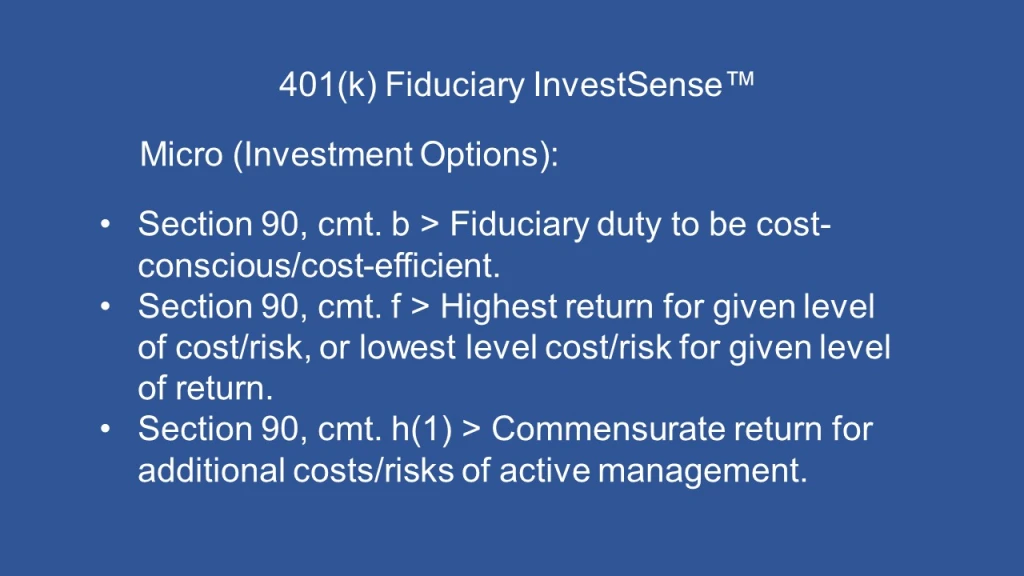
As for the second question, Section 90 of the Restatement, more commonly known as the “Prudent Investor Rule,” offers three fundamental guidelines addressing the importance of cost-consciousness/cost-efficiency of a plan’s investment options:

The last bullet point highlights a key aspect of 401(k)/403(b) fiduciary prudence and cost-efficiency – commensurate return for the additional costs and risks assumed by the plan participant. In terms of actively managed mutual funds, research has consistently and overwhelmingly shown that the majority of actively managed mutual funds are cost-inefficient:

  • 99 % of actively managed funds do not beat their index fund alternatives over the long term net of fees.4
  • Increasing numbers of clients will realize that in toe-to-toe competition versus near-equal competitiors, most active managers will not and cannot recover the costs and fees they charge.5
  • [T]here is strong evidence that the vast majority of active managers are uable to produce excess returns that cover their costs.6
  • [T]he investment costs of expense ratios, transaction costs and load fees all have a direct, negative impact on performance….[The study’s findings] suggest that mutual funds, on average, do not recoup their investment costs through higher returns.7  

The Active Management Value RatioTM (AMVR)
Several years ago I created a simple metric, the AMVR. The AMVR is based on the research of investment icons such as Nobel laureate Dr. William F. Sharpe, Charles D. Ellis, and Burton L. Malkiel. The AMVR allows plan sponsors, trustees, and other investment fiduciaries to quickly determine whether an actively managed fund is cost-efficient relative to a comparable index fund. The AMVR allows the user to assess the cost-efficiency of an actively managed fund from several perspecitives.

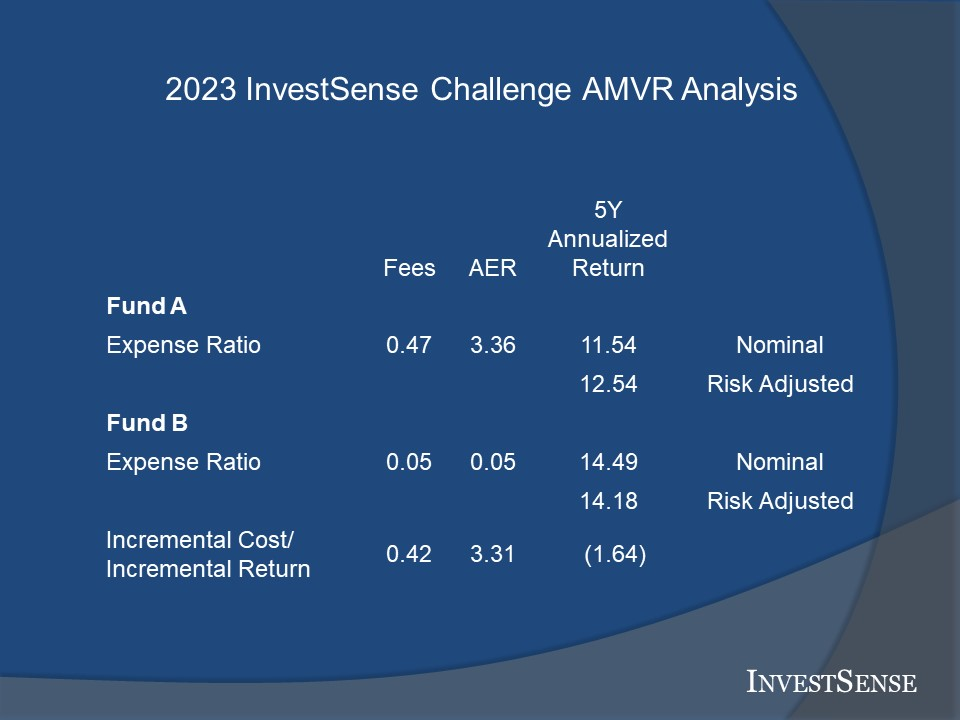
The slide below shows an AMVR analysis comparing the retirement shares of a popular actively managed fund, the Fidelity Contrafund Fund (FCNKX), and the retirement shares of Vanguard’s Large Cap Growth Index Fund (VIGAX). The analysis compares the two funds over a recent 5-year time period. When InvestSense provides forensic services, we provide both a five-year and ten-year analysis to determine the consistency of any cost-efficiency/cost-inefficiency trend.

An AMVR analysis can provide any amount of detail the user desires. On a basic level, the fact that the actively managed fund failed to outperform the comparable index fund benchmark immediately indicates that the actively managed fund is imprudent relative to the Vanguard fund.

Add to that the fact that the actively managed fund imposed an incremental, or additional, cost of 42 basis points without providing any corresponding benefit for the investor. A basis point is a term commonly used in the investment world. A basis point equals 1/100th of one percent (0.01). 100 basis points equals 1 percent.

So the bottom line is that the actively managed fund underperformed the benchmark Vanguard fund and imposed an additional charge without providing a commensurate return for the extra charge. A fiduciary’s actions that result in wasting a client’s or a beneficiary’s money is never prudent.8

If we treat the actively managed fund’s underpreformance as an opportunity cost, and combine that cost with the excess fee, we get a total cost of 2.06. The Department of Labor and the General Accountability Office have determined that over a twenty year time period, each additional 1 percent in costs reduces an investor’s end-return by approximately 17 percent.9 So, in our example, we could estimate that the combined costs would reduce an investor’s end-return by approximately 34 percent. This is not an example of effective wealth management.

The AMVR is calculated by dividing an actively managed fund’s incremental correlation-adjusted costs by the fund’s incremental risk-adjusted return. The goal is an AMVR score greater than zero, but equalt to or less than one, which indicates that costs did not exceed return. While the user can simply use the actively managed fund’s incremental cost and incremental returns based on the two funds’ nominal, or publicly reported, numbers, the value of such an AMVR calculation is very questionable.

A common saying in the investment industry is that return is a function of risk. In other words, as comment h(2) of Section 90 of the Restatement states, investors have a right to receive a return that compensates them for any additional costs and risks they assumed in investing in the investment. The Department of Labor has taken a similar stand in two interpretive bulletins.10 That is why a proper forensic analysis always uses a fund’s risk-adjusted returns.

While the concept of correlation-adjusted returns is relatively new, it arguably provides a better analysis of the alleged value-added benefits, if any, of active management. The basis premise behind correlation-adjusted costs is that passive management often provides all or most of the same return provided by a comparable actively managed fund. As a result, the argument can be made that the actively managed fund was imprudent since the same return could have been achieved by passive management alone, without the wasted excess costs of the actively managed fund.

Professor Ross Miller created a metric called the Active Expense Ratio (AER).11 Miller explained that actively managed funds often combine the costs of passive and active management in such a way that it is hard for investors to determine if they are receiving a commensurate return. The AER provides a method of separating the cost of active management from the costs of passive management.

The AER also calculates the implicit amount of active management provided by an actively managed fund, a term that Miller refers to as the actively managed fund’s “active weight.” Miller then divides the active fund’s incemental costs by the fund’s active weight to calculate the actively managed fund’s AER.

Miller found that an actively managed fund’s AER is often 400-500 percent higher than the actively managed fund’s stated expense ratio. In the AMVR example shown above, dividing the actively managed fund’s incremental correlation-adjusted costs by the fund’s active weight would result in an implicit expense ration approximately 700 percent higher than the fund’s publicly stated incremental cost (3.31 vs. 0.42). Based on the AER, these significantly higher costs would be incurred to receive just 12.5 percent of active management.

Using the same 1:17 percent analysis for each additional 1 percent in costs/fees, using the AER metric and the active fund’s underperformance would result in a projected loss of approximately 84 percent over twenty years. So much for “retirement readiness.”

Additional information on the AMVR can be found at my “The Prudent Investment Fiduciary Rules” blog and searching under “Active Management Value Ratio.”

Fiduciary Risk Management and Annuities
I have written numerous posts about annuities on both my “The Prudent Investment Fiduciary Rules” blog and my “CommonSense InvestSense” blog. Fortunately, the inherent fiduciary liability issues can be addressed by using the same two question fiduciary risk management approach that was mentioned earlier, with the answer to both questions being “yes.” Therefore, a liability-designed 401(k)/403(b) plan will totally avoid the inclusion of annuities, in any form, within the plan.

As a former securities compliance director, I am very familiar with the questionable marketing techniques used by some annuity companies, including the ongoing refusal to provide full transparency with regard to spreads and other financial information. Both ERISA and Department of Labor interpretive bulletions have stressed the importance of providing material information to plan sponsors and plan participants so that they can make informed decisions about including annuities within a plan and about whether to invest in annuities.

The two blogs provide analyses of various types of annuities, especially variable annuities and fixed indexed annuities. My basic advice to my fiduciary risk management clients is simple – “if you don’t have to go there…don’t!”

Annuities are complex and confusing investments, with numerous potential fiduciary liability “traps.” Annuity advocates often try to further confuse and intimidate plan sponsors by engaging in technical details. I strongly recommend adopting my response – stop them before they begin and simply explain that ERISA does not require that pension plans offer annuities within a plan. Therefore, from a fiduciary risk management standpoint, there is no reason to offer any type of annuity within the plan.

Going Forward
Three fiduciary risk management questions that I often ask both myself and my fiduciary clients:

  • Why is it that cost/benefit analysis is often used by businesses to determine the cost-efficiency of a proposed project, but yet cost-efficiency is rarely used by plan sponsors and other investment fiduciaries to determine the cost-efficiency of investments being considered by a pension plan or other fiduciary entity?
  • Why is it that plan sponsors will blindly accept conflicted advice from “advisers” without requiring that the adviser document the prudence of their recommendations througn prudence/breakeven analyses such as the AMVR or an annuity breakeven analysis?
  • Why do plan sponsors insist on making it so unnecessarily difficult and costly by refusing to see the simplicity, praticality, and prudence of the federal government’s Thrift Saving Plan?

The three bullet points remind me of one of my favorite quotes – “there are none so blind, as they who will not see.” I am not sure to whom it should be properly atttributed. The two most cited sources are the Bible and Jonathan Swift.

The point of this post is to emphasize that ERISA compliance is not that difficult to accomplish if a plan talks with the right people and approaches the compliance issues right from the start, when actually designing or re-designing the plan . If that is not possible, there are relatively simple ways to transaction into a liability-driven plan.

One of the services InvestSense provides is fiduciary prudence oversight services. By using fiduciary prudence and risk management compliance tools such as the AMVR and annuity breakeven analyses, and requiring that all plan advisers and investment consultants document their value-added proposition with such validating documents, a plan sponsor can significantly and efficiently simplify the required administration and monitoring of their 401(k) or 403(b) plan.

Notes
1. 29 CFR § 2550.404(a); 29 U.S.C. § 1104(a).
2. Hughes v. Northwestern University., 142 S. Ct. 737, 211 L. Ed. 2d 558 (2022)
3. Tibble v. Edison International, 135 S. Ct 1823 (2015).
4. Laurent Barras, Olivier Scaillet and Russ Wermers, False Discoveries in Mutual Fund Performance: Measuring Luck in Estimated Alphas, 65 J. FINANCE 179, 181 (2010).
5. Charles D. Ellis, The Death of Active Investing, Financial Times, January 20, 2017, available online at https://www.ft.com/content/6b2d5490-d9bb-11e6-944b-eb37a6aa8e. 
6. Philip Meyer-Braun, Mutual Fund Performance Through a Five-Factor Lens, Dimensional Fund Advisors, L.P., August 2016.
7. Mark Carhart, On Persistence in Mutual Fund Performance,  52 J. FINANCE, 52, 57-8 (1997).99
8. Uniform Prudent Investor Act, https://www.uniformlaws.org/viewdocument/final-act-108?CommunityKey=58f87d0a-3617-4635-a2af-9a4d02d119c9 (UPIA).
9. Pension and Welfare Benefits Administration, “Study of 401(k) Plan Fees and Expenses,” (DOL Study) http://www.DepartmentofLabor.gov/ebsa/pdf; “Private Pensions: Changes needed to Provide 401(k) Plan Participants and the Department of Labor Better Information on Fees,” (GAO Study).
10. 29 CFR Section 2509.94-1 )(IB 94-1) and Section 2509.15-1 (IB 15-1).
11. Ross Miller, “Evaluating the True Cost of Active Management by Mutual Funds,” Journal of Investment Management, Vol. 5, No. 1, 29-49 (2007) https://papers.ssrn.com/sol3/papers.cfm?abstract_id=746926.

Copyright InvestSense, LLC 2024. All rights reserved.

This article is for informational purposes only, and is neither designed nor intended to provide legal, investment, or other professional advice since such advice always requires consideration of individual circumstances.  If legal, investment, or other professional assistance is needed, the services of an attorney or other professional advisor should be sought

Investment Policy Statements Crucial to Fiduciary Duty

by Chris Tobe, CFA, CAIA

The Investment Policy Statement (IPS) for a pension plan or other investment pool is a critical element in the governance and is a main fiduciary control on investments.   

As stated in the IFEBP Investment Policy Handbook, “If an employee benefit plan does not have an investment policy statement, it does not have an investment policy.” [i]  Chris Carosa, in his Forbes column, says a “401(k) IPS is a legal document that serves as the solid compliance backbone of the plan”.[ii] Josh Itzoe in his book, the Fiduciary Formula, says about an IPS, “I believe a written investment policy is the only way to demonstrate a thoughtful process and make well informed, prudent investment decisions consistent with the fiduciary requirements imposed by ERISA.” [iii]


A major U.S. regional ERISA law firm for plans remarked,

Since most plans maintain an IPS, not having one can be seen as ‘outside the lines’ and may subject the plan’s fiduciary compliance to greater scrutiny. In fact, it is not hard to imagine a plaintiff’s firm arguing that a plan’s failure to have an IPS is de facto evidence of a fiduciary breach.[iv]

In the CFA standards for Pension Trustees says  “Effective trustees develop and implement comprehensive written investment policies that guide the investment decisions of the plan (the “policies”).” [v] The CFA Code assumes any investments of any size will have an Investment Policy Statement (IPS). 

The Society for Human Resources Management (SHRM) outlined the percentage of defined contribution plans with an Investment Policy Statement.  Basically 90% for plans over $50mm in 2008, most likely much higher today[ii] The complete breakdown was as follows:

$10 million or less – 68%

$10 million to $50 million – 78%

$50 million to $500 million – 90%

$500 million to $1 billion – 89%

More than $1 billion – 92%

I believe any plan without an IPS is in fiduciary breach and they should be reviewed annually. [i].  


[i] 4.5.2   The investment policy statement is reviewed at least annually to ensure it is aligned with current facts and circumstances.

www.fi360.com/uploads/media/handbook_stewards_2020.pdf


[i] http://www.cfainstitute.org/-/media/documents/code/other-codes-standards/pension-trustee-code-of-conduct-2019.pdf

[ii]  Benefits Magazine 2008 https://www.shrm.org/resourcesandtools/hr-topics/benefits/pages/401kinvestmentstatement.aspx

Predicting Future 401(k) Litigation Risk by Size of Plans

by Chris Tobe, CFA CAIA

The 401(k) market differs greatly by size.  85 percent of 401k plans (534 out of 631 thousand defined contribution plans) (DC Plans) are under $5 million in size.  The DOL is overwhelmed with the 534 thousand plans under $5 million, of which there are enough bad actors doing engaged in highly questionable activities, such as taking participants’ money for personal use, that they have not touched the excessive fees issue, leaving it to the legal community to address such concerns.  Less than 1 percent of DC Plans are over $200 million in assets and are generally cost effective to litigate.

However, less than 1 percent is still nearly 4000 plans with over $200 million each in assets.   However, within this 4000, differences vary greatly by size as well.   My best guess is that less than 500 actions have been filed according to what I have found.   I still believe there is room for around 2500 more actions to be filed over the next decade.      

An August 2022 Bloomberg article cites $150 million in settlements over the last 3 years. Bloomberg puts the number filed at around 200 since 2019 so my estimates may be conservative.[i]  Bloomberg notes that decisions issued in the seven months since the US Supreme Court Hughes decision have tended to favor plaintiffs over defendants. Bloomberg predicts that “employers negotiating future settlements may be facing higher price tags than the $1 million to $5 million range seen over the past few years.” This Bloomberg article shows a growing pace of ERISA litigation.

An August 2022 article by Fred Barstein of 401kTV also predicts the rapid growth of litigation in smaller 401(k) plans. [ii]

401(k) plans of $3 billion and more assets
According to my data base there are 334 plans over $3 billion in assets.  This has been the most litigated group, with well over 100 actions filed. There is still a high probability of 100 or more cases coming from this group, perhaps even more if there is double dipping, as many earlier litigating plans have gone halfway at best in lowering fees.

For larger plan administrative costs, fees above $50 a head, or even one high fee option, may be enough to trigger a suit. This could apply to plans that have already been litigated once and did not adequately cut costs the first time. Does every plan option have to been prudent even those who go through to the brokerage window?  If so, this could this be litigated as high fee funds and even Crypto Currency are in widely held brokerage windows.

Many of the largest plans unitize investments with defined benefit plans. Will the new level of transparency go through to target date funds with underlying alternatives like Private Equity?  Alternative contracts typically contain multiple fiduciary breaches, excessive fees along with liquidity and other breaches. 

401(k) plans of $1b – $3 billion

There are an estimated 717 plans between $1-$3 billion, with probably 200 that have been litigated, leaving room for maybe 300 more. 

There are lots of plans with administrative costs above $50 a head, or even more with at least one high fee option, along with all the other attributes like brokerage windows like the largest plans.

401(k) plans of $500m – $1 billion
There are 961 plans between $500m $1 billion, with probably only 50 or less cases litigated.  This area will probably have the most explosive growth, with well over 600 plans with high fee providers. There are many higher fee insurance recordkeepers in this group and conflicted consultants, along with share class violations in many funds.

401(k) plans of $200m – $500m
There are 2259 plans between $200-$500 million. 2022 will start to see a great growth in litigation in this area.      Plans in this group who start fixing their plans could greatly minimize their chances of litigation. I still guess that over 1500 plans could be subject to litigation. There are even more higher fee insurance recordkeepers in this group and conflicted consultants, along with share class violations in many funds.

403(b) plans
ERISA 403(b) plans include: not-for-profit hospitals, and not-for-profit universities, private not-for-profit K-12 schools. Non-ERISA 403(b) plans include public K-12 schools, public universities and some university related hospitals.

The largest 30 or so private universities 403(b)s have already been hit with litigation.  Northwestern is typical with 3 different recordkeepers Fidelity, Vanguard, & TIAA.  This portion of the 403(b) market with multiple recordkeepers is unique as almost all 401(k), which is more oriented toward single record keeper, so all could be litigated around administrative costs.   Fidelity and TIAA also have high-cost options and TIAA has high-cost higher risk annuity options as well.  The next 100 or so private universities will be at great risk of litigation.

The big wave of 403(b) litigation will probably be hospitals.   While they typically only have one recordkeeper, they are much more likely than 401(k) plans of the same size to use higher fee (especially insurance company) based platforms.

401(k) plans of $50m – $200m
There are an estimated 8646 plans between $50-$200 million. I predict litigation will be low in 2022 as there are so many larger targets.  However, over the next decade it could pick up.   This gives plans in this size range time to clean up their plans, giving maximum value to participants while minimizing litigation risk in the future.

Higher fee insurance recordkeepers, conflicted consultants along with multiple share class violations, are rampant in this group with much higher percentage.

401(k) plans of $20-$50m and $5-20m
There are an estimated 14915 plans between $20-$50 million and an estimated 69343 plans between $5-$20 million. I predict that litigation involving these plans will be rare during the next 5 years, as there are so many larger targets, but over the next decade it could pick up.   This gives plans in this size range time to clean up their plans, giving maximum value to participants while minimizing litigation risk in the future.

Parting Thoughts
401(k) litigation is only in its infancy, with only 15-20 percent of the 3000 potential largest complaints filed. This number could triple if the litigation goes down to plans from $50-$200 million.   All of the controversy now is mostly in the largest cases being litigated.   Most of these smaller cases are much more clear-cut regarding potential fiduciary violations.

Plans can fix themselves or wait to be sued. Unfortunately, many are close-minded, relying solely on conflicted advice from brokers and insurance agents that tell plans that they are OK when they actually are not. Many plans will be in for a rude awakening. 


[i] https://news.bloomberglaw.com/litigation/suits-over-401k-fees-nab-150-million-in-accords-big-and-small?context=search&index=0  
[ii] https://www.wealthmanagement.com/rpa-edge/why-lawsuits-against-rpas-smaller-dc-plans-are-inevitable

Contact Info: 542-648-1303, tobech348@gmail.com, christobe.com

Brokerage Windows Exposed by Crypto

By Chris Tobe, CFA, CAIA  June 14, 2022

Crypto, trying to bribe its way into 401ks via Congress and with providers like Fidelity, has exposed a non-transparent dark area of 401(k) that has been on the back burner – brokerage windows.   A typical plan has 12 to 16 main options, but a brokerage window could add hundreds of additional choices that so far have escaped any oversight.  Fidelity stated they would put crypto as a main option and prompted this response from the DOL

“The plan fiduciaries responsible for overseeing [cryptocurrency] investment options or allowing such investments through brokerage windows should expect to be questioned about how they can square their actions with their duties of prudence and loyalty.”[i

The DOL advisory council put together a report on brokerage windows that basically said they are so immaterial, that the DOL needs to give little or no oversight to them since those in the brokerage window are aware of the additional risks.[v]

A report cites PSCSA that

23.2 percent of all retirement plans offer a brokerage window, and nearly 40 percent of those with more than 5,000 participants do. Even though brokerage windows are being offered in many plans, participants do not use them widely only 1.5 percent of plan assets are invested through brokerage windows. DOL states that custodians saw a usage ranged from .03 percent to 3 percent. [vi]

Because of their size, less attention has been paid to brokerage windows both by the DOL and the plaintiff’s bar.  But with the declaration by Fidelity to offer crypto as a main option within plans and the DOL doing its job by sounding concerns, people realized that there could be crypto investing already going on in brokerage windows, with most plans not having a clue.

Fidelity, who is the largest runner of brokerage windows and who cut the deal with bitcoin to put them on their platform, are most likely receiving millions of undisclosed dollars from the crypto crowd.

Crypto is pouring millions into DC lobbying, and seems shocked that DOL did their job and did not roll over like they did with private equity investments under Trump.

Bloomberg writes that

Under that guidance, which the DOL issued last month, employers could be responsible for risky crypto trades their workers make in workplace 401(k)s. The DOL’s employee benefits enforcement agency will launch what it’s calling “an investigative program” that requires plan officials to “square their actions with their duties of prudence and loyalty” if they allow crypto investments in self-directed accounts, according to the guidance.[vii]

“This is a very damning statement about brokerage windows,” said Lisa Tavares, a partner at Venable LLP and a former IRS attorney.”

Since almost all brokerage windows have excessive fees and many have excessive risks that do not pass fiduciary scrutiny, this opens up almost any plan with a brokerage window to potential litigation. 

Leading plaintiffs firm Keller Rohrback LLP is investigating whether employees and retirees have paid unnecessary fees in connection with their use of brokerage windows such as excessive fees, selecting funds based on the amount of fees shared with the brokerage firm, and selecting more expensive share classes despite the availability of less expensive classes of the same fund.   They have targeted particular large firms like Continental Airlines, Kimberly-Clarke, Lilly, and Caterpillar looking for plaintiffs.[viii]

In the article, “401(k)s with Bitcoin Should Expect Lawsuits: Lawyers,” trade publication “Ignites” quotes Jerry Schlichter as saying that

Any employer who would follow the Fidelity lead by offering cryptocurrency and 401(k) plan is exposing itself to very serious risk of a fiduciary breach…. As an unproven, highly volatile investment, Bitcoin would test the prudence standard under the Employee Retirement Income Security Act….The account will carry a fee of up to 90 basis points, plus undisclosed commission fees, which would be 20 times as much as a simple index fund.[ix]

The defense bar is trying to talk up a structure the digital accounts to qualify for 404(c) protections. Schlichter, however, suggested that 404(c) protections would not provide a safe harbor anyway. He pointed to a Supreme Court decision handed down in January that found that plan sponsors could not escape their responsibility for allowing imprudent investments in their plans even if they feature them alongside prudent ones. Schlichter represents the plaintiffs in that case, the plan participants in Northwestern University’s 403(b) plan. Quoting Schlichter,

“[The Supreme Court] said, ‘No, the employer plan sponsor has the duty to furnish only prudent options,’ and the same applies here.'”

Any 401(k) plans with a brokerage window will be subject to severe fiduciary liability unless they can prove they have provided 100% prudent options.  This will most likely lead to much more litigation and many more settlements, as the cost of proving 100% prudent options will be extremely expensive. 


[i] DOL Guidance Could Put a Crimp in 401(k) Brokerage Windows SHRM   https://www.shrm.org/resourcesandtools/hr-topics/benefits/pages/dol-guidance-could-crimp-401k-brokerage-windows.aspx.  

[ii] https://www.morningbrew.com/daily/stories/2022/05/27/crypto-money-is-shaking-up-us-politics.

[iii] https://news.bloomberglaw.com/crypto/yellen-says-crypto-is-very-risky-option-for-retirement-savers?context=search&index=4

[iv] https://news.bloomberglaw.com/daily-labor-report/401-crypto-investment-restrictions-eyed-by-labor-regulators?context=search&index=0

[v] DOL Advisory Council on Pension Benefit Plans Understanding Brokerage Windows in
Self-Directed Retirement Plans December 2021 (“Brokerage Windows”).

[vi] Brokerage Windows, supra.

[vii] https://news.bloomberglaw.com/daily-labor-report/new-crypto-guidance-rewrites-rules-on-401k-brokerage-windows.

[viii] https://krcomplexlit.com/the-newsroom/keller-rohrback-l-l-p-investigates-excessive-fees-401k-brokerage-window

[ix] https://www.ignites.com/lead/c/3622614/465124?referrer_module=t.cohttps://uselaws.com/media-turns-to-jerry-schlichter-for-guidance-following-fidelity-bitcoin-announcement/

Brave New World: How Hughes v. Northwestern, the “Fiduciary Responsibility Trinity,” and the Active Management Value Ratio Are Changing the 401(k) Landscape

I was in a local mall the other day looking for a dress shirt. I figured there would be no problem. Wrong. I had not been to a mall since the pandemic started. What I quickly discovered is that the work-at-home movement has resulted in less demand and, thus, less floor space for dress shirts. Makes sense. I had just not considered that as a possible result of the Covid pandemic.

But my trip to the mall made me think about the potential similarity, or changes, that we are already starting to see in the courts since the Northwestern decision. Actually, I think the trends we are seeing, and can expect to continue to see going forward, are a result of the combination of the Tribble, Northwestern and Brotherton decisions, what I refer to as the “fiduciary responsibility trinity.” (Trinity)

My recent post on the “CommonSense 401(k) Project” site, “The “Fiduciary Responsibility Trinity: ERISA Fiduciary Law After the Hughes/Northwestern Decision,” discussed the significance of each of the three decisions. In talking with colleagues in both the legal and 401(k)/403(b) consulting industry, they all report that plan sponsors seemingly have not responded to any of the legal issues addressed in the Trinity.

In talking with some plan sponsors, I have seen the same seeming “indifference” toward the changing legal landscape for 401(k)/403(b) plans and plan sponsors. I would describe the two attitudes that I have seen as “it is what it is, but we are not going to make it worse by tipping employees off to the situation, to “we’re just going to ignore it and hope we do not get sued.”

As I have explained to some plan sponsors, there are obvious risks to such strategies. ERISA attorneys routinely scan the Form 5500 records for possible cases. Plans that decide to ignore any ERISA problems and try to rely on the “we did not know, we meant no harm” defense can expect courts to reject such strategies citing that “willful ignorance” is no defense. Under ERISA, plan sponsors are held legally responsible for information that they knew, or should have known, by performing their legal obligation to independently perform a through and objective investigation and evaluation of all investment options within a plan.

What really amazes me is that so many plan sponsors are unwilling to even listen to objective suggestions from experienced professionals who could easily re-designed their 401(k)/403(b) plan to create a win-win situation for both plan sponsors and plan participants, one that truly furthers the “retirement readiness” campaign while reducing the costs of the plan and the potential liability exposure of the plan sponsor.

When I look at the current 401(K)/403(B) litigation crisis, I see one dominant theme- cost-inefficiency. When I say cost-efficiency, I mean both in terms of unnecessary fees/costs and in the overall design of most plans, especially with regard to the number of cost-inefficient investment options offered.

In Tibble, SCOTUS recognized the Restatement of Trusts (Restatement) as a viable resource in resolving fiduciary issues. The two dominant themes throughout the Restatement are diversification, as a means of risk management, and cost consciousness/cost-efficiency.

A couple of years ago I created a simple metric, the Active Management Value Ratio. (AMVR) The AMVR is based primarily on the concepts set out in Charles D. Ellis’ classic, “Winning the Loser’s Game.” I actually discovered Ellis’ classic in 1985, back when it was still titled “Investment Policy: Winning the Loser’s Game.” Ellis’ book forever changed the way I think about investing.

In creating the AMVR, I simply took Ellis’ core concept of comparing incremental costs to incremental returns.

So, the incremental fees for an actively managed mutual fund relative to its incremental returns should always be compared to the fees for a comparable index fund relative to its returns. When you do this, you’ll quickly see that that the incremental fees for active management are really, really high—on average, over 100% of incremental returns!

That simple approach is reflected in the overall simplicity of the calculations required to compute an actively managed fund’s AMVR score. The following AMVR analysis charts show how the basic AMVR only requires the ability to subtract and divide.

In analyzing the AMVR data, the two key questions are:

1. Did the actively managed fund provide a positive incremental return?
2. If so, did the fund’s incremental return exceed the fund’s incremental costs?

If the answer to either of these questions is “no,” the actively managed fund is not cost-efficient, and an imprudent investment choice, relative to the benchmark fund.

The first AMVR analysis compares a fund often found in 401(k) plans, Fidelity Contrafund, K shares (FCNKX), with the Fidelity Large Cap Growth Fund (FSPGX). Since FCNKX failed to provide a positive incremental return relative to FSPGX, our fiduciary prudence analysis can stop.

The second AMVR analysis compares another fund commonly found in 401(k) plans, American Fund’s Growth Fund of America, R-6 shares (RGAGX), with the Vanguard Large Cap Growth Fund, Admiral shares. Again, since RGAGX failed to provide a positive incremental return relative to VIGAX, the fiduciary prudence analysis can stop.

Later, I revised the AMVR to allow investors, investment fiduciaries and attorneys to factor in the high correlation of returns that currently exists between most actively managed U.S. equity funds and comparable index funds. In my opinion, this allows for a more meaningful and valuable analysis of the cost-efficiency of an actively managed funds. After all, a plan sponsor’s fiduciary duties of loyalty and prudence require that the plan sponsor always put the plan participant’s and their beneficiaries’ interests first.

Many actively managed funds like to compare their returns to comparable market indices, such as the Standard & Poor’s 500 Index. Unlike comparable index funds, market indices do not have actual costs that can be used to evaluate cost-efficiency. Actively managed funds know this.

In my AMVR forensic analysis charts, I include a fund’s Active Expense Ratio, (AER) The AER metric, created by Professor Ross Miller, factors in an actively managed fund’s correlation of returns relative to a comparable index fund to produce the effective expense ratio of an actively managed fund.

Professor Miller explained the importance of and the concept behind the AER by stating that

Mutual funds appear to provide investment services for relatively low fees because they bundle passive and active fund management together in a way that understates the true cost of active management. In particular, funds engaging in closet or shadow indexing charge their investors for active management while providing them with little more than an indexed investment. Even the average mutual fund, which ostensibly provides only active management, will have over 90% of the variance in its returns explained by its benchmark index.

John Bogle also addressed the significance in factoring in correlations of return:

As active management continues to morph into passive indexing-already approaching the commonplace in the large-cap fund category-managers will have to reduce their fess commensurately. After all, a correlation of 99 comes close to meaning that 99 percent of the [the fund’s] portfolio is effectively indexed. A 1.5 percent expense ratio on the remaining portfolio, therefore, represents an annual fee of 150 percent(!) on the actively managed assets.

Even if investors are willing to tolerate that cost at the moment, it is only a matter of time until they realize that their ongoing deficit to the stock market’s return is a reflection of the simple fact that they effectively own an index fund, but at a cost that is grossly excessive.

The AMVR Fidelity Contrafund chart clearly shows how the combination of a high correlation of returns and high incremental cost can dramatically reduce an actively managed fund’s cost-efficiency

Another benefit of the AMVR is that it allows plan sponsors to avoid “closet index” funds. Closet index funds, aka “index huggers,” are actively managed mutual funds that promote the alleged advantages of active management in order to justify their high fees. However, in reality, such funds often track, in most cases actually underperform, comparable, but far less expensive, index funds. High incremental costs plus underperformance equal imprudence and fiduciary liability exposure.

Going Forward
Bottom line, courts are increasingly realizing that there is simply no legally justifiable reason for plan sponsors not to make the changes required by the fiduciary responsibility Trinity, to properly protect both plan participants and themselves from unnecessary problems such as excessive fees and cost-inefficient investment options. Having an abundance of cost-inefficient investment options only provides proof of yet another form of cost-inefficiency, the law of diminishing returns.

Creating a win-win 401(k)/403(b) plan is relatively simple. But plan sponsors must be willing to at least listen to sound, simple, and objective advice from experienced 401(k) consultants and learn how to properly utilize analytical tools such as the Active Management Value Ratio, as the legal field is increasingly using the metric to establish liability and calculate damages.

The changes created by the fiduciary responsibility Trinity are not going anywhere, Therefore, it is incumbent on plan sponsors to make the necessary changes, both in terms of attitude and design, or face litigation, even repeated litigation, for their failure to fulfill their fiduciary duties. As Einstein properly noted, “[w]e cannot solve our problems with the same thinking we used when we created them.”

James W. Watkins, III, is a licensed attorney (41 years), specializing in securities and ERISA law, a Certified Financial Planner™ professional (32 years) and an Accredited Wealth Management Advisor. He has extensive experience in evaluating the legal prudence of various types of investments, including mutual funds, and advising 401(k)/403(b) pension plans on both designing and monitoring plans to ensure legal compliance.  

Private Equity in 401(k) Plans: A Ticking Time Bomb

Private Equity along with other illiquid contract investments like hedge funds, private debt, real estate are a potential Fiduciary Time Bomb for plans and their participants

Center for Economic and Policy Research’s Eileen Appelbaum recently said “Much as private equity firms may wish it were different, they have been mostly unable to worm their way into workers’ 401(k)s and abscond with their retirement savings,[i] from a series of articles on how the new Trump DOL rules were connected to massive political donations by the Private Equity industry.[ii]  

A report by University of Oxford professor Ludovic Phalippou shows that in the last 15 years, private equity firms generally have not provided better returns to investors than low-fee stock index funds. Prof. Phalippou has shown excess mostly hidden fees and expenses to exceed 6% killing net returns. [iii]    

Noted founder of investment consulting firm Richard Ennis in quoting Beath & Flynn 2020 study says that private equity (as a class of investment) in fact ceased to be a source of value-added more than a decade ago. [iv] 

Jeff Hooke of Johns Hopkins book the “Myth of Private Equity” goes into great detail on an asset class and its numerous fiduciary flaws.  He documents that many performance claims are made up by the managers with no independent verification and are greatly exaggerated. [v]

The plan as I see it is to bury Private Equity into Target Date Funds where they can hide these Fiduciary Time bombs collect the massive fees and hope that they do not blow up.   Their main claim for inclusion is excessive performance which is dubious at best.

A Private Equity like structure technically private debt has cost JP Morgan over $400 million in damages in 401(k) litigation.  This private debt was put in a JP Morgan CIT, which was put in JPM broad bond CIT, with was put in a JPM stable value CIT.[vi] [vii] This type of layering is what I expect to see in Target Date CIT’s.

Former SEC Attorney Ted Siedle goes over the Fiduciary Breaches common in most Private Equity funds in his Forbes Column that should make any fiduciary nervous.  [viii]

1.   Private equity offering documents generally prominently state (in capital, bold letters) that an investment in a private equity fund is speculative, involves a high degree of risk, and is suitable only for persons who are willing and able to assume the risk of losing their entire investment.  

2. Largely “unconstrained” and may change investment strategies at any time.  Can engage in borrowing, or leverage, on a moderate or unlimited basis.  No assurance of diversification since funds generally reserve the right to invest 100 percent of their assets in one investment.  Heightened offshore legal, regulatory, operational and custody risk.

3. Myriad conflicts of interest, self-dealing practices. The investment manager determines the value of the securities held by the fund. Such valuation affects both reported fund performance as well as the calculation of the management fee and any performance fee payable to the manager. [ix] Naked Capitalism writes “The toothless and captured Institutional Limited Partners Association has proposed a fee disclosure template which has gone nowhere.”[x]  It is widely known there is a massive underreporting of fees.

4. Business practices that may violate ERISA. Private equity fund offering documents often disclose that investors agree to permit managers to withhold complete and timely disclosure of material information regarding assets in their funds. Further, the fund may have agreed to permit the investment manager to retain absolute discretion to provide certain mystery investors with greater information and the managers are not required to disclose such arrangements. As a result, the fund you invest in is at risk that other unknown investors are profiting at its expense—stealing from you. Finally, the offering documents often warn that the nondisclosure policies may violate applicable laws. That is, certain practices in which the fund’s managers engage may be acceptable to high-net-worth individuals (or unknown to them) but violate laws applicable to ERISA plans. [xi]

5.  Lack of disclosure has led to numerous violations some pointed out by the SEC, others pertaining to IRS like monitoring fees tax law violations and management fee waivers tax law violations.

These 5 points are a very abbreviated list of Former SEC Attorney Ted Siedle’s column on the Fiduciary Breaches in Private Equity funds in his 8/23/20 Forbes Column.  [xii]

Even a small allocation to a Target Date Fund, with the excessive risk, lack of outperformance and excessive fees seem to make it a Fiduciary Risk.

If you have underlying Private Equity or are seriously considering it, get an independent legal opinion (from a firm that does not represent PE firms) that the actual underlying Private Equity contract passes ERIA fiduciary muster.   Make sure your fiduciary liability insurance covers Private Equity many do not.

While the Trump DOL “get out of jail free card” letter may protect a plan from Department of Labor action on Private Equity, you are making a dangerous bet in litigation, that the judge will block transparency and discovery of these contracts. 

With no proven performance advantage, grossly excessive fees, and numerous fiduciary issues there seems to be nothing but harm in adding Private Equity into your 401(k) plan.

Chris Tobe, CFA, CAIA is an expert on Private Equity Corruption writing the book Kentucky Fried Pensions, and dozens of articles..  http://www.christobe.com/alternatives/


[i] https://www.dailyposter.com/biden-reversal-gives-wall-street-a-big-win/

[ii] https://www.dailyposter.com/news-trump-just-fulfilled-his-billionaire/

[iii] https://papers.ssrn.com/sol3/papers.cfm?abstract_id=3623820  an Inconvenient Fact Private Equity Returns U.of Oxford  Ludovic Phalippou

[iv] https://richardmennis.com/blog/how-to-improve-institutional-fund-performance

[v] https://cup.columbia.edu/book/the-myth-of-private-equity/9780231198820

[vi] https://www.nytimes.com/2012/03/23/business/jpmorgan-discloses-it-lost-in-arbitration-to-american-century.html

[vii] https://casetext.com/brief/whitley-v-jp-morgan-chase-co-et-al_memorandum-of-law-in-opposition-re-49-motion-to-dismiss-first-amended

[viii] https://www.forbes.com/sites/edwardsiedle/2020/08/23/trump-dolsec-fail-to-warn-401ks-about-massive-private-equity-dangers/?sh=62e7fb7eb808

[ix] https://www.forbes.com/sites/edwardsiedle/2020/08/23/trump-dolsec-fail-to-warn-401ks-about-massive-private-equity-dangers/?sh=62e7fb7eb808

[x] https://www.nakedcapitalism.com/2022/02/sec-set-to-lower-massive-boom-on-private-equity-industry.html?

[xi] https://www.forbes.com/sites/edwardsiedle/2020/08/23/trump-dolsec-fail-to-warn-401ks-about-massive-private-equity-dangers/?sh=62e7fb7eb808

[xii] https://www.forbes.com/sites/edwardsiedle/2020/08/23/trump-dolsec-fail-to-warn-401ks-about-massive-private-equity-dangers/?sh=62e7fb7eb808