Damages -Parties in Interest, Prohibited Transactions, & Disgorgement: TIAA Case Study

I. Introduction

This section refines the definitions of ‘party in interest’ and ‘prohibited transaction’ as applied in litigation involving TIAA. In Cunningham v. Cornell, TIAA simultaneously acted as recordkeeper, annuity issuer, and provider of other investment options. This case provides a clear framework for analyzing the structural conflicts and prohibited transactions associated with insurer-issued fixed annuities under ERISA and measuring damages.

II. Party in Interest

ERISA §3(14) defines a ‘party in interest’ broadly to include fiduciaries of the plan, service providers such as recordkeepers and consultants, employers sponsoring the plan, and any entity receiving direct or indirect compensation from the plan. TIAA is a party in interest in multiple capacities: as the recordkeeper, as the issuer of fixed annuity products, and as a provider of affiliated investment funds.

III. Prohibited Transactions Framework

A. Recordkeeping Compensation

As recordkeeper, TIAA received compensation directly from plan assets. Under ERISA §406(a)(1)(C), such arrangements constitute transactions with a party in interest, presumptively prohibited absent a statutory exemption.

B. Issuance of Fixed Annuities with Spread Profits

TIAA’s issuance of fixed annuities with hidden spreads also constitutes a prohibited transaction. The insurer profits directly from the difference between general account yields and crediting rates paid to participants. This implicates:
– ERISA §406(a)(1)(A) and (C): transfer of plan assets to, or furnishing of services by, a party in interest;
– ERISA §406(b)(1): fiduciary self-dealing when TIAA retains discretion to set crediting rates.

Thus, both the recordkeeping function and the spread mechanism independently trigger prohibited transaction analysis.

IV. Damages and Disgorgement

The proper remedy for a prohibited transaction under ERISA §409 is restitution or disgorgement of all profits obtained through the unlawful conduct. Disgorgement is an equitable remedy designed to restore participants to the position they would have occupied absent the prohibited transaction. It prevents unjust enrichment by requiring fiduciaries or parties in interest to surrender profits obtained at the expense of plan participants.

Disgorgement does not require proof of participant reliance or precise quantification of the general account yield. Instead, once a prohibited transaction is established, the burden shifts to the fiduciary or party in interest to demonstrate that no loss occurred. If they cannot, all spread profits must be disgorged.

Courts have repeatedly recognized this principle in fiduciary breach cases. In Brotherston v. Putnam, the First Circuit affirmed that once a fiduciary breach and related loss are shown, the burden shifts to fiduciaries to prove that the same losses would have occurred absent the breach. The Supreme Court in Hughes v. Northwestern reaffirmed the ongoing duty to monitor investments and remove imprudent ones.

Applied to TIAA, disgorgement would require the company to return the difference between what its general account earned and what it credited to participants. For example, if the general account earned 6% and participants received 4.5%, TIAA would be required to disgorge the 150 basis points retained as spread. This figure has been documented in the range of 120–150 basis points annually, as cited in NBC News (2024) and subsequent independent analyses. Importantly, the industry has not disputed these figures, underscoring their credibility. As TIAA has consistently had the highest rates among fixed IPG annuities, damages for other fixed annuities will be the TIAA 150bps spread plus the difference in yield between the other annuity and TIAA.

The Discovery Barrier: General Account Returns

In practice, litigants face years of stonewalling when requesting general account return data. Insurers argue that such information is proprietary and competitive. Thus, while the spread is the true measure of insurer profits, direct calculation is often impossible.³

This creates a paradox: the central harm (undisclosed spread profits) is simultaneously the central figure withheld in discovery. Plaintiffs risk being left without a calculable damages model, even when the fiduciary breach is clear.

Alternative Damage Models: Disgorgement

The Maersk complaint provides a practical alternative: a disgorgement-based model. Under this theory, insurers must disgorge all profits derived from the prohibited transaction, irrespective of plaintiffs’ ability to calculate them precisely. Courts have long recognized disgorgement as an equitable remedy in ERISA cases. See Donovan v. Bierwirth, 754 F.2d 1049 (2d Cir. 1985).⁴

Reasonable Estimates and Fiduciary Latitude

Even absent full disclosure, courts may allow plaintiffs to use reasonable estimation methods:
– Comparator Returns — Using published yields on insurer-issued bonds or peer general account disclosures.
– Stable Value Benchmarks — Data from Hueler Stable Value Universe or Morningstar stable value indices.
– Economic Inference — Expert testimony showing spreads between credited rates and general account yields.

In Brotherston, the First Circuit endorsed damages models based on benchmarks rather than precise historical data.² Similarly, in Tibble v. Edison Int’l, 575 U.S. 523 (2015), courts accepted inferential models when defendants obstructed discovery.⁵

Policy Concerns and Fiduciary Implications

If insurers are allowed to withhold general account data, fiduciaries cannot meet their duty of prudence or loyalty. This regulatory gap highlights why annuities should not be default investments in ERISA retirement plans. Allowing equitable remedies such as disgorgement, and granting plaintiffs latitude in estimation, ensures fiduciary accountability despite insurer opacity.

V. Expert Commentary

TIAA annuities highlight the risks of structural conflicts and undisclosed spreads. As stated in NBC News (2024), annuities ‘flunk the most basic investment principle of diversification—do not put all your eggs in one basket.’ Public reporting has confirmed that TIAA annuities retain hidden spread fees of 120–150 basis points annually. Importantly, this figure has not been disputed by the industry. While other insurers may present even greater risks, TIAA remains the most visible example of how spread-based compensation undermines fiduciary protections.

VI. Conclusion

In Cunningham v. Cornell, TIAA’s dual roles as recordkeeper and annuity issuer created multiple prohibited transactions. Both the direct recordkeeping compensation and the hidden annuity spreads represent transactions with a party in interest. Under ERISA, these arrangements are per se prohibited absent exemptions. The proper remedy is disgorgement of spread-based profits, ensuring that plan assets are used solely for the benefit of participants and beneficiaries. Disgorgement is not punitive but restorative—it returns ill-gotten gains and enforces the exclusive benefit rule at the heart of ERISA.

The core harm in fixed annuity cases is the hidden spread profit, but insurers’ refusal to disclose general account returns makes direct measurement nearly impossible.

Courts should recognize:
1. Spread profits are per se compensation and subject to ERISA’s prohibited transaction rules.
2. Insurers’ refusal to disclose data should not immunize them from liability.
3. Plaintiffs are entitled either to full disgorgement of profits or to rely on reasonable estimates from comparator data.

Only by adopting these principles can ERISA fulfill its purpose of protecting plan participants from hidden and excessive fees.

Footnotes

¹ Cunningham v. Cornell Univ., 86 F.4th 961 (2d Cir. 2023).

² Brotherston v. Putnam Invs., LLC, 907 F.3d 17 (1st Cir. 2018), cert. denied, 140 S. Ct. 911 (2020).

³ See SEC v. TIAA, Admin. Proceeding File No. 3-20200 (July 13, 2021) (regarding disclosure failures).

⁴ Donovan v. Bierwirth, 754 F.2d 1049 (2d Cir. 1985).

⁵ Tibble v. Edison Int’l, 575 U.S. 523 (2015).

  1. My NBC interview on TIAA annuity risks and fees “Annuities flunk the most basic investment principle of diversification- do not put all your eggs in one basket” at 2:14 https://www.nbcnews.com/video/rhode-island-retirement-plan-prevents-many-state-workers-from-accessing-contributions-247724101790 written version is at https://www.nbcnews.com/news/us-news/rhode-island-sheriffs-retirement-account-woes-bring-scrutiny-state-run-rcna229290
    • I was quoted in this August 2025 article  TIAA has hidden spread fees 120-150 basis points. This was in addition to have been quoted by  NBC at 120 bps in August 24, which importantly has never been challenged by the industry in over a year.
  2. Annuity Executive brags on 200bps 2% fees Tracer, Zachary.  2013.  “Prudential Says Annuity Fees Would Make Bankers Dance.”  Bloomberg.  March 6, 2013.  https://www.bloomberg.com/news/articles/2013-03-06/prudential-says-annuity-fees-would-make-bankers-dance

3. FED noted in 2021 described the spreads annuity marketers earn on the products as “notoriously high life annuity price markups.” https://papers.ssrn.com/sol3/papers.cfm?abstract_id=3902305

Annuity Risks and Hidden Fees: Dangerous to Ignore, Difficult to Measure Damages

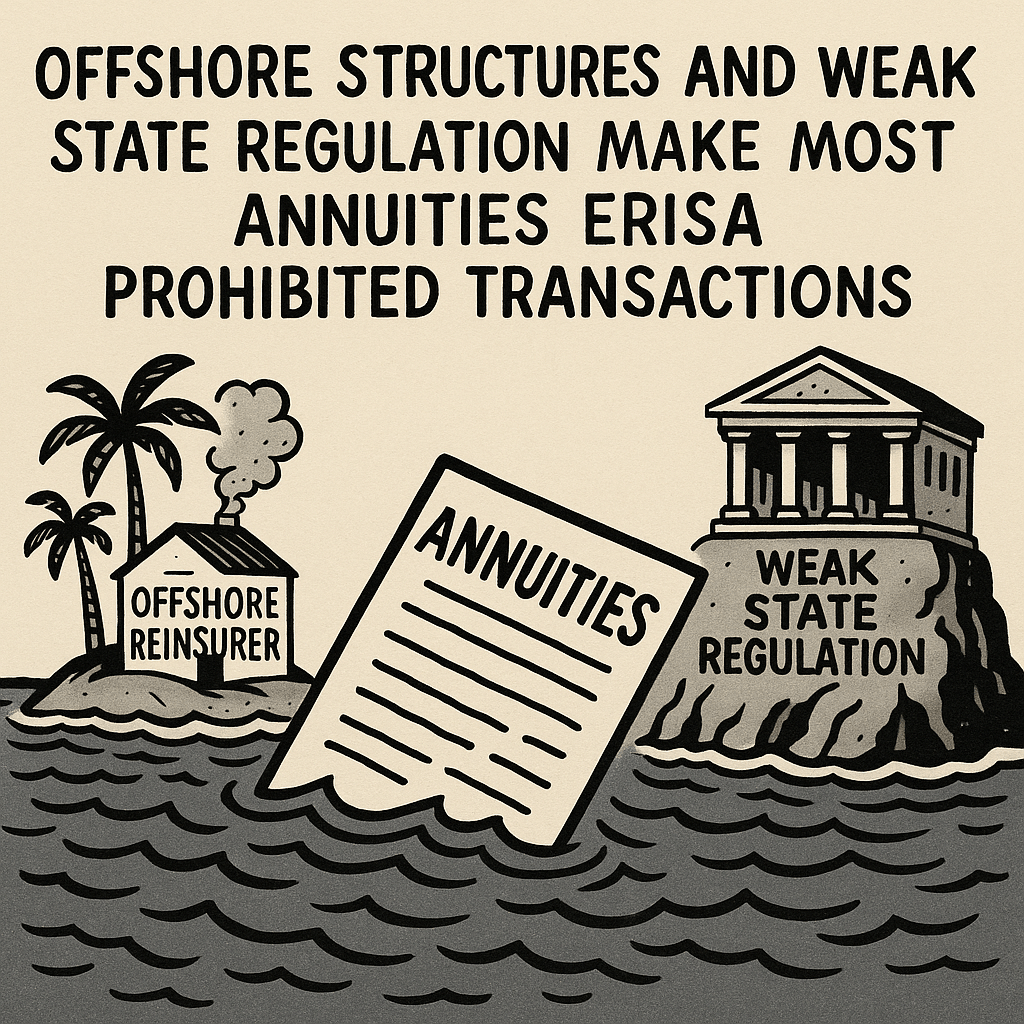
Insurance companies are under weak, captive state regulation, which allows them to hide excessive risks and fees behind contracts with little to no meaningful disclosure. Fiduciaries under ERISA, however, are required to know the risks and fees in any investment before committing participant assets, and to monitor those risks on an ongoing basis. One-sided, secretive annuity contracts make it especially challenging to quantify damages or evaluate prudence.[1]

Pulitzer Prize–winning journalist Gretchen Morgenson has repeatedly exposed the hidden risks and fees buried in TIAA’s General Account fixed IPG annuity products in 401(k) type plans. In her August 2024 NBC News investigation, I was quoted as estimating that TIAA extracts excessive hidden spread profits of over 120 basis points (1.2%) annually on its flagship annuity, TIAA Traditional.[2]

Just one year later, in September 2025, I repeated my claim that TIAA’s hidden annuity spreads range from 120 to 150 basis points. Still, not a single insurer has challenged the accuracy of these numbers. Instead, TIAA’s spokesman declined to disclose what the company earns on these products, dismissing the question as ‘competitive and proprietary information.'[3]

Legal and Fiduciary Framework

Documenting that one-sided annuity contracts are ERISA Prohibited Transactions should be easier after the Supreme Court’s ruling in Cunningham v. Cornell. The Court clarified that since most annuity providers in plans are a party in interest, fiduciaries therefore have a duty to know and evaluate these spreads and risks.[4] Dr. Tom Lambert and I have an upcoming paper in the Journal of Economic Issues documenting these risks.[5] I have also written extensively in my blog about how annuities flunk prohibited transaction tests.[6]

With Pension Risk Transfer (PRT) annuities, one way to measure risk is to compare an annuity with downgrade provisions to one without. Insurers, because such provisions are less profitable, claim they will not write annuities with downgrade provisions. Yet such annuities have been issued in the past and could be again. Fiduciaries, in collusion with annuity providers, fail to ask for downgrade provisions because of monetary incentives.[7]

Annuity providers refuse to disclose risk and fees, but after Cunningham v. Cornell, judges may begin compelling disclosure in ERISA discovery. In the meantime, damages must be estimated through a variety of methods.[8]

My experience at Transamerica for 7 years, making profits, was that we wanted at least 200 basis points for any spread annuity product, general account, or separate account.   Industry knowledge was that most insurers (who belonged to LIMRA) had similar 200-400 bps spreads, the exception being TIAA with lower spreads, 120 to 150 basis points with higher yields.   Since spreads and general account returns are still (illegally under ERISA) secret,  in litigation, we have taken the difference between the 2% yield of Prudential IPG GA vs. the 4.5% yield of TIAA to capture at least half the total spread profits to measure damages.

Measuring Annuity Risk: Credit Default Swaps and the Illusion of ‘Zero Risk’

1. The Problem of Measuring Annuity Risk

Insurance companies that issue Institutional Pension Guarantees (IPG) and PRT annuities often argue that the credit and liquidity risk embedded in these products is negligible or even ‘zero.’ In practice, the opposite is true:

• Single-Entity Credit Risk: Annuity obligations are backed solely by one insurance company. Default risk is concentrated.[9]

• Liquidity Risk: Annuities are long-duration obligations (often 10–30 years) that cannot be traded or hedged.[10]

2. Credit Default Swaps as a Proxy for Risk

Credit default swaps (CDS) provide one of the few market-based ways to measure credit risk. Short-term (1–5y) CDS spreads exist for insurers like MetLife, Prudential, Lincoln, and Athene. Longer horizons (10–20y) are illiquid or unavailable.[11]

3. The Regulatory and Fiduciary Gap

When insurers claim annuity risk is ‘too high to measure,’ they shift the burden of disclosure onto fiduciaries and participants. This creates fiduciary blind spots and regulatory loopholes. State regulators focus on solvency metrics that mask true long-term risk, while insurers misleadingly compare annuities to Treasury-like guarantees.[12] UPDATE November 6, 2025: Insurers use small ratings agencies to get favorable ratings on Private Credit.  The SEC is investigating Egan-Jones for this Practice.    Egan Jones has only 20 analysts rating over 5000 different issues.   https://www.bloomberg.com/news/articles/2025-11-06/egan-jones-probed-by-sec-over-its-credit-ratings-practices    Bloomberg Analysis of NAIC shows that capital charges for AA-rated issues are half of what an A rating is, so the incentive in $billions is to inflate ratings

4. Policy Implications and Recommendations

Recommendations include: (a) transparency in disclosures, (b) stress testing scenarios, (c) enhanced federal oversight to prohibit misleading ‘risk-free’ marketing, and (d) requiring downgrade provisions in PRT contracts.[13]

Conclusion: The central paradox of annuity risk is this: the longer the promise, the greater the exposure—yet the harder it is to measure. The absence of a CDS market beyond 5 years signals that risks are too high or uncertain to price.[14]

Market Snapshot: Indicative Insurer CDS (bps)

IssuerTenorLatest Level (bps)As-of Date
MetLife5Y62.0Sep 30, 2025
AIG5Y74.2Sep 30, 2025
Prudential Financial5Y57.6Sep 30, 2025
Lincoln National5Y97.8Sep 30, 2025
Athene5Y111.8Sep 30, 2025

Chapter: Insurer Yield Curves, Spread Profits, and Tail Risk

Insurance company general accounts are fundamentally different from Treasuries or diversified mutual funds. They carry unique credit, liquidity, and tail risks, but convert these into spread profits largely invisible to policyholders and even fiduciaries.[15]

1. Yield Curve Steepness

Insurer portfolios rely on long-dated, illiquid assets with much steeper yield curves than Treasuries. The insurer pockets the maturity premium.[16]

2. Spread Profit Decomposition

Policyholders see short-duration crediting rates, while hedging costs and residual profits flow to the insurer.[17]

3. Misperception of Tail Risk

Investors struggle to distinguish between 1-in-100 and 1-in-10,000 events, despite the 100-fold difference. Insurers exploit this by monetizing tail risk.[18]

4. Regulatory Optics vs. Economic Risk

Treasury-based hedges shorten reported duration to ~2–3 years, but true long-horizon risks remain embedded.[19]

5. Fiduciary Implications

Fiduciaries must not confuse lack of market pricing with absence of risk. Disclosures should highlight steep curves, spread profits, and tail risk.[20]

Footnotes / Sources

1. ERISA fiduciary obligations, DOL regulations: https://www.dol.gov/agencies/ebsa/about-ebsa/our-activities/resource-center/fact-sheets/what-is-erisa

2. Gretchen Morgenson, NBC News, Aug 2024: https://www.nbcnews.com/investigations/tiaa-pushes-costly-retirement-products-cover-losses-whistleblower-rcna161198   

3. NBC News, Sep 2025 reporting on TIAA annuity spreads: https://www.nbcnews.com/news/us-news/rhode-island-sheriffs-retirement-account-woes-bring-scrutiny-state-run-rcna229290

4. Cunningham v. Cornell University, Supreme Court (2023).

5. Lambert & Tobe, forthcoming, Journal of Economic Issues. https://papers.ssrn.com/sol3/papers.cfm?abstract_id=4763269

6. Commonsense401kProject blog: https://commonsense401kproject.com/2025/06/13/annuities-are-prohibited-transactions-via-chat-gpt/    https://commonsense401kproject.com/2025/05/10/annuities-flunk-prohibited-transactions-exemption-scotus-ruling-will-open-floodgates-of-litigation/   https://commonsense401kproject.com/2025/07/27/diversification-abandoned-why-plan-fiduciaries-must-rethink-fixed-annuities-and-pension-risk-transfers/  https://commonsense401kproject.com/2025/08/12/4-sets-of-books-how-trumps-401k-push-opens-the-door-to-accounting-chaos/ https://commonsense401kproject.com/2025/06/24/state-guarantee-associations-behind-annuities-are-a-joke/

7. Example downgrade provisions in annuity contracts (see case filings, expert reports).

8. Post-Cunningham ERISA litigation implications. https://news.bloomberglaw.com/daily-labor-report/high-courts-cornell-ruling-stands-to-supercharge-401k-suits

9. NAIC Risk-Based Capital reports: https://content.naic.org

10. Fabozzi, Handbook of Stable Value Investments.

11. ICE / Investing.com CDS quotes for PRU, LNC, etc.: https://www.investing.com

12. State regulator solvency rules vs. economic risk, NAIC: https://content.naic.org

13. DOL Advisory Opinion 2025-04A: https://www.dol.gov/agencies/ebsa/about-ebsa/our-activities/resource-center/advisory-opinions/2025-04a

14. Richard Ennis, critiques of pension fund assumptions: https://papers.ssrn.com/sol3/papers.cfm?abstract_id=4678722

15. Moody’s and Reuters reporting on offshore reinsurance/private credit: https://www.reuters.com

16. NAIC data on private credit/mortgage holdings: https://content.naic.org

17. Company filings on new money yields and crediting rates (10-Ks, Statutory Statements).

18. Kahneman & Tversky, Prospect Theory literature.

19. NAIC reports on derivatives and ALM hedges: https://content.naic.org

20. Fiduciary case law and expert commentary (see Cunningham v. Cornell, Grink v. Virtua, etc.).

21.Federal Reserve Bank of Minneapolis Summer 1992 Todd, Wallace SPDA’s and GIC’s http://www.minneapolisfed.org/research/QR/QR1631.pdf

22 Testimony by Ben S Bernanke, Federal Reserve, US House of Representatives, Washington DC, 24 March 2009 https://www.bis.org/review/r090325a.pdf

23https://www.federalreserve.gov/publications/files/financial-stability-report-20250425.pdf

24 The Last SIFI: the Unwise and Illegal Deregulation of Prudential Financial” by Jeremy Kress. https://www.stanfordlawreview.org/online/the-last-sifi-the-unwise-and-illegal-deregulation-of-prudential-financial/

25 Tobe, Christopher B., The Consultants Guide to Stable Value. Journal of Investment Consulting, Vol. 7, No. 1, Summer 2004, Available at SSRN: https://ssrn.com/abstract=577603

26 Applebaum, Eileen.  2023.  “Letter to ERISA Advisory Council on Private Equity and Life Insurance and Annuity Companies.”    https://cepr.net/letter-to-erisa-advisory-council-on-private-equity-and-life-insurance-and-annuity-companies/

Big Win for Retirees as Pension Risk Transfer Case Against Bristol Myers, State Street, and Athene Proceeds

The recent ruling by Judge Margaret Garnett in the Southern District of New York marks a watershed moment for retirees challenging the safety and legality of Pension Risk Transfers (“PRTs”). In Doherty v. Bristol-Myers Squibb Co., No. 24-cv-06628 (S.D.N.Y. Sept. 29, 2025), the court refused to dismiss key claims against Bristol-Myers, its pension fiduciaries, and State Street Global Advisors for their role in transferring $2.6 billion in retiree pension obligations to Athene, a Bermuda-linked annuity insurer owned by Apollo Global Management. While the ruling does not resolve the case, it allows retirees’ central allegations to move forward: that their benefits were placed at “substantial risk” by offloading them to Athene, and that the transaction stripped them of longstanding ERISA protections and federal backstops. For thousands of pensioners, this is a significant victory—the first step in holding corporate sponsors and their advisers accountable for shifting obligations into opaque, private-equity-controlled insurance structures.

Substantial Risk of Default (p. 9 of Opinion)

At the heart of Judge Garnett’s decision is the finding that plaintiffs plausibly alleged a “substantial risk” that Athene could default on its obligations. The court credited detailed allegations that Athene operates as one of the so-called “new risk-taking insurers,” with portfolios concentrated in illiquid, volatile assets such as private credit and structured products. Unlike traditional insurers with conservative surplus levels, Athene ranked near the very bottom of U.S. carriers in surplus-to-risk ratios. Even more troubling, 80% of Athene’s liabilities were reinsured through Bermuda affiliates owned by Apollo itself. Such affiliated reinsurance lacks the arm’s-length pricing discipline of the open market and, because Bermuda requires less capital than U.S. regulators, magnifies counterparty risk. The court highlighted parallels between Athene and other recently failed insurers that collapsed under similar capital structures. For retirees, this means their lifetime benefits now hinge on the solvency of a highly leveraged private-equity-controlled insurer—rather than on a Fortune 500 plan sponsor or the Pension Benefit Guaranty Corporation (PBGC). (See Doherty v. Bristol-Myers Squibb Co., No. 24-cv-06628, slip op. at 9–12 (S.D.N.Y. Sept. 29, 2025)).

Reduction of Protections and Guarantees (p. 13 of Opinion)

Equally important, Judge Garnett recognized that the Athene transaction diminished retiree protections. Once Bristol-Myers terminated its plan through annuitization, retirees lost both ERISA fiduciary protections and PBGC insurance coverage. In their place, they now rely solely on state guaranty associations, which cap coverage at levels far below the obligations owed. This substitution is no small matter. The PBGC is a federal entity backed by Congress. State guaranty associations, by contrast, are fragmented nonprofits with weak funding and uneven benefit caps. For retirees with larger pensions, the coverage gap could be devastating in the event of insurer insolvency. (See Doherty v. Bristol-Myers Squibb Co., slip op. at 13–15).

As argued in prior analyses, including *Annuities Are Prohibited Transactions via ChatGPT* (June 13, 2025)[1] and *State Guarantee Associations Behind Annuities Are a Joke* (June 24, 2025)[2], this shift from federal to state protection materially reduces security for beneficiaries. This legal recognition—that annuitization materially reduces participant protections—will resonate in every ongoing and future PRT case.

Disappointment on “Party in Interest” (p. 24 of Opinion)

The one setback in the ruling was the court’s conclusion that Athene was not a “party in interest” under ERISA because it merely sold a product, rather than serving as a fiduciary. While this shields Athene from certain prohibited transaction claims, it leaves Apollo and its insurance subsidiaries effectively “too big to jail.” This is particularly galling given Apollo’s history. Its founder and long-time CEO, Leon Black, paid Jeffrey Epstein $170 million for so-called “tax advice.” Apollo has since expanded its control over retirement assets by acquiring insurers such as Athene, exploiting regulatory arbitrage to chase yield with retirees’ money. The decision reflects an unfortunate judicial blind spot: acknowledging the risks of private-equity-backed annuities while refusing to hold the insurers themselves to ERISA’s highest fiduciary standards. (See Doherty, slip op. at 24).

State Street’s Role and the Missing “Downgrade” Clause

A central claim against State Street remains: that as adviser to Bristol-Myers, it failed to negotiate appropriate safeguards. Most notably, State Street did not require Athene to maintain a “downgrade provision” to protect retirees if the insurer’s creditworthiness deteriorated. Such provisions, common in sophisticated reinsurance and corporate bond agreements, could have forced Bristol-Myers to step back in or provide collateral if Athene’s ratings slipped. By ignoring this safeguard, State Street effectively placed retirees at the mercy of Apollo’s investment decisions. As argued in *Weak Standards Make Annuities Prohibited Transactions in ERISA Plans* (Sept. 15, 2025)[3], fiduciaries cannot simply chase the lowest-cost annuity contract—they must prudently evaluate long-term risks and negotiate protections like downgrade provisions.

Broader Implications: ERISA, Annuities, and Private Equity

This decision arrives amid growing scrutiny of PRTs, as more corporations unload pension obligations onto insurers. As argued in *Pension Risk Transfer Annuities Should Be Prohibited* (Dec. 17, 2024)[4], these transactions invert ERISA’s core principle: fiduciaries are supposed to safeguard benefits, not gamble them in search of surplus recapture. The Bristol-Myers case exemplifies the pattern: employer motivation to capture surplus assets; consultant motivation to maintain ties with insurers and private equity sponsors; insurer motivation to collect premiums to invest in higher-yielding, higher-risk private credit. Meanwhile, retirees lose federal protections and are left hoping their annuity provider weathers the next financial downturn. (See Doherty, slip op. at 17–19).

Conclusion: A Step Forward, But More Work Ahead

The court’s refusal to dismiss most claims is a big win for retirees. For the first time, a federal court has recognized that transferring pensions to a private-equity-backed insurer like Athene creates a “substantial risk” of default and strips away critical protections. Still, the fight is far from over. By excusing Athene as a mere “product seller,” the ruling underscores how ERISA’s framework lags behind the realities of today’s financial engineering. Unless courts, Congress, or the Department of Labor impose stricter standards, employers and consultants will continue to use PRTs to offload liabilities, enrich themselves, and expose retirees to unacceptable risks. For retirees and their advocates, the Bristol-Myers case is both a warning and an opportunity. It warns that the private-equity insurance model is fundamentally unstable. And it offers an opportunity to establish new legal precedent: that fiduciaries must negotiate meaningful protections, such as downgrade clauses, and that regulators must revisit whether annuitization itself is consistent with ERISA’s promise of prudence and loyalty.

Footnotes

[1] Commonsense401kProject, “Annuities Are Prohibited Transactions via ChatGPT,” June 13, 2025.

[2] Commonsense401kProject, “State Guarantee Associations Behind Annuities Are a Joke,” June 24, 2025.

[3] Commonsense401kProject, “Weak Standards Make Annuities Prohibited Transactions in ERISA Plans,” Sept. 15, 2025.

[4] Commonsense401kProject, “Pension Risk Transfer Annuities Should Be Prohibited,” Dec. 17, 2024.

[5] Doherty v. Bristol-Myers Squibb Co., No. 24-cv-06628 (S.D.N.Y. Sept. 29, 2025).

DOL Advisory 2025-04A: A Multi-Billion Dollar Gift to the Private Equity and Insurance Industry

Introduction

In September 2025, the U.S. Department of Labor’s Employee Benefits Security Administration (EBSA) issued Advisory Opinion 2025-04A While framed as clarifying fiduciary duties under ERISA’s Qualified Default Investment Alternative (QDIA) regulation, the opinion appears instead to function as a multi-billion-dollar subsidy to insurance companies and private equity managers.¹

By providing supposed  legal cover for the inclusion of annuities and alternative assets inside target date funds (TDFs)—the default option for most 401(k) participants—the DOL attempts to shield fiduciaries from liability, lowers transparency standards, and undermines ERISA’s long-standing prudence and loyalty requirements.  It facilitates this by secretly allowing regulatory arbitrage from SEC oversight to weak captive state banking regulators and state insurance commissioners.

The DOL Advisory Opinion 2025-04A

The Advisory opinion was framed as guidance on AllianceBernstein’s (“AB”) Lifetime Income Strategy (LIS) program. The program allows AB to select and rotate insurance companies offering guaranteed annuities within its managed target date funds.²

The DOL summarized AB’s process as follows:

“AB selects insurers for participation in the LIS program by first sending a request for proposals seeking information about the insurers’ business (e.g., their lines of business and financials), their ability to offer guarantees, and the cost of such guarantees. AB selects the insurers to include in the LIS program based on the insurers’ claims paying ability and ability to provide quarterly guaranteed rates based on a fixed insurance fee. On a quarterly basis, AB reviews each insurer’s credit ratings and the guaranteed rates currently provided. AB also consults with an independent insurance research expert to assess the reasonableness of the guarantees being provided given the fixed insurance fee and confirm each insurer’s ability to continue to meet their obligations.”²

Conveniently AB is not encouraged to negotiate the best rates or risk liquidity protections like downgrade provisions.   In my experience most so called “independent insurance research expert” are very pro insurance and do limited negotiation.    Also allows a reliance on credit ratings with examples like AIG has shown to be imprudent.

 The DOL further emphasized:

“When a plan complies with the QDIA regulation, plan fiduciaries remain responsible for the prudent selection and monitoring of the QDIA, but they are not liable for any loss or by reason of any breach that occurs as a result of an investment in the QDIA.”²

This seems to be a big gift the of fiduciary liability industry, which happens to be where the recently confirmed DOL EBSA secretary held a major interest.

Cover for Corrupt Target Date Funds

The timing and tone of this Advisory fit seamlessly into a broader industry push to corrupt target date funds by embedding high-fee, low-transparency products. Insurers such as TIAA already hide spread-based annuity fees of 120–150 basis points inside state-regulated contracts tucked into TDFs.³

Similarly, private equity managers view TDFs as the ultimate distribution channel for illiquid, high-fee investments.⁴

Lifetime Income as a Trojan Horse

The DOL cloaks its endorsement of annuity-laden TDFs under the guise of “lifetime income.” This concept has been politically popular since the SECURE Act of 2019, which encouraged the inclusion of annuities in defined contribution plans. But lifetime income products create liquidity traps and single-entity credit risk.⁵

More troublingly, insurers routinely fail to disclose spread profits. These spreads—often exceeding 100 basis points—are invisible to participants and shielded from fiduciary scrutiny under weak state insurance regulation.⁶

Encouragement of Weak Regulatory Structures

The Advisory explicitly broadens QDIA eligibility to include products housed in variable annuities, collective investment trusts (CITs), and pooled investment vehicles:  

“To clarify its position, the Department added a new paragraph (e)(4)(vi) of the QDIA regulation in the final rule, providing that [a]n investment fund product or model portfolio that otherwise meets the requirements of [the regulation will] not fail to constitute a product or portfolio…solely because the product or portfolio is offered through variable annuity or similar contracts or through common or collective trust funds or pooled investment funds and without regard to whether such contracts or funds provide annuity purchase rights, investment guarantees, death benefit guarantees or other features ancillary to the investment fund product or model portfolio.”²

This is a bait and switch it appears to be Federally regulated OCC collective investment trusts (CITs), when in reality most will be weak state regulated CITs.   Instead of SEC regulated Variable Annuities, they will be using “similar” poorly state regulated annuities.

This allows managers to select from the weakest of 50 state regulators for both CITs and annuities.

Conclusion: A Retreat from ERISA

ERISA was designed to impose the highest duties of loyalty and prudence on plan fiduciaries. Advisory Opinion 2025-04A is a dramatic departure from that framework. It permits fiduciaries to outsource judgment to asset managers like AB. It blesses opaque annuities and alternative investments inside QDIAs. It provides liability shields (“no breach” safe harbor) that reduce accountability. It weakens disclosure by encouraging state-regulated annuities and CITs. The result is a multi-billion-dollar windfall for insurers and private equity firms—at the direct expense of American workers’ retirement security.

Footnotes

¹ U.S. Department of Labor, EBSA Advisory Opinion 2025-04A, https://www.dol.gov/agencies/ebsa/about-ebsa/our-activities/resource-center/advisory-opinions/2025-04a

² Ibid.

³ Commonsense 401k Project, “TIAA Leads the Way to 401k Target Date Corruption,” Sept. 22, 2025, https://commonsense401kproject.com/2025/09/22/tiaa-leads-the-way-to-401k-target-date-corruption/

⁴ Commonsense 401k Project, “Keep Private Equity Out of 401k Target Date Funds,” Sept. 4, 2025, https://commonsense401kproject.com/2025/09/04/keep-private-equity-out-of-401k-target-date-funds/

⁵ Commonsense 401k Project, “401k Lifetime Income: A Fiduciary Minefield,” Feb. 10, 2022, https://commonsense401kproject.com/2022/02/10/401k-lifetime-income-a-fiduciary-minefield/

⁶ Commonsense 401k Project, “TIAA Exposed for Excessive Hidden Annuity Spread Fees—Again,” Sept. 21, 2025, https://commonsense401kproject.com/2025/09/21/tiaa-exposed-for-excessive-hidden-annuity-spread-fees-again/

TIAA Leads the Way to 401(k) Target Date Corruption

TIAA is on the cutting edge of corruption in the retirement space, pioneering the use of hidden contract-based investments inside Target Date Funds (TDFs). In Rhode Island, as featured in the NBC story, these TDFs are designated as the default option, or Qualified Default Investment Alternative (QDIA). The problem is that while marketed as “low-cost,” these products rely on undisclosed spread profits embedded in insurance contracts.  These secret profits rely on secret credit and liquidity risks that were exposed when some local Sheriffs wanted some liquidity in their retirement.

In Rhode Island, TIAA falsely claimed its annuity-based TDFs had lower fees than an all–index fund solution offered by Vanguard. State documents even listed the cost of the TIAA annuity sleeve as “0.00%.” In reality, spread-based profits—estimated at 120 to 150 basis points annually—drain millions of dollars each year from participants’ savings.

By comparison, Vanguard’s Target Retirement Funds charge around 0.06%. The economic reality is stark: Rhode Island participants are effectively paying TIAA about $4 million annually in hidden spread revenues, versus just $200,000 if their money had remained in Vanguard’s all-index solution.


False Comparisons Against Vanguard

TIAA’s strategy hinges on comparing apples to oranges. By disguising spread profits as “no fees,” they make their annuity-based products appear cheaper than Vanguard’s transparent index funds. This deception works because Vanguard’s fee disclosures comply with SEC mutual fund standards—while TIAA relies on weak state insurance rules and Collective Investment Trust (CIT) structures to obscure costs and risks.


Exploiting CIT Loopholes

TIAA’s use of CITs enables it to sneak in annuity contracts under the radar. Unlike SEC-regulated mutual funds, CITs are governed only by state trust and banking regulators, with far weaker standards of disclosure, accounting, and fiduciary oversight. This loophole is already being exploited not just for annuities, but as a potential template to insert opaque private equity, hedge funds, and even crypto into retirement plans.

CITs allow blended accounting inside target date funds.  A single target date fund could hold mutual funds (market value accounting), annuities (book value accounting), private equity (manager valuations), and even crypto—all in one NAV. The net asset value the participant sees will be a cocktail of different accounting standards, some transparent, some opaque.

Fraudulent return smoothing from annuities and private equity is achieved by artificially low reported volatility and correlations, which overallocate them in Asset Allocation models that drive target date fund risk allocations. You could be looking at a “smooth” performance line without realizing risk is hidden under the hood.


Gateway to Broader Corruption

This tactic is the proverbial “gateway drug” of retirement plan corruption. Once annuities can be slipped into Target Date Funds under the guise of “no fee” products, the door is wide open for even more dangerous alternatives. Trump’s 2025 Executive Order on retirement plans explicitly promoted private equity, crypto, and annuities in 401(k) plans.

By hiding annuity contracts in state-regulated CITs, TIAA is creating the blueprint for a much broader erosion of fiduciary protections in America’s retirement system.


Conclusion

TIAA’s behavior demonstrates how retirement plan corruption evolves: it starts with hidden spread fees in annuity contracts, embeds them in default TDFs, and expands the model to private equity and cryptocurrency. Regulators and fiduciaries who ignore these practices are enabling a dangerous shift away from transparency and participant protection.

The SEC and Department of Labor must step in to reassert federal standards. Otherwise, public retirement savers will continue to pay billions in undisclosed costs while believing they are invested in “low-fee” products.


Footnotes

  1. Rhode Island Sheriff’s retirement account woes bring scrutiny to state-run plan, NBC News (Sept. 2025). Link.
  2. Christopher Tobe, Trump’s Crypto and Private Equity in 401k Push Enabled by the Gateway Drug Annuities, Commonsense 401k Project (Aug. 7, 2025). Link.
  3. Christopher Tobe, Keep Private Equity Out of 401k Target Date Funds, Commonsense 401k Project (Sept. 4, 2025). Link.
  4. Christopher Tobe, Trump’s Executive Order is Not a Get Out of Jail Free Card for 401k Plan Sponsors (Fixed Annuity Example), Commonsense 401k Project (Aug. 28, 2025). Link.
  5. Christopher Tobe, 4 Sets of Books: How Trump’s 401k Push Opens the Door to Accounting Chaos, Commonsense 401k Project (Aug. 12, 2025). Link.

TIAA Exposed for Excessive Hidden Annuity Spread Fees — Again

Pulitzer Prize–winning journalist Gretchen Morgenson has once again exposed the hidden risks and fees buried in TIAA’s annuity products. In her August 2024 NBC News investigation, I was quoted estimating that TIAA extracts excessive hidden spread profits of over 120 basis points (1.2%) annually on its flagship annuity, TIAA Traditional

Just one year later, in September 2025, I repeated my claim that TIAA’s hidden annuity spreads range from 120 to 150 basis points — and still, not a single insurer has challenged the accuracy of these numbers

Instead, TIAA’s spokesman declined to disclose what the company earns on these products, dismissing the question as “competitive and proprietary information.” That answer may suffice in public-sector retirement plans exempt from ERISA, but in ERISA-covered plans, the Supreme Court’s ruling in Cunningham v. Cornell makes clear that TIAA is a party in interest, and fiduciaries therefore have a duty to know and evaluate these spreads. Hiding them is a fiduciary red flag.


Liquidity Lockups and Credit Risk

The Rhode Island sheriffs who protested TIAA’s retirement products in 2025 were not just upset about undisclosed costs. What pushed them to the brink was discovering that their money was locked up, subject to liquidity restrictions that prevented access to their savings

As Dr. Tom Lambert and I explain in our forthcoming article in the Journal of Economic Issues, these restrictions are not incidental: they exist because nearly 50% of TIAA’s balance sheet consists of illiquid private credit and mortgages. Furthermore, if TIAA were downgraded, the liquidity would get worse.

Participants are forced to bear liquidity and single-entity credit risk. The risk of a General Account IPG product, such as the TIAA annuity, has been documented by Fabozzi to be 10 times that of a synthetic diversified stable value fund, like Vanguard RST or Fidelity MIPS. The return premium from these risks is quietly diverted into TIAA’s spread profits.


False Comparisons Against Vanguard

TIAA has also claimed, falsely, that its annuity-based Target Date Funds are cheaper than low-cost Vanguard index funds. In Rhode Island, state documents listed the cost of TIAA’s annuity sleeve as “0.00%”, while actual spread profits drained millions from participants each year

By comparison, Vanguard’s Target Retirement Funds charge around 0.06%. The economic reality: participants in the Rhode Island plan are paying TIAA about $4 million annually in hidden spread revenues, versus just $200,000 if their money had remained in Vanguard’s all-index solution


Regulatory Arbitrage: Weak State Oversight

Unlike SEC-registered mutual funds, annuity contracts operate under state insurance regulation. This allows TIAA to present products with:

  • No fee disclosure (spread profits hidden),
  • No diversification (single-issuer credit risk), and
  • Liquidity restrictions that participants do not control

Meanwhile, TIAA funnels these opaque contracts into state-regulated Collective Investment Trusts (CITs) — weak vehicles that lack the transparency and accountability standards of mutual funds. This stealth tactic could set the precedent for hiding not just annuities, but also private equity and even crypto allocations in retirement defaults.


The Broader Pattern of Misrepresentation

This is not an isolated scandal. Regulators in Montana, Vermont, and Washington have been probing TIAA for steering participants into high-cost proprietary products

In 2021, the SEC and New York Attorney General fined TIAA $97 million for propelling clients into higher-cost accounts without disclosure

In 2024, the SEC fined TIAA another $2.2 million for conflicts of interest in IRA recommendations

These actions expose a consistent pattern: TIAA maximizes profits by obscuring true costs while claiming to offer “low-fee” retirement solutions.


Conclusion: Fiduciary Breach in Plain Sight

TIAA’s hidden annuity spreads represent not just an accounting quirk, but a structural breach of fiduciary principles:

  • Excessive hidden fees (120–150 bps vs. 5 bps index funds),
  • Liquidity lockups that enrich TIAA at participants’ expense,
  • Single-entity credit risk that violates the duty to diversify.

As I said in my NBC interview, annuities “flunk the most basic investment principle of diversification — do not put all your eggs in one basket.”

The bottom line: annuities should be prohibited as default investments in ERISA retirement plans. Until regulators impose SEC-style transparency and fiduciaries demand disclosure of spread profits, TIAA will continue to extract billions in hidden fees from unsuspecting teachers, nurses, and public servants.


References

  1. Gretchen Morgenson, “TIAA pushes costly retirement products to cover losses,” NBC News (Aug. 2024). Link.
  2. Gretchen Morgenson, “Rhode Island sheriffs’ retirement account woes bring scrutiny to state-run plan,” NBC News (Sept. 2025). Link.
  3. Chris Tobe & Tom Lambert, “Safe Annuity Retirement Products and a Possible U.S. Retirement Crisis,” Journal of Economic Issues (forthcoming 2025). SSRN link.
  4. Federal Reserve Board, “What’s Wrong with Annuity Markets?” FEDS Working Paper No. 2021-44 (Aug. 2021).
  5. Cunningham v. Cornell Univ., 86 F.4th 961 (2d Cir. 2023).
  6. Handbook of Stable Value Investments, edited by Frank J. Fabozzi, CFA 1998. Chapter 14 

TIAA investigations, settlements, and lawsuits

Weak Standards Make Annuities Prohibited Transactions in ERISA Plans

Introduction

ERISA was enacted to impose strict fiduciary, accounting, and investment performance standards on retirement plan assets. SEC-registered mutual funds must meet these standards through transparent reporting, daily pricing, and oversight by independent boards. By contrast, insurance-based annuities operate under weaker fiduciary standards, opaque accounting rules, and undisclosed performance spreads, making them unlikely to qualify for an exemption from ERISA’s prohibited transaction rules.¹

As my earlier analyses demonstrate, annuities have become a gateway drug that opened the door to non-standard accounting and conflicted arrangements in retirement plans.²

I. Fiduciary Standards: ERISA §404(a) vs. NAIC Rule 275

ERISA §404(a) imposes explicit duties of prudence and loyalty, requiring fiduciaries to act solely in the interest of participants and beneficiaries. By contrast, NAIC Rule 275, the state insurance ‘best interest’ standard, does not include a loyalty duty and permits conflicts of interest if disclosures are made.³ Plan fiduciaries cannot rely on NAIC compliance to meet ERISA duties. A product that satisfies Rule 275 may still violate ERISA’s exclusive benefit rule, making it a prohibited transaction.

II. Accounting Standards: Book Value vs. Market Value

Mutual funds must report daily mark-to-market NAVs under SEC rules, fully reflecting gains and losses. Annuities, especially General Account or Separate Account contracts, are governed by statutory accounting. Assets are often held at amortized cost, meaning losses are hidden unless realized. Portfolios frequently contain 30–50% private credit and alternatives.⁴ Book-value accounting disguises true risk, making annuities appear ‘safe’ when underlying portfolios may be volatile or impaired.

III. Investment Performance Standards: Spreads and Opaqueness

Mutual funds disclose expense ratios, portfolio holdings, and benchmark comparisons. Annuities credit 2–3% to participants while earning 6–7% on general account assets. The undisclosed spread—sometimes over 400 basis points—represents pure insurer profit.⁵ This opacity prevents fiduciaries from assessing the reasonableness of compensation, triggering ERISA §406(b) self-dealing prohibitions.

IV. Conflicted Providers and “Party in Interest” Risks

In many 401(k) plans, the recordkeeper is also the annuity provider. As Cunningham v. Cornell highlighted, this dual role creates inherent conflicts of interest. When insurers steer plan assets into affiliated annuities, fiduciaries face direct exposure under the prohibited transaction rules.⁶

V. Transparency Suppression: Prudential and NAIC RBC Proposal

Prudential, domiciled in New Jersey, shields its quarterly solvency filings under N.J. Stat. §17-23-1, denying plan fiduciaries access to critical risk data.⁷ The NAIC Capital Adequacy Task Force has proposed banning public disclosure of insurer Risk-Based Capital (RBC) scores, even though the Society of Actuaries warns that transparency is essential.⁸ Fiduciaries cannot evaluate insurer solvency without this data, a critical factor in selecting annuities.

VI. Litigation Outlook

The Supreme Court has already narrowed available exemptions from prohibited transaction rules.² Combined with weak fiduciary standards, opaque accounting, undisclosed spreads, and active suppression of solvency data, annuities present a litigation time bomb: plaintiffs will argue that fiduciaries cannot prudently select annuities without access to solvency and fee data. Courts will increasingly view annuities as per se prohibited transactions absent full transparency. Most annuities do not have downgrade provisions, so their liquidity risks go up simultaneously with their credit risk. Fabozzi, in the 1998 Handbook of stable value, says that General Account fixed annuities have 10 times the risk of synthetic diversified stable value.

Conclusion

Annuities fail across three pillars: fiduciary duties, accounting standards, and performance transparency. SEC-registered mutual funds meet all three; annuities meet none. By continuing to rely on these weaker standards, insurers are ensuring that their products will be viewed as prohibited transactions under ERISA, and plan fiduciaries who adopt them will face heightened litigation risk.

Footnotes

¹ ERISA §406; see also https://commonsense401kproject.com/2025/06/13/annuities-are-prohibited-transactions-via-chat-gpt/
² https://commonsense401kproject.com/2025/05/10/annuities-flunk-prohibited-transactions-exemption-scotus-ruling-will-open-floodgates-of-litigation/
³ Comparison of ERISA §404(a) with NAIC Rule 275; see also https://commonsense401kproject.com/2025/07/27/diversification-abandoned-why-plan-fiduciaries-must-rethink-fixed-annuities-and-pension-risk-transfers/
https://commonsense401kproject.com/2025/08/12/4-sets-of-books-how-trumps-401k-push-opens-the-door-to-accounting-chaos/
⁵ Spread profits analysis; see https://commonsense401kproject.com/2025/06/24/state-guarantee-associations-behind-annuities-are-a-joke/
⁶ Cunningham v. Cornell Univ., 86 F.4th 961 (2d Cir. 2023).
⁷ N.J. Stat. §17-23-1.
⁸ NAIC, Capital Adequacy Task Force, Special National Meeting Packet (2025), p.56.

SOURCES

The Handbook of Stable Value Investments 1st Edition by Frank J. Fabozzi 1998 Jacquelin Griffin Evaluating Wrap Provider Credit Risk in Synthetic GICs pg. 272 https://www.amazon.com/Handbook-Stable-Value-Investments/dp/1883249422

National Association of Government Defined Contribution Administrators.  2010.  2010 Issue Brochure – What Plan Sponsors Should Know About Stable Value Funds (SVF) www.nagdca.org/documents/StableValueFunds.pdf

Shames, Mitch.  2022.  “Annuities: The straw that breaks the back of retirement plan fiduciaries,” Benefits Pro.  May 3, 2022.  https://www.benefitspro.com/2022/05/03/annuities-the-straw-that-breaks-the-back-of-retirement-plan-fiduciaries/?slreturn=20240312164319 .  Accessed on March 12, 2024.

Tobe, Christopher B.  2004. “The Consultants Guide to Stable Value.”  Journal of Investment Consulting, 7(1), Summer 2004, Available at SSRN: https://ssrn.com/abstract=577603 .  Accessed on March 12, 2024. 

Federal Reserve Bank of Minneapolis Summer 1992 Todd, Wallace SPDA’s and GIC’s http://www.minneapolisfed.org/research/QR/QR1631.pdf

“Safe” Annuity Retirement Products and a Possible US Retirement Crisis Journal of Economic Issues Accepted 2024  Dr. Tom Lambert and Chris Tobe  https://papers.ssrn.com/sol3/papers.cfm?abstract_id=4761980

Testimony by Ben S Bernanke, Federal Reserve, US House of Representatives, Washington DC, 24 March 2009 https://www.bis.org/review/r090325a.pdf

Keep Private Equity out of 401(k) Target Date Funds

Over half of all 401(k) assets are invested in Target Date Funds (TDFs), the default investment for most workers. Proposals to embed 15% allocations to private equity (PE) in these TDFs raise severe fiduciary, legal, and policy concerns.

Private equity’s opaque self-valuations, smoothed returns, and layered fees (≈600 bps) make it wholly unsuitable for retirement savers—particularly in default funds where workers have no choice. This is not innovation; it is regulatory arbitrage designed to funnel billions in hidden fees out of participant accounts.


Key Findings

1. Fees 100x higher than index funds.

  • PE all-in costs: ~6.0% annually (Phalippou 2020).
  • Index funds: 0.03%–0.05%.
  • A 15% sleeve adds 0.90% annual drag to the entire TDF—cutting lifetime wealth by 20–25%.

2. Fraudulent return smoothing.

  • PE funds self-price and delay write-downs.
  • Reported volatility and correlations are artificially low.
  • Asset allocation models therefore over-allocate to PE, embedding mispriced risk in retirement glidepaths.

3. Liquidity mismatch.

  • TDFs promise daily liquidity.
  • PE funds lock up capital for 10+ years.
  • Participants could face redemption delays, gates, or markdowns inconsistent with plan representations.

4. Weakest regulator wins.

  • SEC and OCC rules demand transparency and independent valuation.
  • Sponsors are instead turning to state-chartered CITs, where oversight is minimal and disclosure optional.
  • This is textbook regulatory arbitrage.

5. Fiduciary red flags.

  • ERISA requires prudence and reasonable fees.
  • Supreme Court precedent (Tibble; Hughes) obligates ongoing monitoring and removal of high-cost options.
  • Embedding PE in QDIAs (defaults) is especially egregious because workers never affirmatively opt in.

Policy Recommendations

  1. DOL & SEC Joint Guidance: Prohibit private equity allocations in QDIAs until independent valuation and full fee disclosure are mandatory.
  2. State CIT Oversight: Close the loophole by requiring federal standards (SEC/OCC level) for any retirement-plan CIT.
  3. Fee Disclosure Reform: Mandate reporting of all fees, including portfolio company monitoring and transaction charges.
  4. Participant Protections: Require opt-in consent, with plain-English disclosures, before allocating participant funds to PE.

Conclusion

Private equity in 401(k) Target Date Funds is not diversification—it is defaulting American workers into opaque, fee-rich products they cannot understand or escape. This violates fiduciary duty under ERISA and undermines retirement security. Regulators and policymakers should act now to prevent a massive transfer of wealth from retirement savers to private equity sponsors.

Trump’s Executive Order Is Not a “Get Out of Jail Free Card” for 401(k) Plan Sponsors – Fixed Annuity Example

President Trump’s recent Executive Order promoting the inclusion of private equity, crypto, and annuities in 401(k) plans has been widely interpreted in the retirement industry as a green light for sponsors to load plans with opaque, high-risk, or high-fee products. But as fiduciary attorney Jim Watkins makes clear in his August 11 article, the Executive Order does not erase the fundamental duties under ERISA. Plan sponsors still bear the highest obligation of loyalty and prudence. Courts have consistently ruled that failure to independently investigate and evaluate investments constitutes a breach of fiduciary duty.

The Legal Precedent: Independent Investigation Required

Federal courts have long reinforced this principle, and it is nearly impossible to do an independent investigation of Private Equity, Crypto, or Annuities.  Tip to Jim Watkins on cites

  • Liss v. Smith, 991 F. Supp. 278, 297 (S.D.N.Y. 1989), citing In re Unisys Savings Plan Litigation, 74 F.3d 420, 435 (3d Cir. 1996), and Whitfield v. Cohen, 682 F. Supp. 188, 195 (S.D.N.Y. 1988), emphasized that “the failure to make any independent investigation and evaluation of a potential plan investment” is itself a fiduciary breach.
  • In In re Citigroup ERISA Litigation, 112 F. Supp. 3d 156 (S.D.N.Y. 2015), aff’d 2017, the court underscored that fiduciaries must independently and thoroughly evaluate each investment option offered in a 401(k) plan.

The message is clear: no Executive Order can override statutory fiduciary standards established by ERISA and reinforced by decades of case law.

Application to Fixed Annuities in Today’s 401(k) Plans

The most immediate application of these rulings is to fixed annuities offered in 401(k) plans—especially those marketed by insurers and recordkeepers:

  • Conflicted Providers: Fixed annuities are often offered by the plan’s recordkeeper, a “party in interest” under ERISA (Cunningham v. Cornell). This creates an inherent conflict when the recordkeeper profits from spreads or commissions embedded in the product.
  • Undisclosed Spreads: Unlike mutual funds, fixed annuities lack transparent expense ratios. Insurers earn investment returns on their general account portfolios—often 6–7%—but credit participants only 2–3%. The undisclosed spread, sometimes exceeding 400 basis points, is pure profit to the insurer and impossible for a plan sponsor to evaluate without disclosure.
  • Hidden Commissions: Many consultants and brokers recommending fixed annuities receive undisclosed insurance commissions, further tainting the fiduciary process.
  • Opaque Contracts: Few plan sponsors, and even fewer consultants, actually read or understand the dense insurance contracts that govern these products.
  •  

Transparency Failures = Fiduciary Breaches

Because fixed annuity spreads are concealed, plan fiduciaries cannot meet their duty of prudence to “independently investigate and evaluate” the investment option. As the courts in Liss, Unisys, Whitfield, and Citigroup ruled, the absence of such an investigation is itself a breach—regardless of whether the investment later performs well or poorly.

Trump’s Executive Order does not insulate plan sponsors from liability when they rubber-stamp insurer products without rigorous due diligence. Fiduciaries who rely on conflicted recordkeepers or consultants, accept opaque annuity contracts at face value, or fail to benchmark spreads against transparent stable value alternatives are exposing themselves—and their participants—to enormous risks.

Conclusion

The lesson for plan sponsors is straightforward: ERISA’s fiduciary duty of prudence cannot be waived by presidential decree. Courts have already provided the roadmap: every investment option, especially opaque fixed annuities, must be independently investigated and evaluated. Failure to do so is a fiduciary breach.

In today’s environment, the real danger is that plan sponsors misinterpret political signals as permission to ignore their duties. The law says otherwise.

Misleading Claims of GIPS Compliance at Ohio STRS

What STRS Tells Members

Ohio State Teachers Retirement System (STRS) regularly states that its investment program is audited for compliance with the CFA Institute’s Global Investment Performance Standards (GIPS®). In fact, STRS highlights the “ACA Performance Services Letters” as if they are an independent certification that the entire portfolio — including private equity — meets these rigorous standards.

The Problem: GIPS Does Not Cover Everything

  • Traditional assets like public equities and bonds can be benchmarked and reported under GIPS, which require daily pricing, market valuation, and time-weighted returns.
  • Private equity and other alternatives are fundamentally different:
    • Returns are often based on manager self-valuations, not market pricing.
    • Cash flows are irregular and subject to GP discretion.
    • Leverage, subscription lines of credit, and co-investments distort reported returns.
  • GIPS itself has special guidance for alternative assets, but these provisions cannot cure the fact that STRS only gets opaque, manager-provided marks, not independent valuations.

Why the ACA Letters Mislead

  • The ACA Performance Services assurance letters STRS shows to members don’t certify the quality of the numbers — they only certify that certain composites were presented “in accordance” with GIPS procedures.
  • This is an attestation engagement, not a financial audit. It does not:
    • Verify the accuracy of private equity valuations;
    • Guarantee that fees and expenses are correctly applied;
    • Confirm that all assets are included.
  • Importantly, ACA letters are limited-scope. They may only cover selected composites or asset classes — not the entire STRS portfolio.

Why This Matters for Fiduciary Duty

  • Teachers are being told that STRS’s entire investment program is GIPS-compliant, when in reality the most opaque, highest-fee asset class — private equity — falls outside the effective scope.
  • The assurance letters create a false sense of security, leading members to believe that their money is being measured with the same transparency as public mutual funds.
  • Fiduciaries who repeat these claims risk breaching their duty of loyalty and prudence by substituting “compliance marketing” for real transparency.

Bottom Line

STRS’s claim of “full GIPS compliance” is misleading at best, deceptive at worst.

  • Yes, portions of the portfolio may follow GIPS procedures.
  • But the private equity portfolio — where billions are at stake and transparency is weakest — is not independently validated under GIPS.
  • Until STRS subjects its private equity program to true independent valuation and public disclosure of contracts, no compliance letter can change the fact that teachers are being misled about their returns.

Possible CFA Ethics Violations by STRS Ohio Charterholders

According to LinkedIN there are at least 10 CFA charterholders working at STRS Ohio.  CFA Charterholders sign an annual statement affirming they will comply with the CFA Institute Code of Ethics and Standards of Professional Conduct. At a minimum, three key principles apply here:

  • Standard I(C): Misrepresentation — Members must not make or allow false or misleading claims.
  • Standard I(D): Misconduct — Members must not engage in conduct that compromises professional reputation or integrity.
  • Standard V(A): Diligence and Reasonable Basis — Members must exercise diligence, independence, and thoroughness in making recommendations and ensuring performance reporting is accurate.
  • Standard VII(A): Conduct as Members and Candidates — Members must not engage in conduct that compromises the integrity of CFA Institute or the CFA designation.

1. Misleading GIPS Compliance Claims

  • Issue: STRS claims full GIPS compliance, and public-facing ACA “assurance” letters are used to reinforce this. In reality, compliance does not extend to private equity — the largest and most opaque asset class.
  • Possible Violation:
    • Standard I(C): Misrepresentation — By signing off on these claims (or staying silent while they’re used in STRS materials), CFA charterholders could be complicit in misrepresenting performance standards to members.
    • Standard V(A): Diligence and Reasonable Basis — If CFAs knew or should have known private equity returns were not validated under GIPS, endorsing compliance is not diligent or reasonable.

2. The Anonymous Letter → QED Case Against Trustees

  • Issue: Attorney General Yost’s case against reform trustees Steen and Fichtenbaum was built on an anonymous staff letter, very likely authored or supported by STRS investment staff (including CFA charterholders).
  • Possible Violation:
    • Standard I(D): Misconduct — Participating in or enabling an anonymous smear campaign violates the professional duty of honesty and integrity.
    • Standard IV(A): Loyalty — A CFA charterholder’s duty is to their client — in this case, Ohio teachers — not to protecting STRS management from scrutiny.
    • Standard VII(A): Conduct as Members — Hiding behind anonymous letters to trigger “lawfare” undermines the integrity of the CFA designation.

3. Endorsing ACA as “Governance Consultant”

  • Issue: Instead of hiring an independent governance consultant, STRS hired ACA, a firm with a track record of legitimizing excessive pay (see CalPERS case via Naked Capitalism). ACA also backs STRS’s questionable GIPS claims.
  • Possible Violation:
    • Standard VI(A): Disclosure of Conflicts — CFA charterholders involved in recommending ACA had a duty to disclose potential conflicts — namely, ACA’s incentive to validate STRS’s compensation structure.
    • Standard I(C): Misrepresentation — By presenting ACA as “independent,” when ACA’s business model favors staff, charterholders may have misled the board and members.
    • Standard III(A): Loyalty, Prudence, and Care — Endorsing conflicted advisors who rationalize excessive fees and bonuses undermines fiduciary duty to beneficiaries.

Broader Concern: Culture of Silence vs. “Name and Shame”

The CFA Code emphasizes integrity of markets and protecting clients first. Charterholders are expected to “name and shame” — meaning they should call out unethical practices even when doing so is uncomfortable.

At STRS, instead of whistleblowing, CFA charterholders:

  • Accepted inflated bonuses linked to opaque valuations,
  • Backed staff-driven narratives over independent governance, and
  • Stayed silent while trustees were attacked with the QED distraction.

That silence itself could be construed as a violation of Standard I(D) Misconduct and Standard VII(A) Conduct as Members.


Conclusion

There is a colorable case that multiple CFA Standards may have been violated by STRS charterholders:

  1. Misrepresentation (I(C)) — GIPS compliance claims that omit private equity.
  2. Misconduct (I(D)) — Anonymous letters weaponized against trustees.
  3. Conflicts of Interest (VI(A)) — Supporting ACA despite conflicts.
  4. Loyalty, Prudence, and Care (III(A)) — Failing to protect teachers from excessive fees and secrecy.

At minimum, these raise grounds for referral to the CFA Institute’s Professional Conduct Program.