Testimony to ERISA Advisory Council – US Department of Labor by Chris Tobe, CFA, CAIA July 10, 2024
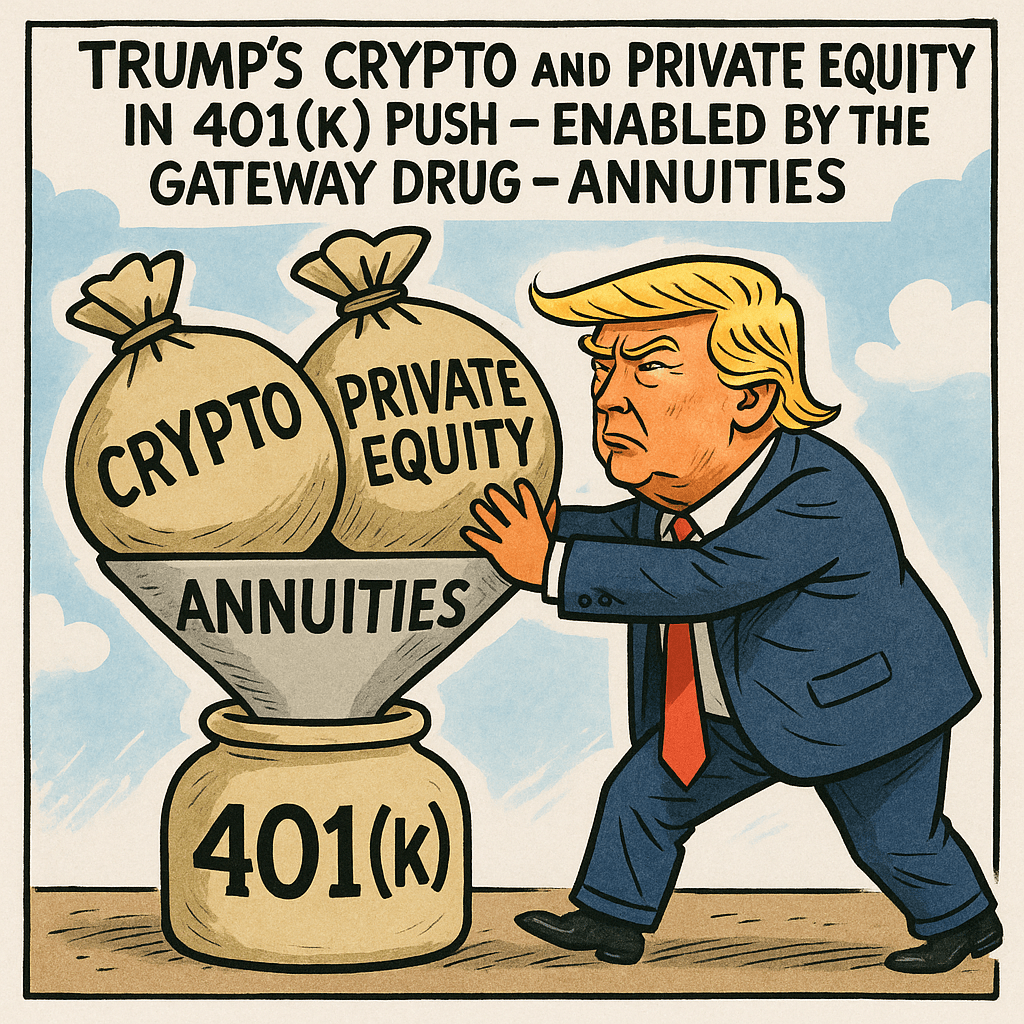
I want to concentrate on the largest QDIA – Target Date Funds. Target Date Funds (TDF’s) are now above 50% of all 401(k) assets. They deserve more fiduciary oversight by regulatory structure and internal policy – not less. Historically Target Date Funds in SEC registered mutual funds have been a solid norm. The industry wants to insert high fee high risk non-transparent contracts like Annuities, Private Equity and Crypto into Target Date funds, but SEC registered mutual funds transparency requirements prevent them, so they seek to open up other structures particularly Collective Investment Trusts (CITs).
Target Date Funds are the dominant default option or QDIA (Qualified Default Investment Alternatives) in most plans resulting in the highest level of fiduciary responsibility. They are the most non-transparent plan investment option and the easiest to hide fees and play performance games. Despite the high level of fiduciary risk, TDF’s are specifically designed to avoid accountability and thus need the most scrutiny.[1]

QDIA History
I have been involved in the QDIA issue for over 17 years when I wrote and signed the 2006 QDIA letter for AEGON Institutional Markets In late September 2023 I, along with former Assistant Labor Secretary Phyllis Borzi, briefed the White House Office of Management and Budget (OMB) and the Department of Labor on the proposedFiduciary Rule now out but under legal attack. I emphasized the severe fiduciary issues that surround contract products like annuities and private equity. I urged the need for strong fiduciary standards especially as annuities and private equity are being put in Target Date funds which are QDIA’s which need the highest level of transparency and accountability.[1]
Federally Regulated Structures
I believe the highest levels of transparency and accountability are in federally regulated investment structures with underlying federally regulated securities. No matter the structure plans and participants need transparency down to the underlying SEC registered stocks and bonds. Not a dead end to a piece of paper or a contract with no federal protections.
SEC registered mutual funds, while not perfect, are a fairly transparent structure that in general provides the accountability needed for the QDIA. The fiduciary analysis that James Watkins did earlier depends on the transparency of SEC Mutual Funds. Once we get away from Federally regulated mutual funds the issues with transparency and accountability multiply
I think the DOL to properly regulate needs a partner federal regulator in investments– i.e. the SEC on mutual funds, with CIT’s perhaps the OCC to ensure protection of retirement assets.
Target Date CITS
Collective Investment Trusts or CITS have grown by $ billions especially as Target Date Funds in the QDIA role.
There is a general assumption that CITs are regulated by the Federal Government Office of Comptroller of the Currency. Some CITs are regulated by the OCC while most used in 401(k)s are regulated by one of 50 state bank regulators. This allows CITs to choose their own state regulator who may or may not have lax oversight. [1]
Some CITs have full transparency down to the security level and are clones of established mutual funds such as Vanguard and Fidelity and are actually superior because of lower fees to the mutual funds, but many do not. In May 2023, SEC chair Gary Gensler sounded the alarms on CIT’s “Rules for these funds lack limits on illiquid investments and minimum levels of liquid assets. There is no limit on leverage, requirement for regular reporting on holdings to investors…”.[1] With these lax rules they can hide high fees and high risks in non-securities, contracts such as private equity, crypto and annuities.[2]
Accumulation 99% – Decumulation1%
Small 401k balances are the biggest threat to retirement security. The median balance reported by Fidelity in May was only $28,900[3] Fees are a major drag on balances over time.
For Decumulation just make withdrawals on a calculator without the added fees and risks of an annuity there is already a low-cost solution. Many 401k plans on web site give you a withdrawal amount for a certain number of years. The Decumulation issue is primarily a sales push by the annuity industry
On Longevity Risk I am more concerned with participants outliving their weak state regulated insurance company than outliving their income. Risk and high fees on annuities create more problems than they solve.
Annuities are sold not bought. I spent 7 years in institutional annuity product design with AEGON/Transamerica.I believe if participants were ever given full disclosures on inflation adjusted income, fees and risks in annuities they would never choose them themselves. According to the Federal Reserve[1] and my latest submitted paper[2] annuity risks are excessive.
Starting only in the last month the trade press has started saying the quiet part out loud mentioning the fact spread/fees are not disclosed could be problematic for putting annuities into target date funds.[3] These spread/fees have been some of the best kept secrets in investments slipping out last in 2013 when an executive bragged at a conference, they were over 200 basis points. [4] Under any fiduciary analysis annuities should be prohibited transactions and are only allowed under an exemption.[5]
The annuity industry is trying to get the DOL to aid them tricking or forcing their products onto participants. This requires the use of cherry-picked state insurance regulators for the insurance contracts and the use of cherry-picked state banking regulators to hide these products in poorly state regulated CIT’s. [6]
Participant support you see in industry polls is driven by the perception of an annuity as close to the size of a social security payment. The average person has 12 different jobs, and with the median balance would produce an annuity of maybe $250 a month. [7] Since Social security is indexed to inflation, and annuities are not, most will be immaterial in $$ to social security (5% to 10%). Participants, when given a choice and full transparency, will for the most part avoid annuities.
I am perplexed why the DOL would help in blocking transparency to participants
Mutual funds are not perfect
While they are the most transparent vehicle currently, Target Date Mutual Funds are not without issues. Changes and differences in Asset Allocation are not easy to follow and understand by participants. James Watkins calls it the Black Box issue around changing asset allocations. Here is what I said in my Pensions & Investments piece in May.
Yet even in an SEC regulated mutual fund, performance can be manipulated more easily in Target Date Funds. For example, a 2040 fund could have a 90% Equity/10% Fixed allocation with high fees and outperform in most time periods a 2040 fund with a 80% Equity and 20% fixed allocation with low fees. Performance manipulation games are even easier in a state regulated CIT. If the performance is not broken down by asset class and risk adjusted for asset allocation it is useless to a fiduciary.[14]
QDIA Recommendations
QDIA investments should be held to the highest fiduciary standards of transparency and accountability.
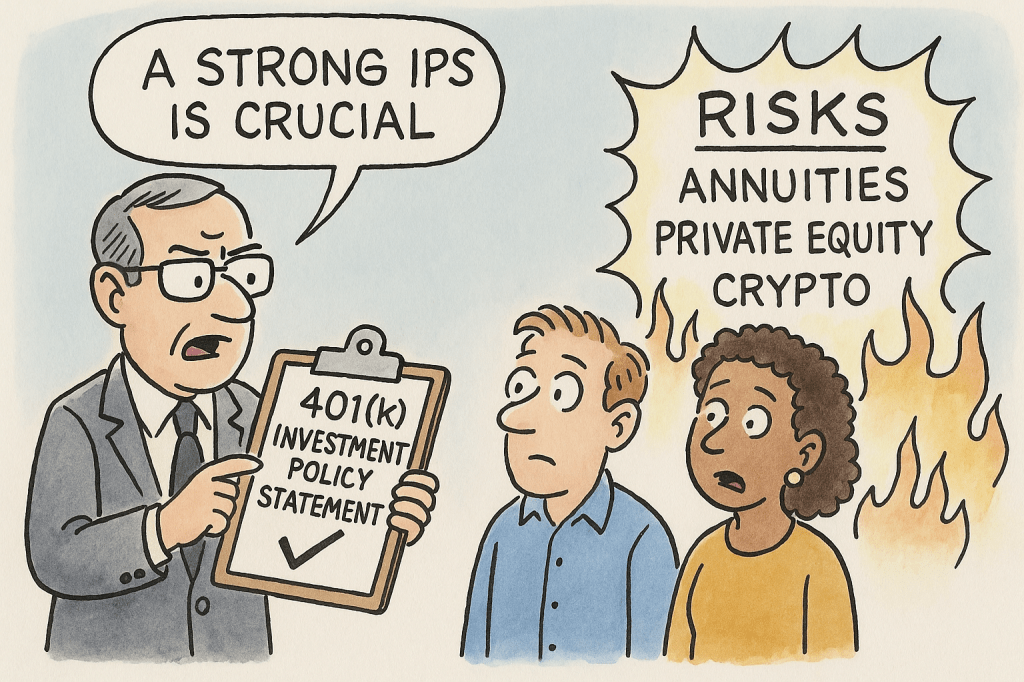
I would never recommend a state regulated annuity product because of the excessive hidden fees and risks for any part of a 401k plan. I would never recommend Private Equity or other non-regulated contract for any part of a 401k plan. I would never recommend Crypto or related non-regulated products to any part of a 401(k) plan.
Blessing any of these products for the QDIA creates many risks in the future
SEC registered Mutual Funds are OK for now, but outside them structures should have 100% underlying plan/participant ownership in SEC registered securities – stocks and bonds. This can be tested by using investments which can and are willing to adhere to CFA Institute Global Investment Performance Standards (GIPS) [2].
Collective Investment Trusts (CIT’s) should be Federally regulated by the Office of Comptroller of Currency (OCC), not by the weakest of 50 cherry picked state banking regulators.
The DOL should be pushing for more transparency, not allowing less.
BIO
Chris Tobe, CFA, CAIA has over 20 years’ experience working with 401(k) investments as a consultant and currently is the Chief Investment Officer for Hackett Robertson Tobe. His opinions do not necessarily reflect those of HRT. He works directly as a consultant to retirement plans and serves as a litigation consultant on many ERISA cases. He writes a column for the Commonsense 401K Project and has an upcoming book 401k Investments- Target Date and Stable Value
Notes
[1] https://commonsense401kproject.com/2022/04/30/problems-with-target-date-funds/
[2] [1] https://commonsense401kproject.com/2023/11/05/annuity-junk-fees-in-current-401k-plans/
[3] https://commonsense401kproject.com/2022/02/22/cits-collective-investment-trusts-in-401k-the-good-and-the-bad/Natalya Shnitser Boston College – Law School November 2023 https://clsbluesky.law.columbia.edu/2023/11/09/overtaking-mutual-funds-the- hidden-rise-and-risk-of-collective-investment-trusts/; https://papers.ssrn.com/sol3/papers.cfm?abstract_id=4573199 pg.25
[4] [1] SEC May 2023 https://www.sec.gov/newsroom/speeches-statements/gensler-remarks-investment-company-institute-05252023#_ftnref27
[8] https://ir.library.louisville.edu/faculty/943/
[11] https://commonsense401kproject.com/2022/05/11/annuities-are-a-fiduciary-breach/
[13] https://www.msn.com/en-us/money/retirement/you-think-your-401-k-looks-bad-these-people-are-doing-worse-don-t-be-one-of-them/ar-BB1oVuPe?item=themed_featuredapps_enabled?loadin [1] https://www.pionline.com/industry-voices/commentary-target-date-funds-fiduciary-risks
[2] https://ir.library.louisville.edu/faculty/943/
[3] https://riabiz.com/a/2024/5/11/fidelity-voya-and-boa-smooth-blackrocks-launch-of-guaranteed-paycheck-etfs-but-401k-plan-participants-may-yet-balk-at-high-unseeable-fees-and-intangibility-of-benefits
[4] https://www.bloomberg.com/news/articles/2013-03-06/prudential-says-annuity-fees-would-make-bankers-dance?embedded-checkout=true
[5] https://commonsense401kproject.com/2022/05/11/annuities-are-a-fiduciary-breach/
[6] https://commonsense401kproject.com/2024/03/26/just-how-safe-are-safe-annuity-retirement-products-new-paper-shows-annuity-risks-are-too-high-for-any-fiduciary/
[8] https://ir.library.louisville.edu/faculty/943/
[11] https://commonsense401kproject.com/2022/05/11/annuities-are-a-fiduciary-breach/
[14] https://www.pionline.com/industry-voices/commentary-target-date-funds-fiduciary-risks
[15] CFA GIPS https://commonsense401kproject.com/2023/02/01/401k-plan-sponsors-should-look-to-cfa-code-for-investment-governance/