More 401(k) Cases Will Survive Dismissal

By Chris Tobe, CFA, CAIA

The recent Sixth Circuit decision in Johnson v. Parker-Hannifin Corp. indicates a possible 2025 trend in fiduciary litigation in favor of plan participants according to attorney Jim Watkins in his latest piece. [i]  The ruling confirms that in most cases participants do not have adequate information and disclosure until discovery and that premature dismissal is unfair to participants.

The lack of transparency and disclosures in 401(k) plans requires the discovery process to give plan participants a fair shot at recovery of damages from poorly managed plans.    This decision seems to recognize these facts and puts the burden of proof to show a prudent fiduciary process on the plan sponsor, which requires discovery.

The 401(k) type plans being litigated are a small fraction of the total 700,000 plans in the U.S.   Around 7,000 or 1% are $100 million or more in assets which are the ones currently large enough to litigate.  Of this 7000 around 5000 are low (Vanguard) to below average cost (Fidelity) recordkeepers.    This leaves around 2000 that are worth while litigating for plaintiff attorneys.  The DOL EBSA is understaffed having to cover 700,000 plans, so many participants rely on litigation or the threat of it to drive better outcomes.   My analysis is limited to these top 1% of plans.

Current Disclosures

The IRS/DOL 5500 form and accompanied financial statement is the major and primary form of public disclosure.   It lists total assets of the plan and the number of participants.  It lists an aggregate total of administrative costs.  Financials usually have a list of investment options, but does not disclose their fees, or even what share class they are so you can look up the fees.  It usually lists the recordkeeper.   Plaintiffs’ attorneys to narrow down potential poorly managed cases primarily rely on their ability to spot high fee recordkeepers and high fee funds just by their names.  There is no disclosure of administrative or fund fees or performance, so no data to show the level of damages.      

Participant statements are a mixed bag.  Some have partial fee information, some do not.  in 2012, the DOL mandated annual 404a-5 participant disclosures due to this lack of information.   Some plans include these with their quarterly statements, but many firms send it out in a separate not easy to understand piece of paper and participants typically throw it away.  However, participants can request these 404a-5 disclosures without discovery.

404a-5 disclosures essentially only provide an accurate description by ticker for the SEC registered mutual funds in the fund.  This is a small step forward because some plans do not even provide ticker (which shows share classes) on statements (or 5500) which has only one real purpose – to hide fee information.  Once the ticker is disclosed, data like performance and fees can be easily found on the internet.  So the disclosure of fees and performance on the 404a-5 is merely creating an impression of additional transparency.

I believe target date funds in SEC registered mutual funds were designed to hide fees and manipulate performance.  They bundle funds into other funds, and without sub-fund level detail,  it is nearly impossible to evaluate their performance and fees.  The aggregate fee & performance data from the 404a-5 disclosure statements is a start, but far from a complete means of evaluating funds.

404a-5 statements have totally inadequate disclosure on administrative and recordkeeping costs.  Manipulative games like Revenue Sharing makes the costs for participants nearly impossible to ascertain.   

404a-5 statements have totally inadequate disclosure on collective investment trusts (CITs), a growing sector in the large plan market, especially with target date funds. CITs often have inadequate state oversight and regulation, which requires little or no disclosure.[ii]

404a-5 statements also have totally inadequate disclosure on insurance products, especially with regard to IPG Fixed Annuities, but also regarding index annuities,and the new fad lifetime annuities.[iii]

 The 404a-5 disclosures only cover the most recent 10 year period. SEC mutual fund share class violations constitute a small fraction of the damages in current cases.

Discovery Basic

It is the current inadequate disclosures from the 5500 and 404a-5 statements that makes discovery essential.   Most of what plaintiffs need in discovery is information that really should have been disclosed already in both the 5500 and 404a-5 statements..

For the state-regulated insurance products and CIT’s, a plaintiff needs the same level of information on fees/spreads that you would receive in a SEC registered Mutual Fund.   Defense attorneys want to block this information since it can reveal prohibited transactions and hidden fees.[iv]

The 6th Circuit stated that “The ultimate question is whether the fiduciary engaged in a reasoned decision-making process.”  [v]   401(k) plan fiduciaries hold monthly or quarterly meeting.  To determine if this was a prudent process, at a minimum, you need the minutes and materials from these meetings.    Defense attorneys want to block access to this information because it almost always reveals flaws in a plan’s oversight.   

According to attorney Watkins:

“Based upon my experience, I submit the real reason that the plans oppose any type or amount of discovery is to conceal the fact that (1) the investment committee never developed a prudent process for managing the plan, but rather blindly accepted the recommendations of the plan adviser or other conflicted, and (2) the fact that the plan never conducted the independent investigation and evaluation required under ERISA, but blindly accepted the recommendations of others.”  [vi]    

In my ownexperience, I regularly find a clueless committee without even an investment policy, driven by blind reliance on a conflicted broker or consultant who receives undisclosed hidden compensation from recommending high fee high risk products.[vii] 

This information is readily and easily available at a minimal cost to the plan and should have already been disclosed.

Additional Discovery

Administrative costs, which include record keeping costs, are totaled on the 5500 form, and you can divide this number by the amount of participants.   Many lpaintiff firms may file a claim if they find a number above $40 a participant per year.   The defense’s argument is often that number is not correct, basically that they lied on their DOL/IRS form, offering convoluted and self-serving reasons for the alleged error.    They basically want the court to take the story that what they really charged was less than what they told the DOL/IRS, hoping that the3 plaintiff and the court will take their word for it without documentation.    The participants have no access to any information on these administrative costs.   This information is convoluted and complex, so much so that few committees understand it. It needs extensive discovery to get to the details. 

Because of the lack of transparency in administrative costs. plaintiff’s need at least some limited discovery. In a recent Sixth Circuit case, Forman v. TriHealth 40 F.4th 443, 450},, Judge Sutton of the Sixth Circuit spoke out in this issue, stating that too many ERISA actions alleging a breach of fiduciary duties were being inequitably and prematurely dismissed without allowing plaintiffs any discovery whatsoever:

This is because “[n]o matter how clever or diligent, ERISA plaintiffs generally lack the inside information necessary to make out their claims in detail unless and until discovery commences. . . . If plaintiffs cannot state a claim without pleading facts which tend systemically to be in the sole possession of defendants, the remedial scheme of the statute will fail, and the crucial rights secured by ERISA will suffer.” “Plausibility requires the plaintiff to plead sufficient facts and law to allow ‘the court to draw the reasonable inference that the defendant is liable for the misconduct alleged.. Because imprudence “is plausible, the Rules of Civil Procedure entitle” the plaintiffs “to pursue [their imprudence] claim . . . to the next stage.”

Sponsors many times select vendors that cherry-pick their own state regulator for both insurance products and most collective investment trusts (CIT)s.[viii]  Sponsors typically do not have any documentation that these products are exempt from prohibited transaction restrictions. You need extensive discovery to get the details on fees and risks in these products.  

Most discovery needed by plaintiffs is information that should be public or at least accessible to plaintiffs already, so it is essential to have it in most cases.    Some more detailed discovery is needed to accurately compute the damages. 

It is unfair to put the burden of proof on Plaintiffs who are blocked from seeing the information they need to prove damages.    The burden of proof needs to be on the plan sponsor who controls all the information. [ix]


[i] https://fiduciaryinvestsense.com/2024/11/28/fudamental-unfairness-sixth-circuit-decision-addresses-the-premature-dismissal-of-erisa-actions/

[ii] https://commonsense401kproject.com/2024/07/31/chris-tobe-dol-testimony/

[iii] https://commonsense401kproject.com/2024/11/19/burden-of-proof-is-on-plan-sponsors-hoping-to-qualifyfor-annuity-prohibited-transactions-exemption/
[iv] https://commonsense401kproject.com/2024/11/29/crypto-private-equity-annuity-contracts-are-impossible-to-benchmark/

[v] https://fiduciaryinvestsense.com/2024/11/28/fudamental-unfairness-sixth-circuit-decision-addresses-the-premature-dismissal-of-erisa-actions/

[vi] https://fiduciaryinvestsense.com/2024/11/28/fudamental-unfairness-sixth-circuit-decision-addresses-the-premature-dismissal-of-erisa-actions/

[vii] https://commonsense401kproject.com/2023/03/12/investment-policy-statements-crucial-to-fiduciary-duty/

[viii] https://commonsense401kproject.com/2024/10/10/annuities-exposed-as-prohibited-transaction-in-401k-plans/

[ix] https://commonsense401kproject.com/2024/11/19/burden-of-proof-is-on-plan-sponsors-hoping-to-qualifyfor-annuity-prohibited-transactions-exemption/

Liability-Driven Designed 401(k)/403(b) Plans

Liability-driven investing is a common concept in connection with defined benefit plans. I first heard the term used in a article by Marcia Wagner of the Wagner Group. Liability-driven investing refers to the selection of investments that are best designed to help the plan secure the returns needed by the plan to fulfill their obligations under the terms of the plan.

It has always struck me that the liability-driven concept is equally applicable to designing defined contribution plans such as 401(k) and 403(b) plans. Better yet, by factoring in fiduciary risk management principles, defined contribution plans can create the best of both worlds, win-win plans that provide prudent investment options while minimizing or eliminating fiduciary risk.

Plan sponsors often unnecessarily expose themselves to fiduciary liability simply because they do not truly understand what their duties are under ERISA. One’s fiduciary duties under ERISA can be addressed by asking two simple questions.

1. Does Section 404(a) of ERISA explicity require that a plan offer the category of investments under consideration?
2. If so, could/would inclusion of the investment under consideeration result in uunecessary liability exposure for the plan?

As for the first question, Section 404(a)1 of ERISA does not explicity require that any specific category of investment be offered within a plan. As SCOTUS stated in the Hughes decision2, the only requirement under Section 404(a) is that each investment option offered within a plan be prudent under fiduciary law. Furthermore, as SCOTUS stated in its Tibble decision3, the Restatement of Trusts (Restatement) is a valuable resource in addressing and resolving fiduciary issues.

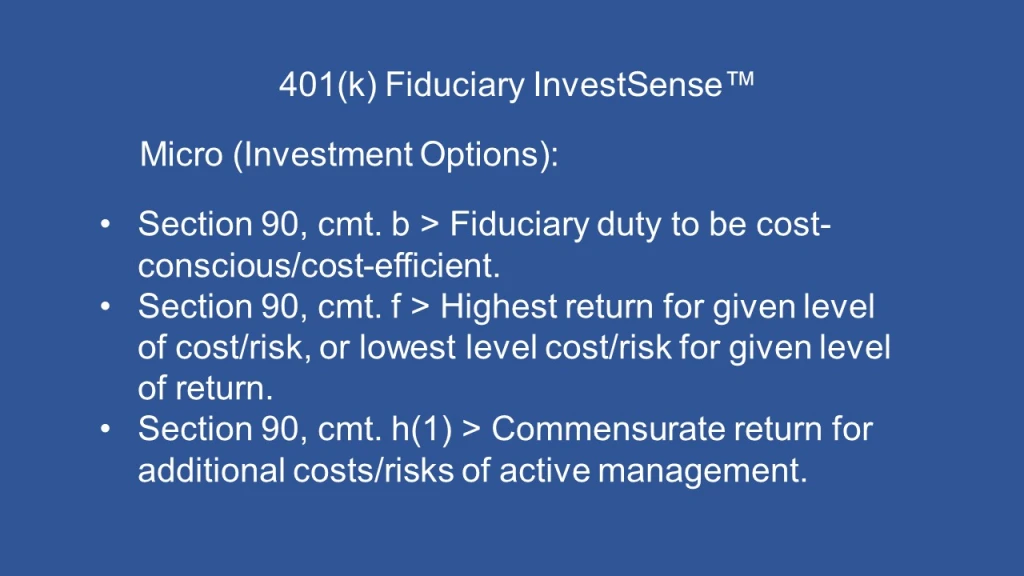
As for the second question, Section 90 of the Restatement, more commonly known as the “Prudent Investor Rule,” offers three fundamental guidelines addressing the importance of cost-consciousness/cost-efficiency of a plan’s investment options:

The last bullet point highlights a key aspect of 401(k)/403(b) fiduciary prudence and cost-efficiency – commensurate return for the additional costs and risks assumed by the plan participant. In terms of actively managed mutual funds, research has consistently and overwhelmingly shown that the majority of actively managed mutual funds are cost-inefficient:

  • 99 % of actively managed funds do not beat their index fund alternatives over the long term net of fees.4
  • Increasing numbers of clients will realize that in toe-to-toe competition versus near-equal competitiors, most active managers will not and cannot recover the costs and fees they charge.5
  • [T]here is strong evidence that the vast majority of active managers are uable to produce excess returns that cover their costs.6
  • [T]he investment costs of expense ratios, transaction costs and load fees all have a direct, negative impact on performance….[The study’s findings] suggest that mutual funds, on average, do not recoup their investment costs through higher returns.7  

The Active Management Value RatioTM (AMVR)
Several years ago I created a simple metric, the AMVR. The AMVR is based on the research of investment icons such as Nobel laureate Dr. William F. Sharpe, Charles D. Ellis, and Burton L. Malkiel. The AMVR allows plan sponsors, trustees, and other investment fiduciaries to quickly determine whether an actively managed fund is cost-efficient relative to a comparable index fund. The AMVR allows the user to assess the cost-efficiency of an actively managed fund from several perspecitives.

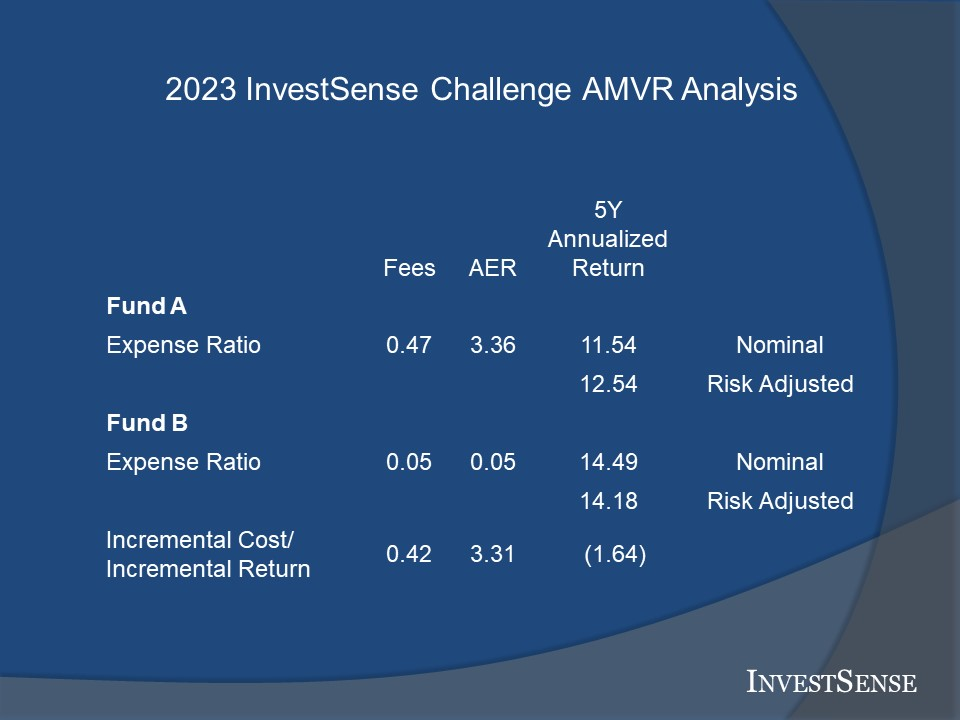
The slide below shows an AMVR analysis comparing the retirement shares of a popular actively managed fund, the Fidelity Contrafund Fund (FCNKX), and the retirement shares of Vanguard’s Large Cap Growth Index Fund (VIGAX). The analysis compares the two funds over a recent 5-year time period. When InvestSense provides forensic services, we provide both a five-year and ten-year analysis to determine the consistency of any cost-efficiency/cost-inefficiency trend.

An AMVR analysis can provide any amount of detail the user desires. On a basic level, the fact that the actively managed fund failed to outperform the comparable index fund benchmark immediately indicates that the actively managed fund is imprudent relative to the Vanguard fund.

Add to that the fact that the actively managed fund imposed an incremental, or additional, cost of 42 basis points without providing any corresponding benefit for the investor. A basis point is a term commonly used in the investment world. A basis point equals 1/100th of one percent (0.01). 100 basis points equals 1 percent.

So the bottom line is that the actively managed fund underperformed the benchmark Vanguard fund and imposed an additional charge without providing a commensurate return for the extra charge. A fiduciary’s actions that result in wasting a client’s or a beneficiary’s money is never prudent.8

If we treat the actively managed fund’s underpreformance as an opportunity cost, and combine that cost with the excess fee, we get a total cost of 2.06. The Department of Labor and the General Accountability Office have determined that over a twenty year time period, each additional 1 percent in costs reduces an investor’s end-return by approximately 17 percent.9 So, in our example, we could estimate that the combined costs would reduce an investor’s end-return by approximately 34 percent. This is not an example of effective wealth management.

The AMVR is calculated by dividing an actively managed fund’s incremental correlation-adjusted costs by the fund’s incremental risk-adjusted return. The goal is an AMVR score greater than zero, but equalt to or less than one, which indicates that costs did not exceed return. While the user can simply use the actively managed fund’s incremental cost and incremental returns based on the two funds’ nominal, or publicly reported, numbers, the value of such an AMVR calculation is very questionable.

A common saying in the investment industry is that return is a function of risk. In other words, as comment h(2) of Section 90 of the Restatement states, investors have a right to receive a return that compensates them for any additional costs and risks they assumed in investing in the investment. The Department of Labor has taken a similar stand in two interpretive bulletins.10 That is why a proper forensic analysis always uses a fund’s risk-adjusted returns.

While the concept of correlation-adjusted returns is relatively new, it arguably provides a better analysis of the alleged value-added benefits, if any, of active management. The basis premise behind correlation-adjusted costs is that passive management often provides all or most of the same return provided by a comparable actively managed fund. As a result, the argument can be made that the actively managed fund was imprudent since the same return could have been achieved by passive management alone, without the wasted excess costs of the actively managed fund.

Professor Ross Miller created a metric called the Active Expense Ratio (AER).11 Miller explained that actively managed funds often combine the costs of passive and active management in such a way that it is hard for investors to determine if they are receiving a commensurate return. The AER provides a method of separating the cost of active management from the costs of passive management.

The AER also calculates the implicit amount of active management provided by an actively managed fund, a term that Miller refers to as the actively managed fund’s “active weight.” Miller then divides the active fund’s incemental costs by the fund’s active weight to calculate the actively managed fund’s AER.

Miller found that an actively managed fund’s AER is often 400-500 percent higher than the actively managed fund’s stated expense ratio. In the AMVR example shown above, dividing the actively managed fund’s incremental correlation-adjusted costs by the fund’s active weight would result in an implicit expense ration approximately 700 percent higher than the fund’s publicly stated incremental cost (3.31 vs. 0.42). Based on the AER, these significantly higher costs would be incurred to receive just 12.5 percent of active management.

Using the same 1:17 percent analysis for each additional 1 percent in costs/fees, using the AER metric and the active fund’s underperformance would result in a projected loss of approximately 84 percent over twenty years. So much for “retirement readiness.”

Additional information on the AMVR can be found at my “The Prudent Investment Fiduciary Rules” blog and searching under “Active Management Value Ratio.”

Fiduciary Risk Management and Annuities
I have written numerous posts about annuities on both my “The Prudent Investment Fiduciary Rules” blog and my “CommonSense InvestSense” blog. Fortunately, the inherent fiduciary liability issues can be addressed by using the same two question fiduciary risk management approach that was mentioned earlier, with the answer to both questions being “yes.” Therefore, a liability-designed 401(k)/403(b) plan will totally avoid the inclusion of annuities, in any form, within the plan.

As a former securities compliance director, I am very familiar with the questionable marketing techniques used by some annuity companies, including the ongoing refusal to provide full transparency with regard to spreads and other financial information. Both ERISA and Department of Labor interpretive bulletions have stressed the importance of providing material information to plan sponsors and plan participants so that they can make informed decisions about including annuities within a plan and about whether to invest in annuities.

The two blogs provide analyses of various types of annuities, especially variable annuities and fixed indexed annuities. My basic advice to my fiduciary risk management clients is simple – “if you don’t have to go there…don’t!”

Annuities are complex and confusing investments, with numerous potential fiduciary liability “traps.” Annuity advocates often try to further confuse and intimidate plan sponsors by engaging in technical details. I strongly recommend adopting my response – stop them before they begin and simply explain that ERISA does not require that pension plans offer annuities within a plan. Therefore, from a fiduciary risk management standpoint, there is no reason to offer any type of annuity within the plan.

Going Forward
Three fiduciary risk management questions that I often ask both myself and my fiduciary clients:

  • Why is it that cost/benefit analysis is often used by businesses to determine the cost-efficiency of a proposed project, but yet cost-efficiency is rarely used by plan sponsors and other investment fiduciaries to determine the cost-efficiency of investments being considered by a pension plan or other fiduciary entity?
  • Why is it that plan sponsors will blindly accept conflicted advice from “advisers” without requiring that the adviser document the prudence of their recommendations througn prudence/breakeven analyses such as the AMVR or an annuity breakeven analysis?
  • Why do plan sponsors insist on making it so unnecessarily difficult and costly by refusing to see the simplicity, praticality, and prudence of the federal government’s Thrift Saving Plan?

The three bullet points remind me of one of my favorite quotes – “there are none so blind, as they who will not see.” I am not sure to whom it should be properly atttributed. The two most cited sources are the Bible and Jonathan Swift.

The point of this post is to emphasize that ERISA compliance is not that difficult to accomplish if a plan talks with the right people and approaches the compliance issues right from the start, when actually designing or re-designing the plan . If that is not possible, there are relatively simple ways to transaction into a liability-driven plan.

One of the services InvestSense provides is fiduciary prudence oversight services. By using fiduciary prudence and risk management compliance tools such as the AMVR and annuity breakeven analyses, and requiring that all plan advisers and investment consultants document their value-added proposition with such validating documents, a plan sponsor can significantly and efficiently simplify the required administration and monitoring of their 401(k) or 403(b) plan.

Notes
1. 29 CFR § 2550.404(a); 29 U.S.C. § 1104(a).
2. Hughes v. Northwestern University., 142 S. Ct. 737, 211 L. Ed. 2d 558 (2022)
3. Tibble v. Edison International, 135 S. Ct 1823 (2015).
4. Laurent Barras, Olivier Scaillet and Russ Wermers, False Discoveries in Mutual Fund Performance: Measuring Luck in Estimated Alphas, 65 J. FINANCE 179, 181 (2010).
5. Charles D. Ellis, The Death of Active Investing, Financial Times, January 20, 2017, available online at https://www.ft.com/content/6b2d5490-d9bb-11e6-944b-eb37a6aa8e. 
6. Philip Meyer-Braun, Mutual Fund Performance Through a Five-Factor Lens, Dimensional Fund Advisors, L.P., August 2016.
7. Mark Carhart, On Persistence in Mutual Fund Performance,  52 J. FINANCE, 52, 57-8 (1997).99
8. Uniform Prudent Investor Act, https://www.uniformlaws.org/viewdocument/final-act-108?CommunityKey=58f87d0a-3617-4635-a2af-9a4d02d119c9 (UPIA).
9. Pension and Welfare Benefits Administration, “Study of 401(k) Plan Fees and Expenses,” (DOL Study) http://www.DepartmentofLabor.gov/ebsa/pdf; “Private Pensions: Changes needed to Provide 401(k) Plan Participants and the Department of Labor Better Information on Fees,” (GAO Study).
10. 29 CFR Section 2509.94-1 )(IB 94-1) and Section 2509.15-1 (IB 15-1).
11. Ross Miller, “Evaluating the True Cost of Active Management by Mutual Funds,” Journal of Investment Management, Vol. 5, No. 1, 29-49 (2007) https://papers.ssrn.com/sol3/papers.cfm?abstract_id=746926.

Copyright InvestSense, LLC 2024. All rights reserved.

This article is for informational purposes only, and is neither designed nor intended to provide legal, investment, or other professional advice since such advice always requires consideration of individual circumstances.  If legal, investment, or other professional assistance is needed, the services of an attorney or other professional advisor should be sought