I. Introduction
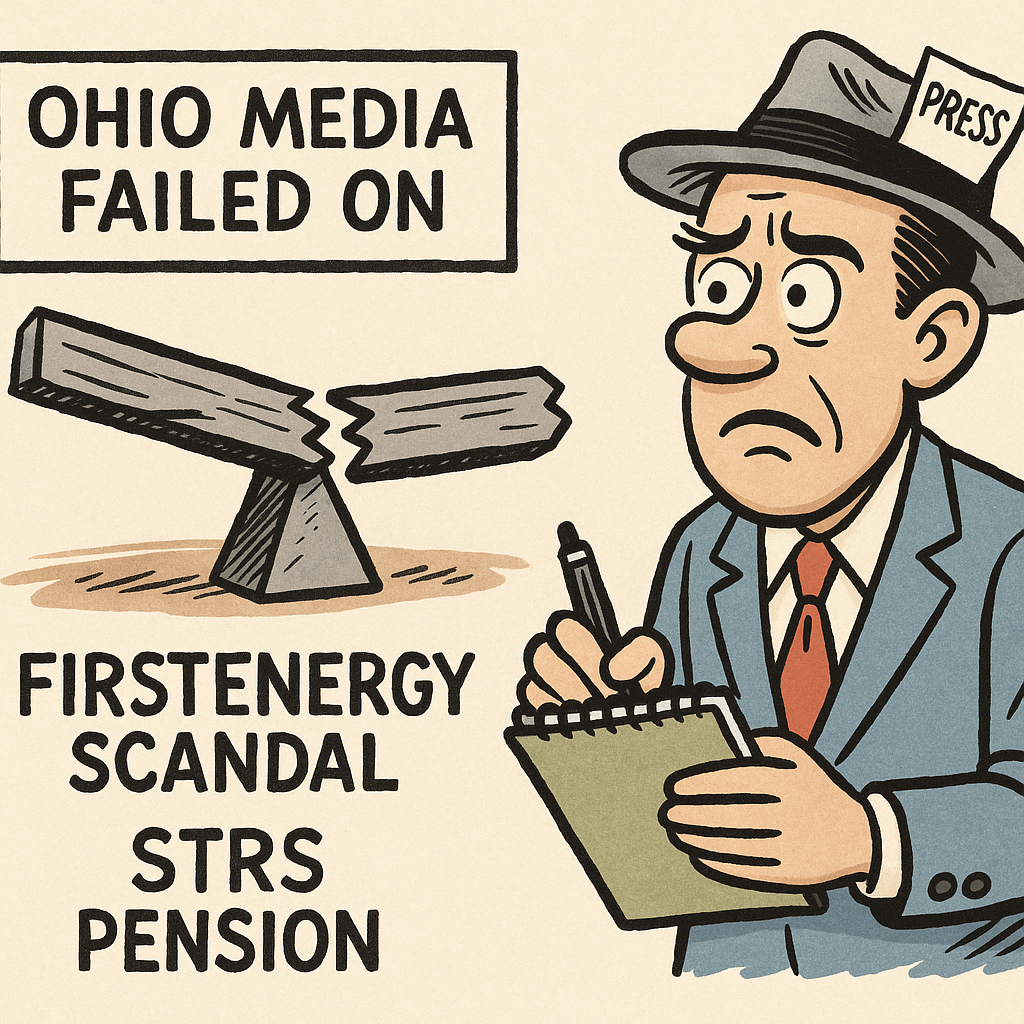
Ohio educators and retirees have been betrayed not only by their pension system but also by much of their state’s press corps. While the State Teachers Retirement System (STRS) funnels hundreds of millions annually into secret no-bid private equity contracts, the Ohio media—with rare exceptions—has amplified a manufactured scandal around “QED,” a firm with no assets, no SEC registration, and no role in managing STRS money.
Instead of asking why billions in opaque contracts remain hidden, much of Ohio’s press corps acted as enablers for Attorney General Dave Yost and Governor Mike DeWine, echoing their narrative and distracting from the real corruption.
II. The QED Distraction
QED was a concept firm, never SEC-registered, with $0 in assets and $0 in fees from STRS. Yet Yost’s office pushed QED into headlines as if it represented a major scandal. Media outlets latched on, running story after story about a phantom firm while ignoring the forensic audit’s findings that STRS pays nearly $1 billion per year in opaque fees through secret contracts with private equity managers.
This strategy—spotlighting a harmless decoy while burying the billion-dollar issue—is straight out of the FirstEnergy HB 6 playbook: focus public attention on a side-show while dark money flows in the shadows.
III. The Toledo Blade: A Lone Voice for Transparency
Amid this landscape, the Toledo Blade stood out. Its editorials and reporting consistently called for:
- Full transparency of STRS private equity contracts.
- An end to excessive bonuses for staff tied to opaque performance benchmarks.
- Alignment with teachers’ interests, not Wall Street’s.
The Blade connected STRS to Ohio’s broader pay-to-play culture, warning that without transparency, the system was vulnerable to the same type of scandal that exploded with FirstEnergy. Their editorials declared plainly: teachers want indexing, transparency, and no bonuses—and that is what the board should deliver.
IV. Columbus Dispatch & Cincinnati Enquirer: A Different Agenda
Contrast this with the Columbus Dispatch and Cincinnati Enquirer, both owned by Gannett, which itself is controlled by Apollo Global Management—one of the largest private equity managers in the world and a major STRS contractor.
Instead of scrutinizing the hidden fees or Apollo’s role, the Dispatch and Enquirer often:
- Echoed Yost’s QED talking points, portraying the phantom firm as the scandal.
- Downplayed or ignored the forensic audit, which documented real abuses.
- Dismissed reform trustees and teacher groups as disruptive or politically motivated, rather than whistleblowers.
It is no coincidence: media outlets owned by private equity have a structural incentive to protect private equity’s reputation and suppress stories that could threaten their fee streams.
V. Have Ohio Media Learned Nothing from FirstEnergy?
The FirstEnergy HB 6 scandal should have been the media’s wake-up call. For years, Ohio outlets treated HB 6 as just another political fight, underestimating the depth of corruption. It took federal prosecutors to expose that dark-money entities had funneled tens of millions to secure favorable legislation.
Now history repeats itself:
- Dark money + opaque contracts + complicit officials.
- A press corps (outside Toledo) unwilling to follow the money.
- Ownership structures that align major newspapers with the very private equity firms extracting fees from STRS.
The question is not whether STRS corruption is real—it is whether Ohio’s media will expose it, or repeat the mistakes of HB 6 by shielding political and financial power until federal indictments force their hand.
VI. Conclusion
Ohio teachers deserve better than a pension system riddled with conflicts and a press corps that enables misdirection. The Toledo Blade has set the example, insisting on transparency and reform. The rest of Ohio’s media must decide whether they stand with educators and retirees, or with politicians and private equity firms.
Until then, the “QED scandal” will be remembered not as a revelation, but as a cover-up—engineered by officials and amplified by a complicit press—to protect the real scandal hiding in plain sight.
Ohio Media Coverage of STRS: A Tale of Two Narratives
| Outlet | Ownership / Control | Coverage of STRS Private Equity | Treatment of QED | Editorial Stance on Bonuses & Transparency | Conflict Context |
| Toledo Blade | Locally owned (Block Communications, family-run) | Consistently presses for transparency of all private equity contracts; cites forensic audit; highlights hidden fees & conflicts | Treated QED as irrelevant side-show; focused on real issue of opaque contracts | Published multiple editorials demanding: (a) no bonuses, (b) indexing over alternatives, (c) full contract disclosure | Independent paper not owned by national PE-controlled conglomerates; fewer conflicts |
| Columbus Dispatch | Gannett (controlled by Apollo Global Management, a PE giant with STRS contracts) | Downplays or omits forensic audit findings; avoids deep reporting on opaque PE fees | Elevated QED into a “scandal,” often repeating Attorney General Yost’s narrative | Editorials and coverage have tended to portray reform trustees as disruptive; have not demanded transparency | Apollo’s ownership of Gannett creates structural conflict: a PE firm managing STRS assets also controls the Dispatch |
| Cincinnati Enquirer | Gannett (Apollo Global Management) | Similar to Dispatch: minimal investigative coverage of hidden PE fees | Reported heavily on QED, framing it as the “problem” at STRS | Teacher reformers framed as political; bonuses and staff defended as “market practice” | Same Apollo conflict; reinforces “protect private equity” editorial line |
| Cleveland Plain Dealer / Cleveland.com | Advance Publications (Condé Nast parent, not PE owned) | Coverage sporadic; tends to echo state officials’ talking points; limited forensic investigation | Reported on QED, but not as aggressively as Gannett papers | Mixed coverage: sometimes sympathetic to teachers, but little editorial leadership on reform | No direct Apollo conflict, but resource-constrained newsroom often reprints wire and official narratives |
| Dayton Daily News | Cox Enterprises (privately held, diversified media) | Limited investigative reporting; tends to cover STRS in political rather than financial terms | Mentioned QED scandal, not skeptical of it | Rare editorials; neutral to deferential toward STRS staff and officials | Not PE-owned, but relies heavily on statehouse reporting that echoes official narratives |
Key Contrasts
- Toledo Blade – Only paper to frame STRS as a transparency and fiduciary crisis, consistently supporting teachers. Editorials directly linked STRS secrecy to potential corruption and called for reform.
- Gannett Papers (Dispatch & Enquirer) – Amplified the QED distraction while burying the story of $900m+ in hidden fees. Their ownership by Apollo Global Management (a major STRS contractor) creates an unavoidable structural conflict of interest.
- Other Ohio Papers – Often echo official statements and lack resources for deep financial investigations, leading to coverage that reinforces the AG/Governor narrative rather than challenging it.
Lessons from FirstEnergy HB 6
- Just as most Ohio media failed to follow the money during the FirstEnergy scandal—until federal prosecutors forced the issue—so too with STRS.
- The same dark-money channels and conflicted law firms are at play, but the press (outside Toledo) is not connecting the dots.
- Ownership conflicts (Apollo → Gannett) raise questions about editorial independence when covering private equity’s role in STRS.
APPENDIX
Ohio TV STRS/QED framing in Private-Equity Shaped Media Ecosystem
Core points:
- Ownership & financing matter. Apollo’s majority stake in Cox Media Group puts Ohio broadcasting squarely within a private-equity ownership model. Scripps (public) is a large consolidator; Gannett’s statewide print/digital network runs on Apollo-financed debt—creating a broader sponsor-centric news economy. Axios+1
- Narrative selection favors scandal over substance. WEWS/News 5’s STRS/QED packages emphasize alleged steering/ethics, while complex fiduciary issues (fees, benchmarking, PE smoothing) get less oxygen—matching a broader national pattern in PE-adjacent media. News 5 Cleveland WEWS
- Result: Viewers receive a vivid story about “QED and bad actors,” but less on how STRS’s alternative-asset costs and benchmarks may drive funding gaps—information retirees need to evaluate stewardship.
1) Who owns the Ohio TV megaphones?
- Cox Media Group (CMG) — majority-owned by Apollo Global Management affiliates since 2019; CMG historically held significant Ohio TV and newspaper assets (e.g., WHIO-TV Dayton and Dayton Daily News). Apollo’s 2019 buyout put local TV/newspapers under a PE umbrella; CMG later sold 12 stations to Imagicomm (2022), but Apollo’s CMG stake is a clear PE footprint in Ohio broadcasting. Axios
- Gannett/GateHouse (newspapers, not TV) — relevant for statewide news agendas. The 2019 New Media/GateHouse merger that created today’s Gannett was financed by Apollo ($1.792B loan @ 11.5%, per NewsGuild; similar coverage in Forbes). While not TV, their statewide print/digital network sets a parallel tone that TV often follows. The NewsGuild – CWA+2Forbes+2
- E.W. Scripps (NASDAQ: SSP) — publicly traded broadcaster headquartered in Cincinnati; owns WEWS Cleveland (News 5) and WCPO Cincinnati, among many others. Scripps is not PE-owned but relies on Blackstone for debt lines
Why it matters: Even when a broadcaster (Scripps) is not PE-owned, adjacent ownership ecosystems (Apollo-controlled CMG; Apollo-financed Gannett) can shape shared sourcing, editorial framing, and agenda-setting across markets.
2) The STRS/QED arc on Ohio TV (WEWS/News 5)
- Reporter: WEWS’s Morgan Trau covers the Statehouse and authored multiple STRS/QED pieces; her station page and X profile confirm role/location. News 5 Cleveland WEWS+1
- Coverage themes: News 5’s recent report (example: “whistleblower, investment firm at center of … testify…”) advances the alleged ‘QED steering’ narrative (AG Yost’s case), framing QED as central to impropriety and tying it to reform board members—echoed by Ohio Capital Journal and AP summaries of the litigation timeline. News 5 Cleveland WEWS+2Ohio Capital Journal+2
What’s notable for your critique:
- The “QED as bogeyman” frame dominated airtime while long-running questions about STRS fees, benchmarks, and alternative-asset underperformance got less sustained, technical coverage—mirroring the concern in your essay about Ohio media focusing on scandal optics over the fiduciary substance. (Your linked analysis.)
- That imbalance aligns with national patterns where PE-connected media ecosystems emphasize personality/process controversy while de-emphasizing fee/benchmark mechanics.
3) Private-equity touchpoints in Ohio TV
- Apollo → CMG (majority owner): PE has a direct station-ownership footprint via CMG; Ohio viewers are within that distribution (e.g., WHIO-TV market). Even when not dictating day-to-day editorial, ownership incentives (leverage, cost-cutting, reliance on wire/centralized content) can narrow bandwidth for technical pension reporting. Axios
- Scripps (public) interacts with debt/portfolio reshuffles (Gray swaps, sales) that similarly reward scalable, conflict-friendly narratives (short packages, political drama) over deep dives into private-market fees, benchmark engineering, and smoothing—the very topics reformers press. Scripps
- Gannett (Apollo-financed) sets parallel print/digital agendas statewide. Even though it’s not TV, those newsrooms’ story selection cascades into broadcast rundowns, magnifying frames that are comfortable for financial sponsors and burdensome for reformers. The NewsGuild – CWA
4) Conclusion
- Safe, supportable claims:
- Apollo-affiliated funds control Cox Media Group (since 2019) and thus have direct ownership exposure to Ohio TV markets. Axios
- Scripps is publicly traded and owns WEWS & WCPO; it actively swaps/sells stations to optimize portfolio scale depends on PE firms like Blackstone for credit. Scripps+1
- WEWS’s Morgan Trau produced multiple STRS/QED stories; News 5 coverage foregrounds QED/board-misconduct allegations that AG Yost pursued. News 5 Cleveland WEWS
- AP and Ohio Capital Journal pieces show the state’s litigation narrative advancing the “contract-steering/hostile takeover” frame, which TV then amplifies. AP News+1
 The CommonSense 401k Project
Well done!
Yahoo Mail: Search, Organize, Conquer
LikeLike
Pingback: Ohio’s Epstein Blind Spot: While Wexner Dominates Headlines, Apollo’s Leon Black remains in Shadows | The CommonSense 401k Project
Pingback: EPSTEIN, APOLLO, AND OHIO TEACHERS’ BILLIONS | The CommonSense 401k Project