TIAA is on the cutting edge of corruption in the retirement space, pioneering the use of hidden contract-based investments inside Target Date Funds (TDFs). In Rhode Island, as featured in the NBC story, these TDFs are designated as the default option, or Qualified Default Investment Alternative (QDIA). The problem is that while marketed as “low-cost,” these products rely on undisclosed spread profits embedded in insurance contracts. These secret profits rely on secret credit and liquidity risks that were exposed when some local Sheriffs wanted some liquidity in their retirement.
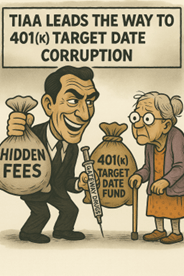
In Rhode Island, TIAA falsely claimed its annuity-based TDFs had lower fees than an all–index fund solution offered by Vanguard. State documents even listed the cost of the TIAA annuity sleeve as “0.00%.” In reality, spread-based profits—estimated at 120 to 150 basis points annually—drain millions of dollars each year from participants’ savings.
By comparison, Vanguard’s Target Retirement Funds charge around 0.06%. The economic reality is stark: Rhode Island participants are effectively paying TIAA about $4 million annually in hidden spread revenues, versus just $200,000 if their money had remained in Vanguard’s all-index solution.
False Comparisons Against Vanguard
TIAA’s strategy hinges on comparing apples to oranges. By disguising spread profits as “no fees,” they make their annuity-based products appear cheaper than Vanguard’s transparent index funds. This deception works because Vanguard’s fee disclosures comply with SEC mutual fund standards—while TIAA relies on weak state insurance rules and Collective Investment Trust (CIT) structures to obscure costs and risks.
Exploiting CIT Loopholes
TIAA’s use of CITs enables it to sneak in annuity contracts under the radar. Unlike SEC-regulated mutual funds, CITs are governed only by state trust and banking regulators, with far weaker standards of disclosure, accounting, and fiduciary oversight. This loophole is already being exploited not just for annuities, but as a potential template to insert opaque private equity, hedge funds, and even crypto into retirement plans.
CITs allow blended accounting inside target date funds. A single target date fund could hold mutual funds (market value accounting), annuities (book value accounting), private equity (manager valuations), and even crypto—all in one NAV. The net asset value the participant sees will be a cocktail of different accounting standards, some transparent, some opaque.
Fraudulent return smoothing from annuities and private equity is achieved by artificially low reported volatility and correlations, which overallocate them in Asset Allocation models that drive target date fund risk allocations. You could be looking at a “smooth” performance line without realizing risk is hidden under the hood.
Gateway to Broader Corruption
This tactic is the proverbial “gateway drug” of retirement plan corruption. Once annuities can be slipped into Target Date Funds under the guise of “no fee” products, the door is wide open for even more dangerous alternatives. Trump’s 2025 Executive Order on retirement plans explicitly promoted private equity, crypto, and annuities in 401(k) plans.
By hiding annuity contracts in state-regulated CITs, TIAA is creating the blueprint for a much broader erosion of fiduciary protections in America’s retirement system.
Conclusion
TIAA’s behavior demonstrates how retirement plan corruption evolves: it starts with hidden spread fees in annuity contracts, embeds them in default TDFs, and expands the model to private equity and cryptocurrency. Regulators and fiduciaries who ignore these practices are enabling a dangerous shift away from transparency and participant protection.
The SEC and Department of Labor must step in to reassert federal standards. Otherwise, public retirement savers will continue to pay billions in undisclosed costs while believing they are invested in “low-fee” products.
Footnotes
- Rhode Island Sheriff’s retirement account woes bring scrutiny to state-run plan, NBC News (Sept. 2025). Link.
- Christopher Tobe, Trump’s Crypto and Private Equity in 401k Push Enabled by the Gateway Drug Annuities, Commonsense 401k Project (Aug. 7, 2025). Link.
- Christopher Tobe, Keep Private Equity Out of 401k Target Date Funds, Commonsense 401k Project (Sept. 4, 2025). Link.
- Christopher Tobe, Trump’s Executive Order is Not a Get Out of Jail Free Card for 401k Plan Sponsors (Fixed Annuity Example), Commonsense 401k Project (Aug. 28, 2025). Link.
- Christopher Tobe, 4 Sets of Books: How Trump’s 401k Push Opens the Door to Accounting Chaos, Commonsense 401k Project (Aug. 12, 2025). Link.
 The CommonSense 401k Project
Pingback: Wall Street Journal Exposes Target Date CIT Corruption — But They’ve Only Scratched the Surface | The CommonSense 401k Project