Introduction
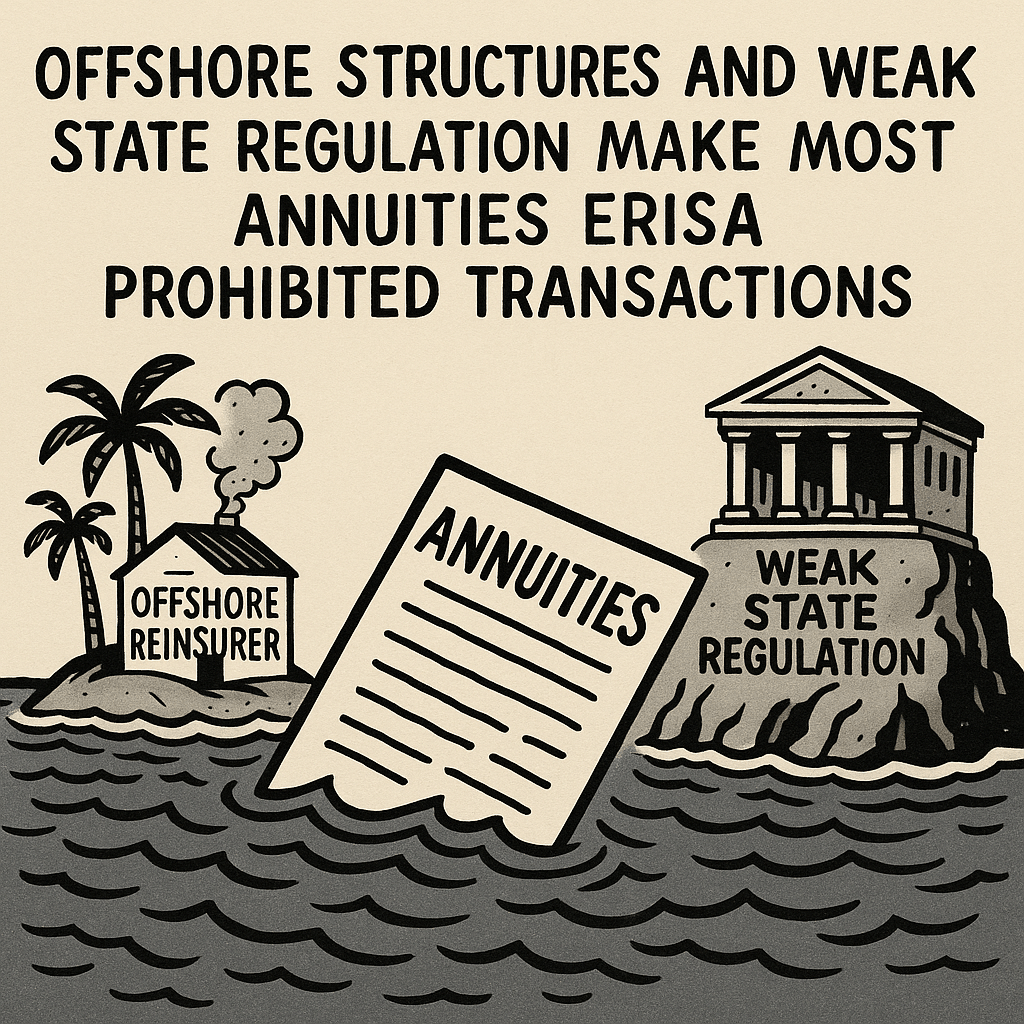
Billions of dollars in U.S. Retirement plans are in fixed annuities in 401(k) and 403(b), pension risk transfer annuities in Defined Benefit pensions, and other annuity and insurance products. The modern annuity business under U.S. life insurers is far removed from the stable, conservative guarantees many plan fiduciaries assume. A growing body of evidence shows that large life/annuity companies are off-loading liability, investing in opaque private credit, and relying on offshore reinsurance domiciles with lighter regulation. These structural features raise serious concerns for retirement plans subject to Employee Retirement Income Security Act of 1974 (ERISA) fiduciary and prohibited-transaction rules. In short: unless an annuity contract is carefully designed, it may expose the plan to a prohibited transaction or breach of prudence.
This article draws on prior analysis of annuity risks — particularly my posts on downgrade clauses, hidden fees, pension-risk transfers, diversification failures, and guarantee association weaknesses — and integrates recent regulatory and industry data. The conclusion: fiduciaries must view most standard annuities as structurally incompatible with ERISA’s fiduciary protections unless key safeguards are present.
The Offshore/Reinsurance Loophole
Leverage and Jurisdictional Arbitrage
Major life insurers and annuity writers have increasingly used offshore reinsurance arrangements to improve capital efficiency and hide risk. According to a recent report by Moody’s Investors Service, U.S. life insurers shifted nearly $800 billion in reserves offshore between 2019 and 2024, primarily to Bermuda and the Cayman Islands. Reuters Another report from AM Best Company states that Bermuda accounted for over 40% of U.S. life-annuity writers’ ceded reserves in 2024. AM Best News+1
Offshore domiciles often permit looser regulatory requirements: different accounting rules, lower capital charges, and less public transparency than U.S. domestic state-based regulation. For example, one commentary notes that Bermuda allows insurers to file under GAAP rather than U.S. statutory accounting, enabling deferral of recognizing certain liabilities. Insurance News | InsuranceNewsNet+1
Reinsurance Risk and Embedded Illiquidity
When a U.S. insurer issues an annuity contract but then cedes the liability (and perhaps assets) to an affiliated or offshore reinsurer, plan participants face counterparty risk: if the reinsurer fails, the original issuer may be exposed to a recapture risk or be unable to meet obligations. Research from the Institute and Faculty of Actuaries (UK) on “reinsurance recapture risk” documents limited industry transparency and significant risks inherent in these arrangements. ResearchGate
In addition, offshore vehicles allow insurers to invest in illiquid, high-yield private assets (private credit, side-cars, private equity) which may not match the liquidity of participant-facing guarantees. A recent brief from the American Academy of Actuaries states that these “asset-intensive” reinsurance structures require strong governance — which is often lacking. Actuary.org
The Weakness of State Regulation for U.S. Insurers
Most annuity writers are regulated at the state level, under state insurance departments and guaranty associations. But there are multiple structural weaknesses:
- Inconsistent standards: Each state sets its own solvency requirements, reserve methods, and guarantee-association limits.
- Guarantee associations are limited: Many states cap the payout under guarantee associations at a level far below typical retirement-income exposures (often $250k). My prior post “State Guarantee Associations Behind Annuities Are a Joke” pointed this out.
- Regulatory arbitrage: Insurers exploit weaker jurisdictions (via offshore reinsurance) to reduce capital without necessarily reducing risk. The Bank of England warned that offshore “funded reinsurance” transfers can be a form of regulatory arbitrage, prompting potential intervention. Financial Times
Taken together, these features mean the “guarantee” behind many annuities is only as strong as the balance sheet of an insurer backed by high-leverage offshore structures, not the simple promise to participants.
Why This Creates ERISA Fiduciary & Prohibited Transaction Risk
Fiduciary Prudence and Diversification
Under ERISA, plan fiduciaries must act prudently and diversify plan investments “so as to minimize the risk of large losses.” But an annuity contract backed by offshore-leveraged insurer structures and illiquid investments introduces concentrated and correlated risks: a market downturn could impair the entire insurer’s ability to meet guarantees. Without exit rights or downgrade protections you flagged in your prior blog (“Why ERISA Plans Require a Downgrade Clause…”), a fiduciary cannot monitor or respond to deteriorating credit/exposure.
Prohibited Transactions Under ERISA
ERISA §406 prohibits plan fiduciaries from causing the plan to engage in transactions with parties in interest on terms that are less than fair, or that result in the plan being operated for the benefit of a party in interest over participants. When an insurer (or affiliated reinsurer) is both a plan investment provider and engages in internal profit extraction via spreads, leveraged private investments, and offshore reinsurance, the following concerns arise:
- Self-dealing – When an insurer transfers risk offshore and pockets spread profits rather than returning them to participants, it may be acting as a party in interest engaging in self-serving transactions.
- Lack of transparency / disclosure – Plan fiduciaries cannot evaluate the terms of the annuity contract if the underwriting, assets backing the guarantee, or reinsurer credit quality are unknown or offshore-opaque.
- Lack of exit/monitoring rights – Without appropriate contract terms (e.g., downgrade clause, liquidity rights) the fiduciary cannot prudently monitor or remove the investment when risk changes. Prior blog posts (“Annuities Are Prohibited Transactions via ChatGPT” and “Annuities Flunk Prohibited Transaction Exemptions – SCOTUS Will Open Floodgates”) explain how these deficiencies render many annuities ineligible for safe-harbor exemptions.
In combination, these structural flaws mean the plan is exposed to prohibited-transaction risk by investing in annuities under these conditions. The contract terms plus the insurer’s structure make the transaction with the insurer a transaction with a party in interest that is not “fair” to participants and lacks the fiduciary protections required under ERISA.
Practical Steps for Plan Fiduciaries
- Require contract protections: Insist on downgrade clauses, an exit right or commutation right, transparency on backing assets, and reinsurer credit/investment disclosures.
- Avoid offshore-leveraged providers: If an insurer uses offshore reinsurance in a way that shields its assets or elevates leverage, fiduciaries should treat the annuity as high risk.
- Document the review process: A prudent process must show that the fiduciary evaluated the insurer’s structure, reinsurance arrangements, asset backing, regulatory domicile, and exit rights, and determined that the annuity still meets the plan’s IPS.
- Benchmark alternatives: Consider whether pooled group annuity contracts with clean credit and transparent structure provide a better option; avoid “black-box” private-credit-levered annuities.
Conclusion
The convergence of offshore reinsurance, weak state regulation, insurer leverage, and lack of contract exit/monitoring rights means many modern annuities are structurally incompatible with ERISA’s dual requirements of fiduciary prudence and prohibited‐transaction avoidance. Unless a plan contract is designed specifically to account for these risks (and mitigate them via downgrade language, transparency, exit rights, plain-vanilla asset backing, strong domicile/underwriter credit), fiduciaries should treat the default assumption as: This annuity may be a prohibited transaction and a prudence breach waiting to happen.
Bottom line: Perennial industry marketing about “guarantees for life” hides the fact that many of these contracts are built on offshore arbitrage, high leverage, and opaque assets. That architecture is antithetical to retirement-plan fiduciary governance and safe plan design.
 The CommonSense 401k Project