I. Introduction
Private equity has long been marketed to U.S. retirement plans as a source of diversification and “illiquidity premium.” But for ERISA fiduciaries, private equity contracts are not simply another asset class; they are contracts structured to evade transparency, domiciled in offshore havens, and riddled with conflicts. Unlike mutual funds or collective investment trusts (CITs) subject to SEC or OCC oversight, private equity partnerships are bespoke, one-sided agreements with managers and affiliates who extract hidden fees and indemnify themselves against liability.
II. ERISA’s Fiduciary and Prohibited Transaction Framework
ERISA imposes the highest fiduciary standard in U.S. law. Fiduciaries must act solely in participants’ interests, with the prudence of an expert, and for the exclusive benefit of plan participants (29 U.S.C. §1104(a)(1)). The statute also flatly prohibits certain transactions: deals with “parties in interest” (29 U.S.C. §1106(a)) and self-dealing by fiduciaries (29 U.S.C. §1106(b)). Once triggered, they are per se violations unless the fiduciary demonstrates an exemption under §408, and under Cunningham v. Cornell Univ. the burden rests with fiduciaries.
III. Offshore Domiciles and Regulatory Arbitrage
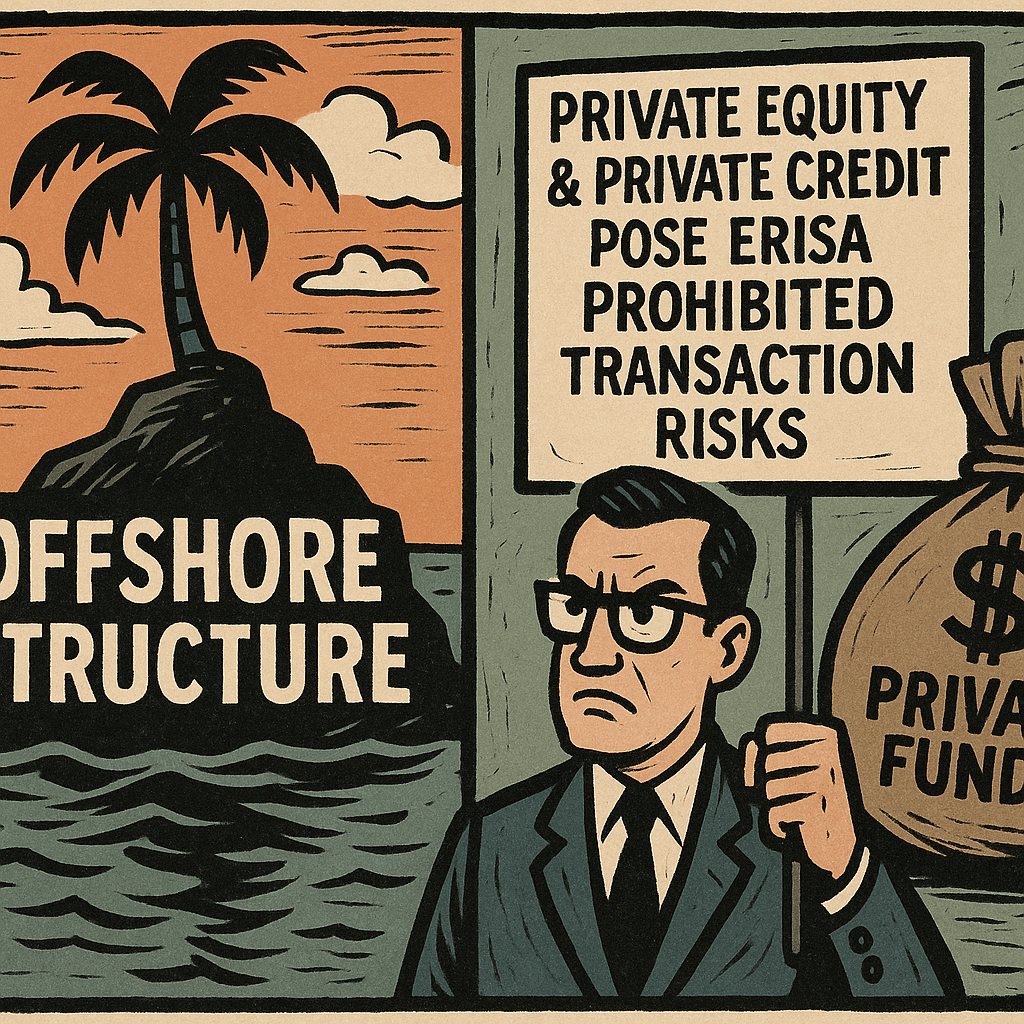
Most private equity funds are domiciled offshore — Cayman Islands, Luxembourg, or Jersey — or structured in Delaware partnerships. These domiciles provide tax and secrecy advantages to managers while obscuring risks and fees from investors. Trustees at Kentucky TRS admitted they could not even disclose which offshore jurisdictions were used for their private equity allocations, illustrating how these structures undermine fiduciary transparency.
IV. The “25% ERISA Exemption” and Its Abuse
Under the DOL’s plan asset regulation, if less than 25% of a fund’s investors are ERISA plans, the fund is exempt from ERISA’s fiduciary standards. This loophole allows private equity managers to deliberately structure investor pools to avoid ERISA oversight, commingling ERISA assets in vehicles designed to evade fiduciary duties. Fiduciaries allocating into these structures are still liable for knowingly participating in prohibited transactions.
V. Hidden Fees, Four Sets of Books, and Conflicts
Private equity funds extract multiple layers of fees: management fees, carried interest, monitoring and transaction fees, and financing spreads on affiliated debt. Managers often maintain multiple sets of records for tax, investors, and regulators. Independent research by Phalippou and others shows that all-in costs exceed 600 basis points annually. This far surpasses index fund costs of 3–10 basis points and violates ERISA’s requirement that expenses be reasonable.
VI. Friends and Family Side Letters
Side letters grant favored investors preferential disclosure, liquidity, or fee terms. ERISA plans are rarely among the favored class. Instead, insiders profit at the expense of plan participants. Offering documents often warn that these selective disclosure practices may violate applicable law. Under ERISA, they are transfers of plan value to other investors without adequate consideration — a prohibited transaction.
VII. Illiquidity and Monitoring Failures
Private equity contracts bind fiduciaries for 7–12 years with little or no exit rights. Valuations are controlled by the GP, preventing fiduciaries from independently monitoring prudence as required by Tibble v. Edison. Secondary sales are restricted and discounted, leaving fiduciaries unable to act if investments become imprudent.
VIII. Why Private Equity is a Prohibited Transaction
Bringing the evidence together:
1. GPs and affiliates are parties in interest, receiving compensation directly and indirectly.
2. Waivers of fiduciary duty and indemnification clauses create textbook self-dealing.
3. Side letters transfer value away from ERISA investors.
4. Offshore domiciles and 25% exemptions are deliberate attempts to evade oversight.
5. Illiquidity and opaque accounting make prudence and monitoring impossible.
Therefore, private equity contracts are per se prohibited transactions unless an exemption applies, and fiduciaries bear the burden of proof. No credible exemption exists.
IX. Policy Implications
Allowing private equity in 401(k)s undermines participant protections, normalizes opaque insider-driven contracts, and invites other high-risk vehicles like crypto and offshore private credit. Courts should recognize that PE in ERISA plans is incompatible with fiduciary duties and prohibited transaction rules.
Appendix Update – Financial Times (Dec. 10, 2025): Retailization of Private Equity Deepens Fiduciary Risk
A new Financial Times analysis, co-authored by Ludovic Phalippou and William Magnuson, documents a significant industry push to extend private equity access to everyday investors, including 401(k) and other retail retirement savers — and explains why this “retailization” of private funds heightens legal and fiduciary risks rather than mitigating them. Financial Times
1. Private Equity Designed for Sophisticated Investors, Not Retail Plans
Historically, private equity funds operated under a light regulatory regime because they were assumed to be accessible only to sophisticated institutional investors with the capacity to evaluate complex fee structures, valuation conventions, illiquidity, and bespoke governance arrangements. In contrast, everyday retirement savers — including 401(k) participants — lack these institutional safeguards and repeat-player advantages. LinkedIn
2. Rising Legal Vulnerabilities When Exposed to Retail Savers
The FT article highlights specific vulnerabilities that are now exposed when private equity products are marketed to non-institutional investors:
- Opaque Performance Measures: Common private-equity metrics such as internal rate of return (IRR) can be misleading, particularly when used without context on timing, reinvestment returns, or hurdle structures.
- Hidden and Complex Fee Structures: Catch-up clauses, waterfall provisions, and other bespoke compensation mechanics are often poorly understood even by institutional LPs, and are likely to be poorly understood by retirement plan fiduciaries and participants.
- Valuation and Liquidity Risks: The infrequent and GP-controlled nature of valuations in private equity obscures true risk and may misstate returns relative to liquidity needs of retirement plans.
- Suitability and Disclosure Gaps: Retail investors expect public company-style disclosures and safeguards that private equity by design does not provide. Their lack prompts higher litigation risk when practices are perceived as misleading or unfair. Financial Times
Because retail investors do not fear being cut off from future funds — unlike institutional LPs — the FT commentary underscores that courts, not regulators, may become the primary venue for enforcing accountability in cases of misrepresentation, unfair practices, and lack of transparency. The piece suggests that “tobacco-style” legal challenges could emerge as investors challenge private equity’s opaque practices once retail capital is involved. LinkedIn
3. Implications for ERISA Fiduciaries and Prohibited Transaction Analysis
This Financial Times critique strengthens the view that private equity’s intrinsic structural and disclosure characteristics make it incompatible with the ERISA fiduciary and prohibited-transaction framework:
- ERISA’s prudence standard requires fiduciaries to act with the care of a “prudent man” in light of the information available. When basic valuation, fee, and liquidity information is non-standardized and opaque, the prudence standard cannot be meaningfully satisfied.
- ERISA’s disclosure requirements and prohibited-transaction rules are premised on transparency and arm’s-length conflict discipline — conditions that private equity’s documented marketing and structuring practices actively undermine when extended to retail retirement assets.
- The heightened legal risk of misrepresentation claims — foreshadowed in the FT coverage — underscores that reliance on traditional private equity justification (e.g., institutional sophistication, negotiated side letters, bespoke GP terms) does not extend to 401(k) fiduciaries, whose participants are not repeat sophisticated actors.
The FT commentary thus reinforces that private equity, particularly as it is evolving to include retail investor access (e.g., through 401(k) platforms or retailized vehicles), presents novel and acute ERISA compliance challenges and potential prohibited transaction risks not addressed by current industry guardrails. Financial Times
Appendix: Private Equity Contracts and Prohibited Transactions
Exhibit 1: Fiduciary Duty Waivers & Indemnification
- Source: Ch10PrivateEquitysFinal (2023_01_26 17_16_45 UTC).doc
Excerpt:
“Other sections of limited partnership agreements waive the general partner’s fiduciary duty. One common means of doing that is to provide that the general partner may consider interests other than that of the investors in his fund, including his own interest. Pension funds should never indemnify vendors against criminal liability. Officers and directors who approved such an indemnification would breach their fiduciary duty to the fund. Indeed, pension funds should not indemnify vendors for the vendors’ own negligence.”
Cited examples: Blackstone V, Blackstone VI, Oak Hill III (all held by KRS). Kentucky Retirement Systems (KRS) held Blackstone and Oak Hill contracts where indemnification clauses explicitly covered “criminal” conduct, while other sections allowed the GP to consider its own interests ahead of investors - ERISA impact: This constitutes a transfer of value from plan participants to insiders — a clear §406(a)(1)(D) violation (transfer of plan assets for less than adequate consideration).
Exhibit 2: Offshore Domiciles & 20% Plan Asset Exemption
Source: Offshore Private Equity Prohibited Transaction.docx; Ch10PrivateEquitysFinal.
Excerpt:
“Most private equity and private credit funds used by U.S. pension and 401(k) plans are organized in offshore domiciles like the Cayman Islands, Luxembourg, or Jersey. The purpose is tax avoidance and regulatory arbitrage—not participant protection. These structures often shield disclosure of true expenses and valuation practices, and favor affiliates through preferential terms hidden in side letters.”
“KY TRS counsel Beau Barnes replied that members and taxpayers do not have a right to know what offshore tax haven TRS has put his money. The only source of domicile information is within confidential documentation.”
ERISA impact: If a fund claims exemption under the 20% rule, then ERISA fiduciaries cannot rely on statutory protections inside the contract. That makes any allocation itself a prohibited transaction, as plan assets are knowingly commingled into structures designed to evade ERISA
Exhibit 3: Friends and Family Side Letters
Source: Tobe AltsCrypPE11mar25.docx book chapter in upcoming book 401k invesments
Excerpt:
“Private equity fund offering documents often disclose that investors agree to permit managers to withhold complete and timely disclosure of material information. The fund may have agreed to permit the investment manager to retain absolute discretion to provide certain mystery investors with greater information. As a result, the fund you invest in is at risk that other unknown investors are profiting at its expense. Offering documents warn these nondisclosure policies may violate applicable laws.”
Exhibit 4: Illiquidity and Monitoring Failures
Source: Tobe Offshore Private Equity Prohibited Transaction.docx
Excerpt:
“Private equity and private credit contracts typically lock fiduciaries into long-term, illiquid structures (7–12 years for PE). ERISA requires fiduciaries to monitor and, if necessary, remove imprudent investments. But in these vehicles, no liquidity exists to exit a deteriorating manager. Secondary sales are limited, heavily discounted, and often require GP consent.”
ERISA impact: Lock-in periods and GP-controlled valuations make ongoing prudence impossible.
Exhibit 5: Hidden Fees & Four Sets of Books
Source: Tobe Offshore Private Equity Prohibited Transaction.docx; Ch10PrivateEquitysFinal.
Excerpt:
“Private equity and private credit funds generate fees in layers: management fees, carried interest, transaction, monitoring, and advisory fees paid to affiliates, and financing spreads embedded in affiliated lending. Managers often keep multiple sets of records—one for investors, one for regulators, one for tax, and one for themselves. This opacity mirrors the hidden spread profits problem with annuities.”
ERISA impact: Hidden fee extraction is a prohibited transaction: plan assets are transferred to parties in interest for less than adequate consideration (§406(a)(1)(D)).
Add-On Section: The Trillion-Dollar Carry—Private Equity’s Hidden Fee Machine
Ludovic Phalippou’s latest research (April 2025) quantifies, for the first time, the aggregate “carried-interest” compensation earned by private-equity fund managers—and the findings expose just how massive and opaque this income stream has become. Using fund-level cash-flow data and fee terms from over 12,000 funds representing $8 trillion in deployed capital, Phalippou estimates that aggregate carried interest now exceeds $1 trillion, absorbing roughly 18 percent of all investor profitsLudoNov25.
1. Concentrated and Conflicted
Over 70 percent of all carry flows to U.S.-based managers, and more than half accrues to leveraged-buyout funds, not venture-capital vehicles. Venture capital accounts for less than 10 percent of total carry, undermining the industry’s long-standing political claim that favorable tax treatment is needed to “encourage innovation.” If carry were taxed as ordinary income rather than capital gains, Phalippou estimates that the United States would have collected roughly $250 billion in additional tax revenue over the study periodLudoNov25.
In ERISA terms, this represents a massive transfer of plan-asset profits to the general partners (GPs) of private-equity partnerships—exactly the sort of self-dealing compensation Congress sought to prevent through the prohibited-transaction rules.
2. Effective Fees Far Above the Advertised “2 and 20”
Phalippou’s investor-level analysis of 15,900 limited partners (LPs) reveals that a subset of LPs—particularly asset managers and captive insurers—pay effective carry rates exceeding 25 percent of profits, and occasionally above 40 percent. By contrast, endowments and public pensions experience somewhat lower incidence because their portfolios are more diversified and include more funds-of-funds.
This means ERISA-plan investors committing to private-equity funds may, in practice, be paying double-digit “spread” compensation above the stated contractual rate—precisely the hidden remuneration that should trigger a §406(a)(1)(C) and (D) prohibited-transaction analysis.
3. Fiduciary Implications for ERISA Plans
The study’s trillion-dollar total underscores that carried interest is not a side bonus—it is a dominant source of profit for private-equity general partners, effectively functioning as a performance-based revenue-sharing scheme. When ERISA plan assets are invested in such funds, the GP becomes a party-in-interest receiving variable compensation from plan assets, violating the core prohibition on self-dealing unless a specific exemption (e.g., PTE 84-14 or PTE 77-4) can be affirmatively proven to apply. Nothing in the LPA structure or disclosure regime ensures that such exemptions are satisfied. In fact, Phalippou’s finding that carry payments track “scale and incidence” rather than actual alpha performance supports the argument that these fees constitute unearned, conflicted compensation.
4. Policy and Enforcement Takeaways
Phalippou’s trillion-dollar estimate transforms the policy debate:
- The “carried-interest loophole” is not a minor tax quirk but the largest single unreported compensation pool in global finance.
- Because public and ERISA-regulated pensions are among the dominant limited partners, a substantial fraction of that trillion dollars was extracted from retirement trust assets.
- The data provide a quantitative foundation for DOL and SEC enforcement: if even a small portion of these payments derive from plan-asset funds without a valid exemption, the entire structure constitutes a systemic prohibited-transaction breach
Phalippou, Ludovic, The Trillion Dollar Bonus of Private Capital Fund Managers (June 12, 2024). Available at SSRN: https://ssrn.com/abstract=4860083 or http://dx.doi.org/10.2139/ssrn.4860083
Appendix 2: Why Even AI Cannot Cure Private Equity’s Structural Problems — Reinforcing the Prohibited-Transaction Thesis
A. Setting the Stage: AI Hype vs. Private Market Reality
Recent commentary by Ludovic Phalippou highlights a growing trend among allocators: the belief that artificial intelligence (AI) and machine-learning (ML) tools can overcome private markets’ opacity and complexity — making them more “manageable,” transparent, or at least assessable. Top1000funds.com+1
Yet according to Phalippou, and echoed by multiple practitioners and academic studies, the core structural problems of private equity remain — and in many respects, AI may even make them worse. Top1000funds.com+2Interactive Brokers+2
B. Key Limitations of AI in Private Equity — Implications for ERISA Fiduciaries
| PE Structural Problem | Why AI Fails to Resolve It (per Phalippou & other experts) | Implication for ERISA Plans / Fiduciary Duty |
|---|---|---|
| Opacity & strategically framed disclosures (fund documents, LP agreements, side letters, fee structures, recycled fees, exemptions, special clauses) | AI tools often rely on summarizing large text volumes — but in private-market funds, the “meat” is hidden in footnotes, exceptions, complex clauses, and custom contractual terms. What matters (e.g., how “net invested basis” is calculated, how portfolio-company fees are “rebated,” how recycling clauses are triggered) is typically buried in dense legal prose that AI summarizers may gloss over or misinterpret. Top1000funds.com+2Interactive Brokers+2 | Using AI-based due-diligence or screening tools gives a false sense of transparency. Fiduciaries relying on AI summaries may miss critical risks, conflicts, or hidden fees. The result: imprudent allocations based on inadequate information — exactly what ERISA’s prudence standard is meant to prevent. |
| Non-standardized, inconsistent metrics across funds (e.g., different treatments of carry, recycled fees, expense allocations, valuation conventions) | AI algorithms — especially those trained on public markets or “standard” data sets — struggle when each fund uses its own bespoke conventions. The heterogeneity makes apples-to-apples comparisons deceptive or impossible. As Phalippou notes, inconsistent disclosures mean that even “basic elements” such as multiples of money can vary materially across funds. Top1000funds.com+2Top1000funds.com+2 | Artificial standardization through AI can mask the true variability and risks across funds. Fiduciaries may be misled into believing they have comparable investments when hidden structural differences make actual risk/return profiles wildly divergent. That undermines the “reasonable and prudent person” analysis required under ERISA. |
| Long feedback loops and illiquidity — private-equity funds often lock up capital for 7–10+ years; valuations are infrequent, stale, and controlled by GPs | AI thrives on high-frequency data, rapid feedback loops, and standardized metrics. By contrast, private markets deliver delayed, sparse, fragmented, and strategically curated data — the very environment AI is ill-suited for, according to Phalippou. Top1000funds.com+2Interactive Brokers+2 | The illusion that AI can “make PE manageable” undercuts the reality of undiversifiable illiquidity and stale, opaque valuations. Fiduciaries cannot rely on AI-generated “model valuations” or “screening outputs” as a substitute for real transparency and periodic, reliable valuation and oversight. |
| Potential for manipulation, “gaming,” and hidden disclosures — GPs aware of AI screening may adapt their documents to obscure downside, over-emphasize favorable metrics, or bury adverse info in footnotes or hidden clauses | Phalippou warns that as asset owners adopt AI tools, GPs will adapt — inserting more obfuscation in footnotes, complex side-letter terms, and ambiguous language designed to mislead summarization tools. Top1000funds.com+1 | This dynamic magnifies the conflict-of-interest risk: AI-powered “transparency” becomes a veneer. Because AI can be fooled, fiduciaries may unwittingly accept flawed assumptions or understates risks — a recipe for imprudence and potential self-dealing under ERISA. |
C. Why This Matters: AI Doesn’t Substitute for ERISA Protections — It Reinforces Their Necessity
- The described AI-driven efforts to “quantify” or “standardize” private equity obscure how deeply non-standard and bespoke PE funds are. That heterogeneity is exactly why ERISA’s fiduciary and prohibited-transaction framework — requiring transparency, independent valuation, disclosure of conflicts, and prudent monitoring — is critically important. AI doesn’t eliminate the need; it makes poor compliance more plausible.
- The use of AI may give fiduciaries — and plan sponsors — a false sense of security, especially if they believe AI screening suffices for due diligence. But given the structural limitations and possibility of AI being “gamed,” that confidence would be misplaced.
- In fact, the presence of “AI due diligence” as a selling point or justification for including PE in pension plans may represent a new layer of misrepresentation — akin to “tech-enabled opacity.” If a PE fund pitches itself to a pension with “AI-optimized reporting / analytics,” that may signal not transparency, but an effort to automate obfuscation.
Thus, far from mitigating the risks of PE as a plan asset, the rise of AI-enhanced private-market investing amplifies the prudential and fiduciary risks — buttressing the argument that PE contracts should be treated as per-se prohibited transactions under ERISA (or at least subjected to the strictest scrutiny).
D. Addendum to Original Appendix Exhibits: AI & “Model Risk” as Additional Evidence of Conflicted Compensation and Lack of Prudence
You may insert an additional exhibit — something like:
Exhibit 6: AI-Enabled Private-Equity as New Mode of Obscured Risk Compensation
- Summary of Phalippou’s remarks at the 2025 Fiduciary Investors Symposium (footnote-buried clauses, non-standard metrics, risk of GP adaptation to AI screening). Top1000funds.com+1
- Reference to academic evidence on AI/LLM bias, confirmation bias, and model risks when applied to complex, non-standard financial contracts. arXiv+1
- Correlation to hidden-fees & carried interest issues already documented: AI does not substitute for oversight, but may facilitate deeper concealment.
Conclusion (for the Appendix)
The latest scholarship and industry commentary — especially from Phalippou — confirms an uncomfortable truth: AI does not resolve private equity’s underlying conflict, opacity, and risk structure. If anything, by enabling a new veneer of “data-driven sophistication,” it may exacerbate the very problems that make PE incompatible with ERISA’s fiduciary and prohibited-transaction framework.
Accordingly, the proliferation of AI-driven investment tools and “AI-optimized” PE funds should strengthen — not weaken — the case that PE allocations in retirement plans like 401(k)s, defined-benefit pensions, or other ERISA-regulated vehicles are fundamentally incompatible with the statutory duty of prudence and prohibited-transaction rules.
Ted Siedle OHIO STRS Review www.orta.org/_files/ugd/0d570d_193880f4f8fd48ad9613bf6ba5a5fb66.pdf
Naked Capitalism Private Equity Contracts https://trove.nakedcapitalism.com/
 The CommonSense 401k Project
Pingback: Rep. Randy Fine files bill to force Private Equity, Annuities and Crypto into 401(k)s – Update 12/21/25 | The CommonSense 401k Project