How CIT wrappers, offshore PE structures, hidden fees, and academic evidence now make entire TDFs per se ERISA violations of Private Equity.
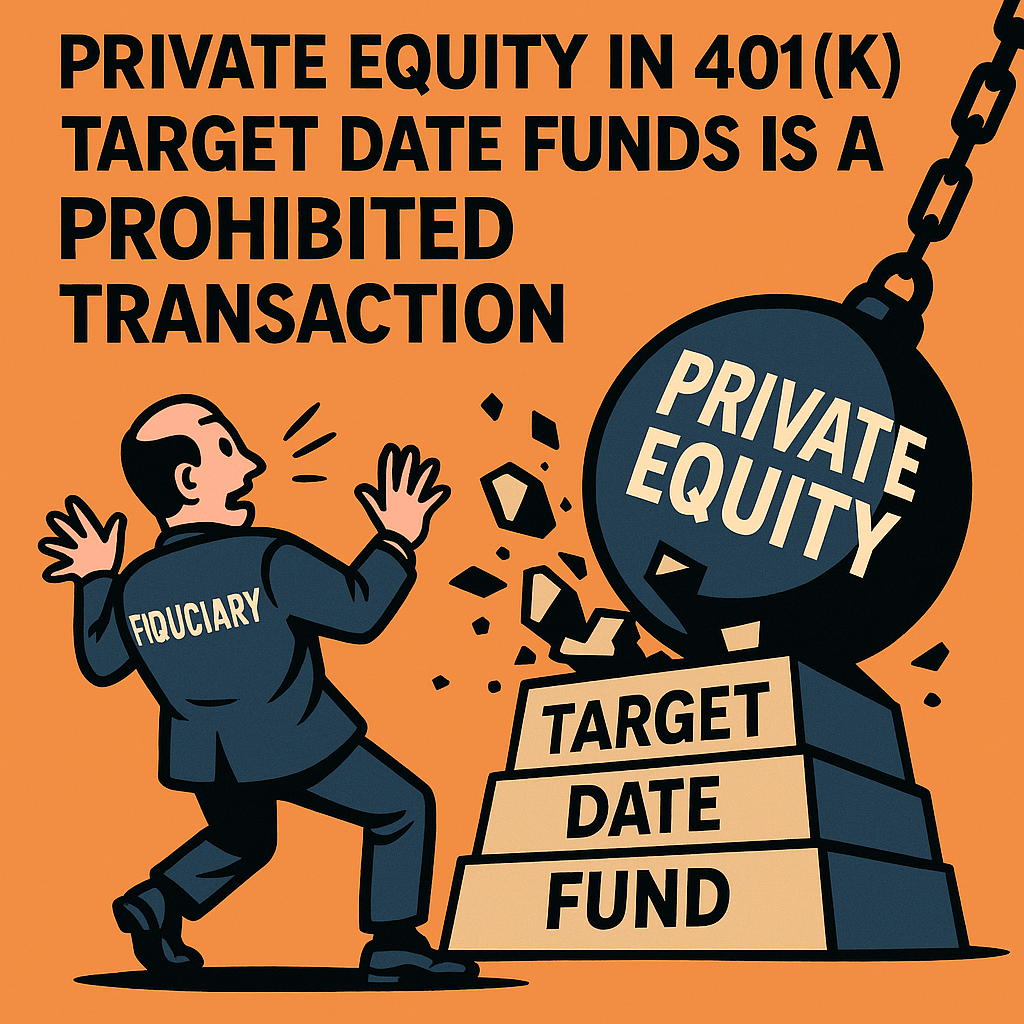
“Private Equity Is a Wrecking Ball Inside 401(k) Target Date Funds”
INTRODUCTION
This report expands and fully develops the legal, economic, regulatory, and fiduciary basis demonstrating that any allocation to Private Equity (PE) or Private Credit (PC) within a 401(k) Target Date Fund (TDF)—including allocations as small as 1–10%—renders the entire TDF a prohibited transaction under ERISA §§406(a) and 406(b). It incorporates a new November 25 paper: PRIVATE EQUITY & LITIGATION RISK by Ludo Phalippou of Oxford and William Magunson of Texas A&M cites misleading performance metrics, manipulable valuations, opaque fees, limited liquidity, and fiduciary duty waivers, becoming significant litigation risks when ordinary investors enter the picture. Phalippou/Magunson charts how private enforcement could reshape the industry and explores how the future of private equity will increasingly be shaped by judges, not regulators. https://papers.ssrn.com/sol3/papers.cfm?abstract_id=5748424
Across these sources, the conclusion is consistent and unambiguous: **Private Equity is incompatible with ERISA’s fiduciary duties of prudence and loyalty, and its compensation and conflict structure necessarily triggers prohibited transactions.**
I. PRIVATE EQUITY IS ALWAYS A PROHIBITED TRANSACTION UNDER ERISA
Private Equity is structurally incompatible with ERISA because:
1. The GP is a party-in-interest (ERISA §3(14))
2. PE fees are prohibited self-dealing (ERISA §406(b)(1))
3. Carried interest is additional compensation (ERISA §406(b)(3))
4. Valuations are unverifiable, violating prudence. Even stated returns do not justify risks
5. Monitoring is impossible
6. Benchmarking is impossible
7. PE uses offshore affiliates for undisclosed conflicts
Each is independently sufficient to trigger a prohibited transaction.
III. PRIVATE EQUITY GP STATUS AS PARTY-IN-INTEREST
The General Partner:
• Controls capital calls • Controls cash flows • Sets valuations
• Charges fees directly to plan assets • Extracts carried interest
• Engages in related-party transactions with offshore affiliates
Under ERISA §3(14)(A),(B),(C),(E),(F), this qualifies as a **party-in-interest**. Under ERISA §3(21), a GP exercising discretionary authority over plan assets is a fiduciary—yet PE GPs refuse to acknowledge fiduciary status. This mismatch itself is disqualifying under ERISA’s loyalty standard.
The CFA Institute report THE ECONOMICS OF PRIVATE EQUITY ALEXANDER LJUNGQVIST CEPR 2024 https://rpc.cfainstitute.org/research/foundation/2024/economics-of-private-equity states: “Private equity is characterized by extreme opacity… LPs cannot verify valuations and must rely on GP reporting.”¹ This is irreconcilable with ERISA.
IV. PE FEES VIOLATE ERISA §406(b)(1) AND §406(b)(3)
Private Equity’s fee stack includes:
• management fees • monitoring fees • advisory fees • broken-deal expenses • fund-level financing fees • offshore pass-through fees • carried interest (20%)
Phalippou (2025)³ documents:
“Aggregate carried interest exceeds one trillion dollars… approximately 18–20% of investor profits.” The Trillion Dollar Bonus of Private Capital Fund Managers Ludovic Phalippou∗ https://papers.ssrn.com/sol3/papers.cfm?abstract_id=4860083 April 2025
Every dollar of carry ie, performance fees is a direct transfer of plan assets to a party-in-interest.
V. PERFORMANCE VALUATIONS ARE UNVERIFIABLE — ACTUAL PERFORMANCE AFTER FEES DOES NOT COMPENSATE FOR RISK
• Ennis shows that even flawed reported performance does not justify investment
“The Demise of Alternative Investments,” by Richard Ennis Journal of Portfolio Management, October 1, 2025. https://richardmennis.com/blog/what-is-the-future-of-alternative-investing “Alternatives have failed for 15 years—no alpha, only higher fees, lower transparency, and higher risk.”

- IRR is manipulated through subscription lines. Net IRR differs sharply from economic IRR
• GP-controlled valuations distort performance. Interim valuations are “noisy, biased, and unverifiable” But PE valuations are Level 3, unobservable, and controlled entirely by conflicted GPs. Thus, **prudence is mathematically impossible**.
VI. ERISA TREATS A TARGET DATE FUND AS A SINGLE PLAN-ASSET DECISION
A Target Date Fund is a “bundled” investment product. Fiduciaries do not select sleeves—they select the entire product. The Department of Labor (DOL) confirmed in SunAmerica Advisory Opinion 2003‑12A and again in Frost Bank Advisory Opinion 2011‑06A that an investment manager’s selection of a multi-asset product constitutes a **single fiduciary transaction**.
Therefore: **IF ANY COMPONENT OF A TDF ENGAGES IN A PROHIBITED TRANSACTION, THE ENTIRE TDF IS TAINTED.** ERISA contains no de minimis exception for prohibited transactions. A fiduciary cannot argue that “only 10%” of the TDF is exposed. The fiduciary decision is binary: the TDF is either prudent, loyal, and exempt—or it is not.
Once the fiduciary “touches” a prohibited transaction, **the entire investment is prohibited.**
VIII. TARGET DATE FUNDS WITH PE HAVE THE WORST POSSIBLE FIDUCIARY PROFILE
Target Date Funds amplify PE risks due to: • QDIA default capture • Participants lacking sophistication • Layers of subadvisers • Greater fee opacity • Inadequate benchmarking • Use of “aggregate glidepaths” that hide PE allocations.
Target Date funds put in poorly state regulated Collective Investment Trusts (CITs) enable them to hide Private Equity.
The mixture of QDIA status + PE opacity is toxic under ERISA.
The conclusion from all available research is unmistakable:
If even 1–10% of a Target Date Fund is invested in private equity or private credit, the entire TDF becomes a prohibited transaction
Fiduciaries cannot meet ERISA’s duties of prudence or loyalty when TDFs contain PE/PC, offshore affiliated transactions, unverifiable valuations, or CIT opacity.
📌
Appendix How We Got Here: TDFs as Private Equity’s New Backdoor
After the SEC rejected widespread public-fund PE access, and after the 2020 DOL letter failed to open the retail PE market, private equity firms pivoted:
**➡ away from retail investors
➡ into 401(k) default investments
➡ through opaque CIT-wrapped Target Date Funds**
BlackRock, Fidelity, State Street, and TIAA now promote TDFs that include:
- private equity
- private credit
- CLO mezzanine debt
- PE-sponsored reinsurance vehicles
- illiquid alternative credit strategies
These are inserted at the CIT level, where no SEC disclosure is required.
Boston College law professor Natalya Shnitser shows:
- CITs have overtaken mutual funds in 401(k)s
- CITs lack SEC oversight, Form N-PORT transparency, independent auditor requirements, uniform fee schedules, or conflict disclosures
- Fiduciaries cannot evaluate valuations, fees, counterparty risk, or affiliated transactions
On page 25:
“Regulators lack visibility into CIT investment strategies and conflicts. Plan fiduciaries are similarly limited.”
This alone makes CIT-wrapped PE TDFs per se imprudent.
Natalya Shnitser Boston College – Law School November 2023 Overtaking Mutual funds the hidden rise and risk of Collective Investment Trusts https://papers.ssrn.com/sol3/papers.cfm?abstract_id=4573199 pg.25
5. COLLECTIVE INVESTMENT TRUSTS (CITs): THE NEW SHADOW 401(k) UNIVERSE
CITs vs. Mutual Funds:
| Feature | Mutual Fund | CIT |
| SEC-regulated | ✔ | ✘ |
| Daily holdings disclosure | ✔ | ✘ |
| Uniform fee reporting | ✔ | ✘ |
| Auditor oversight | ✔ | ✘ |
| Public fact sheets | ✔ | ✘ |
| ERISA-specific transparency | Limited | ✘ |
| Used to hide PE in TDFs | Rare | Common |
Shnitser’s research makes clear:
CITs enable exactly the type of hidden PE exposure PE firms have been seeking for 20 years.
 The CommonSense 401k Project
Pingback: Rep. Randy Fine files bill to force Private Equity, Annuities and Crypto into 401(k)s | The CommonSense 401k Project
Pingback: Private Equity as an ERISA Prohibited Transaction updated Nov. 30, 2025 | The CommonSense 401k Project