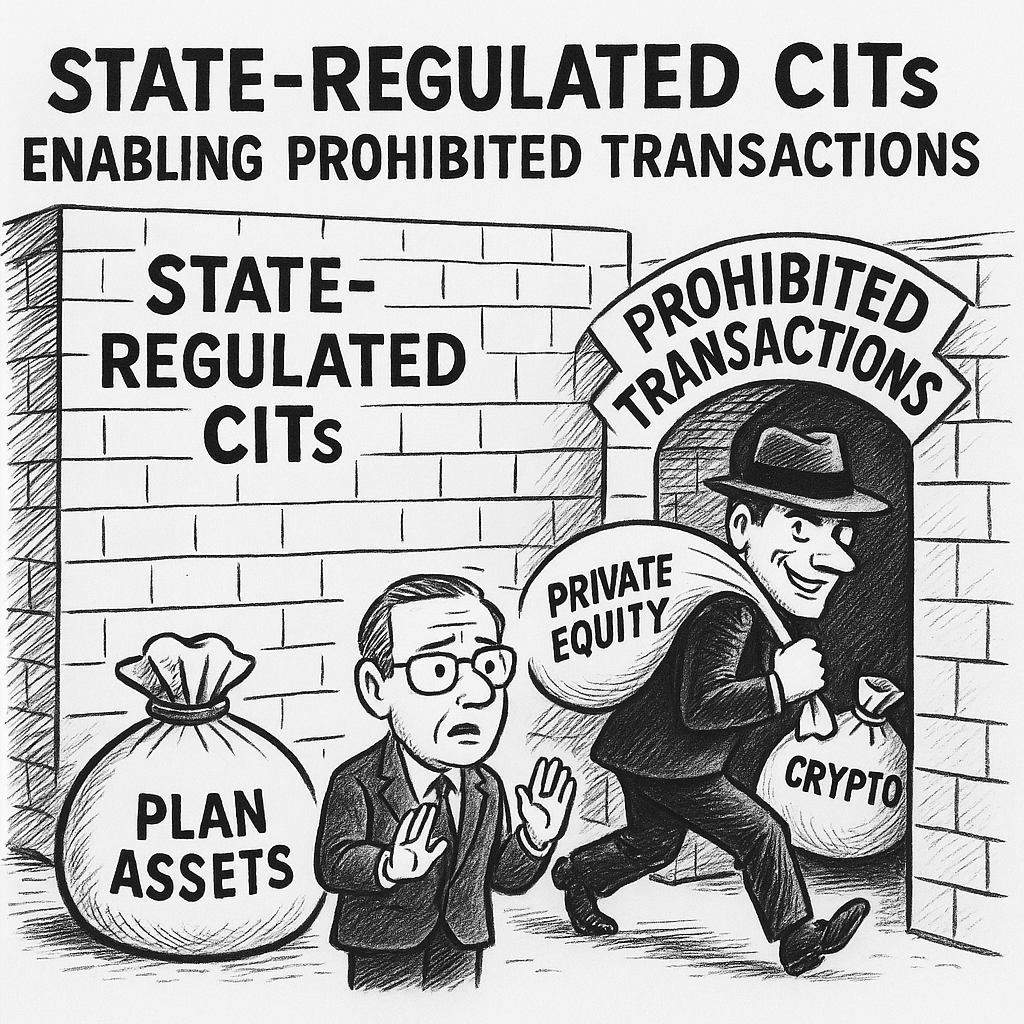
How Opaque, Non-SEC-Regulated Target-Date Products Create Structural Conflicts, Hide Fees, Inflate Risks, and Enable Party-in-Interest Self-Dealing
I. Introduction: The Quiet Rise of State-Regulated CITs in 401(k) Plans
Over the last decade, Collective Investment Trusts (CITs)—private pooled vehicles chartered under state banking law—have displaced SEC-registered mutual funds as the dominant structure inside 401(k) Target Date Funds (TDFs).
Most participants and many fiduciaries do not know that their “Target Date Fund” is not a mutual fund, carries no SEC oversight, and exists inside the murky regulatory environment of a single state bank regulator.
As Natalya Shnitser of Boston College Law School documented in Overtaking Mutual Funds: The Hidden Rise and Risk of CITs, this migration was encouraged by asset managers because CITs allow:
https://papers.ssrn.com/sol3/papers.cfm?abstract_id=4573199 pg.25
- Lower disclosure requirements
- Deeper fee structures (including revenue-sharing)
- Alternative assets that would be prohibited or limited in mutual funds
- Contractual opacity that prevents fiduciaries from evaluating risks or costs
- Unmonitored, self-dealing transactions with plan service providers
In May 2023 SEC chair Gary Gensler https://www.sec.gov/newsroom/speeches-statements/gensler-remarks-investment-company-institute-05252023#_ftnref27 “Rules for these funds lack limits on illiquid investments and minimum levels of liquid assets. There is no limit on leverage, [nor any] requirement for regular reporting on holdings to investors…”.
These characteristics make CITs, especially state-regulated TDFs, natural vehicles for ERISA prohibited transactions—including both §406(a) party-in-interest transactions and §406(b) fiduciary self-dealing.
This concern is reflected in:
Commonsense401kProject: Target Date Funds in State-Regulated CITs—Risk and Prohibited Transaction Basis https://commonsense401kproject.com/2025/11/02/target-date-funds-in-state-regulated-collective-investment-trusts-citsrisk-and-the-basis-for-a-prohibited-transaction-claim/
Tobe Testimony Before ERISA Advisory Council, 2025* https://commonsense401kproject.com/2025/06/29/erisa-advisory-council-testimony-released/
Since Cunningham v. Cornell if the CIT is a parties in interest the burden is on the defense to prove that it is not a Prohibited Transaction.
II. Regulatory Arbitrage: CITs Exist Outside the SEC Regime
A. What CITs avoid compared to mutual funds
| Investor Protection | SEC Mutual Fund | State-Regulated CIT |
| Prospectus | ✔ Required | ✘ None |
| Statement of Additional Information | ✔ Required | ✘ None |
| N-PORT / N-CEN disclosures | ✔ Required | ✘ None |
| N-CSR semi-annual reports | ✔ Required | ✘ None |
| Limits on illiquid assets | ✔ 15% cap | ✘ No limit |
| Independent board | ✔ Required | ✘ No requirement |
| Public audit | ✔ Mandatory | ✘ Often not disclosed |
Result:
CITs provide no reliable public record of holdings, liquidity, risk exposures, valuation methods, counterparty risks, or fee layers.
B. State regulators were never designed for ERISA oversight
Most CITs are chartered under a small number of states—e.g., New Hampshire, Delaware, South Dakota—whose banking departments:
- have minimal staff,
- do not require public disclosure,
- do not review investment risk,
- do not monitor fees, and
- do not enforce ERISA fiduciary duties.
Thus, a CIT Target Date Fund is an ERISA plan investment regulated by a state banking clerk rather than by the SEC.
This regulatory arbitrage is exactly what allows hidden compensation, opaque allocations, and conflicts of interest—all foundational elements of ERISA prohibited transactions.
III. How CITs Enable ERISA Prohibited Transactions
There are three major pathways through which CITs create structural prohibited transactions, even when fiduciaries believe they are saving fees.
A. Prohibited Transaction Pathway #1: CITs Allow Asset Managers to Sell Their Own Products to Plans (ERISA §406(a))
Under ERISA §406(a)(1)(A), (C), and (D), a plan fiduciary cannot cause the plan to purchase investments from a party-in-interest.
CITs make this violation easy and nearly invisible because:
- The CIT trustee, sub-advisor, and platform provider are often affiliates of the recordkeeper.
- The CIT holds proprietary underlying funds, managed by affiliates of the same institution.
- The CIT agreement often discloses no underlying holdings, making it impossible for fiduciaries to detect self-dealing.
This creates a multi-layer prohibited transaction, where each dollar flowing into a CIT TDF automatically flows into affiliated funds—often through multiple revenue streams.
The Commonsense 401(k) “Revenue Sharing as Prohibited Transaction” article documents exactly how these arrangements have hidden indirect compensation for years.
B. Prohibited Transaction Pathway #2: CITs Enable Fiduciary Self-Dealing (ERISA §406(b))
Under §406(b), no fiduciary may:
- deal with plan assets for its own account,
- receive additional compensation, or
- act on behalf of an adverse party.
CITs facilitate all three:
1. Menu construction conflicts
Recordkeepers or their affiliates design TDF CITs whose underlying components include:
- affiliated large-cap funds
- affiliated bond funds
- affiliated real-asset or REIT funds
- affiliated money market funds
- affiliated “alt” sleeves (private equity, private credit)
- funds with hidden fixed, index and other separate account annuities
Every dollar directed into the TDF becomes a dollar of revenue for the platform’s affiliates.
2. Hidden indirect compensation
Revenue-sharing is documented extensively in:
- Commonsense 401(k): Why Revenue Sharing Is a Prohibited Transaction
- SEC studies and enforcement actions
- The hidden-stream analysis in Shnitser’s CIT paper
CIT trust documents typically avoid publishing:
- shelf fees
- sub-transfer agency fees
- platform fees
- “trustee administrative fees”
- wrap fees
- indirect compensation from underlying managers
3. Fiduciary cannot monitor what it cannot see
Because CITs many times
are opaque, a fiduciary:
- cannot evaluate risk,
- cannot identify underlying investments,
- cannot review performance drivers,
- cannot benchmark the TDF to an SEC-regulated equivalent,
- cannot detect conflicts of interest.
This creates a Tibble v. Edison duty-to-monitor violation by definition.
C. Prohibited Transaction Pathway #3: CITs Allow Hidden Alternative Assets (Private Equity, Private Credit, Crypto)
This risk is already documented in:
- Commonsense 401(k): Hiding Private Equity in Target Date Funds
- Commonsense 401(k): Toxic Target Date Funds
- Brokerage Windows Exposed by Crypto
- Target Date Benchmarks: The ChatGPT Analysis
- Tobe’s Testimony Before the ERISA Advisory Council
Why this matters:
Mutual funds must comply with SEC liquidity and valuation rules and cannot easily add:
- private equity
- venture capital
- private credit
- structured credit
- crypto exposure
- hedge-fund-style derivatives
- long-lockup assets
CITs have no such constraints.
Thus, a CIT Target Date Fund can quietly embed:
- 5%–15% private equity
- illiquid private credit pools
- crypto ETFs or crypto derivative exposure
- real-estate private placements
- offshore alternative vehicles
…without plan sponsors or participants knowing.
Why this is a prohibited transaction
If a party-in-interest provides these alternative products through a CIT structure:
- The CIT trustee uses its fiduciary authority to place plan assets in affiliated or compensated vehicles (ERISA §406(b)(1)).
- The CIT manager receives additional compensation for selecting its own or its affiliates’ alternatives (§406(b)(3)).
- Plan fiduciaries lack the information required to evaluate the prudence of these alternatives—an independent breach under §404(a)(1)(B).
This is the “dark-pool prohibited transaction” problem.
IV. Why CITs Fail the ERISA Prudence Standard
Under ERISA §404(a), fiduciaries must act:
- with the care of a prudent expert,
- for the exclusive benefit of participants, and
- based on complete and accurate information.
Because CITs do not disclose:
- holdings
- risks
- valuation methods
- liquidity
- alternative exposures
- revenue-sharing
- indirect compensation
- fee layers
- benchmarking methodology
…it is impossible for a fiduciary to conduct the required prudence analysis.
You cannot prudently monitor what you cannot see.
(Tibble, Hughes, Sweda, NYU, Yale, MIT)
Therefore, CITs—especially CIT TDFs used as QDIAs—fail prudence as a matter of structure, not performance.
V. CIT Target-Date Funds as QDIAs: A Systemic ERISA Failure
In my 2025 ERISA Advisory Council testimony, you explained that:
- The DOL never evaluated the risks of CITs when issuing the QDIA rule in 2007.
- The QDIA regulation assumed TDFs would be SEC-regulated mutual funds.
- The DOL did not anticipate that state-regulated CITs would replace mutual funds.
Today, a majority of QDIA flows sit inside:
- non-transparent,
- state-regulated,
- conflict-ridden,
- alternative-enabled,
- recordkeeper-profit-center CITs.
This aligns with my earlier work:
- Problems with Target Date Funds
- Toxic Target Date Funds: Worst of the Worst
- Target Date Benchmarks: ChatGPT
This makes QDIA a huge source of ERISA prohibited transactions.
VI. Damages Framework
Damages in cases involving state-regulated CIT TDFs include:
1. Overcharges from hidden revenue-sharing
Often 20–80 bps annually.
2. Underperformance vs. SEC-regulated benchmarks
Especially vs. Freedom Index, Vanguard, or Morningstar peer averages.
3. Alternative asset risk premiums
Participants bear the liquidity risk while the manager captures the premium.
4. Valuation smoothing
CITs often “smooth” alternative asset valuations, masking losses and exacerbating sequence-of-returns risk.
5. Prohibited transaction disgorgement
All indirect compensation flowing to party-in-interest affiliates must be returned.
VII. Conclusion: CITs Are the Primary Structural Mechanism Enabling ERISA Prohibited Transactions in 401(k) Target-Date Funds
State-regulated CITs:
- Avoid SEC oversight
- Hide conflicts and fee layers
- Allow self-dealing with affiliates
- Enable alternative assets hidden from participants
- Conceal indirect compensation
- Prevent fiduciaries from evaluating prudence
- Create built-in ERISA §406 prohibited transactions
- Fail the §404 prudent-expert standard
- Endanger retirement security for over 100 million workers
CITs are not merely a “cheaper version” of mutual funds.
They are the central tool enabling modern 401(k) prohibited transactions.
Given the opacity, conflicts, and inability to monitor risk, CIT TDFs should be disallowed as QDIAs and prohibited for ERISA plans unless:
- all holdings are publicly disclosed,
- all fee layers are disclosed and unbundled,
- no affiliated products are used,
- no revenue-sharing exists, and
- independent fiduciaries oversee the structure.
Until then, CITs remain the most dangerous, least transparent, and most conflict-ridden structure in the modern 401(k) system.
1. CIT Basic structure: who owns whom?
- Great Gray Trust Company, LLC is the trustee and fiduciary for a large family of bank collective investment trusts (“Great Gray Funds”). These CITs are explicitly exempt from ʼ33/ʼ40 Act registration. Great Gray Trust Company+2Great Gray Trust Company+2
- Great Gray Trust Company is a wholly-owned subsidiary of Great Gray Group, LLC. Great Gray Trust Company
- Madison Dearborn Partners (“MDP”), a large private-equity firm, purchased Great Gray from Wilmington and now owns Great Gray Group. Lever+1
- MDP is actively investing across financial services and wealth / retirement platforms (NFP, Wealthspire, Fiducient, etc.), with Great Gray specifically identified as an “investment trust service provider” in its portfolio. Wall Street Journal
Great Gray is the fiduciary trustee over state-regulated CITs that hold private markets, and Great Gray itself is owned by a private-equity sponsor whose business model is to grow fee flows into private markets and wealth platforms.
2. Great Gray’s specific role in pushing private markets via CITs
From their own marketing:
- They describe themselves as a “center of the retirement ecosystem,” working with 200+ recordkeepers and a broad web of advisers and intermediaries. Great Gray Trust Company
- They emphasize that CITs are exempt from ʼ33/ʼ40 registration, and that the trustee (Great Gray) “maintains ultimate fiduciary authority over the management of, and investments made in, the Funds.” Great Gray Trust Company+2Great Gray Trust Company+2
- They are now explicitly building target-date CITs with private equity and private credit exposure—Panorix TDF series with BlackRock providing the glidepath and private markets sleeves; Wilshire as sub-advisor. PLANADVISER+3Great Gray Trust Company+3BlackRock+3
- They publish advisor FAQs and “CIT 101” pieces explaining how to incorporate private markets into DC plans and “debunking misconceptions” about CITs, positioning themselves as the primary evangelist for the structure. Great Gray Trust Company+2Great Gray Trust Company+2
That directly supports my“state-regulated CITs as vehicles to hide private equity” thesis: the whole point of this product push is to embed PE/PC inside a bank CIT wrapper overseen by a trustee that is itself owned by a PE sponsor.
3. Additional vertical conflict: RPAG acquisition and distribution
- Great Gray Group acquired Retirement Plan Advisory Group (RPAG), a leading 401(k) practice-management and model-portfolio platform for advisors. Career Services | UNLV+3Great Gray Trust Company+3Ropes & Gray+3
- Both Great Gray and RPAG are owned by Madison Dearborn Partners. Great Gray Trust Company+2PLANADVISER+2
That creates a “vertical stack”:
PE sponsor (MDP) → Great Gray Group →
• Great Gray Trust (CIT trustee / manufacturer)
• RPAG (advisor platform pushing models & product selection)
So when an RPAG-aligned advisor recommends a Great Gray CIT or a TDF filled with private markets, the same private-equity sponsor ultimately profits at multiple levels: platform economics, trustee fees, potentially sub-advisor or related-party economics (and of course increased AUM in private markets, which tend to have higher fees and longer lock-ups).
For ERISA, that’s fertile ground for:
- Party-in-interest status under ERISA §3(14) for the trust company, the parent, and potentially affiliated managers/platforms that receive compensation from the CIT or underlying investments.
- Prohibited transactions under §406(a) (transfers to or use by/for a party in interest) and §406(b) (fiduciary self-dealing, acting for its own account in transactions involving plan assets).
4. Concrete conflict themes you can plead or put in a memo
Here are a few angles you can directly plug into the “State-Regulated CITs as Vehicles for ERISA Prohibited Transactions” piece:
- PE-owned fiduciary pushing non-SEC–registered products
- Great Gray publicly promotes the fact that its CITs are exempt from the ’33 and ’40 Acts, and that the bank trustee (itself) holds “ultimate fiduciary authority.” Great Gray Trust Company+2Great Gray Trust Company+2
- At the same time, Great Gray is owned by a private-equity firm whose investors benefit when flows leave low-margin, transparent mutual funds and enter higher-fee, opaque private-market products.
- That creates a structural incentive to:
- Prefer CITs over mutual funds, even where mutual funds are cheaper and more transparent.
- Prefer CITs that allocate to private markets (and other alternative strategies) over low-cost index CITs.
- Cross-platform steering and “ecosystem capture”
- Because MDP also owns RPAG and other wealth/retirement platforms, the sponsor controls both the manufacturing (Great Gray CIT / TDF products) and a big piece of the distribution (advisors using RPAG tools). Wall Street Journal+3Great Gray Trust Company+3Ropes & Gray+3
- That raises classic loyalty and prudence issues: plan-level fiduciaries may be relying on “independent” advisor tools and research that are, in fact, owned or influenced by the same private-equity sponsor that profits if CITs/PE win the mandate.
- Party-in-interest + hidden fee streams
- Great Gray Trust, Great Gray Group, and affiliates (including RPAG) all plausibly become parties in interest once they provide services to the plan or receive direct/indirect compensation from plan assets.
- If a Great Gray CIT invests in private markets or uses sub-advisers, and:
- any MDP fund owns an interest in those managers, or
- the CIT pays revenue-sharing / platform fees back up the stack,
then you have indirect compensation and equity interests that ERISA treats as prohibited self-dealing absent a very carefully tailored exemption.
- MDP’s long record of financial-services / wealth platform holdings, including “investment trust service provider Great Gray Trust Company.” Wall Street Journal+1
- Industry-standard PE strategy of taking GP stakes or co-investments in asset managers.
- Opacity of state-regulated CITs + private markets
- Great Gray’s own materials emphasize that CITs are bank products with their own Declarations of Trust; many are governed under state banking/trust law (e.g., Nebraska, South Dakota, etc.), with much weaker disclosure regimes than SEC-registered funds. Great Gray Trust Company+2Great Gray Trust Company+2Once you layer private equity/private credit exposures inside that wrapper, you compound opacity:
- Limited partnership agreements often restrict disclosure.Valuations and fees are not transparent to participants.Oversight shifts from SEC mutual-fund exam staff to thinly staffed state banking/insurance regulators.
- Great Gray’s own materials emphasize that CITs are bank products with their own Declarations of Trust; many are governed under state banking/trust law (e.g., Nebraska, South Dakota, etc.), with much weaker disclosure regimes than SEC-registered funds. Great Gray Trust Company+2Great Gray Trust Company+2Once you layer private equity/private credit exposures inside that wrapper, you compound opacity:
 The CommonSense 401k Project
Pingback: Rep. Randy Fine files bill to force Private Equity, Annuities and Crypto into 401(k)s | The CommonSense 401k Project
Pingback: Why the INVEST Act Should Be Opposed — – forcing hidden Private Equity onto public school teachers | The CommonSense 401k Project
Pingback: Wall Street Journal Exposes Target Date CIT Corruption — But They’ve Only Scratched the Surface | The CommonSense 401k Project
Pingback: 401(k) Disclosures – Trump DOL moving toward blocking Transparency | The CommonSense 401k Project