There is a common thread running through what we are seeing in:
- The media — where reporters struggle to explain why private equity results never quite match the story being told (see the NYT H-E-B piece you dissected),
- The courts — where judges are beginning to realize that fake benchmarks and opaque reporting create fiduciary illusions (see your Intel analysis),
- State governments — where pension reports in Kentucky, Chicago, North Carolina, Rhode Island and California show performance standards that would never be tolerated in public markets,
- And now Vermont — where Tim McGlinn, CFA/CAIA, documents how the state is effectively misrepresenting private equity performance to the public.
This is not coincidence.
It is not incompetence.
It is a system.
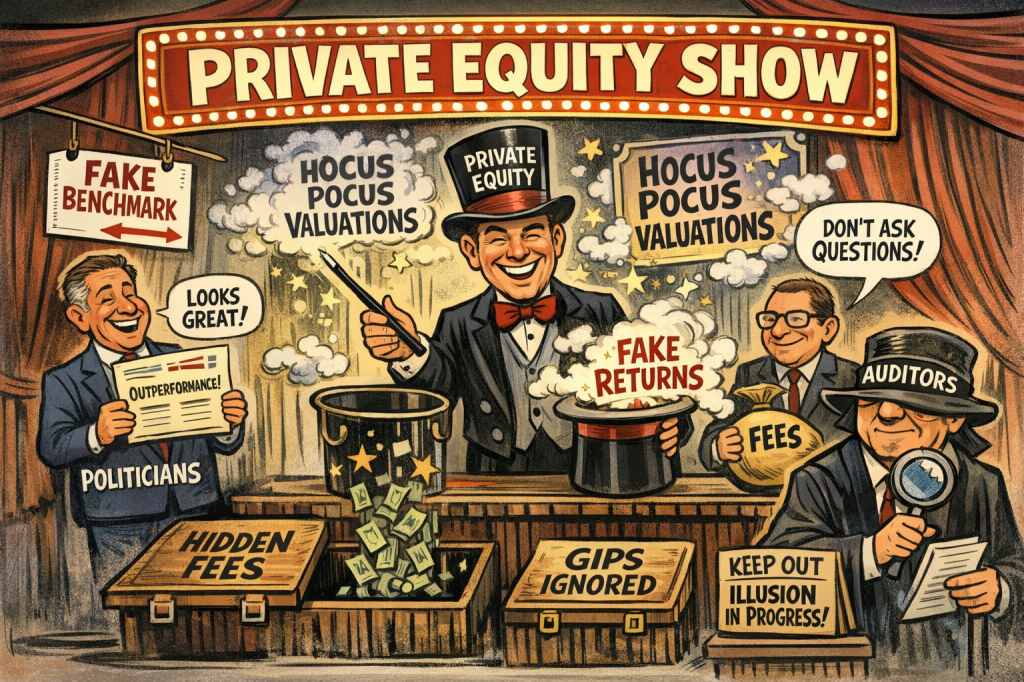
A system in which private equity performance is engineered, narrated, benchmarked, and reported in ways that would be considered securities fraud if done in public markets.
And everyone involved gets paid to look the other way.
Vermont: The “Brave Little Lie”
Tim McGlinn’s recent piece on Vermont is one of the clearest examples yet of what is happening nationwide. https://thealtview.substack.com/p/vermont-repeat-irr-juicing-offender
Vermont reports private equity performance using:
- Internal Rate of Return (IRR) without proper context,
- Non-investable benchmarks,
- Valuations that lag markets by months,
- Performance presentations that omit what would have happened in a simple passive alternative.
What McGlinn shows is devastating:
Vermont is not measuring performance relative to anything a fiduciary could actually invest in.
That is not a technical mistake.
That is performance engineering.
The same engineering documented in multiple states
The same engineering Richard Ennis quantified nationally.
The same engineering hidden behind GIPS non-compliance https://www.amazon.com/Kentucky-Fried-Pensions-Cover-up-Corruption/dp/1483964752
Different state. Same playbook.
The Wall Street Journal Said the Quiet Part Out Loud
The WSJ piece — “When Your Private Fund Turns $1 into 60 Cents” — exposed what happens when the cash reality of private equity finally collides with the reported narrative. https://www.wsj.com/finance/investing/when-your-private-fund-turns-1-into-60-cents-445d63c2
When funds need liquidity, when secondaries clear at discounts, when distributions don’t come, the math that “worked” on paper falls apart.
Because the performance was never market performance.
It was accounting performance. This was a rare piece in the WSJ by the great Jason Zweig most articles are much more friendly to Private Equity https://commonsense401kproject.com/2026/01/21/the-ny-times-missed-the-real-h-e-b-401k-story/
The GIPS Problem Nobody Wants to Talk About
There are no performance standards in Private Equity they basically make up their own standards so they can make up their own performance:
- Almost all stock and bond managers comply with CFA GIPS.
- Almost no private equity or hedge fund managers do.
- There are detailed GIPS standards for alternatives that require full fee and valuation transparency.
- They refuse to adopt them.
As the CFA GIPS staffer said:
“I would be concerned why a manager would not be compliant.”
Public pensions have adopted CFA ethics codes.
They cite CFA standards.
They do not require GIPS from the very managers charging the highest fees.
Why?
Because if they did, the performance story would collapse.
You can’t hide fee layering, recycled expenses, subscription line distortions, and appraisal-based smoothing inside a GIPS composite.
So pensions simply don’t ask.
This is the Madoff rule McGlinn alludes to:
If you ask too many questions, you don’t get access to the “top quartile” fund.
Benchmark Engineering: The Silent Fraud Mechanism
Private equity is benchmarked against:
- Public indices plus arbitrary spreads,
- Benchmarks lagged by a quarter,
- CPI-based targets instead of market returns,
- Internal composites that evolve over time.
This guarantees:
- Losses are delayed,
- Volatility is suppressed,
- Illiquidity is rewarded whether earned or not,
- “Alpha” appears every year.
Richard Ennis showed nationally that funds underperform passive benchmarks by ~1.4% annually while claiming +0.3% policy outperformance. https://finance.yahoo.com/news/17-trillion-illusion-why-one-154227184.html?
That 1.7% gap is the fingerprint of this system.
The Courts Are Starting to See It
Some of the lower courts have fallen for the deceptive Wall Street Private Equity attorneys “Meaningful Benchmarks” ploy to block transparency of illegal and high fee Private Equity contracts. https://commonsense401kproject.com/2026/01/20/why-the-meaningful-benchmark-standard-is-a-judicial-illusion-built-for-wall-street/
However, the Supreme Court taking on Intel is a hopeful sign that Courts are beginning to recognize that fake benchmarks create fiduciary illusions.
When performance is measured against something that cannot be owned, “outperformance” is meaningless. This does not hold up under careful application of ERISA fiduciary standards.
This is not just bad measurement.
It is misleading disclosure.
Why This Is Systematic — Not Accidental
Look at who benefits:
| Actor | Benefit from the deception |
| Private equity managers | Hide fees, control valuations, claim alpha |
| Pension consultants | Justify complexity, look sophisticated |
| Pension staff | Earn bonuses versus slow benchmarks |
| Politicians | Point to “outperformance” in reports |
| Media | Repeat the narrative without understanding mechanics |
Everyone in the chain has incentives aligned to not look too closely. https://commonsense401kproject.com/2025/12/11/how-americas-largest-pension-consultants-became-the-distribution-arm-for-private-equity/
Exactly what the Mark Higgins CFA piece warned
“Incentives are dangerously aligned in private markets.”
:
This Would Be Fraud in Public Markets
Imagine a mutual fund that:
- Set its own benchmark,
- Delayed marking losses,
- Refused GIPS,
- Hid fee layers,
- Reported outperformance versus something investors couldn’t buy,
- Paid managers bonuses based on it.
The SEC would shut it down.
Pensions do this every year.
People Are Paid to Look the Other Way
Your prohibited-transaction thesis nails the moral core of this: https://commonsense401kproject.com/2025/10/27/private-equity-as-an-erisa-prohibited-transaction/
These structures survive because fiduciaries, consultants, and staff are compensated inside the system that benefits from the opacity. The deception is not loud.
It is polite. Technical. Professional. Credentialed.
It is benchmark math, valuation timing, performance standards, and narrative framing.
Which makes it far more effective.
The Bottom Line
Tim McGlinn showed it in Vermont.
The WSJ showed it when liquidity hit.
Richard Ennis showed it nationally.
CFA warned about it.
Courts are starting to see it.
Private equity performance, as reported by pensions, is not a reflection of economic reality.
It is the product of:
- Benchmark engineering,
- Valuation lag,
- Performance Standards (GIPS) avoidance,
- Fee opacity,
- Governance capture,
- And incentives aligned to preserve the illusion.
This is not bad investing.
This is systematic performance deception.
And until pensions are forced to measure private equity against investable public benchmarks, full fee transparency, and GIPS-level standards, the numbers they report should be treated as marketing, not measurement.
 The CommonSense 401k Project