The INVEST Act seeks to open 403(b) plans — often held by teachers, nonprofit employees, and others — to Collective Investment Trusts (CITs). On the surface, supporters call this “modernizing retirement,” “parity with 401(k),” and “lower cost institutional investing.” Sadly, rhetoric like that obscures a far darker truth: for many Americans, this law would legalize a structural conduit for hidden fees, opaque private-market gambles, and regulatory arbitrage — all at the expense of transparency, fiduciary duty, and retirement safety.
🚨 CITs Are Fundamentally Different From Mutual Funds — and Risky
CITs are not SEC-regulated; rather than SEC oversight, they operate under state banking/trust law (or OCC, IRS/DOL) when they’re “state-regulated.” That means no mandatory prospectus, no N-PORT/N-CEN holdings/flow disclosures, no regular public reports, no independent boards, and — critically — no restrictions on illiquid or alternative assets. The CommonSense 401k Project+2CLS Blue Sky Blog+2
As documented in my own recent analysis, this regulatory structure is tailor-made for ERISA §406 prohibited transactions — self-dealing, hidden revenue sharing, affiliated-manager placements, “alternative sleeves” — all far harder to spot or challenge than in a mutual-fund wrapper. The CommonSense 401k Project
The risk isn’t just theoretical: CITs now manage trillions (by some estimates ~$7 trillion) in defined-contribution assets; many major 401(k) Target-Date Funds (TDFs) have migrated from transparent mutual funds into opaque CIT wrappers. CLS Blue Sky Blog+2Yale Law Journal+2
Thus CITs are not simply a “cheaper mutual-fund alternative.” They are — structurally — a different and far riskier regime.
🧱 Private-Equity, Private Credit, Crypto — Hidden in Plain Sight
The real danger is not just opacity; it is that CITs under the new regime become the delivery vehicle for private markets, annuities, and alternative investments into retirement plans that ordinary savers trust to be safe. As I laid out previously: CIT TDFs as QDIAs are perfectly positioned to:
quietly embed private equity, private credit, crypto, real-asset private placements, or other illiquid/alternative investments under a “Target Date Fund” label; The CommonSense 401k Project+2CLS Blue Sky Blog+2
hide multiple layers of fees (sub-TA, wrap, trustee, platform, revenue-sharing), none of which are transparently disclosed; The CommonSense 401k Project+1
create “vertical stack” conflicts of interest — e.g., the same private-equity sponsor owning the trustee, the CIT issuer, the recordkeeper, and possibly advisor-platform arms — meaning that each layer profits when savers’ money is funneled into opaque investments. The CommonSense 401k Project
In effect: under the INVEST Act, retirement savings — even for teachers, nonprofit staff, lower-paid workers — could get funneled into the same private-market gambits that now benefit ultra-wealthy fund investors. And with minimal transparency, no signal, and little chance for participants to know what’s going on until it’s too late.
🏦 Regulatory Arbitrage — The “Hole” That Saves Private Markets
The shift to CITs represents classic regulatory arbitrage: by moving plan assets from SEC-regulated mutual funds into state-chartered trust vehicles, fund managers and private-equity sponsors escape public disclosure, liquidity/resale requirements, independent boards, and robust oversight. The CommonSense 401k Project+2NYU Law+2
That’s not just a compliance tweak — it’s a fundamental renaming of risk. A “Target-Date Fund” under a CIT is no longer the transparent, retail-friendly product most plan participants think they’re getting. It is a private-market trust in a cloak of respectability.
⚖️ For Retirement Savers and Fiduciaries — This Is A Regression
Fiduciaries under Employee Retirement Income Security Act (ERISA) are supposed to act with the care of a “prudent expert.” But how can that duty be meaningfully discharged when holdings, fee structures, valuation, liquidity, and conflicts are hidden? You cannot prudently evaluate what you cannot see. The CommonSense 401k Project+1
For plan participants — especially those in nonprofit, education, public service 403(b) plans — the shift under INVEST could undermine retirement security. What looks like a “safer, institutional-grade” retirement fund might in practice be a high-fee, illiquid, high-risk private-market bet.
And legal recourse is likely to be limited. By layering private-market investments inside bank-trust CITs, the accountability framework that protects mutual-fund investors becomes fragmented and attenuated.
🎯 What Should Be Done Instead
If lawmakers genuinely care about “parity” and “modernizing” retirement, that shouldn’t mean sacrificing transparency and investor protections. Instead of opening the door to CITs in 403(b)s en masse, policymakers should insist on structural reforms:
Full disclosure — all CIT holdings, underlying investments, fees, and related-party flows must be publicly available and easily accessible to plan participants.
Ban or strictly limit alternative / illiquid / private-market investments in retirement-plan CITs — particularly for non–ERISA 403(b) plans — unless underlying vehicles meet public-fund standards (liquidity, valuation, reporting).
Independent fiduciary oversight — true independent boards or third-party fiduciaries (not affiliates of providers/recordkeepers) should manage CITs for retail retirement plans.
Restore mutual-fund (or equivalent) QDIA defaults — if a default is needed, default to transparent, low-cost SEC-regulated mutual funds, not opaque CIT-TDFs.
Until such reforms are guaranteed, letting 403(b) plans invest in CITs is not “modernization.” It’s a regression — a regulatory carve-out designed to benefit private-equity, insurance, and asset-management firms at the expense of everyday workers.
📢 Conclusion: INVEST Act = Privatizing Risk Under the Guise of “Retirement Reform”
The INVEST Act’s attempt to give 403(b)s access to CITs should not be celebrated — it should be stopped, or at least substantially amended. For most Americans, retirement savings are not a speculative venture; they are a guarantee of future stability. Opening the door to opaque, alternative-heavy, private-market trusts — without meaningful transparency or fiduciary protections — undermines the very purpose of retirement plans.
Congress should reject the “privatization of risk” in favor of real retirement security: transparent, liquid, low-cost investments — not hidden private-equity funnels.
Why Rep. Randy Fine’s ERISA Bill Looks Like a Gift to Private Equity, Annuities, Crypto.
In April 2025, the U.S. Supreme Court handed down one of the most consequential ERISA decisions in decades: Cunningham v. Cornell University. This was an unanimous decision. Fine filed a bill to be more pro-Wall Street than the most pro-business justices of the current court
For the first time, the Court clarified that plaintiffs do not need to plead an exemption under ERISA §408 to survive a motion to dismiss. It is enough to plausibly allege a prohibited transaction under §406(a)(1)(C)—a fiduciary causing the plan to transact with a party in interest.
This seemingly technical point is a tectonic shift.
Cunningham dramatically lowers the barrier for bringing prohibited-transaction suits involving:
Insurance annuities
Recordkeeping and administrative arrangements
Private equity and alternative assets
Collective investment trusts (CITs)
Crypto access and custodial arrangements
Any relationship with a service provider can now face discovery unless the fiduciary proves that an exemption applies—at the defendant’s burden.
Corporate counsel, insurance lobbyists, PE firms, and employer-side ERISA lawyers panicked. Plaintiffs’ firms rejoiced. And within months, Congress saw a new bill—one designed to effectively reverse Cunningham at the pleading stage.
That bill came from a surprising place: Rep. Randy Fine, a first-term Republican from Florida’s new 6th District, best known not for retirement policy but for fiery pro-Israel rhetoric “no genocide” “no starvation” “no problem” and a deeply intertwined relationship with the Republican Jewish Coalition’s donor base. He is also a staunch Trump loyalist and Trumps DOL EBSA appointee has reflected the strong industry opposition to Cunningham https://www.levernews.com/the-corporate-crusade-of-trumps-top-retirement-cop/
This is where the story gets interesting.
H.R. 6084: The ERISA Litigation Reform Act—A Cunningham Counterstrike
On November 18, 2025, Rep. Randy Fine introduced H.R. 6084, the ERISA Litigation Reform Act. Its twin goals are simple:
Raise the pleading standard for ERISA prohibited-transaction suits.
Stay discovery until plaintiffs prove additional factual detail.
In other words: make it harder to sue annuity providers, private-equity platforms, recordkeepers, and crypto custodians—the exact entities most exposed after Cunningham.
The official statement from Fine’s office frames this as protecting employers from “abusive litigation tactics.” Committee Chairman Rep. Tim Walberg immediately endorsed the bill, calling it an essential reform for America’s retirement system.
But here’s the question:
Why is a freshman Florida congressman—whose political identity revolves around pro-Israel activism and cultural fights—leading the charge to shield private equity, annuity issuers, and crypto-adjacent financial players from ERISA suits?
The answer appears to be found in the donor network behind his campaign.
Follow the Money: RJC → Finance Billionaires → Fine
According to publicly available OpenSecrets-linked reporting:
RJC-PAC sent over $60,000 to “Randy Fine for Congress”, making Fine one of its top beneficiaries in the 2024–2025 cycle.
RJC-PAC’s funding base is heavily weighted toward high-net-worth donors from the hedge-fund, private-equity, and financial-services world.
Major RJC donors include individuals associated with Elliott Management (Paul Singer), Cerberus Capital, Apollo-adjacent networks, real-estate investment conglomerates, and other alternative-asset firms.
Historically, pro-Israel Republican super-donors like Sheldon Adelson poured tens of millions into RJC infrastructure, much of it tied to Wall Street wealth.
Put simply:
Fine is a direct financial product of a political network funded by the same financial titans who benefit most from blocking ERISA litigation against alternative assets and insurance contracts.
This doesn’t mean quid pro quo. It means alignment. It means interests line up neatly.
The RJC’s donor base includes players in those industries. And now a top RJC-funded candidate is carrying a bill that would give them precisely what they want.
The Broader Pattern: Protecting Alts in 401(k)s While Weakening Prohibited-Transaction Enforcement
H.R. 6084 doesn’t exist in a vacuum. It fits into a larger mosaic:
1. The Retirement Investment Choice Act (H.R. 5748)
A bill that would codify the Trump-era Labor Department policy allowing private equity, private credit, and non-transparent alternatives inside 401(k) plans.
2. Industry push to allow crypto in DC plans
Fidelity and other players have lobbied heavily to protect crypto access in self-directed brokerage windows—and to shield themselves from fiduciary exposure.
3. The rise of CITs holding annuities and private-credit instruments
Cunningham threatens all of these. H.R. 6084 gives them breathing room.
Why Fine? Why Now?
If you were drafting the perfect congressional messenger for this mission, you’d want someone who:
Is brand-new to Congress (not yet publicly tied to legacy retirement-policy positions).
Has a baked-in donor base from high-net-worth finance circles.
Has strong ideological credentials that shield them from intra-party criticism.
Is ambitious and eager to prove usefulness to leadership and donors.
Is aligned with a donor ecosystem where Wall Street capital and pro-Israel politics overlap heavily.
That person is Randy Fine.
He may not fully grasp the ERISA implications of his own bill. But his donors do. His committee allies do. And the financial-services industry absolutely does.
The Real Stakes: Cunningham v. Cornell Opens the Door—Fine Tries to Shut It
By shifting the pleading burden in prohibited-transaction cases back onto defendants, the Supreme Court restored the design of ERISA §406: to presume such transactions are improper unless proven otherwise.
If Congress now steps in to create a heightened pleading standard or a discovery stay, the result is predictable:
Annuity issuers avoid discovery into spread-based compensation.
Private-equity platforms avoid discovery into opaque fee structures.
Recordkeepers avoid discovery into revenue-sharing and “soft-dollar” conflicts.
Crypto custodians and fintech platforms avoid discovery into payments for distribution or platform placement.
And plan participants lose the oversight mechanism that ERISA was designed to provide.
Conclusion: Cunningham Opened a Door—Randy Fine is Trying to Close It for the Donors Who Stand to Lose
Whether or not Randy Fine personally understands the depth of ERISA fiduciary duties is almost beside the point.
What matters is this:
Cunningham v. Cornell made it easier to sue financial institutions for conflicted 401(k)/403(b) arrangements.
The industries most threatened—annuities, private equity, crypto, recordkeepers—have deep donor overlap with the Republican Jewish Coalition’s finance-heavy donor network.
RJC-PAC is one of Fine’s largest political benefactors.
Fine is now carrying a bill that would protect those donors’ industries by weakening ERISA enforcement.
This is not a coincidence. It is the normal, predictable machinery of American political economy.
And it is a reminder: Follow the money, and ERISA policy suddenly makes perfect sense.
Update 12/19/25— Fine Bill appears to be Dead on Arrival, Encore Fiduciary Conflict, and What This Means for Fiduciary Risk & Litigation
Thankfully such a blatant sellout to Private Equity, Annuities and Crypto was too much for a narrow majority to kill such legislation.
Since the original post on Rep. Randy Fine’s bill to effectively roll back the Cunningham v. Cornell University Supreme Court decision, additional context has emerged that underscores both the conflict-of-interest dynamics at play and the likely litigation response from plaintiff fiduciary lawyers.
1) Encore Fiduciary & Aronowitz: A Clear Conflict of Interest
The firm Encore Fiduciary — whose leadership until recently included Daniel Aronowitz, now Presidentially nominated to lead the Employee Benefits Security Administration (EBSA) — has publicly positioned itself as an advocate against ERISA litigation, calling for an end to what it terms “regulation by litigation.” Aronowitz’s testimony before the Senate emphasized reducing fiduciary litigation and easing plan sponsor exposure, including in areas such as private equity and crypto investment lineups for 401(k) plans. planadviser.com
This background raises an obvious conflict of interest: Encore’s business model includes focusing on fiduciary liability insurance and underwriting against litigation risk. As the head of EBSA, Aronowitz has influence over the very enforcement regime that determines how prohibited transaction claims and fiduciary breaches are litigated or regulated. Advocating publicly against litigation — especially in cases like Cunningham/Cornell — aligns with Encore’s commercial interests as much as any public-policy rationale.
Indeed, Encore has published commentary suggesting that plaintiffs’ fiduciary lawsuits such as Cornell are “frivolous” and constitute “litigation abuse” — arguing for heightened pleading standards to block access to discovery in prohibited transaction claims. Encore Fiduciary
That stance dovetails neatly with Fine’s bill (H.R. 6084, the ERISA Litigation Reform Act), which similarly seeks to raise barriers to prohibited transaction claims — effectively insulating annuities, private equity, recordkeeping arrangements, and crypto custodial arrangements from early litigation exposure. The CommonSense 401k Project The alignment between Encore’s advocacy and a sitting EBSA nominee — pushed by Fine’s caucus office — underscores that this is not a neutral policy debate but one deeply entangled with provider economic interests.
2) The Cunningham v. Cornell University Decision: Why Industry Feared It
The April 2025 Cunningham decision was unanimous (9–0) and significantly shifted the legal landscape by lowering the pleading standard for ERISA §406 prohibited transaction claims. Under Cunningham, plaintiffs no longer need to plead that a plan’s transaction lacked a statutory exemption before discovery proceeds; instead, claiming a prohibited transaction — including with a party-in-interest — is sufficient to get past initial motions. Supreme Court
This matters enormously for annuities and other insurance products. Annuities are per se transactions with parties in interest. Before Cunningham, industry defendants could often get prohibited transaction claims dismissed before discovery by arguing that a §408 exemption applied. Cunningham now means fiduciaries and insurers must plead and prove exemptions after discovery, increasing litigation risk, cost, and settlement leverage for plaintiffs.
That risk is precisely why firms like Encore have framed prohibited transaction suits as “absurd” or “frivolous,” and why Fine’s bill would reverse that dynamic by raising pleading thresholds and limiting early lawsuits. But critics argue such proposals would effectively immunize product vendors and fiduciaries from meaningful fiduciary accountability — contrary to ERISA’s protective purposes.
3) Why Fine’s Bill Is Likely Dead on Arrival (and What It Signals)
On its face, H.R. 6084 is so egregious — a legislative attempt to insulate Wall Street product vendors from fiduciary scrutiny — that it is unlikely to pass outside of a narrow party majority. Fine’s sponsorship of this bill is telling precisely because he is not a retirement policy expert; his political profile is dominated by cultural and geopolitical issues, not ERISA law. That suggests his sponsorship is not driven by substantive policy consensus, but by donor and industry networks that benefit from limiting ERISA litigation exposure. The CommonSense 401k Project
This dynamic mirrors why some industry actors openly oppose Cunningham — not because it undermines retirement plan administration, but because it makes it easier for plaintiffs to challenge products like annuities under ERISA’s prohibited transaction framework.
4) Implications for Annuity & Prohibited-Transaction Litigation
If Cunningham stands and the Fine bill falters, the litigation environment for prohibited transaction and fiduciary breach suits around annuities looks increasingly active:
Plaintiffs can now more easily survive early dismissal — gaining discovery into annuity pricing, spread profits, conflicts, and exemption defenses. Supreme Court
Increased discovery and lower pleading thresholds make it cost-effective for fiduciary lawyers to pursue cases involving annuities in 401(k) plans, especially where exemptions are routinely claimed without justification.
The industry’s public push to weaken litigation standards inadvertently signals heightened litigation risk, as plan participants and fiduciary attorneys see Cunningham as a green light to pursue cases that previously stalled at the pleadings stage. Sidley Austin
In effect, the very sector that wants to discourage prohibited transaction lawsuits — including annuity issuers and fiduciary insurers — is under pressure from participants and courts to justify their exemptions and fiduciary processes on the merits rather than avoiding discovery.
5) Broader Policy Context: Alternatives and Risk Resistance
This legislative tussle also intersects with broader regulatory movements pushing alternative assets such as private equity and cryptocurrencies into DC plans. Recent executive orders and regulatory proposals have directed agencies to consider cryptocurrency and private equity as 401(k) investment options, framing them as “competitive” and “diversification enhancing” even though most participants express little interest once risks and fees are explained. LinkedIn
Senators from both parties have sounded alarms about exposing retirement plans to these risky assets, warning they lack transparency and traditional investor protections. Senate Banking Committee
The contrast could not be starker: while industry and some political actors push to broaden product menus to include high-risk assets, courts and participant advocates are pushing back via **fiduciary litigation — particularly prohibited transactions — to ensure products genuinely benefit participants rather than vendors.
Bottom Line
The controversy around Rep. Fine’s bill and the public positioning of Encore Fiduciary’s leadership reflect an industry backlash to the Supreme Court’s Cunningham decision — a backlash driven not by participants’ interests but provider risk mitigation. Rather than weakening ERISA enforcement, this episode is likely to spur more fiduciary litigation, especially around annuities and other non-transparent products that have long escaped rigorous prohibited transaction scrutiny.
**APPENDIX
Why a Pro-Business Supreme Court Ruled Unanimously in Cunningham —
And Why the Fine Bill May Be Doomed by ERISA’s Own Architecture**
There is an apparent contradiction that has puzzled many ERISA lawyers: Why would a Supreme Court that is widely described as “pro-business” issue a unanimous opinion in Cunningham v. Cornell that makes it easier for plaintiffs to sue plan fiduciaries and service providers?
A deeper look at the Court’s ERISA jurisprudence reveals the answer
Thole v. U.S. Bank (2020) shut down DB plan standing so aggressively that the Court had to preserve standing and enforcement power in defined-contribution (DC) plans.
And once you understand that logic, the Randy Fine bill looks not only dangerous — but possibly unconstitutional or structurally impossible under ERISA.
1. Thole v. U.S. Bank: The Court Closed the Door in DB Plans
In Thole v. U.S. Bank (2020), the Supreme Court held 5–4 that defined-benefit (DB) participants lack Article III standing to sue for fiduciary breaches unless they can show an immediate financial loss.
Because DB benefits are fixed and guaranteed (unless the plan collapses), the Court reasoned that mismanagement doesn’t necessarily injure individual participants.
It was a massive win for employers, private-equity-heavy pension portfolios, and corporate de-risking strategies.
But it created a structural problem.
Thole wiped out ERISA fiduciary enforcement in DB plans.
plan fiduciaries suing themselves (never happens), or
criminal cases (extremely rare).
The Court knew what it had done.
2. Cunningham v. Cornell: The Court Had to Leave the DC Door Open
Fast-forward to 2025.
Cunningham v. Cornell arrives — focusing on §406(a)(1)(C) prohibited-transaction claims in 403(b)/DC plans.
The question: Must plaintiffs plead and disprove an exemption (408) at the motion-to-dismiss stage?
The Second Circuit said yes. The Supreme Court unanimously said no.
Why?
Because if the Court had closed off §406 claims in DC plans the same way it closed DB standing in Thole, ERISA enforcement would be nearly dead.
Cunningham is the “counterweight” to Thole.
Once Thole gutted DB enforcement, the Court had to preserve DC standing and DC prohibited-transaction claims to keep ERISA’s structure constitutional and functional.
Some key doctrinal reasons:
ERISA §406 is designed to be strict-liability unless an exemption is proven. The burden is on fiduciaries — not participants.
Congress intended broad enforcement in DC plans because participant accounts rise or fall based on fiduciary conduct.
If both DB and DC plan enforcement vanished, ERISA’s protective purpose would be nullified, contradicting 29 U.S.C. §1001 and decades of precedent.
Thus, the Court ruled 9–0 to preserve basic DC enforcement.
This is the only position that keeps ERISA’s statutory scheme coherent.
3. Cunningham Wasn’t “Anti-Business” — It Was Doctrinal Maintenance
The Justices weren’t siding with plaintiffs. They were preserving:
statutory interpretation integrity,
the §406/§408 burden structure,
constitutional standing doctrine, and
the basic idea that DC participants must have a remedy.
Even the Court’s staunchest “pro-business” members (Alito, Gorsuch, Roberts) signed on because ERISA’s architecture left no other legal option.
To rule the other way would have:
broken ERISA’s strict-liability structure,
inverted burdens of proof contrary to the text,
expanded Thole into DC plans (unthinkable), and
left ERISA practically unenforceable.
Which brings us to the new bill.
4. Why the Randy Fine Bill May Be Impossible to Implement Under ERISA
Some ERISA attorneys are already saying quietly what you’re saying loudly:
H.R. 6084 may be unworkable or even unconstitutional because it would violate ERISA’s core structural principles — the very principles the Supreme Court just reaffirmed in Cunningham.
Problems with the Fine bill:
(1) It tries to reverse the burden of proof Congress placed on fiduciaries.
ERISA §406 presumes transactions with parties in interest are prohibited. The defendant must prove reasonableness under §408.
H.R. 6084 tries to force plaintiffs to disprove a §408 exemption before discovery — exactly what the Supreme Court rejected.
(2) It would undermine basic trust-law foundations.
ERISA’s fiduciary scheme is explicitly built on trust law, where fiduciaries carry the burden to justify conflicted transactions.
Congress cannot legislate away the trust-law core without rewriting ERISA from scratch.
(3) It could violate Article III by stripping remedies.
If both DB (Thole) and DC (under H.R. 6084) claims lack meaningful enforcement, courts could find the statute constitutionally deficient.
(4) It directly contradicts the unanimous statutory interpretation in Cunningham.
The Supreme Court’s reasoning is built on the text — not on policy:
Exemptions are affirmative defenses.
Plaintiffs do not need to plead them.
Burden is on fiduciaries.
H.R. 6084 would flip all of that, setting itself up for immediate judicial invalidation.
(5) It conflicts with ERISA’s remedial purpose in §1001.
Congress explicitly declared the purpose of ERISA is to provide “ready access to the Federal courts” and “adequate remedies.”
A law closing off both DB and DC enforcement could violate Congress’s own statutory preamble unless rewritten wholesale.
5. The Bottom Line: The Supreme Court Already Told Congress What It Can’t Do
Thole closed DB standing.
Cunningham kept DC standing alive because otherwise ERISA enforcement collapses.
The Fine bill aims to do indirectly what the Court explicitly said plaintiffs don’t need to do.
For that reason, the bill is likely dead on arrival in the courts, even if it passed legislatively.
Put bluntly:
If Congress passed H.R. 6084, it would almost certainly be struck down as violating ERISA’s structure, statutory text, and basic trust-law principles reaffirmed unanimously in Cunningham.
Some employer-side attorneys already know this. Some are quietly admitting it. Others are hoping no one notices.
Appendix: The Two-Step ERISA Rollback Strategy Behind “Democratizing Alternatives”
How the Wagner White Paper and Encore’s “Higher Pleading Standard” Campaign Work Together to Protect Private Equity, Annuities, and Crypto
Your main post explains why Rep. Randy Fine’s bill (H.R. 6084) is best understood as a Cunningham counterstrike—a legislative attempt to re-raise the barrier to prohibited-transaction cases by requiring more detail up front and restricting discovery. The CommonSense 401k Project This Appendix adds an important framing: the policy ecosystem is not just legislative. It is also being built through “thought leadership” legal memos that normalize alternatives in DC plans and describe ERISA’s prohibited-transaction design as a litigation “problem” to be fixed.
Two recent examples show the full architecture:
Wagner Law Group White Paper: normalize private equity/alternatives as prudent “portfolio modernization” and promise future “safe harbors” and reduced litigation uncertainty.
Read together, they are a two-step strategy to strip ERISA’s effective bite without openly repealing ERISA.
Step One: Wagner’s “Permission Structure” for Private Equity and Alternatives in 401(k)s
The Wagner white paper is framed as neutral “fiduciary considerations,” but its practical effect is to legitimize and operationalize the expansion of private equity, private debt, crypto-related vehicles, real estate, infrastructure, and annuity/lifetime-income structures inside DC plans.
A. It leans heavily on Executive Order policy signals—without grappling with ERISA’s statutory prohibitions
Wagner’s opening premise is that a White House action “signals” a more favorable environment and directs agencies to create safe harbors and reduce legal uncertainty.
WagnerWhitePaperAlternativeInve…
But executive orders and agency tone shifts don’t change ERISA §406. They can repackage the narrative, but they can’t repeal the statute.
B. It treats DOL “neutrality” as a green light
Wagner highlights the DOL’s rescission of the 2021 supplemental statement as a return to a “neutral, principled-based approach.”
WagnerWhitePaperAlternativeInve…
That’s exactly the rhetorical move product manufacturers need: “We’re not endorsing—just being neutral.” In practice, “neutrality” becomes a distribution strategy for opaque, high-fee structures.
C. It moves the debate into §404 “prudence process” and away from §406 “prohibited transaction”
Wagner repeatedly emphasizes that the “duty of prudence is assessed based on processes, not outcomes,” using Intel/Natixis to steer fiduciaries toward documenting committee steps.
WagnerWhitePaperAlternativeInve…
But process formalism is the wrong center of gravity for many alternative structures, because the core issue is often structural conflicts and compensation—i.e., §406 prohibited transactions—where “good process” does not legalize an inherently conflicted arrangement.
D. It acknowledges liquidity and valuation problems—then downplays them into “manageable considerations”
Wagner concedes the obvious: liquidity mismatch and valuation are central risks (stale marks, true-ups, lagged valuations, “hard to value” assets).
WagnerWhitePaperAlternativeInve…
It even explains that plan-level funds may rely on valuation reports with lags (e.g., quarterly with a 30-day lag) and face “true-up” risk later.
WagnerWhitePaperAlternativeInve…
But it frames these as technical process issues (“hire valuation agents”) rather than the core enforcement problem: once you embed products that cannot be independently priced daily, you are effectively asking participants to accept manager-controlled mark-to-model NAVs—the same mechanism that makes benchmarking and accountability collapse.
Bottom line of Step One: Wagner supplies a legal-professional narrative that tells plan fiduciaries: you can do this, just document it, hire experts, and watch for safe harbors.
WagnerWhitePaperAlternativeInve…
Step Two: Encore’s Campaign to Make ERISA Prohibited-Transaction Claims Harder to Bring (and Much Harder to Discover)
Encore’s December 18, 2025 post is explicit: it argues that Congress must “fix” the Cunningham pleading framework by raising the pleading standard and limiting access to discovery. Encore Fiduciary
A. Encore defines the problem correctly—then frames the solution as “litigation reform,” not ERISA compliance
Encore complains that after Cunningham, “the mere allegation that a plan hired a service provider…is enough to survive a motion to dismiss” if the complaint also says fees were too high. Encore Fiduciary But that is not a bug in ERISA. It is ERISA’s design:
§406 treats conflicted transactions as presumptively improper
§408 exemptions are affirmative defenses
discovery is often the only way participants can prove hidden compensation and conflicts
B. Encore ties its argument directly to Fine’s bill and the goal of overriding Cunningham
Encore explicitly says Fine’s bill would “override” Cornell/Cunningham and describes it as addressing a “must-fix” problem. Encore Fiduciary That aligns precisely with the mechanism you describe in the Fine post: raise barriers, stay discovery, and blunt §406 suits targeting annuities, PE platforms, recordkeepers, and crypto custody. The CommonSense 401k Project
C. Encore’s “unworkable law” claim is really a defense of hidden economics
Encore argues the law becomes “unworkable” if hiring a service provider triggers discovery pressure. Encore Fiduciary But the reason defendants fear discovery is not because ERISA is irrational. It’s because discovery is where you find:
spread-based compensation in annuities / stable value
revenue-sharing and platform payments
affiliate deals, cross-subsidies, and “free” services funded elsewhere
opaque valuation practices and fee layering
conflicts buried in non-core options, managed accounts, custom TDF unitization, and CIT wrappers
In short: Encore is attacking the enforcement pathway precisely because the enforcement pathway reveals the economics.
Why the Two Pieces Fit Together: “Expand First, Disarm Enforcement Second”
Seen as a system, Wagner + Encore map onto a predictable playbook:
1) Normalize and distribute opaque products into DC plans
That is how you “strip ERISA” without formally repealing it: keep the statute on paper, but remove the functional ability to enforce it.
The Key Contradiction You Should Highlight
Wagner admits alternatives bring:
fee opacity
liquidity mismatch
valuation subjectivity and stale marks
WagnerWhitePaperAlternativeInve…
Encore simultaneously argues courts should make it harder for plaintiffs to get discovery unless they plead more specific facts up front. Encore Fiduciary
But plaintiffs often cannot plead “specific facts” about valuation manipulation, revenue sharing, spread profits, and affiliate payments until they get discovery, because those facts are controlled by the defendants and hidden behind:
proprietary fee schedules and revenue-sharing arrangements
So the combined message becomes:
“We want to move more complex, harder-to-value, harder-to-disclose products into 401(k)s… and also make it harder for participants to use litigation to learn what those products really cost and how they really work.”
That is not “democratizing access.” It is democratizing exposure while privatizing information.
Appendix: The Two-Pronged Campaign to Mainstream Alternatives and Disable ERISA Enforcement
(Wagner “Alternatives in 401(k)s” white paper + Encore’s HR 6084 / pleading-standard push)
This appendix is designed to bolt onto your November 29, 2025 post on Rep. Randy Fine’s bill and Cunningham. It shows how two seemingly separate “thought leadership” streams are actually complementary parts of the same policy machine:
Wagner Law Group provides the “how-to” legal memo for injecting private equity / private credit / crypto / real estate / annuities into participant-directed plans—by reframing everything as a §404 “prudence/process” discussion and leaning heavily on Trump’s Executive Order 14330 and prospective “safe harbors.”
Encore Fiduciary provides the “litigation shield” narrative—arguing that Cunningham made ERISA “unworkable” and demanding Congress raise pleading standards and stay discovery so prohibited-transaction cases die before plaintiffs can obtain the very evidence (fees, side payments, spreads, valuation inputs, affiliate deals) that proves conflicts.
Put plainly: first normalize alternatives in 401(k)s, then neuter the enforcement mechanism that would expose how those alternatives actually pay.
A. Wagner’s Paper: “Process” as a Substitute for Legality
1) The core framing problem: “prudence theater” instead of §406 analysis
Wagner sets the stage by celebrating a “more favorable regulatory environment” for “Investment Solutions that incorporate alternative investments.”
WagnerWhitePaperAlternativeInve…
But notice what disappears in the paper’s architecture: ERISA §406’s per se prohibitions and the real-world implication of Cunningham (burden shifts; exemptions are affirmative defenses; discovery becomes the battleground). Instead, Wagner repeatedly presents alternatives as a matter of:
prudent selection
monitoring
documentation
“key considerations” (fees, valuation, liquidity)
…as if a “good process” can cure a structurally conflicted transaction.
That is the same conceptual error you’ve flagged repeatedly in your prohibited-transaction writing: §404 process cannot legalize a prohibited transaction under §406.
2) Executive Order 14330 as a rhetorical lever (not a legal change)
Wagner leans hard on Trump’s Executive Order 14330 and, critically, highlights the EO’s directive to develop “appropriately calibrated safe harbors” and to “curb ERISA litigation.”
WagnerWhitePaperAlternativeInve…
That’s not neutral fiduciary education—it is policy advocacy language that presumes litigation is the problem, not conflicted compensation.
And Wagner’s “watch for pending safe harbor guidance” framing nudges fiduciaries to behave as if future administrative safe harbors will sanitize what is, in many settings, a current statutory problem.
Wagner explicitly pitches alternatives via target-date suites, managed accounts, and custom TDFs, including the use of “Non-Core Options” that participants don’t directly select.
WagnerWhitePaperAlternativeInve…
This is the practical playbook for what you’ve been calling laundering:
bury fee layers
obscure benchmarks
disconnect participants from line-of-sight holdings
reduce accountability through “unitization” and valuation smoothing
Wagner treats this as operational sophistication. Your framework treats it as transparency regression by design—especially dangerous after Cunningham, because the entire point of §406 pleading is to open discovery into exactly these hidden arrangements.
B. Encore’s Argument: Rewrite Pleading Rules So §406 Can’t Function
That’s not an “ERISA crisis.” That is ERISA functioning as written: §406 presumes certain transactions are suspect; §408 exemptions are defenses to be proven by defendants.
1) Encore’s thesis (in their words): discovery is the enemy
Encore complains that Cunningham gives plaintiffs “a free pass to discovery every time that a plan hires a service provider,” creating pressure to settle. Encore Fiduciary
But for alternatives/annuities/crypto/CITs, discovery is not a nuisance—it is the only tool participants have to uncover:
indirect compensation
spread profits
revenue sharing / platform payments
affiliate self-dealing
valuation inputs and “true-up” practices
gate/redemption discretion and side letters
In other words, Encore is openly describing a world where plans can transact in opaque, conflicted markets without the risk of having to produce documents early.
2) The HR 6084 mechanism: shift the burden back to plaintiffs
Encore praises HR 6084 (Fine’s ELRA) because it would require plaintiffs to plead and prove that a transaction does not qualify for the §408(b)(2) “reasonable compensation” exemption—at the motion-to-dismiss stage.
Encore also notes the bill would “generally stay discovery until after a motion to dismiss is ruled on.”
That combination is the whole trick:
Plaintiffs must allege non-exemption facts
But plaintiffs can’t access the facts because discovery is stayed
Result: de facto immunity for opaque compensation models
This is especially potent for private equity, private credit, annuities, and crypto custody, because the most important economic evidence is not public and often not meaningfully disclosed to participants.
3) “Frivolous” is a marketing label, not a legal analysis
Encore repeatedly characterizes these cases as “baseless” or “frivolous,” including Cornell itself. Encore Fiduciary+1
But the Supreme Court was explicit that the statute’s structure compels the burden allocation—and Encore admits that, too, while blaming Congress for writing ERISA that way. Encore Fiduciary
So what Encore is really saying is: ERISA’s design is inconvenient for the plan sponsor / service provider market, therefore Congress should redesign it.
That is precisely why this belongs in your Randy Fine narrative.
C. How the Two Pieces Fit Together: “Open the Door to Alternatives, Close the Courthouse Door”
Here’s the combined logic chain you can state plainly in your post:
Wagner tells fiduciaries: the White House wants alternatives in 401(k)s; DOL is moving back to “neutrality”; safe harbors are coming; proceed with a prudent process.
WagnerWhitePaperAlternativeInve…
WagnerWhitePaperAlternativeInve…
Encore tells Congress: Cunningham makes it too easy to sue; discovery is the problem; raise pleading standards; stay discovery; force plaintiffs to plead away exemptions. Encore Fiduciary+1
Randy Fine’s HR 6084 operationalizes Encore’s wish list while the Trump EO provides the policy “wind at the back” for the Wagner “how-to memo” ecosystem. The CommonSense 401k Project+1
Net effect: alternatives get distributed more widely, while ERISA enforcement becomes harder precisely where opacity is greatest.
That is not “democratizing access.” It is democratizing fee extraction.
D. Closing
Wagner’s white paper is the polite, professionalized version of the sales pitch: “Don’t worry—just document the process, and the regulatory winds are shifting.”
WagnerWhitePaperAlternativeInve…
Encore’s blog is the hard-edged political version: “Don’t allow discovery—raise pleading standards—make plaintiffs plead away exemptions up front.” Encore Fiduciary+1 Together they reveal the real strategy behind the Fine bill: expand distribution channels for private equity, annuities, and crypto wrappers inside 401(k)s and then strip participants of the only practical enforcement tool that can expose hidden compensation and conflicts after Cunningham.
The Wagner paper functions less as neutral fiduciary analysis and more as a legal normalization memo for private equity and alternatives in DC plans. Its core flaws are:
Treating ERISA §404 prudence as the controlling standard while largely ignoring ERISA §406 prohibited transactions
Framing private equity risk as a disclosure and process problem rather than a structural illegality
Relying on executive orders and agency tone shifts as if they could override statute
Using litigation outcomes selectively while ignoring Cunningham v. Cornell’s burden-shifting implications
Normalizing conflicted compensation, valuation opacity, and liquidity mismatches as manageable “considerations”
Failing to analyze private equity managers, insurers, trustees, and consultants as parties in interest
They say “sunlight is the best disinfectant.” For decades, Californians have trusted their public pension system — CalPERS — to safeguard retirement savings. But what if a massive portion of those savings is being channeled into a shadowy financial machine, enriching a few powerful firms like Apollo, and potentially fueling dark-money political influence?
With roughly $50 billion flowing through private-equity and alternative-asset funds managed by a handful of giant firms, including Apollo, CalPERS is among the largest financiers of big private capital in America. Yet nearly none of that money is traceable once it enters no-bid contracts, asset-management fees, carried interest, and opaque side deals. The funds disappear into the pockets of firms like Apollo — firms with deep links to political influence, former executives in roles of power, and a history shadowed by scandal.
As one compelling recent exposé argues, state pension money may have indirectly funded operations tied to Jeffrey Epstein via Apollo — raising hard questions about oversight, ethics, and democracy.
That lack of transparency isn’t a bug — it’s a feature. And it directly threatens the integrity of public pensions, the independence of politics, and the trust Californians place in both. With Montana setting new laws that limit the effects of Dark Money post Citizens United, it is California’s turn.
🛑 Why a Ballot Initiative Is Needed — And Why Apollo Matters
1. Public pensions shouldn’t bankroll private-equity firms with checkered histories
CalPERS — and through it, public employees and taxpayers — effectively underwrites the profits of firms like Apollo. Once that money enters the private-equity ecosystem, the trail vanishes. Apollo fees, carried interest, and “co-investments” are seldom subject to public disclosure.
That matters when such firms have histories of controversy. Apollo’s senior executives and business dealings have intersected with scandals, including associations with high-profile figures, hedge-fund influence, and a web of global capital flows. If funds derived from pensions are then used for political contributions, media acquisitions, or lobbying — none of it needs to be public or traceable.
2. The “black box” of private equity + political money = systemic risk
Because private-equity firms like Apollo often operate behind limited-partner confidentiality, shell-company structures, and complex fee/carry arrangements, it becomes virtually impossible to trace how pension-derived income is redirected into political power. That’s not transparency — it’s a built-in mechanism for influence laundering: public pension money → private equity fees → dark-money spending.
A constitutional or statutory-level reform is needed to:
Force full disclosure of all private-market managers receiving pension-derived money (GP name, fund name, amount paid, fees, carry).
Require PJCE (political-justice contribution/expenditure) reporting by any firm or entity receiving significant pension money — within 30 days, not after months or years.
Prohibit or strictly cap contributions/independent expenditures from entities yet to disclose their pension-income provenance.
3. This reform can unite workers, retirees, taxpayers, and voters
CalPERS’ beneficiaries — public-sector workers, retirees, school-employees — are already squeezed by underfunded pensions, rising contributions, and opaque management fees. A transparency initiative with Apollo as a central example speaks to a broad coalition:
Public-sector employees demanding their pensions be protected, not gambled;
Taxpayers wary of hidden financial flows underwriting political campaigns;
Advocates for campaign-finance reform opposed to dark-money dominance;
Retirees who deserve clarity on how their retirement savings are invested and what returns (or risks) follow.
4. It aligns with recent calls for broader campaign-finance and pension reform
Many Californians already support tighter campaign-finance rules. A “Pension-to-Politics Transparency” initiative — especially with vivid examples like Apollo — gives voters a concrete, actionable reform that connects pensions, private equity, and democratic integrity.
👇 What the Initiative Should Demand — Starting With Apollo-Level Disclosure
Full public disclosure of all private-equity / alternative-asset managers receiving pension-derived funds — including GP name, fund name(s), vintage(s), committed capital, fees paid, carried interest structure, co-investments, side letters, and any other revenue streams tied to pension money.
Real-time political-contribution reporting by any firm or entity that receives more than a threshold (e.g., $5M/year) from public pension funds — including direct contributions and independent expenditures for or against candidates or ballot measures.
Bans or strict limits on political contributions by firms still holding large amounts of public-pension-derived capital — to prevent conflicts of interest and the appearance of quid pro quo.
Clawback provisions and oversight — beneficiaries (or a public-interest watchdog) can challenge and recover fees if performance is poor, governance standards are violated, or political-spending disclosure is incomplete or false.
Independent audits and transparency enforcement — including publicly accessible data sets, regular audits of private-equity allocations, returns, and political-spending links.
🎯 Why This Could Be a Winning Campaign Theme for a Reform-Oriented California Governor
Anchoring a campaign on corporate accountability, pension integrity, and anti-dark-money promises both moral clarity and political appeal.
With Apollo — and other PE giants — so widely disliked by ordinary voters (especially given recent scandals), a reform-minded candidate can position themselves as a champion of the public, not just big finance.
Besides Porter other progressive candidates could support this issue as well as populist libertarian type candidates.
For public-sector, retirees, and working Californians — the idea that their retirement savings shouldn’t be financing shadowy political campaigns is likely to resonate strongly.
The issue transcends traditional left–right divides: workers, taxpayers, good-government reformers, and even fiscally conservative voters have reason to support transparency as it appears they are doing in Montana
.
✊ Final Thought: Pension Money — Not Political Money
Pension funds were meant to guarantee retirement security and financial stability. Instead, increasingly they have become sources of opaque wealth for private-equity firms — firms like Apollo, which then channel profits into political influence lines no one votes for.
It’s time for California voters to demand accountability. It’s time for a ballot initiative to expose the private-equity black box. And it’s time for a Governor who stands for pensions, transparency, and democracy — not secret money and hidden power.
If you believe in public integrity, fairness for retirees, and a democracy free from shadowy financial influence — share this post, support the initiative, and help build momentum for real reform.
California Needs a “Pension-to-Politics Transparency” Initiative — Montana Model and Apollo Shows Why
They say “sunlight is the best disinfectant.” For decades, Californians have trusted their public pension system — CalPERS — to safeguard retirement savings. But what if a massive portion of those savings is being channeled into a shadowy financial machine, enriching a few powerful firms like Apollo, and potentially fueling dark-money political influence?
With roughly $50 billion flowing through private-equity and alternative-asset funds managed by a handful of giant firms, including Apollo, CalPERS is among the largest financiers of big private capital in America. Yet nearly none of that money is traceable once it enters no-bid contracts, asset-management fees, carried interest, and opaque side deals. The funds disappear into the pockets of firms like Apollo — firms with deep links to political influence, former executives in roles of power, and a history shadowed by scandal.
As one compelling recent exposé argues, state pension money may have indirectly funded operations tied to Jeffrey Epstein via Apollo — raising hard questions about oversight, ethics, and democracy.
That lack of transparency isn’t a bug — it’s a feature. And it directly threatens the integrity of public pensions, the independence of politics, and the trust Californians place in both. With Montana setting new laws that limit the effects of Dark Money post Citizens United, it is California’s turn.
🛑 Why a Ballot Initiative Is Needed — And Why Apollo Matters
1. Public pensions shouldn’t bankroll private-equity firms with checkered histories
CalPERS — and through it, public employees and taxpayers — effectively underwrites the profits of firms like Apollo. Once that money enters the private-equity ecosystem, the trail vanishes. Apollo fees, carried interest, and “co-investments” are seldom subject to public disclosure.
That matters when such firms have histories of controversy. Apollo’s senior executives and business dealings have intersected with scandals, including associations with high-profile figures, hedge-fund influence, and a web of global capital flows. If funds derived from pensions are then used for political contributions, media acquisitions, or lobbying — none of it needs to be public or traceable.
2. The “black box” of private equity + political money = systemic risk
Because private-equity firms like Apollo often operate behind limited-partner confidentiality, shell-company structures, and complex fee/carry arrangements, it becomes virtually impossible to trace how pension-derived income is redirected into political power. That’s not transparency — it’s a built-in mechanism for influence laundering: public pension money → private equity fees → dark-money spending.
A constitutional or statutory-level reform is needed to:
Force full disclosure of all private-market managers receiving pension-derived money (GP name, fund name, amount paid, fees, carry).
Require PJCE (political-justice contribution/expenditure) reporting by any firm or entity receiving significant pension money — within 30 days, not after months or years.
Prohibit or strictly cap contributions/independent expenditures from entities yet to disclose their pension-income provenance.
3. This reform can unite workers, retirees, taxpayers, and voters
CalPERS’ beneficiaries — public-sector workers, retirees, school-employees — are already squeezed by underfunded pensions, rising contributions, and opaque management fees. A transparency initiative with Apollo as a central example speaks to a broad coalition:
Public-sector employees demanding their pensions be protected, not gambled;
Taxpayers wary of hidden financial flows underwriting political campaigns;
Advocates for campaign-finance reform opposed to dark-money dominance;
Retirees who deserve clarity on how their retirement savings are invested and what returns (or risks) follow.
4. It aligns with recent calls for broader campaign-finance and pension reform
Many Californians already support tighter campaign-finance rules. A “Pension-to-Politics Transparency” initiative — especially with vivid examples like Apollo — gives voters a concrete, actionable reform that connects pensions, private equity, and democratic integrity.
👇 What the Initiative Should Demand — Starting With Apollo-Level Disclosure
Full public disclosure of all private-equity / alternative-asset managers receiving pension-derived funds — including GP name, fund name(s), vintage(s), committed capital, fees paid, carried interest structure, co-investments, side letters, and any other revenue streams tied to pension money.
Real-time political-contribution reporting by any firm or entity that receives more than a threshold (e.g., $5M/year) from public pension funds — including direct contributions and independent expenditures for or against candidates or ballot measures.
Bans or strict limits on political contributions by firms still holding large amounts of public-pension-derived capital — to prevent conflicts of interest and the appearance of quid pro quo.
Clawback provisions and oversight — beneficiaries (or a public-interest watchdog) can challenge and recover fees if performance is poor, governance standards are violated, or political-spending disclosure is incomplete or false.
Independent audits and transparency enforcement — including publicly accessible data sets, regular audits of private-equity allocations, returns, and political-spending links.
🎯 Why This Could Be a Winning Campaign Theme for a Reform-Oriented California Governor
Anchoring a campaign on corporate accountability, pension integrity, and anti-dark-money promises both moral clarity and political appeal.
With Apollo — and other PE giants — so widely disliked by ordinary voters (especially given recent scandals), a reform-minded candidate can position themselves as a champion of the public, not just big finance.
Besides Porter, other progressive candidates could support this issue as well as populist libertarian type candidates.
For public-sector, retirees, and working Californians — the idea that their retirement savings shouldn’t be financing shadowy political campaigns is likely to resonate strongly.
The issue transcends traditional left–right divides: workers, taxpayers, good-government reformers, and even fiscally conservative voters have reason to support transparency as it appears they are doing in Montana
.
✊ Final Thought: Pension Money — Not Political Money
Pension funds were meant to guarantee retirement security and financial stability. Instead, increasingly they have become sources of opaque wealth for private-equity firms — firms like Apollo, which then channel profits into political influence lines no one votes for.
It’s time for California voters to demand accountability. It’s time for a ballot initiative to expose the private-equity black box. And it’s time for a Governor who stands for pensions, transparency, and democracy — not secret money and hidden power.
If you believe in public integrity, fairness for retirees, and a democracy free from shadowy financial influence — share this post, support the initiative, and help build momentum for real reform.
Why DOL-EBSA Has No Investment Oversight Capacity, While SEC Has Hundreds of Investment Experts
More than half of all 401(k) assets—and virtually all 403(b) and governmental 457 assets—are held in products that are not SEC-regulated mutual funds. Tens of billions more sit in:
Insurance company general-account annuities,
Separate account annuities,
State-regulated Collective Investment Trusts (CITs) that bury insurance contracts and spread-based arrangements in their portfolios,
Pension Risk Transfer (PRT) annuities, which are essentially opaque, bank-like liabilities without bank-like oversight.
Yet the federal agency responsible for enforcing ERISA—the Department of Labor’s Employee Benefits Security Administration (EBSA)—has almost no staff with expertise in investments, securities analysis, annuities, credit, or risk modeling.
This is the regulatory hole that the insurance industry, and increasingly the private-equity-owned life insurance industry, has deliberately exploited for 40+ years.
1. Staffing Comparison: SEC vs. DOL–EBSA
A rough but conservative comparison shows the scale of the problem:
Securities and Exchange Commission (SEC)
~4,500 total staff, with
500–800 investment professionals across:
Division of Investment Management
Division of Trading & Markets
Office of Compliance Inspections and Examinations
Division of Economic and Risk Analysis
Dozens of PhD economists, quantitative modelers, structured-product experts, securities lawyers, and examiners.
Hundreds of staff devoted purely to mutual fund, ETF, investment adviser, and securities-market oversight.
Department of Labor – EBSA
~875 total staff nationwide
Of these, only 15–20 have any involvement in investment-related matters—and not one is an actual investment professional in the sense the SEC uses that term.
Almost all EBSA staff are:
lawyers,
field auditors focused on operational compliance (contributions, timeliness, eligibility),
health-plan specialists,
benefits advisors.
EBSA does not employ securities analysts, portfolio managers, credit analysts, actuaries specializing in insurer risk, or quantitative risk modelers.
In other words:
The agency responsible for policing over $12 trillion in ERISA plan investments has fewer investment experts than a single medium-sized mutual fund complex.
2. EBSA Has Never Actively Supervised Pension Investments—Not Once in 35 Years
This matches the lived experience of many practitioners—including mine:
“In 35 years I have never seen DOL-EBSA work on a pension investment issue.”
The reason is institutional:
EBSA is structurally designed to investigate plan operations, not investment products.
EBSA field offices have zero analytic tools equivalent to what the SEC or even FINRA examiners use.
EBSA has never built risk dashboards, market-surveillance tools, CDS-implied credit tools, or portfolio review capabilities.
Staff are not permitted to opine on suitability, credit risk, liquidity risk, or spread-based conflicts.
Instead, EBSA outsources investment expertise to:
vendors,
industry sources,
or the very firms under investigation.
This is why EBSA repeatedly misses massive structural issues—including state-regulated CITs hiding annuity contracts, PRT annuities structured to evade securities regulation, and spread-based insurance products siphoning revenue from plan assets.
3. 50 State Insurance Regulators: Zero Investment Oversight for Pension Products
State insurance departments have even less capacity:
They employ actuaries and solvency examiners—not investment professionals with ERISA expertise.
Retirement products are 1–3% of their workload; health and property/casualty consume the rest.
Most states have no staff who specialize in stable value, separate accounts, or complicated annuity structures used in DC plans.
When a regulator “investigates,” they refresh the NAIC template—the NAIC being a trade group that exists to protect insurers.
In 35 years, I have personally seen:
No state insurance commissioner ever take action regarding pension investment insurance products—not one article, not one investigation, not one expert report.
This is why insurers prefer to sell state-regulated products into federally regulated ERISA plans—the definition of a jurisdictional loophole.
4. State-Regulated CITs: The Newest Regulatory Escape Hatch
As I’ve documented extensively (linking to pieces below):
State-regulated CITs can embed annuity contracts, spread-based insurance instruments, and opaque fee-sharing arrangements without SEC registration.
The DOL provides no oversight,
State banking supervisors have no expertise,
And the documents are drafted by bank-trust firms and insurance companies who know exactly what they are doing.
See my latest analyses:
State-Regulated CITs as Vehicles for ERISA Prohibited Transactions
Target Date QDIA CIT Testimony & Analysis
DOL’s Flawed PRT Report
Collectively, they show that regulators don’t even know what is inside these vehicles, much less how to evaluate conflicts, spreads, liquidity guarantees, or insurer credit risk.
5. DOL Advisory Council Capture: The Lifetime Annuity Lobby Writes the Script
My testimony to the ERISA Advisory Council revealed:
Several council members were actively promoting lifetime annuities as the QDIA solution,
The hidden fee structures were not understood—or deliberately ignored,
The Council had no expertise on insurer credit risk, synthetic vs. general-account stable value, or spread-based compensation,
No one on the Council cited CDS spreads, rating downgrades, or insurer leverage risks.
My conclusion is the only reasonable one:
The Council is structurally captured by industry.
6. The Result: The Biggest Unregulated Sector in U.S. Finance
Because of this regulatory vacuum, we now have:
1. $1+ trillion in annuity products sold into ERISA plans with no securities oversight.
2. $1+ trillion in state-regulated CITs with no federal risk oversight.
3. $3+ trillion in PRT annuities with no federal credit-risk oversight.
4. Hidden spread-based compensation that no regulator evaluates.
Insurance companies know exactly what they’re doing:
Avoid the SEC.
Avoid EBSA.
Avoid state regulators who don’t understand annuity investment risk.
Avoid transparency.
Push annuities through QDIA rules, automatic enrollment, CITs, and PRTs where oversight is weakest.
The Hidden Conflicts, Kickbacks, and CIT Incentives That Make Consultants the Most Dangerous and Least-Litigated Actors in the 401(k) Ecosystem
I. Introduction: The Invisible Hand Behind Most 401(k) Abuses
Most 401(k) excessive-fee or prohibited-transaction cases focus on:
recordkeepers,
asset managers,
plan committees, or
corporate fiduciaries.
But one powerful player has remained largely untouched by litigation:
👉 The 401(k) consultant.
In theory, consultants exist to protect plan sponsors by:
providing objective advice,
benchmarking fees,
evaluating investments, and
negotiating recordkeeping arrangements.
In practice, many consultants:
hold insurance licenses,
operate through broker-dealers,
receive undisclosed indirect compensation,
design investment menus tilted toward proprietary or paying partners,
push state-regulated CITs loaded with hidden fees, and
embed themselves in the RFP process so they can “validate” their own recommendations.
My 2022 article (“Conflicted 401(k) Consultants—Should Plan Sponsors Fire Them, Sue Them, or Both?”) warned that consultants were the least transparent but most influential actors in the system.
Today, with the explosion of CITs, Target Date Funds, and revenue-sharing through trust structures, the case for including consultants as defendants has become overwhelming.
II. Consultants Are Parties-in-Interest Under ERISA — Making Their Compensation a Prohibited Transaction
Under ERISA §3(14), any service provider receiving compensation from the plan is a party-in-interest.
This includes:
consultants,
investment advisors,
broker-dealer reps,
insurance-licensed consultants,
dual registrants (RIA + broker).
Under ERISA §406(a):
A fiduciary cannot cause a plan to engage in a transaction with a party-in-interest.
Meaning:
If a consultant receives any form of compensation tied to the products they recommend,
and the plan buys the product based on their advice, 👉 it is automatically a prohibited transaction.
Under ERISA §406(b):
Fiduciaries cannot use their authority to gain additional compensation.
Fiduciaries cannot act on behalf of an adverse party.
Fiduciaries cannot receive compensation from any source related to the transaction.
When a consultant:
recommends a CIT,
a target-date fund,
a stable-value product,
a recordkeeper’s proprietary platform, or
a bundled investment “suite”
and receives compensation tied to that choice, 👉 it is per se illegal under §406(b).
III. The New Era of Consultant Conflicts: CITs, TDFs & Hidden Compensation
CITs (Collective Investment Trusts)—especially state-regulated CITs—are the perfect vehicle for consultant conflicts because:
✔ They avoid SEC reporting
(no prospectus, no N-PORT, no holdings report)
✔ They hide fee layers
(no public disclosure of sub-TA, trustee fees, wrap fees, admin fees, platform access payments)
✔ They allow revenue-sharing without detection
(no requirement to itemize payments)
✔ They can embed alternative assets
(private equity, private credit, crypto sleeves)
✔ They are often sold by consultant-affiliated broker-dealers
(which collect soft dollars and platform fees)
This creates the modern version of the old insurance kickback model.
🔥 In the 1990s–2010s:
Insurance-licensed consultants were caught receiving secret commissions for pushing group annuity products.
🔥 In the 2020s–present:
Consultants now receive indirect compensation for pushing CITs—the new opaque bucket where revenue-sharing is easiest to hide.
IV. Consultants Have Already Paid Millions in ERISA Settlements — and More Cases Are Coming
While most lawsuits do NOT name consultants, the few that have done so show how powerful those claims can be.
✔ Lockton Advisors (Norton Healthcare Case)
Case:Disselkamp v. Norton Healthcare Settlement: $5.75 million What happened: Lockton was sued as a co-fiduciary for steering the plan into high-fee arrangements and failing to monitor compensation. The settlement demonstrates that consultants are exposed when named.
✔ Northern Trust (AutoZone Case)
Case:Iannone v. AutoZone Settlement: $2.5 million (2025) Consultant role: Northern Trust is not only an asset manager but also an ERISA “consultant” and fiduciary to plan menus. Plan participants alleged that its advice steered assets into its own underperforming products.
Consultants structured many of the recordkeeping and investment lineups in these cases, but plaintiffs’ attorneys often fail to name them.
✅ 1. Consultants can receive compensation connected to CITs — but it rarely appears as a traditional “commission.”
Unlike annuities (which frequently paid overt sales commissions or “street level comp”), CITs do not typically pay direct sales commissions to advisors or consultants.
But CITs do allow a wide range of indirect, hidden, or platform-based fees, including:
✔ Sub-TA (sub-transfer agency) payments
✔ Recordkeeping rebates
✔ “Platform access” or “shelf-space” payments
✔ Revenue-sharing from the underlying funds held inside the CIT
✔ “Trustee administrative fees” paid to intermediaries
✔ Consulting/marketing support agreements
✔ Soft-dollar style “research arrangements”
✔ Product placement fees
✔ Wrap fees baked into the CIT operating expense
✔ Spread-based profits inside stable value CITs (a big one)
These are economically identical to commissions — they just aren’t called that.
✅ 2. Why consultants love CITs: they open more channels for hidden compensation than mutual funds.
Mutual funds have:
SEC Form N-1A disclosures
N-PORT/N-CEN transparency
Strict distribution rules
12b-1 fee disclosure
Anti-pay-to-play requirements
CITs have:
No SEC filings
No public prospectus
No disclosure of revenue-sharing
No public audit reports
No rules prohibiting embedded platform payments or deal arrangements
In other words:
CITs were designed to bypass the disclosures that would reveal conflicts of interest.
Consultants — especially large broker-dealer affiliated consulting firms — have migrated from mutual fund revenue-sharing to CIT revenue-sharing because it is harder for ERISA plaintiffs and DOL examiners to detect.
✅ 3. Consultants with insurance licenses ARE the ones most likely to engage in these conflicts
Many consultants operate “co-managed” or “model portfolio” platforms that integrate Fidelity CITs, and receive fees based on assets directed into the model.
If they influence fund selection, this is, per se, illegal.
✔ Co-fiduciaries in a self-dealing scheme (§405)
Sponsors failed to monitor hidden conflicts.
This is the same theory used in:
Yale 403(b)
Cornell
MIT
Hughes v. Northwestern (Supreme Court — fiduciary monitoring failure)
And increasingly in revenue-sharing / CIT fee cases.
✅7. Important: Fidelity is not the only CIT provider with these conflicts, but it is one of the largest.
And because Fidelity CITs are:
state-regulated (NH)
opaque
non-SEC reporting
deeply integrated with Fidelity recordkeeping
—They are exceptionally fertile ground for undisclosed consultant compensation.
Consultants influence:
menu architecture
QDIA selection
TDF default mapping
benchmarking studies
manager search RFPs
“fee analysis” reports
advice and rollover platforms
Every one of these can be monetized.
🔥 Summary (for litigation & investigation use)
Yes — consultants can receive disclosed OR undisclosed compensation tied to CITs, including Fidelity CITs.
CITs make this much easier because they operate outside SEC scrutiny and allow:
revenue-sharing
platform fees
shelf-space arrangements
sub-TA payments
soft-dollar equivalents
affiliate routing
hidden spreads
product-placement payments
These payments are:
• Almost never visible to plan fiduciaries
• Almost never disclosed in the consultant’s ADV
• Almost always prohibited transactions under ERISA
• Often tied directly to selecting or retaining the CIT QDIA
This is a major litigation opening and likely the next wave of ERISA enforcement.
Appendix: The “Missing Defendant” in PRT and 401(k) Annuity Cases — Conflicted Consultants Who Profit When Plans Buy Annuities
Your consultant-defendant article (focused on Private Equity conflicts) extends naturally to fixed annuities, lifetime income products in 401(k)s, and PRT annuities. In annuity cases, the consultant’s conflict can be even more direct: insurance-adjacent compensation (commissions, overrides, contingent compensation, referral economics, affiliate agency revenue, or insurer-paid incentives), coupled with systematic “risk omission” (no CDS analysis; no downgrade protection; no offshore/reinsurance scrutiny).
1) The core problem: consultants can be “fiduciaries in the room,” but behave like brokers in the shadows
A recurring pattern in annuity placements is that the consultant markets itself as a neutral “advisor,” while structurally sitting inside a revenue ecosystem tied to insurance distribution or insurance markets. One publicly documented example is Lockton’s own compensation disclosure describing compensation that can include insurer-paid commissions (percentage of premium) and/or client fees. Lockton
That structure creates a plausible theory that the consultant’s economic incentives align with closing annuity premium, not with minimizing counterparty risk for participants.
2) Disselkamp/Norton shows consultants can end up paying real money
The Norton Healthcare ERISA settlement reporting makes clear that Lockton and Norton each paid half of a $5.75 million settlement. PLANADVISER+1 Even though the published reports describe the case in share-class terms, the larger litigation lesson is the same one you’re highlighting: consultants are not untouchable “service providers.” They can be—and sometimes are—co-defendants and payors.
3) In PRT specifically, consultants are not “independent”—many are deeply embedded in the insurance industry
PRT is an insurance transaction. Consultants who operate as (or alongside) insurance brokers / reinsurance brokers / insurance-market specialists have obvious incentive and framing issues.
For example, WTW’s own PRT commentary describes the market as “stable” with “strong insurers ensuring retiree security” while also emphasizing that WTW is “immersed in the insurance industry” as a “primary and reinsurance broker…risk adviser…and technology provider.” WTW+1 That is not a neutral posture; it is an “inside-the-industry” posture—exactly the kind of structural positioning that can support co-fiduciary / knowing participation allegations when risk is glossed over.
4) “Risk omission” becomes circumstantial evidence of conflicted incentives
Your PRT/annuity framework focuses on two objective risk controls that are routinely missing:
When a consultant repeatedly fails to insist on these, especially while marketing PRT as “retiree security,” that failure is not just negligence—it can be pled as circumstantial evidence of conflict: the consultant’s business model rewards premium placement and market throughput, not demanding terms that would reduce insurer profitability or complicate execution.
5) The “PRT consultant ecosystem” is huge—plaintiffs should treat it like recordkeeping: follow the money and standardize the claims
The PRT market has a recognizable cast and productized infrastructure:
Milliman publishes a “Pension Buyout Index” tracking buyout cost vs accounting liability—essentially a market barometer that normalizes the transaction and drives timing. Milliman
October Three markets PRT as “risk transfer,” touts “comprehensive annuity searches & cost negotiations,” and explicitly lists “Department of Labor 95-1 financial analysis” among its PRT services. octoberthree.com This is important: marketing “DOL 95-1 analysis” can be used in pleadings to show the consultant held itself out as performing a prudence-critical function—supporting a fiduciary or functional fiduciary theory depending on facts and plan delegation.
6) The key pleading move: consultants should be added when they (a) shaped the decision, (b) controlled or dominated the search, or (c) profited directly/indirectly from the placement
In PRT and 401(k) annuity cases, consider naming the consultant when facts plausibly show:
Decision-shaping: consultant recommended annuitization, framed it as “safest,” discouraged alternatives, or managed the committee’s narrative.
Search control: consultant ran the insurer “beauty contest,” controlled what bids were shown, or structured evaluation criteria.
Compensation conflict: consultant (or an affiliate/agency/subsidiary) received commissions/fees tied to placement, or had “insurance-side” economics that scaled with premium. (Lockton’s public compensation disclosure supports the general plausibility of insurer-paid compensation models in the consulting/broker ecosystem.) Lockton
Omissions that matter: no CDS-type analysis; no downgrade clause negotiation; no offshore reinsurance mapping; no stress scenarios. These omissions are not “academic”—they go to the heart of prudence and loyalty.
7) Discovery targets that will make or break the consultant-defendant theory
If you want courts to stop “looking the other way,” you need targeted discovery that forces transparency. In any PRT/lifetime annuity case, demand:
All compensation streams tied to the transaction (commissions, overrides, insurer-paid incentives, “consulting fees,” vendor management fees, referral revenue, affiliate agency revenue).
All communications with insurers, reinsurers, broker-dealers, and any insurance agency affiliates.
Morningstar and industry analysts have noted structural problems with third-party 3(38) investment managers:
Third-party ERISA §3(38) investment managers are often selected from narrow restricted menus of investment options controlled or influenced by broker/dealers or affiliated providers, meaning the “independent manager” is not truly independent. Morningstar
In practice, the outsourcing of investment discretion does not eliminate a sponsor’s fiduciary obligation; sponsors still bear the duty to prudently select and monitor the 3(38) manager itself. PLANSPONSOR
Analysts point out that a 3(38) manager that assembles a lineup from a constrained set of products offered by a vendor it is affiliated with does not meaningfully reduce conflict or liability — it shifts liabilities in ways that can obscure accountability. Morningstar
This dynamic undermines claims that outsourcing fiduciary duties to third parties eliminates meaningful fiduciary accountability. In litigation, it highlights how decision-making can be structured to shield primary actors (consultants, outsourced fiduciaries) unless they are named defendants.
Why ADV Part 2 is the smoking gun
Form ADV Part 2 is where RIAs must disclose conflicts, compensation arrangements, and other business activities in plain English. The SEC’s Part 2 instructions explicitly frame the brochure as client-facing disclosure of business practices and conflicts. SEC
This matters because, in ERISA cases, defendants often argue: “no conflict,” “no comp,” “we were independent,” “we were only advising.” ADV2 language is where they frequently admit the opposite — they (or affiliates) sell insurance and may receive compensation when clients buy insurance products.
The core “insurance affiliate” conflict pattern
A. The structure
Plan sponsor hires “consultant” / RIA for retirement plan advice (3(21) advice, sometimes 3(38) discretion, or “non-fiduciary” consulting dressed up as process).
Same firm discloses in ADV2 that it (or an affiliate/subsidiary/related person) is an insurance agency/producer or offers insurance products.
Consultant recommends or steers the plan to a fixed annuity / GA stable value / group annuity / guaranteed product (or to a recordkeeper platform where these sit).
Insurance affiliate receives commissions / overrides / production credits / marketing allowances (sometimes described vaguely as “insurance compensation,” “standard commissions,” or “may receive compensation from the insurance company”).
This is the kind of self-interested “two-hat” conduct that can turn into (i) a duty of loyalty breach and (ii) prohibited-transaction exposure.
B. “They admit it” language (example: Prime Capital)
Prime Capital’s disclosure bundle literally includes a heading “Insurance Agent or Agency” (and explains insurance sales require a license, etc.), i.e., the firm is acknowledging insurance sales activity as part of the business model. Prime Capital Financial+1
You can generalize this: many firms tuck these admissions into:
Item 10 (Other Financial Industry Activities and Affiliations)
Item 11 (Code of Ethics, Participation, or Interest in Client Transactions)
Item 12 (Brokerage Practices)
Item 14 (Client Referrals and Other Compensation)
Item 4/5 (Services and Fees—where they casually disclose insurance comp is separate)
What to extract from ADV2 for pleading or an appendix
When you pull an ADV2, you want to capture exact phrases that establish:
1) They (or affiliates) are licensed to sell insurance
“insurance commissions are in addition to advisory fees”
3) They keep the advisory fee while also earning insurance comp
This is the “double dip” that reads terribly to a judge:
advisory fee plus commission
advisory fee reduced? (often not)
“we do not offset fees” type admissions
4) They use “referrals” and “revenue sharing” language to sanitize comp
Sometimes the insurance comp is described as:
“referral fee”
“solicitor arrangement”
“economic benefit”
“marketing support”
That’s still compensation tied to the recommendation.
Why fixed annuities are especially potent (ERISA framing)
Fixed annuities are a sweet spot because:
compensation is frequently front-end, opaque, and not plan-participant visible, and
insurers/recordkeepers often sit in “party in interest” roles already (service providers).
So if the consultant is effectively acting “for its own account” in steering the plan into an annuity that triggers comp to its insurance affiliate, you’re in ERISA 406(b) territory (self-dealing / conflicted advice), and potentially 406(a) depending on the party-in-interest relationships and flows.
Even if you ultimately frame it as a loyalty/prudence breach, ADV2 admissions are excellent for:
How Opaque, Non-SEC-Regulated Target-Date Products Create Structural Conflicts, Hide Fees, Inflate Risks, and Enable Party-in-Interest Self-Dealing
I. Introduction: The Quiet Rise of State-Regulated CITs in 401(k) Plans
Over the last decade, Collective Investment Trusts (CITs)—private pooled vehicles chartered under state banking law—have displaced SEC-registered mutual funds as the dominant structure inside 401(k) Target Date Funds (TDFs). Most participants and many fiduciaries do not know that their “Target Date Fund” is not a mutual fund, carries no SEC oversight, and exists inside the murky regulatory environment of a single state bank regulator.
As Natalya Shnitser of Boston College Law School documented in Overtaking Mutual Funds: The Hidden Rise and Risk of CITs, this migration was encouraged by asset managers because CITs allow:
These characteristics make CITs, especially state-regulated TDFs, natural vehicles for ERISA prohibited transactions—including both §406(a) party-in-interest transactions and §406(b) fiduciary self-dealing.
Since Cunningham v. Cornell if the CIT is a parties in interest the burden is on the defense to prove that it is not a Prohibited Transaction.
II. Regulatory Arbitrage: CITs Exist Outside the SEC Regime
A. What CITs avoid compared to mutual funds
Investor Protection
SEC Mutual Fund
State-Regulated CIT
Prospectus
✔ Required
✘ None
Statement of Additional Information
✔ Required
✘ None
N-PORT / N-CEN disclosures
✔ Required
✘ None
N-CSR semi-annual reports
✔ Required
✘ None
Limits on illiquid assets
✔ 15% cap
✘ No limit
Independent board
✔ Required
✘ No requirement
Public audit
✔ Mandatory
✘ Often not disclosed
Result: CITs provide no reliable public record of holdings, liquidity, risk exposures, valuation methods, counterparty risks, or fee layers.
B. State regulators were never designed for ERISA oversight
Most CITs are chartered under a small number of states—e.g., New Hampshire, Delaware, South Dakota—whose banking departments:
have minimal staff,
do not require public disclosure,
do not review investment risk,
do not monitor fees, and
do not enforce ERISA fiduciary duties.
Thus, a CIT Target Date Fund is an ERISA plan investment regulated by a state banking clerk rather than by the SEC.
This regulatory arbitrage is exactly what allows hidden compensation, opaque allocations, and conflicts of interest—all foundational elements of ERISA prohibited transactions.
III. How CITs Enable ERISA Prohibited Transactions
There are three major pathways through which CITs create structural prohibited transactions, even when fiduciaries believe they are saving fees.
A. Prohibited Transaction Pathway #1: CITs Allow Asset Managers to Sell Their Own Products to Plans (ERISA §406(a))
Under ERISA §406(a)(1)(A), (C), and (D), a plan fiduciary cannot cause the plan to purchase investments from a party-in-interest.
CITs make this violation easy and nearly invisible because:
The CIT trustee, sub-advisor, and platform provider are often affiliates of the recordkeeper.
The CIT holds proprietary underlying funds, managed by affiliates of the same institution.
The CIT agreement often discloses no underlying holdings, making it impossible for fiduciaries to detect self-dealing.
This creates a multi-layer prohibited transaction, where each dollar flowing into a CIT TDF automatically flows into affiliated funds—often through multiple revenue streams.
The Commonsense 401(k) “Revenue Sharing as Prohibited Transaction” article documents exactly how these arrangements have hidden indirect compensation for years.
B. Prohibited Transaction Pathway #2: CITs Enable Fiduciary Self-Dealing (ERISA §406(b))
Under §406(b), no fiduciary may:
deal with plan assets for its own account,
receive additional compensation, or
act on behalf of an adverse party.
CITs facilitate all three:
1. Menu construction conflicts
Recordkeepers or their affiliates design TDF CITs whose underlying components include:
Endanger retirement security for over 100 million workers
CITs are not merely a “cheaper version” of mutual funds. They are the central tool enabling modern 401(k) prohibited transactions.
Given the opacity, conflicts, and inability to monitor risk, CIT TDFs should be disallowed as QDIAs and prohibited for ERISA plans unless:
all holdings are publicly disclosed,
all fee layers are disclosed and unbundled,
no affiliated products are used,
no revenue-sharing exists, and
independent fiduciaries oversee the structure.
Until then, CITs remain the most dangerous, least transparent, and most conflict-ridden structure in the modern 401(k) system.
1. CIT Basic structure: who owns whom?
Great Gray Trust Company, LLC is the trustee and fiduciary for a large family of bank collective investment trusts (“Great Gray Funds”). These CITs are explicitly exempt from ʼ33/ʼ40 Act registration. Great Gray Trust Company+2Great Gray Trust Company+2
Great Gray Trust Company is a wholly-owned subsidiary of Great Gray Group, LLC. Great Gray Trust Company
Madison Dearborn Partners (“MDP”), a large private-equity firm, purchased Great Gray from Wilmington and now owns Great Gray Group. Lever+1
MDP is actively investing across financial services and wealth / retirement platforms (NFP, Wealthspire, Fiducient, etc.), with Great Gray specifically identified as an “investment trust service provider” in its portfolio. Wall Street Journal
Great Gray is the fiduciary trustee over state-regulated CITs that hold private markets, and Great Gray itself is owned by a private-equity sponsor whose business model is to grow fee flows into private markets and wealth platforms.
2. Great Gray’s specific role in pushing private markets via CITs
From their own marketing:
They describe themselves as a “center of the retirement ecosystem,” working with 200+ recordkeepers and a broad web of advisers and intermediaries. Great Gray Trust Company
They emphasize that CITs are exempt from ʼ33/ʼ40 registration, and that the trustee (Great Gray) “maintains ultimate fiduciary authority over the management of, and investments made in, the Funds.” Great Gray Trust Company+2Great Gray Trust Company+2
They are now explicitly building target-date CITs with private equity and private credit exposure—Panorix TDF series with BlackRock providing the glidepath and private markets sleeves; Wilshire as sub-advisor. PLANADVISER+3Great Gray Trust Company+3BlackRock+3
They publish advisor FAQs and “CIT 101” pieces explaining how to incorporate private markets into DC plans and “debunking misconceptions” about CITs, positioning themselves as the primary evangelist for the structure. Great Gray Trust Company+2Great Gray Trust Company+2
That directly supports my“state-regulated CITs as vehicles to hide private equity” thesis: the whole point of this product push is to embed PE/PC inside a bank CIT wrapper overseen by a trustee that is itself owned by a PE sponsor.
3. Additional vertical conflict: RPAG acquisition and distribution
PE sponsor (MDP) → Great Gray Group → • Great Gray Trust (CIT trustee / manufacturer) • RPAG (advisor platform pushing models & product selection)
So when an RPAG-aligned advisor recommends a Great Gray CIT or a TDF filled with private markets, the same private-equity sponsor ultimately profits at multiple levels: platform economics, trustee fees, potentially sub-advisor or related-party economics (and of course increased AUM in private markets, which tend to have higher fees and longer lock-ups).
For ERISA, that’s fertile ground for:
Party-in-interest status under ERISA §3(14) for the trust company, the parent, and potentially affiliated managers/platforms that receive compensation from the CIT or underlying investments.
Prohibited transactions under §406(a) (transfers to or use by/for a party in interest) and §406(b) (fiduciary self-dealing, acting for its own account in transactions involving plan assets).
4. Concrete conflict themes you can plead or put in a memo
Here are a few angles you can directly plug into the “State-Regulated CITs as Vehicles for ERISA Prohibited Transactions” piece:
Great Gray publicly promotes the fact that its CITs are exempt from the ’33 and ’40 Acts, and that the bank trustee (itself) holds “ultimate fiduciary authority.” Great Gray Trust Company+2Great Gray Trust Company+2
At the same time, Great Gray is owned by a private-equity firm whose investors benefit when flows leave low-margin, transparent mutual funds and enter higher-fee, opaque private-market products.
That creates a structural incentive to:
Prefer CITs over mutual funds, even where mutual funds are cheaper and more transparent.
Prefer CITs that allocate to private markets (and other alternative strategies) over low-cost index CITs.
Cross-platform steering and “ecosystem capture”
Because MDP also owns RPAG and other wealth/retirement platforms, the sponsor controls both the manufacturing (Great Gray CIT / TDF products) and a big piece of the distribution (advisors using RPAG tools). Wall Street Journal+3Great Gray Trust Company+3Ropes & Gray+3
That raises classic loyalty and prudence issues: plan-level fiduciaries may be relying on “independent” advisor tools and research that are, in fact, owned or influenced by the same private-equity sponsor that profits if CITs/PE win the mandate.
Party-in-interest + hidden fee streams
Great Gray Trust, Great Gray Group, and affiliates (including RPAG) all plausibly become parties in interest once they provide services to the plan or receive direct/indirect compensation from plan assets.
If a Great Gray CIT invests in private markets or uses sub-advisers, and:
any MDP fund owns an interest in those managers, or
the CIT pays revenue-sharing / platform fees back up the stack, then you have indirect compensation and equity interests that ERISA treats as prohibited self-dealing absent a very carefully tailored exemption.
You don’t even have to prove a specific MDP → underlying GP relationship in the complaint stage; you can plead it as information-and-belief given:
MDP’s long record of financial-services / wealth platform holdings, including “investment trust service provider Great Gray Trust Company.” Wall Street Journal+1
Industry-standard PE strategy of taking GP stakes or co-investments in asset managers.
Opacity of state-regulated CITs + private markets
Great Gray’s own materials emphasize that CITs are bank products with their own Declarations of Trust; many are governed under state banking/trust law (e.g., Nebraska, South Dakota, etc.), with much weaker disclosure regimes than SEC-registered funds. Great Gray Trust Company+2Great Gray Trust Company+2Once you layer private equity/private credit exposures inside that wrapper, you compound opacity:
Limited partnership agreements often restrict disclosure.Valuations and fees are not transparent to participants.Oversight shifts from SEC mutual-fund exam staff to thinly staffed state banking/insurance regulators.
That lines up perfectly with my “regulatory hole” narrative and gives you a neat bridge to the Thole “structural risk” angle you like: participants can’t monitor or exit an opaque, PE-stuffed CIT controlled by a PE-owned trustee.
How CIT wrappers, offshore PE structures, hidden fees, and academic evidence now make entire TDFs per se ERISA violations of Private Equity.
“Private Equity Is a Wrecking Ball Inside 401(k) Target Date Funds”
INTRODUCTION
This report expands and fully develops the legal, economic, regulatory, and fiduciary basis demonstrating that any allocation to Private Equity (PE) or Private Credit (PC) within a 401(k) Target Date Fund (TDF)—including allocations as small as 1–10%—renders the entire TDF a prohibited transaction under ERISA §§406(a) and 406(b). It incorporates a new November 25 paper: PRIVATE EQUITY & LITIGATION RISK by Ludo Phalippou of Oxford and William Magunson of Texas A&M cites misleading performance metrics, manipulable valuations, opaque fees, limited liquidity, and fiduciary duty waivers, becoming significant litigation risks when ordinary investors enter the picture. Phalippou/Magunson charts how private enforcement could reshape the industry and explores how the future of private equity will increasingly be shaped by judges, not regulators. https://papers.ssrn.com/sol3/papers.cfm?abstract_id=5748424
Across these sources, the conclusion is consistent and unambiguous: **Private Equity is incompatible with ERISA’s fiduciary duties of prudence and loyalty, and its compensation and conflict structure necessarily triggers prohibited transactions.**
I. PRIVATE EQUITY IS ALWAYS A PROHIBITED TRANSACTION UNDER ERISA
Private Equity is structurally incompatible with ERISA because:
1. The GP is a party-in-interest (ERISA §3(14))
2. PE fees are prohibited self-dealing (ERISA §406(b)(1))
3. Carried interest is additional compensation (ERISA §406(b)(3))
4. Valuations are unverifiable, violating prudence. Even stated returns do not justify risks
5. Monitoring is impossible
6. Benchmarking is impossible
7. PE uses offshore affiliates for undisclosed conflicts
Each is independently sufficient to trigger a prohibited transaction.
III. PRIVATE EQUITY GP STATUS AS PARTY-IN-INTEREST
• Charges fees directly to plan assets • Extracts carried interest
• Engages in related-party transactions with offshore affiliates
Under ERISA §3(14)(A),(B),(C),(E),(F), this qualifies as a **party-in-interest**. Under ERISA §3(21), a GP exercising discretionary authority over plan assets is a fiduciary—yet PE GPs refuse to acknowledge fiduciary status. This mismatch itself is disqualifying under ERISA’s loyalty standard.
The CFA Institute report THE ECONOMICS OF PRIVATE EQUITYALEXANDER LJUNGQVIST CEPR 2024 https://rpc.cfainstitute.org/research/foundation/2024/economics-of-private-equity states: “Private equity is characterized by extreme opacity… LPs cannot verify valuations and must rely on GP reporting.”¹ This is irreconcilable with ERISA.
IV. PE FEES VIOLATE ERISA §406(b)(1) AND §406(b)(3)
“Aggregate carried interest exceeds one trillion dollars… approximately 18–20% of investor profits.” The Trillion Dollar Bonus of Private Capital Fund Managers Ludovic Phalippou∗ https://papers.ssrn.com/sol3/papers.cfm?abstract_id=4860083 April 2025
Every dollar of carry ie, performance fees is a direct transfer of plan assets to a party-in-interest.
V. PERFORMANCE VALUATIONS ARE UNVERIFIABLE — ACTUAL PERFORMANCE AFTER FEES DOES NOT COMPENSATE FOR RISK
• Ennis shows that even flawed reported performance does not justify investment
IRR is manipulated through subscription lines. Net IRR differs sharply from economic IRR
• GP-controlled valuations distort performance. Interim valuations are “noisy, biased, and unverifiable” But PE valuations are Level 3, unobservable, and controlled entirely by conflicted GPs. Thus, **prudence is mathematically impossible**.
VI. ERISA TREATS A TARGET DATE FUND AS A SINGLE PLAN-ASSET DECISION
A Target Date Fund is a “bundled” investment product. Fiduciaries do not select sleeves—they select the entire product. The Department of Labor (DOL) confirmed in SunAmerica Advisory Opinion 2003‑12A and again in Frost Bank Advisory Opinion 2011‑06A that an investment manager’s selection of a multi-asset product constitutes a **single fiduciary transaction**.
Therefore: **IF ANY COMPONENT OF A TDF ENGAGES IN A PROHIBITED TRANSACTION, THE ENTIRE TDF IS TAINTED.** ERISA contains no de minimis exception for prohibited transactions. A fiduciary cannot argue that “only 10%” of the TDF is exposed. The fiduciary decision is binary: the TDF is either prudent, loyal, and exempt—or it is not.
Once the fiduciary “touches” a prohibited transaction, **the entire investment is prohibited.**
VIII. TARGET DATE FUNDS WITH PE HAVE THE WORST POSSIBLE FIDUCIARY PROFILE
Target Date Funds amplify PE risks due to: • QDIA default capture • Participants lacking sophistication • Layers of subadvisers • Greater fee opacity • Inadequate benchmarking • Use of “aggregate glidepaths” that hide PE allocations.
Target Date funds put in poorly state regulated Collective Investment Trusts (CITs) enable them to hide Private Equity.
The mixture of QDIA status + PE opacity is toxic under ERISA.
The conclusion from all available research is unmistakable:
If even 1–10% of a Target Date Fund is invested in private equity or private credit, the entire TDF becomes a prohibited transaction
Fiduciaries cannot meet ERISA’s duties of prudence or loyalty when TDFs contain PE/PC, offshore affiliated transactions, unverifiable valuations, or CIT opacity.
📌
Appendix How We Got Here: TDFs as Private Equity’s New Backdoor
After the SEC rejected widespread public-fund PE access, and after the 2020 DOL letter failed to open the retail PE market, private equity firms pivoted:
**➡ away from retail investors
➡ into 401(k) default investments ➡ through opaque CIT-wrapped Target Date Funds**
BlackRock, Fidelity, State Street, and TIAA now promote TDFs that include:
private equity
private credit
CLO mezzanine debt
PE-sponsored reinsurance vehicles
illiquid alternative credit strategies
These are inserted at the CIT level, where no SEC disclosure is required.
Boston College law professor Natalya Shnitser shows:
CITs have overtaken mutual funds in 401(k)s
CITs lack SEC oversight, Form N-PORT transparency, independent auditor requirements, uniform fee schedules, or conflict disclosures
Fiduciaries cannot evaluate valuations, fees, counterparty risk, or affiliated transactions
On page 25:
“Regulators lack visibility into CIT investment strategies and conflicts. Plan fiduciaries are similarly limited.”
This alone makes CIT-wrapped PE TDFs per se imprudent.
Pension Governance, Fee Economics, Media Influence, and Political Incentives
I. Overview
Private Equity (PE) is one of the most politically dominant financial sectors in the United States. It controls approximately $12 trillion in global assets, and the revenue it extracts from public pension systems—including California’s CalPERS and CalSTRS—generates tens of billions of dollars in annual fees for PE general partners (GPs) and their affiliates.
Katie Porter has emerged as one of the few national-level elected officials willing to challenge PE’s influence, particularly in:
Health care
Housing and rents
Corporate governance abuses
Private Equity fee extraction from public pensions
Because of this, Porter represents a credible threat—not just rhetorically, but structurally—to one of PE’s largest and most reliable revenue sources: California’s public pension system, which is one of the largest pools of institutional capital on earth.
Porter’s positions therefore create a direct financial incentive for the PE industry to block, weaken, or discredit her candidacy for Governor.
II. Why Katie Porter Threatens Private Equity’s Economic Interests
1. California Public Pensions Are a $50+ Billion PE Fee Machine
CalPERS and CalSTRS together hold more than $75 billion in Private Equity positions. Assuming typical fee structures (2% management + 20% carry + monitoring fees, transaction fees, fund-of-fund layers), these systems generate at least:
≈ $3 billion per year in recurring fees and carried interest paid to PE managers.
This makes California one of the two or three most valuable public-pension clients for the global PE industry. No other U.S. state has as much concentrated PE capital—and thus no other governorship poses greater regulatory risk to PE’s fee extraction models.
Katie Porter, if elected, would appoint or influence:
CalPERS & CalSTRS board members
CalPERS CEO
CalPERS CIO
Legislative oversight structures
Transparency initiatives
Fiduciary standards for alternatives
Her governorship alone could shift tens of billions of dollars in capital allocation and transparency expectations.
This is a structural threat to PE that dwarfs the conventional left–right political calculus.
2. Porter’s Policy Agenda Collides Directly With PE Business Models
Health Care
Porter is one of the few members of Congress who has directly attacked:
PE-owned emergency room staffing companies
PE roll-ups of physician practices
Surprise-billing profit strategies
Debt-driven hospital consolidation
Health care is one of the most lucrative sectors in PE, generating outsized IRRs. Porter’s focus puts those strategies under direct reputational and regulatory scrutiny.
Housing
Porter has criticized:
PE consolidation of rental housing
Institutional single-family landlords
Eviction-driven returns
Fee layering on tenants
PE firms such as Blackstone and Invitation Homes are among the largest landlord entities in the U.S.
Pensions and Financial Transparency
Porter has been one of the few national politicians willing to challenge:
Hidden carry structures
Non-disclosure agreements
Fee opacity
“Zombie funds”
Private credit valuation risk
Benchmark manipulation
If she brings these issues into California state policy, PE faces:
Higher transparency obligations,
Stricter fiduciary standards, and
Potential capital reallocation away from opaque funds.
III. How Private Equity Has Already Signaled its Political Preferences
1. Evidence from the 2024–2025 California Senate Race
While direct campaign-finance records require careful interpretation, multiple political observers noted that:
PE-linked donors and financial-sector PACs were disproportionately aligned with Adam Schiff rather than Porter.
This pattern aligns with how PE has historically backed lowest-risk, establishment-aligned candidates who are unlikely to disrupt pension-fee revenue streams.
Porter, by contrast, has:
No donor dependence on the finance industry
Built her brand on adversarial oversight
Already taken positions hostile to PE sectors (health care, housing)
This makes her a high-risk candidate for PE’s interests.
IV. How Private Equity Typically Responds to Political Threats
Private Equity rarely attacks a candidate on policy because its business model cannot withstand public scrutiny. Instead, PE-funded messaging networks use:
A. Personality-Based Attacks
Focus on tone, communication style, or staff management
Use micro-scandals to divert attention from PE’s own impact
This pattern is identical to how establishment actors targeted Elizabeth Warren, where Native American heritage and personality tropes were used to obscure her substantive financial-reform agenda.
B. Identity-Based Distractions
Exactly as you noted: instead of debating Porter’s policy threat to PE’s business interests, PE-aligned media will highlight:
Her alliance with Elizabeth Warren
Cultural or identity issues
Gender-coded expectations of “likeability” and “temperament”
C. Narrative Inversion
The goal is to shift the voter conversation away from:
PE’s harmful effects on health care
PE’s role in driving housing unaffordability
PE’s fee extraction from pensions
…and toward anything else.
V. The Ohio Case: A Playbook for How Private Equity and Hedge Fund Influences California Media
In my Ohio analysis, you documented how:
The press manufactured “fake scandals” around personalities
Meanwhile burying or ignoring massive pension corruption
Local media outlets aligned with PE-linked donors
High-fee public pension contracts were protected by political actors
(See: “Ohio Media’s Complicity: How a Fake Scandal Hid the Real Teacher Retirement System Corruption”)
This model is instructive:
If PE can turn an entire state’s press ecosystem against a reformer to protect fee revenue, California—where tens of billions in fees are at stake—will face the same pattern.
Like Ohio = Private Equity Apollo controls the Gannett papers by debt which include Ventura County Star, The Desert Sun, Record Searchlight, Salinas Californian, Visalia Times-Delta,
A major newspaper Sacramento Bee / McClatchy is owned by the Chatham Asset Management hedge fund and is basically the paper of record for CALPERS and CALSTRS. They also contol the Fresno Bee, Modesto Bee and others
The Alden Global Capital hedge fund owns the Media News group, which includes the San Diego Union-Tribune, Orange County Register, L.A. Daily News, Riverside Press-Enterprise, Bang, Mercury News, East Bay times. Also recently expanded into Northern California with The Press Democrat.
Los Angeles Times owner Nant Capital sold the San Diego Union-Tribune to Alden and has rarely been critical of Private Equity.
Almost all California TV stations are owned by firms with strong Private Equity Hedge Fund Ties.
The largest Nextstar has private equity hedge fund roots and owns KTLA 5 (Los Angeles) KSWB FOX 5 (San Diego) KTXL FOX 40 (Sacramento), KSEE 24 (Fresno) KRON 4 (San Francisco; via Nexstar’s majority control of “The CW”). Additional affiliates in Bakersfield, Chico/Redding, Palm Springs.
Sinclair Broadcast Group is hedge fund owned and includes KMPH FOX 26 (Fresno) KPTH/KTVU partnerships in some markets and multiple smaller market affiliates in Northern and Central CA
TEGNA was nearly purchased by Apollo in 2022 but was blocked by the FCC and they own KGTV ABC 10 (San Diego) and KXTV ABC 10 (Sacramento)
Scripps is publicly held, but is heavily HF led and credit lines from Blackstone. Scripps owns KGTV, KSBW (Monterey/Salinas), KERO (Bakersfield)
VI. Why PE and CalPERS Staff Interests Align Against Porter
Reform candidates become targets of orchestrated negative coverage
California’s dynamic is similar—but the capital at stake is vastly larger.
VII. PE’s Dark-Money Ecosystem in California
Private Equity already exerts considerable influence in California through:
Charter school lobbying (as shown in The Intercept, July 2021)
Dark-money networks routed through 501(c)(4)s
PACs aligned with real estate, hospital chains, and tech investors
Groups that present as “education reform” or “innovation” advocates
Porter opposes charter-school expansion. PE-backed charter networks see her as a threat to:
Real estate acquisitions
Asset-backed leverage structures
Cash-flow extraction from public-school budgets
This adds another multimillion-dollar incentive for PE to oppose her.
VIII. Why Porter Is Uniquely Dangerous to the PE–Pension Complex
Porter understands—down to the legal and accounting levels—how:
Carried interest works
Valuation smoothing works
Pension-fund PE benchmarks are engineered
Capital-call structures manipulate risk
Opaque reporting burdens pensions with unmonitored liabilities
Private credit threatens system solvency
A California Governor with that level of literacy would be the first in modern history.
The “alarming scenario” for PE looks like this:
Porter appoints a CalPERS Board majority interested in transparency
CalPERS shifts $10–20 billion out of opaque PE/credit
CalSTRS follows
LA County and SF City & County mimic the model
California becomes the first state to audit PE fees line-by-line
Other states copy the model
A single California governor could trigger a national retrenchment of PE in public pensions.
This is why PE cannot allow her to win.
IX. Conclusion: Why You Are Seeing Personality Attacks Instead of Policy Debate
Private Equity cannot defend:
surprise medical billing
PE-run emergency rooms
housing consolidation
fee extraction from teacher pensions
opaque valuation methodologies
charter-school dark money
performance-lag gimmicks
political corruption in pension governance
So it avoids those topics entirely.
Instead, it pushes:
personality narratives
identity politics
small “scandals”
staff management stories
“tone” criticism
character-based tropes
guilt-by-association techniques
Because the truth—that California’s next Governor could put $50+ billion of PE fee streams at risk—would collapse PE’s political strategy overnight.
Katie Porter is not being targeted because she is “difficult.” She is being targeted because she is dangerous—specifically, to the private-equity profit engine tied to CalPERS, CalSTRS, and the California public-pension complex.
I. Introduction: Judges Are Not Seeing the Real Risk
Despite clear, quantifiable evidence that most Pension Risk Transfer (PRT) annuities violate ERISA’s prudence, loyalty, and prohibited-transaction rules, federal courts have repeatedly dismissed PRT complaints on superficial grounds.
Judges are not just wrong; they are missing the entire risk story.
The pattern is consistent:
They assume “annuities are safe” because insurers have not recently failed—ignoring Executive Life, Confederation Life, and AIG.
They defer to a captured Department of Labor (DOL) whose 2024–25 PRT reports downplay risk and were influenced heavily by insurer lobbying.
They treat PRT transactions as routine outsourcing, instead of the massive conflicted-party transactions they truly are.
They allow insurers to hide behind state regulation, ignoring offshore reinsurers, spread arbitrage, credit-default-swap pricing, and the lack of downgrade provisions.
They adopt a “no harm, no foul” approach that is wildly inconsistent with ERISA’s mandate that fiduciaries evaluate risk before harm occurs.
The question is no longer, “Are judges missing something?” It is: “Why are judges refusing to even look?” See the recently added Appendix for new PRT Academic Research.
II. Structural Reasons Judges Currently Give Insurers a Free Pass
Judges often do not grasp that a PRT annuity is not a bond. It is a credit-risk bet on a single insurer, whose solvency is priced daily in the CDS market and has no maturity.
Under ERISA, fiduciaries must prove prudence—not plaintiffs.
Many district courts flipped the burden, demanding plaintiffs prove:
the insurer will fail,
the guaranty association will be insufficient,
spread profits will impair benefits.
This is legally incorrect.
3. Courts Ignore Prohibited Transactions (the Strongest Claim)
PRT transactions trigger at least three independent §406 violations:
§406(a)(1)(D): transfer of plan assets that benefits a party in interest (insurer earns spread income).
§406(b)(1): fiduciary self-dealing through consultants tied to insurers (common in State Street, Mercer, etc.).
§406(b)(3): kickbacks disguised as reinsurance or spread arrangements.
See my article https://commonsense401kproject.com/2025/11/01/annuities-are-a-prohibited-transaction-dol-exemptions-do-not-work/. Annuities are almost always ERISA Prohibited Transactions. Insurers blatantly claim that these annuity contracts have a Prohibited Transaction Exemption (PTE) but most flunk PTEs because they are one-sided contracts as documented by their failing of the Impartial Conduct Standards 1. Loyalty 2. Prudence 3. Reasonable Compensation 4. No misleading statements. The DOL is totally ignorant of PTEs, and the industry knows this and has gotten away with this fraud for decades until recent litigation facilitated by Cunningham v. Cornel
shows:
No insurer has ever proven compliance with PTE 95-60 or 84-24.
Courts have wrongfully treated these exemptions as if they automatically apply.
That is a reversible error.
4. Courts Wrongly Treat PBGC Loss as Irrelevant
Removing retirees from PBGC protection is an immediate, quantifiable harm:
Participants lose a federal backstop.
They lose downgrade protection.
They become unsecured creditors of a single private insurer.
Plaintiffs framed both prohibited-transaction and imprudence claims.
Athene’s offshore reinsurance is especially egregious.
State Street’s consultant conflicts create a classic §406(b) problem.
The plan could have chosen a downgrade-protected annuity, but did not.
The insurer (Athene) is associated with Apollo’s extreme private-credit and offshore strategies, making the risk objectively higher.
This is the perfect case for plaintiffs.
A settlement would be enormous because:
Damages = the present value of the increased risk premium (CDS spread difference) over the lifetime of the annuity obligations.
Plaintiffs can quantify damages using the Lambert–Tobe efficient-frontier model.
Discovery would expose Apollo/Athene’s offshore structures—something they will pay heavily to avoid.
V. Why Appeals Must Highlight the “Missing Evidence Problem”
The most compelling appellate argument is procedural:
Courts are dismissing cases without allowing discovery necessary to evaluate risk—thereby insulating insurers from any review.
This violates:
The pleading standards of Twombly and Iqbal (plausibility was established).
The fiduciary-monitoring requirements under Tibble v. Edison.
The prohibited-transaction rules under Harris Trust.
Appeals can force discovery where:
Credit-risk documents,
consultant conflicts,
downgrade analyses,
reinsurance structures,
spread profit calculations
will destroy the defense.
VI. Conclusion: These Cases Are “The New Tobacco”—And Courts Must Stop Looking Away
PRT annuities represent:
immense hidden risk,
massive undisclosed compensation to insurers,
offshore opacity,
downgrades without recourse,
loss of PBGC protection,
actuarial manipulation,
and a growing link to private credit that resembles 2008 all over again.
Judges have been asleep at the wheel. Appeals are not just warranted—they are essential.
The Bristol-Myers case is the turning point. If it proceeds through discovery, Athene and State Street will face unprecedented exposure.
If it settles, it will be one of the largest ERISA settlements in history.
But plaintiffs must push these cases to the appellate courts—because district judges have shown they are unwilling (or unable) to confront the insurance-industry machinery head-on.
——————————————————————————-
Appendix 1: What the New Corporate-Finance Literature Reveals About PRT Motives and Systemic Risks
A new academic study—Sven Klingler, Suresh Sundaresan, and Michael Moran (2022)—provides the most comprehensive empirical analysis to date of why corporations execute Pension Risk Transfers (PRTs) and what the consequences are for the pension system. Although written from a corporate-finance standpoint rather than a fiduciary or participant-protection perspective, its findings strongly reinforce the central warnings in this article: PRTs are most attractive to financially strong sponsors, increase systemic risk for the PBGC, and shift risk onto retirees without disclosure or safeguards. 22Paper
Below is a short summary of the findings most relevant to litigation, fiduciary duty, and the urgent need for appellate review.
1. Corporations use PRTs not because they are safer—but because the PBGC premium structure is distorted
The authors demonstrate that PRT decisions are driven primarily by:
High “flow-through costs”—the size of the plan relative to the company, which drives earnings volatility and credit-rating pressure.
A large “PBGC wedge”—the mismatch between high PBGC premiums and the low economic value of the “PBGC put” for financially strong companies.
Their regression evidence shows that a one-standard-deviation increase in either factor increases the probability of a PRT by 43–55%. 22Paper
This is critical for ERISA cases: PRTs are not chosen because they reduce risk to retirees. They are chosen because PRTs allow corporations to escape PBGC premiums and balance-sheet volatility, regardless of the insurer’s credit risk. That is the opposite of a “best-interest-of-participants” standard.
2. Companies engaging in PRTs are the safest sponsors with the least risky pension portfolios
The paper finds:
PRT sponsors have lower default risk, measured via Expected Default Frequency (EDF).
PRT sponsors have 6.5 percentage points less equity risk in their pension portfolios.
These “safer sponsors” are precisely the ones that least need to offload risk—and whose retirees lose the PBGC guarantee as soon as the annuity contract is executed. 22Paper
Implication for my argument: PRTs increase systemic risk because they remove the safest and most stable plans from the PBGC insurance pool, leaving PBGC with the weakest sponsors. Yet courts routinely ignore this actuarial and systemic fact when dismissing PRT-related fiduciary claims.
3. PRTs have already reduced PBGC’s insured participant base by more than 10%
The paper shows that from 2012–2021:
$150+ billion in obligations were transferred.
The number of PBGC-insured participants fell by ~10%.
PRTs reduced total DB plan assets by about 7%.
This contraction of the insured pool is accelerating. 22Paper
Litigation relevance: When courts say “participants are not harmed,” they ignore evidence that PRTs structurally:
Weaken the PBGC’s solvency.
Reduce risk-pool diversification.
Increase the probability of future benefit losses for the remaining PBGC participants.
This is directly contrary to ERISA’s statutory design.
4. PRTs are part of a broader corporate de-risking strategy that often includes plan freezes, lump-sum buyouts, and terminations
The study documents that companies doing PRTs are dramatically more likely to:
Offer lump-sum windows
Freeze the DB plan
Terminate the plan entirely
This aligns with my argument that PRTs are not a one-off insurance procurement but a structural dismantling of the DB system—done without participant consent and without meaningful regulatory scrutiny. 22Paper
5. The paper inadvertently supports plaintiffs: PRTs produce a “one-time cost spike” and require full funding—meaning they are expensive unless the sponsor is highly motivated to escape risk
The authors find:
PRTs cause a major spike in pension expenses in the transfer year.
Sponsors must fully fund the liabilities and pay insurer markups.
This again refutes the idea that PRTs are participant-oriented prudence decisions.
A rational sponsor would only accept these costs if it perceives a private corporate benefit—not because the annuity is prudently selected for retirees.
**Conclusion:
Even in corporate-friendly academic research, PRTs are shown to raise systemic risk, weaken the PBGC, and be driven by corporate incentives—not participant protection**
The Klingler–Sundaresan–Moran paper is valuable because it:
Confirms that corporate incentives dominate, not ERISA prudence.
Demonstrates that PRTs increase systemic and pool risk.
Shows that safe sponsors offload liabilities to insurers of varying credit quality.
Documents that PRTs meaningfully shrink PBGC coverage.
For appellate judges, this should be a wake-up call: the economics profession itself views PRTs as risk-shifting devices that degrade system-wide protection, not as benign or “equivalent” replacements for DB pensions.
—————————————————————————————————
Appendix 2: The New O’Brien–Walters PBGC Analysis—Why Courts Are Wrong About PBGC Guarantees After PRTs
Our legal argument—that courts are ignoring material credit-risk evidence, CDS spreads, downgrade risks, and the absence of downgrade-trigger clauses—is strongly reinforced by these findings.
Source:“The Forgotten Promise: Why PBGC Retirement Benefit Guarantees Should Continue After Pension Risk Transfer Transactions,” Kevin O’Brien & Spencer Walters, Ivins, Phillips & Barker, Nov. 2025 https://www.ipbtax.com/PRT-PBGC-Guarantees
I. Overview and Relevance to PRT Litigation
A newly released white paper by nationally recognized ERISA attorneys Kevin P. O’Brien and Spencer F. Walters (Ivins, Phillips & Barker) provides the strongest statutory and historical argument to date that PBGC guarantees legally continue even after a pension plan executes a Pension Risk Transfer (PRT).
Their central conclusion is simple and explosive:
PBGC’s current position that its guarantees cease after a PRT is unsupported by statute, contradicted by PBGC’s own earlier interpretations, and inconsistent with both legislative history and IRS/ERISA regulatory structure.
This analysis directly undermines decades of judicial assumptions that PRT annuitants “lose PBGC protection,” and it creates new grounds for appeal in cases such as Konya v. Lockheed Martin, Doherty v. Bristol-Myers, and others.
Ironically, the O’Brien–Walters paper shows that both plaintiffs and defendants have been litigating on a false premise—that PBGC’s 1991 reversal is legally valid. The authors show it is not.
II. PBGC’s Original Rule (1981): PBGC Guarantees Continue After an Annuity Is Purchased
O’Brien and Walters highlight that PBGC’s original 1981 regulation and preamble explicitly promised that PBGC would guarantee annuity payments if an insurer failed:
“In the unlikely event that an insurance company should fail… the PBGC would provide the necessary benefits.” — PBGC Final Rule, 46 Fed. Reg. 9532 (Jan. 28, 1981)
IPB OBrien-Walters 2025 White P…
This destroys modern arguments claiming PBGC never intended to insure post-PRT annuity recipients.
The PBGC reversed itself only in 1991, with no statutory change and no Congressional authorization.
III. Statutory Text: ERISA §4022 Requires PBGC Guarantees to Continue
The authors make a powerful statutory argument:
ERISA §4022 guarantees “all nonforfeitable benefits… under a single-employer plan which terminates.”
A benefit paid through an annuity contract remains a benefit “under the plan,” because:
The annuity is pursuant to and arises out of the plan.
Treasury regulations for 415, 417, 401(a)(9), 411(d)(6), 402, 401(h) all treat annuity-contract payments as plan benefits.
PBGC itself argued in Lami v. PBGC (1989) that annuity payments are plan benefits for §4044 purposes.
Thus PBGC cannot claim that annuity payments are “under the plan” when reducing their own liability (as in Lami), but not “under the plan” when guaranteeing benefits.
This is the most devastating contradiction.
IV. Legislative History: Congress Refused PBGC’s Request to End Guarantees
In the mid-1980s, PBGC, worried about Executive Life and steel/airline failures, explicitly asked Congress to amend ERISA to remove PBGC responsibility for insurer insolvency.
Congress rejected that request.
1983 PBGC proposal: rejected
1985 Reagan Administration bill (H.R. 2995): rejected
1986 SEPPA amendments: Congress affirmed PBGC obligations continue after standard termination.
The paper cites the House Education & Labor Committee:
“A certification of close-out does not affect the PBGC’s obligations under Section 4022.”
Congress was crystal clear.
V. PBGC’s 1991 Reversal Was Purely an Administrative Power Grab
The PBGC had financial problems in the early 1990s and unilaterally reversed its position through regulatory reinterpretation.
It did so:
Without statutory authority
Without revising §4022
Ignoring its own 1981 rule
Ignoring Lami v. PBGC
Citing only a change in its “mission interpretation”
O’Brien & Walters note PBGC even admitted it had no internal legal analysis supporting the reversal.
In 2025, under Loper Bright, the PBGC’s 1991 policy receives zero Chevron deference and must be judged under Skidmore, where it fails every factor.
VI. Policy Argument: PBGC Should Be the Backstop, Not State Guaranty Associations
The paper argues that reversing PBGC coverage contradicts ERISA’s purpose:
PBGC was created as a federal guarantee program, not insurers.
State guaranty funds are:
inconsistent across states,
capped at extremely low levels,
funded only after insurer insolvency,
not designed for large plan failures.
Under the PBGC’s original model:
State insurance guaranty pays first
PBGC covers any shortfall
This layered approach was the explicit PBGC understanding in 1981.
VII. Implications for PRT Litigation
This analysis provides new ammunition for plaintiffs—and new exposure for defendants.
A. Standing
Courts in Konya and Doherty held that loss of PBGC protection = concrete injury. But if PBGC protection never legally disappears, then:
PRTs do not eliminate federal protection
Courts must recognize the PBGC guarantee as still in force
Claims of “no injury” or “mootness” by defendants collapse
B. Fiduciary Breach
Plan fiduciaries who rely on PBGC’s 1991 informal interpretation may be:
violating the statute,
ignoring legislative history,
failing to secure PBGC protections that legally exist.
C. Prohibited Transactions
If PBGC protections remain:
Fiduciaries cannot argue that PRT annuities are “safe substitutes”
Private insurers bear full credit risk—and PBGC’s guarantee is the only federal backstop
Offshore reinsurance, private credit exposures, and lack of downgrade clauses become more alarming
D. Appeals
Appellate courts now have:
statutory basis
regulatory history
unsuccessful Congressional repeal attempt
PBGC’s own contradictory positions
Loper Bright and Skidmore deference rules
This appendix strengthens every pending appeal.
VIII. How This Appendix Strengthens Our Thesis
Our original article argued that courts are ignoring:
insurer risk (CDS spreads)
offshore reinsurance exposure
lack of downgrade clauses
conflicts of interest
state guaranty inadequacy
The O’Brien–Walters paper adds an entirely new dimension:
PRTs may not actually divest PBGC protection at all. Courts have been relying on a legally wrong assumption.
This transforms PRT litigation.
IX. Conclusion: PBGC Guarantees Likely Still Apply—Courts Must Correct the Record
The O’Brien–Walters paper demonstrates:
PBGC’s 1991 reversal was unauthorized and inconsistent
ERISA’s statutory text supports ongoing PBGC protection
Legislative history confirms Congressional intent
Judicial dicta (e.g., Beck v. PACE) is not binding
Modern courts are applying an incorrect understanding of PBGC’s obligations
This appendix gives plaintiffs a powerful new argument in appeals and may shift the landscape of PRT litigation nationwide.
Appendix 3: The Hong v. Credit Suisse/UBS Case—A Fiduciary Test of Pension Risk Transfer Governance
The November 2025 correspondence from attorney Edward Stone on behalf of former Credit Suisse employee Victor Hong provides a detailed example of the fiduciary and transparency failures embedded in recent corporate Pension Risk Transfer (PRT) transactions HongUBSPrt.
1. False and Misleading Participant Communications
Mr. Hong’s December 2024 “Notice of Annuity Contract” claimed that the transfer of the Credit Suisse Employees’ Pension Plan to Nationwide Life Insurance Company would “not affect the value of his pension benefit.” As Stone’s letter notes, this representation was materially false because the transaction eliminated ERISA coverage and PBGC insurance protection, exposing participants to the sole credit risk of Nationwide and removing uniform fiduciary and reporting standards.
This pattern mirrors industry-wide conduct in which sponsors and insurers present PRTs as “neutral” conversions, when in fact participants lose statutory rights and transparency.
2. Loss of Diversification and Fiduciary Oversight
Before the PRT, Hong’s pension was backed by a diversified, ERISA-regulated portfolio subject to minimum-funding, reporting, and fiduciary standards. After the transfer, his claim rests entirely on Nationwide’s general-account credit. He no longer receives annual statements or protections tied to diversified trust assets—a risk shift analogous to replacing a diversified fund with a single corporate bond.
3. Key Due-Diligence Questions Ignored
Stone’s letter enumerates specific fiduciary-process inquiries that the plan administrators refused to answer:
Which insurers were solicited to bid?
What were the relative bid prices and credit-quality differentials?
Who served as the independent fiduciary charged with identifying the “safest available annuity” as required by ERISA 95-1?
Were credit-default-swap spreads or insurer solvency metrics evaluated?
What criteria and methodology were used to select Nationwide?
The absence of responses to these fundamental questions demonstrates a failure of prudence and loyalty. No evidence was provided that any independent fiduciary evaluated downgrade risk or insurer solvency.
4. UBS Response and Denial of Disclosure Obligations
UBS’s January 30, 2025 response explicitly declined to furnish nearly all requested information, asserting that ERISA §1024(b)(4) did not require disclosure beyond the basic plan document and an amendment authorizing the PRT. UBS refused to produce the annuity-provider bids, independent-fiduciary reports, or the executed contract—claiming the latter “has not yet been finalized.” This response highlights a regulatory blind spot: once a PRT is announced, participants are stripped of standing to demand fiduciary documentation, even though the transaction permanently alters their benefit security.
5. Legal and Systemic Implications
The Hong correspondence illustrates the same systemic issues identified in academic and policy analysis:
Material misrepresentation of “no change” in benefit value conceals the loss of federal insurance and oversight.
Opaque fiduciary selection processes prevent scrutiny of insurer risk or conflicts of interest.
Regulatory gap: once obligations are transferred, participants fall outside ERISA Title I enforcement and into fragmented state insurance regimes.
Together, these factors confirm that current judicial deference to PRTs ignores both factual and structural evidence of participant harm.
Expert Opinion Summary
The Hong case provides direct, documentary evidence that major financial institutions—now under UBS ownership—executed a PRT that (a) misrepresented participant protections, (b) failed to demonstrate independent fiduciary diligence, and (c) relied on narrow disclosure interpretations to avoid transparency. These practices substantiate the expert conclusion that PRTs violate ERISA’s fiduciary and anti-misrepresentation standards and exemplify why appellate courts must revisit lower-court assumptions that such transfers are risk-neutral.
I. Introduction — From “Gateway Drugs” to Hidden Crypto Exposure
Trump-era executive orders have again opened the 401(k) casino. Just as fixed and variable annuities were sold into plans under the false pretense of a DOL “safe harbor,” crypto now follows the same playbook—masked behind Target-Date Funds (TDFs) wrapped in State-regulated Collective Investment Trusts (CITs). These opaque, bank-trust vehicles avoid SEC registration and ERISA’s disclosure regime, giving Wall Street a new place to hide high-fee, high-risk bets.
II. How Crypto Becomes a Prohibited Transaction
Under ERISA §406(a)(1)(C) & (D), a plan engages in a prohibited transaction if a fiduciary causes the plan to furnish services or assets to, or engage in any transaction with, a party-in-interest— including the recordkeeper, trustee, or any affiliate. Once crypto exposure is embedded in a TDF or brokerage window managed by a plan’s own service provider, several triggers appear, including affiliate conflicts, spread profits, hidden placement within Target-Date CITs, and lack of a viable PTE.
III. The Valastro Framework — Fiduciary Void Meets Regulatory Capture
Valastro describes a “regulatory void” surrounding crypto in 401(k)s and a Trump administration “all-in on cryptocurrencies.” Her forthcoming analytical framework would extend fiduciary prudence standards to brokerage windows—precisely where crypto is now being funneled. Yet absent DOL enforcement, plan sponsors inherit full fiduciary liability when participants lose savings.
IV. Parallels to the Fixed-Annuity “Get-Out-of-Jail-Free Card”
As detailed in Trump’s Executive Order Is Not a Get-Out-of-Jail-Free Card (Aug 2025), insurers long claimed that any product blessed by State regulators or a DOL exemption is automatically ERISA-compliant. Crypto promoters now borrow that script—arguing that Executive Order 14330 “democratizes alternatives.” In reality, it merely shifts risk from issuers to participants while removing federal oversight.
V. Accounting Chaos — “Four Sets of Books” in Digital Form
In Four Sets of Books (Aug 2025) I showed how plan sponsors, insurers, and consultants each maintain separate ledgers—obscuring true returns. The same structure applies to crypto: Blockchain ledgers record token flows; custodians maintain off-chain balances; recordkeepers report synthetic daily values; and trustees book nominal “unit values.”
VI. Target-Date CITs as the Hidden Vector
Crypto exposure will likely surface inside default TDFs, buried within State-regulated CITs. Because participants rarely opt out of defaults, millions could be involuntarily exposed to crypto volatility—without prospectus, SEC registration, or clear ERISA bonding. That alone establishes both fiduciary imprudence and self-dealing.
VII. Fiduciary Implications and Enforcement Roadmap
The DOL retains power under §406 to challenge crypto inclusion as an imprudent plan investment. Plaintiffs can also plead that fiduciaries knowingly allowed party-in-interest transactions lacking valid exemptions.
VIII. Conclusion — Crypto as the Next ERISA Time Bomb
Crypto in retirement plans repeats every structural flaw of the annuity and private-equity experiments: opacity, conflicted service providers, and regulatory arbitrage. Valastro’s “Retirement Roulette” metaphor captures it perfectly—plan sponsors have turned workers’ savings into a spin of the digital wheel.
Add-On: Crypto in Brokerage Windows Is Still a Prohibited Transaction
I. Brokerage Windows—The Illusion of Fiduciary Escape
Professor Lauren K. Valastro’s Regulating Retirement Savings Roulette makes clear that the so-called self-directed brokerage window (SDBA) is no regulatory safe zone. She writes that “no agency or court has confirmed the existence of fiduciary duties relating to brokerage windows,” yet those windows are now the primary mechanism through which crypto enters 401(k)s. By allowing virtually unrestricted trading access inside an ERISA plan, sponsors and recordkeepers pretend that fiduciary obligations stop at the menu—but ERISA never permits abdication.
II. The Fidelity Crypto Pay-to-Play Model
Fidelity reportedly accepted hundreds of millions of dollars from crypto issuers and exchanges to gain shelf space on its brokerage-window platform. Such arrangements are indistinguishable from mutual-fund revenue-sharing schemes that courts have already deemed transactions for consideration with a party-in-interest. When a recordkeeper or trust platform receives direct or indirect compensation from a product provider whose assets are sold through the plan—even via SDBA—§406(a)(1)(C) and (D) apply.
III. Benchmarking Impossible = Fiduciary Imprudence
As Commonsense 401(k) reported in November 2024, crypto, private equity, and annuity contracts are impossible to benchmark. If a fiduciary cannot verify pricing, fees, or fair value, prudence and loyalty are violated. Valastro confirms this opacity “portends both increased costs and potential losses without legal safeguards.”
IV. Brokerage Windows Exposed by Crypto
In Commonsense 401(k)’s June 2022 piece “#401k Brokerage Windows Exposed by #Crypto,” it was predicted that open-architecture rhetoric would conceal profit-sharing deals. Crypto has turned SDBAs into fee-generating casinos, where recordkeepers win regardless of participant losses.
V. Why “Participant Choice” Doesn’t Cure a Prohibited Transaction
ERISA’s fiduciary duties run to the plan itself—not whichever participant clicks “buy.” Offering a conflicted feature is a breach. Valastro’s proposed framework—extending fiduciary review to brokerage-window design—confirms that participant direction is not a magic shield.
VI. Conclusion—The Hidden “Fifth Book”
Brokerage windows create a fifth set of books: unreported payments for platform access. In the crypto context, these off-balance-sheet incentives complete the circle of self-dealing. Whether crypto sits in a Target-Date CIT or a brokerage window, the result is identical under ERISA—an unbenchmarkable, conflicted, and inherently prohibited transaction.
Lauren K. Valastro, “Regulating Retirement Savings Roulette,” 63 San Diego L. Rev. (2026 forthcoming)
Appendix: Senator Warren’s 2026 Warning and the Emerging Risk of “Hidden Crypto” Inside CITs
Why this appendix matters
Since the publication of Crypto as a Prohibited Transaction in 401(k) Plans, the legal and regulatory landscape has deteriorated in precisely the direction fiduciaries should fear. Rather than strengthening ERISA protections, federal policy signals now point toward expanded access to crypto assets in retirement plans, coupled with weaker transparency and oversight.
1. Senator Warren places fiduciaries on formal notice
In her January 2026 letter, Sen. Warren warned that allowing crypto assets into retirement plans “endangers investors” due to:
Extreme volatility
Lack of transparent valuation
Absence of reliable methods to project future returns
Weak or nonexistent investor protections
Conflicts of interest at the highest political and industry levels
The letter explicitly references:
A 33% Bitcoin decline in six weeks, wiping out nearly $800 billion in market value
GAO findings that crypto assets have “uniquely high volatility” and no standard valuation framework
The Trump Administration’s Executive Order directing agencies to re-interpret ERISA’s definition of permissible plan assets to accommodate crypto
WarrenJan26lettertoseconcryptov…
For ERISA purposes, this letter matters because it eliminates any argument that fiduciaries lacked knowledge of crypto’s risks. After January 2026, ignorance is no defense.
2. The Executive Order accelerates prohibited-transaction risk
The August 2025 Executive Order cited by Sen. Warren directs DOL and the SEC to “reevaluate” ERISA guidance to permit alternative assets — including crypto — in 401(k) plans.
This directive does not create a statutory exemption under ERISA §406. Instead, it creates pressure on regulators to relax enforcement, shifting the burden to private litigants.
Critically:
An Executive Order cannot override ERISA’s prohibited-transaction statute
Any crypto exposure involving related parties, indirect compensation, revenue sharing, or affiliated service providers remains presumptively unlawful
Fiduciaries remain personally liable for prohibited transactions, regardless of political signals
This mirrors earlier regulatory failures involving annuities, proprietary funds, and private equity — all of which later became major litigation waves.
3. The next frontier: Crypto concealed inside CITs
Public debate has largely focused on direct crypto options and brokerage windows. That focus misses the more dangerous development: crypto exposure embedded inside Collective Investment Trusts (CITs), particularly in target-date CITs.
CITs present a uniquely dangerous combination:
No SEC registration
Limited public disclosure
No prospectus
Opaque valuation methodologies
Broad latitude to hold derivatives, tokens, or blockchain-linked instruments
As documented in your December 2025 analysis of target-date CIT corruption, CIT structures allow asset managers to bury high-risk exposures several layers down, beyond participant visibility and often beyond sponsor understanding.
Crypto exposure can enter CITs through:
Tokenized “private credit” instruments
Blockchain-based derivatives
Crypto-linked notes
Offshore vehicles held by the trust
“Alternative sleeve” allocations inside target-date CITs
Participants may never see the word “crypto” — yet still bear its full volatility.
4. Why hidden crypto in CITs is an ERISA violation
Embedding crypto inside CITs triggers multiple ERISA violations simultaneously:
A. Prohibited transactions (§406(a) and §406(b)) If the CIT manager or affiliate:
Sponsors the trust
Serves as recordkeeper or adviser
Receives indirect compensation tied to assets
…then crypto exposure inside the CIT constitutes a per se prohibited transaction, regardless of performance.
B. Failure of disclosure ERISA requires fiduciaries to understand and disclose material risks. Crypto exposure hidden inside a CIT:
Defeats meaningful participant disclosure
Prevents informed consent
Violates fiduciary duty even absent losses
C. Imprudent concentration of uncompensated risk Crypto introduces:
Extreme volatility
Correlated drawdowns
Valuation gaps
Liquidity mismatches
When embedded in a default investment (QDIA), these risks are imposed on participants without choice — a direct violation of ERISA’s core protective purpose.
5. Senator Warren’s letter strengthens future litigation
For plaintiff attorneys, Sen. Warren’s letter is not merely political commentary. It is evidence:
Evidence that crypto risk was well-documented
Evidence that volatility and valuation problems were widely known
Evidence that fiduciaries were warned before allowing crypto exposure
Courts have repeatedly held that fiduciary breach claims are strengthened when defendants ignored contemporaneous warnings from regulators, legislators, or oversight bodies.
This letter will be cited in:
Motions opposing dismissal
Discovery disputes
Expert reports
Trial records
6. The broader pattern: Regulatory retreat, litigation advance
Crypto follows a familiar pattern:
Regulators signal permissiveness
Industry exploits structural loopholes
Risks are hidden, not eliminated
Losses materialize
Litigation becomes the primary enforcement mechanism
CITs are the perfect vehicle for Step 3.
Fiduciaries who believe crypto exposure is “allowed” because it is indirect, pooled, or rebranded are repeating the same errors made with:
Proprietary mutual funds
General account annuities
Private equity in target-date funds
Those errors proved costly.
Conclusion
Sen. Warren’s January 2026 letter removes all ambiguity. Crypto is volatile, opaque, and unsuitable for retirement plans — particularly when concealed inside nontransparent structures like CITs.
Fiduciaries who permit crypto exposure — directly or indirectly — now do so with full notice of the risk and full exposure to ERISA liability.
For regulators, this appendix is a warning. For fiduciaries, it is a last chance. For plaintiff attorneys, it is a roadmap.

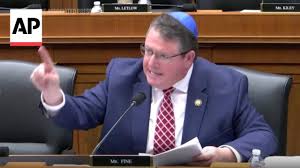



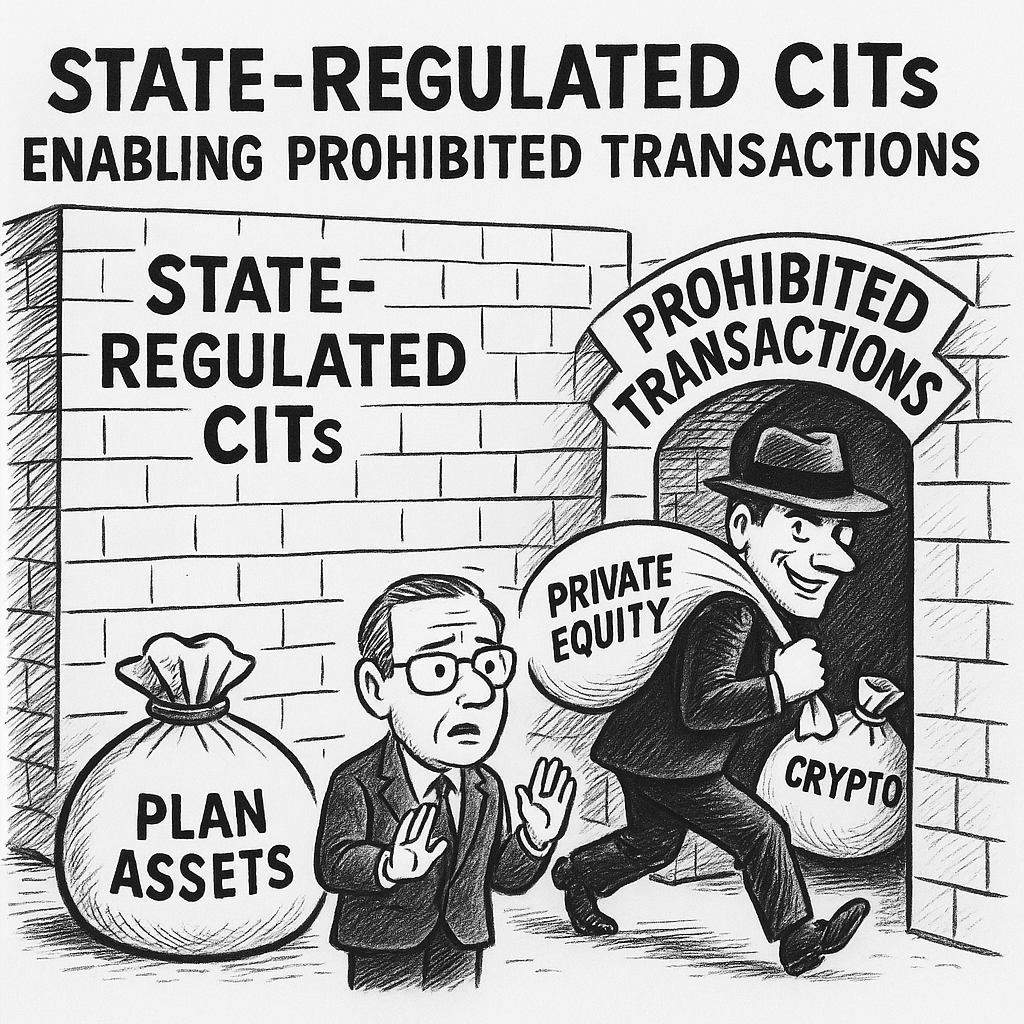
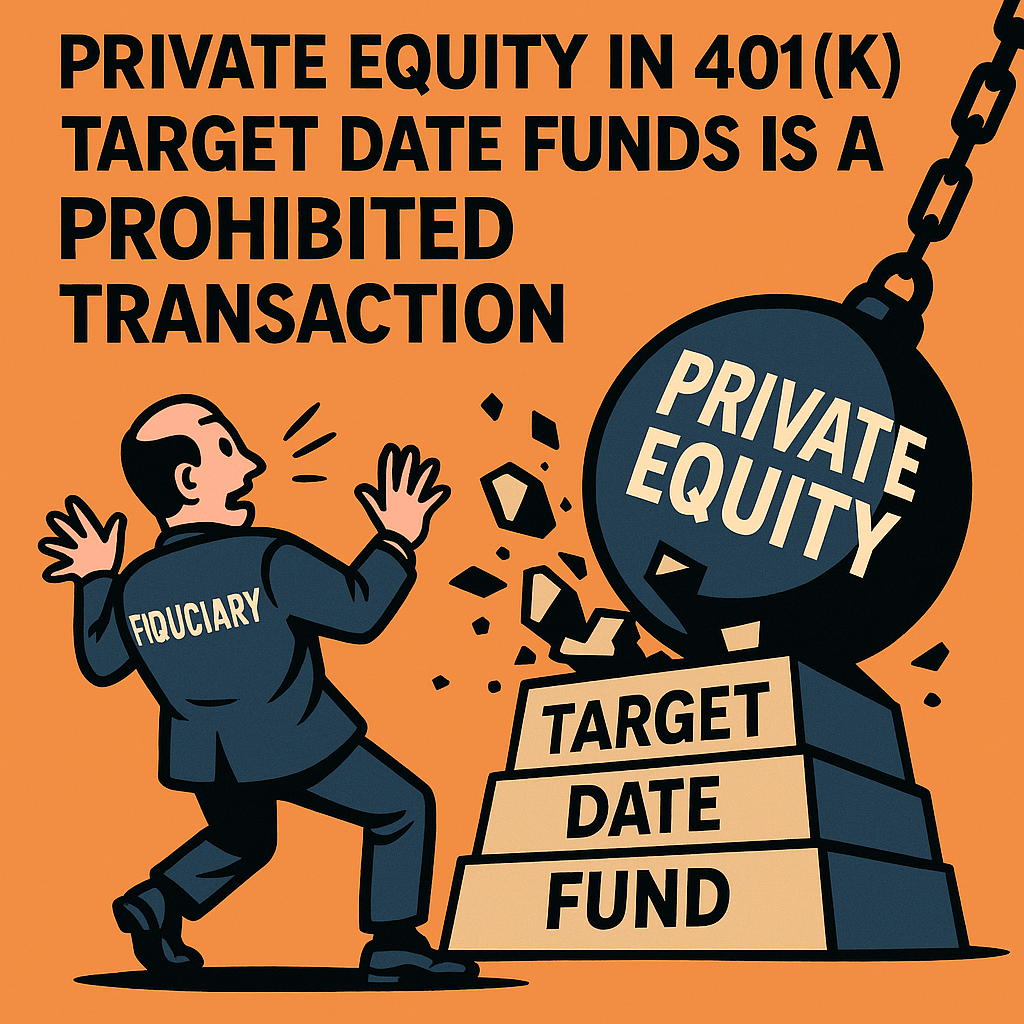



 The CommonSense 401k Project