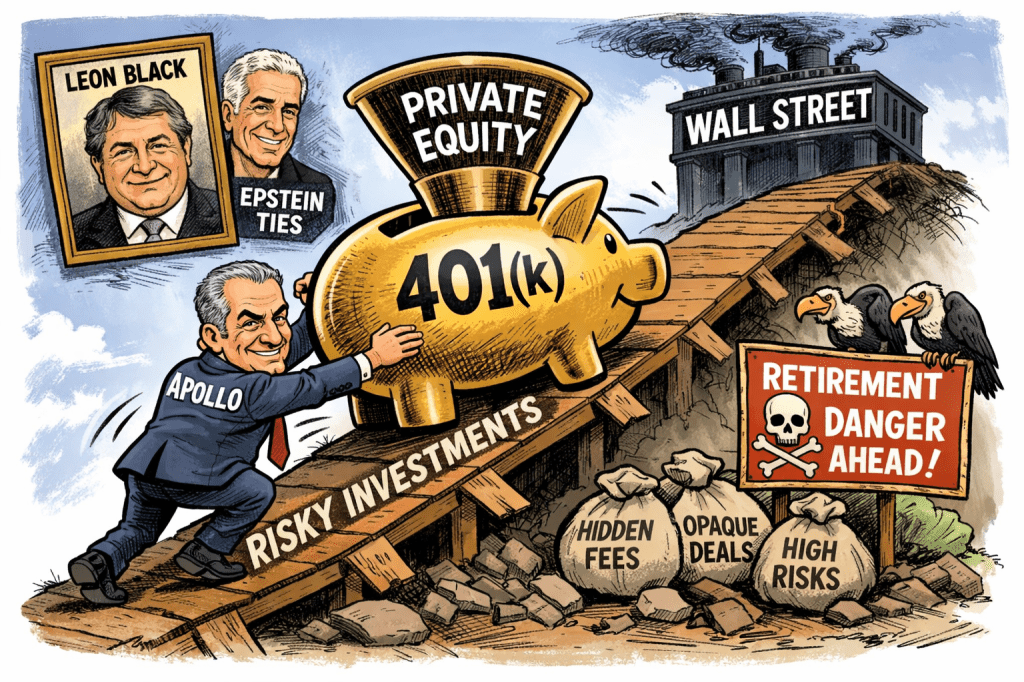
Wall Street never stops looking for a new pool of captive money. Now Apollo Global Management — the firm long shadowed by Jeffrey Epstein through co-founder Leon Black — is pushing to move deeper into America’s 401(k) system under CEO Marc Rowan. That push is no longer theoretical. Reuters reported in August 2025 that Rowan publicly welcomed an expected Trump administration move to channel more retirement assets into private markets, saying he believed the industry was “on the cusp” of serving the 401(k) and defined-contribution marketplace and that regulatory changes to make this easier were “common sense.”
The timing could hardly be more revealing. In February 2026, Apollo and Schroders announced a partnership that includes a collective investment trust for the U.S. defined-contribution market, targeted for launch in the second quarter of 2026. Schroders was recently purchased by TIAA division of Nuveen. Empower also set up deals with Apollo to put private assets into 401(k)s. Reuters and Apollo’s own announcement described the project as a retirement product blending public and private exposures for the defined-contribution channel. In other words, Apollo is not merely cheering from the sidelines. It is building the distribution pipe.
This is exactly the danger. Private equity has always depended on opacity, delayed pricing, layered fees, insider-friendly contracts, and benchmarks that can be manipulated or custom-built. Those features are a scandal in a public pension. In a retail 401(k), where workers are told they have daily liquidity and transparent account values, they become something worse: a structural mismatch between what participants are shown and what they actually own. Your March 6 piece makes that point directly — that private equity often survives in retirement plans only when buried inside more complex wrappers where participants cannot see the contracts, compensation, or valuation mechanics clearly.
That is why the political and regulatory backdrop matters so much. On August 7, 2025, the White House issued an executive order explicitly aimed at “democratizing access” to alternative assets in 401(k) plans and directed the Labor Department and SEC to facilitate that access. The Department of Labor then issued Advisory Opinion 2025-04A in September 2025, expanding the room for products housed in variable annuities, CITs, and pooled vehicles to qualify within QDIA-type structures. At the same time, SEC Commissioner Mark Uyeda gave a November 2025 speech urging broader access to private markets in defined-contribution plans. The direction of travel has been unmistakable: open the gates, soften the guardrails, and normalize illiquid, hard-to-price products in retirement plans built for ordinary workers.
But disclosure has not kept pace — not remotely. Your February 2026 comment letter to DOL laid out the core defect: participants often are not given full look-through holdings, underlying manager identities, layered fees, affiliate relationships, embedded insurance exposures, or even clarity about who regulates the product. As you wrote there, electronic delivery cannot solve a substantive transparency failure; it merely “accelerates opacity.” That criticism applies with even greater force to private-equity-laced CITs and hybrid retirement products.
The accounting problem is just as severe. In my “4 Sets of Books” piece, I noted that private assets inside 401(k)s are commonly valued using Level 3 inputs and often priced by managers or appraisers chosen by managers. That means the same firms collecting the richest fees are often closest to the marks participants are asked to trust. The more private assets migrate into 401(k) structures, the more retirement savers will be forced to rely on numbers that are neither market-clearing nor independently testable in real time.
And this is where Apollo’s own credibility problem becomes impossible to ignore. Just last week, Reuters reported that Apollo, Leon Black, and Marc Rowan were sued by shareholders who allege they concealed business ties to Jeffrey Epstein for years. Reuters also reported in February that Apollo publicly stated Rowan had no business or personal relationship with Epstein as scrutiny intensified. Whether Apollo ultimately prevails in that litigation is not the point here. The point is simpler and more devastating: one of the firms most aggressively seeking access to America’s retirement savings is simultaneously defending itself against allegations that it misled investors about its Epstein-related business ties. That is not a due diligence green flag. That is a fiduciary siren.
This is why Marc Rowan’s “common sense” line should be turned on its head. Common sense says that a private-equity giant born in secrecy, enriched by hidden fee structures, and still engulfed in Epstein-related fallout should not be handed a new franchise over workers’ nest eggs. Common sense says that 401(k)s are not venture-capital pools, not valuation laboratories, and not a bailout mechanism for an industry desperate for fresh retail capital as institutional investors push back on fees, illiquidity, and disappointing net returns. Common sense says that if a product cannot survive full fee transparency, clear legal accountability, independent valuation, and easy participant comprehension, it does not belong in a retirement plan.
Apollo’s campaign is not about democratizing finance. It is about democratizing extraction. The private-equity industry sees trillions sitting in 401(k)s and wants in. Marc Rowan is trying to lead that march. Fiduciaries, regulators, unions, and participants should say no — before workers discover too late that their retirement plan has become just another permanent-capital vehicle for Wall Street.
TIAA Traditional has long been marketed to professors, researchers, hospital workers, and nonprofit employees as the gold-standard “safe” retirement product. That sales pitch depends on one central illusion: that a general-account annuity can be treated like a conservative bond substitute when, in reality, it is a conflicted insurance product issued by the very financial institution profiting from the spread, controlling the crediting rate, and locking participants into liquidity restrictions they often do not understand until it is too late. TIAA’s own materials and even a favorable outside guide confirm the basic structure: TIAA Traditional is backed by TIAA’s General Account, not by a segregated portfolio owned by participants, and many contract forms restrict withdrawals to multi-year installment windows rather than true daily liquidity.
That matters far more after Cunningham v. Cornell. In April 2025, the Supreme Court held that ERISA plaintiffs alleging a prohibited transaction under §406(a) do not have to negate exemptions at the pleading stage; the Court specifically described TIAA and Fidelity as service providers and therefore parties in interest in the Cornell plans. In plain English, that means a fiduciary who causes plan assets to flow to TIAA through a conflicted annuity structure has stepped directly into prohibited-transaction territory unless TIAA or the fiduciaries can prove an exemption. The old defense playbook—forcing plaintiffs to plead around exemptions before discovery—has been badly weakened.
TIAA Traditional is exactly the sort of product that should trigger that scrutiny. The insurer sets the crediting rate. The insurer holds the assets on its own balance sheet. The insurer decides how much of the underlying yield to pass through and how much to retain. And the insurer has every incentive to preserve a hidden spread for itself. That is not arm’s-length pricing. That is not transparent compensation. It is the classic structure of a party in interest dealing with plan assets through a proprietary product whose economic terms are largely invisible to participants and, too often, to fiduciaries themselves. My September 2025 NB Cpiece put the hidden spread at roughly 120 to 150 basis points annually and noted that TIAA still would not disclose what it earns, calling the information “competitive and proprietary.” NBC’s 2024 investigation likewise reported whistleblower allegations that TIAA pushed higher-cost in-house products to shore up losses elsewhere, while the later Rhode Island reporting described participants trapped in opaque, illiquid TIAA products with undisclosed costs and little practical exit.
The conflict does not disappear because TIAA Traditional carries a guarantee. A guarantee from the same conflicted insurer is not a cure for conflicted dealing. It is part of the product being sold. And the positive review you pointed to, far from rebutting the prohibited-transaction case, actually reinforces it. The uploaded Scholar Financial guide explains that TIAA Traditional is backed by TIAA’s General Account; states that legacy RA and GRA contracts are “highly restricted”; and acknowledges that many withdrawals must be paid through a Transfer Payout Annuity in 10 annual installments, while Retirement Choice contracts may require 84 monthly installments. It also highlights that more liquid versions of the product usually offer lower crediting rates, which is simply another way of admitting that participants are being paid less or more depending on how much liquidity they surrender to TIAA. That is not a plain-vanilla fixed income investment. It is a proprietary insurance bargain in which TIAA prices the lockup, controls the spread, and captures the economics.
The balance-sheet risk is also far uglier than the marketing implies. TIAA says the General Account is invested mostly in public and private fixed income, high-grade commercial mortgage loans, Treasuries, high-yield fixed income, structured credit, and alternatives. Dr.Lambert and I published an article that compares the TIAA underlying portfolio to that of the Vanguard RST stable value fund. Vanguard holds 74% in high-quality (AA and above) rated securities, while TIAA only holds 12.5% in rated securities. While the Vanguard is nearly 96% liquid in public securities, the TIAA portfolio is only 48% liquid. Many of the AA fixed-income securities they tout are illiquid private credit and private mortgage contracts rated by 2nd-tier rating agencies. https://www.tandfonline.com/doi/full/10.1080/00213624.2026.2613361
It is a massive, opaque insurer portfolio with material exposure to precisely the sectors—private credit, structured credit, commercial real estate, and illiquid fixed income—where price discovery can break down, and smoothing can mask deterioration. Participants are told they own something steady. In truth, they are depending on TIAA’s internal accounting, asset-liability management, and discretionary crediting decisions.
That is why the “low risk” story around TIAA Traditional is so misleading. As your January 2026 critique of TIAA’s target-date research argued, the product looks less volatile than bonds mainly because it is not marked to market; the risk is hidden on the insurer’s balance sheet while returns are smoothed through discretionary crediting. TIAA’s own consultant-facing materials continue to market TIAA Traditional as something that can “complement bonds” and improve portfolio stability, but that framing sidesteps the central fiduciary question. A plan fiduciary is not allowed to call something safe merely because the danger is hard to see. If a product concentrates participants in the credit risk of one insurer, pays undisclosed spread compensation to that insurer, and relies on opaque internal valuation and crediting practices, it is not a clean bond alternative. It is a conflicted insurance product.
The stable-value comparison is devastating for TIAA. As you argued in your March 2026 and December 2025 pieces, diversified synthetic stable value is structurally different because it typically relies on diversified underlying fixed-income holdings and wrap contracts rather than a single insurer’s general account. Even the industry has been forced to acknowledge that synthetic funds can be safer in important respects. Once that point is conceded, the legal problem for TIAA Traditional becomes harder to avoid. If fiduciaries have access to less-conflicted, more transparent, more diversified capital-preservation options, why are they steering participants into a proprietary general-account annuity issued by a party in interest that retains an undisclosed spread and imposes heavy liquidity restraints? That is exactly the sort of question §406 exists to force into daylight.
The defenders of TIAA Traditional will say the product has paid competitive credited rates for decades, has strong insurer ratings, and has served educators well. But none of those points resolves the ERISA problem. A prohibited transaction does not become lawful because it produced decent historical returns. Hidden compensation does not make one loyal merely because the counterparty is prestigious. And liquidity restrictions do not become prudent because some participants failed to read the contract. The issue is structural conflict: TIAA is on both sides of the deal. It designs the product, manages the balance sheet, sets the crediting rate, withholds the spread, and then asks fiduciaries to place retirement assets into that structure without full price transparency. That is the very type of self-interested arrangement ERISA was written to police.
NBC’s reporting should have ended the complacency. The 2024 whistleblower story alleged TIAA pushed costly proprietary products to cover losses elsewhere. The latter Rhode Island story showed what these structures can look like on the ground: workers stuck in products they cannot freely access, with costs and restrictions far murkier than the sales pitch suggested. Put that together with the Court’s recognition in Cunningham that TIAA is a party in interest, and the legal theory becomes straightforward. When ERISA fiduciaries place plan assets into TIAA Traditional, they are not merely selecting a conservative retirement option. They are causing the plan to transact with a conflicted insurer through a proprietary annuity contract whose compensation is opaque, whose liquidity is restricted, and whose risks are hidden behind insurance accounting. That is why TIAA Traditional should be analyzed not as a benign “guaranteed” option, but as a prohibited transaction waiting to be litigated.
The real scandal is that TIAA’s aura of public-mindedness still disarms scrutiny. For generations, TIAA wrapped itself in the language of education, service, and retirement security. But ERISA does not have a nonprofit halo exception. It does not excuse undisclosed spread extraction because the logo looks trustworthy. It does not permit fiduciaries to ignore single-entity credit concentration because the insurer has a long history. And after Cunningham, it no longer makes sense to pretend that party-in-interest status is some technical sideshow. TIAA Traditional is a general-account annuity sold by a party in interest, with hidden spread economics, heavy liquidity limitations, and opaque balance-sheet risk. That is not merely imprudent. Under a faithful reading of ERISA, it is prohibited.
The stable value industry’s own trade association inadvertently exposes the structural problem with general-account fixed annuities in retirement plans. I agree that these lawsuits against low-risk diversified synthetic-based stable value are baseless and harmful.
In recent amicus briefs filed in federal ERISA litigation, the Stable Value Investment Association (SVIA) explains that stable value products fall into several very different categories. Synthetic stable value products—individually managed accounts and pooled funds—hold the underlying bond portfolios directly for the benefit of the retirement plan. Insurance company products, by contrast, are issued and guaranteed by a single insurance company and backed by that insurer’s general account. https://www.stablevalue.org/svia-and-u-s-chamber-of-commerce-file-amicus-brief/
That seemingly technical distinction is the entire ballgame. In a synthetic stable value structure, the retirement plan owns the underlying assets—typically diversified portfolios of high-quality bonds—and insurance “wrap” providers merely guarantee book-value liquidity. The plan therefore, retains ownership of the portfolio and diversifies credit risk across many issuers.
In a general-account annuity, the plan owns nothing. The assets are commingled with the insurance company’s liabilities and participants become general creditors of the insurer. Their retirement security therefore, depends on the solvency of a single financial institution.
This difference is not subtle. It is a fundamental transformation of a retirement plan asset into an insurance company liability. The SVIA briefs also acknowledge another crucial difference: compensation structures. Synthetic stable value funds typically charge explicit, disclosed fees, while insurance company products often compensate themselves through an undisclosed “spread” between the insurer’s investment earnings and the crediting rate paid to participants.
That spread structure creates a classic ERISA prohibited transaction. Under ERISA §406, a fiduciary may not cause the plan to engage in a transaction that allows a service provider to receive undisclosed or excessive compensation from plan assets. Yet the spread in a general-account annuity is not negotiated as a transparent fee. Instead, the insurer keeps whatever investment earnings exceed the declared crediting rate, a figure that participants and fiduciaries often cannot observe or benchmark.
In other words, the insurance company is simultaneously:
the issuer of the product,
the manager of the assets,
the counterparty to the contract, and
the party determines its own compensation.
No independent market mechanism exists to test whether that spread is reasonable. The SVIA briefs further note that general-account products are “offered and guaranteed by a single insurance company.” That means participants bear concentrated exposure to one insurer’s credit risk, while the insurer captures the upside from investing the assets.
Synthetic stable value does the opposite. Credit risk is diversified across many bonds and multiple wrap providers, fees are disclosed, and the plan retains ownership of the portfolio.
In short:
Structure
Asset Ownership
Credit Risk
Fees
Synthetic Stable Value
Plan trust owns bonds
Diversified
Explicit
General Account Annuity
Insurer owns assets
Single insurer
Hidden spread
The insurance industry likes to present general-account products as “guaranteed.” But the guarantee is only as strong as the issuing insurer. History provides many reminders—from Executive Life to more recent insurance failures—that these guarantees are far from risk-free.
From a fiduciary perspective, the problem is not simply that general-account annuities carry more credit risk. The problem is that they combine opaque compensation, single-entity credit exposure, and self-dealing by the product issuer.
Those characteristics are precisely the types of conflicts ERISA’s prohibited-transaction rules were designed to prevent.
Synthetic stable value products demonstrate that another structure is possible—one where the plan retains ownership of the assets, fees are transparent, and risks are diversified.
Which raises the obvious question fiduciaries should be asking:
If a transparent, diversified structure exists, why place retirement assets into opaque general-account contracts where the insurer controls the assets, determines its own compensation, and concentrates credit risk in a single institution?
Under ERISA’s strict prohibited-transaction framework, that question may eventually have a simple answer. Because they never should have been there in the first place.
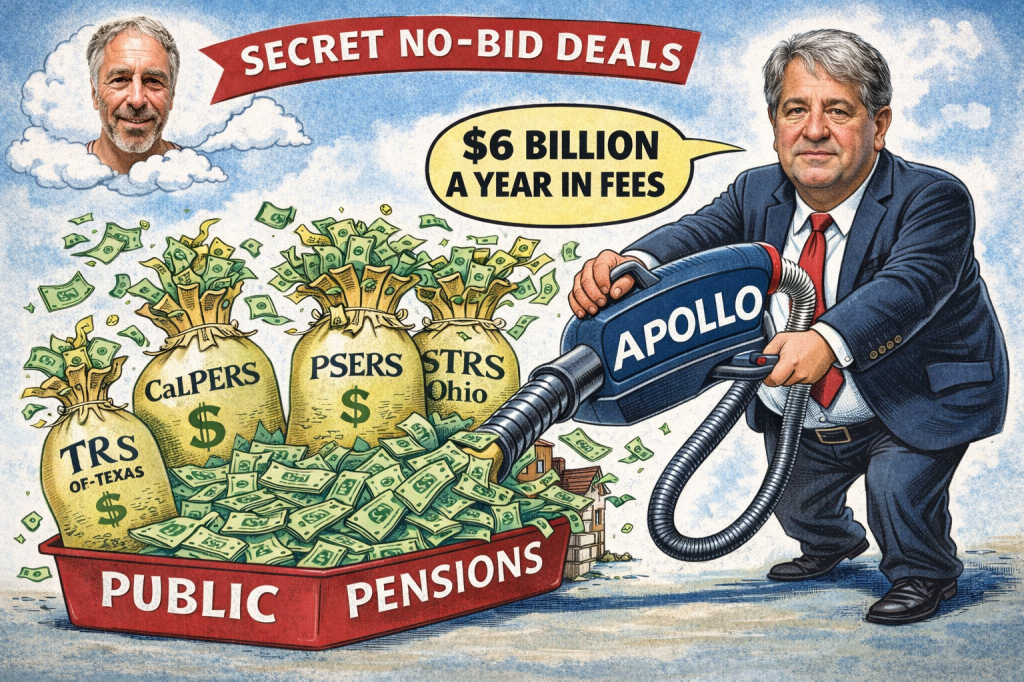
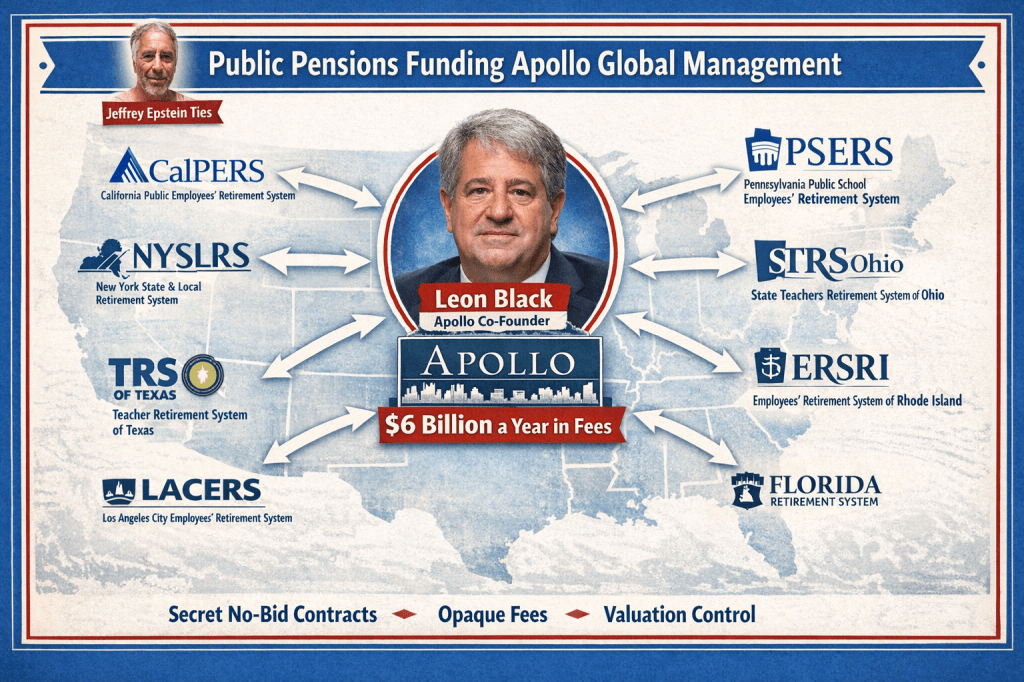
Public pensions across the United States may be paying as much as $6 billion a year to Apollo Global Management through a web of secret private equity and private credit contracts that most beneficiaries, taxpayers, and often even trustees themselves are never allowed to see. That estimate is not pulled out of thin air. It comes from combining two facts the industry would rather not discuss at the same time.
First, Apollo co-founder Joshua Harris admitted at a 2013 meeting of the Philadelphia Board of Pensions that the firm’s capital base was overwhelmingly dependent on public retirement systems. Asked directly whether Apollo had many public pension investors, Harris responded bluntly that “almost all” of Apollo’s capital came from public funds, estimating that roughly 75% to 80% of Apollo’s capital was supplied by public pension plans. https://www.phila.gov/pensions/PDF/IM_03_28_13_Investment_Minutes.pdf
Second, academic research by Oxford finance professor Ludovic Phalippou has repeatedly estimated that the true economic cost of private equity—including management fees, carried interest, transaction fees, monitoring fees, and portfolio-company charges—can reach 600 basis points annually, or roughly 6% of invested capital.
If public pension plans collectively have roughly $100 billion invested with Apollo, applying Phalippou’s cost estimate produces a staggering result: roughly $6 billion per year flowing from public retirement systems to one private equity firm. Even if the estimate is imprecise, the order of magnitude is the point. These are not marginal fees. They represent a massive transfer of retirement wealth from teachers, firefighters, public employees, and ultimately taxpayers to Wall Street managers operating under contracts that remain hidden from the public whose money is at stake.
And those contracts raise serious legal questions. During my time as a trustee of the Kentucky Retirement Systems, I repeatedly asked to see the private equity partnership agreements governing these investments. Like many trustees across the country, I was told they were confidential. Trustees responsible for billions of dollars of public pension assets were effectively asked to approve investments whose governing legal documents could not be publicly disclosed.
Only through a rare discovery process during a federal investigation was I able to obtain a number of these contracts. In 2014 I provided eleven of them to Naked Capitalism’s trove archive, and around the same time, the Pennsylvania pension system accidentally disclosed twelve private equity agreements, including the Apollo Investment Fund VIII Limited Partnership Agreement. https://trove.nakedcapitalism.com/LPAs/verified-as-LPAs/Apollo_Investment_Fund_VIII_LPA_S1.pdf The industry response was immediate: the documents were quickly pulled down after Apollo became aware of the disclosure. Fortunately, the files were captured during a brief window and preserved.
Those documents revealed what public pension beneficiaries are normally forbidden to see.The Apollo contract shows a structure that places enormous power in the hands of the general partner while sharply limiting oversight by investors. Valuation authority rests largely with the manager itself. Broad indemnification provisions protect the firm from liability except in cases of extreme misconduct. The agreement allows Apollo to operate parallel vehicles and affiliated funds while maintaining discretion over allocations across them. So called Advisory boards exist but are mostly boondoggles to wine and dine pension staff so they keep their secrets. https://www.bloomberg.com/authors/AR2mdR8I6A4/neil-weinberg
In other words, the manager holds the authority, the protections, and the conflicts—while the pension system holds the capital and the risk. I believe this would be found to be illegal in many states. This structure is not accidental. It is precisely why the contracts must remain secret. Public pension funds are not private investors deploying personal wealth. They are public trust funds, governed by state constitutions, fiduciary statutes, and procurement rules designed to protect taxpayer resources. Trustees of these systems have a duty to act solely in the interest of beneficiaries and to manage funds prudently and transparently.
Yet private equity allocations frequently bypass the procurement safeguards that apply to almost every other form of public spending. Instead of competitive bidding or documented market comparisons, staff and consultants typically recommend a specific private equity fund and negotiate privately with the manager. The board is then presented with a take-it-or-leave-it opportunity framed as a limited investment window.
In effect, multi-billion-dollar investment mandates are awarded through secret no-bid contracts.
In any other context involving public funds—construction projects, infrastructure contracts, or technology procurement—such arrangements would immediately trigger investigations into favoritism or corruption. But in the world of private equity, this process has become routine.
The secrecy itself may conflict with state open-records laws and fiduciary obligations. Pension assets are public trust funds, and fiduciaries generally cannot bind those assets under contracts that prohibit disclosure of the governing terms. Yet private equity partnership agreements routinely contain confidentiality provisions preventing the public from seeing fee structures, conflict provisions, valuation policies, and indemnification clauses.
When beneficiaries cannot see the contracts governing their retirement money, meaningful accountability disappears.
The valuation provisions in these contracts are particularly troubling. Private equity managers typically retain substantial control over how portfolio assets are valued. Those valuations determine reported performance, and performance determines both carried interest and the ability to raise new funds. When the same party that profits from strong valuations also controls the valuation process, the conflict of interest is obvious.
Under traditional fiduciary law, trustees are expected to maintain independent oversight over the valuation of trust assets. Delegating that authority to a counterparty whose compensation depends on the outcome would normally raise serious red flags. Yet in private equity, that structure has become standard practice.
Broad indemnification provisions compound the problem. Many LPAs shield the general partner from liability except in cases of extreme misconduct, limiting investors’ ability to pursue claims even if negligent decisions damage the fund. Public pension trustees generally cannot waive legal protections on behalf of beneficiaries in this way without careful justification.
Taken together, the secrecy, valuation control, indemnification protections, and absence of competitive procurement raise the possibility that many private equity contracts are inconsistent with the fiduciary duties imposed on public pension trustees under state law. But even if the legal issues were ignored, another problem looms.
Public pension funds appear increasingly reluctant to confront the true value of their private equity and private credit portfolios. As markets tighten and private credit defaults rise, there is growing evidence that many assets may be significantly overvalued. If these holdings were forced into the open market today, they might clear at 70 cents on the dollar or less, revealing billions in hidden losses.
The consequences of acknowledging those losses would be enormous. Funding ratios would decline. Consultants’ performance claims would collapse. And pension staff—many earning $300,000 or more annually with bonuses tied to reported investment performance—could see compensation sharply reduced or even face clawbacks. The incentives to delay recognition of those losses are therefore powerful.
Many pension trustees are appointed by political officials. Those officials operate in a post-Citizens United political environment where private financial firms, including Apollo and their executives, can legally contribute vast sums to political organizations and super PACs secretly. Whether or not such contributions influence pension investment decisions, the appearance of conflict is impossible to ignore.
Apollo, via its debt control of Gannett, controls the main state media in many of the markets, especially state capitols of the below-mentioned Public Pension Plans, like the Columbus Dispatch, Tallahassee Democrat, Springfield (IL) State Journal, Austin American-Statesman. Indianapolis Star, Des Moines Register, Topeka Capital-Journal, Lansing State Journal, Jackson Clarion-Ledger, The Providence Journal.
Apollo was founded by Leon Black, whose relationship with convicted sex trafficker Jeffrey Epstein ultimately forced Black to step down as CEO after it was revealed that he had paid Epstein more than $150 million for financial services. This caused serious divestiture talks in 2019 and 2020 that CEO Marc Rowan calmed by saying Epstein’s involvement was limited to Leon Black personally and that it was for tax advice. New Epstein files released in February 2026 document that Rowan was lying and that his and Apollos’ involvement with Epstein was extensive. The Teachers Unions AFT and AAUP have filed a complaint with the SEC and a civil class action has been filed against Apollo for lying about its Epstein involvement. www.aft.org/sites/default/files/media/documents/2026/Letter_to_SEC_re_Apollo_Global_Management_February_17_2026.pdf
Not because private equity is inherently illegitimate, and not because every Apollo investment has failed. But because fiduciaries cannot responsibly commit public retirement assets to opaque, no-bid contracts that place enormous power in the hands of private managers while denying transparency to the public whose money is at stake. Apollos recent issues around Epstein strain their credibility as a manager of public funds. https://commonsense401kproject.com/2026/02/05/the-apollo-epstein-files-why-public-pensions-should-reopen-the-2019-divestment-debate/
The longer pensions remain entangled in this system, the greater the risk that hidden losses, undisclosed conflicts, and legal challenges will eventually surface. When that day comes, retirees and taxpayers will ask a very simple question:
Why did no one act sooner?
A partial list of over 58 pensions that hold Apollo is below.
Alaska Permanent Fund Apollo PE funds
Arizona PSPRS Apollo PE funds
California Public Employees’ Retirement System (CalPERS) Apollo Investment Fund VI and related vehicles
California State Teachers’ Retirement System (CalSTRS) Apollo Investment Funds VI, VII, IX, X; Hybrid Value II
Chicago Teachers Pension Fund 2024 performance confirms Apollo PE/PC as manager
Colorado PERA Apollo Investment Funds III,IV,V,VI, VII, Distresssed DIF
Colorado School Apollo Credit Opp III & DIF
Connecticut Retirement Plans & Trust Funds Apollo Investment Fund VIII
Florida State Board of Administration Apollo PE funds IV, V PC Accord V and VI
Georgia Teachers Retirement System
Idaho PERSI Apollo PE funds
Illinois Teachers Retirement System Apollo PE funds X
Illinois Municipal Apollo Credit Wilshire
Indiana Public Retirement System (INPRS) Apollo Origination Partnership
Iowa Public Employees Retirement System Apollo PE funds Wilshire
Kansas Public Employees Retirement System Apollo PE funds VIII,IX
Kentucky Teachers Apollo REIT & Apollo Stock
Los Angeles City Employees’ Retirement System (LACERS) Apollo PE funds VI
Los Angeles (CA) Water and Power has PE fund X
Louisiana Teachers’ Retirement System of Louisiana (TRSL), Apollo Credit, Natural Resources
Maryland State Retirement & Pension System ?PE funs
Massachusetts PRIM Apollo PE funds
Michigan RS Apollo Investment fund VIII, IX Hybrid Value Funds, Credit/ Opportunistic Credit
Minnesota State Board of Investment Apollo/Athene Dedicated Investment Program II
Mississippi PRS Apollo VIII IX Private Equity funds
Montana Board of Investments Stock holdings?
Nebraska Investment Council India Property Fund II LLC.
New Hampshire Retirement System Apollo PE funds
New Jersey Division of Investment: Stock holdings?
New Mexico State Investment Council Apollo PE VII, VIII PC
New York City Teachers’ Retirement System Apollo PE funds
New York City (NY) ERS PE $500mm 2013
New York City (NY) Police PE fund VI
New York State Apollo PE VIII
North Carolina Retirement Systems Apollo PE funds VI, VII
Ohio Highway Patrol SHPRS: Apollo PE funds
Ohio SERS: “Core Farmland Fund, LP Wilshire
Ohio State Teachers Retirement (STRS) PE Apollo S3 Equity Hybrid Solutions
Ohio Public OPERS Apollo PE funds, Oregon Public Employees Retirement Fund (OPERF), Apollo PE VI, VII, VIII, IX.
Oregon PER recently comitted $300mm to Apollo distressed debt fund as well as earlier funds like Apollo PE IX
Pennsylvania PSERS Apollo PE funds IV $620mm
Pennsylvania SERS Apollo PE funds VI- VIII
Rhode Island Retirement System Apollo PE VIII, IX
San Diego City Employees Retirement System Apollo PE funds
San Francisco (SFERS) San Francisco Employees’ Retirement System Apollo PE funds Wilshire
South Carolina RS $750mm
South Dakota Retirement System Apollo PE funds
Texas County & District PE fund X
Texas ERS Apollo Credit Strategies
Texas Municipal Fund VIII
Texas TRS Teachers’ Retirement Apollo PE funds
Tennessee Consolidated Retirement System Stock holdings?
San Francisco Employees’ Retirement System Apollo PE funds
San Diego City Employees’ Retirement System Apollo PE funds
University of Calfiornia PE VII, VIII Principal Wilshire
Virginia Retirement System Apollo PE funds
Washington State Investment Board (WSIB) Apollo S3 Equity & Hybrid
AI Infrastructure, Epstein Lies, and the Growing Fiduciary Risk
Public pension funds across the United States are quietly helping finance one of the largest artificial-intelligence infrastructure buildouts in the world. But they are doing it through a firm whose credibility with investors should already have been exhausted.
That firm is Apollo Global Management.
Over the past decade, Apollo has built a massive private-equity and private-credit empire fueled by public pension money from teachers, firefighters, and state workers across the country. Now that same capital is being deployed into the booming artificial-intelligence infrastructure industry—particularly hyperscale data centers and GPU compute facilities required for AI systems.
What pension trustees may not fully appreciate is that this new AI infrastructure empire is being built by a firm whose leadership has repeatedly misled investors and the public about its relationship with Jeffrey Epstein, and whose business model increasingly relies on opaque private credit structures and complex financial engineering that reduce transparency for the very public funds financing it.
The problem is not merely reputational.
It is fiduciary.
The New Apollo: From Buyouts to AI Infrastructure
Apollo is no longer just a private-equity buyout firm. It has quietly become one of the largest financiers of digital infrastructure in the world.
Through a combination of private-equity funds, infrastructure vehicles, and private-credit structures, Apollo has built a portfolio of hyperscale data-center developers and AI infrastructure platforms that now stretch across the United States and Europe.
Among the most significant are Stream Data Centers, a U.S. hyperscale data-center developer whose majority stake was acquired by Apollo funds to accelerate a development pipeline exceeding four gigawatts of computing capacity. These campuses are being built in markets such as Dallas, Chicago, Phoenix, and other major cloud corridors.
Apollo infrastructure funds have also invested in Yondr Group, a global developer of hyperscale data-center campuses supporting the rapid expansion of artificial-intelligence computing infrastructure.
In Europe, Apollo infrastructure vehicles acquired a pan-European colocation platform carved out of STACK Infrastructure, creating a network of highly interconnected data-center facilities in cities including Stockholm, Oslo, Copenhagen, Milan, and Geneva.
And in perhaps the clearest example of Apollo’s growing role in AI infrastructure finance, Apollo-managed funds recently led a $3.5 billion financing package supporting a $5.4 billion acquisition and lease of GPU compute infrastructure—including advanced NVIDIA chips—used by a subsidiary of Elon Musk’s artificial-intelligence company xAI.
In other words, Apollo has positioned itself as a central financier of the physical infrastructure behind the AI boom.
But the money for these investments does not originate with Apollo.
It originates with public pensions.
The Pension Money Pipeline
Public pensions do not typically invest directly in data-center campuses or AI hardware. Instead they commit capital to Apollo funds, which pool those commitments and deploy the capital into infrastructure platforms, credit vehicles, and acquisitions.
The capital chain looks like this:
Public pensions → Apollo funds → Apollo infrastructure platforms → AI data centers and compute infrastructure.
The list of pension systems providing capital upstream of Apollo’s infrastructure push is extensive.
Major systems with documented commitments include the California State Teachers’ Retirement System (CalSTRS), the California Public Employees’ Retirement System (CalPERS), the Indiana Public Retirement System, the Connecticut Retirement Plans and Trust Funds, and the State Teachers Retirement System of Ohio.
CalSTRS alone has committed hundreds of millions of dollars across multiple Apollo private-equity funds and hybrid-value vehicles. CalPERS has also committed hundreds of millions to Apollo partnerships.
Ohio’s teacher pension system has been reported to have roughly $600 million invested in Apollo private-equity partnerships.
Across the country, other systems—including pensions in Pennsylvania, Oregon, Washington, Colorado, Arizona, Florida, Texas, North Carolina, Illinois, Iowa, Kansas, Rhode Island, and Massachusetts—have also committed capital to Apollo vehicles.
Because these investments are made as limited-partner commitments to private-equity funds, pension trustees often cannot see exactly where their capital ultimately flows. But economically the pipeline is clear.
Public pensions provide the capital base.
Apollo deploys it.
And increasingly it is being deployed into AI infrastructure.
The scale of this capital flow is enormous.
The Epstein Problem That Never Went Away
Apollo’s rapid expansion into infrastructure is occurring while the firm still struggles with the shadow of its founder’s relationship with Jeffrey Epstein.
Apollo co-founder Leon Black paid Epstein more than $150 million for purported tax and estate planning services. Investigations later revealed that Epstein had also helped introduce Black to a network of wealthy investors.
For years, Apollo attempted to portray the relationship as a purely professional advisory arrangement.
But multiple investigations, documents, and witness testimony have painted a far more troubling picture of the firm’s culture and leadership.
More recently, Apollo CEO Marc Rowan has repeatedly attempted to minimize the firm’s connections to Epstein and characterize the scandal as a closed chapter.
Yet new disclosures and reporting continue to contradict that narrative.
For public pension trustees, the issue is not merely reputational embarrassment. It raises a fundamental fiduciary question.
Why are public pension funds still allocating billions of dollars to a firm whose leadership misled investors and the public about one of the most notorious financial scandals in modern history?
The AI Gold Rush—and the Transparency Problem
Apollo’s push into artificial-intelligence infrastructure is also occurring in an investment environment that is becoming increasingly opaque.
Unlike traditional infrastructure investments such as toll roads or airports, AI data centers often involve complicated financing structures combining private equity, infrastructure funds, structured credit, and long-term leasing arrangements tied to cloud and AI companies.
These structures can obscure the true economic exposure and risk borne by investors.
Public pension trustees may believe they are investing in diversified private-equity funds. In reality, portions of their capital may be concentrated in highly leveraged infrastructure bets tied to the volatile AI technology cycle.
In addition, Apollo has become one of the largest players in private credit, a market where assets are rarely marked to market and valuations can remain artificially stable even as underlying credit risk deteriorates.
That lack of transparency creates a dangerous combination:
• opaque asset valuations • illiquid infrastructure assets • complex credit structures • and limited disclosure to public pension investors.
When these risks are layered onto the governance concerns surrounding Apollo’s leadership history, the fiduciary implications become increasingly difficult to ignore.
The Fiduciary Case for Divestment
Public pension trustees have a legal obligation to act solely in the interests of plan beneficiaries.
That duty includes evaluating not only financial risk but also governance risk, reputational risk, and the credibility of investment managers entrusted with billions of dollars of retirement savings.
Apollo now presents all of those risks simultaneously.
It is a firm whose founder’s relationship with Jeffrey Epstein became one of the largest governance scandals in modern finance.
It is a firm that has repeatedly attempted to minimize or obscure that relationship.
And it is a firm whose current growth strategy depends heavily on opaque private-credit structures and infrastructure investments that public pension trustees may struggle to fully evaluate.
The AI infrastructure boom may ultimately prove profitable.
But fiduciary duty does not require pensions to finance it through a manager whose credibility has been compromised and whose investment structures reduce transparency.
Public pension systems have divested from firms in the past over far less serious concerns.
They have divested over political controversies, environmental risks, and governance failures.
If fiduciary standards mean anything, they should apply equally to Apollo.
The Question Trustees Must Now Ask
Across the United States, teachers and public workers are unknowingly helping finance a global network of artificial-intelligence data centers through investments in Apollo funds.
Most beneficiaries likely have no idea that their retirement savings are being routed through a firm tied to one of the largest financial scandals of the past decade.
Nor do they know that the same capital is helping build the physical infrastructure behind the AI boom.
Public pension trustees must now confront a simple question.
Should the retirement savings of millions of teachers and public employees continue to finance the expansion of a firm whose credibility with investors was shattered by the Epstein scandal?
Or is it time for pensions to finally do what they should have done years ago:
The private credit boom has been built on a simple premise: that loans held inside private funds are somehow safer, smoother, and more stable than those traded in public markets. Pension boards and insurance regulators have been told repeatedly that these assets produce steady income, modest volatility, and superior returns compared with traditional bonds. But the illusion of stability rests almost entirely on one thing — the ability of managers to avoid marking their portfolios to market. When assets do not trade, managers get to decide what they are worth.
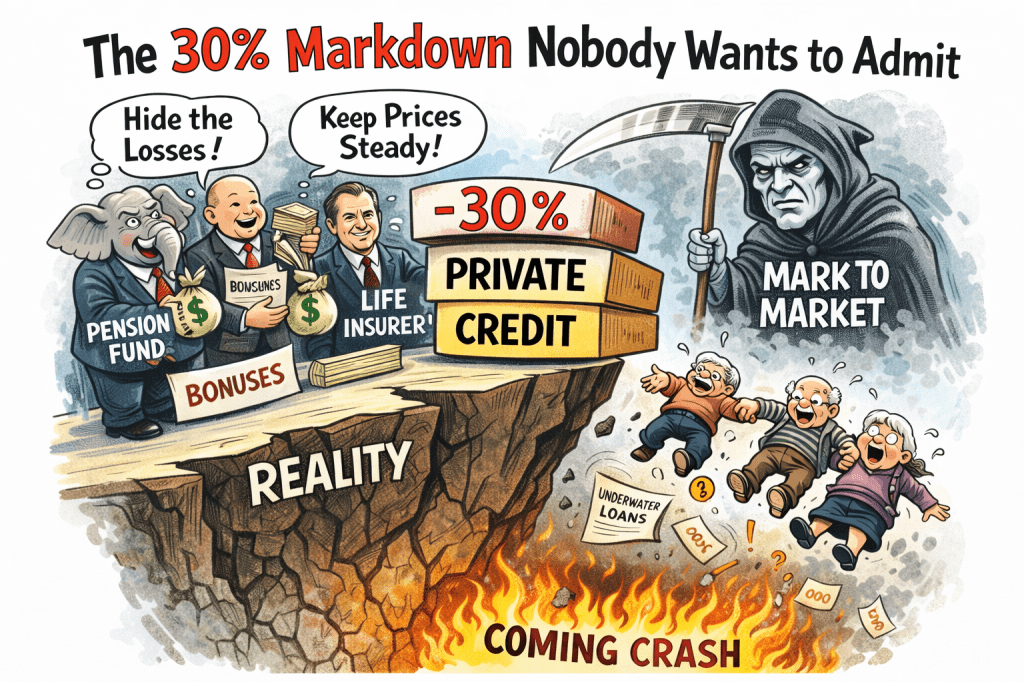
Recent market signals suggest that if private credit were forced into real price discovery today, the markdown would be severe. Secondary market bids for private credit funds have appeared at roughly 65 cents on the dollar, implying discounts of about 35% to stated net asset value. That is not a theoretical model; it is what buyers are actually willing to pay for exposure to these portfolios right now. Even industry research has quietly acknowledged that private market assets often require discounts of 11–20% just to transact. The market is telling us something clear: the values reported by many funds likely exceed what investors could realize in a forced sale.
Loans are marked quarterly using appraisal-style methodologies, comparable transactions, and manager estimates. Unless a borrower defaults outright, there is often no requirement to reflect the deterioration in market value that occurs as credit spreads widen or financing conditions worsen. In other words, a loan can lose a large portion of its economic value while the accounting value barely moves.
That is why defaults are such a misleading indicator of the true damage. Fitch reported recently that private credit defaults reached 9.2% in 2025, the highest level recorded. But defaults are only the visible failures — the tip of the iceberg. In most credit cycles the bulk of losses occur not because loans immediately default, but because their market value declines long before that point. When portfolios are not marked to market, those losses remain hidden until they can no longer be ignored.
Public pensions have powerful incentives to delay that moment. Large allocations to private credit and other alternative assets have been used to justify bonuses, consultant fees, and claims of superior performance. A sudden mark-to-market adjustment could expose years of overstated returns and raise uncomfortable questions about governance and oversight. Honest pricing could cause serious scandals around pay-to-play since most Private Credit vehicles are in secret no-bid contracts many offshore. The temptation to smooth valuations, delay recognition, and hope that markets recover is enormous.
Life insurers face a similar dilemma. The insurance industry now holds enormous volumes of private credit, particularly through structures associated with asset managers like Apollo and affiliated insurers such as Athene. For insurers, recognizing large valuation losses can trigger credit-rating pressure and regulatory scrutiny. As a result, there is strong incentive to rely on model-based valuations rather than market prices for as long as possible. In some cases the only external signal of rising risk may come from the derivatives market, where credit default swaps begin to price in deterioration long before accounting values change.
This dynamic creates a dangerous illusion. Reported values remain stable while economic values erode underneath them. When losses finally appear — often through defaults or forced sales — they arrive suddenly and in concentrated bursts. By that point the markdown reflects only the loans that have already collapsed, while the broader decline in portfolio value has been ignored for years.
If private credit portfolios were forced into true market pricing today, the evidence suggests the haircut could easily approach 30 percent or more across many strategies. That number is uncomfortable, but it aligns with what secondary buyers are already implying and with the discounts required to move private assets in stressed conditions. The danger is not simply the loss itself. It is the delayed recognition.
By postponing market pricing, pension systems and insurers risk transforming what could have been a gradual adjustment into a much larger reckoning later. The longer valuations remain detached from reality, the more dramatic the correction becomes when markets finally impose discipline.
The private credit boom promised stability. But stability created by accounting discretion rather than market pricing is not stability at all. It is simply a markdown waiting to happen — and the longer it is delayed, the larger it is likely to be.
Legal Appendix: When Private Credit Lies Meet ERISA
The growing exposure of retirement systems to private credit creates a legal risk that few pension sponsors appear to be acknowledging.
Private credit assets are typically not marked to market. Their valuations are often based on internal models or manager-supplied estimates rather than observable market prices. That creates the possibility that pension plans are carrying assets at inflated values.
If those valuations are overstated, the consequences extend far beyond investment performance.
They affect ERISA compliance and federal insurance premiums.
Defined benefit pension plans insured by the Pension Benefit Guaranty Corporation (PBGC) must pay annual variable-rate premiums based on underfunding levels. The stronger a plan’s funding ratio appears, the lower its PBGC premium.
But funding ratios depend directly on the reported value of plan assets.
If private credit assets are carried above their true economic value — for example, if the market would impose the kind of 20–30% markdowns increasingly discussed in credit markets — then pension funding ratios are overstated.
Overstated funding ratios mean lower PBGC premiums.
At that point the issue is no longer simply poor investment judgment.
It begins to resemble misrepresentation to a federal insurance program.
The legal exposure does not stop there.
Private credit risks are also surfacing in the annuity market that increasingly replaces pension plans. Pension Risk Transfer (PRT) annuities and fixed annuities in defined contribution plans do not mark liabilities to market either. But credit deterioration eventually reveals itself through two signals markets cannot hide:
Credit rating downgrades, and
Rising credit-default-swap (CDS) spreads, which reflect the market’s real-time assessment of insurer default risk.
When those signals emerge, plaintiffs will inevitably ask a simple question:
Did fiduciaries ignore market evidence that the underlying credit risk was deteriorating?
The Supreme Court’s pending Intel ERISA case may determine whether courts remain able to examine opaque investments like private credit at all. If the Court requires plaintiffs to produce perfect benchmarks before discovery, the practical effect will be to shield private-credit valuations from scrutiny — precisely because those assets lack transparent market pricing.
In other words, the Court may decide whether opacity becomes a legal defense.
If the market ultimately forces the 30% markdown in private credit that many analysts now expect, the legal consequences could cascade through the retirement system:
overstated pension funding ratios,
reduced PBGC premiums based on inflated assets, and
annuity portfolios whose risk was hidden until credit spreads exploded.
When that happens, the question will not be whether losses occurred.
The question will be who knew the valuations were unrealistic — and who kept using them anyway.
Indiana has now crossed a line that many fiduciary experts warned was coming. In 2026, the state enacted legislation requiring its public defined contribution retirement plans to provide participants access to cryptocurrency investments. In practical terms, Indiana has become the first state in the country to formally mandate that retirement savers be allowed to invest their pension money in crypto assets. https://www.plansponsor.com/indiana-law-mandates-access-to-crypto-investments-for-state-plan-participants/
“It is fiscally irresponsible to allow state pension funds to be opened up to such risk simply because we want to send a message that the Indiana House of Representatives is supportive of the crypto industry,” said Rep. Ed DeLaney (D-Indianapolis) in a statement “If state funds are invested in cryptocurrency and that investment goes bad, the state still has an obligation to pay for those pensions https://indianapolisrecorder.com/house-bill-1042-crypto-investment/
The decision represents a dramatic shift in the direction of public retirement policy. While the private sector has flirted with cryptocurrency inside brokerage windows and speculative platforms, most fiduciaries have treated it cautiously due to extreme volatility, valuation uncertainty, fraud risk, and the absence of a long-term performance history. Yet Indiana lawmakers have now moved in the opposite direction—legally requiring access to the very asset class that regulators have repeatedly warned retirement investors to approach with caution.
Reports from pension industry publications describe the legislation as forcing Indiana’s public defined contribution plans to allow cryptocurrency exposure for participants. Rather than restricting speculative assets inside retirement plans, the state has effectively mandated that they be available.
From a fiduciary standpoint, this move raises immediate questions. Under long-standing pension law principles—particularly the fiduciary standards embedded in ERISA and mirrored in many state pension statutes—retirement assets must be invested prudently and solely in the interest of plan participants. Investments that are excessively risky, poorly understood, or subject to extraordinary volatility present obvious challenges under that standard. https://commonsense401kproject.com/2025/11/03/crypto-as-a-prohibited-transaction-in-401k-plans-target-date-and-brokerage-windows/
Cryptocurrency sits squarely inside that danger zone. Unlike traditional assets such as stocks, bonds, or real estate, cryptocurrencies have no underlying cash flows, no reliable valuation framework, and extreme price swings that can wipe out large portions of value in short periods of time. The market has repeatedly demonstrated susceptibility to fraud, manipulation, exchange failures, and sudden collapses. These characteristics make crypto fundamentally different from the diversified investments traditionally used to fund retirement security.
That is why many fiduciary analysts have argued that crypto may actually constitute a prohibited transaction in retirement plans when offered by service providers who profit from trading, custody, and platform fees. The structure can create conflicts of interest where plan providers benefit from speculative trading activity rather than long-term retirement outcomes.
Even members of Congress have raised alarms. Senator Elizabeth Warren and other lawmakers have questioned the role of retirement-plan service providers promoting cryptocurrency investments to plan participants, warning that these products expose retirement savers to risks that many do not fully understand.
Indiana’s new law appears to move directly against those warnings. But the crypto decision also cannot be viewed in isolation. Indiana’s pension system has already been deeply involved in opaque alternative investments for years, including private equity, private credit, and hedge fund structures that often operate through confidential contracts and limited disclosure.
One of the most controversial relationships involves Apollo Global Management, the private equity firm long associated with financier Leon Black, whose ties to Jeffrey Epstein generated intense scrutiny across public pension systems. Despite those controversies, Indiana’s pension system has continued allocating large sums to Apollo-related strategies. In 2024 alone, Indiana Public Retirement System reportedly committed roughly $180 million to private equity and private credit investments, including structures connected to Apollo. https://commonsense401kproject.com/2026/02/05/the-apollo-epstein-files-why-public-pensions-should-reopen-the-2019-divestment-debate/
More broadly, Indiana has billions of dollars invested in alternative assets such as private equity and hedge funds, many of which operate through confidential agreements negotiated outside competitive bidding processes. These arrangements often involve high fees, limited transparency, and valuation practices that differ significantly from public market investments.
Seen in that context, the move toward cryptocurrency looks less like an isolated experiment and more like the next step in a broader shift toward increasingly opaque and speculative investments inside public retirement systems. First came private equity and private credit—asset classes criticized for hidden fees and opaque performance reporting. Now comes crypto, an asset class defined not just by opacity but by extreme volatility and the absence of fundamental valuation anchors.
The pattern raises a deeper question about the direction of public pension governance. Retirement systems were originally designed to protect workers’ long-term financial security through prudent diversification and disciplined oversight. Increasingly, however, some systems appear willing to embrace speculative investments that would once have been considered far outside the boundaries of fiduciary responsibility.
Indiana may now hold the distinction of being the first state to mandate access to cryptocurrency inside retirement plans. Whether it will also become the first test case for whether such investments violate fiduciary law remains to be seen.
Over the last decade, private equity has been sold to pension funds as the cure for everything: low interest rates, weak public-market returns, and supposedly “inefficient” markets that only elite managers can exploit. Yet as the evidence accumulates, a different picture has emerged. Study after study suggests that the performance story underpinning the expansion of private equity into pension portfolios may itself be a carefully constructed illusion. When returns are properly measured and compared, the promised outperformance often evaporates. As documented in the analysis “Private Equity Performance: A Systematic Deception,” https://commonsense401kproject.com/2026/01/25/private-equity-performance-a-systematic-deception/, the reporting conventions used by private equity managers—particularly the use of internal rate of return and selectively constructed benchmarks—can obscure the true economic performance delivered to investors.
Recent research continues to reinforce this concern. A steady stream of academic and policy studies has challenged the assumption that private equity consistently outperforms public markets. Reports from policy groups and academic researchers have increasingly found that, once fees and risk are properly accounted for, private equity often performs no better—and sometimes worse—than simple public-market alternatives. These findings have been echoed in recent research from Harvard Business School and other institutions examining the structure of private equity returns. In short, the claim that pensions must invest in private equity to meet their obligations is becoming harder to sustain. https://www.evidenceinvestor.com/post/private-equity-in-your-pensionhttps://pestakeholder.org/reports/private-equity-underperforms/
Performance, however, is only part of the story. Private equity also brings unusually high fees and complex risks. When pension plans receive full transparency on these elements—returns, costs, leverage, and contractual structures—the investment often appears far less attractive. In fact, a detailed analysis titled “Private Equity as an ERISA Prohibited Transaction” https://commonsense401kproject.com/2025/10/27/private-equity-as-an-erisa-prohibited-transaction/ argues that, when properly disclosed, many private equity arrangements would struggle to meet the fiduciary standards required under U.S. pension law. Under the Employee Retirement Income Security Act (ERISA), fiduciaries must act solely in the interest of plan participants and must avoid conflicts of interest and excessive compensation. Private equity’s opaque fee structures and related-party arrangements raise serious questions under those standards, as well as under the fiduciary laws governing many state and local public pension systems. UK, Canada, and Austrailian laws are less direct but carry the same overall fiduciary principles.
This creates a fundamental problem. If private equity cannot survive under full transparency, the only way to place it inside pension plans is to obscure it. The growing use of complex investment vehicles—such as layered target-date funds and other multi-asset structures—has increasingly allowed private equity exposures to be embedded within broader portfolios where the underlying contracts and fee arrangements remain difficult for participants to see. As described in the analysis of the H-E-B 401(k) case, these structures can effectively hide private equity exposures inside retirement plans while limiting the ability of participants to evaluate the true costs and risks. https://commonsense401kproject.com/2026/01/21/the-ny-times-missed-the-real-h-e-b-401k-story/A WSJ article by Jason Zweig started to look at some of the structures used to hide private equity ie. State regulated CITshttps://commonsense401kproject.com/2025/12/07/wall-street-journal-exposes-target-date-cit-corruption-but-theyve-only-scratched-the-surface/
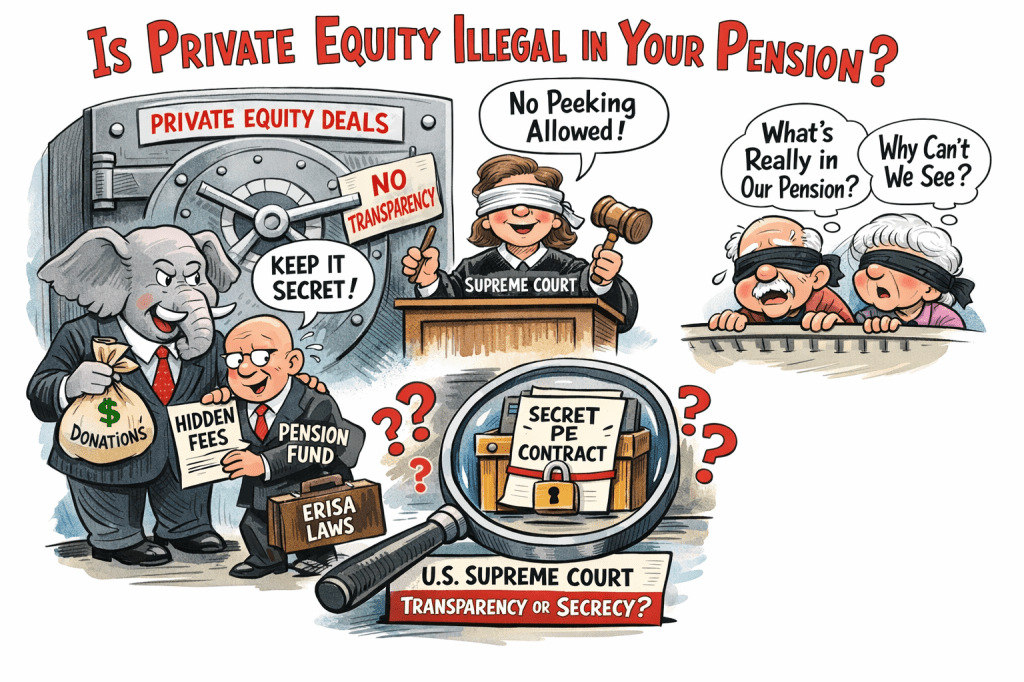
The legal battle over transparency is now reaching the highest levels of the U.S. judicial system. In litigation involving a major corporate retirement plan, participants have sought access to the underlying private equity arrangements embedded in their plan’s investment options. The case has drawn the attention of the U.S. Supreme Court, but notably the Court is not being asked to decide whether private equity itself is legal inside pension plans. Instead, the issue is far more basic: whether plan participants are allowed to see the contracts and information necessary to evaluate the investment at all.
This fight over transparency has attracted extraordinary attention from the financial industry and from regulators. The Department of Labor under the Trump administration—whose political environment included significant financial support from private equity firms such as Apollo, Carlyle, Blackstone, and KKR—submitted arguments supporting a ploy called “meaningful benchmarks” https://commonsense401kproject.com/2026/01/20/why-the-meaningful-benchmark-standard-is-a-judicial-illusion-built-for-wall-street/ that would limit the disclosure obligations faced by plan fiduciaries. If those arguments prevail, the result would be a legal framework in which private equity investments can remain embedded in retirement plans while the participants whose savings are at stake may never see the underlying agreements.
That reality highlights the deeper issue facing pension systems around the world. The debate is often framed as whether private equity delivers higher returns which looks more suspect every day. Yet the more fundamental question is whether pension beneficiaries have the right to know what they own. If the investment truly benefits them, transparency should strengthen the case for it. If it cannot withstand transparency, the problem may not be the disclosure rules—it may be the investment itself.
The Supreme Court’s Intel decision will therefore determine more than the outcome of a single lawsuit. It will decide whether the legal system allows retirement savers to look inside the black box that increasingly holds their future security. Until that box is opened, the question will remain unresolved: not simply whether private equity performs, but whether it can legally exist inside a pension plan at all. The temporary blocking of transparency means $billions to the Private Equity industry, while participants will not see the losses until it is too late.
Appendix A – United Kingdom: The Same Problem Under a Different Name
The United Kingdom does not use the American language of ERISA prohibited transactions, but the basic legal problem looks remarkably similar once the fog clears. UK pension trustees operate under a strict “best interests of members” duty and a prudent-person investment standard. The law expects trustees to ensure that pension assets are invested with proper regard for security, liquidity, diversification, and profitability. It also explicitly warns that investments not traded on regulated markets—exactly the category where private equity lives—must be kept at prudent levels.
That framework sounds reasonable until one asks a simple question: how can trustees demonstrate prudence if they cannot even see the full economics of the investment?
Private equity depends heavily on opaque valuations, irregular reporting, and complicated fee layers that are often buried in partnership agreements rather than disclosed in plain view. The more one examines the structure, the more the “best interests” obligation begins to collide with the way the asset class actually operates. Trustees are expected to evaluate performance, compare alternatives, and document why an investment benefits members. But the private equity industry’s preferred reporting conventions—internal rates of return, smoothed valuations, and selective benchmarking—make that evaluation extraordinarily difficult.
UK regulators already understand the problem. The Pensions Regulator has repeatedly warned trustees that private markets require far stronger governance, deeper due diligence, and heightened scrutiny of costs and risks. That warning alone is telling. Investments that are inherently compatible with fiduciary obligations do not usually require constant reminders about the dangers of opacity.
So the British version of the question is slightly different from the American one. It is not simply “Is private equity illegal in your pension?” It is this: how can trustees prove that a highly opaque, illiquid, high-fee asset class satisfies their legal duty to act in members’ best interests when the case for the investment becomes weaker as transparency increases?
In other words, the same contradiction exists in the UK that appears in the United States. Private equity may not violate the law automatically—but the more sunlight applied to the investment, the harder it becomes to reconcile with the duties trustees are sworn to uphold.
Appendix B – Canada: Fiduciary Duty Meets the Black Box
Canada’s pension laws differ in structure from ERISA, but they revolve around the same foundational principle: fiduciaries must act prudently and solely in the interests of beneficiaries. Pension administrators are legally required to exercise the care, diligence, and skill of a prudent person managing someone else’s assets. They must also avoid conflicts of interest and ensure that plan governance protects beneficiaries.
That sounds straightforward—until private equity enters the picture.
The private equity model thrives on opacity. Fees are layered and often partially hidden. Valuations are subjective and frequently delayed. Benchmark comparisons are difficult because the investments are illiquid and priced internally. These characteristics are not incidental quirks of the asset class; they are structural features.
For a fiduciary, those features present a problem. Canadian law expects pension administrators to understand the investments they approve and to evaluate whether they genuinely serve the interests of beneficiaries. But how can an administrator confidently perform that duty when the full economics of the investment may not even be visible?
Canada also preserves an important principle that resonates with the transparency fight now unfolding in the United States: beneficiaries have rights to information about the plans that hold their retirement savings. Pension law in several provinces provides inspection rights and disclosure obligations that are meant to prevent retirement systems from becoming black boxes.
Private equity pushes directly against that principle. The industry frequently insists that its partnership agreements and detailed fee arrangements remain confidential. In effect, beneficiaries are asked to trust that their money is being invested prudently while the most important details remain hidden.
So Canada’s version of the debate arrives at the same uncomfortable question facing American courts. If an investment can only function inside a pension plan when its true economics are shielded from scrutiny, how can administrators claim they are fulfilling their fiduciary duty of care?
Canada may not frame the issue as an ERISA prohibited transaction. But the logic leads to the same place: the more opaque the investment structure becomes, the more difficult it is to reconcile with fiduciary responsibility.
Appendix C – Australia: Transparency Meets Private Equity
Australia’s superannuation system may provide the clearest international test of the private-equity-in-pensions debate because the regulatory framework places extraordinary emphasis on member outcomes and transparency.
Superannuation trustees are subject to a “best financial interests” duty that requires them to demonstrate that every investment decision benefits members. Regulators also impose extensive disclosure obligations, strict governance standards, and performance testing designed to compare funds against measurable benchmarks.
In theory, this framework should create one of the most transparent retirement systems in the world.
But private equity does not fit comfortably inside that system.
Australian regulators have already expressed concern about the valuation and liquidity risks associated with unlisted assets such as private equity. These investments are difficult to price, often depend on internal valuations, and may be slow to reflect changes in market conditions. When markets fall sharply, public assets reprice immediately. Private assets often move slowly, creating the illusion of stability where none may actually exist.
That illusion can distort performance comparisons, making portfolios appear more stable or more successful than they truly are.
Regulators have therefore pushed for stronger governance, independent valuations, and better oversight of unlisted asset pricing. Those warnings reveal a deeper truth: private equity’s core mechanics sit uneasily inside a system built around transparency and accountability.
The Australian debate ultimately mirrors the American one. If superannuation trustees must prove that every investment serves members’ best financial interests, they must be able to measure its costs, risks, and performance honestly.
Yet private equity’s structure—layered fees, opaque valuations, and limited disclosure—makes that proof extremely difficult.
Which leads to the same unavoidable question now confronting pension systems worldwide: if an investment only works when its true economics remain hidden, does it really belong in a retirement system that is supposed to operate in the open?
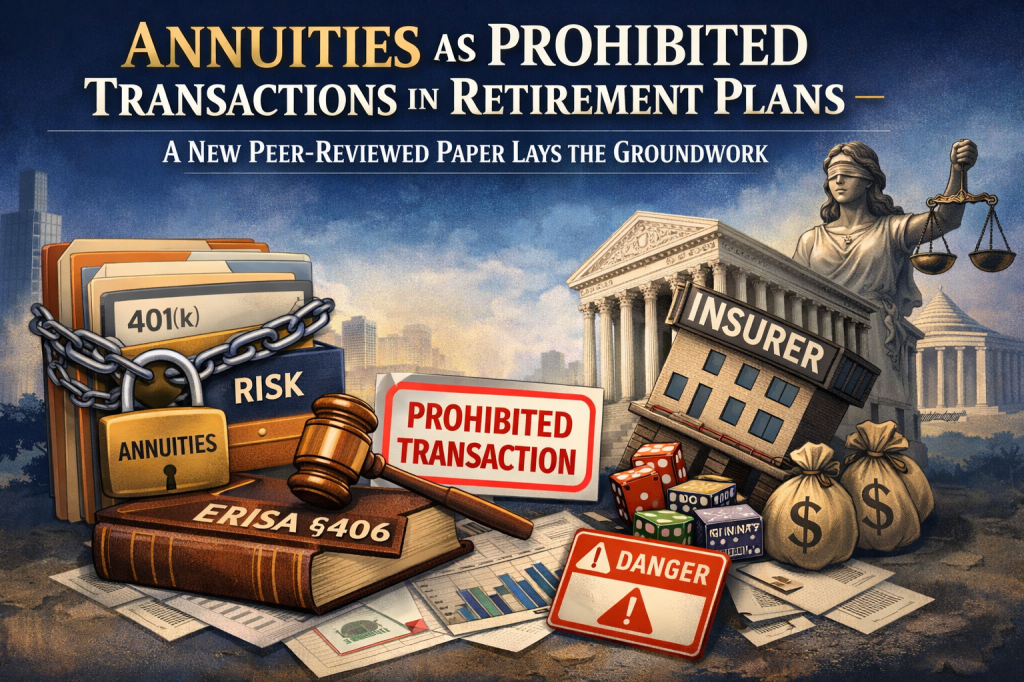
The paper was submitted nearly two years ago. Since then, the retirement landscape has changed dramatically: major Supreme Court decisions have reshaped ERISA litigation standards, and Washington has entered a new deregulatory phase at both the Department of Labor and the SEC. But if anything, the developments of the last two years make the paper more urgent, not less.
For the first time in an academic journal article, we systematically lay out why many annuity structures — particularly fixed annuities and pension risk transfer contracts — may fundamentally conflict with core fiduciary principles embedded in ERISA and the common law of trusts.
1. Annuities Fail the Most Basic Investment Principle: Diversification
The foundational fiduciary rule is simple: do not put all your eggs in one basket.
Fixed annuities violate that rule at their core.
Unlike a diversified bond portfolio, a general account annuity exposes participants to:
Single-entity credit risk
Single-entity liquidity risk
Participants are effectively lending 100% of their assets to one insurance company, whose balance sheet they do not control, cannot exit, and often cannot even fully see.
That is not diversification. That is concentration risk disguised as “guarantee.”
Under ERISA’s prudence and diversification standards, this structural concentration alone raises serious prohibited transaction questions when plans enter into these contracts with insurers that are parties in interest.
2. The Forgotten Crises: 1992 and 2008
The life insurance industry has already experienced two major stress events in modern times:
The early 1990s insurance failures (Executive Life and others)
The 2008 financial crisis (AIG)
Following the 1992 crisis, the Federal Reserve explicitly warned about the structural weakness of guaranteed investment contracts (GICs). These are not diversified investment vehicles — they are insurance promises dependent on the issuer’s claims-paying ability.
In 2008, the Fed made clear that without federal intervention, stable value insurance backing 401(k) plans could have evaporated overnight.
Unlike bank deposits (FDIC) or defined benefit pensions (PBGC), annuities have:
No federal insurance
No federal prudential regulator
State guaranty coverage typically capped at $300,000
Less than 1% prefunded capacity relative to liabilities
Participants are told they are “guaranteed.” They are not told the guarantee depends on a lightly regulated balance sheet.
3. Pension Risk Transfer: Swapping PBGC for Private Credit Risk
We introduce and analyze the rise of Pension Risk Transfer (PRT) annuities — where companies replace PBGC-insured defined benefit pensions with single-insurer annuity contracts.
This is one of the most significant structural shifts in U.S. retirement security in decades.
A diversified pension portfolio backed by federal insurance is replaced with:
A single insurer obligation
No federal insurance
State guaranty patchwork protection
Major litigation is already emerging around these transfers.
The fiduciary question is simple: Is it prudent to replace a diversified, federally backstopped pension with a concentrated private contract dependent on insurer solvency?
4. The Structural Risk Difference: Insurance Contracts vs. Securities
Annuity contracts differ fundamentally from regulated securities:
Diversified Bonds
Fixed Annuity
Marked to market
Not marked daily
Liquid
Illiquid
Sellable if downgraded
Generally locked
SEC regulated
State insurance regulated
PBGC protection (DB)
No federal backstop
When a bond is downgraded, a fiduciary can sell it.
When an insurer is downgraded, participants ride it down.
That is single-entity liquidity risk layered on top of credit risk — and rarely disclosed as such.
5. Athene and the Private Equity Model
We analyzed Athene, owned by Apollo, as a case study of the private-equity-backed insurer model. This was years before the Jeffrey Epstein connection to Athene was exposed.
Academic research now documents how private equity ownership of insurers leads to:
Increased allocations to private asset-backed securities
Regulatory capital arbitrage
Use of affiliated reinsurance
Greater exposure to commercial real estate and leveraged credit
When annuity premiums become a funding vehicle for private credit strategies, the risk profile changes materially.
Participants are rarely told that their “safe” retirement product may be financing leveraged buyouts or complex structured debt.
6. Balance Sheet Reality: TIAA vs. Vanguard Synthetic Stable Value
We directly compare TIAA’s General Account to Vanguard’s diversified synthetic stable value trust. Since submission TIAA has been the subject of 2 major stories from NBC.
Key differences:
Vanguard: 74% AA or higher securities; ~96% public and liquid
Even the most conservative general account insurer holds materially more illiquid and privately valued assets than diversified security-based stable value structures.
Yet both are marketed as “safe.” The risk is not the same.
7. Hidden Spreads: The $Billions Nobody Sees
Perhaps the most underappreciated issue is spread income.
Insurance companies do not primarily charge visible expense ratios.
They:
Take participant funds into the general account.
Invest at a portfolio yield.
Credit participants a lower rate.
Keep the spread — often 200 basis points or more.
Public statements have confirmed spreads exceeding 2%.
That is enormous in a low-risk asset class.
These spreads:
Are generally undisclosed.
Are not competitively bid in many cases.
Vary dramatically across nearly identical products.
Appear disconnected from measurable risk.
In any other fiduciary context, secret, discretionary profit margins of this magnitude would invite scrutiny.
8. Pricing Is Arbitrary — Not Risk-Based
We demonstrate that pricing often depends not on underlying risk, but on:
Negotiating power
Sales relationships
Platform constraints
Opaque crediting rate practices
Two nearly identical products can produce radically different participant returns.
We construct a risk-return efficient frontier showing that many fixed annuities fall well below what fiduciaries would consider efficient.
In other words: Participants are bearing higher risk for lower return. That is not prudence.
Why This Matters Now
Since our submission:
ERISA litigation has intensified.
Pension risk transfer lawsuits have expanded.
Private credit exposure in insurers has grown.
Regulatory oversight has loosened.
Disclosure initiatives face rollback.
Meanwhile, annuities are being aggressively marketed as the solution to retirement insecurity. Our paper does not argue against lifetime income. It argues that: If a product violates diversification, embeds hidden spreads, concentrates single-entity risk, and operates without federal prudential safeguards — it must be examined under the prohibited transaction and fiduciary frameworks that govern retirement plans.
This article lays the academic foundation for it. The courts will ultimately decide where regulators hesitate.
Below are additional annuity blog articles published since the submission of the paper.
The DOL made a major step forward with the 404a-(5) fee disclosure in 2012. These provide solid transparency in 401k plans using SEC registered Mutual Funds. These disclosure has resulted in high-fee mutual funds being called out in legislation. Wall Street and the Insurance industry, to hide excessive fees and risks, have moved away from transparent SEC Mutual Fund structures into state-regulated insurance annuity structures and state-regulated CIT structures. These poorly regulated state structures can allow them to hide Crypto, Private Equity, Private Credit, and annuities. While prior DOLs have been passive on this issue, the Trump DOL is actively helping to block fee and risk transparency in statements with amicus briefs.
Below is my DOL Comment Letter from 2/25/26 Comment Tracking Number: mm2-zwz3-38pd
U.S. Department of Labor Employee Benefits Security Administration Re: Requirement to Provide Paper Statements in Certain Cases – Amendments to Electronic Disclosure Safe Harbor RIN: 1210–ACXX Federal Register Document No. 2026-03723
Comment Letter – Disclosure Gaps for Annuities and Collective Investment Trusts (CITs)
Dear Sir or Madam:
I appreciate the opportunity to comment on the Department’s proposed amendments to the electronic disclosure safe harbor. While the proposal addresses the format and delivery of disclosures, it does not address a more fundamental problem: the substantive inadequacy of disclosures for certain retirement plan investment vehicles—particularly annuities and collective investment trusts (CITs).
Electronic delivery standards cannot compensate for disclosures that omit material information. In several high-growth retirement products, participants are not receiving the core data necessary to understand risk, cost, regulatory oversight, and conflicts of interest.
I respectfully urge the Department to address the following disclosure deficiencies.
I. Annuities in ERISA Plans: Critical Omitted Disclosures
Annuities offered within defined contribution plans frequently lack basic disclosures that would be standard for mutual funds or registered investment products. Specifically:
A. No Mandatory Spread or Embedded Fee Disclosure
Many fixed and group annuity contracts do not disclose:
The insurer’s earned spread (general account yield vs. credited rate)
Asset management compensation embedded in the contract
Affiliate transaction revenue
Credit-risk charges or capital arbitrage economics
Participants are often shown only a “crediting rate,” without disclosure of:
The underlying asset portfolio yield
The insurer’s retained margin
How crediting rates are determined
Whether adjustments reflect asset performance or internal discretion
This absence of spread transparency makes meaningful fee comparison impossible and undermines ERISA’s fiduciary standards.
B. No Disclosure of State of Issuance or Regulatory Jurisdiction
Participants are not told:
In which state the annuity contract is issued
Which state insurance commissioner has primary oversight
Whether the issuing entity is domiciled offshore (e.g., Bermuda reinsurance arrangements)
What guaranty association protections apply
Given the decentralized and opaque nature of U.S. insurance regulation, disclosure of regulatory jurisdiction is material. Participants cannot assess insolvency risk without knowing which regulator governs the issuing insurer.
C. No Uniform Risk Benchmarking Standard
Unlike mutual funds, fixed annuities do not provide:
Duration disclosure
Credit quality breakdown
Asset allocation
Stress-test sensitivity
Comparable benchmarks
Without these, participants cannot assess whether they are being compensated for credit risk or liquidity risk.
II. Collective Investment Trust (CIT) Target Date Funds: Structural Opacity
CIT-based target date funds represent a rapidly expanding portion of retirement plan assets. Yet disclosure standards are significantly weaker than for ’40 Act funds.
Participants are often not provided:
Full look-through holdings
Underlying asset manager identities
Layered fee structures
Affiliate transaction disclosures
Credit exposures in insurance-wrapped sleeves
Disclosure of whether embedded annuities exist
Many CITs operate under state banking supervision rather than SEC oversight. Participants are rarely informed:
Whether the regulator is a state banking commissioner or the OCC
What disclosure regime governs the product
Whether federal securities antifraud standards apply
This regulatory ambiguity is material and should be disclosed prominently.
III. The Regulatory Identity Problem
The Department should require that all retirement plan investment disclosures clearly state:
The primary regulator (SEC, OCC, state banking commissioner, or state insurance department).
The legal form of the product (mutual fund, CIT, separate account, general account, group annuity contract, etc.).
Whether the product is subject to federal securities laws.
Whether the product’s assets are insulated from the sponsor’s balance sheet.
Participants cannot evaluate risk without knowing the legal structure and regulator.
IV. Electronic Delivery Without Substantive Transparency Is Insufficient
The proposed rule focuses on delivery mechanisms (paper vs. electronic). However:
If the content lacks fee transparency, electronic delivery merely accelerates opacity.
If underlying risks are not disclosed, format reforms are immaterial.
If embedded compensation and spread economics remain hidden, ERISA’s fiduciary safeguards are weakened.
The Department should not modernize delivery standards while ignoring substantive disclosure gaps.
V. Recommended Amendments
I respectfully urge the Department to:
Require disclosure of insurer spread and credited-rate determination methodology for all annuity products in ERISA plans.
Require disclosure of state of issuance and primary regulator for annuity contracts.
Mandate look-through disclosure of underlying holdings and fees for CIT-based target date funds.
Require clear identification of the regulatory authority governing CITs.
Require disclosure of affiliate relationships between recordkeepers, asset managers, insurers, and CIT sponsors.
Establish a “meaningful benchmark” requirement for fixed annuities comparable to stable value or Treasury benchmarks.
Clarify that lack of transparency in these areas may implicate prohibited transaction concerns under ERISA §406.
VI. Conclusion
Electronic disclosure reform is welcome. But disclosure reform without substantive transparency will not protect plan participants.
Annuities and CIT-based target date funds are among the fastest-growing retirement products. Their regulatory frameworks are fragmented. Their disclosures are often incomplete. Their embedded compensation structures are opaque.
If ERISA’s fiduciary protections are to remain meaningful, participants must be given clear, standardized, comparable, and regulator-specific disclosures.
I appreciate the Department’s consideration and would welcome further dialogue on these issues.