While Washington talks, state legislators are beginning to act.
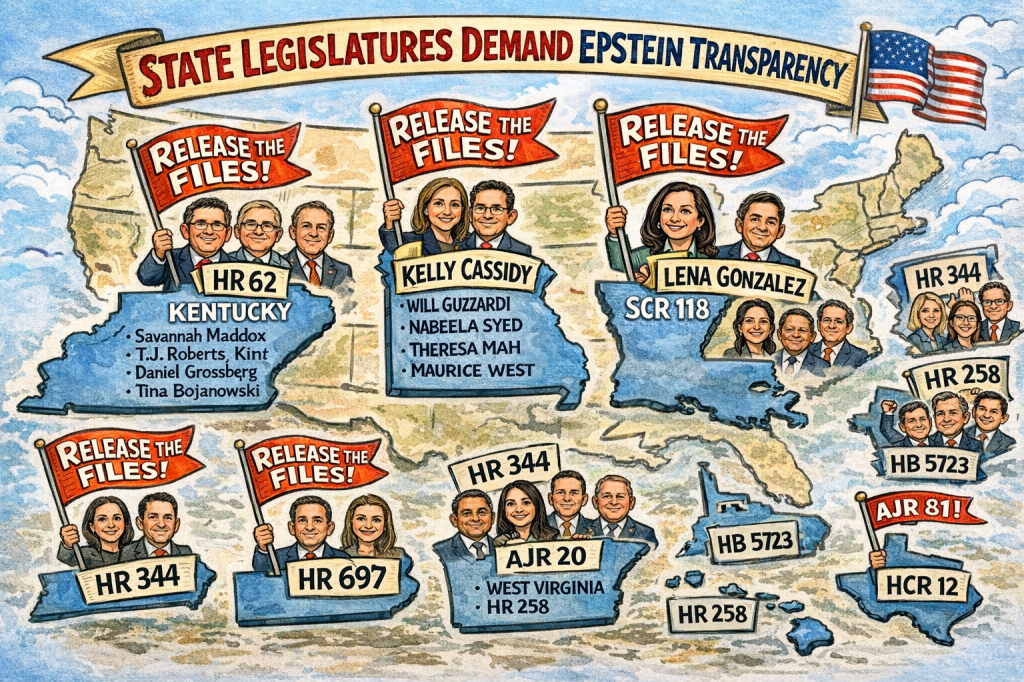
From Kentucky to California to Illinois and Hawaii, a growing number of lawmakers are doing something Congress has largely avoided: formally demanding full transparency, accountability, and prosecution tied to the Jeffrey Epstein files.
This is not theoretical. These are filed resolutions, recorded votes, and named sponsors—a real, emerging political movement.
Kentucky: The First Real Breakthrough
Kentucky has become ground zero for state-level Epstein accountability.
House Resolution 62 (HR 62)
Primary Sponsor: Rep. Steven Doan
Co-sponsors (bipartisan):
Savannah Maddox
Tina Bojanowski (D)
Lindsey Burke
Adrielle Camuel
Beverly Chester-Burton
Mark Hart
Kimberly Holloway
Candy Massaroni
Marianne Proctor
T.J. Roberts
👉 The resolution:
Urges the U.S. Attorney General to investigate and prosecute individuals tied to Epstein
Explicitly recognizes Thomas Massie’s leadership on forcing file disclosure
🟨 Illinois: The First State to Actually Pass a Resolution
If Kentucky is the spark, Illinois is the first state to act decisively.
House Resolution 697 (HR 697)
Primary Sponsor: Rep. Kelly Cassidy
Co-sponsors (33 legislators):
Joyce Mason, Mary Gill, Theresa Mah
Nabeela Syed, Sharon Chung
Justin Cochran, Margaret Croke
Eva Dina Delgado, Katie Stuart
Elizabeth Hernandez, Maura Hirschauer
Maurice West, Dave Vella
Edgar Gonzalez, Gregg Johnson
Rick Ryan, Michael Crawford
Will Guzzardi, Michelle Mussman
Daniel Didech, Jawaharial Williams
Jehan Gordon-Booth, Kimberly Du Buclet
Janet Yang Rohr, Kambium Buckner
Dagmara Avelar, Lindsey LaPointe (and others)
What Illinois did that no one else has:
Passed the resolution unanimously (69–0)
Called for:
Full release of Epstein files
Minimal redactions (victim protection only)
Appointment of a special prosecutor
👉 The resolution explicitly warns:
Documents may have been “illegally redacted or withheld”
Political figures may have been shielded
This is not cautious language. This is a direct accusation of federal misconduct.
🟦 California: Moving—But Slower
California has introduced two separate measures, showing momentum—but hesitation.
SCR 118
Primary Sponsor: Sen. Lena Gonzalez
Coauthor: Asm. Josh Lowenthal
AJR 20
Sponsor: Asm. Jasmeet Bains
👉 These measures:
Call for release of Epstein-related records
Condemn withholding and excessive redaction
But unlike Illinois:
They are still working through the process
No final passage yet
👉 Translation:
California is engaged—but not leading
🌺 Hawaii: Quiet but Broad Coalition
Hawaii has built one of the largest sponsor blocs in the country.
SCR 191 (and companion resolutions)
Sponsors include:
Karl Rhoads
Stanley Chang
Mike Gabbard
Carol Fukunaga
Lorraine Inouye
Jarrett Keohokalole
Brandon Elefante
Joy San Buenaventura
👉 What makes Hawaii unique:
Large multi-member coalition
Coordinated House + Senate activity
Strong alignment with full transparency demands
🧭 Other States: Early Signals
Additional states have filed similar measures:
Pennsylvania (HR 344) – calls for transparency and accountability Ben Waxman, Benjamin Sanchez, Carol Hill-Evans, Dan Williams, Emily Kinkead, Gina Curry
Michigan (HR 258) – pushes federal review Betsy Coffia, Carol Glanville, Carrie Rhenigans, Cynthia Neeley, Donavan McKinney, Dylan Wegela, Emily Dievendorf, Erin Byrnes Ds Jaime Greene R others
Louisiana (HR 2) – early-session resolution Kyle Green (D)
Texas (HCR 12) – prior effort (did not advance) Jessica Gonzalez, Rafael Anchia
👉 These are smaller—but important:
They show geographic spread
Not confined to one ideology or region
🚨 What This Movement Really Means
1. This is no longer a fringe issue
Illinois: passed resolution
Kentucky: bipartisan sponsorship
Hawaii: multi-member coalition
California: multiple bills
👉 That’s a national pattern emerging
2. The divide is not party—it’s willingness
Across states:
Democrats dominate in Illinois and California
Republicans + Democrats align in Kentucky
👉 The real split is:
Who is willing to demand full transparency—and who is not
3. State legislatures are stepping in where Congress stalled
Congress passed the Epstein Files Transparency Act
“From Kentucky to Illinois to California, state legislators are beginning to do what federal leadership has failed to do: demand full, unredacted accountability for the Epstein network.”
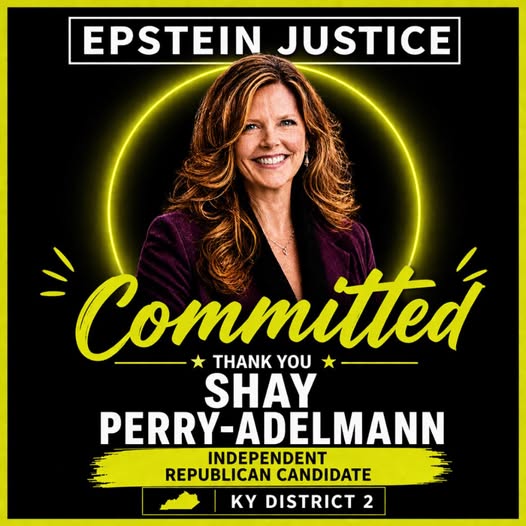
A candidate going up against Guthrie in the R Primary has endorsed Epstein Justice- Shay Perry-Adelman.
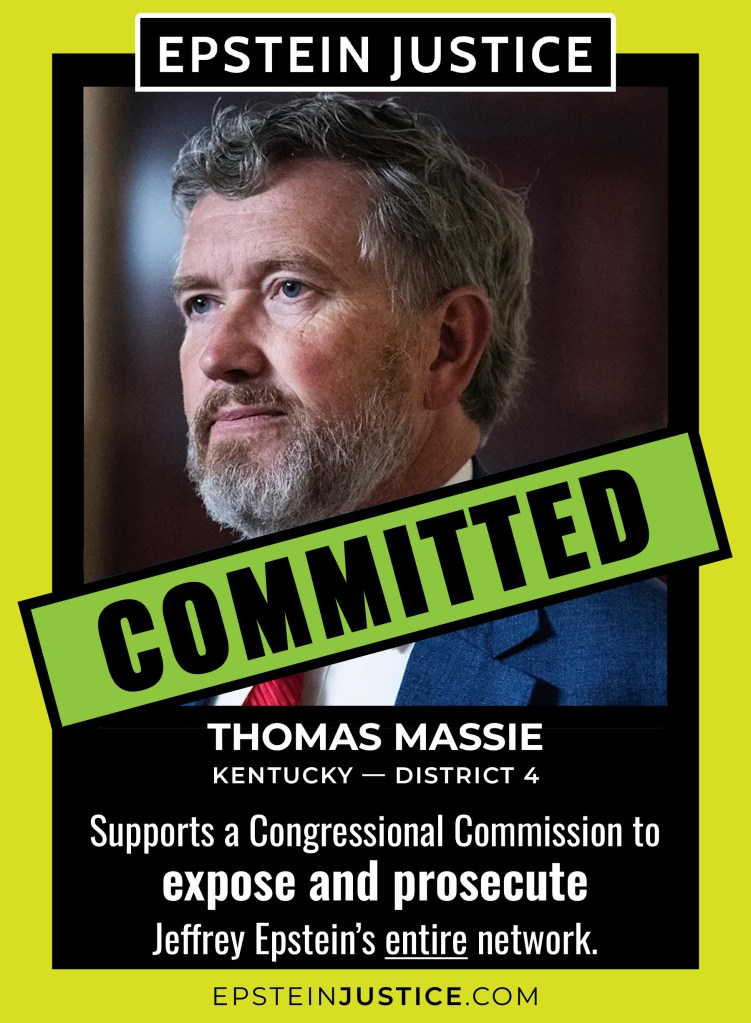
Of the entire KY Congressional Delegation only Thomas Massie signed the Massie-Khanna Discharge Petition. Lone Democrat Morgan McGarvey , and remaining Republicans Barr, Comer, Guthrie, Rogers, did NOT sign the Massie–Khanna discharge petition. There were 4 brave Republicans including Massie and only 4 pathetic Democrats which included Morgan McGarvey from Louisville.
The Kentucky General Assembly is in session for 2026 and Kentucky House Resolution 62 urges the DOJ to investigate and prosecute crimes revealed in Epstein Files and credits Thomas Massie for Leadership and Disclosure. The primary sponsor is Steve Doan, Republican of Northern Kentucky. Co-Sponsors Republicans: Savannah Maddox, Josh Calloway, Mark Hart, Kimberly Holloway, Candy Massaroni, Marianne Proctor, T.J. Roberts Republicans: Savannah Maddox, Josh Calloway, Mark Hart, Kimberly Holloway, Candy Massaroni, Marianne Proctor, T.J. Roberts Democrats: Tina Bojanowski, Lindsey Burke, Adrielle Camuel, Beverly Chester-Burton, Anne Donworth. The Senate has an nearly identical Senate Resolution 95 and is sponsored by 5 Republicans – Lindsey Tichenor, Aaron Reed, Shelly Frommeyer, Steve Rawlings. and Gex Williams. If you know any of these co-sponsors thank them contact your representatives. However, Senate and House leadership in Kentucky seems to be controlled by the Epstein Class and the bills are stalled in committee.
Tuesday, May 19, 2026, primary day. Thomas Massie is plainly the strongest Kentucky and US federal candidate running on full Epstein-file release and deeper transparency. He introduced the bipartisan Epstein Files Transparency Act, later used a discharge petition to force the issue, and has continued publicly pressing for fuller disclosure and naming powerful figures he says deserve scrutiny. Epstein class donors are spending $6 -$10 million at least in Dark Money to defeat him in the Republican Primary.
Ed Gallrein anti-Massie proEpstein candidate outside donors including Miriam Adelson, Paul Singer, and John Paulson. Gallrein is the Trump-backed challenger in a race driven primarily by Massie’s Israel positions and his Epstein-file push. Paulson is named in the Epstein Files.
For the U.S. Senate Republican primary, the official field widely reported includes Andy Barr, Daniel Cameron, Nate Morris. While Barr has publicly supported release of the Epstein files in Congress, I found much stronger evidence of him as an AIPAC-/Israel-lobby-aligned candidate than as a transparency leader on Epstein. Independent trackers that compile FEC/OpenSecrets data list Barr among Kentucky members backed by pro-Israel interest groups, and Barr also publicly endorsed Massie’s anti-Massie challenger Ed Gallrein. https://commonsense401kproject.com/2025/07/22/many-congress-get-donations-from-firms-linked-to-jeffrey-epstein-ky-congressman-andy-barr-example/ Barr clearly needs to be opposed.
In the U.S. Senate Democratic primary, Charles Booker is the clearest pro-transparency fit. I found multiple recent Booker posts explicitly demanding release of the files, praising survivors, attacking the “Epstein class,” and calling for accountability. I also found a direct Booker post praising Thomas Massie and Ro Khanna working together.
On sitting US. Representative James Comer, the picture is mixed. Comer, as House Oversight chair, did move some Epstein-related oversight steps, including subpoenaing records from the Epstein estate and later pushing actions involving DOJ officials. But Kentucky and national coverage also framed him as an alternative to Massie’s more aggressive full-release push, and recent reporting says members still want him to enforce subpoenas more aggressively after Bondi’s ouster. If someone is in Comer’s district they should urge him to full transparency.
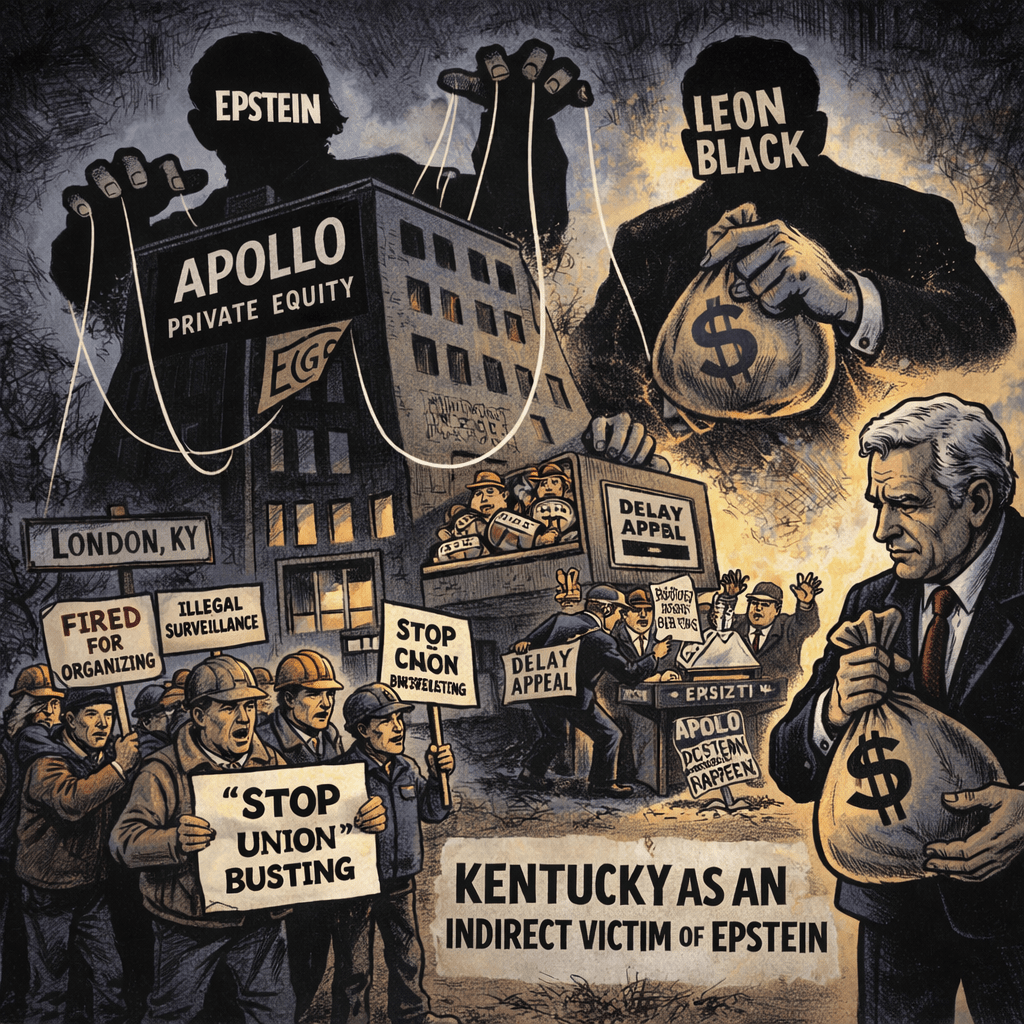
Of Kentucky’s 3 largest daily newspapers, I would classify 2 as pro-Epstein and 1 as Epstein Class related. Both the Louisville Courier and Northern Kentucky (Cincinnati) Enquirer are owned by Gannett USA Today, which is controlled by Apollo, whose CEO and founder Leon Black was Jeffrey Epstein’s main funder post 2008.
The Lexington Herald Leader part of McClatchy was purchased by Chatham hedge fund in 2020 who promoted Trump via the National Enquirer they own . Chatham founder Anthony Melchiorre is a major Trump funder and dined with him after the election. The SEC charged Chatham and Melchiorre over improper trading in AMI debt securities related to National Enquirer and ; they paid $19.375 million to settle. Melchiorree is clearly in the Epstein class and is inclined to not favor coverage.
Apollo controls Cox Media properties in Paducah KBSI and WDKA. Apollo via Lumen Technologies and Brightspeed controls a lot of the rural broadband and telephone infrastructure.
The Kentucky Pensions have less Apollo exposure than most other states. Kentucky Teachers owns moderate amounts of Apollo common stock and their REIT. Kentucky Public Pensions however has hired Apollo-controlled Wilshire as its so-called independent consultant. Both pensions should divest from their Apollo holdings due to its ties to Jeffrey Epstein. https://commonsense401kproject.com/2026/03/23/divest-from-apollo-now-before-markets-courts-or-congress-force-it/ Apollo portfolio company Makers Pride in London KY has been accused of illegal labor practices.
The Department of Labor is selling its new fiduciary rule as protection.
Protection from lawsuits. Protection through process. Protection via a checklist.
But strip away the language, and the reality is far more troubling:
👉 This rule is not about reducing litigation. 👉 It is about unlocking new revenue streams for Wall Street and the insurance industry—while leaving plan sponsors holding the liability.
The Bait: “Follow the Checklist, Reduce Your Risk”
The DOL’s message is simple:
If fiduciaries evaluate:
fees
performance
liquidity
complexity
valuation
…then they will be protected.
But even under the rule itself, that protection is weak:
It is not a true safe harbor
It is only a rebuttable presumption
Plaintiffs can still challenge the outcome
So what the DOL is really offering is not protection—it is procedural cover.
The Switch: Open the Door to High-Fee, Opaque Products
While promising protection, the rule simultaneously:
Encourages alternative investments in 401(k)s
Channels those investments into state-regulated CITs
Facilitates inclusion of annuities and insurance products
These are not low-cost index funds.
These are:
Private equity
Private credit
Insurance-wrapped products
Spread-based annuities
👉 In other words: the highest-margin products in the entire financial system.
Why Wall Street and Insurers Win Immediately
This rule creates an immediate economic shift:
💰 More complexity = more fees
Private markets → higher management fees
CITs → less fee transparency
Annuities → hidden spreads (often 100–300+ bps)
💰 Less transparency = less pricing pressure
No SEC disclosure regime
No daily pricing discipline
No meaningful benchmarking
💰 Faster revenue recognition
Fees and spreads are earned today
Risks are borne later
Translation:
👉 Wall Street and insurers get paid now 👉 Participants take the risk later 👉 Plan sponsors absorb the liability when things go wrong
CITs: The Perfect Revenue Vehicle (and Litigation Time Bomb)
The rule effectively pushes plans into Collective Investment Trusts (CITs).
Why?
Because CITs allow:
Mixing of public and private assets
Limited disclosure
State-level oversight instead of SEC regulation
And here’s what most fiduciaries—and participants—don’t realize:
👉 Many CITs are regulated at the state level (PA, NH, MD, etc.) 👉 That fact is often buried in fine print 👉 Underlying holdings are frequently undisclosed or poorly understood
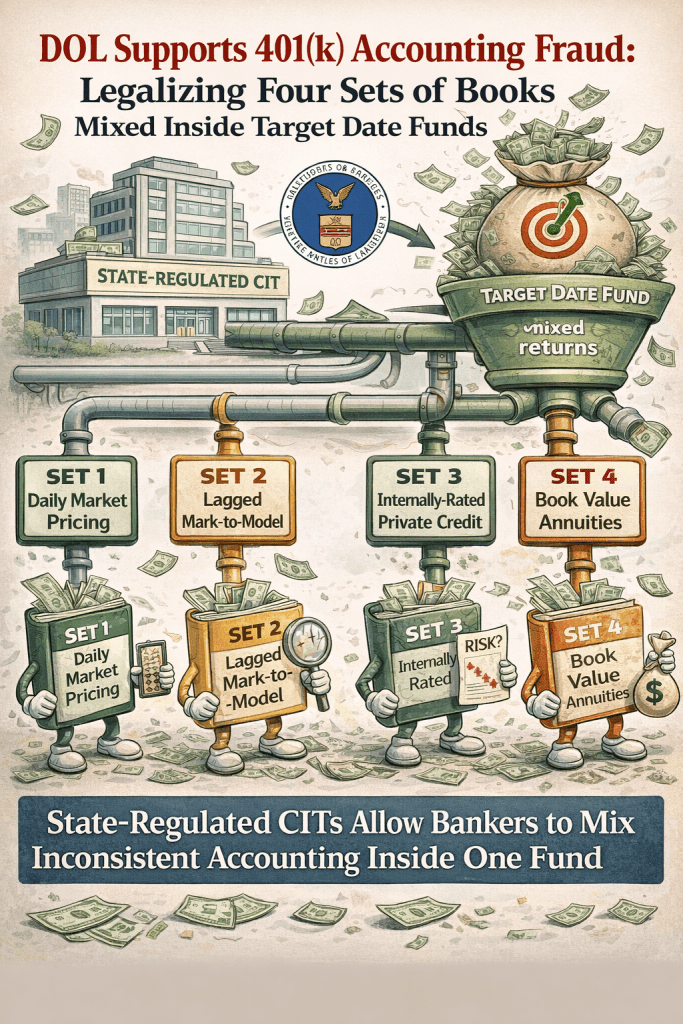
The Department’s proposed rule effectively legitimizes opaque investment structures in 401(k)s that obscure true economic value and risk and violate basic accounting standards. By encouraging use of Private Equity, Private Credit, Crypto, and Annuities (with underlying private credit)—particularly through state-regulated collective investment trusts (CITs)—the rule permits commingling of assets subject to inconsistent valuation regimes, including book value, mark-to-model, smoothed returns, and market pricing. This creates multiple “sets of books” within a single target date fund, undermining ERISA’s core fiduciary duty of prudence and transparency. This proposal invites systemic mispricing, conflicts of interest, and prohibited transactions.
The Department of Labor’s latest proposed rule—“Fiduciary Duties in Selecting Designated Investment Alternatives”—is being pitched as modernization. In reality, it is a sweeping regulatory green light for what can only be described as 401(k) accounting chaos.
At its core, the rule explicitly encourages fiduciaries to include “alternative assets” in defined contribution plans, including target date funds, which comprise over 50% of 401k assets. But what the Department fails to acknowledge—because it cannot defend—is that these assets are not governed by a single, consistent accounting framework.
Instead, the rule enables a structure where multiple incompatible valuation systems coexist inside a single fund:
Public equities → daily market pricing
Private equity → lagged, mark-to-model valuations
Private credit → internally rated, often non-observable pricing
Annuities → book value with discretionary crediting rates
The rule’s most dangerous feature is not what it says—but where it pushes assets.
The Department knows full well that SEC-registered mutual funds cannot accommodate this level of accounting inconsistency. So instead, the rule effectively channels these investments into state-regulated Collective Investment Trusts (CITs).
CITs:
Are not subject to SEC transparency standards
Do not require full fee or underlying asset disclosure
Allow commingling with insurance products and private markets
Operate under OCC/state banking rules that lack ERISA-level protections
Under any honest application of ERISA §406 and the Supreme Court’s decision in Cunningham v. Cornell, this structure raises clear prohibited transaction concerns.
Yet instead of addressing that conflict, the DOL is building a regulatory shield around it.
“Alternative Assets” = Already Embedded Risk
The industry narrative is that alternatives are new to 401(k)s.
That is false.
As documented extensively, private credit, real estate debt, and illiquid assets are already embedded—primarily inside annuities.
Funnels assets into lightly regulated CIT structures
Protects annuity providers and their undisclosed spread profits
This is not reform.
It is a coordinated rollback of fiduciary accountability.
And if finalized, it will mark the moment when the Department of Labor stopped protecting retirement savers—and started protecting the financial products that extract from them.
—————————————————————-
Appendix A
Accounting and Valuation Failures in Private Market Assets and Their Conflict with ERISA Fiduciary Standards
I. Overview
Modern defined contribution plans increasingly incorporate private equity, private credit, and annuity-based investments—often through collective investment trusts (“CITs”) and target date funds. These instruments rely on heterogeneous and incompatible accounting regimes, including:
Level 1 fair value (observable market prices)
Level 3 fair value (model-based valuations)
Net Asset Value (“NAV”) practical expedients
Book value accounting (insurance general account products)
The coexistence of these regimes within a single investment vehicle produces non-comparable, non-verifiable, and potentially misleading valuations, undermining ERISA’s fiduciary requirements of prudence and loyalty.
II. Private Market Accounting Is Inherently Subjective and Unreliable
A. Level 3 Fair Value Relies on Manager Discretion
Under ASC 820 Fair Value Measurement and IFRS 13 Fair Value Measurement, private equity and private credit investments are typically classified as Level 3 assets, meaning:
No observable market inputs exist
Valuations depend on internal models
Significant managerial judgment is required
Accounting academics have repeatedly warned that such valuations lack reliability and comparability.¹
The Institute of Chartered Accountants in England and Wales notes that fair value for illiquid assets is “controversial” due to its reliance on subjective estimates and managerial discretion, particularly for Level 3 inputs.²
Similarly, academic research finds that private equity valuation requires “significant preparer discretion,” with outcomes highly sensitive to assumptions rather than market evidence.³
B. Valuation “Stickiness” and Opportunistic Smoothing
Empirical accounting research demonstrates that private asset valuations are not merely subjective—they are systematically biased.
Recent literature finds that Level 3 valuations exhibit “stickiness,” meaning:
Losses are delayed
Volatility is artificially suppressed
Reported returns are smoothed over time
This creates what researchers describe as **“opportunistic valuation behavior.”**⁴
Such smoothing directly conflicts with the requirement that fiduciaries evaluate investments based on current and accurate economic value, rather than lagged or managed figures.
III. NAV-Based Accounting Creates Circular and Non-Verifiable Valuation
A. NAV as a Practical Expedient Undermines Independent Verification
Private equity funds commonly report values using NAV, which is:
Calculated by the fund manager
Not independently market-tested
Often accepted by auditors without full verification
Under ASC 820, NAV may be used as a “practical expedient,” but this creates a circular valuation problem:
Managers determine value → fiduciaries rely on that value → no independent price discovery occurs.
Accounting and regulatory commentary has noted that investors may rely on NAV even where it does not reflect realizable value, raising serious concerns about transparency and accuracy.⁵
B. Immediate Mark-Ups and Internal Pricing
NAV-based accounting also permits:
Immediate valuation increases upon acquisition
Use of comparable multiples chosen by the manager
Internal revaluation without market transactions
These practices further detach reported values from objective economic reality, particularly in stressed markets.
IV. Private Credit Accounting Lacks Market Discipline
Private credit presents even greater accounting concerns:
Loans are not traded in active markets
Credit ratings are often internal or privately assigned
Valuations rely on discounted cash flow models using subjective inputs
Academic work on private credit markets highlights:
Opaque borrower quality
Lack of price transparency
Persistent spreads that are not clearly tied to observable risk metrics⁶
This results in valuations that are:
Non-comparable to public fixed income
Highly sensitive to assumptions
Potentially disconnected from actual default risk
V. Mixing Accounting Regimes Produces Non-Comparable and Misleading Results
A. Multiple Valuation Systems Within a Single Fund
When these assets are combined—particularly in target date CITs—participants are exposed to simultaneous use of incompatible accounting systems:
Asset Type
Accounting Method
Public equities
Daily market pricing (Level 1)
Private equity
Model-based fair value (Level 3)
Private credit
Internal valuation / discounted cash flow
Annuities
Book value with discretionary crediting
Academic literature emphasizes that fair value itself is controversial for private assets; combining it with non-fair-value accounting (e.g., book value) creates even greater distortion.¹
B. Lack of Comparability and Benchmark Integrity
Because these valuation systems operate differently:
Returns are not measured on a consistent basis
Volatility is artificially dampened for illiquid assets
Benchmarks become meaningless or misleading
This directly undermines the ability of fiduciaries to:
Compare investment alternatives
Assess risk-adjusted performance
Monitor ongoing prudence
VI. Conflict with ERISA Fiduciary Duties
A. Duty of Prudence
Under Employee Retirement Income Security Act of 1974 §404(a)(1)(B), fiduciaries must act with:
“care, skill, prudence, and diligence under the circumstances then prevailing.”
This requires evaluation based on:
Reliable data
Objective valuation
Comparable metrics
Where valuations are:
subjective
internally generated
non-verifiable
a fiduciary cannot reasonably determine whether an investment is prudent.
B. Duty of Loyalty and Prohibited Transactions
Under ERISA §406(a) and (b), fiduciaries must avoid:
transactions with parties in interest
conflicts of interest
undisclosed compensation
Accounting opacity exacerbates these risks by:
obscuring embedded fees (e.g., annuity spreads)
masking transfer of value to affiliated entities
preventing participants from understanding true costs
C. Process Cannot Cure Unreliable Inputs
Courts have emphasized that fiduciary review must be based on a reasoned and informed process. However:
A process relying on unreliable or non-comparable data
cannot produce a prudent outcome
Thus, a checklist-based approach—such as that proposed by the DOL—does not cure:
flawed valuation methodologies
lack of transparency
structural accounting inconsistencies
VII. Implications of the DOL Proposed Rule
The DOL’s proposed rule on fiduciary duties in selecting investment alternatives emphasizes:
process-based compliance
consideration of multiple factors
fiduciary discretion
However, it does not require:
standardized valuation methods
reconciliation of accounting regimes
independent verification of private asset values
As a result, the rule effectively permits fiduciaries to:
rely on inconsistent accounting frameworks
document compliance without resolving valuation conflicts
include opaque investments in participant-directed plans
VIII. Conclusion
Accounting and academic literature consistently demonstrate that:
Private market valuations are subjective and model-driven
Reported values are often smoothed and lagged
NAV-based accounting is circular and non-verifiable
Private credit lacks objective pricing discipline
When these assets are combined with publicly traded securities and insurance products, the result is a multi-layered accounting structure that obscures true economic value.
Such a structure is fundamentally incompatible with ERISA’s requirements of:
prudence
transparency
loyalty
and creates a substantial risk of:
mispricing
hidden compensation
prohibited transactions
📚 Footnotes
Renato Maino & Vera Palea, Private Equity Fair Value Measurement: A Critical Perspective on IFRS 13 (Bocconi Univ.) (noting reliability and comparability concerns in fair value accounting for private equity).
Institute of Chartered Accountants in England and Wales (ICAEW), Fair Value Measurement by Listed Private Equity Funds (highlighting subjectivity and controversy in Level 3 valuations).
João Gomes et al., Valuation of Private Equity Investments (Univ. of Manchester) (finding significant reliance on preparer judgment and assumptions).
Accounting research (2026) (documenting “stickiness” and opportunistic valuation in Level 3 assets).
See, e.g., commentary on NAV reliance in private equity valuation practices (noting limited independent verification and potential divergence from realizable value).
Y. Zou (2026), Private Credit Markets (describing opacity, internal pricing, and lack of observable market benchmarks).
Comment on DOL Proposed Rule (EBSA-2026-0166):
A Checklist No One Will Follow—and No One Will Enforce
The Department of Labor’s proposed rule creates the illusion of fiduciary rigor through an elaborate, process-based checklist. In reality, most investment products—especially those involving alternative assets, annuities, and state-regulated CITs—cannot meaningfully satisfy these standards.
The rule requires fiduciaries to evaluate performance, fees, liquidity, valuation, complexity, and benchmarks in an “objective, thorough, and analytical” manner. But this is theater, not enforcement.
1. Most Products Fail the Test—So the Test Won’t Be Applied
If the checklist were applied honestly:
Private equity and private credit would fail on valuation transparency
Annuities would fail on fee disclosure and conflicts (spread pricing)
CITs would fail on comparability and benchmark integrity
So what happens?
Fiduciaries will “paper the file” and proceed anyway.
And the DOL has effectively invited that outcome by:
Emphasizing process over results
Providing a safe harbor for documentation, not outcomes
Avoiding any requirement for objective, market-based validation
2. The Enforcement Reality: DOL Rarely Polices Investment Choices
The premise of the rule is that it reduces litigation risk and improves fiduciary compliance.
That ignores reality.
Even the DOL’s own enforcement posture shows:
Focus on egregious misconduct (fraud, embezzlement, operational failures)
Shifting priorities away from complex fiduciary investigations
In practice, the DOL has never systematically enforced investment selection standards at the level this rule pretends to require.
This rule does not change that.
It simply gives regulators—and fiduciaries—cover to say the process was followed.
3. This Rule Is Not About Litigation Risk—It Barely Applies to Plans That Get Sued
The DOL frames this as addressing litigation risk.
That is fundamentally misleading.
ERISA litigation is overwhelmingly concentrated in large plans
Roughly 9,000 plans over $100 million face meaningful litigation exposure
The remaining 700,000+ small plans are effectively outside the plaintiff bar’s economic reach
This rule primarily affects:
Small and mid-sized plans
Plans without sophisticated oversight
Plans heavily dependent on bundled providers
These are precisely the plans where:
Prepare an analysis of the DOL’s proposed rule re alternative investments in terms of compliance with the Administrative Procedures Act, especially re misleading statements that could harm plan sponsors and plan partucipants, and inconsistencies re ERISA and other applicable laws that could frustrate ERISA’s intended goals and purposes
Below is a structured, litigation-oriented analysis of the Department of Labor’s (DOL) proposed rule on alternative investments in defined contribution (DC) plans, focusing on Administrative Procedure Act (APA) vulnerabilities, misleading framing, and conflicts with ERISA and trust law principles.
I. Regulatory Context and Framing
The proposed rule—“Fiduciary Duties in Selecting Designated Investment Alternatives”—implements a policy shift driven by a 2025 Executive Order to expand access to private equity, private credit, real estate, and digital assets in 401(k) plans.
It introduces:
A procedural due diligence framework for fiduciaries
A safe harbor concept tied to compliance with that framework
An explicit policy goal of reducing perceived litigation barriers to offering alternatives
At the same time, the rule acknowledges heightened risks:
Illiquidity
Valuation uncertainty
Complexity and fees
This dual structure—encouragement + procedural shielding—creates the core APA and ERISA tensions.
II. APA Compliance Analysis
A. Arbitrary and Capricious Standard (5 U.S.C. § 706(2)(A))
1. Selective Framing of Risk (Material Omission Problem)
The DOL emphasizes process (due diligence factors) but downplays or structurally neutralizes substantive risk considerations, despite acknowledging:
Liquidity mismatch concerns
Retail investor suitability issues
APA vulnerability:
An agency acts arbitrarily when it fails to consider an important aspect of the problem (Motor Vehicle Mfrs. Ass’n v. State Farm).
Here, the “important aspect” is whether certain asset classes are inherently imprudent for participant-directed plans, not merely whether procedures were followed.
Argument: The rule substitutes process compliance for substantive prudence, effectively ignoring:
Structural unsuitability of illiquid assets in daily-valued plans
Asymmetric information between fiduciaries and participants
This is not just a policy choice—it is a category error under trust law, which the APA requires the agency to rationally address.
2. Internal Inconsistency (Safe Harbor vs. Fiduciary Duty)
The rule:
Requires fiduciaries to consider risk factors
Simultaneously offers liability protection (“safe harbor”) if procedures are followed
APA issue:
The agency cannot reconcile how procedural compliance immunizes outcomes that may be substantively imprudent.
This creates a logical inconsistency:
If an investment is imprudent in substance, no amount of process cures the breach under trust law.
Failure to reconcile this contradiction is classic arbitrary-and-capricious reasoning.
Sponsors may believe checklist compliance satisfies fiduciary duty
4. Undermining Judicial Oversight
Attempts to preemptively shape liability standards via regulation
VI. Bottom-Line Assessment
From an APA and ERISA perspective, the rule is vulnerable because it:
Elevates procedural compliance over substantive fiduciary duty
Creates misleading impressions of legal protection
Fails to reconcile inherent incompatibilities between alternative assets and DC plan structures
Advances policy objectives that may conflict with ERISA’s participant-protective purpose
In litigation terms, the strongest theme is:
The DOL is attempting to reframe fiduciary law from a substantive standard grounded in trust law into a procedural checklist regime, without statutory authority and in a manner that misleads regulated parties and endangers plan participants.
—————————————————————————
🔧 If you want next:
I can convert this into:
Complaint-ready section with case law (Cunningham, Brotherston, etc.)
Expert report format with exhibits
Visual “Accounting Stack” diagram to pair with this appendix
This appendix is very strong for judges because it reframes your argument from opinion → accounting system failure.
Top of Form
Bottom of Form
Fiduciary processes are weakest
Conflicts of interest are highest
Documentation is most likely to be boilerplate
In other words, the rule expands theoretical fiduciary duties where enforcement is weakest and litigation is nonexistent.
4. The Real Outcome: Regulatory Safe Harbor for Box-Checking
The practical effect of this rule is simple:
Investment providers design products that cannot pass the checklist substantively
Advisors and recordkeepers create templated “fiduciary files”
Committees sign off based on process documentation
The DOL does not second-guess outcomes
Result:
👉 A “check-the-box fiduciary system” 👉 Where compliance = paperwork 👉 And prudence = narrative justification
5. Why This Matters
This is not a neutral modernization.
It is a structural shift that:
Decouples fiduciary duty from measurable reality
Expands high-risk, opaque investments into weakly governed plans
Provides regulatory cover for decisions that would not withstand true scrutiny
Combined with:
State-regulated CIT opacity
Spread-based annuity economics
Multi-layered valuation inconsistencies
This rule creates the perfect environment for: 👉 Undetectable underperformance 👉 Hidden compensation 👉 Systematic fiduciary failure without accountability
Bottom Line
This rule is not about improving fiduciary behavior.
It is about standardizing defensibility.
Most products cannot pass the checklist. Most fiduciaries will pretend they did. And the DOL will look the other way—just as it always has.
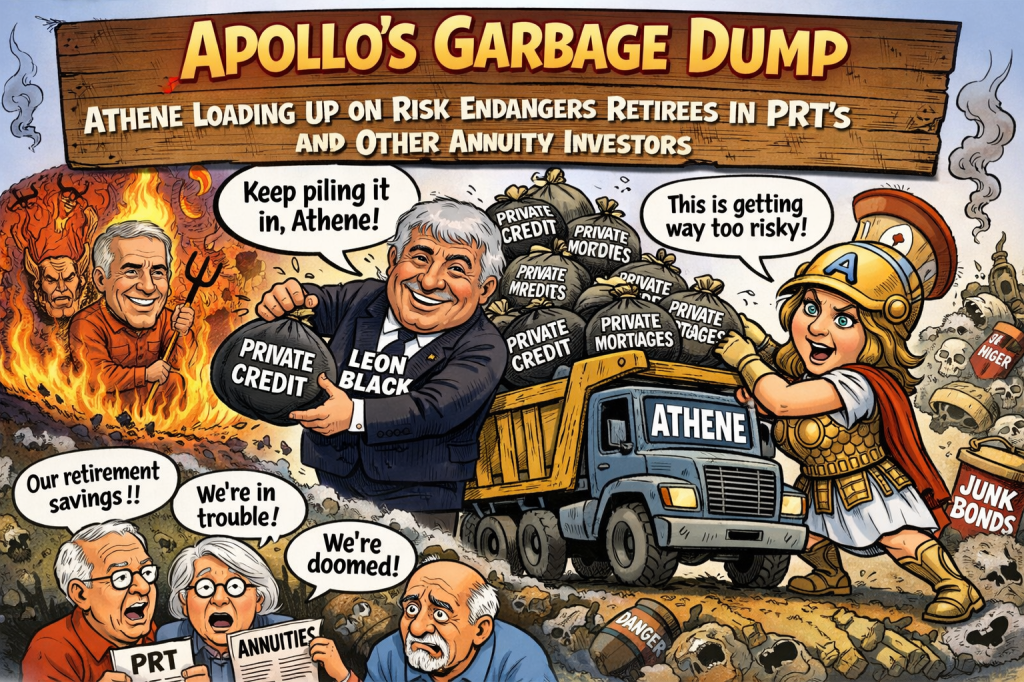
PRT annuities depend on one thing: The long-term financial strength of the insurer. But now that insurer Athene is: Increasing leverage via FHLB, Absorbing large real estate loan portfolios, Exposed to private credit stress, and Operating under prior regulatory violations
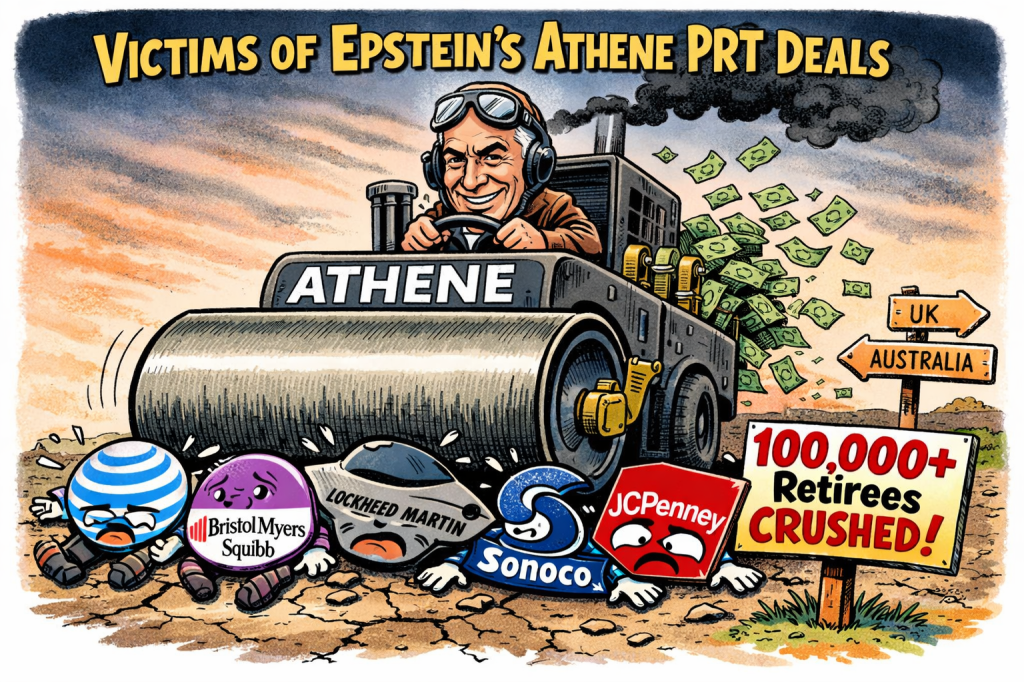
Athene paid a $45 million penalty for improper PRT activity in April 2020, after an investigation found its pension risk transfer (PRT) business had solicited and placed group annuity contracts with an unlicensed subsidiary. The Department of Financial Services cited violations of New York Insurance Law, noting the subsidiary had entered into 14 large-scale pension risk transfer transactions involving thousands of New York policyholders. https://www.dfs.ny.gov/reports_and_publications/press_releases/pr202004132
The American Federation of Teachers and the American Association of University Professors filed a complaint letter to the SEC on Apollo that specifically mentions Athene.
I believe your decision re only paying 20m has frankly, left me felling quite uneasy, colors my view about the Athene or Rothschild transaction. ……Athene,income, capital,foreign, exit, corporate, insurance regs, out and inbound issues, basis, appropriate discount rates. ? …….We can talk about Rowen request re Athene, complex 2 billion in taxes on transaction. ?
Rowen refers to Apollo CEO Marc Rowen who previously filed an SEC report in which he claimed no contact with Epstein or his involvement with Apollo issues like Athene.
Rising CDS spreads (market signaling higher credit risk) Renewed scrutiny from Epstein-related disclosures and Ongoing litigation risk at Apollo and the conclusion becomes unavoidable: The risk profile of Athene-backed annuities is increasing—not decreasing.
Apollo says Athene’s access to cheap government-backed FHLB funding makes annuities safer. In reality, it allows them to load more risk onto the balance sheet that retirees depend on. The $9 billion commercial real estate loan transfer isn’t a sign of strength. It’s a signal that the risks of private credit and real estate are being quietly shifted into the very entity that is supposed to guarantee pension benefits.
Wall Street keeps telling regulators, lawmakers, and plan sponsors that private credit in 401(k) plans is coming. That is the distraction. Private credit is not coming. It is already here. And not in the place anyone is debating.
Roughly 98% of all private credit exposure inside 401(k) and 403(b) plans already sits inside one product: fixed annuities—buried inside insurance company general accounts where participants cannot see it, price it, or escape it. Of the 9000 401(k) and 403(b) plans with over $100 million in assets, over 3500 hold fixed annuities. For the over 700 thousand plans, probably half hold fixed annuities https://commonsense401kproject.com/2026/01/23/fixed-annuities-are-the-dirty-secret-hiding-in-401k-and-403b-plans/
The real scandal is not future allocations to private markets. It is the massive, undisclosed private credit exposure already embedded in the system today.
The Misdirection: Target Date Funds with “Future” Private Credit, and Lifetime Annuities
The current policy debate focuses on whether private equity or private credit should be allowed inside target date funds. There is also a huge push for Lifetime Income Annuities
But today:
Actual direct private credit exposure inside target date funds is minimal to negligible
Lifetime income annuity adoption remains tiny with very low balances
Most participants have no direct allocation at all
This is not where the risk is. This is narrative management. Some bait and switch pushing lifetime annuities, knowing that any rules encouraging them will make it easier to retain fixed annuities.
Synthetic Funds like Fidelity MIPS and Vanguard RST, and products from T.Rowe Price, Galliard, Invesco, are transparent diversified and do not contain private credit.
Public pension trustees still think the Apollo problem is reputational. It isn’t.
It has now become regulatory, legal, and financial—at the same time.
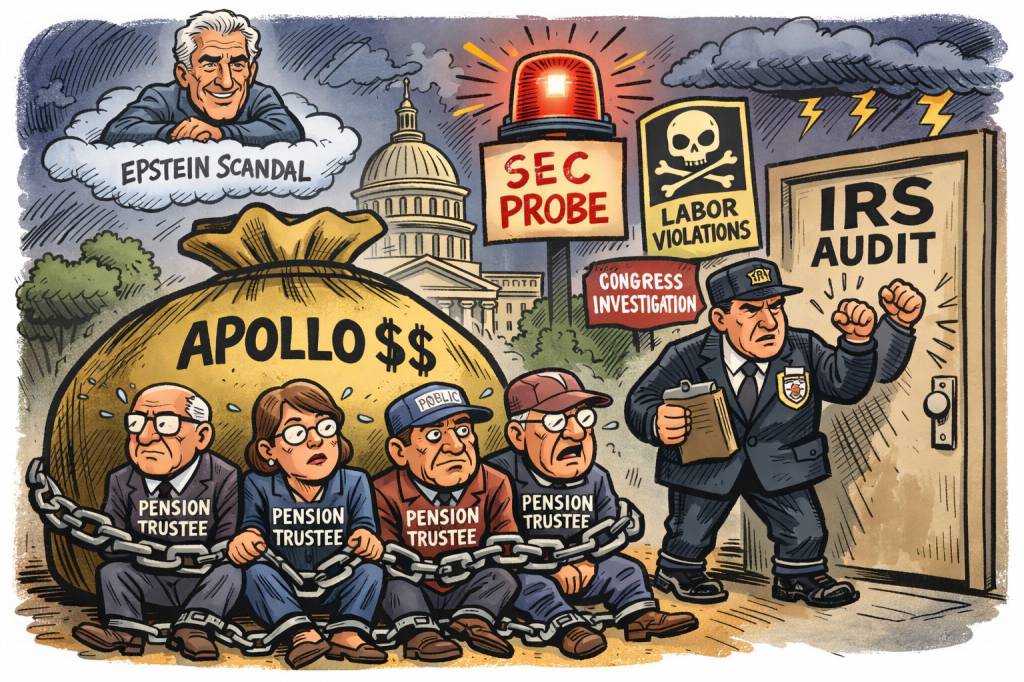
And the window to act voluntarily is closing fast. Since the February 1st Financial Times of London story dropped was soon followed by a SEC complaint by AFT and AAUP unions on February 12, and stock drop cases filed the next week after Apollo stock tanked over 35%, losing nearly $20 billion in value.
Apollo Is No Longer “Headline Risk”—It Is a Systemic Risk
For years, pensions were sold a carefully constructed narrative:
Leon Black’s relationship with Jeffrey Epstein was “personal”
The Apollo facts have become harder and harder for fiduciaries to wave away. In the February 17, 2026 SEC complaint from AFT and AAUP, the unions asked the Commission to investigate whether Apollo’s prior disclosures about its and its executives’ ties to Jeffrey Epstein painted an “inaccurate and incomplete picture.” Their letter pointed to newly released Epstein documents referring to Marc Rowan, including meetings at Apollo’s offices, breakfasts involving Rowan, Leon Black, and Epstein, discussions of donor-advised funds, tax matters, a possible Apollo inversion, and other business-related contacts. The letter concluded that the 2021 disclosures may have offered “an inaccurate depiction of the extent of Apollo’s ties with Jeffrey Epstein” and said the SEC should investigate whether the statements were materially false or misleading.
That matters enormously for pension fiduciaries. In 2019 and again in 2021, many institutional investors were told, in substance, that the Epstein problem at Apollo was largely personal to Leon Black and was being cleaned up. The new AFT-AAUP complaint directly challenges that sanitized version, arguing that the public record now suggests a broader and deeper institutional relationship. Whether the SEC ultimately agrees is not the point. The point is that pensions are on notice that the old comfort story may no longer hold. Once fiduciaries have credible notice that a manager may have mischaracterized material relationships, continuing to invest without a serious re-underwriting of the manager becomes its own governance failure.
Apollo co-founder Joshua Harris admitted at a 2013 meeting of the Philadelphia Board of Pensions that the firm’s capital base was overwhelmingly dependent on public retirement systems. Asked directly whether Apollo had many public pension investors, Harris responded bluntly that “almost all” of Apollo’s capital came from public funds, estimating that roughly 75% to 80% of Apollo’s capital was supplied by public pension plans. https://www.phila.gov/pensions/PDF/IM_03_28_13_Investment_Minutes.pdf
The UN Human Rights Office is looking into Jeffrey Epstein’s files as a transnational “global criminal enterprise. Many US pensions have signed onto the UN Global Compact on Human Rights. Investment firms like Apollo have signed, which could lead to divestment. https://news.un.org/en/story/2026/02/1166980
This is no longer a contained issue. It is expanding across disclosure, governance, and labor fronts simultaneously.
Once fiduciaries are on notice that: disclosures may have been inaccurate, governance failures may be deeper than represented and Epstein-related ties may have been broader than disclosed the legal standard changes. Trustees no longer get to say: “We didn’t know.”
Congress has already shown its hand. They aimed it at ESG specially the Environmental. But the logic doesn’t care about politics. Apply it to Apollo around Governance. Holding Apollo could endanger the IRS tax status of the plan.
Apollo’s stock collapse is not a side issue. It is confirmation. Between January and early March 2026, Apollo’s stock fell sharply wiping out tens of billions in market value.
That decline did three things at once:
1. Converted Governance Risk into Financial Loss
This is no longer theoretical.
Public pensions now hold:
Apollo private equity and private credit (paying fees and likely hidden losses)
Apollo stock (APO taking huge losses 2026)
Apollo REIT (ARI -26% last 5 years)
They are simultaneously: clients and victims
2. Triggered Securities Litigation
This type of decline automatically triggers:
stock-drop lawsuits
securities fraud claims
institutional investor recovery actions
This creates a direct fiduciary obligation: Pensions must evaluate whether to pursue recovery.
3. Exposed an Irreconcilable Conflict
Pensions now face a contradiction they cannot explain:
suing Apollo (as shareholders)
while allocating billions to Apollo (as clients)
Or worse:
not suing at all—because of the conflicted relationship of Apollo secret no-bid contracts
That is the exact type of conflict regulators look for.
What They Cannot Do
They cannot:
stay invested
keep paying fees
ignore the stock collapse
ignore SEC complaints
ignore labor violations
and claim they are acting solely in beneficiaries’ interest. That position is no longer credible.
Appendix: Senator Wyden’s Findings on Apollo Founder Leon Black
In a March 20, 2026 letter, Senator Ron Wyden details extraordinary financial dealings between Apollo co-founder Leon Black and Jeffrey Epstein, including $170 million in payments between 2012 and 2017—amounts far exceeding what Black paid elite law firms for similar estate planning work. Wyden notes that, according to a U.S. Virgin Islands settlement, Epstein used money paid by Black to help fund his sex trafficking operations, raising serious questions about whether these payments were truly for legitimate services . The letter highlights newly unsealed Department of Justice records suggesting the arrangement “went well beyond” traditional tax or estate planning and may have involved undisclosed or improper purposes. https://www.finance.senate.gov/imo/media/doc/senator_wyden_letter_to_leon_black_redacted.pdf
Wyden further raises concerns about potential financial misconduct, including evidence that payments to Epstein may have been channeled through a questionable 501(c)(3) structure to maximize tax deductions, and that Black’s estate planning arrangements involved $141 million in overpayments tied to Apollo-related partnership interests. Additional records cited in the letter suggest Epstein may have acted as an intermediary for payments to women and was involved in activities far removed from legitimate advisory services. Taken together, the Senate Finance Committee’s findings underscore that the Apollo–Epstein relationship is not merely historical—it presents unresolved questions about financial integrity, governance, and compliance that remain directly relevant to fiduciaries evaluating continued investment exposure. https://www.finance.senate.gov/continuing-epstein-investigation-wyden-questions-leon-black-over-new-revelations-in-epstein-files-appearance-of-hush-money-payments-and-surveillance-of-women
From an FTX-funded Super PAC to pro-crypto legislation, the money trail behind one Indiana congresswoman shows how the industry buys influence before it sells risk to retirees
It didn’t happen in a vacuum. It happened after the crypto industry quietly built political allies—one race at a time. And in southern Indiana, no figure better represents that strategy than Erin Houchin—a congresswoman whose rise to power was boosted by crypto-linked money and whose political positioning now aligns almost perfectly with the industry’s most aggressive expansion goals.
Call it what it is: the making of Indiana’s Queen of Crypto.
The Origin Story: FTX Money in a Southern Indiana Primary
Houchin’s path to Congress runs straight through one of the most notorious financial scandals of the modern era.
In her 2022 Republican primary, a little-known super PAC—American Dream Federal Action—suddenly flooded Indiana’s 9th District with ads supporting her candidacy. That spending was decisive. It helped propel Houchin past her rivals and into Congress.
But here’s what voters were not told at the time: That PAC was funded entirely by Ryan Salame, a senior executive at FTX. Not a diversified donor base. Not grassroots support. One man. One checkbook. One crypto insider.
And that story only got worse with time. Federal prosecutors later charged Salame with campaign finance violations tied to a broader scheme involving illegal political contributions connected to the FTX empire. He ultimately pleaded guilty and was sentenced to prison.
The political machine that helped elect a sitting member of Congress in Indiana was funded by a man who later admitted to breaking federal election laws tied to crypto money.
Her breakthrough victory was materially assisted by money from the inner circle of one of the largest financial frauds in history.
Round Two: The Crypto Money Doesn’t Stop
The story doesn’t end with FTX. After entering Congress, Houchin continued to show up in the same financial ecosystem. Campaign finance data shows contributions tied to Andreessen Horowitz, the Silicon Valley powerhouse heavily invested in crypto infrastructure, exchanges, and token platforms. Different players. Same industry.
And at the same time, Houchin’s political positioning became unmistakable. She aligned with the pro-crypto legislative push in Washington, including support for industry-backed frameworks like the CLARITY Act, and she has been publicly embraced by crypto advocacy groups such as Stand With Crypto, which labels her a “strongly supportive” candidate.
.
From Campaign Money to Retirement Policy
Indiana recently became the first state in the country to effectively mandate access to crypto investments inside retirement plans—a historic shift that exposes workers to one of the most volatile and least regulated asset classes ever created.
“It is fiscally irresponsible to allow state pension funds to be opened up to such risk simply because we want to send a message that the Indiana House of Representatives is supportive of the crypto industry,” said Rep. Ed DeLaney (D-Indianapolis) in a statement “If state funds are invested in cryptocurrency and that investment goes bad, the state still has an obligation to pay for those pensions https://indianapolisrecorder.com/house-bill-1042-crypto-investment/
This did not happen by accident. It happened in a political environment where:
Crypto money had already influenced elections
Pro-crypto lawmakers had already been elevated
The industry had already gained a foothold in policy conversations
And lawmakers like Erin Houchin were already in place.
The Real Risk: Turning 401(k)s Into Crypto Distribution Channels
The final step in this process is the most dangerous.
Once crypto enters retirement plans—whether through brokerage windows, target-date funds, or collective investment trusts—it stops being a speculative side bet and becomes a default exposure for ordinary workers.
The same industry that used political money to gain influence is now positioning itself to capture retirement assets at scale.
The Political Reality: Influence First, Accountability Later
There is no need to prove a direct quid pro quo to understand what is happening.
The sequence tells the story:
A crypto-funded PAC boosts a candidate
The donor later pleads guilty to campaign finance violations
The candidate enters Congress
The candidate aligns with crypto-friendly policy
The state moves to integrate crypto into retirement systems
That is not coincidence.
That is a pipeline of influence.
Conclusion: Indiana as the Test Case for a National Problem
Indiana is not just another state experimenting with financial innovation. It is the first clear example of how crypto moves: From campaign finance To political legitimacy To retirement plan integration
And at the center of that story sits Erin Houchin—the “Queen of Crypto”
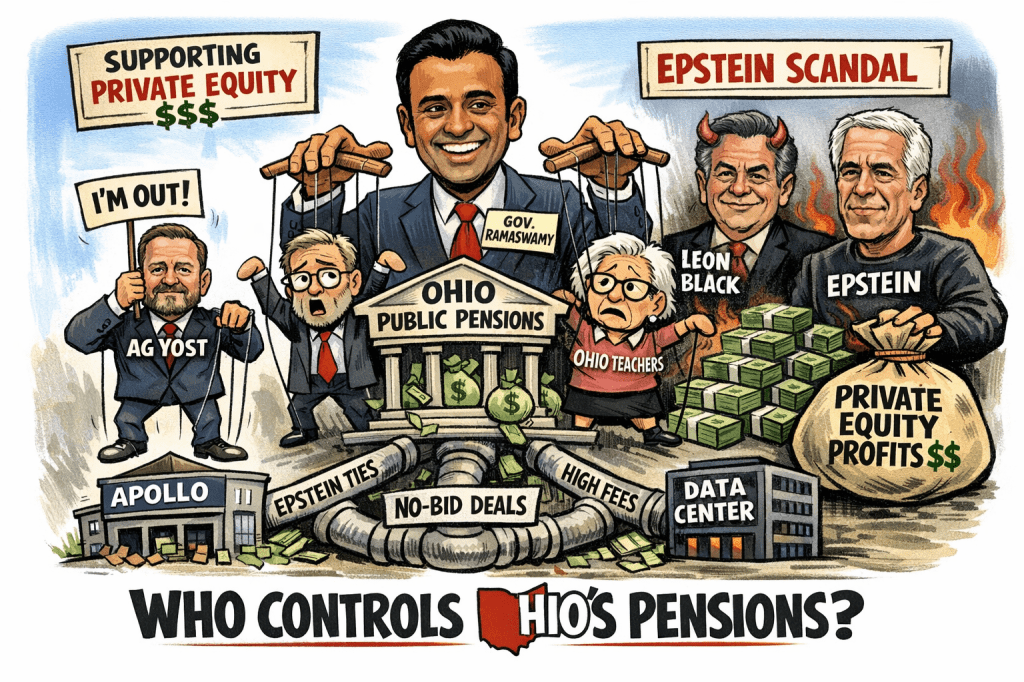
There is a growing effort across the country to scrutinize—and in some cases divest from—private equity firms entangled in conflicts, secrecy, and scandal. Nowhere is that pressure more justified than with Apollo Global Management, whose documented ties to Jeffrey Epstein and reliance on public pension capital have triggered renewed calls for accountability. https://commonsense401kproject.com/2026/03/10/jeffrey-epstein-funder-leon-blacks-apollo-bleeds-public-pensions-of-6-billion-a-year-through-secret-no-bid-contracts/ But in Ohio, that effort is likely to collide head-on with a potential governor whose financial roots and policy instincts are deeply aligned with the very system under scrutiny: Vivek Ramaswamy.
Ramaswamy is often marketed as a biotech entrepreneur, but the deeper story is one of private equity alignment. A significant portion of his wealth traces not to traditional operating businesses, but to data monetization platforms like Datavant, which was backed and scaled by New Mountain Capital. This is not incidental—it is emblematic. Datavant sits at the intersection of private equity, data extraction, and long-duration capital structures, the same ecosystem that increasingly dominates public pension portfolios.
That ecosystem depends heavily on state and local pension systems for capital. In Ohio, that includes both the Ohio Public Employees Retirement System and State Teachers Retirement System of Ohio—multi-billion-dollar funds that have allocated significant assets to private equity managers, including Apollo and its affiliated credit vehicles. As documented in prior analysis, these investments are often executed through opaque, no-bid contracts with layered fee structures that can exceed 500–600 basis points annually when fully loaded.
The political question is simple: would a Governor Ramaswamy support divestment from firms like Apollo in light of their Epstein ties, fee extraction, and governance concerns? The financial answer is far more revealing: it is highly unlikely.
Ramaswamy’s economic worldview is not merely tolerant of private equity—it is structurally dependent on it. His alignment extends beyond passive investment exposure into active policy advocacy. He has publicly supported the expansion of data center infrastructure—an asset class increasingly dominated by private equity and private credit vehicles, including those tied to Apollo. These data centers are not neutral infrastructure plays; they are fee-generating machines financed by the same pension capital that bears the downside risk.
This creates a reinforcing loop: public pensions allocate to private equity → private equity finances data centers and data platforms → political actors aligned with those interests promote further expansion → pension capital becomes even more dependent on the same opaque structures.
Ramaswamy’s involvement with Strive Asset Management adds yet another layer to this conflict. Strive positions itself as a challenger to ESG-driven investing, but in practice, it operates as a gatekeeper—advising and influencing pension allocations in Republican-controlled states such as Indiana. This is not a passive role. It places Strive—and by extension Ramaswamy—directly in the flow of pension capital decisions, including allocations to private equity managers.
In other words, the same individual who could oversee Ohio’s pension systems has already built a business model around influencing where those systems invest. That is not reform. That is vertical integration.
If Ohio’s pensions were to seriously consider divesting from Apollo or similar firms—whether due to Epstein-related governance concerns, hidden fee structures, or the growing risks in private credit—such a move would run directly counter to the financial architecture that underpins Ramaswamy’s own wealth and network. And that is before considering the broader systemic risk.
Private equity’s expansion into private credit, insurance balance sheets, and data infrastructure has created what can only be described as a shadow financial system—one that avoids mark-to-market discipline, obscures true fee levels, and concentrates risk in ways that are difficult for beneficiaries to see and even harder for fiduciaries to challenge. Ohio’s pensions are deeply embedded in this system.
A governor aligned with private equity is not going to unwind that exposure. He is far more likely to defend it. The result is a potential collision between fiduciary duty and political economy. Beneficiaries—teachers, public workers, retirees—have a right to demand transparency, competitive bidding, and independence from conflicted intermediaries. But those demands threaten a system that has become extraordinarily profitable for private equity firms and their political allies. The Apollo-Epstein controversy is not just a reputational issue. It is a stress test of whether public pension systems can act independently of the financial and political networks that influence them.
The Political Consolidation Behind Private Equity Power in Ohio
The political landscape in Ohio has already shifted in a way that reinforces—not challenges—the private equity status quo. When Dave Yost exited the 2026 gubernatorial race, it was not a neutral event. It effectively cleared the field for Vivek Ramaswamy, consolidating Republican political power behind a single candidate aligned with private equity interests. Yost’s withdrawal came immediately after the Ohio Republican Party endorsed Ramaswamy, turning what he described as a difficult path into a “vertical cliff” and eliminating meaningful intra-party opposition.
This matters for one reason: it removes one of the last potential institutional checks on how Ohio’s public pension capital is deployed. Because the stakes are not abstract. As documented in Epstein, Apollo, and Ohio Teachers’ Billions, https://commonsense401kproject.com/2026/02/23/epstein-apollo-and-ohio-teachers-billions/ Ohio’s largest pension systems—particularly State Teachers Retirement System of Ohio—have already committed billions to private equity structures tied to Apollo Global Management and its affiliates. These allocations are not passive index exposures. They are embedded in opaque, illiquid vehicles with limited transparency, no competitive bidding, and fee structures that can extract extraordinary value from beneficiaries over time.
The Epstein connection is not a historical footnote—it is a governance red flag. Apollo’s co-founder Leon Black was documented as having extensive financial ties to Jeffrey Epstein, raising serious questions about oversight, fiduciary judgment, and counterparty risk at the exact firms entrusted with public pension assets.
And yet, despite this, there has been no serious political push in Ohio to re-evaluate or unwind these relationships.
Ohio Highway Patrol SHPRS: Apollo PE funds
Ohio SERS: “Core Farmland Fund, LP Wilshire
Ohio State Teachers Retirement (STRS) PE Apollo S3 Equity Hybrid Solutions
Ohio Public OPERS Apollo PE funds, Oregon Public Employees Retirement Fund (OPERF), Apollo PE VI, VII, VIII, IX.
Yost’s exit helps explain why. With the Republican field consolidated behind Ramaswamy—and with additional statewide officials and party infrastructure aligning in the same direction—the probability of a coordinated effort to investigate, much less divest from, Apollo or similar private equity firms drops dramatically.
Instead, what emerges is something far more concerning: political consolidation that mirrors financial concentration. Ohio’s pensions are already heavily allocated to private equity. Now the political leadership overseeing those pensions is converging around a candidate whose personal wealth, business ventures, and advisory networks are deeply intertwined with that same ecosystem. That is not a coincidence. It is alignment. And for beneficiaries—teachers, public employees, retirees—it raises a fundamental question: if both the capital and the political oversight are concentrated within the same private equity orbit, who exactly is left to challenge the system?
Ramaswamy will keep all the Apollo funds in Ohio
In Ohio, voters have a new option by voting for Amy Acton for Governor. Acton is more likely to support divestiture
There are scandals on Wall Street. And then there is Apollo Global Management. Apollo was co-founded by Leon Black, the billionaire who paid convicted sex trafficker Jeffrey Epstein $158 million for mysterious “tax advice.” That relationship detonated into one of the ugliest scandals in modern finance and ultimately forced Black to step down as CEO. Yet despite that disgrace, Apollo remains deeply embedded in the American financial and political system. This is on top of a long history of scandals and violations with the SEC, EPA, and others.
Apollo CEO Marc Rowan is now leading the private-equity industry’s push to move trillions of dollars from 401(k) plans into opaque private assets. The sales pitch is dressed up in the language of “democratizing private markets.” But the reality is much simpler. Private equity needs fresh capital. Institutional investors are increasingly questioning fees, illiquidity, and performance. So Wall Street, led by Apollo, is now targeting the largest untouched pool of money in the country — American workers’ retirement savings.
And the political doors are wide open. Rowan has become one of the most influential financiers in Washington and was recently named to President Trump’s advisory structures related to Gaza reconstruction and governance. That alone should make people uncomfortable. But the deeper problem is the extraordinary web of influence surrounding Apollo and the agencies that are supposed to police it.
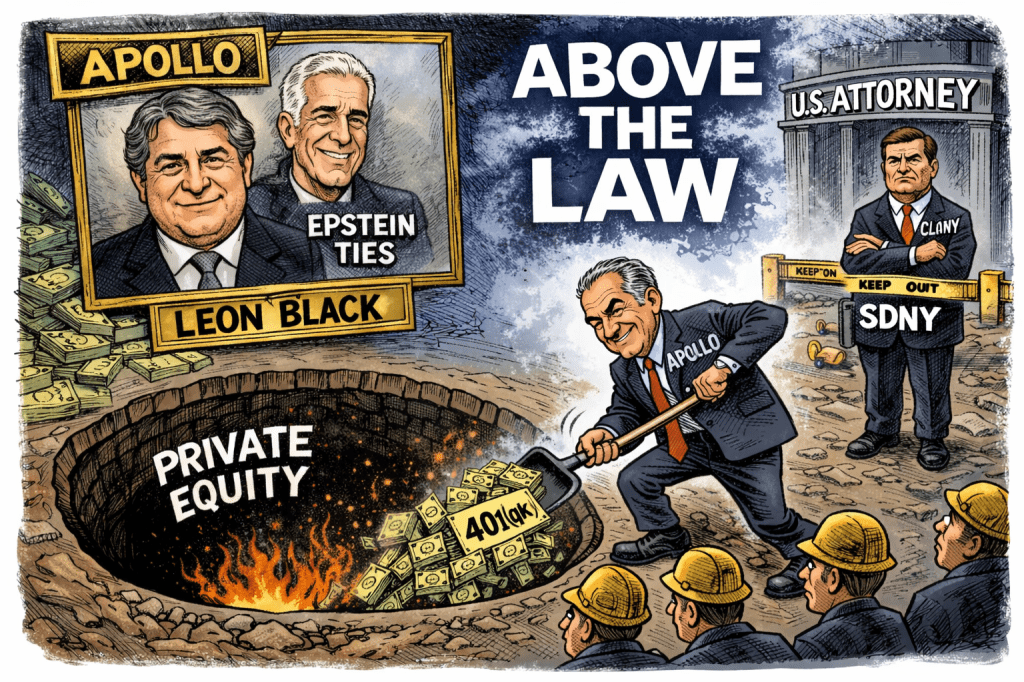
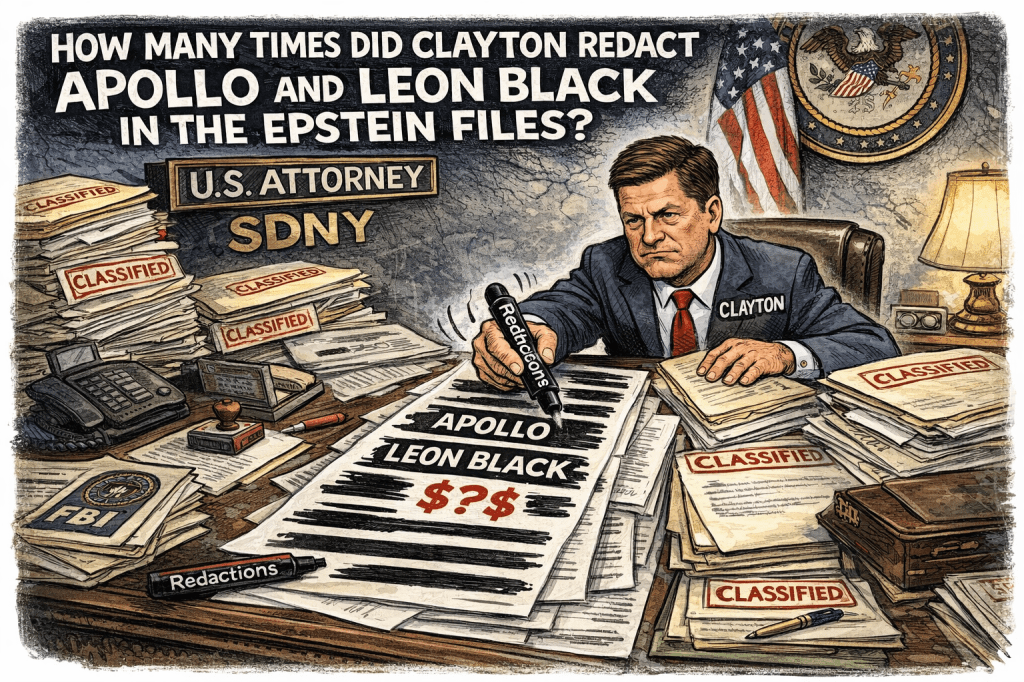
Consider the man now running the most powerful financial crime prosecutor’s office in the country. Jay Clayton, the U.S. Attorney for the Southern District of New York — the office that historically prosecutes Wall Street corruption — previously served as chairman of Apollo’s board. According to reporting by The Lever, Clayton still holds more than $1 million in Apollo investments.
What is worse, Attorney General Pam Bondi put Clayton in charge of the redactions of the Epstein files. My question is how many redactions did he make that involved Apollo and Leon Black? Pam Bondi has a long history with Apollo, hiring them to manage hundreds of millions for the Florida Retirement System when she was a trustee of that Pension.
Think about that for a moment. The top federal prosecutor in Manhattan has deep financial ties to a private-equity firm whose founder’s Epstein relationship remains the subject of lawsuits and investigations. The office that prosecuted Jeffrey Epstein now has a leader financially connected to the firm founded by Epstein’s most famous billionaire client. On top he was assigned by the US Attorney General to oversee redactions of millions of files, where he had numerous conflicts.
Meanwhile, the scandals keep coming. In February, Epstein file disclosure (maybe the one in a hundred Clayton missed) emails showing CEO Marc Rowan’s involvement with Epstein and that Epstein provided advice to Apollo, in contrast to SEC documents filed in 2021. In March 2026, Apollo, Leon Black, and Marc Rowan were sued by shareholders who alleged the firm had misled investors for years about its relationship with Epstein. The lawsuit claims Apollo’s filings falsely denied doing business with Epstein, even though he allegedly played a significant role in advising senior leadership.
Apollo has built a vast empire extracting fees from public pension funds through secretive, no-bid contracts, opaque valuation methods, and complex structures that hide the true cost of private equity and private credit. As much as 85% of their assets come from taxpayer funds. As documented in prior reporting, the firm’s fee machine likely drains billions of dollars annually from public retirement systems.
And now Apollo wants the next frontier. Your 401(k). The plan is straightforward. Private equity firms partner with asset managers to build collective investment trusts, target-date funds, and hybrid products that quietly insert private assets into retirement portfolios. Workers will be told they are receiving “diversification.” What they are actually receiving are illiquid assets priced by models, surrounded by multiple layers of fees, and wrapped in disclosures almost no participant can understand. It is a perfect system for Wall Street. Daily pricing in 401(k)s becomes fiction. Transparency disappears. Benchmarking becomes meaningless. And the fees — always the fees — continue flowing upward.
For decades, private equity thrived because public pensions provided patient capital with limited scrutiny. Now even those investors are asking questions about performance and fee extraction. So the industry is hunting for something better. Captive capital. A 401(k) participant cannot negotiate terms. They cannot demand transparency. They cannot fire the manager running the fund inside their target-date product.
If a firm was built by a billionaire who secretly paid Jeffrey Epstein $158 million… If that firm’s executives are currently being sued for allegedly concealing Epstein ties… If the nation’s top Wall Street prosecutor previously chaired that firm and still holds financial stakes in it…Why in the world would anyone allow that firm to manage workers’ retirement savings?
Public pensions should divest from Apollo. Regulators should scrutinize every contract the firm holds. And Congress should slam the door on the private-equity industry’s attempt to convert America’s 401(k) system into the next extraction machine.
Because if Apollo and the rest of the private-equity industry succeed, the Epstein scandal will end up being remembered not as the moment Wall Street cleaned house — but as the moment it realized it could get away with almost anything.