You can benchmark a mutual fund. You can benchmark an index fund. You can even benchmark a synthetic stable value fund—if you know what you’re doing.
But you cannot benchmark a General Account or Separate Account fixed annuity.
That is not an accident. That is the design.
And it is the reason fixed annuities do not fit inside an ERISA fiduciary framework built on comparability, measurability, and transparency.
You’ve written for years that GA/SA annuities are prohibited transactions in practice. The missing piece most fiduciaries, consultants, and courts still don’t grasp is this:
Fixed annuities have comparables in the marketplace. They do not have a legitimate benchmark.
That difference is everything.
What a benchmark actually is (and why annuities can’t have one)
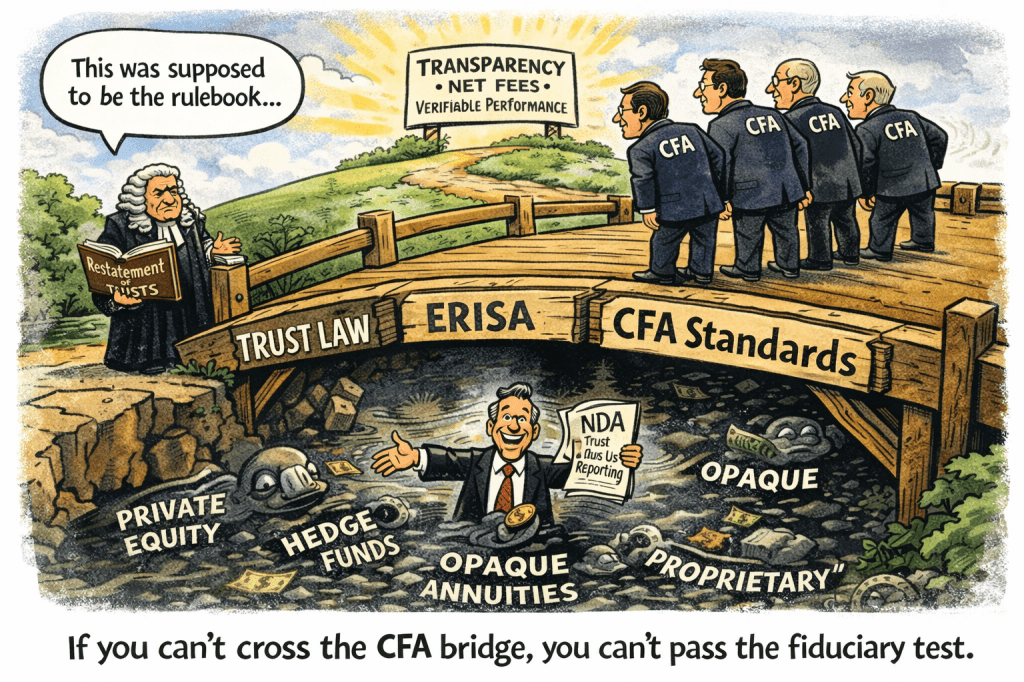
From the CFA Institute’s trustee framework and the Restatement of Trusts logic applied in cases like Brotherston, a benchmark must:
Be investable
Be transparent
Use market value accounting
Allow apples-to-apples fee and performance comparison
Reflect the same risk profile
SEC-registered mutual funds do this perfectly. That’s why 401(k)s are built around them.
As your book chapter explains, fee transparency + performance transparency is the foundation of fiduciary oversight. Once disclosures improved in 2012, litigation increased, and fees fell. That is how the system is supposed to work.
And say “We already outlawed this in 1940 and 1974. How did it come back?”
The question courts and regulators should be asking
Not:
“Is this permitted by the plan document?”
But:
“Would this be permitted if this were a private trust and the beneficiary demanded the books?”
That is the fiduciary test ERISA was built on.
And it’s the test many modern retirement structures cannot pass.
Appendix: The Quiet Erosion of Trust Law Inside ERISA
The story above makes a simple point: ERISA is trust law applied to pensions. Its backbone is the Restatement (Second) of Trusts. Its cousins are the disclosure regimes of the Securities Act of 1933, the Securities Exchange Act of 1934, and the structural protections of the Investment Company Act of 1940. Congress imported those principles into the Employee Retirement Income Security Act after pension looting scandals.
This appendix addresses a harder claim:
Over time—and especially in recent years—new rules, exemptions, and litigation trends have weakened ERISA’s trust-law core, not by repealing it, but by engineering around it.
How erosion happens (without saying “weaken ERISA”)
Modern changes rarely say, “reduce fiduciary duty.” Instead, they:
Redefine what counts as adequate disclosure Long documents, layered structures, and “proprietary” claims substitute for clarity. Participants receive information, but not usable information.
Expand what can be treated as ‘prudently justified’ Illiquid, opaque, hard-to-benchmark assets are normalized inside daily-valued plans so long as a paper process exists.
Rely on exemptions and safe harbors Prohibited-transaction exemptions, rollover rules, and advice frameworks create compliance paths that dilute the bright lines trust law once enforced.
Narrow who can sue and when Litigation doctrines and standing rules reduce the practical ability of beneficiaries to challenge conflicted structures, even when trust-law principles would condemn them.
Shift oversight from structure to documentation If the file shows a process, courts increasingly defer—even when the underlying structure obscures fees, conflicts, or valuation risk.
The pattern across administrations (and visible now)
This trend did not begin with any single administration. But the current legislative and regulatory push—often framed around ESG, choice, or access to private markets—accelerates the shift from trust principles to paper compliance.
For example, proposals emphasizing “pecuniary factors only” or expanding access to private assets in retirement plans may sound participant-protective. In practice, without parallel requirements for fee transparency, independent valuation, and real benchmarking, they risk:
Making it easier to justify opaque alternatives on a “financial” rationale
Hardening the legal defense that complexity equals prudence
Further distancing ERISA practice from the Restatement’s simple tests: loyalty, prudence, disclosure, and conflict avoidance
What trust law would still ask
A chancery judge applying trust law would ask:
Can the beneficiary see the fees?
Can the beneficiary verify the value?
Can the beneficiary compare the investment to a known benchmark?
Is anyone in the chain paid more if this option is chosen?
If the answer to any of those is “no” or “we can’t disclose,” trust law’s presumption is against the trustee.
Modern ERISA practice too often presumes the opposite: if it’s disclosed somewhere and documented, it is presumed acceptable.
Why this matters for today’s reforms
When new laws or rules are proposed—whatever their stated political goal—the test should be:
Do they move ERISA closer to or farther from its trust-law roots?
If a change:
Expands opacity,
Normalizes illiquidity without valuation safeguards,
Relies on exemptions over bright lines,
Or makes challenges harder for beneficiaries,
then it functionally weakens ERISA, even if the statute’s words remain untouched.
The through-line
From 1933 to 1940 to 1974, Congress responded to financial abuse the same way: force sunlight, ban conflicted structures, empower beneficiaries.
When modern policy trends move in the opposite direction—toward complexity, exemptions, and reduced accountability—they don’t repeal those laws.
They hollow them out.
That is the quiet erosion this article warns about.
For years, Morningstar has positioned itself as the independent umpire of the mutual fund world.
The star ratings. The analyst reports. The fiduciary consulting.
If Morningstar approves it, fiduciaries feel safe.
But buried in Morningstar’s own SEC filings is something most plan sponsors, consultants, and courts do not realize:
Morningstar is deeply embedded in the business of helping insurance companies design retirement plan investment menus built around CITs, annuities, and proprietary insurance wrappers — the very structures now raising ERISA prohibited transaction concerns.
This isn’t speculation. It’s in their Form ADV.
Morningstar Retirement: Not What People Think
Morningstar Investment Management’s “Retirement” division does not simply analyze mutual funds.
They explicitly say they: “construct custom model portfolios for employer-sponsored retirement plans using the investment options available in a plan’s lineup.”
That sounds harmless — until you read the next sentence: “The universe of underlying holdings is generally defined by the Institutional Client and can include investment products that are affiliated with that Institutional Client.”
Translation: If Lincoln, MetLife, TIAA, Principal, Empower, or an insurance platform defines the menu, Morningstar builds portfolios using those proprietary insurance products.
They are not evaluating an open market of mutual funds. They are working inside insurer-defined universes.
The MetLife Smoking Gun
Morningstar has a dedicated ADV brochure for: “Advisory Services to MetLife ExpertSelect Program”
In this document, Morningstar openly states:
“We selected the menu of investment options available in the MetLife ExpertSelect Program from the universe of investments that MetLife is authorized to offer.”
They go further: “We do not review the annuity products in connection with the Program.”
Read that again. Morningstar — the supposed fiduciary expert — builds the menu but does not review the annuity products.
They also state: “The lineups we build are limited to a universe of mutual funds and other investment vehicles, such as CITs and guaranteed retirement income products such as annuities.”
So Morningstar’s job here is: Make insurance menus look like diversified retirement lineups.
The Target Date Angle Nobody Talks About
Morningstar also offers:
“Personal Target Date Fund Services” “Custom Model Portfolios” “3(21) and 3(38) fiduciary services”
But those services are constrained to: “the investment options available in the plan lineup.”
And those lineups, in insurance platforms, are:
CITs
Stable value
Separate accounts
Annuity sleeves
Proprietary trust wrappers
This is exactly the structure now showing up in TIAA, Lincoln, MetLife, and other insurance-based target date designs where:
The participant thinks they are in mutual funds, But they are inside insurance contracts.
Morningstar is often the firm paid to “monitor” and “approve” these lineups.
And Morningstar Gets Paid Very Well For This
Their fee schedules show:
2–15 basis points for institutional asset management
3–8 bps for fiduciary services
Minimums of $100,000 to $450,000
Special target-date and managed account fees
This is a huge revenue business tied directly to insurer retirement platforms.
They even disclose: “We receive direct or indirect cash payments from unaffiliated third parties for referring their services to other advisory firms or investors.”
And: “We provide compensation to Institutional Clients to provide marketing or educational support…”
This is not a passive ratings agency. This is an active participant in the insurance retirement ecosystem.
Why Their Articles Read the Way They Do
When Morningstar writes articles like:
“The hidden trend changing 401(k) plans”
“Target date fund trends”
They present the rise of CITs and insurance-based structures as innovation.
They never mention:
Prohibited transaction risk
Party-in-interest issues
Share class access problems
Insurance wrapper conflicts
Hidden spread compensation
Fiduciary benchmarking problems
Because this is the ecosystem they are paid to support.
What Morningstar is actually doing in many insurance platforms is:
Monitoring the funds inside the insurance cage.
They are not asking:
Why are we in the cage at all?
The Real Question Fiduciaries Should Ask
When Morningstar is hired in a Lincoln, MetLife, TIAA, or similar platform, the right question is:
Are they acting as an independent fiduciary reviewer?
Or Are they being paid to make an insurance menu look prudent?
Because their own ADV says the latter.
The Bottom Line
Morningstar is no longer just the referee of the mutual fund world.
They are now a key architect of insurance-based retirement plan menus where:
CITs replace mutual funds
Annuities hide inside target dates
Proprietary wrappers block institutional pricing
Fiduciary conflicts multiply
And they disclose it all — if you read the fine print.
Most fiduciaries never do.
Appendix: Morningstar’s Dual Role — Ratings Provider and Insurance Scorekeeper
While the main article above documented how Morningstar serves as a referee, scorer, and evaluator for the insurance industry — especially in distributing and marketing annuity products — there is a parallel role that is even more consequential for pension risk transfers and fiduciary decision-making: Morningstar’s participation on the credit-rating side of private insurance-backed securities.
1. Morningstar Is Now a Major Player in Privately Rated Securities
Life insurers have shifted a growing share of their portfolio into privately placed debt, direct lending, and private credit — assets that are not traded publicly and for which there is no market price discovery. To make these assets look “investment grade,” insurers increasingly rely on private letter ratings (PLRs) — credit opinions issued by small, non-S&P/Moody’s rating firms.
Among the few firms active in this market is Morningstar DBRS — the credit rating arm of Morningstar that issues private ratings on securities typically held by insurance companies or structured finance vehicles.
According to industry data, as of year-end 2023, approximately 86% of U.S. insurers’ privately rated securities were rated by small CRPs including Morningstar DBRS. The result is that a large portion of the so-called “investment grade” portfolio backing life annuities is not rated by the major public agencies at all, but by niche providers whose methodologies and transparency are not subject to broad market scrutiny.
2. The Conflicted Incentives of Private Letter Ratings
Private letter ratings are fundamentally different from public credit ratings:
They are paid for by the issuer or sponsor, not by market subscribers.
They apply to securities that have no public trading market.
Their output cannot be independently verified by investors or fiduciaries.
Their methodology disclosures are limited or proprietary.
When Morningstar DBRS assigns an investment-grade letter to a privately placed life-insurer bond or private credit tranche, that rating becomes part of the narrative insurers use to declare that “over 90% of our portfolio is investment grade.” In other words, Morningstar’s rating opinion gets rolled up into insurer marketing and fiduciary disclosures, even though the underlying assets may be opaque, illiquid, and of uncertain credit quality.
This raises an obvious question: Should a ratings arm of a firm that also earns fees from insurers for scoring insurance products be treated as independent when it privately rates securities sold to those same insurers?
3. Egan-Jones, SEC Scrutiny, and Why It Matters Here
The financial press has reported that the SEC is investigating Egan-Jones for its rating practices, raising concerns about whether private CRPs are applying appropriate standards or simply rubber-stamping risk. (See: “Egan-Jones Probed by SEC Over Its Credit Ratings Practices,” Financial Advisor Magazine.)
Morningstar’s credit arm has not been the subject of the same public regulatory scrutiny — but the structural problem is the same:
A firm with revenue streams tied to the insurance ecosystem is issuing “investment grade” opinions on assets that lack public market validation.
That is neither transparent nor consistent with the way public credit ratings are expected to function in capital markets.
4. PLRs Populate Annuity Backing Portfolios With Unknown Risk
Even if regulators decide to restrict or ban private letter ratings going forward, that would only affect new ratings. It would not address the estimated $1.6–$1.8 trillion of private credit already on U.S. life insurers’ balance sheets — much of it rated privately by firms such as Morningstar DBRS.
Because these assets:
Are illiquid,
Are not publicly traded,
Do not have transparent pricing, and
Are often backed by non-bankruptcy-remote structures or reinsurance vehicles,
their credit quality cannot be independently confirmed. The only basis for believing they are investment grade is the letter assigned by a small CRP.
That dynamic helps explain why widely followed market indicators such as credit default swap (CDS) spreads for large life insurers often show persistent credit risk that does not align with the high investment-grade ratings insurers tout. (See your October 29 article on annuity risk as measured by CDS.)
5. Morningstar’s Dual Roles Create a Perverse Incentive Loop
Morningstar:
Scores insurance products (e.g., annuities) for platforms and distributors,
Rates peripheral securities held by insurance companies, and
Participates in data and analytics ecosystems that insurers and fiduciaries use for decision-making.
This combination raises two systemic concerns:
A. Conflicts of Interest — When an insurance-industry scoring provider also issues credit ratings for instruments used to back those same products, there is a risk that independence is compromised — or at least perceived to be.
B. Lack of Market Discipline — Because private letter ratings are not subject to public market verification, they allow insurers to present opaque risk as “safe,” undermining the ability of fiduciaries to evaluate risk meaningfully.
Conclusion: Ratings Matter — Especially When They Don’t Match Reality
Your main article argues that Morningstar helps design the insurance playbook. This appendix shows a darker side of how that playbook is supported: by obscuring underlying asset risk with opaque ratings.
In a world where:
General account assets are increasingly private credit,
CDS spreads suggest elevated insurer risk,
PBGC backstops are disappearing after PRTs,
And fiduciaries are told to rely on “investment grade” labels,
it is no longer acceptable to treat privately rated credit as equivalent to S&P/Moody’s investment grade.
ERISA fiduciaries, regulators, and courts need to recognize that:
A rating is only as good as the transparency, independence, and accountability behind it.
If the referee is also the designer of the playbook, and also rates the teams, then the game is not being called fairly — and retirees are the ones on the field with no protection.
There is a common thread running through what we are seeing in:
The media — where reporters struggle to explain why private equity results never quite match the story being told (see the NYT H-E-B piece you dissected),
The courts — where judges are beginning to realize that fake benchmarks and opaque reporting create fiduciary illusions (see your Intel analysis),
State governments — where pension reports in Kentucky, Chicago, North Carolina, Rhode Island and California show performance standards that would never be tolerated in public markets,
And now Vermont — where Tim McGlinn, CFA/CAIA, documents how the state is effectively misrepresenting private equity performance to the public.
This is not coincidence. It is not incompetence. It is a system.
A system in which private equity performance is engineered, narrated, benchmarked, and reported in ways that would be considered securities fraud if done in public markets.
And everyone involved gets paid to look the other way.
When performance is measured against something that cannot be owned, “outperformance” is meaningless. This does not hold up under careful application of ERISA fiduciary standards.
This is not just bad measurement. It is misleading disclosure.
Why This Is Systematic — Not Accidental
Look at who benefits:
Actor
Benefit from the deception
Private equity managers
Hide fees, control valuations, claim alpha
Pension consultants
Justify complexity, look sophisticated
Pension staff
Earn bonuses versus slow benchmarks
Politicians
Point to “outperformance” in reports
Media
Repeat the narrative without understanding mechanics
These structures survive because fiduciaries, consultants, and staff are compensated inside the system that benefits from the opacity. The deception is not loud. It is polite. Technical. Professional. Credentialed.
It is benchmark math, valuation timing, performance standards, and narrative framing.
Which makes it far more effective.
The Bottom Line
Tim McGlinn showed it in Vermont. The WSJ showed it when liquidity hit. Richard Ennis showed it nationally. CFA warned about it. Courts are starting to see it.
Private equity performance, as reported by pensions, is not a reflection of economic reality.
It is the product of:
Benchmark engineering,
Valuation lag,
Performance Standards (GIPS) avoidance,
Fee opacity,
Governance capture,
And incentives aligned to preserve the illusion.
This is not bad investing.
This is systematic performance deception.
And until pensions are forced to measure private equity against investable public benchmarks, full fee transparency, and GIPS-level standards, the numbers they report should be treated as marketing, not measurement.
While the trade press, lobbyists, and Congress argue endlessly about putting lifetime income annuities into retirement plans, they are ignoring the much bigger, much quieter, and much more dangerous reality: Fixed annuities are already everywhere in 401(k) and 403(b) plans. Not income annuities. Not fancy new products. Plain vanilla, insurance company general account fixed annuities. And they have been sitting there for 20 years, largely unnoticed, unexamined, and almost never litigated. They are the dirty secret of defined contribution plans. By talking endlessly about Lifetime Income Annuities which barely register at under 1%, which sound good, they hope to hide these fixed annuities.
The scale no one talks about Using the RxTrima ERISA database: 774,172 ERISA plans 725,689 are defined contribution plans (mostly 401(k)s, some ERISA 403(b)s) The litigation universe (plans > $100 million): 9,010 plans Of roughly 9,000 plans over $100 million reviewed: 3,579 plans hold fixed annuities $207 BILLION in plan assets Let that sink in.
While journalists obsess over whether a handful of plans might add lifetime income, thousands of plans already hold hundreds of billions inside insurance company balance sheets.
Breakdown:
Plan Size# of Plans with Fixed Annuities
Over $1B 17
$500M–$1B 27
$300M–$500M 57
$100M–$300M 320
$50M–$100M 482
$30M–$50M 532
$10M–$20M 1,260
Under $10M 700 This is not a niche issue. This is systemic.
Who the major players are These are not fringe insurers.
Insurer# Plans $Assets
Empower 930 $51.8B
TIAA 392 $58.3B
Principal 612 $20.1B
MassMutual 253 $13.1B
NY Life 300 $11.8B
MetLife 196 $11.2B
Lincoln 194 $8.7B
Transamerica 215 $6.7B
Voya 157 $5.2B
VALIC 93 $3.8B
This is dangerous under ERISA These are primarily general account contracts. That means: Plan assets become liabilities of the insurer’s balance sheet. They are not mutual funds. They are not CITs. They are not segregated. They are loans to the insurance company.
And under ERISA §406: That is a transfer of plan assets to a party in interest.
Why Fixed Annuity Contracts are mostly Secret Because they hide under different names like: “Stable value” “Capital preservation” “Fixed account” “Guaranteed account” “General account GIC” “Group annuity contract” And they sit quietly for years paying 2–3% while the insurer earns 5–7% on the same money. That spread is never disclosed. Never benchmarked. And just starting to be litigated.
The industries where this is concentrated From your notes: Education (ERISA 403(b)s) —345 plans dominated by TIAA Medical / hospitals —780 plans heavy Lincoln and others Financial firms —206 plans led by Principal, Empower Unions/nonprofits — 274 plans led by Empower, MassMutual These are exactly the plans plaintiff firms usually ignore because they don’t look like fee cases. Many are 403(b)s But they are prohibited transaction cases, not fee cases.
The real irony While Congress pushes bills to allow annuities into plans… There are already 3,500+ plans with $207 billion sitting in annuities that likely never complied with ERISA in the first place. This is not a future problem. This is a 20-year-old problem hiding in plain sight.
The punchline The retirement industry wants you to debate whether lifetime income annuities should be allowed into 401(k)s. They do not want you to notice that Fixed Annuities are already there, and are a litigation bomb ready to go off.
When a Plan’s Alternatives Echo the Same Secrecy and Conflicts Now Before the Supreme Court
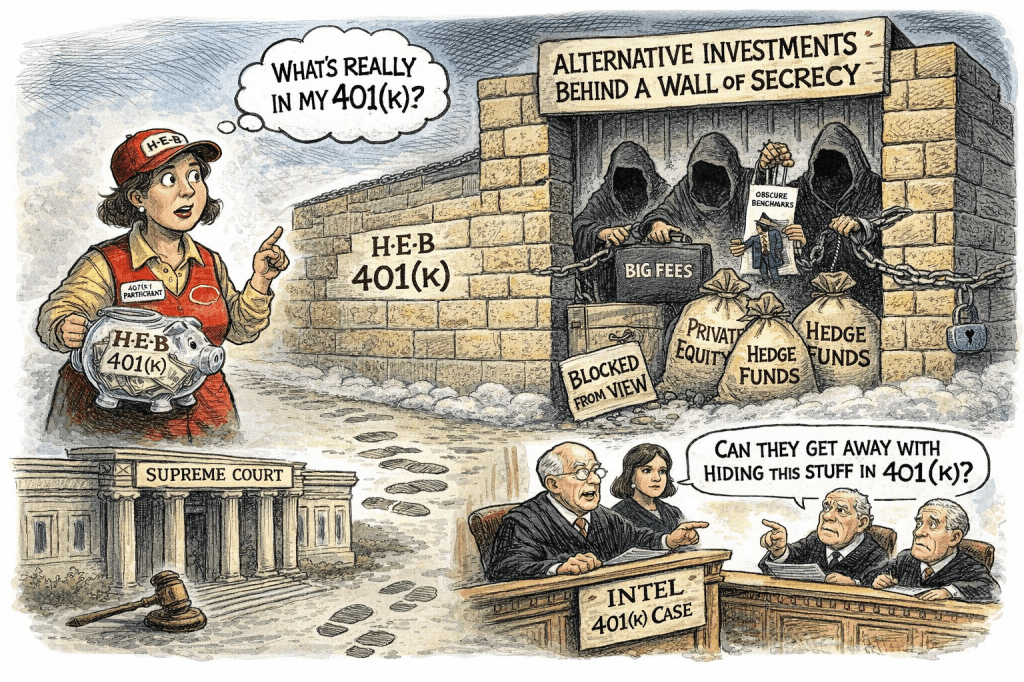
The New York Times recently published a sympathetic profile about one H-E-B employee’s retirement savings, celebrating the virtues of long-term compounding and disciplined contributions. It’s a feel-good human narrative — but it carefully avoids the structural questions that truly matter to millions of participants.
Other alternate investments (hedge funds, private credit, opportunistic funds): $128,585,560
This is over $609 million in private and alternative assets — a striking allocation in what is supposed to be a daily-valued 401(k) designed for retail savers. Even holding a conservative interpretation of categories, the plan still lists well over $300 million in hard-to-value, illiquid positions.
HEB
That kind of exposure isn’t a minor footnote. It’s a strategic investment decision with big consequences.
Stale Valuations and “Daily Liquidity” — A Problem Wrapped in Language
H-E-B discloses in its 5500 that these alternative positions are:
Valued using “good faith estimates.”
Using manager valuations that may lag by 4–15 weeks
Used to price daily participant transactions
Participants assume the risk that true values may differ materially when actual trades settle later
HEB
Translated: the plan’s “daily valuation” window is an illusion. The values that participants see when they rebalance or change allocations, can be stale, and updated only after the fact — meaning participants make real decisions based on outdated information.
This too closely resembles the valuation and benchmark games at issue in the Intel Supreme Court case — where opaque pricing, bespoke benchmarks, and frozen valuations shield fiduciaries from accountability.
Private Equity in a 401(k)? Yes — But the Problem Is Bigger Than ‘Illiquidity’
Many PE vehicles embed fees and compensation that don’t become transparent until years later — carried interest that accrues in ways participants don’t see, placement agent fees shared with plan service providers, and revenue sharing that goes unseen. The plan’s total recordkeeping cost picture becomes distorted.
These hidden economic interests resemble the sort of related-party and soft-dollar conflicts that ERISA’s prohibited transaction rules were designed to prevent.
2) Manager-Controlled Valuation + Lack of Objective Benchmark
PE and other alternative asset managers often control monthly or quarterly NAV establishment. That’s fine for an endowment — not fine when:
A participant’s daily balance changes based on stale data
ERISA’s prudence and disclosure duties assume auditable, observable benchmarks and valuations — things private markets resist.
3) Liquidity Mismatch
Daily-tradable 401(k) interests priced on stale alternative valuations simply don’t behave like truly liquid vehicles. When participants rebalance, they get a price that may not reflect actual realized market value — transferring valuation risk to participants without their informed consent.
The Supreme Court Intel Case Isn’t About Pleading Rules — It’s About Secrecy
The conventional reporting treats the Intel case as a narrow statute-of-limitations fight. That’s the superficial framing.
What’s really at stake is:
Do fiduciaries have to disclose compensation, conflicts, and valuation mechanics transparently?
Or can they bury this information in opaque structures, stale assumptions, and “trust us” language?
Can participants ever compare plan performance to meaningful benchmarks — or does the “fiduciary illusion” shield fiduciary failures?
Why is a large plan diverting hundreds of millions into assets participants cannot evaluate?
Why are valuations lagged by weeks in a daily liquidity vehicle?
What benchmarks exist against which participants can measure performance?
What hidden compensation flows to advisers tied to these alternative allocations?
Is this consistent with ERISA’s core duties of loyalty, prudence, and disclosure?
These aren’t abstract academic questions. They go to the heart of whether retirement plans serve participants or structural economic interests tied to private markets and product fees.
The Convergence: H-E-B and Intel
If the Supreme Court allows fiduciaries to hide behind complexity and stale valuation benchmarks, then:
H-E-B’s allocation structure becomes a safer defensive line
More plans will emulate similar private market exposure without meaningful transparency
Participants will have no clear benchmark or valuation certainty for key portions of their retirement wealth
But if the Court affirms:
Meaningful disclosure duties
Real benchmarks (not proprietary or opaque targets)
A requirement that valuations reflect current participant realities
Then H-E-B’s structures — and those of countless other plans — are suddenly exposed to real fiduciary scrutiny.
The Bottom Line
Counting retirement balances is easy. Understanding what participants own, at what price, and with what conflicts is hard.
That is the structural issue the NY Times missed — and the Supreme Court must confront.
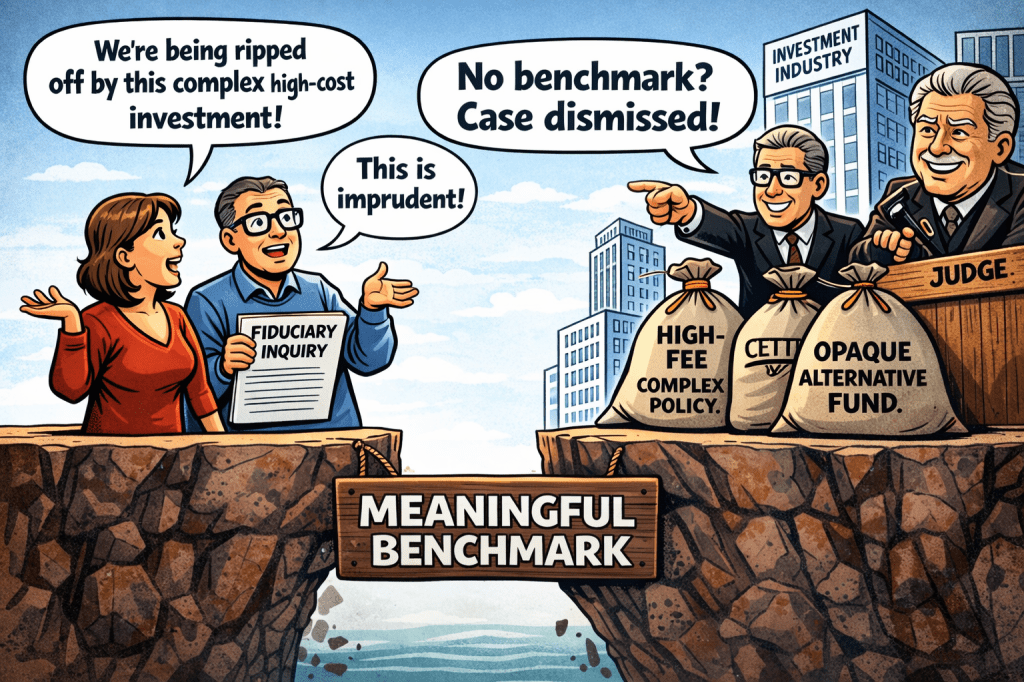
Over the last decade, a judicially fabricated standard has crept into ERISA litigation: the so-called “meaningful benchmark” requirement for claims alleging imprudence or excessive costs.
This appendix explains:
Where the concept came from
Why it is illegitimate as a substantive rule
How it masks high-fee, high-risk products that cannot be meaningfully benchmarked
1. Origins: A Procedural Pleading Universe, Not an Investment Principle
The idea of a “meaningful benchmark” did not originate in investment theory, economics, or statutes. It was born out of ERISA procedural case law, largely as a 12(b)(6) pleading standard for plaintiffs alleging fiduciary breaches based on investment performance or fees.
The early case law adopted by some circuits required that, to survive a motion to dismiss, a complaint alleging underperformance or excessive costs must include a comparator that is sufficiently similar — an “apples-to-apples” alternative that plausibly shows the fiduciary could have done better. Courts demanded such comparators because plaintiffs often had no discovery, and judges were (purportedly) reluctant to let cases proceed on uninformed guesses about what the fiduciary could have done differently.
But critically:
There is no statute that requires a “meaningful benchmark.”
ERISA’s prudence standard focuses on process, not performance relative to a counterfactual benchmark.
Benchmarks were a judicial convenience, not a substantive legal test.
2. It Is a Procedural Standard, Not a Substantive Investment Rule
The “meaningful benchmark” doctrine is a pleading rule — a device courts use to decide whether a complaint plausibly alleges imprudence before any discovery. It does not represent a real investment standard under ERISA or fiduciary law.
Indeed:
Some courts require it at the motion-to-dismiss stage.
Other circuits reject it as inappropriate fact-finding before discovery.
The Supreme Court now is considering this very issue in the Intel/Anderson cases — whether a meaningful benchmark is required at all at the pleading stage. The fact that this question has reached the Supreme Court underscores how unsettled and judge-crafted this standard really is.
In other words, meaningful benchmark is not a regulatory requirement; it is a judge’s attempt to police litigation before discovery by demanding early comparators. It is a procedural gatekeeper, not substantive law.
3. Why It Is Deceptive — Especially Against Insurance and Annuity Products
The meaningful benchmark standard sounds appealing — who wouldn’t want apples-to-apples comparisons? But in practice, it gives impermissibly broad cover to Wall Street, insurance companies, and institutional defenders because:
📌 a) Certain products cannot be benchmarked
· Fixed annuities · General account insurance contracts · Proprietary separate accounts · Private equity and hedge funds
These products have no market-priced peers — you cannot find another open-end mutual fund that does what a fixed annuity does under discretionary crediting and balance-sheet mechanics.
Nothing in finance theory or asset pricing mandates that annuities must be compared to Vanguard, BlackRock, or S&P 500 products. Benchmarks are easier for public market instruments precisely because they have prices. Annuities do not. Thus, the meaningful benchmark standard is illogical when it comes to products that cannot be benchmarked.
4. The Standard Is Being Used to Hide, Not Reveal, Risk
The meaningful benchmark doctrine effectively says:
“If you cannot show an obvious benchmark that demonstrates harm, you have no case.”
That standard flips fiduciary law on its head.
Under ERISA, the duty of prudence is about process and risk-adjusted judgment — not about whether some benchmark existed on which the fiduciary could have hypothetically outperformed. Instead, defendants have latched on to this judicial invention to argue that a lack of benchmark equals lack of harm — a position that serves Wall Street and insurance producers very well.
5. The Investment Industry Loves It — Because It Lets Them Sneak In Opaque, High-Fee Products
Investment intermediaries and insurers have a strategic advantage when the standard is “meaningful benchmark.”
Why?
Because the industry sells products that do not have logical benchmarks:
Annuities
Indexed insurance contracts
Private market funds
Multi-asset strategies with proprietary glidepaths
These products cannot be meaningfully compared to:
Public index funds
Mutual funds
Standard benchmarks
So the industry says:
“There is no market benchmark — therefore the allegation fails.”
This argument presumes the answer, rather than evaluating whether the fiduciary followed a prudent process or whether the product’s risks and costs were adequately disclosed and managed.
6. The Standard Was Never Explained in Investment Texts or Statutes
You won’t find “meaningful benchmark” defined in:
ERISA itself
DOL regulations
Investment management texts
SEC rules
It is purely a judicial procedural rule, created in cases like Ruilova, Barrick Gold, Oshkosh, and others that required comparators in pleadings. But there is no canonical source where the concept was explained and justified in investment academic literature. It is a creature of litigation economics, not fiduciary economics.
Now the Supreme Court is being asked to decide whether that procedural invention should even survive constitutional and statutory scrutiny.
7. The Standard Shields Wall Street at the Cost of Participants
Here’s the real impact:
👉 Judges who require a “meaningful benchmark” are effectively saying to plaintiffs:
“If you can’t find a near-identical investment strategy with public pricing, you have no case.”
This approach:
Promotes a hindsight performance regime
Undermines process-based prudence
Shields producers of opaque, illiquid, proprietary products
Raises barriers to scrutiny even where conflicts and undisclosed compensation are obvious
That is the opposite of ERISA’s purpose.
ERISA is supposed to protect participants from conflicts of interest, hidden costs, and imprudent choices, not protect Wall Street by enforcing a “benchmark inoculation” against scrutiny.
8. Because Judges Lack Investment Economics Training, They Default to Benchmarks
One reason the meaningful benchmark standard took hold is that many judges:
Lack finance or investment economics training
Are uncomfortable evaluating risk and compensation structures that do not fit classic mutual fund models
Are influenced by industry amici and defense briefings that frame benchmarks as the only way to demonstrate imprudence
The result:
A “benchmark requirement” becomes a judicial shortcut — not because it is technically correct, but because it makes litigation easier for courts that do not want to engage with real economics.
This dynamic benefits Wall Street, not participants.
9. As We Explained Earlier in Commonsense, Benchmarks Don’t Work for Complex Solutions
Our earlier discussion of target-date benchmarks — including why simple index comparisons are inadequate and how product design matters more than benchmarking — already exposed this fallacy. Benchmarks assume liquidity, transparency, and comparability — all of which are absent in the annuity, separate account, and private market contexts at issue in Intel, Cho, and other cases.
10. Bottom Line — “Meaningful Benchmark” Is a Procedural Illusion
The “meaningful benchmark” standard is not a substantive fiduciary rule; it is:
A judicial pleading device
A procedural barrier
A way for judges uncomfortable with investment economics to avoid deep analysis
A shield for the industry to hide products that cannot be bench-marked
And it should not be used to legitimize high-fee, high-risk contracts in ERISA plans — especially when:
The products are opaque;
Compensation is hidden;
Benchmarks don’t exist; and
Participants rely on fiduciaries, not benchmarks, for informed decisions.
Appendix — Why “Meaningful Benchmarks” Fail in the Real Investment World of 401(k)s
This appendix ties together three threads I have been documenting for years:
Courts are demanding a “meaningful benchmark” at the pleading stage,
The reality that many 401(k) structures don’t have true benchmarks (annuities, opaque CIT sleeves),
And the deeper truth that even where benchmarks exist (target dates, active mutual funds), benchmarking is easily gamed because asset allocation dominates outcomes.
The result? A legal standard built on a market myth.
1) What fiduciaries can actually control
As your benchmarking chapter reminds us:
The dominant driver in performance that fiduciaries control is fees. Asset allocation is largely chosen by participants. Ch13MFPerfBenchmarksFeesSep24
That’s not rhetoric. That’s supported by:
SPIVA scorecards (active underperformance),
Pew/Yale/SEC/DOL research on fee drag,
And decades of academic work showing that fees are the only guaranteed negative in investment performance.
So when courts ask plaintiffs to produce a “meaningful benchmark,” they are asking the wrong question.
The right fiduciary question is:
Did the fiduciary select a structure where fees and performance are measurable and comparable at all?
2) SEC mutual funds: why benchmarking works here
SEC-registered mutual funds are the gold standard because they provide:
Daily NAV (mark-to-market),
Transparent expense ratios,
Prospectus/SAI disclosures,
Comparable peer data,
Long performance histories,
GIPS-like discipline embedded by regulation.
This is why tools like AMVR (Watkins) work. This is why Brotherston endorsed index comparisons. This is why index funds reduce fiduciary risk.
Because true benchmarking is possible.
3) CITs, annuities, and private sleeves: where benchmarking collapses
Your chapter makes this explicit:
Many CITs do not disclose underlying holdings or fees.
General Account and Separate Account annuities use book value, not market value.
Private equity, private credit, and real estate funds often do not comply with GIPS.
The only observable number is the crediting rate.
There is no traditional benchmark. Only comparables. Ch13MFPerfBenchmarksFeesSep24
That’s a crucial distinction courts are missing.
You cannot benchmark something that refuses to be benchmarked.
You can only compare:
TIAA crediting rate vs. Principal crediting rate,
Stable value crediting vs. Hueler median,
GA annuity vs. synthetic stable value vs. G Fund.
Those are comparables, not benchmarks.
Yet courts are demanding a “benchmark” where none can exist.
4) Stable value proves the point
The industry itself admits this problem.
As documented:
23 of 35 managers benchmark to money markets (which they always beat),
Others use CMT, GIC index, Hueler, SIMI, blended bond indices,
Consultants admit book value is meaningless for manager evaluation,
Market value returns are hidden by smoothing,
GIPS excludes GICs from mark-to-market.
The industry can’t agree on a benchmark because there isn’t one.
Yet courts expect plaintiffs to produce one at the pleading stage.
5) Target date funds: even transparency doesn’t save benchmarking
Even when you do have SEC transparency (mutual fund TDFs), benchmarking still breaks down.
Why?
Because 90% of TDF performance is asset allocation.
A manager can:
Shift glidepath equity by 5–10%,
Time international vs domestic,
Adjust bond duration,
Change risk posture,
…and instantly make any index comparison meaningless.
That’s why you wrote:
TDF benchmarks can be manipulated by market timing, making them useless.
So if benchmarking is this fragile even in transparent mutual funds, imagine how absurd it is to demand it for:
CIT target dates with private sleeves,
Insurance-wrapped target dates,
Annuity-backed capital preservation.
6) The legal fiction exposed
Courts now say:
“Show me a meaningful apples-to-apples benchmark or your case fails.”
But in large parts of the 401(k) world:
Apples are hidden,
Oranges are opaque,
And the fiduciary chose the fruit bowl.
The inability to benchmark is not a plaintiff failure.
It is evidence of a fiduciary failure to select transparent, measurable investments.
7) What the CFA and GIPS standards quietly say
Your chapter cites the CFA Primer:
Fiduciaries should require:
Clear benchmarks
Transparent holdings
Defined risk/return objectives
Reporting standards
Many annuity managers, CIT structures, and private vehicles cannot comply.
That’s the tell.
If it can’t be benchmarked under CFA/GIPS ideals, it shouldn’t be in a 401(k).
8) Why index funds dominate large plans
SPIVA shows 85–91% of active managers lose to their benchmark over 10 years.
Vanguard’s own data: 0 of 87 active funds beat benchmarks meaningfully.
Why do mega-plans go index?
Because benchmarking is easy and defensible.
That’s fiduciary risk reduction.
9) The inversion courts are creating
Courts are turning this logic upside down:
Investment reality
Judicial expectation
Some products cannot be benchmarked
Plaintiffs must benchmark them
Opaque structures hide fees/performance
Plaintiffs must prove what’s hidden
Comparables are the only tool
Courts demand benchmarks
Transparency is fiduciary duty
Opacity becomes litigation shield
That’s backwards.
10) The Brotherston principle courts are forgetting
Brotherston said:
Compare to index funds or suitable benchmarks, and the burden shifts to fiduciaries.
Courts now require plaintiffs to do that before discovery — even when the structure prevents it.
The punchline
“Meaningful benchmark” is a judicial illusion because:
In mutual funds, benchmarking works but is unnecessary because fees tell the story.
In TDFs, benchmarking is manipulable because asset allocation dominates.
In CITs, annuities, and private sleeves, benchmarking is impossible because transparency is absent.
So when courts demand benchmarks, they are demanding something the fiduciary structure itself prevents.
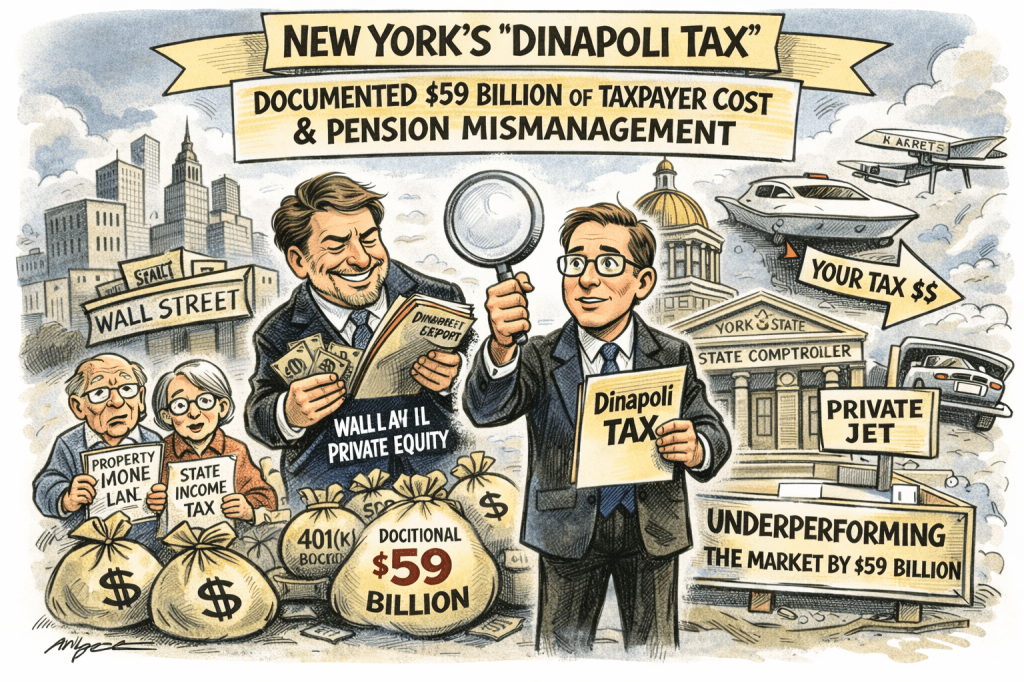
In New York, the Comptroller is the sole trustee of the pension. Candidate Drew Warshaw has published a study that the $59 billion in excess fees is borne by NY Taxpayers and is essentially a tax. https://www.drewwarshaw.com/ideas/dinapolitax
The Warshaw report “DiNapoli Tax” frames Fees as a Hidden Tax: How Underperformance Becomes a Public Burden. The DiNapoli Tax framework does something pension insiders rarely want done it treats investment fees and underperformance as a form of taxation.
Here’s the chain—simple but devastating: Private-market-heavy portfolios underperform investable benchmarks net of fees, which reduces asset growth. Reduced asset growth increases required employer contributions. Employers fund those contributions with tax revenue. Taxpayers unknowingly subsidize fee extraction and failed complexity
The report’s estimate—$59.1 billion since 2007—is not an abstract “missed opportunity.” It is the present value of additional checks written by the State of New York, counties, cities, and school districts and their taxpayers.
Fees are often the dominant driver of net underperformance. The opposition report shows that in FY 2025 alone, Roughly 13% of employer contributions went directly to investment management fees to external managers, many of whom underperformed public markets
In other words, taxpayers paid fees first, and only then funded benefits. The DiNapoli Tax report aggregates costs that are typically hidden across multiple layers: Management fees, Performance fees (carried interest), Transaction and monitoring fees, Partnership expenses and Fund-of-fund fees.
Controller DiNapoli covers up the $59 billion Loss. Last week, New York State Comptroller Thomas DiNapoli rushed out a press release proclaiming that an “independent review” had cleared the New York State Common Retirement Fund (CRF) of ethical, fiduciary, and conflict-of-interest concerns. According to the Comptroller, the report proves that New York’s pension fund “operates at the highest ethical and professional standards.”
These so-called independent reviews collapse under even modest scrutiny. It never grapples with the central economic finding of the opposition report: $59 billion in avoidable taxpayer costs.
The reports DiNapoli cites are not independent in any meaningful fiduciary sense. They are procedural compliance audits, not economic fiduciary reviews. They examine whether boxes were checked—not whether retirees and taxpayers were harmed. The most recent review, conducted by Weaver & Tidwell LLP, explicitly states that it does not analyze investment performance, valuation accuracy, or economic outcomes. Instead, it limits itself to whether transactions complied with internal policies and DFS regulations, which are written by the Comptroller’s own office.
The Comptroller’s “independent” reviews repeatedly emphasize compliance with disclosure rules while never quantifying the economic impact of fees. A fund can be perfectly compliant—and still impose tens of billions in avoidable tax burden. That is exactly what the DiNapoli Tax report alleges. And it is exactly what the Comptroller refuses to confront.
A Benchmark Shell Game is used to hide these problems. New York relies on custom, non-investable benchmarks that flatter reported results while obscuring real economic performance. The Weaver report praises the Fund’s asset-allocation process but never evaluates whether those benchmarks are structurally biased in favor of private markets.
Compliance with a bad benchmark is not prudence; it is misdirection.
Valuation Risk is also ignored. The DiNapoli press release leans heavily on claims of “high transparency.” Yet the Weaver review accepts conflicted manager-provided NAVs at face value and explicitly disclaims any responsibility for testing valuation accuracy or loss recognition timing.
Why the DiNapoli Tax Report Matters — and Why You Haven’t Heard About It
The DiNapoli Tax report — a clear, dollar-denominated indictment of how underperformance in New York’s public pensions translates into higher taxes — should be front-page news. Instead, it’s barely registered outside a few niche outlets. Why? Because powerful private-equity interests have an interest in burying the story..
New York officials s since Citizens United have had the ability to receive secret dark money contributions from Private Equity. Politically connected and current MSNBC media darling, Steven Rattner. co-founded private-equity firm Quadrangle. Quadrangle became entangled in New York’s notorious pension pay-to-play scandal involving placement agents and political consultants around the State Comptroller’s office. Rattner/Quadrangle retained Hank Morris (a political consultant tied to the Comptroller) in a way regulators viewed as improper, with enforcement and settlement outcomes reported by major outlets. New York’s Attorney General also filed pleadings describing alleged misconduct in connection with the New York State Common Retirement Fund.
DealBook Nation is a good description of NY media. “DealBook” is shorthand not just for a New York Times newsletter, but for an entire elite finance media ecosystem centered in New York: with editors, reporters, conference stages, think-tank panels, cable-news green rooms, and carefully curated “thought leaders.” Private equity is not merely covered by this ecosystem; it is embedded within it.
The Comptroller is not just defending past actions. He is running for re-election—and expanding allocations to the very asset classes these reviews refuse to scrutinize.
Until New York commissions a real independent review that: Uses investable public benchmarks, Performs PME and cash-flow analysis, Independently audits private-asset valuations, and Quantifies dollar underperformance …claims of being “cleared” should be treated for what they are: whitewash, not accountability.
The retirement industry would like you to believe that the Supreme Court’s decision to hear Anderson v. Intel is a narrow, technical dispute about whether “alternative investments” belong in 401(k) plans.
That is industry spin.
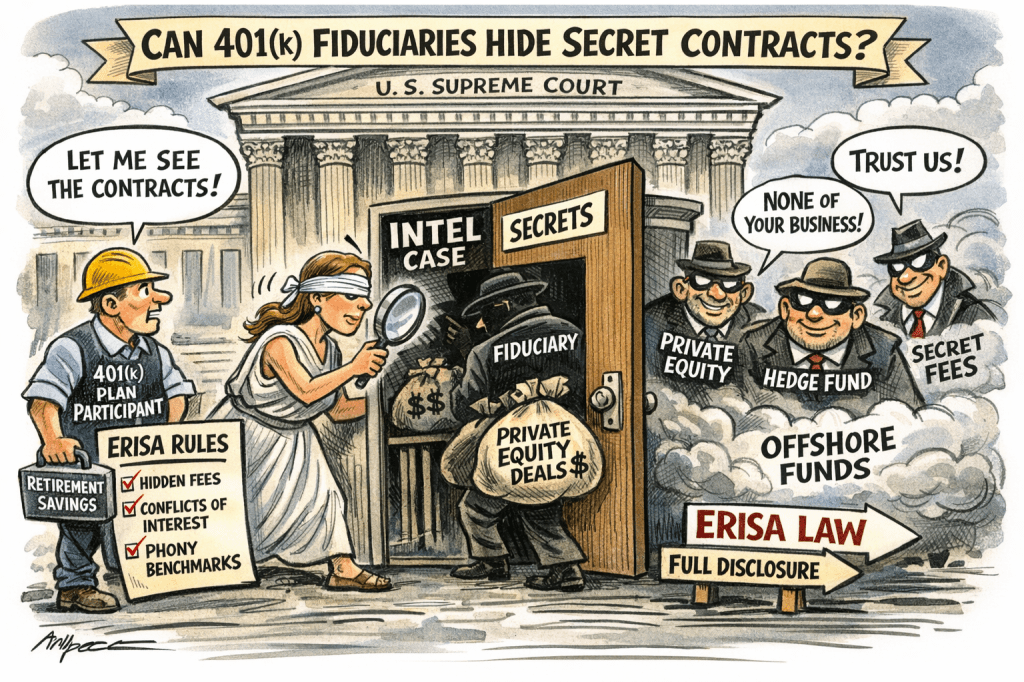
The Intel case is not about whether private equity is “good” or “bad.” It is about whether ERISA fiduciaries can hide the governing investment contracts, invent benchmarks, and still claim compliance with the strictest fiduciary law in the country.
If Intel prevails, the consequences will not stop with private equity. They will extend directly to target-date funds, annuities, private credit, and any opaque product that depends on secrecy to survive scrutiny.
The Industry Narrative: “Nothing to See Here”
Industry groups such as NAPA frame Intel as reassurance:
Private equity is just another asset class
Fiduciaries followed a prudent process
Plaintiffs are asking courts to micromanage investments
Disclosure of contracts is unnecessary
This framing is designed to shift the focus away from the core problem:
Intel will not disclose the private-equity contracts—nor even the names of the funds—while asking courts to assume those contracts are prudent, fairly priced, and conflict-free.
That is not how ERISA works.
The Real Issue: You Cannot Prove Prudence While Hiding the Contract
ERISA is not a “trust us” statute.
Under ERISA §404 and §406:
Fiduciaries must demonstrate prudence and loyalty
Transactions with parties in interest are presumptively prohibited
Fiduciaries—not participants—bear the burden of proving an exemption
As the Supreme Court made clear in Cunningham v. Cornell, once a prohibited transaction is plausibly alleged, the burden shifts to the fiduciary.
That burden cannot be met if the fiduciary refuses to disclose:
The investment contract
The fee and carry structure
The valuation methodology
The indemnification provisions
The conflicts and affiliate transactions
Secrecy is not neutral. Secrecy defeats the exemption.
Private Equity in a 401(k) Is Not a “Fund” — It’s a Contract
This is where the industry misleads courts and fiduciaries.
Private equity is not a security with a market price. It is a bespoke service contract governed by a limited partnership agreement.
That contract determines:
Who controls valuation (the manager)
How performance is measured (IRR and GP-asserted NAV)
How fees are extracted (management fees, transaction fees, carry)
How conflicts are resolved (usually in favor of the GP)
Without seeing the contract, there is no way to benchmark, monitor, or audit the investment.
That is not a technical quibble. It is a fatal fiduciary defect.
The Intel Case Mirrors TIAA’s Target-Date “Risk Illusion”
If this sounds familiar, it should.
Intel’s strategy—hiding private-equity contracts while claiming prudence—is functionally identical to TIAA’s target-date fund strategy of hiding annuity contracts inside CITs and separate accounts.
In both cases:
The core economic engine is contractual, not market-based
The risks are masked by invented benchmarks
The valuation depends on manager discretion
The fiduciary claims “diversification” while avoiding disclosure
As I explained in TIAA’s Target Date Funds Are Built on a Risk Illusion, you cannot create real diversification—or real performance—by hiding contractual risk behind smoothed numbers.
Private equity in a 401(k) target-date fund is simply the next iteration of the same illusion.
Intel’s defenders repeatedly argue that the plan used “appropriate benchmarks.”
But non-investable benchmarks are not benchmarks.
Private equity relies on:
Lagged, GP-asserted NAVs
IRRs that ignore cash-flow timing risk
Peer universes built from the same flawed data
This is no different from annuity providers benchmarking opaque general-account products against invented indices that no participant could ever invest in.
ERISA does not permit fiduciaries to benchmark themselves to their own homework.
Why the Supreme Court Took the Case
The Supreme Court did not take Intel because it wants to bless private equity in 401(k)s.
It took the case because the lower courts have allowed fiduciaries to use opacity as a litigation shield, undermining ERISA’s enforcement framework.
The question before the Court is simple:
Can an ERISA fiduciary satisfy its duties while hiding the governing investment contracts from participants and courts?
If the answer is yes, ERISA’s prohibited-transaction rules collapse—not just for private equity, but for:
Annuities
Private credit
Insurance separate accounts
Crypto-linked products
Any future opaque “innovation”
Bottom Line for Fiduciaries
This case is a warning.
If your investment strategy depends on:
Secret contracts
Invented benchmarks
Smoothed valuations
“Trust us” disclosures
you do not have an innovation problem. You have a fiduciary problem.
The Supreme Court should—and likely will—make clear that ERISA does not permit secrecy as a substitute for prudence.
And when it does, the fallout will reach far beyond Intel.
Appendix 1 Why the “Meaningful Benchmark” Standard Is a Judicial Illusion Built for Wall Street
Over the last decade, a judicially fabricated standard has crept into ERISA litigation: the so-called “meaningful benchmark” requirement for claims alleging imprudence or excessive costs.
This appendix explains:
Where the concept came from
Why it is illegitimate as a substantive rule
How it masks high-fee, high-risk products that cannot be meaningfully benchmarked
1. Origins: A Procedural Pleading Universe, Not an Investment Principle
The idea of a “meaningful benchmark” did not originate in investment theory, economics, or statutes. It was born out of ERISA procedural case law, largely as a 12(b)(6) pleading standard for plaintiffs alleging fiduciary breaches based on investment performance or fees.
The early case law adopted by some circuits required that, to survive a motion to dismiss, a complaint alleging underperformance or excessive costs must include a comparator that is sufficiently similar — an “apples-to-apples” alternative that plausibly shows the fiduciary could have done better. Courts demanded such comparators because plaintiffs often had no discovery, and judges were (purportedly) reluctant to let cases proceed on uninformed guesses about what the fiduciary could have done differently.
But critically:
There is no statute that requires a “meaningful benchmark.”
ERISA’s prudence standard focuses on process, not performance relative to a counterfactual benchmark.
Benchmarks were a judicial convenience, not a substantive legal test.
2. It Is a Procedural Standard, Not a Substantive Investment Rule
The “meaningful benchmark” doctrine is a pleading rule — a device courts use to decide whether a complaint plausibly alleges imprudence before any discovery. It does not represent a real investment standard under ERISA or fiduciary law.
Indeed:
Some courts require it at the motion-to-dismiss stage.
Other circuits reject it as inappropriate fact-finding before discovery.
The Supreme Court now is considering this very issue in the Intel/Anderson cases — whether a meaningful benchmark is required at all at the pleading stage. The fact that this question has reached the Supreme Court underscores how unsettled and judge-crafted this standard really is.
In other words, meaningful benchmark is not a regulatory requirement; it is a judge’s attempt to police litigation before discovery by demanding early comparators. It is a procedural gatekeeper, not substantive law.
3. Why It Is Deceptive — Especially Against Insurance and Annuity Products
The meaningful benchmark standard sounds appealing — who wouldn’t want apples-to-apples comparisons? But in practice, it gives impermissibly broad cover to Wall Street, insurance companies, and institutional defenders because:
📌 a) Certain products cannot be benchmarked
· Fixed annuities · General account insurance contracts · Proprietary separate accounts · Private equity and hedge funds
These products have no market-priced peers — you cannot find another open-end mutual fund that does what a fixed annuity does under discretionary crediting and balance-sheet mechanics.
Nothing in finance theory or asset pricing mandates that annuities must be compared to Vanguard, BlackRock, or S&P 500 products. Benchmarks are easier for public market instruments precisely because they have prices. Annuities do not. Thus, the meaningful benchmark standard is illogical when it comes to products that cannot be benchmarked.
4. The Standard Is Being Used to Hide, Not Reveal, Risk
The meaningful benchmark doctrine effectively says:
“If you cannot show an obvious benchmark that demonstrates harm, you have no case.”
That standard flips fiduciary law on its head.
Under ERISA, the duty of prudence is about process and risk-adjusted judgment — not about whether some benchmark existed on which the fiduciary could have hypothetically outperformed. Instead, defendants have latched on to this judicial invention to argue that a lack of benchmark equals lack of harm — a position that serves Wall Street and insurance producers very well.
5. The Investment Industry Loves It — Because It Lets Them Sneak In Opaque, High-Fee Products
Investment intermediaries and insurers have a strategic advantage when the standard is “meaningful benchmark.”
Why?
Because the industry sells products that do not have logical benchmarks:
Annuities
Indexed insurance contracts
Private market funds
Multi-asset strategies with proprietary glidepaths
These products cannot be meaningfully compared to:
Public index funds
Mutual funds
Standard benchmarks
So the industry says:
“There is no market benchmark — therefore the allegation fails.”
This argument presumes the answer, rather than evaluating whether the fiduciary followed a prudent process or whether the product’s risks and costs were adequately disclosed and managed.
6. The Standard Was Never Explained in Investment Texts or Statutes
You won’t find “meaningful benchmark” defined in:
ERISA itself
DOL regulations
Investment management texts
SEC rules
It is purely a judicial procedural rule, created in cases like Ruilova, Barrick Gold, Oshkosh, and others that required comparators in pleadings. But there is no canonical source where the concept was explained and justified in investment academic literature. It is a creature of litigation economics, not fiduciary economics.
Now the Supreme Court is being asked to decide whether that procedural invention should even survive constitutional and statutory scrutiny.
7. The Standard Shields Wall Street at the Cost of Participants
Here’s the real impact:
👉 Judges who require a “meaningful benchmark” are effectively saying to plaintiffs:
“If you can’t find a near-identical investment strategy with public pricing, you have no case.”
This approach:
Promotes a hindsight performance regime
Undermines process-based prudence
Shields producers of opaque, illiquid, proprietary products
Raises barriers to scrutiny even where conflicts and undisclosed compensation are obvious
That is the opposite of ERISA’s purpose.
ERISA is supposed to protect participants from conflicts of interest, hidden costs, and imprudent choices, not protect Wall Street by enforcing a “benchmark inoculation” against scrutiny.
8. Because Judges Lack Investment Economics Training, They Default to Benchmarks
One reason the meaningful benchmark standard took hold is that many judges:
Lack finance or investment economics training
Are uncomfortable evaluating risk and compensation structures that do not fit classic mutual fund models
Are influenced by industry amici and defense briefings that frame benchmarks as the only way to demonstrate imprudence
The result:
A “benchmark requirement” becomes a judicial shortcut — not because it is technically correct, but because it makes litigation easier for courts that do not want to engage with real economics.
This dynamic benefits Wall Street, not participants.
9. As We Explained Earlier in Commonsense, Benchmarks Don’t Work for Complex Solutions
Our earlier discussion of target-date benchmarks — including why simple index comparisons are inadequate and how product design matters more than benchmarking — already exposed this fallacy. Benchmarks assume liquidity, transparency, and comparability — all of which are absent in the annuity, separate account, and private market contexts at issue in Intel, Cho, and other cases.
10. Bottom Line — “Meaningful Benchmark” Is a Procedural Illusion
The “meaningful benchmark” standard is not a substantive fiduciary rule; it is:
A judicial pleading device
A procedural barrier
A way for judges uncomfortable with investment economics to avoid deep analysis
A shield for the industry to hide products that cannot be bench-marked
And it should not be used to legitimize high-fee, high-risk contracts in ERISA plans — especially when:
The products are opaque;
Compensation is hidden;
Benchmarks don’t exist; and
Participants rely on fiduciaries, not benchmarks, for informed decisions.
Appendix 2 — Lessons from Pizarro v. Home Depot for the Intel Litigation
Recent commentary by James W. Watkins, III, JD, CFP® on the Pizarro v. Home Depot litigation — especially his critiques of the EBSA amicus briefs in that case — highlights fiduciary failures and regulatory capture dynamics that are deeply relevant to the Intel / Anderson litigation now before the Supreme Court.(fiduciaryinvestsense.com; fiduciaryinvestsense.com)
Watkins’s insights reveal systemic issues in how fiduciary standards are being interpreted and enforced — or, more accurately, how they are being diluted by regulators, industry amici, and courts. As Intel asks whether courts can demand “meaningful benchmarks” at the pleading stage, Watkins’s Home Depot critique shows why that question cannot be abstracted from larger issues of disclosure, economic substance, and fiduciary candor.
1. Disclosure and Secrecy: The Core of Fiduciary Duty
One of Watkins’s central points in Fair Dinkum: A Critique of the EBSA’s Amicus Brief in Pizarro v. Home Depot is that the Department of Labor (via EBSA) abandoned core fiduciary responsibilities by advocating positions that underplay the importance of disclosure and economic substance.
Specifically:
EBSA’s amicus brief emphasized process compliance over economic substance, effectively arguing that plan sponsors who followed certain procedural boxes were insulated from liability — even if they failed to disclose material economic facts about the investments at issue.
This mirrors the antinomian argument we see in Intel/Anderson: that plaintiffs must plead a “meaningful benchmark” before discovery — a procedural hurdle that distracts from whether the fiduciary failed to disclose material investment risks and economic realities in the first place.
Watkins’s critique of the EBSA amicus brief demonstrates a consistent pattern: regulators preferring formalism over substance, process over transparency.
In Intel, this manifests as judicial and amicus rhetoric that treats benchmarks as a proxy for prudence instead of focusing on whether fiduciaries provided investors with material information needed to evaluate risk and compensation.
2. Fiduciary Loyalty vs. Regulatory Theater
In The DOL’s Pizarro v. Home Depot Amicus Brief: Borzi and Gomez Don’t Live Here Anymore, Watkins documents how EBSA’s position effectively reframes fiduciary law to insulate conflict-laden decisions so long as process step boxes are checked.
The essential critique:
Fiduciary law historically requires both prudent process and loyalty to act solely in the interest of participants.
EBSA’s brief prioritized procedural immunities, not fiduciary loyalty — downplaying whether plan sponsors adequately disclosed economic conflicts.
This insight directly applies to Intel/Anderson. The push for a “meaningful benchmark” at the motion-to-dismiss stage:
Empowers defendants to argue that as long as there is no obvious comparator, there is no plausible claim — even if fiduciaries concealed material risk, compensation, or conflicts.
Shifts the focus from fiduciary loyalty and investor protection to procedural immunity.
Watkins’s work shows why this shift is perilous: it validates the very illusions that erode fiduciary protections — the same illusions central to the Intel and Cho litigation context.
3. Proprietary Economics and the Failure of Transparency
A common theme in Watkins’s writing on Home Depot is the danger of proprietary or undisclosed economics — where fiduciaries or issuers refuse to provide meaningful economic information.
In the Home Depot context, the EBSA amicus brief was criticized for diminishing the value of transparency:
The brief implied that plan sponsors can satisfy ERISA so long as they rely on procedural checklists and industry standards — even when economic substance and proprietary fee structures are opaque to participants and fiduciaries alike.
This has direct parallels to the Intel case’s context:
Many of the allegedly imprudent decisions at issue involved products (annuities, proprietary CITs, etc.) with undisclosed compensation via spread, discretionary pricing, and other opaque features.
A benchmark requirement effectively punishes plaintiffs for not discovering and pleading economic comparators that only discovery will reveal — a barrier rooted in secrecy, not sound fiduciary analysis.
Watkins’s critique highlights the inconsistency in accepting opaque proprietary economics as part of a safe process — which dovetails with Intel’s concern about how courts treat benchmarks without probing the underlying economics.
4. Regulatory Capture and the Fiduciary Standard’s Erosion
Watkins’s commentary repeatedly underscores a broader institutional issue: regulatory capture, where the very agencies tasked with protecting workers tilt too heavily toward industry risk minimization.
In The DOL’s Pizarro v. Home Depot Amicus Brief…, he observes that:
Regulators have shifted toward interpretations that emphasize procedural compliance over fiduciary duty grounded in economic substance, transparency, and loyalty to participants, a pattern that disadvantages claimants and advantages industry defenders.
This regulatory shift mirrors judicial trends that:
Require plaintiffs to overcome stringent procedural banners (like meaningful benchmarks);
Allow defendants to hide behind process boxes;
Tolerate industry amici positions that diminish the core fiduciary obligations.
In the Intel litigation, this context matters because the Supreme Court’s treatment of pleading standards can either reinforce or reverse this trend. If courts continue to elevate procedural hurdles (like benchmarks) above substantive inquiry into transparency, risk, and conflicts, the regulatory erosion Watkins describes will be cemented in doctrine.
5. What Judges and Amici Miss When They Focus on Benchmarks
From Watkins’s Home Depot insights, three interlocking lessons emerge that should inform how we read Intel:
A. Benchmarks Are Not a Substitute for Disclosure or Loyalty: Benchmarks are tools for analysis — but they do not deliver material information to participants nor do they safeguard against conflicted economics.
B. Procedural Immunities Cannot Cure Conflicted Economics: Neither a checklist of steps nor an absence of a meaningful benchmark at the pleadings stage can justify a decision where economic risks and conflicts were not disclosed.
C. Regulatory and Judicial Emphasis on Procedural Thresholds Encourages Secrecy: When regulators and courts raise procedural bars (e.g., benchmarks before discovery), they inadvertently incentivize opacity, not fiduciary candor.
Watkins’s critiques show that fiduciary duty is both procedural and substantive — it demands transparency and duty of loyalty, not just procedural boxes.
6. Implications for Intel’s Outcome and Fiduciary Law
Taken together, Watkins’s writings on Home Depot illuminate three key takeaways relevant to the Supreme Court’s consideration of benchmarks in Intel/Anderson:
Benchmarks cannot be elevated to a doctrinal requirement that displaces core fiduciary obligations — especially where proprietary economics and conflicts are in play.
Judicial or regulatory moves toward proceduralism (benchmarks before discovery) embed the same kind of fiduciary illusions that Intel criticizes — secrecy, veneer of process, and reliance on industry dicta.
A correct fiduciary analysis must center economic substance, transparency, and conflict disclosure — not shortcut substitutes like early benchmarks.
In other words, Intel should be read as an opportunity to reaffirm fiduciary law’s core values, not to entrench a pleading-stage benchmark regime that rewards secrecy and shields conflicted conduct — the very trends Watkins has decried in Pizarro.





 The CommonSense 401k Project