Kentucky’s three major pension plans remain national laggards. KERS Nonhazardous, less than 30% funded by Kentucky’s own measure, is either the worst or second-worst-funded public pension plan in America among plans with more than $10 billion in liabilities. Kentucky Teachers is only about 58%–60% funded, and CERS is only about 61% funded—placing both in or near the bottom quarter of major public plans and roughly twenty percentage points below the national average.
Illinois has the worst credit rating of any state at A. Kentucky, Pennsylvania, & New Jersey are tied for 2nd worst at A+. The other 46 states are AA. The threat to Kentucky’s credit rating to an Illinois or below, helped force the legislature to begin fully funding the KERS actuarially required contribution in fiscal year 2015. Nevertheless, accumulated underfunding, adverse experience and later reductions in actuarial assumptions caused KERS Nonhazardous to fall further, reaching its historic low of 12.9% funded in fiscal year 2018 the worst for any state plan in U.S. History. Kentucky then began contributing amounts above the ARC because the plan faced a genuine depletion or insolvency risk.
CERS has a deceptive, deliberate underfunding policy. The legislature’s 2018 12% rate collar allowed CERS to certify employer rates below the uncapped actuarially determined rate, pushing part of today’s pension bill onto future taxpayers.
CERS actuaries calculate an actuarially determined contribution rate. The CERS Board certifies a lower statutory rate when the 12% collar applies. Cities pay 100% of the lower certified rate. Nevertheless, the pension trust receives less than the uncapped actuarially determined contribution. That lets local financial statements claim there was no contribution “deficiency” because the city paid the entire legally certified amount—even though CERS did not receive the full actuarially calculated amount.
The CERS contribution cap allows cities and counties to defer part of the actuarially determined pension contribution. The state does not forgive or assume the deferred amount. It remains in CERS as additional unfunded liability that must be recovered from participating employers in later years. Economically, local governments are borrowing from their employees’ pension fund at approximately CERS’s 6.5% assumed rate of return.
BENEFITS CUT IN REAL TERMS
A KERS or CERS retiree receiving $2,900 a month has lost nearly $98,000 since Kentucky stopped granting pension COLAs in 2011, measured against Social Security’s COLAs. That estimate captures only the frozen pension check. It does not include the additional loss from reduced retiree-health subsidies, increased premiums, deductibles, copayments, Medicare-related changes, and other benefit shifting during the same period. Kentucky’s teachers continued receiving a 1.5% pension COLA, but that adjustment substantially lagged Social Security inflation protection. Moreover, a significant portion of the financing used to stabilize teachers’ retiree health benefits came from mandatory contributions taken from active teachers’ paychecks—effectively requiring teachers to help finance the solution through reduced take-home pay.
A Kentucky retiree whose pension was $2,900 per month after the last KERS/CERS COLA in July 2011 has lost approximately $97,800 through September 2026, compared with receiving Social Security’s annual COLAs.
September 2026 monthly benefit
Actual/estimated benefit
Shortfall vs. Social Security benchmark
Social Security COLA benchmark
$4,273.52
—
KTRS with annual 1.5% COLA
$3,625.67
$647.84/month
KERS/CERS with no COLA
$2,900.00
$1,373.52/month
Kentucky retirees experienced a double reduction in retirement security: pension income failed to keep pace with inflation, while the economic value of retiree health coverage also declined. For KERS and CERS retirees, the combined loss is therefore materially greater than the estimated $97,800 pension-only loss.
Chris Tobe, CFA, CAIA, is the author of Kentucky Fried Pensions, available on Amazon
That is waiting for the fire before admitting someone replaced the sprinkler system with a garden hose.
In Dow v. Lumen Technologies, Lumen transferred approximately $1.4 billion of pension obligations covering 22,600 retirees to Athene. Before the transaction, the retirees had a diversified pension portfolio, Lumen’s continuing contribution obligation, ERISA protections, and the federal Pension Benefit Guaranty Corporation.
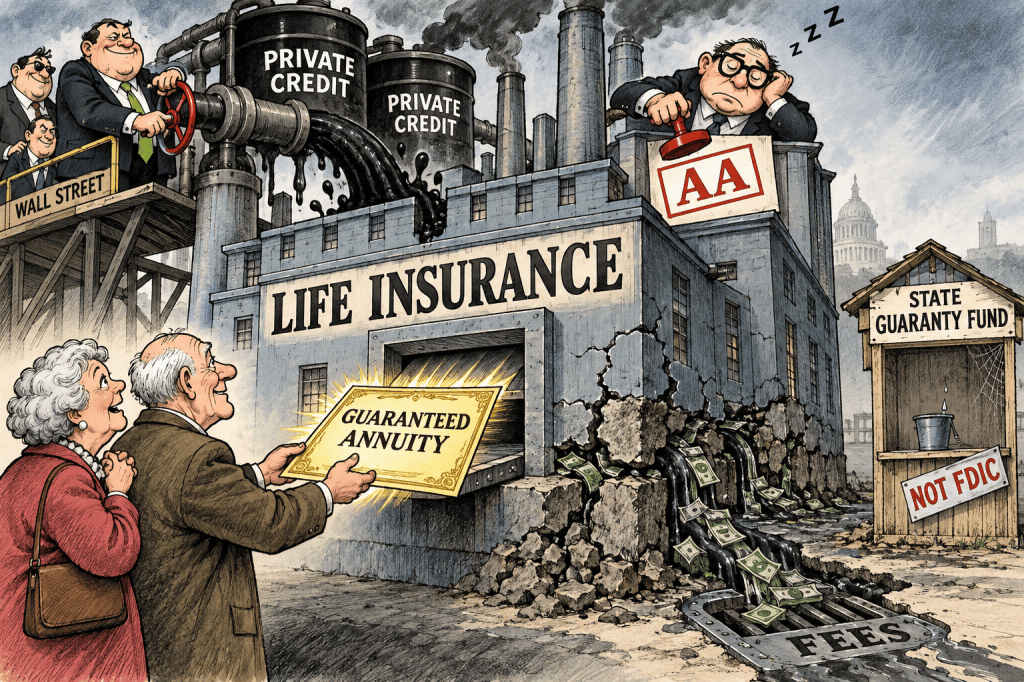
Afterward, they depended primarily on one private-equity-controlled insurer—Athene—and the flimsy, post-failure state guaranty-association system.
U.S. District Judge Lewis Babcock nevertheless ruled that the retirees had not plausibly alleged an injury because Athene has made its payments since 2021.
By that logic, a fiduciary can exchange a federally protected pension for a materially riskier single-company promise and nobody is injured until the company actually defaults.
That is wrong.
Risk has value.
Federal protection has value.
Diversification has value.
A downgrade escape provision has value.
Losing those protections is an injury today.
Lumen Kept the Savings. Retirees Got Athene.
Lumen calls this a “pension risk transfer.”
For once, Wall Street chose an honest name.
The risk did not disappear. Lumen transferred it from itself to retirees.
Before the transaction, Lumen had to support its pension plan. If investments underperformed, Lumen generally had to contribute more. If the plan and sponsor failed, the PBGC provided a federal backstop.
After the transaction, Lumen escaped those obligations. It also stopped paying PBGC premiums for the transferred retirees.
The retirees received an Athene annuity.
Lumen allegedly saved money by choosing Athene instead of safer traditional insurers. It kept those savings while retirees absorbed the additional credit, liquidity, regulatory, affiliate, offshore-reinsurance, and recovery risks.
Lumen got cash savings.
Athene got $1.4 billion in pension obligations.
Retirees got the risk.
How is that not an injury?
This Was Not Just Any Insurance Company
The court discussed Athene as though it were simply another highly rated insurer that happened to submit a competitive bid.
That ignores the extraordinary scrutiny surrounding Athene and Apollo.
Athene is Apollo’s giant insurance balance sheet—the place where Apollo-originated private credit, mortgages, structured assets, affiliated investments, and other difficult-to-value obligations can be held against long-term annuity promises.
If the assets are overstated, illiquid, affiliated, or deteriorating, Athene’s annuity holders ultimately bear the risk.
Athene also has a concrete PRT regulatory history. In 2020, the New York Department of Financial Services imposed a $45 million penalty after finding that Athene had conducted 14 large pension-risk-transfer transactions involving thousands of New York policyholders through an unlicensed subsidiary.
That alone should have prevented the court from treating the complaint’s concerns as invented speculation.
Then Athene Appeared in the Epstein Files
The Athene story has now become even more troubling.
The released Epstein files include an April 2015 email in which Jeffrey Epstein claimed involvement in discussions concerning Athene, insurance regulation, capital, foreign structures, tax basis, discount rates, and what he described as a complex transaction involving approximately $2 billion in taxes.
The email referred to a “Rowan request re Athene,” an apparent reference to Apollo co-founder and current CEO Marc Rowan. Other disclosed material shows Rowan met Epstein at Epstein’s New York residence in January 2016. An SEC complaint submitted by the American Federation of Teachers and the American Association of University Professors has called for investigation of Apollo’s disclosures and specifically cited the Athene-related material.
Epstein’s claims are not independent proof that he created Athene’s tax structure or that any crime occurred. Apollo and the individuals involved should have the opportunity to respond fully.
But the documents are unquestionably relevant to transparency, governance, conflicts, and the history of Athene’s structure.
Epstein claimed that he had discussed Athene-related tax and regulatory matters involving the firm’s founders and senior leadership. Leon Black later paid Epstein approximately $158 million for tax and estate-planning services after Epstein’s 2008 conviction. Black has denied wrongdoing and has said the relationship concerned legitimate financial advice.
These are not internet rumors. They are subjects of congressional, regulatory, union, media, and investor scrutiny.
Yet retirees challenging the transfer of their federally protected pensions to Athene are being denied discovery because a judge has decided they suffered no injury.
That is backwards.
The extraordinary Athene-related disclosures are precisely why discovery is necessary.
The Credit Market Is Already Pricing Athene Risk
The judge focused on Athene’s insurance-company rating.
He apparently ignored the market.
Credit-default-swap prices measure what sophisticated investors charge to insure against a company’s default. Athene’s CDS protection has been extraordinarily expensive compared with several large traditional insurers.
CDS prices are not predictions that Athene will fail tomorrow. But they are observable market prices for credit risk.
When the market charges substantially more to protect Athene debt than Prudential, MetLife, or other traditional insurers, a court cannot honestly call the difference in risk purely hypothetical.
The market is saying that the obligations are not interchangeable.
This matters because PRT fiduciaries are supposed to choose the safest available annuity—not merely an insurer capable of obtaining an investment-grade rating.
The ratings agencies may assign a letter.
The CDS market attaches a price.
The price says Athene risk is real.
As I recently wrote, independent academic research has also found an “Apollo premium”. Apollo-controlled portfolio companies reportedly pay approximately 100 basis points more to borrow than otherwise comparable private-equity-controlled companies.
The researchers concluded that lenders appear to demand additional compensation because of Apollo’s reputation for aggressive treatment of creditors.
If sophisticated lenders price Apollo-related conduct risk, why should a federal judge pretend that retirees suffer no injury when their lifetime pensions are transferred to Apollo’s insurer?
The Judge Completely Ignored Downgrade Protection
The decision also exposes the courts’ continuing ignorance of downgrade provisions.
A meaningful downgrade clause could protect retirees before insolvency. It could require collateral, additional security, transfer to a stronger insurer, or another corrective action when the insurer falls below an agreed credit standard.
That is when protection is needed.
Not after the insurer has failed.
Not after rehabilitation begins.
Not after assets are frozen.
Not after policyholders hire lawyers.
Not after state guaranty limits become relevant.
I have repeatedly argued that a general-account annuity containing a strong downgrade provision can be safer than a supposedly protected separate-account annuity without one.
But most PRT annuities appear to give retirees no meaningful right to escape when the insurer deteriorates.
The Lumen retirees did not choose Athene.
They cannot sell their annuity.
They cannot diversify away from Athene.
They cannot move back into the pension plan.
They cannot demand that Lumen resume its guarantee.
They cannot purchase CDS protection on their individual benefits.
And apparently they cannot even obtain discovery unless they wait for Athene to miss a payment.
That is not protection.
That is captivity.
The State Guaranty Association Is Not a Cure
Judge Babcock reasoned that an Athene failure might not cause losses because state guaranty associations could provide protection.
That may be the worst part of the decision.
State guaranty associations are not the PBGC.
They are not the FDIC.
They are not meaningfully prefunded national insurance.
When an insurer fails, the surviving insurers are assessed. Those assessments are subject to annual limits. Coverage varies by state and is capped at the policyholder level.
NOLHGA reported only about $7.53 billion of nationwide annual assessment capacity for allocated annuities in 2023 and a shockingly small $73 million for unallocated annuities.
That is not cash sitting in a national rescue fund. It is principally the statutory capacity to assess surviving companies after failures occur.
Meanwhile, U.S. life-insurer general accounts hold trillions of dollars in assets.
The Chicago Federal Reserve has acknowledged that it is unclear how the guaranty system would handle the failure of a relatively large U.S. insurer.
The system has never been tested against simultaneous distress among today’s giant private-credit-heavy, offshore-reinsured insurance complexes.
Yet the judge used that untested system to conclude that the retirees’ risk was too speculative to enter a courtroom.
State Guaranty Associations Arrive After the Damage
A state guaranty association does not prevent a downgrade.
It does not restore ERISA protection.
It does not restore Lumen’s contribution obligation.
It does not restore PBGC coverage.
It does not give retirees diversification.
It does not prevent rehabilitation, payment restrictions, litigation, restructuring, delays, or losses above state limits.
The sequence is more like this:
First comes deteriorating credit.
Then a downgrade.
Then liquidity pressure.
Then rehabilitation.
Then payment and transaction restrictions.
Then litigation and valuation disputes.
Then possibly liquidation.
Only then does the guaranty association fully enter the picture.
Anything above the state limit may become a creditor claim against an insolvent estate.
That is not equivalent to keeping the pension inside ERISA.
Private Equity Has Made the Guaranty System More Dangerous
The state system was built for isolated insurer failures.
It was not designed for insurers that hold similar portfolios of private credit, CLOs, real estate loans, structured securities, affiliated assets, and offshore-reinsurance recoverables.
If one insurer fails, the surviving insurers must help fund the guaranty response.
But those surviving insurers may own the same types of assets and be suffering the same market losses.
The system then demands more cash from insurers precisely when industry liquidity and capital are already under pressure.
One insurer fails.
Other insurers are assessed.
Those insurers are already exposed to the same private-credit downturn.
Their liquidity weakens.
The guaranty system becomes another source of financial stress.
That is a procyclical rescue mechanism—not a federal guarantee.
No Missed Check Does Not Mean No Injury
Suppose a fiduciary replaces a diversified AA bond portfolio with one BBB obligation paying the same coupon.
Has the investor suffered no injury until the BBB issuer defaults?
Of course not.
The new obligation is worth less because it contains more risk.
The same principle applies here.
Before Lumen’s PRT, retirees had:
Diversified pension assets;
Lumen’s contribution obligation;
ERISA funding requirements;
Federal fiduciary protections; and
PBGC insurance.
Afterward, they had one Athene annuity, limited state guaranty protection, no apparent downgrade exit, and no ability to diversify.
That is a reduction in economic value even if this month’s payment arrived on time.
The court confused the ultimate loss with the present injury.
TholeIs Not a PRT Case
The Supreme Court’s Thole v. U.S. Bank decision involved retirees who remained in the same defined-benefit plan. Their sponsor, plan structure, ERISA protection, and PBGC backstop remained intact.
Lumen’s retirees were removed from that entire system.
Lumen changed:
The entity responsible for payment;
The assets supporting the obligation;
The applicable regulatory system;
The federal protections;
The insolvency process;
The retirees’ recovery rights; and
The party bearing the residual risk.
That is not merely investment mismanagement inside a continuing pension plan.
It is a permanent substitution of obligors and protections.
Even Thole recognized that a substantially increased risk of pension failure could support standing. The Lumen retirees specifically alleged increased risk and a present reduction in the value of their pension promises.
The judge acknowledged that Thole did not involve a PRT—and then essentially treated it as though it did.
Appeal This Decision
The Tenth Circuit should reverse and allow discovery.
The retirees should be permitted to learn:
Which insurers bid;
How much cheaper Athene was;
Whether safer insurers were available;
Whether the market price reflected Athene’s greater credit risk;
What Athene CDS spreads showed at the time;
Whether State Street examined Athene’s affiliates, private credit, offshore reinsurance, liquidity, and regulatory history;
Whether the fiduciaries investigated the Athene references in the Epstein material;
Whether the annuity contains any meaningful downgrade provision;
What happens if Athene is downgraded;
How many retirees have benefits exceeding state guaranty limits;
What Lumen saved in purchase price and PBGC premiums; and
Whether those savings represented risk transferred to retirees without compensation.
Lumen removed retirees from ERISA, eliminated PBGC protection, ended its own pension obligation, selected an insurer under extraordinary regulatory, credit-market, governance, and Epstein-related scrutiny, and apparently provided no meaningful downgrade escape.
The judge says there is no injury because Athene has not failed yet.
The law should not require retirees to wait for the time bomb to explode before they are allowed to examine who built it, who profited from it, and why their fiduciaries put it under their retirement.
Apollo has spent years presenting itself to public pension trustees as an elite investment manager whose higher returns come from superior sourcing, superior underwriting and superior skill. A new academic study now supplies a much uglier explanation for at least part of Apollo’s supposedly special return machine: the financial markets charge Apollo-owned companies a measurable penalty because lenders do not trust Apollo to treat them fairly.
The paper, “The Sponsor Premium,” by University of Chicago law professor Vincent Buccola and Drexel University finance professor Greg Nini, analyzes nearly 1,900 first-lien leveraged loans issued between 2016 and 2025. Its central result should be placed in front of every public pension trustee in America: Apollo portfolio companies paid approximately 13 percent more to borrow—about 100 basis points at the sample’s average yield—than otherwise comparable private-equity-owned companies. The Financial Times appropriately called it the “Apollo premium.”
This is not a small statistical curiosity. The authors say the Apollo premium is approximately equal to the normal yield difference between a B+ loan and a B− loan. Apollo’s reputation, in other words, can cost its portfolio companies roughly the equivalent of a two-notch credit-rating penalty.
And the usual Apollo defense does not work. The researchers controlled for credit ratings, market conditions, industry, loan purpose and sponsor size. Apollo borrowers actually carried substantially less first-lien leverage and accepted tighter, more lender-friendly loan documents. Yet they still paid approximately 100 basis points more. The study concludes that lenders appear to be pricing Apollo’s reputation for aggressive treatment of creditors, including its history of liability-management exercises that can transfer value away from existing lenders.
Wall Street has now put a price on Apollo’s conduct. The question is why public pension boards still refuse to do the same.
The Apollo Premium Is a Tax on Pension Returns
The new research directly strengthens the case for public-pension divestment because the extra borrowing cost is ultimately borne by Apollo’s limited partners—including teachers, firefighters, police officers, public employees and taxpayers.
Consider a portfolio company carrying debt equal to five times EBITDA. A one-percentage-point Apollo premium consumes approximately 5 percent of annual EBITDA. That is money unavailable for employees, capital investment, debt reduction, distributions or growth. It weakens refinancing capacity and can reduce the value of the company when Apollo eventually tries to sell it.
Apollo may call itself an operational genius, but its own reputation appears to impose a recurring financing tax on the companies it controls. Public pensions should demand to know how much this Apollo premium has reduced their private-equity returns and whether Apollo’s valuations, benchmarks and performance reports ever identified it.
This is especially important because private-equity performance is built on manager-controlled marks, delayed recognition of impairments and comparisons against unsuitable public-market or private-market benchmarks. My prior work has explained how private equity uses non-market valuations to manufacture diversification and smooth volatility. The new study adds an independent and observable fact: even the supposedly sophisticated leveraged-loan market sees an Apollo-specific risk that conventional ratings and loan characteristics fail to capture.
If lenders can see and price Apollo’s conduct risk, pension trustees and consultants cannot credibly pretend it does not exist.
Apollo Cannot Charge “Performance” Fees on Risk Apollo Created
The paper is equally damaging to Apollo’s private-credit story.
Apollo may point to higher loan yields as evidence of superior origination and investment alpha. But the academics have identified a different possible source of that yield: compensation demanded by lenders for Apollo’s own reputation for aggressive conduct. A higher coupon is not alpha when it compensates investors for a greater probability of being subordinated, trapped, restructured or otherwise disadvantaged in a liability-management exercise.
Public pensions should not pay Apollo an incentive fee for accepting an Apollo-created risk.
Every pension invested in Apollo credit should require Apollo to separate ordinary credit spread, illiquidity premium and genuine manager value from the premium associated with sponsor conduct and liability-management risk. That analysis must include subsequent restructurings, payment-in-kind income, amendments, write-downs, forced sales and realized recoveries. Counting a high contractual coupon as income while delaying recognition of the corresponding risk is not performance measurement. It is accounting theater.
The conflict becomes even worse when a public pension invests in both Apollo private equity and Apollo private credit. One Apollo vehicle can report higher interest income while another Apollo vehicle’s portfolio company pays the higher expense. Apollo can collect management and performance fees on both sides, while the pension receives two separate reports that conceal the consolidated economic result.
Public pension fiduciaries need a look-through accounting of every Apollo-controlled borrower, lender, fund, affiliate and fee. They need to determine whether Apollo’s claimed credit “outperformance” is merely the market price of dealing with Apollo—and whether pension capital is being moved among Apollo vehicles in ways that maximize Apollo’s fees rather than the pension’s net return.
Leon Black Is Now Suing Congress to Block Its Investigation
The financial evidence arrives as Apollo’s governance history becomes even more indefensible.
Leon Black, Apollo’s co-founder and former chief executive, remains its largest individual shareholder, reportedly owning roughly 7 percent of the company. Black paid Jeffrey Epstein approximately $158 million after Epstein’s 2008 conviction. Black also paid the U.S. Virgin Islands $62.5 million in 2023 in exchange for a broad release of potential Epstein-related claims. The settlement did not constitute an admission of liability, and Black has denied wrongdoing.
Now Black is fighting Congress.
After appearing voluntarily before the House Oversight Committee in June 2026, Black reportedly refused to answer questions concerning nondisclosure agreements and accusations by women. The committee then issued subpoenas for the agreements and for further sworn testimony. Black did not appear for the scheduled September deposition. Instead, he sued the House Oversight Committee and its chairman, James Comer, seeking to invalidate the subpoenas. Members of both parties have condemned his refusal to cooperate, and some have called for contempt proceedings.
Black says the investigation exceeds Congress’s authority and threatens the privacy of uninvolved women. Congress says it is examining how Epstein used powerful relationships to avoid accountability and is seeking information about agreements that may have silenced or restricted women. More than a dozen Epstein survivors urged Black to cooperate fully.
Let that sink in: Apollo’s largest individual shareholder is using his enormous resources to sue a bipartisan congressional committee rather than provide the transparency it demanded concerning Epstein-related matters and nondisclosure agreements.
Public pension trustees cannot separate that conduct from their continuing relationship with Apollo. Governance risk does not disappear because Black resigned as CEO in 2021. His approximately 7 percent ownership represents billions of dollars of continuing economic exposure to Apollo. His son, Joshua Black, also remains employed as an Apollo partner, according to Apollo’s 2026 proxy statement.
Public pensions are therefore not dealing with an ancient chapter that Apollo closed. They remain major investors in a company whose largest individual shareholder is actively litigating to stop congressional scrutiny of matters arising from the scandal that forced him out.
The Evidence Is Now Financial, Fiduciary and Moral
The case for divestment no longer rests on a single scandal.
My May investigation documented CalPERS’ decades-long and deeply conflicted relationship with Apollo: billions of dollars in commitments, secret no-bid contracts, placement-agent commissions, deficient transparency, Apollo’s connection to CalPERS’ longtime consultant Wilshire and pension performance that cannot be independently reconstructed from public records.
Senator Ron Wyden’s investigation added evidence concerning the banking and financial transactions surrounding Epstein, including Black’s enormous payments. The Guardian and other news organizations have continued exposing the scope of Black’s Epstein relationship and the legal machinery used against accusers and their lawyers. Black’s new suit against Congress shows that resistance to transparency is continuing in real time.
Now Buccola and Nini add the economic evidence. Apollo’s conduct is not merely offensive to outsiders. It is sufficiently notorious that sophisticated lenders appear to charge Apollo-controlled companies approximately 100 additional basis points.
These strands reinforce one another:
Governance risk: Epstein, Black, disputed disclosures, congressional subpoenas and continued resistance to transparency.
Conflict risk: pensions invested across Apollo private equity, private credit, insurance and affiliated structures while consultants and valuation processes remain opaque.
Performance risk: an Apollo-specific borrowing penalty that can reduce portfolio-company cash flow and equity value.
Fee risk: Apollo may characterize risk compensation as alpha and charge performance fees on both sides of affiliated economic relationships.
Valuation risk: manager-controlled private marks may not fully or promptly reflect the higher financing cost and reputational discount.
Fiduciary risk: trustees and staff now have independent academic evidence that Apollo’s identity contains material pricing information not captured by conventional ratings.
No prudent pension board can dismiss all of that as public relations noise.
What Public Pensions Should Do Now
Every public pension invested with Apollo should immediately:
Freeze new Apollo commitments, amendments, co-investments and mandate expansions.
Commission a genuinely independent review of all Apollo private-equity, credit, real-estate, insurance and affiliated exposures.
Recalculate Apollo performance using independent valuations and benchmarks adjusted for leverage, illiquidity, sponsor-conduct risk and all fees.
Identify every situation in which one Apollo-managed or Apollo-controlled entity transacted with another using pension capital.
Calculate the portfolio-company cost of the Apollo premium and its effect on pension returns.
Disclose all Apollo limited-partnership agreements, side letters, fee arrangements, valuation policies, related-party transactions and consultant conflicts.
Develop and execute an orderly divestment plan that protects beneficiaries rather than Apollo’s fundraising interests.
CalPERS should lead this process because it helped legitimize Apollo across the public-pension world. Instead, CalPERS has repeatedly protected private-equity secrecy while participants and California taxpayers bear the costs. Its refusal to confront Apollo after each new disclosure has become a governance failure of its own.
Public pension officials will undoubtedly say divestment is complicated, secondary-market sales can be costly and trustees must focus only on financial considerations. The new study answers that excuse. Apollo’s conduct already has a financial price. The market is charging it today.
Trustees do not have to predict whether the next Apollo controversy will involve Epstein disclosures, creditor treatment, an affiliated transaction, a private-credit loss or an Athene insurance problem. Their fiduciary responsibility is to respond to the extraordinary body of evidence already in front of them.
The market has concluded that Apollo’s reputation deserves a 100-basis-point penalty. Public pensions should stop pretending Apollo deserves another commitment.
It is time to divest.
List of Plans with Apollo Funds
Alaska Permanent Fund Apollo PE funds
Arizona PSPRS Apollo PE funds
California Public Employees’ Retirement System (CalPERS) Apollo Investment Fund VI and related vehicles
California State Teachers’ Retirement System (CalSTRS) Apollo Investment Funds VI, VII, IX, X; Hybrid Value II
Chicago Teachers Pension Fund 2024 performance confirms Apollo PE/PC as manager
Colorado PERA Apollo Investment Funds III,IV,V,VI, VII, Distresssed DIF
Colorado School Apollo Credit Opp III & DIF
Connecticut Retirement Plans & Trust Funds Apollo Investment Fund VIII
Florida State Board of Administration Apollo PE funds IV, V PC Accord V and VI
Georgia Teachers Retirement System
Idaho PERSI Apollo PE funds
Illinois Teachers Retirement System Apollo PE funds X
Illinois Municipal Apollo Credit Wilshire
Indiana Public Retirement System (INPRS) Apollo Origination Partnership
Iowa Public Employees Retirement System Apollo PE funds Wilshire
Kansas Public Employees Retirement System Apollo PE funds VIII,IX
Kentucky Teachers Apollo REIT & Apollo Stock
Los Angeles City Employees’ Retirement System (LACERS) Apollo PE funds VI
Los Angeles (CA) Water and Power has PE fund X
Louisiana Teachers’ Retirement System of Louisiana (TRSL), Apollo Credit, Natural Resources
Maryland State Retirement & Pension System ?PE funs
Massachusetts PRIM Apollo PE funds
Michigan RS Apollo Investment fund VIII, IX Hybrid Value Funds, Credit/ Opportunistic Credit
Minnesota State Board of Investment Apollo/Athene Dedicated Investment Program II
Mississippi PRS Apollo VIII IX Private Equity funds
Montana Board of Investments Stock holdings?
Nebraska Investment Council India Property Fund II LLC.
New Hampshire Retirement System Apollo PE funds
New Jersey Division of Investment: Stock holdings?
New Mexico State Investment Council Apollo PE VII, VIII PC
New York City Teachers’ Retirement System Apollo PE funds
New York City (NY) ERS PE $500mm 2013
New York City (NY) Police PE fund VI
New York State Apollo PE VIII
North Carolina Retirement Systems Apollo PE funds VI, VII
Ohio Highway Patrol SHPRS: Apollo PE funds
Ohio SERS: “Core Farmland Fund, LP Wilshire
Ohio State Teachers Retirement (STRS) PE Apollo S3 Equity Hybrid Solutions
Ohio Public OPERS Apollo PE funds, Oregon Public Employees Retirement Fund (OPERF), Apollo PE VI, VII, VIII, IX.
Oregon PER recently comitted $300mm to Apollo distressed debt fund as well as earlier funds like Apollo PE IX
Pennsylvania PSERS Apollo PE funds IV $620mm
Pennsylvania SERS Apollo PE funds VI- VIII
Rhode Island Retirement System Apollo PE VIII, IX
San Diego City Employees Retirement System Apollo PE funds
San Francisco (SFERS) San Francisco Employees’ Retirement System Apollo PE funds Wilshire
South Carolina RS $750mm
South Dakota Retirement System Apollo PE funds
Texas County & District PE fund X
Texas ERS Apollo Credit Strategies
Texas Municipal Fund VIII
Texas TRS Teachers’ Retirement Apollo PE funds
Tennessee Consolidated Retirement System Stock holdings?
San Francisco Employees’ Retirement System Apollo PE funds
San Diego City Employees’ Retirement System Apollo PE funds
University of Calfiornia PE VII, VIII Principal Wilshire
Virginia Retirement System Apollo PE funds
Washington State Investment Board (WSIB) Apollo S3 Equity & Hybrid
Australian Super Funds with Apollo – Hostplus, Care Super, Catholic Super-Equip Super. Micheal West/Cliona O’Dowd
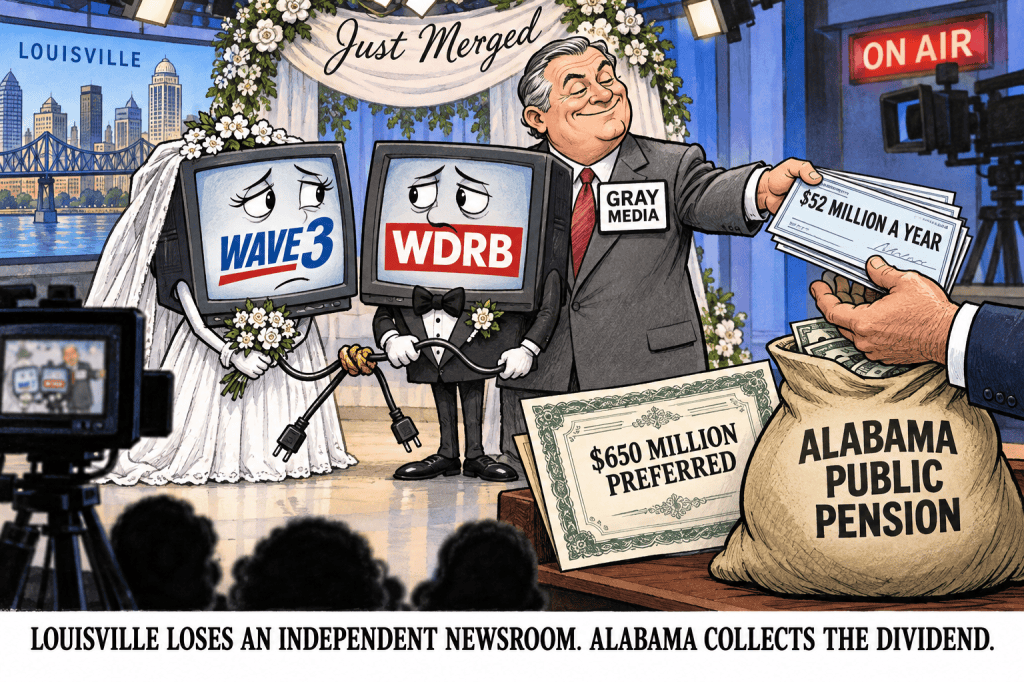
Louisville residents are being told that WAVE and WDRB are “merging.” That harmless-sounding word conceals what is really happening.
WAVE’s corporate parent, Gray Media, purchased WDRB and WBKI from Block Communications as part of an $80 million acquisition. Gray now controls Louisville’s NBC, Fox and CW television operations. Two of the city’s most important competing newsrooms are being brought under one highly leveraged corporate owner.
I went looking for the usual private-equity fingerprints. I expected to find Blackstone, Apollo, KKR or another Wall Street giant financing a familiar consolidation scheme: buy competing businesses, load the company with debt, eliminate supposedly duplicative workers and extract the savings.
I found something even stranger.
The enormous preferred investor sitting above Gray’s ordinary shareholders is not a conventional private-equity fund. It is the Retirement Systems of Alabama—the pension system for Alabama teachers, state employees and judges.
Louisville is losing an independent source of local news while an out-of-state public pension system holds a $650 million senior preferred position in the company doing the consolidating.
This is public-pension capitalism behaving remarkably like private equity.
This Is Not Just a Merger of Television Brands
Gray Media already owned WAVE. In August 2025, it agreed to purchase Block Communications’ broadcast television stations for $80 million. The package included WDRB and WBKI in Louisville, WAND in Illinois and WLIO in Ohio.
The FCC approved the transfers on May 6, 2026, and the acquisition was completed. Gray now owns WAVE, WDRB and WBKI in the Louisville market.
Block Communications was a family-controlled media company—not a private-equity firm. Gray is publicly traded. Therefore, it would be inaccurate to call this a traditional private-equity buyout.
But legal labels do not tell us everything about the economic reality.
When one highly indebted corporation owns two previously competing local newsrooms, the financial incentives are obvious. Gray can combine management, studios, reporters, photographers, producers, engineering, weather operations, graphics, digital platforms and back-office functions.
Corporate management calls these savings “synergies.” Employees generally call them layoffs.
Louisville residents should call it what it is: the elimination of an independent local-news competitor.
The FCC Door Was Conveniently Opened
This transaction would once have faced a serious regulatory obstacle.
The FCC’s Top-Four Prohibition generally prevented one company from owning two of the four highest-rated television stations in the same market. WAVE and WDRB were exactly the kind of important competing stations the rule was intended to keep under separate ownership.
But in July 2025, the Eighth Circuit Court of Appeals vacated the Top-Four Prohibition. The mandate took effect while Gray’s acquisitions were pending. The FCC subsequently approved Gray’s purchase of the Block stations.
Gray did not have to persuade regulators that Louisville desperately needed less competition between WAVE and WDRB. A court had removed the principal ownership barrier.
The result is a Louisville television triopoly: NBC, Fox and CW operations under one corporate roof.
The public deserves to know whether the FCC seriously examined the probable effect on newsroom employment, editorial independence, investigative reporting and the number of distinct local voices. Ownership rules are not merely technical restrictions affecting broadcast licenses. They determine how many separate organizations decide what Louisville residents see, hear and never learn about.
Follow WAVE Back to Alabama’s Pension Fund
The public-pension connection begins with WAVE’s previous parent, Raycom Media.
Before Gray purchased Raycom in 2019, Raycom was controlled and financially backed by the Retirement Systems of Alabama, commonly called RSA. RSA encompasses the Teachers’ Retirement System of Alabama, the Employees’ Retirement System of Alabama and the Judicial Retirement Fund.
RSA behaved less like a conventional pension investor and more like a private-equity sponsor. It backed and controlled a privately held media conglomerate, financed acquisitions, held the investment for years and eventually sold the company to a strategic buyer.
Gray acquired Raycom in a transaction valued at approximately $3.6 billion. The consideration included roughly $2.85 billion in cash, $650 million in newly issued Gray preferred stock and millions of Gray common shares.
Alabama’s pension fund did not simply cash out. It rolled a very large investment into Gray.
At the end of 2019, an RSA filing with the SEC showed that the pension system beneficially owned 7,126,750 Gray common shares, representing 7.6% of the outstanding common stock at the time. Alabama’s teachers’ pension held 4,158,670 shares, while the employees’ system held 2,968,080 shares.
RSA no longer appears among the greater-than-5% common shareholders listed in Gray’s March 2026 proxy statement. That suggests RSA sold enough common stock to fall below the SEC reporting threshold.
But Alabama’s pension system retained the much more interesting security: $650 million of Gray Series A perpetual preferred stock.
Alabama Pensioners Sit Ahead of Ordinary Gray Shareholders
Gray’s 2025 annual report confirms that all 650,000 Series A preferred shares—with a face and liquidation value of $1,000 apiece—remained outstanding on December 31, 2025.
Fitch identified the holder of this $650 million preferred position as the Retirement Systems of Alabama.
These are not ordinary shares that rise and fall alongside everyone else’s investment. They carry powerful financial protections:
Mandatory cumulative dividends of 8% annually when paid in cash
An 8.5% rate if Gray elects to pay dividends with additional preferred shares
Priority over every class of Gray common stock
Restrictions on Gray’s ability to issue securities ranking equal or senior to RSA’s position
Special consent rights protecting the preferred shareholders
Redemption protections involving certain changes of control
An 8% dividend on $650 million equals approximately $52 million annually.
That does not necessarily mean RSA receives exactly $52 million in cash every year because Gray has a payment-in-kind option under specified conditions. But the economic obligation continues either way. If Gray pays cash, RSA receives roughly $52 million annually. If Gray pays in additional preferred stock, the obligation grows at 8.5%.
This preferred position is larger than Gray’s recent stock-market value. It is also senior to the BlackRock, Vanguard and other investment-fund holdings that appear on ordinary shareholder lists.
Therefore, the most important pension investor in this story is not a state plan holding a few thousand Gray shares through an index portfolio. It is RSA holding a bespoke, senior $650 million security created as part of a multibillion-dollar media transaction.
That is much closer to a private-equity-style negotiated investment than to normal pension-fund indexing.
Gray Is Carrying a Mountain of Debt
Gray’s finances make the Louisville consolidation more concerning.
At the end of 2025, Gray reported approximately:
$5.8 billion of outstanding long-term debt
$650 million of Series A preferred stock
$474 million of annual interest expense
A 7.5% average interest rate on its debt
Only $289 million of operating cash flow during 2025
Some of Gray’s debt carries interest rates of 9.625% and 10.5%.
The $80 million Block acquisition is relatively small beside this balance sheet. But that is exactly the point. Gray is not buying WDRB because it suddenly became sentimental about Louisville journalism. It is assembling more broadcast properties within a highly leveraged corporate structure.
Debt and preferred dividends must be paid before ordinary shareholders receive what remains. That creates relentless pressure to increase revenue and reduce expenses.
Once Gray owns both WAVE and WDRB, running two completely separate news operations may look wasteful to corporate accountants. Two sets of reporters, producers, assignment editors, meteorologists, managers, studios and technical employees may represent journalistic competition to viewers—but they represent duplicate expenses on a spreadsheet.
The financial incentive is not difficult to understand:
Buy a competitor.
Combine operations.
Eliminate overlapping jobs.
Preserve two separate station brands.
Sell advertisers and viewers the appearance of competition.
Direct the savings toward interest, preferred dividends and corporate cash flow.
We need not wait for Gray to announce that exact plan before asking questions. Louisville has watched enough corporate consolidations to recognize the pattern.
Alabama’s pension system built and controlled Raycom, sold it to Gray and retained a $650 million preferred interest senior to Gray’s ordinary shareholders.
This is not private equity secretly owning WDRB. It is a public pension system employing a private-equity-style strategy in the company that now controls three Louisville television stations.
The pension fund with the clear, direct and economically important connection is Alabama’s.
That creates a perverse interstate arrangement. Louisville bears the potential loss of newsroom jobs, editorial independence and media competition. Gray receives the consolidation savings. Alabama’s pension system continues to hold a senior security entitled to an 8% cash dividend or an 8.5% payment-in-kind return.
Louisville loses a watchdog. Alabama’s pension fund collects the dividend.
What Gray Needs to Disclose
WAVE and WDRB should not be allowed to cover their own consolidation with public-relations language and vague assurances.
Gray should disclose:
How many WAVE and WDRB employees have been or will be terminated
Whether the stations will retain separate news directors and assignment desks
Whether reporters will be shared across both brands
Whether WAVE and WDRB will compete on investigative stories
Whether either studio or newsroom will close
Whether weather, sports, editing, production and digital operations will be combined
Whether local newscasts will eventually be simulcast or repackaged
What cost “synergies” Gray projected from the Louisville acquisition
Whether those savings were disclosed to banks, bondholders, preferred shareholders or rating agencies
Whether RSA was consulted about or informed of the acquisition
How much Gray has paid RSA in cash and payment-in-kind dividends since 2019
Whether Gray plans to redeem RSA’s $650 million preferred position—and how it would finance that redemption
Louisville’s remaining independent broadcasters should also investigate this story aggressively. Unfortunately, corporate television ownership has become so concentrated nationally that one conglomerate may be reluctant to expose another’s consolidation playbook.
Public Pensions Should Not Be Media Barons
Pension systems exist to provide retirement security—not to function as secretive media holding companies.
RSA’s defenders will say the investment is profitable and that Alabama retirees benefit from the dividends. That is not a complete fiduciary defense. A public pension investment must be evaluated for concentration, liquidity, governance, transparency and political risk—not merely whether it produces an attractive contractual yield.
RSA is no ordinary public pension fund. Under longtime CEO David Bronner, it has operated almost like a state-owned private-equity and economic-development empire: taking a major position in US Airways—with Bronner briefly serving as its chairman—building Alabama’s 26-course Robert Trent Jones Golf Trail and adjoining resorts, owning hotels and office towers that transformed the Montgomery and Mobile skylines, and controlling television and newspaper chains. RSA also ventured into riskier industrial projects, including a $350 million railcar-manufacturing loan and a 47% interest in the subsequently bankrupt Signal International shipbuilder. Whatever one thinks of individual results, Alabama teachers’ and public employees’ retirement money has been used for an extraordinary collection of airlines, golf courses, skyscrapers, hotels, factories and media companies—investments far removed from the diversified, arm’s-length portfolios normally associated with public pensions.
The larger democratic question is even more troubling.
Should one state’s pension official control major news organizations serving residents of other states? Should public pension capital help eliminate competing local newsrooms? Who holds the pension system accountable when the investment may influence what journalists investigate—or decide not to investigate?
There is a running 20 year joke in Alabama. A trooper pulls over the Governor, and the Governor says “do you know who I am?” the trooper says “I do not care if you are David Bronner you are getting a ticket.”
Alabama is frequently criticized for the opacity of RSA’s investment and proxy-voting practices. That lack of transparency becomes more consequential when its investments touch the infrastructure of local democracy.
Louisville residents should not have to trace SEC preferred-stock provisions to discover that Alabama public pension money occupies one of the most powerful financial positions in the company controlling their local television news.
The Bottom Line
The WAVE-WDRB combination is not a classic Apollo or Blackstone private-equity takeover. Calling it one would give Gray an easy way to dismiss legitimate criticism.
The truth is more precise and more revealing.
A heavily leveraged national broadcaster has acquired a leading Louisville competitor after the principal FCC ownership restriction disappeared. That broadcaster owes approximately $5.8 billion to creditors and has $650 million of senior preferred stock outstanding to Alabama’s public pension system. That preferred position carries an 8% cash dividend—approximately $52 million annually—or an 8.5% payment-in-kind alternative.
These financial obligations create enormous pressure to extract savings from supposedly duplicative local operations.
WAVE and WDRB may continue to display different logos. They may retain different anchors and sets. Corporate management may repeatedly promise that both brands remain committed to Louisville.
But different logos do not create independent journalism when the same corporation controls the budgets, employment decisions and editorial resources behind both broadcasts.
Louisville is not merely witnessing a television merger. We are watching one more independent local institution disappear into a leveraged national conglomerate—with Alabama’s public pension system sitting near the front of the financial line.
That deserves far more scrutiny than WAVE or WDRB is likely to give it.
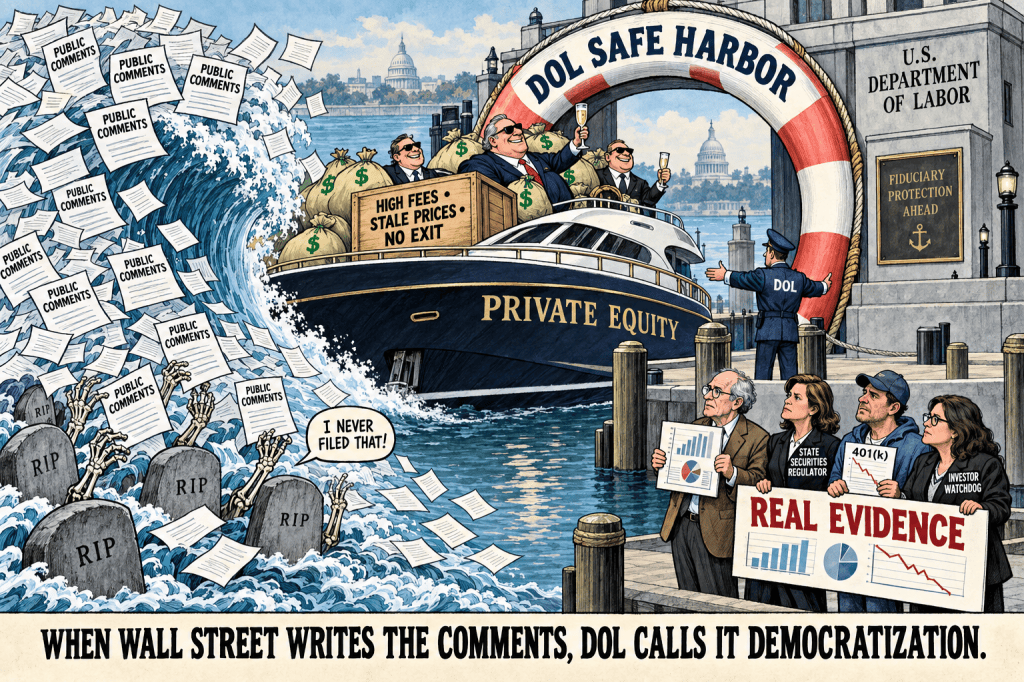
Behind tens of thousands of suspicious form letters, serious academics, regulators and investor advocates exposed the fatal weaknesses in the Department of Labor’s private-equity safe harbor
By Christopher Tobe
The Department of Labor received more than 46,000 public submissions on its proposal to help Wall Street push private equity, private credit, cryptocurrency and other alternative investments into 401(k) plans.
That sounds like an extraordinary public debate. It was not.
The docket was flooded with mass-produced letters—including supposedly pro-private-equity comments attributed to dead people and people who said they never submitted them. Bloomberg data scientists helped expose what appears to be one of the ugliest astroturfing campaigns ever directed at a retirement regulation.
But underneath this contaminated mountain of manufactured support was a much smaller group of serious comments from academics, researchers, securities regulators, investor advocates and investment professionals.
I reviewed those comments in a new 55-page report. The most important conclusion is simple:
The people who actually understand private-market valuation, liquidity, fees and fiduciary law gave the Labor Department powerful reasons not to create this private-equity safe harbor.
Their objections go far beyond the usual warnings about high fees and illiquidity. They show that the Department’s proposed six-factor fiduciary test can be manipulated into a compliance exercise that looks rigorous on paper while relying on numbers supplied by the private-equity industry itself.
A Safe Harbor for Wall Street
The Labor Department’s March 2026 proposal is misleadingly presented as “asset neutral.”
The proposed rule says fiduciaries should examine six factors when selecting investment alternatives:
Performance
Fees
Liquidity
Valuation
Benchmarks
Complexity
Those are sensible words. The problem is what DOL attaches to them.
A fiduciary that documents an “objective, thorough, and analytical” consideration of the factors could receive a presumption of prudence and substantial deference in court.
That is not neutrality. It changes the legal terrain in favor of plan sponsors, consultants, recordkeepers and investment managers.
DOL openly says one purpose of the rule is to reduce fiduciary litigation. Its economic analysis estimates hundreds of millions of dollars in purported savings from reducing the time plans and service providers spend discussing litigation risk.
But DOL treats litigation almost entirely as a cost. It does not adequately count the benefits of litigation:
Recovery of excessive fees and investment losses
Deterrence of self-dealing
Removal of imprudent investments
Improved investment menus
Exposure of hidden compensation
Better fiduciary monitoring
Discovery of documents that participants could never obtain independently
The proposal effectively assigns a dollar value to protecting fiduciaries from lawsuits while assigning little or no value to protecting workers from fiduciary misconduct.
That is not a serious cost-benefit analysis. It is a Wall Street wish list dressed up as economics.
EDHEC exposed a fundamental weakness in DOL’s six-factor framework: the factors are not independent.
Private-equity managers typically value their own holdings through periodic appraisals. Those manager-controlled net asset values, or NAVs, then flow through several parts of the fiduciary analysis.
The same smoothed NAVs can be used to claim:
Low volatility
Small drawdowns
Low correlation with public stocks
Attractive risk-adjusted returns
Diversification benefits
Stable valuations
Superior performance against private-market benchmarks
Six supposedly separate tests may therefore depend on one stale and potentially biased valuation stream.
That is not six-factor due diligence. It is the same questionable number wearing six different costumes.
EDHEC pointed out that appraisal smoothing can make private assets appear much safer than publicly traded investments. Public stocks are repriced every trading day. Private assets may retain old valuations for months, even when comparable public companies are collapsing.
During a market crisis, a public-equity index may immediately show a 20% decline while private equity reports a much smaller loss. That does not necessarily mean private equity protected investors. It may mean that private-equity managers did not mark their holdings down quickly enough.
The Labor Department nevertheless presents comparisons of public-market and private-market drawdowns that could lead fiduciaries to confuse stale prices with safety.
A low reported standard deviation is not proof of low economic risk. A high Sharpe ratio calculated from smoothed returns is not proof of superior risk-adjusted performance. A low correlation created by delayed valuations is not true diversification.
Sometimes the apparent stability of private equity is simply the absence of an honest market price.
Valuation “Independence” Is Not Enough
DOL emphasizes independent valuation processes. EDHEC correctly explained why that is inadequate.
A valuation can be procedurally independent and still be economically wrong.
Fiduciaries need more than a representation that somebody followed an ASC 820 process. At a minimum, they should receive:
The important valuation assumptions
The discount rates and exit multiples
The comparable companies used
A sensitivity analysis
A reasonable valuation range
Explanations for manager overrides
Comparisons between prior valuations and realized sale prices
Secondary-market bids or discounts when available
A valuation of $100 million is not meaningful if a modest change in the discount rate produces a value of $75 million.
Private-equity valuations should not be treated as single, precise numbers. They are estimates with uncertainty ranges. That uncertainty affects performance, risk, fees, participant transactions and every benchmark built from NAVs.
The Benchmark Can Repeat the Same Lie
The proposed rule requires a “meaningful benchmark,” but private-equity benchmarking is notoriously vulnerable to manipulation.
A manager can choose among:
The S&P 500
The Russell 2000
The S&P 600
MSCI ACWI
A private-equity peer index
A custom blended benchmark
One of several public-market-equivalent methodologies
Each choice can produce a materially different answer.
A private-equity benchmark derived from other private-equity NAVs may simply compare one set of questionable valuations with another. It can tell a fiduciary that the manager is marking assets consistently with its peers. It cannot necessarily tell the fiduciary whether those marks reflect economic reality.
Fiduciaries should be required to calculate public-market equivalents using multiple disclosed, investable indices. They should also explain why the selected benchmark reflects the size, geography, leverage and industry exposure of the underlying portfolio.
A custom benchmark should never qualify as “meaningful” merely because a consultant helped construct it.
As I have repeatedly documented in public pensions, custom benchmarks can become slow rabbits designed to be beaten.
NASAA Questions Whether DOL Can Invent a Presumption of Prudence
NASAA questioned whether a regulatory presumption of prudence is consistent with ERISA.
The Supreme Court rejected a special presumption of prudence for employee-stock-ownership-plan fiduciaries in Fifth Third Bancorp v. Dudenhoeffer. ERISA did not contain that presumption, so the Court refused to create it.
DOL now appears to be attempting something similar through regulation.
NASAA also correctly warned that merely considering the six factors cannot guarantee a prudent decision. A fiduciary could review all six, misunderstand the evidence and still select an imprudent investment.
Process matters, but ERISA does not say that any decision reached after completing a checklist must be presumed prudent.
If DOL retains any safe harbor, it should require contemporaneous written records showing:
The actual information reviewed
The alternatives considered
Contradictory evidence
The fiduciary’s independent analysis
Quantitative acceptance and rejection thresholds
The reason the final decision followed from the evidence
Consultant presentations and manager representations should not be enough.
Any presumption must also be explicitly rebuttable. Otherwise, DOL could immunize a facially unreasonable decision simply because the fiduciary assembled the right paperwork.
Participants Are Not Institutional Investors
The CFA Institute attacked the false “democratization” narrative from another direction.
Large institutions can negotiate lower fees, obtain side letters, demand reporting, select experienced managers, control commitment pacing and sometimes obtain seats on advisory committees.
Ordinary 401(k) participants control none of those things.
They cannot choose:
The private-equity manager
The underlying partnerships
The individual deals
The valuation methodology
The liquidity terms
The fee offsets
The leverage
The continuation-vehicle transactions
The timing of capital commitments
The investment’s eventual exit
Workers may not even know that private equity has been placed inside their target-date fund.
The correct comparison is therefore not between an institutional private-equity index and the S&P 500.
The fiduciary must examine the actual product offered to the plan after every additional layer:
Underlying partnership fees
Carried interest
Fund-of-funds expenses
CIT or pooled-fund charges
Valuation expenses
Liquidity-reserve drag
Adviser fees
Recordkeeping fees
Borrowing costs
Related-party charges
By the time a private-equity product reaches a 401(k), workers may receive second-tier access at first-class prices.
That is not democratization. It is distribution.
Fake Liquidity Can Become a Run on the Fund
Several commenters focused on interval funds and evergreen vehicles that offer periodic redemptions while holding assets that may take years to sell.
A quarterly redemption window does not make private equity liquid.
Withdrawals may be funded through:
Cash reserves
New participant contributions
Borrowing
Sales of the most liquid investments
Delayed redemptions
Gates
Queues
Manager discretion
Early redeemers may leave remaining participants with more leverage, fewer liquid assets and a weaker portfolio.
This is especially dangerous in 401(k) plans because participant cash flows are not optional. Workers retire, change jobs, take hardship withdrawals and roll over their accounts. Employers conduct layoffs. Plans terminate. Recordkeepers change.
Liquidity analysis must examine what happens when market stress and participant withdrawals occur simultaneously.
It must also address how a plan removes an imprudent private-equity option. If the investment cannot be sold for years, the fiduciary may discover that it has no practical ability to satisfy its continuing duty to monitor and remove the investment.
The exit plan must be written before the investment is made.
Target-Date Funds Can Hide the Risk
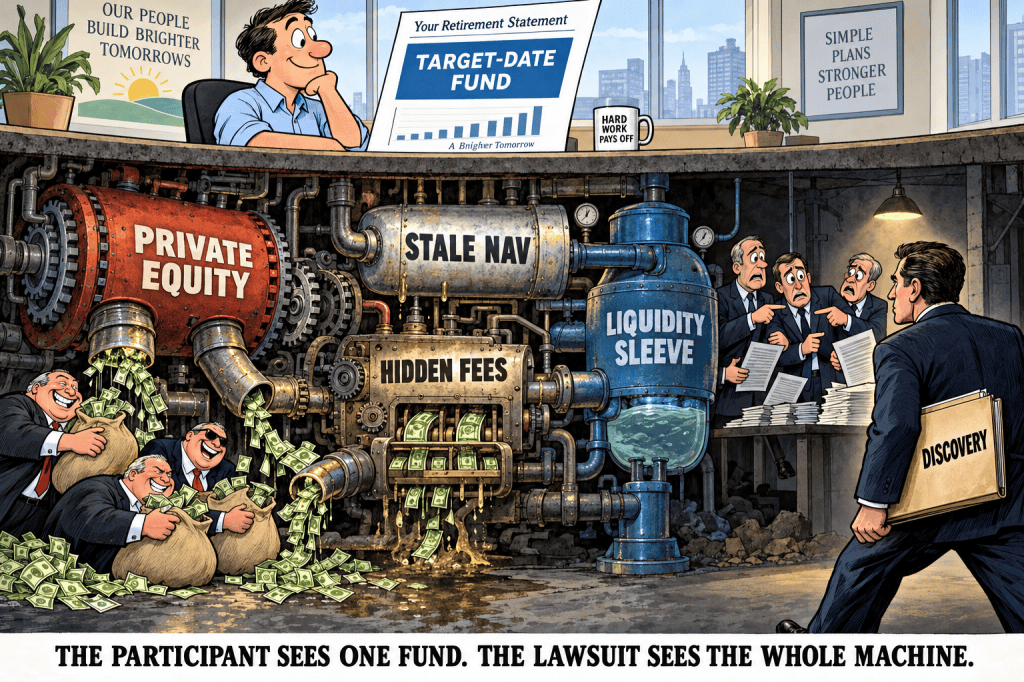
Wall Street’s preferred route into 401(k) plans is not likely to be a stand-alone private-equity fund. It will be a private-equity sleeve buried inside a target-date fund, managed account or white-label allocation fund.
That makes the problem more serious.
Target-date funds are frequently the plan’s qualified default investment alternative. Participants can be placed into them without affirmatively selecting the investment.
The wrapper does not eliminate the underlying opacity. It can hide it behind a simple year—2035, 2045 or 2055.
The private-equity industry will argue that professional management solves the complexity problem. In reality, professional management can transfer the decision away from the participant while preserving every underlying fee, valuation and liquidity problem.
A professionally managed black box is still a black box.
The DOL Should Listen to the Real Comments
The serious opposition came from people and organizations worth hearing:
Boston College Law Professor Renee Jones
MIT finance professor Haoxiang Zhu
EDHEC’s private-assets researchers
The Economic Policy Institute
NASAA
CFA Institute
Americans for Financial Reform
Roosevelt Institute
Experienced financial advisers warning about liquidity mismatches
Members of Congress concerned about retirement security
These commenters did not all demand an absolute prohibition on private equity. They approached the issue from different legal, economic and investor-protection perspectives.
Together, however, they demolished the idea that DOL’s current safe harbor protects workers.
Before any private-equity product receives safe-harbor treatment, the fiduciary should have to demonstrate:
Independently verified valuations
Valuation sensitivity ranges
Reported and unsmoothed risk measures
Multiple public-market-equivalent comparisons
Look-through disclosure of every fee and expense
Look-through leverage and refinancing stress tests
Liquidity stress tests based on actual participant behavior
Protections against stale-price transfers among participants
Analysis of continuation vehicles and cross-fund conflicts
Proof that the plan receives institutional-quality access
A written termination and mapping strategy
Contemporaneous records showing independent fiduciary judgment
A rebuttable—not conclusive—legal presumption
Full preservation of participants’ rights to discovery and relief
Anything less is not a safe harbor for workers.
It is a safe harbor for Wall Street.
The private-equity industry does not need 401(k) participants because workers have been unfairly denied a proven investment opportunity. It needs them because retirement plans represent trillions of dollars in patient capital, steady contributions and investors who cannot easily see—or escape—what is happening inside the product.
The authentic comments in this rulemaking warned DOL about that danger.
The dead people and manufactured form letters apparently told DOL what Wall Street wanted it to hear.
The question now is which group the Department intends to serve.
Appendix: Congress Demands Criminal and Labor Department Investigations of the Fake Pro–Private Equity Comments
Update for “The Smart Money Told Trump’s Labor Department That Private Equity Does Not Belong in Your 401(k)”
By Christopher Tobe
The scandal surrounding the Labor Department’s proposed private-equity safe harbor has now moved beyond suspicious statistics and embarrassing press coverage. Congressional leaders are demanding criminal and administrative investigations into whether stolen or fabricated identities were used to manufacture public support for opening workers’ 401(k) accounts to private equity, private credit, cryptocurrency and other alternative assets.
On September 18, 2026, Senator Bernie Sanders, Representative Robert C. “Bobby” Scott and Representative Jamie Raskin sent a joint letter to Attorney General Todd Blanche and FBI Director Kash Patel requesting a criminal investigation. Scott separately wrote Acting Labor Secretary Keith Sonderling, while Scott and Sanders asked Department of Labor Inspector General Anthony D’Esposito to audit the matter.
The official congressional announcement and links to all three letters should be read together with Bloomberg’s data analysis. They establish that this is no longer merely a debate over whether the comments looked suspicious. Members of Congress with jurisdiction over labor policy, federal investigations and the judiciary are asking who submitted them, whose identities were used, whether federal law was broken and whether the integrity of DOL’s rulemaking process has been corrupted.
The Numbers Do Not Resemble Genuine Grassroots Support
DOL’s docket received more than 47,000 submissions. According to the lawmakers, nearly 12,000 comments supporting the proposed rule showed signs of being manufactured. Bloomberg reporters located purported commenters who said they had never submitted a comment. In other cases, relatives said the named individuals could not have submitted the comments because they were dead.
The contrast identified in the congressional letter is devastating. More than 30,000 comments opposing the rule generally contained the normal identifying details expected from real members of the public. The suspicious supportive comments omitted the commenter’s city, state and email address.
Those omissions matter. They made independent verification harder while allowing thousands of nearly identical voices to appear in the docket as public support. A rulemaking record is supposed to help an agency test evidence and understand the public’s views. It is not supposed to become a landfill for anonymous political marketing.
The Attorney General and FBI Letter Raises Possible Criminal Conduct
The lawmakers point specifically to the federal prohibition against knowingly making materially false statements or representations in matters within federal jurisdiction. They do not claim that a crime has already been proved. They argue—correctly—that the evidence is serious enough to require investigators with subpoena power to determine who generated the comments, who supplied the names, who financed the operation and whether anyone knowingly transmitted false information to the government.
That chain of responsibility is essential. The public deserves to know whether the campaign originated with a public-relations firm, a trade association, an asset manager, a cryptocurrency promoter, a political organization or some combination of them. If contractors or vendors were used, investigators should follow both the data trail and the money trail to the ultimate client.
The investigation should seek, at minimum:
Submission IP addresses, timestamps, user-agent data and other available technical records;
The source of every name, address and other personal identifier used;
Templates, mail-merge files, scripts, application-programming tools and automated submission systems;
Contracts, invoices, payments and communications involving sponsors, trade groups, public-relations firms and vendors;
Evidence showing whether the supposed commenters consented to the use of their identities;
Communications identifying the campaign’s intended regulatory or political objective; and
Any coordination with parties that stood to profit from the proposed safe harbor.
DOL Was Told to Investigate Its Own Compromised Rulemaking
Scott’s letter to Acting Secretary Sonderling goes directly to the integrity of the rulemaking. He warns that the reporting raises legitimate questions about whether DOL’s public-comment process was corrupted and argues that the lack of verifiable public support is another reason to withdraw the proposal.
Withdrawal is the minimum responsible response. DOL should not finalize a rule while a material part of the record is under suspicion. Nor should it quietly count, summarize or cite the suspect submissions as evidence of public support.
The Department should segregate the questioned comments, preserve every associated electronic record and publicly explain whether any of them influenced the proposal’s development, its regulatory-impact analysis or the Department’s understanding of public sentiment. If DOL cannot establish that comments came from the people whose names appear on them, it should not treat those comments as independent public submissions.
Most importantly, DOL must not pretend that deleting fraudulent comments would cure the substantive defects in the rule. The authentic, technically serious comments still warn that private-market valuations are stale and manager-controlled; fees are layered and opaque; liquidity can disappear under stress; benchmarks can be selected to flatter performance; and a regulatory presumption of prudence may improperly weaken ERISA’s participant protections.
Removing fake support would clean the docket. It would not make the proposed safe harbor prudent.
The DOL Inspector General Was Asked for an Independent Audit
Scott and Sanders also sent a letter to DOL Inspector General D’Esposito requesting an immediate audit. Their concern is institutional as well as criminal: Americans must be able to trust that a DOL rulemaking record reflects actual public participation.
An Inspector General review should examine more than the identities behind individual comments. It should determine whether DOL had adequate controls to detect mass-produced or identity-based submissions, whether officials recognized warning signs, whether suspect comments were included in internal tallies or summaries, and whether political appointees or career staff communicated with organizers of the campaign.
The audit should also recommend permanent protections. At a minimum, agencies considering economically consequential retirement rules should retain technical submission data, flag high-volume template campaigns, distinguish unique comments from mass forms, publish methodology for counting duplicates and provide a way for people to report unauthorized use of their identities.
The Rule Has Lost Any Claim to Democratic Legitimacy
Private equity’s sales pitch is “democratization.” The public-comment scandal shows a darker version of that word: manufactured consent used to justify transferring workers’ retirement savings into products that are expensive, illiquid, difficult to value and extraordinarily profitable for Wall Street.
The supposedly unsophisticated public opposition was real enough to provide names, locations and contact information. A large block of the purportedly pro-industry public could not be readily verified—and reportedly included people who were dead or denied participating.
The genuine record remains clear. Serious academics, securities regulators, investor advocates and retirement-policy experts gave DOL detailed reasons why the proposed six-factor safe harbor would not protect participants. The suspicious form letters supplied political volume without comparable analysis.
DOL should preserve the evidence, cooperate fully with DOJ, the FBI and its Inspector General, disclose how the suspect comments were handled, and withdraw the proposed rule. Until investigators identify who created the questionable submissions and whether they affected the agency’s work, finalizing the rule would reward the very conduct now under investigation.
The smart money told DOL that private equity does not belong in ordinary workers’ 401(k) accounts. Congress is now asking whether someone tried to drown out that warning with borrowed names, stolen identities and dead people.
Private Equity Is Being Added on Top of Private Debt, Private Real Estate, Annuities and State-Regulated CITs
By Christopher Tobe, CFA,CAIA The CommonSense 401k Project
Principal Financial Group has announced that it is expanding its “Featured Partner Program” to bring private markets into retirement plans.
This is being marketed as broader diversification and better long-term retirement outcomes. I see something very different: Principal is building a distribution system that can add private equity on top of the private debt, illiquid private real estate, insurance separate accounts, annuity contracts and state-regulated collective investment trusts already found across its retirement platform.
Principal is not new to private debt. Principal Alternative Credit reported nearly 40 direct-lending transactions representing more than $750 million of committed capital in 2021 and described an expansion of its private-debt capabilities. (Principal announcement). The 2026 Featured Partner expansion creates a route for Principal and outside managers to package private-market strategies for defined-contribution plans.
The participant may see one friendly label—perhaps “Target Date 2050.” Underneath it could be layer after layer of contracts, managers, affiliated entities, subjective valuations, liquidity devices and fees.
This is not diversification in any commonsense meaning of the word. It is an illiquidity and opacity layer cake.
And Principal’s own announcement practically writes the first paragraph of the future complaint.
Principal Admits Participants May Not Be Able to Get Their Money
Principal’s August 26 announcement says it plans to collaborate with asset managers, trust companies and fiduciaries to launch a “suite” of CITs combining public and private strategies. The possible delivery systems include CIT-based target-date funds, target-risk funds, managed accounts and other asset-allocation services.
The list of participating private-market firms is a Wall Street greatest-hits collection: AllianceBernstein, Apollo, Ares, Blackstone, Blue Owl, Carlyle, Franklin Templeton, Goldman Sachs, KKR, Morgan Stanley Investment Management, Neuberger, Partners Group, PGIM and Principal Asset Management.
Then, near the bottom of the release, comes the disclosure every plan fiduciary should read slowly:
Because certain private equity investments are less liquid, the investment manager seeks to accommodate daily participant activity using other underlying investments intended to support routine contributions, withdrawals, and rebalancing. However, in some circumstances, transaction processing may be delayed, partially completed, or temporarily unavailable due to fund-level liquidity or valuation conditions.
Translated into plain English: the private assets are not daily liquid. The participant’s apparent daily access depends on other, more liquid investments being available to absorb withdrawals. If liquidity or valuation conditions deteriorate, the participant’s transaction may be delayed, only partly completed or made temporarily unavailable.
Principal calls this making private markets “more practical” for retirement plans. I call it using workers’ liquid retirement savings as the liquidity sleeve for Wall Street’s illiquid contracts.
This Is Not Yet One Fully Disclosed Product—It Is a Product-Building and Distribution Architecture
Principal’s announcement does not identify one completed investment with a prospectus-like package of facts. It announces a program and a future suite.
The release does not tell us:
the private-equity allocation;
the size or composition of each liquidity sleeve;
the complete fee stack;
the carried-interest terms;
the valuation policy or valuation lag;
the leverage and subscription-line exposure;
the identity and chartering jurisdiction of every CIT trustee;
the authority to gate or delay participant transactions;
the recordkeeper exit and portability terms;
the allocation of fiduciary responsibility; or
whether Principal’s recordkeeping economics improve when a plan selects a Featured Partner product.
Those are not minor details. Those details are the investment.
Dr. Brian Leite recently explained that a participant may see one fund while the fiduciary must oversee an ecosystem: sponsor, committee, CIT trustee, allocation manager, private-market manager, underlying funds, valuation process, liquidity sleeve and recordkeeper. His question is exactly right: who is actually responsible for what?
In litigation, I would add three more questions at every layer:
Who exercised discretion?
Who got paid?
What contemporaneous document proves the decision benefited participants rather than Principal and its distribution partners?
Principal Was Already Layered Before It Added Private Equity
I first called Principal’s target-date structure a “Toxic Target Date” in 2022.
At that time, I identified a Principal target-date lineup using 13 underlying funds: five insurance-company separate accounts, four CITs and four proprietary mutual funds—with 25 share classes in the structure. Principal also disclosed exposure to nontraditional and alternative strategies, including real estate and hedge-fund strategies.
Now Principal proposes to add private equity through still more CIT-based structures.
Picture the possible chain:
Participant → target-date or managed-account solution → top-level CIT → private-market CIT or underlying fund → private-equity partnership → portfolio company.
Alongside that chain may sit:
a Principal Life group annuity contract;
Principal insurance separate accounts;
private commercial real estate;
private or less-liquid debt;
stable-value contracts;
public funds used as a liquidity sleeve;
multiple managers and trustees; and
Principal as recordkeeper and platform operator.
Every additional layer creates another place to hide fees, shift valuation responsibility, impose contractual restrictions or disclaim fiduciary status.
Principal’s Private Real Estate Already Shows How the Liquidity Promise Can Fail
Principal does not need to imagine the liquidity problem. It already sells it.
Principal describes its U.S. Property Separate Account as an investment that primarily owns private-equity commercial real estate rather than exchange-traded securities. Its disclosure says investors may not be able to withdraw immediately because real estate sales are time-consuming and market conditions may delay or prevent them. Principal says a pre-existing contractual limitation in the group annuity contract may be used to satisfy withdrawal requests proportionately over time. (Principal disclosure).
Principal’s broader comparison of investment structures states that separate accounts are governed by group annuity contracts and overseen by state insurance departments. It also says Principal Life reserves the right to defer payments or transfers from its separate accounts under the group annuity contracts. (Principal investment-type comparison).
Now add private equity to that ecosystem.
What happens when the private-real-estate account is limiting withdrawals, private-credit marks are stale, private-equity distributions dry up and older workers are simultaneously moving or withdrawing money from the target-date fund?
Does the manager sell the publicly traded assets first?
If so, early redeemers get cash while the remaining participants are left with a more illiquid and difficult-to-value portfolio. That is a classic first-mover advantage and a potential participant-to-participant wealth transfer.
Calling the remaining liquid assets a “liquidity sleeve” does not solve this problem. It merely gives the problem a friendlier name.
State-Regulated CITs Are the Escape Route
Principal’s announcement specifically says the new private-market products will use CITs. That matters.
Principal itself explains that CITs are not mutual funds, are exempt from registration under the Investment Company Act of 1940 and do not give investors the protections of that Act. Principal’s materials say state-chartered CITs are generally governed by state trust laws and state banking regulators, while others may be regulated by the OCC.
Existing Principal LifeTime Hybrid CIT materials identify Principal Global Investors Trust Company as trustee, Principal Global Investors as the affiliated adviser, and state that the adviser and other affiliates may receive fees. They also state that the CITs are not registered with the SEC, the State of Oregon or any other regulatory body. (Principal LifeTime Hybrid CIT disclosure).
That language does not mean the trust company operates without any legal oversight. But it does mean participants do not receive the same federal securities-law structure, public filings, independent-board framework and standardized disclosure regime they would receive in an SEC-registered mutual fund.
Could this exact contract survive inside an SEC-registered mutual fund?
Same fees. Same leverage. Same GP valuation. Same liquidity. Same gates. Same carry. Same side letters. Same affiliated transactions. Same accounting.
If not, why is the answer to find a state-regulated CIT rather than to reject the contract for a participant-directed retirement plan?
Principal’s “Featured Partner” Economics Need Discovery
Principal says the program will create value for financial professionals, plan sponsors and participants. It does not quantify who receives what value.
Principal’s platform disclosures show why fiduciaries cannot accept vague assurances. One Principal disclosure says some Featured Partner investments may qualify a plan for discounted recordkeeping fees if selected in a RetireView model. The same disclosure says an independent 3(21) fiduciary deems the option appropriate through a proprietary screening process and says the investment manager may not be paying Principal an annual inclusion fee.
“May not” is not a compensation disclosure.
Every plan considering one of these private-market products should demand:
the complete 408(b)(2) disclosures;
all direct and indirect compensation to Principal and every affiliate;
platform, connectivity, data and distribution payments;
any recordkeeping discount tied to product selection;
compensation to the 3(21) fiduciary and the complete proprietary screening methodology;
payments among the manager, trustee, recordkeeper and consultant;
every underlying management fee, performance allocation and portfolio-company fee; and
the percentage of gross investment gain ultimately retained by participants.
If selecting a Featured Partner product lowers a sponsor’s visible recordkeeping bill by moving compensation into an opaque investment layer, that is not a bargain. It is cost-shifting—and potentially a loyalty and prohibited-transaction problem.
The Annuity Layer Creates a Separate ERISA Problem
Principal’s retirement platform is not merely an investment marketplace. Principal Life Insurance Company provides insurance products and plan administrative services, and its separate accounts are accessed through group annuity contracts.
Principal’s own materials state that all voting rights associated with mutual-fund shares held through a separate account belong to the separate account—not to the contractholders. They also state that Principal Life is the “Investment Manager” under ERISA for some separate-account assets.
That makes it essential to identify who owns the assets, who exercises authority, who receives the spread or other compensation and whether plan transactions benefit a party in interest or fiduciary.
My position remains that most fixed annuity arrangements in ERISA plans present prohibited-transaction problems. Adding private equity does not cure those problems. It can bury them under another CIT, another manager and another set of disclosures.
After Cunningham v. Cornell University, plan fiduciaries cannot responsibly wave away ERISA §406 concerns by assuming an exemption. They should identify the transaction and parties in interest, state the exemption being relied upon, and prove every condition—including reasonable compensation and adequate disclosure.
Principal Is Selling Complexity—and Handing the Liability to Plan Sponsors
Principal boasts of $114 billion in target-date assets and more than two decades of supporting private assets on its recordkeeping platform. Scale does not make a conflicted or opaque structure prudent. It makes the potential participant exposure larger.
The old Principal disclosure I highlighted in 2022 said the ultimate decision whether a LifeTime Hybrid CIT is appropriate—and whether it may serve as a QDIA—belongs to the plan fiduciaries.
My translation then was blunt: if the sponsor is willing to buy the high-fee, high-risk product, Principal will tell the sponsor the liability is theirs.
Leite’s delivery-chain analysis makes that warning even more important. In a future lawsuit, each provider may point to its contract:
the recordkeeper only processed transactions;
the private-equity manager only managed the underlying assets;
the allocation manager selected the sleeve;
the valuation agent relied on manager-supplied data;
the trustee relied on delegated expertise;
the 3(21) adviser merely gave advice; and
the plan committee made the final decision.
That is why fiduciaries must follow the authority, the money and the disclaimers before investing—not after participants are gated or losses finally appear in the marks.
Questions Every Principal Client Should Ask Now
Before approving any Principal Featured Partner private-market product, I would demand written answers to these questions:
Identify every legal entity, contract, fund and fiduciary in the delivery chain.
Identify the trustee and chartering regulator for every CIT layer.
Show the private-equity, private-credit, private-real-estate and annuity exposure at every point on the glide path.
Show the age and source of every private valuation used in the daily unit price.
Show the liquidity sleeve, its opportunity cost and stress tests under simultaneous withdrawals and market declines.
State exactly when participant transactions can be delayed, partially completed, gated or suspended.
Reconcile every fee and dollar of compensation through every layer.
Disclose every recordkeeping discount or platform benefit tied to selecting the product.
Identify every affiliate and party in interest and the prohibited-transaction exemption relied upon.
Show a net-of-all-fees public-market-equivalent analysis for the entire target-date product—not merely the private-equity sleeve.
Explain whether the product can move to another recordkeeper in kind and what an exit would cost.
Produce the legal opinion explaining why this exact arrangement is prudent and compliant for this specific plan and participant population.
Conclusion: Principal Is Not Democratizing Private Equity—It Is Industrializing Opacity
Principal is combining its enormous retirement recordkeeping platform with private-market managers, trust companies, CITs, target-date funds, managed accounts and existing insurance structures.
That may be an impressive distribution machine. It is not automatically an appropriate retirement investment.
Participants already face Principal structures containing affiliated funds, CITs, insurance separate accounts, private commercial real estate and contractual withdrawal restrictions. Adding Apollo, Blackstone, Blue Owl, Carlyle, KKR and the rest of the private-equity industry does not simplify that structure. It adds valuation subjectivity, leverage, carried interest, long lockups and another layer of parties trying to get paid.
Principal’s own warning says participant transactions may be delayed, partly completed or temporarily unavailable.
Plan fiduciaries should believe that warning.
And plaintiffs’ lawyers should save it.
This article expresses the author’s opinions and is intended for education and fiduciary-governance discussion. It is not legal advice. The legal status of any product or transaction depends on its specific documents, parties, compensation and facts.
The Documents Fiduciaries Will Wish They Had When the Lawsuits Begin
By Christopher Tobe CFA, CAIA. The CommonSense 401k Project
Dr. Brian Leite has performed an important service by showing what private equity inside a 401(k) really looks like. The participant may see one target-date fund or collective investment trust (CIT), but underneath that single line on the participant statement is an ecosystem: the plan sponsor, investment committee, CIT trustee, asset-allocation manager, private-market manager, underlying funds, valuation process, liquidity sleeve and recordkeeper.
That delivery chain is also a potential litigation chain.
The Department of Labor’s 2026 proposed rule may be advertised as a safe harbor, but it is not a free pass. It emphasizes that ERISA prudence remains a process-based obligation and identifies performance, fees, liquidity, valuation, benchmarking and complexity as relevant considerations. The Department also repeats the longstanding requirement that a fiduciary consider relevant facts and circumstances and then act accordingly. A committee that checks six boxes without understanding how those risks interact may be creating a plaintiff’s exhibit, not a defense. (DOL proposed rule, 91 Fed. Reg. 16088).
This new checklist is written from the perspective of the questions plaintiffs, regulators and forensic experts are likely to ask after losses, gates, stale valuations or excessive fees become visible.
I. Map the Entire Delivery Chain—and the Fiduciary Gaps
□ 1. Identify every entity and every discretionary function
Prepare a written responsibility map identifying:
the named plan fiduciary and investment committee;
the appointing fiduciary;
the target-date or asset-allocation manager;
the CIT trustee; and what state regulates them
the private-equity manager and submanagers;
each underlying or feeder fund;
the valuation agent and anyone with override authority;
the recordkeeper and transaction processor;
the party controlling the liquidity sleeve; and
every affiliate receiving direct or indirect compensation.
Litigation questions
Who selected and can remove each manager?
Who sets the private-equity allocation?
Who approves or challenges valuations?
Who can impose a gate, delay a transfer or alter the liquidity sleeve?
Which decisions were delegated, in what document and to whom?
Did any important function fall into a gap where every provider disclaimed responsibility?
Documents to retain: trust documents, participation agreements, investment-management agreements, delegation resolutions, service-provider contracts, side letters, committee charters, responsibility matrices and all fiduciary-status representations or disclaimers.
□ 2. Test substance, not titles
Calling an entity a “trustee,” “consultant,” “platform,” or “non-fiduciary service provider” does not answer who exercised discretion or control. Determine what each party actually did.
Red flag: The private-market manager selects the underlying funds, supplies the marks, earns fees from those funds and disclaims fiduciary status, while the nominal trustee lacks the staff or data to challenge it.
□ 3. Document the selection and monitoring of delegates
Delegating investment authority does not erase the appointing fiduciary’s duty to select and monitor the delegate. Minutes should show the delegate’s qualifications, independence, resources, conflicts, valuation capability, liquidity expertise and actual monitoring standards—not merely its brand name or assets under management.
Red flag: Minutes recite “institutional quality” or “best in class,” but contain no independent analysis and no measurable removal criteria.
II. Prove That the Committee Understood the Product
□ 4. Require a plain-English structure memorandum
Before approval, every voting fiduciary should be able to explain:
what the plan owns at every layer;
which assets are publicly priced and which are manager-marked;
how and when participants can enter or leave;
how capital calls and distributions are handled;
where leverage exists;
how many layers of fees apply; and
what happens in a plan termination, recordkeeper conversion or market crisis.
Litigation question: If committee members cannot explain the structure in deposition, what evidence shows they understood it when they voted?
□ 5. Make expertise a threshold issue
The threshold question is not whether private equity is fashionable or available. It is whether this committee has the information, skill and monitoring capacity to oversee the complete arrangement. If outside expertise is required, document how the adviser was selected, paid and independently tested.
Red flag: The same consultant that recommended the product, receives revenue connected to it, operates an affiliated product or is owned by a private-equity firm.
III. Daily Pricing Is Not Daily Liquidity
□ 6. Separate the daily unit price from the age of the underlying marks
For each private asset, disclose the valuation date, reporting lag, valuation method and whether the daily CIT value is carrying forward an older manager estimate. A daily calculated number is not necessarily a current market-clearing price.
Litigation questions
How old were the private marks used in each day’s participant transactions?
Were public assets marked down immediately while private assets remained stale?
Did participants buy, sell or receive distributions at values later written down?
Determine who provides the initial valuation, who tests it, who can override it, how conflicts are handled and whether an unaffiliated party performs meaningful review. Obtain the valuation policy and override history—not merely a statement that “independent valuation procedures exist.”
Red flag: The manager whose compensation increases with NAV supplies the valuation and the trustee almost never challenges it.
Model whether stale marks allow exiting participants to receive more than the realizable value of their share, leaving remaining participants with the loss. Test the reverse problem for new contributions. This is especially serious in a default fund, where participants did not affirmatively choose the exposure.
Documents to retain: dated asset marks, override logs, subsequent write-downs, participant-level cash flows, NAV files, pricing-error reports and restitution decisions.
IV. Stress the Liquidity Sleeve Until It Breaks
□ 9. Demand the assumptions behind the liquidity sleeve
Identify the sleeve’s size, composition, expected return, rebalancing rules and reliance on contributions, withdrawals, transfers, retirements and the behavior of investors from other plans in the same CIT.
Red flag: The liquidity model assumes normal participant flows, stable markets and uncorrelated withdrawals—the exact assumptions most likely to fail together.
□ 10. Test simultaneous market and participant stress
At minimum, model:
a major public-market decline;
elevated retirements and withdrawals;
employer layoffs or bankruptcy;
termination of one or more participating plans;
a recordkeeper change;
a freeze in private realizations;
capital calls continuing while distributions stop; and
other large CIT investors redeeming at the same time.
Document results, remediation triggers and the individual authorized to act.
□ 11. Identify the first-mover advantage
Determine whether liquid public assets are sold first to meet withdrawals, leaving remaining participants with a more concentrated, leveraged and illiquid portfolio. Specify who absorbs dilution, transaction costs and later write-downs.
□ 12. Put every gate and restriction in front of the committee
List all contractual or discretionary authority to delay, limit, suspend or price-adjust transfers and redemptions. Explain how restrictions interact with participant distributions, QDROs, hardship withdrawals, required minimum distributions, plan termination and mapping during a provider change.
Litigation question: Were participants promised ordinary daily access while material gate authority was buried several contractual layers below the fund description?
V. Find Every Dollar of Fees and Compensation
□ 13. Calculate the total economic cost through every layer
Do not stop at the stated expense ratio of the top-level CIT or target-date fund. Include:
trustee and CIT expenses;
target-date or allocation-management fees;
private-market management and performance fees;
underlying-fund and feeder-fund expenses;
transaction, monitoring, financing and broken-deal fees;
subscription-line and leverage costs;
recordkeeping, platform and distribution compensation;
consultant, OCIO and placement payments;
affiliate compensation; and
the opportunity cost and management cost of the liquidity sleeve.
Report costs in dollars, basis points and as a percentage of gross investment gain retained by intermediaries.
□ 14. Reconcile disclosures against actual cash flows
Compare 408(b)(2) disclosures, Form 5500 reporting, audited financial statements, fund documents, capital-account statements, invoices and portfolio-company payments. Identify fees embedded in NAV rather than separately reported.
Red flag: The plan says it relied on a disclosed expense ratio but cannot produce a reconciliation of total compensation across the structure.
□ 15. Trace party-in-interest and affiliate payments
Build a payment map for the recordkeeper, consultant, trustee, managers, affiliates and placement agents. Determine whether an allocation, retention or removal decision affected any fiduciary’s or service provider’s compensation.
Prohibited-transaction questions
Did plan assets flow to a party in interest or its affiliate?
Did a fiduciary act on both sides, use its authority for its own account or receive consideration connected to a plan transaction?
What exemption is claimed?
Can the defendants prove every condition of that exemption—including reasonable compensation and required disclosure?
After Cunningham v. Cornell University, fiduciaries should assume that prohibited-transaction exemptions will matter in litigation rather than treating them as an afterthought.
VI. Reject Performance Theater
□ 16. Do not compare IRR directly with public-market returns
Require PME and participant-wealth analyses based on actual cash flows. Identify the effect of subscription lines, dividend recapitalizations, leverage, NAV smoothing and the timing of exits. All comparisons must be net of every fee and the cost of liquidity support.
□ 17. Benchmark the participant’s entire product
The relevant comparison is not whether a selectively measured private sleeve beat a chosen benchmark. Compare the entire target-date fund, CIT or managed account against reasonably available, investable alternatives after fees, liquidity drag, leverage and valuation risk.
Use multiple reference points where appropriate, but do not let a “mosaic” of benchmarks become a device for avoiding a clear comparison to a low-cost public implementation.
□ 18. Preserve rejected alternatives and the ex ante analysis
Document the products considered, bids obtained, assumptions used and reasons less expensive and more liquid alternatives were rejected. Benchmarks and success criteria should be selected before results are known.
Red flag: The benchmark, peer group or time period changes after underperformance.
VII. Test Portability, Defaults and Participant Harm
□ 19. Analyze recordkeeper dependence and exit costs
Determine whether the investment can move to another recordkeeper in kind, must be liquidated, can be gated, or gives the incumbent recordkeeper bargaining power. Price the expected and stressed cost of an exit before entry.
□ 20. Apply a higher practical standard to defaulted participants
Private equity placed inside a target-date QDIA reaches participants who may never have chosen it, understood it or known it was there. Evaluate the plan’s actual population: age, turnover, withdrawal patterns, loan usage, retirements, layoffs and concentration in the default. Do not substitute a generic industry demographic study for plan-specific data.
Disclosure should plainly state the private allocation, valuation lag, liquidity mechanism, possible gates, leverage, total layered cost and conflicts. A glossy description of “institutional access” is not a risk disclosure.
Litigation question: Would a reasonable participant understand that a daily displayed value may include old private marks and that daily operation depends on a finite liquidity sleeve?
VIII. Build a Monitoring and Exit Record Before Trouble Arrives
□ 22. Adopt measurable watch-list and removal triggers
Triggers should include:
valuation exceptions or widening secondary-market discounts;
liquidity-sleeve breaches;
gates or delayed transactions in any underlying vehicle;
leverage increases;
fee or affiliate changes;
manager turnover;
regulatory, litigation or audit findings;
persistent PME underperformance; and
deterioration in portability or recordkeeper support.
Assign the person responsible, the reporting frequency and the required response.
□ 23. Monitor the interaction of all six risk factors
Fees, performance, liquidity, valuation, benchmarking and complexity are not independent boxes. A larger liquidity sleeve may reduce returns and increase cost. Stale valuation may suppress reported volatility and distort benchmark comparisons. More provider layers may raise both fees and monitoring risk. Minutes must show that the committee analyzed these interactions.
□ 24. Pre-negotiate the exit
Before investing, document who can terminate each provider, notice periods, redemption queues, gates, in-kind distribution rights, secondary-sale procedures, valuation adjustments, participant communication duties and responsibility for losses or pricing errors.
Red flag: The entry presentation is detailed; the exit plan is a sentence saying liquidity is “expected” to be available.
IX. The Litigation File: Minimum Documents Fiduciaries Should Be Able to Produce
A fiduciary that approves private equity in a 401(k) should expect a request for at least the following:
all committee minutes, decks, notes and emails concerning selection and monitoring;
the complete provider and fiduciary responsibility map;
every contract, trust document, side letter and fiduciary disclaimer;
requests for proposals, bids and rejected alternatives;
all fee disclosures and actual compensation reconciliations;
valuation policies, dated marks, override logs and pricing-error records;
liquidity models, assumptions, stress tests and breach reports;
participant demographic and transaction-flow analysis;
performance files, PME calculations and benchmark-change history;
conflict questionnaires and affiliate/payment maps;
408(b)(2), Form 5500 and audit materials;
recordkeeper portability and conversion analyses;
watch-list reports and evidence of action taken; and
the written exit plan.
If those documents do not exist, generic minutes drafted by counsel after a quarterly presentation will not recreate the investigation.
Conclusion: One Fund on the Statement, Many Defendants in the Complaint
Leite is right that fiduciary governance must cover the complete arrangement. My additional point is blunt: every unexplained handoff in that arrangement can become a litigation theory.
Who controlled the allocation? Who supplied the valuation? Who tested it? Who controlled liquidity? Who got paid? Who could remove the manager? Who knew the assumptions were failing? Who documented the reasonably available alternatives? And who was supposedly responsible when every provider’s contract pointed somewhere else?
Private equity does not become liquid, transparent, cheap or objectively valued because it is placed inside a poorly regulated state bank CIT and wrapped in a target-date fund. Nor does product availability establish fiduciary prudence. A platform’s willingness to process the product is not a legal opinion, a valuation audit, a liquidity guarantee or an exemption from ERISA’s prohibited-transaction rules.
The sales pitch will emphasize access. The lawsuit will emphasize process, conflicts, documents and losses. Fiduciaries should complete this checklist before participants’ retirement money becomes the test case.
This checklist is for fiduciary-governance and educational purposes and is not legal advice. The application of ERISA depends on the facts, governing documents, parties, transactions and available exemptions.
Private equity firms can originate the loans, own the borrowers, value the assets, collect the fees—and leave retirement savers holding the insurance-company promise
A major new paper by George Washington University Law School’s Michael Rand and New England Law’s Melinda Roth helps expose what I believe is one of the most dangerous developments in American retirement finance: life insurers are being turned into captive funding machines for private credit.
Their paper, “Private Credit’s Private Conflicts: Agency Costs, Conflicts of Interest, and the Convergence of Private Equity and Private Credit,” describes giant alternative-asset managers that simultaneously operate:
private-equity funds;
private-credit funds;
direct-lending vehicles;
Business Development Companies;
insurance subsidiaries; and
affiliated financing and valuation platforms.
The historical separation between owner, lender, investment manager and fiduciary is disappearing. In its place is a vertically integrated Wall Street machine that may originate a loan, own the borrower, finance the borrower, restructure the debt, determine the loan’s value and collect fees at every level.
Then the resulting private-credit assets are deposited into a life insurer whose annuities are sold to workers and retirees as “guaranteed.”
That is not diversification.
That is not independent underwriting.
That is not transparent price discovery.
In my opinion, it is a giant conflict-of-interest machine resting on the backs of annuity owners, 401(k) participants, teachers in 403(b) plans and retirees whose pensions have been transferred to insurance companies.
Life insurance has become the cheap-money engine for private credit
Rand and Roth describe how private-capital mega-firms have acquired or partnered with insurers to obtain what they call stable, low-cost insurance float. They specifically point to Apollo and Athene, KKR and Global Atlantic, and Blackstone’s insurance partnerships.
This is the heart of the business model.
The insurer collects billions of dollars from annuity owners. Those long-term promises provide affiliated asset managers with an enormous pool of comparatively cheap and predictable money. The asset manager then puts that money into private loans, structured securities, collateral loans and other assets that it may originate, manage and value itself.
The private-capital firm collects the fees and spreads today.
The insurance company makes promises lasting for decades.
The annuity owner bears the ultimate credit and liquidity risk.
Rand and Roth cite an IMF warning that an increasing share of insurers’ private-credit exposure is being sourced through affiliated managers or private-credit partnerships. The IMF says these arrangements require special attention because of conflicts of interest and lack of transparency.
I would put it more bluntly: When the same financial organization effectively sits on both sides of the transaction, the word “affiliate” may matter more than the credit rating printed on the investment.
The manager may be paid to avoid admitting the loan is bad
Rand and Roth identify a fundamental private-credit valuation conflict.
Unlike a publicly traded bond, a private loan does not trade every day. There may be no observable market price forcing the manager or insurer to recognize deterioration immediately. The manager often determines the value of the very assets on which its fees are calculated.
That creates an obvious incentive to delay write-downs.
The paper explains how payment-in-kind interest, covenant-lite lending and “amend-and-extend” restructurings can postpone default recognition. A borrower that cannot pay cash may be allowed to add more debt to the loan balance. The manager can record income it has not actually received, maintain the loan near its previous reported value and continue collecting fees.
This is Wall Street’s version of extend and pretend.
The loan may look like 100 cents on the financial statement while an actual buyer might pay only 70 or 80 cents—or perhaps far less during a crisis. As I previously wrote, some private-credit investors would rather remain trapped and hide a 26% loss than sell and reveal the cash value of the investment.
That accounting game becomes much more dangerous inside an insurance company.
An insurer must eventually produce cash to pay death benefits, annuity withdrawals, pension benefits and contract surrenders. It cannot pay a retiree with a manager’s estimated NAV. It cannot meet a cash obligation with PIK interest that was never received.
When withdrawals rise or confidence falls, the difference between reported value and cash value stops being theoretical.
Ratings agencies can remain behind the curve
The insurance industry’s standard response is that its private-credit holdings are investment grade and that the insurer itself has a strong financial-strength rating.
That response gives me little comfort.
Private assets do not generate the constant price signals produced by public markets. Ratings agencies frequently depend upon information supplied by issuers, asset managers and modeling firms. A structured private asset may receive a high rating based upon assumptions that have never been tested through a severe liquidity crisis.
Ratings may therefore confirm the accounting model instead of challenging it.
If the asset remains near par on the insurer’s books, the borrower has not formally defaulted, PIK interest is still being accrued and the manager has amended the loan to avoid recognizing trouble, what exactly forces an immediate downgrade?
Usually nothing.
The downgrade may arrive only after the economic deterioration has already occurred. By then, a retirement plan holding an annuity may be trapped by surrender restrictions, market-value adjustments, transfer limitations or regulatory orders.
This is why I have repeatedly argued that annuities used in retirement plans need enforceable downgrade provisions. Participants must be allowed to exit before rehabilitation or insolvency—not years afterward when a regulator finally announces that the insurer is in trouble.
A rating is not liquidity. A rating is not a market price. And a rating issued after the exits have closed is not participant protection.
Annuities in ERISA plans multiply the conflicts
These dangers are especially serious when an insurer’s annuity is placed inside a 401(k) or 403(b) plan.
The participant is not receiving a diversified portfolio of bonds. In a general-account annuity, the participant is receiving the unsecured promise of one insurance company. The insurer controls the assets, selects the affiliated managers, determines the investment strategy and generally keeps the spread between its investment earnings and the amount credited to participants.
The participant commonly receives little meaningful disclosure concerning:
the insurer’s actual investment spread;
private-credit origination and management fees;
affiliate transactions;
internal valuation methods;
PIK income;
offshore reinsurance;
collateral-loan concentration;
the cash value of illiquid assets;
surrender restrictions; or
what happens after a financial-strength downgrade.
In my opinion, this is not merely a prudence problem. It raises ERISA prohibited-transaction questions.
ERISA does not simply ask whether an investment produced an acceptable return. Section 406 addresses transactions between plans and parties in interest, the use of plan assets for a party in interest, fiduciary self-dealing, divided loyalties and compensation received from parties dealing with a plan.
When an insurer or affiliated manager is already providing services to the plan, controls the investment assets, directs money into affiliated private-credit structures, values those assets and receives compensation from the arrangement, fiduciaries should not assume this is an ordinary investment purchase.
The prohibited-transaction analysis should come first.
The industry should have to identify every relevant party in interest, every affiliate, every layer of compensation and every exemption on which it relies. It should not be allowed to hide behind the word “spread” or bury the conflicts inside an insurance-company general account.
Rand and Roth recommend that ERISA’s procedural protections should not cover private-market investments managed by integrated private-equity and private-credit platforms unless there is genuine structural separation, independent valuation oversight and an audit confirming that affiliated credit and equity funds do not hold opposing positions in the same borrower.
That is a minimum safeguard. I would go further for annuities: no adequate disclosure, no independent valuation, no downgrade exit and no demonstrated prohibited-transaction exemption should mean no place in an ERISA plan.
Security Benefit demonstrates why this is not academic
Security Benefit reported nearly $67 billion in admitted assets and an extraordinary concentration in collateral loans. It reportedly held 47% of all collateral loans held by the entire U.S. life-insurance industry in 2024.
A relatively modest reduction in the value of a portfolio that large could consume billions of dollars of apparent balance-sheet protection. A 10% reduction in Security Benefit’s reported assets would be approximately $6.7 billion.
Private-credit accounting can postpone the recognition of such losses. It cannot eliminate them.
The broader federal investigation involving Mark Walter’s insurance empire has already shown why affiliations matter. Delaware Life reportedly reclassified its affiliated investments from less than 5% to approximately 42% of assets. Investigators are examining whether intermediary structures obscured connections between insurance-funded loans and Walter-related businesses.
That does not prove Security Benefit is insolvent. It does prove that regulators, ratings agencies, fiduciaries and annuity purchasers should stop accepting “unaffiliated” as though it were a self-proving fact.
Rand and Roth’s paper explains the underlying architecture: overlapping private-equity, private-credit, insurance and financing entities can create conflicts that existing securities, fiduciary, corporate and contract law were never designed to handle.
State guaranty associations will not repair a private-credit valuation hole overnight
The final sales pitch is always the same:
Don’t worry. The annuity is protected by a state guaranty association.
State guaranty associations are primarily post-funded. They generally obtain money by assessing surviving insurers after a failure. Coverage is capped, divided among different states and dependent upon lengthy rehabilitation or liquidation proceedings.
The system does not maintain an enormous national pool of cash ready to replace a multibillion-dollar hole immediately.
A rescue is also much harder when the failed insurer’s assets consist of private loans, affiliated investments, structured securities and offshore reinsurance recoverables that cannot be independently valued or sold without a substantial discount.
An assuming insurer is not going to accept questionable private assets at the failed company’s claimed value. It will demand cash, additional assets or protection against future losses.
Where will that money come from?
Eventually it may come from assessments against other insurers—many of which may own the same kinds of private-credit assets and may be suffering from the same market conditions. The guaranty system could therefore extract liquidity from surviving insurers at precisely the worst moment.
Private equity collects the fees in good times. Other insurers, policyholders and potentially taxpayers inherit the bill when the strategy collapses.
A “guaranteed” annuity is only as good as the hidden assets and conflicted institutions behind it
Calling the resulting product “guaranteed” does not make these conflicts disappear.
It merely moves them behind the insurance-company curtain.
Retirement fiduciaries must look through the annuity contract and examine the actual assets, affiliates, compensation, valuation methods, reinsurance arrangements and liquidity supporting the promise. They must demand an enforceable right to exit after material deterioration or downgrade. They must also conduct a real ERISA prohibited-transaction analysis instead of accepting the insurer’s assurance that everything has been bundled into an undisclosed spread.
Rand and Roth have provided an important legal map of the conflicts. Now retirement regulators and fiduciaries must stop pretending those conflicts end when private credit enters an insurance company.
My comment connects the federal rulemaking to recurring transparency, access, fee, valuation and governance problems in public pensions
By Christopher Tobe, CFA, CAIA | The Commonsense 401k Project
I have submitted a formal comment to the Securities and Exchange Commission opposing the proposed rescission of Investment Advisers Act Rule 206(4)-5, the federal pay-to-play rule governing investment advisers that seek or hold state and local government business.
The SEC’s September 3, 2026 proposal would remove the rule’s two-year compensation timeout following certain covered political contributions. It would also eliminate Rule 204-2(a)(18), which requires covered registered advisers to preserve specified records concerning associates, government clients, contributions, political action committees and paid solicitors. SEC Chair Paul Atkins has said the current rule is overly prescriptive, burdensome and capable of imposing disproportionate consequences for small or unrelated contributions. The proposal states that antifraud law, fiduciary duties, compliance programs and codes of ethics are likely sufficient to address pay-to-play risk.
I dispute that assessment. In my submitted comment, I explain that general antifraud authority operates mainly after misconduct and harm have occurred, whereas Rule 206(4)-5 provides an objective preventive restraint. I also argue that deleting the associated records would make later detection and investigation more difficult.
What Pension Fight Club shows across party lines
The public-pension documentary Pension Fight Club provides broader context for my submission. I appear in the film alongside current and former trustees, elected officials, union leaders, teachers, journalists, academics and forensic investigators from multiple states and political backgrounds. Again and again, the film returns to the same governance failures: limited access to investment contracts, difficult-to-measure fees, private-market valuation, customized benchmarks, consultant conflicts and resistance encountered by trustees and beneficiaries seeking information.
While no one can prove pay to play due to the lack of Transparency around Citizens United there is a consensus that this Dark Money has a significant influence in the background.
Its relevance to the SEC proceeding is evidentiary and structural: public-pension decisions can involve enormous financial mandates, complex chains of influence, confidential contracts and limited transparency. Those features make an explicit exchange of money for business difficult to prove—and make preventive records more important.
The people highlighted in the film ask the questions I have been asking for years: What is the pension paying? What is it receiving? Who selected the manager? Who evaluates the consultant? Can trustees see the governing contract? Are performance and risk being measured against credible standards? My SEC comment places those questions within the narrower framework of political contributions and adviser selection.
Influence can operate outside a direct campaign contribution
In a separate Commonsense 401k Project analysis, I described financial-industry participation in organizations serving pension trustees, administrators, treasurers, auditors and other public financial officials. I identified sponsorships, commercial memberships, conference access, speaking opportunities, advisory roles and networking benefits offered by organizations including NCPERS, NCTR, NASRA, NAST, NASACT, SFOF, NASP and CII.
I expressly stated that ordinary membership or sponsorship does not prove corruption, a quid pro quo or an improper mandate. My point is that paid access can create a structural conflict when firms competing for public assets also help finance the organizations that educate and convene the officials overseeing those assets. I called for disclosure of payers, amounts, sponsorship tiers, conference participation, speaking opportunities and subsequent public-pension business.
That distinction matters for the SEC debate. Rule 206(4)-5 addresses specified political contributions and solicitation practices; it does not regulate every form of commercial access. The surrounding ecosystem nevertheless affects the economic baseline against which the Commission is evaluating repeal. Political contributions are one channel within a much larger market for proximity to decision-makers.
Ohio and Kentucky: access, appointments and infrastructure investing
My recent Ohio and Kentucky articles examine relationships among public officials, pension governance, financial networks and data-center investment policy. I discuss SFOF connections, the roles of state treasurers and auditors, the Ohio STRS dispute, and public incentives or pension capital associated with data-center development. The conclusions in those articles are mine.
For this SEC rulemaking, I focus on narrower factual questions: Which officials can appoint or influence pension decision-makers? Which financial firms or affiliated organizations fund conferences, policy networks or campaigns involving those officials? Which firms later seek advisory, investment or infrastructure mandates? What records permit regulators and the public to reconstruct the sequence?
My submitted comment argues that a federal recordkeeping floor is valuable because state systems differ in their definitions, disclosure rules, procurement practices and enforcement resources. I offer the Ohio and Kentucky material as a reason to examine those gaps, not as proof that every identified relationship violated Rule 206(4)-5.
Private equity, Apollo and the transparency problem
In several Commonsense articles, I address Apollo, its public-pension relationships, Leon Black’s documented financial relationship with Jeffrey Epstein, and calls for pension systems to reconsider or disclose their exposure. I also discuss Senator Ron Wyden’s investigations and the transparency of financial relationships involving Epstein.
In my opinion, these materials raise serious reputational, due-diligence and governance questions. They do not, standing alone without full transparency, establish that Apollo obtained a particular public-pension mandate through a covered political contribution. Their relevance here is that large private-market mandates combine valuable fees, confidential partnership structures, long lockups and limited public visibility. In my view, removing a preventive federal rule and standardized contribution records would reduce accountability in a market already difficult to examine.
I have also criticized the absence of some public pension funds from securities cases involving Apollo-related losses and questioned whether pension fiduciaries investigated or disclosed their decisions adequately.
Crypto supplies a documented warning about concealed political money
The SEC comment cites the FTX experience as evidence that sophisticated financial actors can route political money through intermediaries. The U.S. Department of Justice stated when Samuel Bankman-Fried was sentenced that he had used customer funds, among other purposes, to make millions of dollars in political contributions to candidates from both major parties. Former FTX executive Ryan Salame was separately sentenced after admitting participation in contributions intended to obscure Bankman-Fried’s association and curry political favor.
Those criminal cases did not concern selection of a public-pension adviser. Their relevance is limited but concrete: campaign-finance records may not reveal the true economic source of a contribution without additional records, investigation and anti-circumvention rules. In my Indiana crypto article, I extend that concern to state retirement policy; the political characterizations there are my opinion.
Fees, consultants, benchmarks and staff incentives
My other articles address public-pension consultants, private-market fees, performance reporting, customized benchmarks and staff incentive compensation. My Ohio STRS work alleges that competing performance measures were used and that the more favorable number affected bonuses. I have called for consistent, investable and independently verifiable benchmarks.
These issues are not themselves pay-to-play violations. They are relevant because they affect the consequences of manager selection. If a politically connected or otherwise favored manager receives a mandate, opaque fee reporting, subjective valuation and slow or customized benchmarks may make it harder to determine whether the decision harmed beneficiaries. Consultant conflicts can further weaken the independence of the selection and monitoring process.
What the submitted SEC comment requests
My filing asks the SEC to retain Rule 206(4)-5 and Rule 204-2(a)(18). I also offer narrower alternatives if the Commission concludes that the current rule imposes excessive consequences in technical cases. Those alternatives include increasing de minimis thresholds, improving the cure process, tailoring the lookback for non-supervisory employees, using tiered sanctions and creating clearer guidance concerning which public offices are covered.
My central claim is straightforward: the Commission should compare targeted amendments with complete rescission before removing both the preventive rule and its records. The SEC proposal is subject to public comment under File No. S7-2026-31.
Congress has found the supposed problem with complicated insurance products: the SEC requires insurers to disclose too much.
Representatives Zach Nunn of Iowa (Athene, Principal) and Brittany Pettersen of Colorado (Empower) have introduced the deceptively named CLEAR Forms Act, H.R. 10234. The insurance-industry-backed legislation would require the SEC to create new registration forms for registered index-linked life insurance, contingent deferred annuities and other registered non-variable insurance contracts.
Its most dangerous provision instructs the SEC to “limit the disclosures” about an insurance company to those required by existing Form N-4 or Form N-6.
That could make it harder—not easier—to uncover the next Mark Walter.
Walter’s insurers show why company disclosure matters
Walter-related insurers—including Delaware Life, Clear Spring Life, formerly Guggenheim Life, and Security Benefit—sell billions of dollars of fixed, indexed and variable annuities.
Their SEC filings have revealed information consumers could never learn from glossy annuity brochures.
A huge SEC registration statement for the Gainbridge OneUp registered index-linked annuity disclosed that:
Clear Spring retained index risk on certain fixed indexed annuities;
Clear Spring purchased the derivatives and performed the hedging;
Gainbridge paid Clear Spring an allowance tied to the “option budget”;
The companies had reinsurance, tax-sharing, administrative-services and books-and-records agreements; and
Affiliates provided accounting, actuarial, marketing and operational services.
That is what indexed-annuity disclosure should reveal. The index is merely a derivative swap over the top of an annuity. The important questions are who holds the money, who manages it, who receives the fees and what risks sit on the insurer’s balance sheet. Read the SEC filing.
Delaware Life proves these are not theoretical concerns
In 2026, Delaware Life acknowledged that its audited 2025 financial statements had been delayed. It then offered rescission rights for certain payments into SEC-registered variable-annuity and variable-life contracts. Read the rescission filing.
Separately, Delaware Life and Clear Spring disclosed major errors in how Walter-related private-credit investments had been classified. Delaware Life’s reported affiliated exposure reportedly rose from less than 5% to approximately 40% of invested assets after reclassification.
This is exactly why consumers need more information about the insurer—not merely a shorter explanation of caps and participation rates.
The bill protects the wrong party
The CLEAR Forms Act says purchasers should receive information needed to make “knowledgeable decisions.” But it then places a statutory ceiling on what the SEC may demand about the issuing insurance company. Read H.R. 10234.
A future prospectus could explain:
The index;
The buffer;
The participation rate;
The surrender period; and
The lifetime-income formula.
Yet it could provide far less useful information about:
Ultimate ownership and control;
Affiliated private-credit investments;
Loans to companies controlled by the insurer’s owner;
Affiliate management and origination fees;
Offshore reinsurance;
Assets without observable market prices;
Internal-control failures; and
The insurer’s real liquidity risk.
In other words, the customer could understand the product’s formula while remaining blind to the financial empire backing the promise.
Traditional indexed annuities are already largely hidden
The bill does not directly cover most traditional fixed indexed annuities because they are already exempt from SEC registration and can hide behind weak state regulation.
That makes the legislation even more troubling. Congress should be extending securities-level transparency to more general-account products—not importing the weaker insurance-disclosure model into federally registered products.
Security Benefit’s Foundations, Strategic Growth and Total Value annuities and Delaware Life’s Retirement Stages and DualTrack products illustrate the problem. Customers receive contracts, illustrations, rate sheets and sales brochures, but not the comprehensive public-company disclosure expected for ordinary securities.
The insurer can change future caps, participation rates and spreads. The purchaser remains locked in by surrender charges. The company keeps the investment spread while the customer bears its single-entity credit and liquidity risk.
Bottom line
The Walter investigation was not triggered because an annuity participation rate was confusing.
It arose from questions about ownership, affiliated transactions, private credit and the use of insurance-company assets across a sprawling financial empire.
Those are precisely the disclosures Congress should strengthen.
The next Mark Walter will not be exposed by a “consumer-friendly” summary prospectus. He will be exposed by following the money through insurers, asset managers, affiliates, reinsurance vehicles and private loans.
The CLEAR Forms Act could make that trail harder to follow.
It should be renamed the Concealing Loans, Entities, Affiliates and Risks Act.