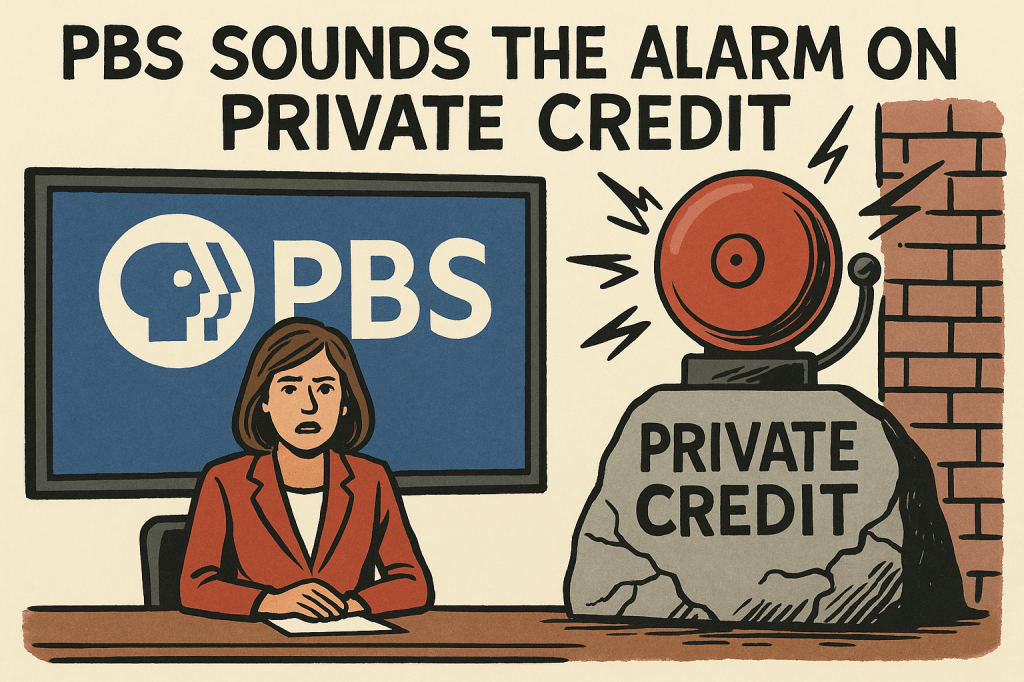
On December 11, 2025, PBS NewsHour did something that almost no mainstream media outlet has done to date: it warned the public—plainly and directly—about the risks of private credit. The segment, airing roughly between the 20- and 28-minute mark of the broadcast, treated private credit not as an exotic investment strategy for sophisticated institutions, but as a growing systemic risk that already touches ordinary Americans through pensions, insurance products, and retirement plans. https://www.pbs.org/video/december-11-2025-pbs-news-hour-full-episode-1765429201/
That alone is significant. PBS is not a sensationalist outlet. When PBS NewsHour devotes prime airtime to a financial product, it is usually because the issue has matured from “industry concern” into a matter of broad public interest and potential harm. Private credit has now crossed that threshold.
PBS Breaks the Silence on Private Credit Risk
What makes the PBS NewsHour segment so important is not just that it covered private credit, but how plainly it described the regulatory hole surrounding it. As PBS explained, “private credit is just lending by nonbanks — financial institutions like pension funds, insurance companies, sovereign wealth funds — but not regulated like the traditional banking system.” That simple framing strips away years of industry marketing and exposes the core issue: private credit performs a bank-like function without bank-level oversight.
Even more telling was the warning from Tom Gober, an insurance fraud examiner, who focused on who ultimately bears the risk. Gober stated: “A very large percent of the population is affected by this higher risk without knowing it.” That observation goes to the heart of the problem. Private credit risk is no longer confined to hedge funds or wealthy investors. It is increasingly embedded—quietly and indirectly—inside pension plans, insurance general accounts, pension risk transfer annuities, target date funds, and state-regulated collective investment trusts, where workers and retirees have no visibility, no pricing transparency, and no meaningful ability to opt out.
When PBS elevates this issue to a national audience, it confirms what fiduciary advocates have been warning for years: private credit is not just an alternative investment—it is a public exposure problem.
The BIS, Financial Times, and the Credit Ratings Problem
PBS’s warning aligns closely with concerns raised by global regulators. In a recent report highlighted by the Financial Times, the Bank for International Settlements (BIS) warned that private loan credit ratings may be “systematically inflated.” The BIS focused on the growing reliance on small or lightly regulated ratings firms—particularly in insurance and private credit markets—where inflated ratings can dramatically reduce capital requirements and mask real credit risk. https://www.ft.com/content/9d1f4e49-5edc-4815-9efb-d4ef41756d72
This is not an academic issue. Inflated ratings distort pricing, suppress risk premiums, and create the conditions for sudden repricing and fire sales when defaults rise or liquidity dries up. The BIS explicitly tied these dynamics to systemic fragility, drawing uncomfortable parallels to the mis-rated mortgage securities that fueled the 2008 financial crisis.
The danger is magnified because private credit assets are illiquid, thinly traded, and often self-priced. When confidence breaks, there is no transparent market to absorb losses—only forced write-downs that cascade through insurance balance sheets and pension portfolios.
What This Means for ERISA Plans and Retirement Savers
These systemic warnings directly reinforce the concerns raised earlier this year in my CommonSense 401k Project’s article, “Private Debt Problematic in ERISA Plans.” https://commonsense401kproject.com/2025/07/18/private-debt-problematic-in-erisa-plans/ As that piece explained, private debt and private credit are fundamentally misaligned with ERISA’s core fiduciary requirements of prudence, diversification, and fair valuation. This will be dealt with in litigation around prohibited transactions in which the burden of proof is on the fiduciary that their private debt is exempt.
Private credit’s lack of observable market pricing, combined with long lockups and opaque fee structures, makes it exceptionally difficult for plan fiduciaries to demonstrate that participants are receiving commensurate value for the risks being taken. Embedding these assets inside target date funds or insurance-wrapped vehicles does not solve the problem—it hides it.
PBS’s reporting underscores an uncomfortable truth: millions of retirement savers are already exposed to private credit risk without knowing it, precisely the scenario ERISA was designed to prevent.
Shadow Banking, Then and Now
None of this is new. Nearly a decade ago, analysts warned that private equity firms were evolving into shadow banks, providing credit outside the regulated banking system. That prediction has now fully materialized. Private equity sponsors control vast private credit platforms that originate, warehouse, and distribute loans with minimal public disclosure.
Naked Capitalism has tracked this evolution for years, repeatedly warning that pensions—including CalPERS—were increasing allocations to private equity and private debt simultaneously, often while adding leverage at the total-fund level. The result is layered risk: illiquidity on top of leverage, wrapped in optimistic assumptions about diversification and yield stability. https://www.nakedcapitalism.com/2016/02/the-new-shadow-banks-private-equity-becomes-private-credit.html?utm_source=chatgpt.com
PBS’s segment confirms that these concerns are no longer fringe critiques—they are entering mainstream financial discourse.
Why the PBS Warning Matters Now
The convergence of warnings—from PBS, the BIS, the Financial Times, and independent analysts—signals that private credit has reached a dangerous inflection point:
- It has grown to systemic scale
- It operates largely outside traditional regulatory frameworks
- Its risks are mispriced through inflated ratings
- And its losses will not be confined to “sophisticated investors,” but absorbed by workers, retirees, and policyholders
When a trusted public broadcaster like PBS feels compelled to warn viewers, fiduciaries and regulators should take notice. The question is no longer whether private credit can create systemic problems—it is whether policymakers will act before those problems become visible through losses.
Conclusion: An Alarm Bell for Fiduciaries
PBS did not mince words, and neither should fiduciaries. Private credit is increasingly intertwined with retirement systems that were never designed to absorb opaque, illiquid credit risk. The warning from Tom Gober—that a large portion of the population is already exposed without knowing it—should be taken as a direct challenge to ERISA fiduciaries, regulators, and courts.
Transparency, prudence, and accountability are not optional under ERISA. If private credit cannot meet those standards, it does not belong in retirement plans—no matter how attractive the yield looks on paper.


Pingback: Is Private Credit Performance a Fraud? | The CommonSense 401k Project