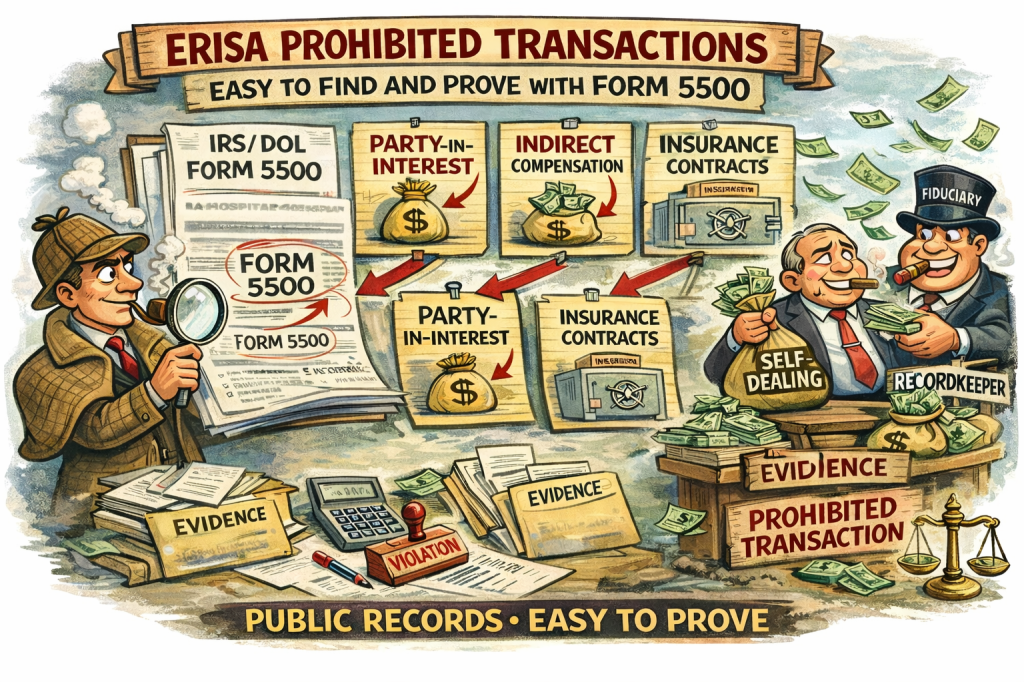
My friend Edward Siedle, a former SEC attorney who has been involved in many ERISA suits was giving a training to DOL attorneys and regulators a few years back. A DOL staffer asked Siedle who polices “Prohibited Transactions,” and Siedle answered you (the DOL) do. The entire room of DOL staffers replied that we do not, we thought outsiders did. So basically, for the last 5 decades, no one has policed prohibited transactions. The industry has lobbied for exemptions, but upon scrutiny, most do not hold up with many products.
The Industry has become deadly fearful of prohibited transactions cases enabled by Cunningham v. Cornell, as they are in a desperate struggle to put in legislation to weaken ERISA https://commonsense401kproject.com/2025/11/29/rep-randy-fine-files-bill-to-force-private-equity-annuities-and-crypto-into-401ks/ to keep it from starting. The Plaintiff bar has in general been slow to adapt because they are mostly focusing on the top 500 largest plans, where it is easier to find plaintiffs and they think they can find easier $$$$.
How to Find ERISA Prohibited Transactions Using the IRS/DOL Form 5500
One of the most misunderstood facts in ERISA litigation is this:
Many prohibited transactions are disclosed by defendants themselves — on the IRS/DOL Form 5500.
The Form 5500 is not confidential. It is a public record, filed annually with the IRS, Department of Labor, and PBGC, and it often contains everything a regulator, journalist, or plaintiff attorney needs to identify conflicted compensation arrangements. It is easily accessible on the web at https://www.efast.dol.gov/5500Search/
Below is a practical guide to finding prohibited transactions using nothing more than the Form 5500—illustrated with the Lakeshore Learning Materials 401(k) Plan (2024) filing.
I. What Is the Form 5500—and Why It Matters
Form 5500 is the Annual Return/Report of Employee Benefit Plan, required under ERISA §§104 and 4065 and the Internal Revenue Code.
Key points:
- It is signed under penalty of perjury
- It is open to public inspection
- It requires affirmative disclosure of:
- Service providers
- Compensation
- Indirect compensation
- Party-in-interest relationships
- Insurance contracts and collective trusts
This makes the Form 5500 one of the most powerful—and underused—tools for identifying ERISA prohibited transactions.
(Page 1 of the filing confirms this plan is a single-employer ERISA plan and that the Form is open to public inspection
LakeshoreSelect24
)
II. Step One: Go Straight to Schedule C (Compensation)
Schedule C is where prohibited transactions often reveal themselves.
A. What Schedule C Discloses
Schedule C requires disclosure of:
- All service providers receiving $5,000 or more
- Whether they received:
- Direct compensation
- Indirect compensation
- Whether required disclosures were provided
This is where fiduciaries often admit conflicts.
III. Example: Principal and SageView Both Admit Indirect Compensation
A. Principal Life Insurance Company (Recordkeeper)
On Schedule C, page 2, the plan lists Principal Life Insurance Company as a service provider:
- Role: Contract Administrator / Recordkeeper
- Direct compensation: $158,327
- Indirect compensation: “Yes” (explicitly checked)
- Principal is identified as a party in interest
LakeshoreSelect24
This matters because:
- A recordkeeper receiving indirect compensation is, by definition, receiving payments from sources other than the plan sponsor
- Those payments often come from:
- Proprietary investment products
- Revenue sharing
- Insurance spread profits
- When the recordkeeper is also offering proprietary investments, ERISA §406(b) is immediately implicated
B. SageView Advisory Group, LLC (Investment Advisor)
The same Schedule C shows:
- SageView Advisory Group, LLC
- Role: Investment Advisory
- Direct compensation: $59,924
- Indirect compensation: “Yes”
- Amount of indirect compensation reported: $16,898
LakeshoreSelect24
This is a critical red flag:
An investment advisor receiving indirect compensation is no longer acting solely on behalf of the plan.
This opens the door to:
- ERISA §406(b)(1): acting for one’s own account
- ERISA §406(b)(3): receipt of consideration from third parties
- https://commonsense401kproject.com/2025/11/18/why-401k-consultants-should-be-included-as-defendants-in-erisa-litigation/
IV. Step Two: Turn to Schedule H, Line 4i (Plan Assets)
After identifying indirect compensation, the next step is to identify what products are generating it.
That happens on Schedule H, Line 4i – Schedule of Assets (Held at End of Year).
V. Principal’s Proprietary Products Are Clearly Marked as Parties in Interest
On page 3 of the filing, the plan’s investments are listed in detail.
Several facts stand out:
A. Principal Target-Date CITs
The plan holds a full suite of Principal Life Time Hybrid CITs (2025 through 2070).
Each of these is marked with an asterisk:
“* Indicates party-in-interest”
LakeshoreSelect24
This confirms:
- The recordkeeper (Principal) is also the investment provider
- Plan assets are invested in party-in-interest products
- Any indirect compensation flowing to Principal is now tied directly to plan asset placement
- https://commonsense401kproject.com/2025/12/07/wall-street-journal-exposes-target-date-cit-corruption-but-theyve-only-scratched-the-surface/
- I specifically target Principal and Prudential target date funds in this piece https://commonsense401kproject.com/2022/06/07/toxic-target-date-case-study-of-the-worst-of-the-worst/ because they can hold alternatives and annuities
B. Principal Fixed Annuity Contract
The Schedule also lists:
- Insurance Company Contract
- Issuer: Principal Life Insurance Company
- Product: Principal Fixed Income Guaranteed Option
- Value: $8,866,376
- Marked as a party-in-interest
- Valued at contract value, not market value
LakeshoreSelect24
This is the classic prohibited-transaction setup:
- Party-in-interest insurer
- Fixed annuity / general account product
- Credited rate set by insurer
- Indirect compensation disclosed on Schedule C
- https://commonsense401kproject.com/2025/11/01/annuities-are-a-prohibited-transaction-dol-exemptions-do-not-work/
VI. Why This Matters for Litigation and Enforcement
This single Form 5500 filing demonstrates how easy it is to identify prohibited-transaction fact patterns:
- Schedule C
- Identify indirect compensation
- Identify parties receiving it
- Schedule H (Line 4i)
- Identify party-in-interest investments
- Identify proprietary products
- Identify insurance contracts valued at contract value
- Connect the dots
- Party-in-interest + indirect comp + asset placement
= ERISA §406 red flag
- Party-in-interest + indirect comp + asset placement
No discovery required. No whistleblower needed. The defendants disclosed it themselves.
VII. Bottom Line
The Form 5500 is not just a compliance filing—it is a roadmap to prohibited transactions.
If regulators, journalists, and courts paid closer attention to:
- Schedule C (indirect compensation), and
- Schedule H (party-in-interest assets),
many ERISA violations would be obvious on their face.
The problem is not lack of evidence.
The problem is lack of enforcement.
 The CommonSense 401k Project