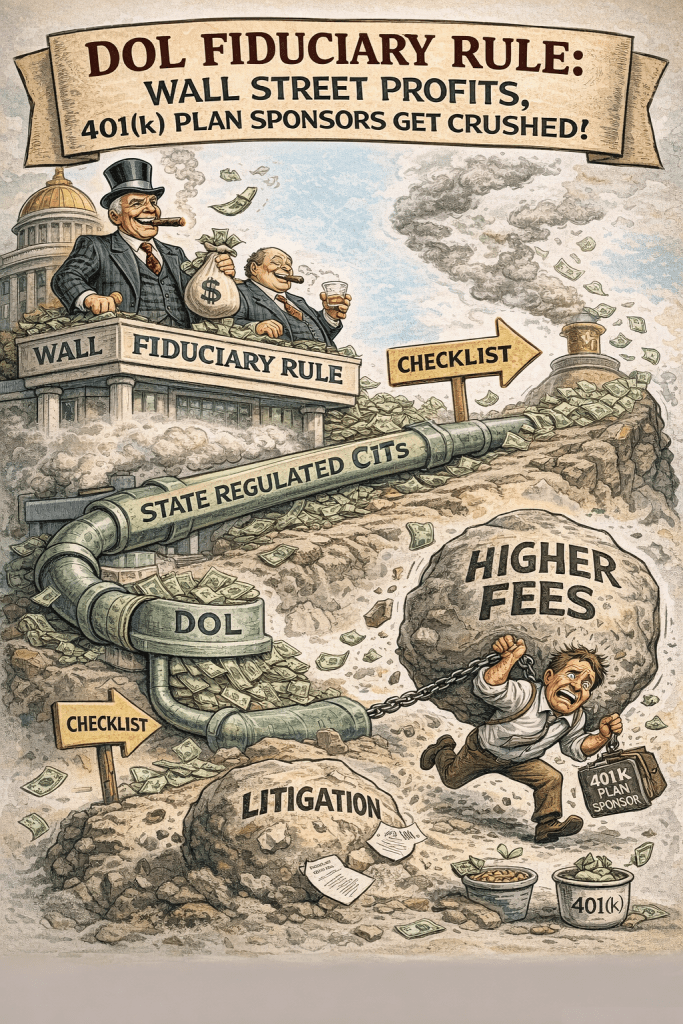
The Department of Labor is selling its new fiduciary rule as protection.
Protection from lawsuits.
Protection through process.
Protection via a checklist.
But strip away the language, and the reality is far more troubling:
👉 This rule is not about reducing litigation.
👉 It is about unlocking new revenue streams for Wall Street and the insurance industry—while leaving plan sponsors holding the liability.
The Bait: “Follow the Checklist, Reduce Your Risk”
The DOL’s message is simple:
If fiduciaries evaluate:
- fees
- performance
- liquidity
- complexity
- valuation
…then they will be protected.
But even under the rule itself, that protection is weak:
- It is not a true safe harbor
- It is only a rebuttable presumption
- Plaintiffs can still challenge the outcome
So what the DOL is really offering is not protection—it is procedural cover.
The Switch: Open the Door to High-Fee, Opaque Products
While promising protection, the rule simultaneously:
- Encourages alternative investments in 401(k)s
- Channels those investments into state-regulated CITs
- Facilitates inclusion of annuities and insurance products
These are not low-cost index funds.
These are:
- Private equity
- Private credit
- Insurance-wrapped products
- Spread-based annuities
👉 In other words: the highest-margin products in the entire financial system.
Why Wall Street and Insurers Win Immediately
This rule creates an immediate economic shift:
💰 More complexity = more fees
- Private markets → higher management fees
- CITs → less fee transparency
- Annuities → hidden spreads (often 100–300+ bps)
💰 Less transparency = less pricing pressure
- No SEC disclosure regime
- No daily pricing discipline
- No meaningful benchmarking
💰 Faster revenue recognition
- Fees and spreads are earned today
- Risks are borne later
Translation:
👉 Wall Street and insurers get paid now
👉 Participants take the risk later
👉 Plan sponsors absorb the liability when things go wrong
CITs: The Perfect Revenue Vehicle (and Litigation Time Bomb)
The rule effectively pushes plans into Collective Investment Trusts (CITs).
Why?
Because CITs allow:
- Mixing of public and private assets
- Limited disclosure
- State-level oversight instead of SEC regulation
And here’s what most fiduciaries—and participants—don’t realize:
👉 Many CITs are regulated at the state level (PA, NH, MD, etc.)
👉 That fact is often buried in fine print
👉 Underlying holdings are frequently undisclosed or poorly understood
That’s Not Just a Disclosure Problem—It’s a Legal Problem
Because once litigation begins, everything changes.
Discovery will ask:
- What regulator governs this CIT?
- What assets are inside it?
- Are any affiliates involved?
- How are values determined?
- What compensation is embedded?
And under Cunningham v. Cornell:
👉 If a party in interest is involved, the burden shifts
One Hidden Conflict Can Blow Up the Entire Structure
This is where the DOL’s rule becomes dangerous.
Inside these CIT-based target date funds, you may find:
- Affiliated private credit funds
- Insurance general account exposure
- Revenue-sharing arrangements
- Spread-based annuities
If any one of those components is found to be a prohibited transaction:
👉 The entire structure becomes subject to challenge
👉 Damages can follow
👉 Fiduciaries—not providers—are on the hook https://commonsense401kproject.com/2026/04/03/dol-401k-fiduciary-rule-enables-accounting-fraud/
The Real Risk Shift: From Providers to Plan Sponsors
Wall Street and insurers are insulated:
- They design the products
- They control the disclosures
- They collect the fees
But they are not fiduciaries.
Plan sponsors are.
So when things go wrong:
👉 It is not the product manufacturer that gets sued
👉 It is the plan committee
Morningstar Already Admits the Questions Aren’t Answered
Even industry observers acknowledge:
- Valuation concerns
- Fee opacity
- Liquidity risks
- Structural complexity
These are not technical issues.
These are the exact elements plaintiffs’ attorneys litigate. https://www.morningstar.com/alternative-investments/private-investments-401ks-we-still-have-questions
Bottom Line
The DOL claims this rule protects fiduciaries.
But the real structure is clear:
Wall Street and insurers:
- Gain new access to 401(k) assets
- Increase fees and spreads
- Face limited transparency requirements
Participants:
- Bear higher costs
- Take on opaque risks
- Lose visibility into their investments
Plan sponsors:
- Assume fiduciary responsibility
- Face increased litigation exposure
- Rely on a “checklist defense” that will not hold up
This rule isn’t a shield.
It’s a handoff:
👉 Profits go to Wall Street and insurance companies
👉 Risk goes to participants
👉 Liability stays with plan sponsors
And when the lawsuits come—as they will—
the checklist won’t save anyone.


🎯🎯🎯
Yahoo Mail: Search, Organize, Conquer
LikeLike