From the NBC Story https://www.nbcnews.com/news/us-news/nations-largest-public-pension-fund-plagued-secrecy-underperformance-p-rcna346330
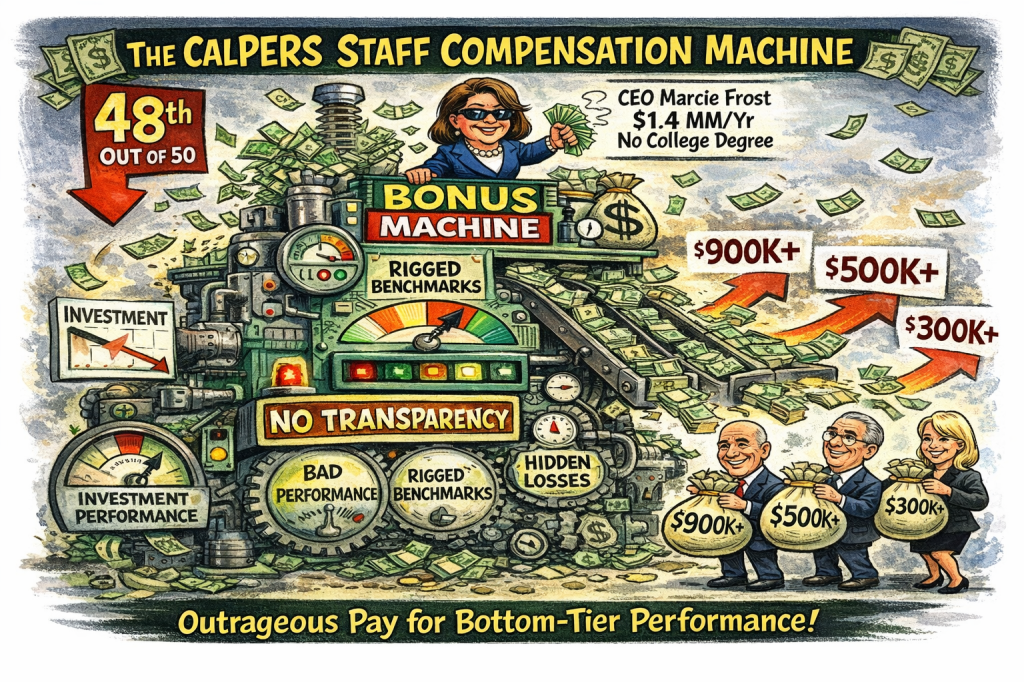
- The fund’s staffers receive “excessive compensation” despite its dismal performance. Four executives make more than $1 million a year, another four more than $900,000 and 26 earn between $500,000 and $900,000.
From the new groundbreaking CalPERS report and NBC report . CALPERS CEO Marcie Frost made $1.4mm despite not having a college degree and is one of 8 making over $900,000 a year. There are 34 making over $500,000 a year and 86 making over $300,000 a year. This is not only an insult to taxpayers and government employees but is so excessive it might endanger the tax status of the plan. These salaries are so excessive that even a mid-level investment employee, the Managing Investment Director of ESG, was singled out in a recentoversight letter from the U.S. House Committee on Education and the Workforce to officials at CalPERS for making $624,024 as one of the factors in challenging the tax status of the plan. https://edworkforce.house.gov/uploadedfiles/02.12.26_calpers_loss_oversight_letter_will_instructions.pdf
Excessive Staff Compensation Driven by Bogus Benchmarks
CalPERS appears to have some of the highest public pension investment staff salaries in the nation, as well as the highest investment performance bonuses. Given that investment performance is dismal, the lavish bonuses awarded to pension staff seem especially unwarranted. Bogus benchmarks drive this excessive compensation. See report https://www.nakedcapitalism.com/2021/08/calpers-comes-dead-last-of-34-public-pension-returns-despite-having-biggest-best-paid-investment-office.html
Compensation levels at CalPERS now extend far beyond the norms of public administration. The Governor of California earns approximately $234,000 annually, yet dozens of CalPERS employees earn multiples of that amount. CEO compensation increased from roughly $406,000 in 2018 to more than $1.24 million in 2024, an increase of more than 200 percent—far outpacing the wage growth of the public workers whose retirement security the fund exists to protect.
These excessive compensation levels are justified through a performance measurement system that is largely internally constructed and consultant-validated rather than independently verified against investable alternatives. In 2022, Naked Capitalism wrote, “… Global Governance Advisors is enabling the giant pension fund’s staff in misappropriating from beneficiaries via the device of fundamentally and pervasively flawed pay benchmarking. https://www.nakedcapitalism.com/2022/04/calpers-consultant-global-governance-advisors-recommends-further-overpaying-grossly-underperforming-calpers-staff.html
Executive incentives rely heavily on CalPERS’ custom policy benchmarks and discretionary organizational metrics rather than direct comparison to transparent market benchmarks. As a result, compensation can rise even during periods marked by leadership instability, governance controversy, and poor investment performance.
Governance concerns are further illustrated by a series of leadership controversies and oversight failures. These include unresolved questions regarding executive credentials, resume exaggeration by senior officers, legal conflicts in hiring processes, and repeated turnover in the Chief Investment Officer role. Horrible turnover with Sr. Execs still existed despite the excessive pay and is well documented in Naked Capitalism. https://www.nakedcapitalism.com/2021/01/calpers-making-it-impossible-to-hire-competent-chief-investment-officer.html https://www.nakedcapitalism.com/2020/08/calpers-chief-investment-officer-ben-meng-made-false-felonious-financial-disclosure-report-more-proof-of-lack-of-compliance-under-marcie-frost.html
[1] https://www.nakedcapitalism.com/2023/09/calpers-chief-investment-officer-nicole-musicco-resigns-abruptly-intensifying-calpers-senior-staffing-instability.html https://www.nakedcapitalism.com/2018/08/los-angeles-times-slams-calpers-vetting-failures-resulting-exodus-cfo-asubonten-resume-misrepresentations-doubts-whether-ceo-marcie-frost-made-needed-changes.html
Compensation advisor GCA benchmarks CalPERS executives against private-sector investment professionals, despite fundamental differences in risk exposure, compensation volatility, and personal capital at risk inflating compensation bands while requiring no performance accountability.
In short, CalPERS pays higher than private sector salaries for investment performance that would result in termination in the private sector. An independent Inspector General would fundamentally alter the structure in which salaries are justified, evaluate the relationship between compensation escalation and measurable long-term net performance, as well as recommend claw back or deferral structures tied to realized economic outcomes rather than interim marks.
Appendix Update — CalPERS CIO Pay Breaks the $2 Million Barrier
August 30, 2026
Since this article was published, CalPERS has supplied an extraordinary new data point supporting its central argument: CalPERS Chief Investment Officer Stephen Gilmore received more than $2.26 million in total pay for fiscal year 2024–25.
This is not merely a number reported by a CalPERS critic. It comes directly from CalPERS’ own compensation disclosure. CalPERS reports Gilmore received $718,750 in base pay plus $1,541,719 in annual incentive pay, for total compensation of $2,260,469.
The incentive alone was therefore more than twice Gilmore’s already extraordinary $718,750 base salary. When CalPERS hired Gilmore in 2024, it publicly announced the $718,750 salary while explaining that additional incentives would depend upon fund performance relative to established benchmarks.
And Gilmore is hardly an isolated case. CalPERS’ own disclosure shows a remarkable concentration of seven-figure compensation:
- CIO Stephen Gilmore — $2,260,469
- Deputy CIO Daniel Bienvenue — $1,596,486
- CEO Marcie Frost — $1,550,601
- Managing Investment Director Arnold Phillips — $1,547,794
- Managing Investment Director Sarah Corr — $1,330,779
- Managing Investment Director Sterling Gunn — $1,267,728
- Managing Investment Director Anton Orlich — $1,264,734
- Deputy CIO Daniel Booth — $1,238,060
- Managing Investment Director Simiso Nzima — $1,166,478
- Managing Investment Director Peter Cashion — $1,114,422
That is more than $14.3 million for just ten CalPERS employees in a single year, based on CalPERS’ published figures.
The August 29, 2026 California Globe report puts the numbers into an even broader context. It reports that approximately 250 California state employees received more than $600,000 in 2025, with Gilmore at the top, and that more than 15 pension investment officers and executives surpassed $1 million. The publication also reports that the top ten CalPERS and CalSTRS compensation packages totaled approximately $15 million.
California Globe — California Paid 250 State Workers More Than $600,000
The Benchmark Problem Gets Even Bigger
The most important issue is not simply whether $2.26 million is “too much” to pay a CIO managing hundreds of billions of dollars. It is how CalPERS determines that its executives have earned these enormous incentive payments.
That question becomes especially important as CalPERS moves further toward its Total Portfolio Approach (TPA). CalPERS says that under TPA it will evaluate investments at the total-fund level rather than adhering to traditional asset-class allocations. CalPERS also says it will publicly compare its active approach with a reference portfolio consisting of 75% global equities and 25% U.S. Treasury bonds.
When investment professionals can receive bonuses exceeding their salaries—and the CIO can receive $1.54 million of incentive compensation in a single year—the construction, selection and governance of performance benchmarks stop being an obscure actuarial or investment-policy question. They become a compensation issue.
That is exactly why CalPERS’ benchmarks deserve extraordinary public scrutiny.
The people choosing investments, measuring performance and operating within CalPERS’ increasingly flexible Total Portfolio Approach can receive millions of dollars whose payment depends upon reported investment performance.
CalPERS has now crossed a remarkable threshold:
A California public pension CIO can make more than $2 million a year—and more than two-thirds of that compensation can come from incentive pay.
The public should therefore be entitled to see, understand and independently reproduce every benchmark calculation that helps generate those bonuses.
At these compensation levels, benchmark transparency is compensation transparency.


Pingback: The Consultant Behind the Public-Pension Pay Machine – GGA Helped Legitimize Excessive Pay at CalPERS, STRS Ohio & Ontario OMERS | The CommonSense 401k Project
Pingback: Pension Staff Are Entering Football Coach Pay Territory While Helping Set Their Own Scoreboard | The CommonSense 401k Project