Private equity has spent decades operating where most Americans rarely see it.
A pension fund owns an LP interest in a private-equity fund. The PE fund owns dozens of companies. The contracts are secret. The fees are complicated. The valuations are subjective. The conflicts are buried in hundreds of pages of documents.
Try explaining that at a neighborhood bar.
Now private equity is buying something entirely different:
Your team.
And that may turn out to be one of Wall Street’s biggest political mistakes.
Fans Aren’t Pension Trustees
People have emotional relationships with sports teams that they simply do not have with investment funds.
They grow up with them.
Their parents took them to games.
They buy jerseys for their children.
Cities build stadiums around them.
And increasingly, millions of Americans have actual money riding on what happens on the field through legalized sports betting.
That creates an explosive combination:
Private capital + beloved civic institutions + billions of dollars of gambling + relatively weak and fragmented regulation.
Private equity may have just kicked over a hornet’s nest.
Sports Has Become an Alternative Asset Class
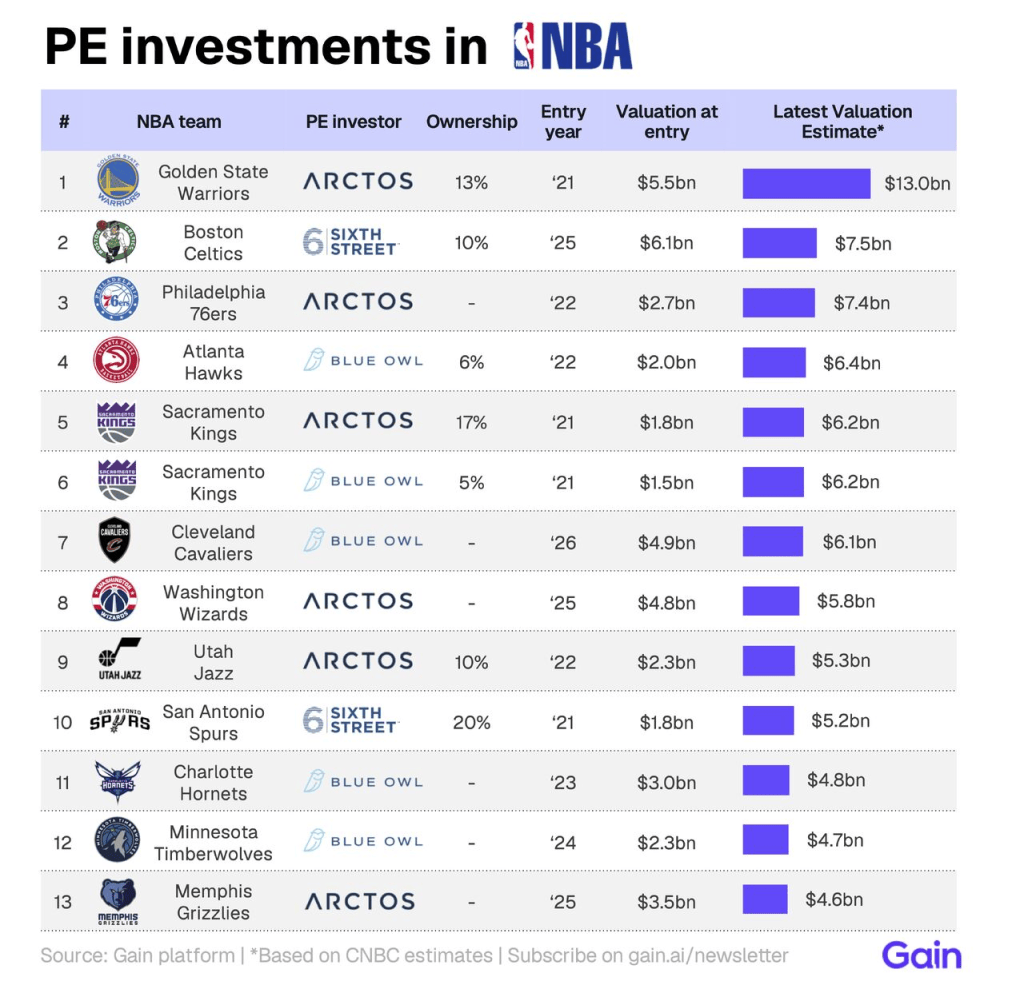
Institutional investors reportedly now hold interests in dozens of North American professional teams.
MLB opened the door to private-equity ownership in 2019.
The NFL followed in 2024.
The NBA, NHL and international soccer have their own variations.
The sales pitch sounds remarkably similar to what pension funds and 401(k) fiduciaries hear about private markets:
Sports franchises are scarce assets.
Revenue is resilient.
Media rights provide predictable cash flows.
Fan loyalty creates barriers to entry.
Franchise values have historically appreciated.
In other words, Wall Street has discovered that perhaps the ultimate captive customer is a sports fan.
The Lakers Are a Warning
The extraordinary escalation in the valuation of the Los Angeles Lakers illustrates what is happening. A franchise isn’t simply a basketball team anymore. It is a media asset.
A real-estate opportunity. A sponsorship platform. A gambling ecosystem. A data business. An entertainment property. And increasingly, an institutional investment.
The danger is that the incentives of the financial owner and the interests of the fan aren’t necessarily the same.
The old owner might have wanted to win a championship. The new financial owner also has to think about IRR. That difference matters.
Henry Abbott Has Been Asking the Right NBA Questions
Basketball journalist Henry Abbott has spent years examining the economics and governance of the NBA rather than simply covering what happens on the court.
Josh Harris is an especially interesting case study.
The modern sports billionaire may simultaneously operate across private equity, professional sports, finance, media relationships and other businesses.
That doesn’t establish wrongdoing.
But it creates something regulators and journalists should understand very well:
conflicts.
And sports leagues largely depend upon themselves to police those conflicts.
Then Add Gambling
This is where the issue becomes much larger.
Professional sports isn’t merely entertainment anymore.
Americans are wagering enormous sums on games, players and individual events within games.
That changes the public-policy stakes.
An owner isn’t merely controlling an entertainment company.
The owner controls an organization producing events upon which outsiders are wagering billions of dollars.
Suddenly questions that once sounded like obscure corporate-governance issues become much more important:
Who owns pieces of multiple teams?
What other businesses do those owners control?
Who finances the teams?
Who owns the media companies?
Who has relationships with sportsbooks?
Who owns the data?
Who receives nonpublic information?
What investments do the owners’ funds hold in companies doing business with their teams or leagues?
And who is actually checking?
Britain Already Knows What Financialization Can Do to Sports
American regulators should spend some time studying British football.
The UK provides decades of examples of what can happen when football clubs become financial assets: leveraged acquisitions, complicated ownership structures, related-party transactions, distressed clubs and supporters discovering that the institution they regarded as belonging to their community was legally somebody else’s financial property.
British football journalist Paul Brown and others have chronicled parts of this transformation.
American sports may be traveling down a similar road—with private equity and sports betting added to the mix.
Now Follow the Money Back to Pension Funds
Here is the part almost nobody in sports journalism is connecting.
Where does private equity get the money?
Much of it ultimately comes from institutional investors.
Public pension funds.
Corporate pension funds.
Endowments.
Foundations.
And increasingly, Wall Street wants access to 401(k)s.
So a teacher, firefighter or state employee can potentially participate in this system twice.
First as a fan, paying increasingly expensive tickets, television subscriptions, merchandise and perhaps gambling losses.
Then as an investor, with retirement money committed to the private funds participating in the financialization of sports.
And the worker may have remarkably little ability to examine what is happening with either role.
The Same Governance Problems Keep Appearing
This is what makes the sports story so important.
The issues are remarkably similar to the problems we have documented in private equity generally:
Opaque ownership.
Secret contracts.
Related-party transactions.
Complicated fee structures.
Questionable valuations.
Multiple layers of intermediaries.
Potential conflicts involving advisers and investors.
Weak or fragmented regulatory oversight.
Enormous amounts of institutional money.
And perhaps most importantly:
The people whose money ultimately finances the system often have the least information about it.
Wall Street Wants Your 401(k), Too
This comes at precisely the moment private-equity managers are trying to expand into America’s enormous defined-contribution retirement system.
As CommonSense recently documented, Bloomberg found evidence raising serious questions about thousands of supposedly grassroots comments supporting the Labor Department’s private-equity initiative—including comments attributed to people who were already dead.
The economic incentive isn’t difficult to understand.
Traditional institutional investors have become increasingly concerned about private-market fees, liquidity, valuations and distributions.
Wall Street needs additional capital.
America’s 401(k) system contains trillions of dollars.
The sports boom provides another window into the same phenomenon.
Private equity keeps searching for pools of dependable cash flow.
Pensions provide dependable capital.
401(k)s provide dependable contributions.
Sports provide dependable fans.
And sports betting provides another enormous stream of money surrounding those fans.
The Hornet’s Nest
Private equity has survived decades of criticism over pension investments partly because pension governance is boring.
LPAs are boring.
Valuation policies are boring.
Fee reconciliation is boring.
ERISA prohibited-transaction rules are boring.
Try telling a Lakers fan that the people financing his team may have undisclosed conflicts.
That isn’t boring.
Try telling a Manchester United supporter that his club is primarily an asset on somebody’s balance sheet.
Not boring.
And try telling someone who just wagered $2,000 on a game that the ownership, financing and business relationships surrounding the teams are too complicated or proprietary for the public to examine.
Definitely not boring.
That is why sports could become private equity’s unexpected political problem.
Private equity didn’t merely buy another portfolio company.
It bought something people love.
And unlike pension beneficiaries trying to obtain a private-equity contract from their retirement system, sports fans number in the tens of millions.
They watch every night.
They argue about every decision.
They follow every dollar.
And increasingly, they bet real money on the outcome.
Private equity may discover that sports fans are considerably harder to manage than pension trustees.