
A new academic report provides unusually strong evidence for a central argument made in both the our investigation of Ohio STRS and our broader CalPERS report: public-pension compensation systems can reward staff for an internally manufactured version of performance that is materially better than the pension’s underlying financial record.
In Retirement at Risk: The Political Economy of Public Pension Governance, Allen Mendenhall and Dan Sutter examine two decades of Ohio State Teachers Retirement System performance reporting. https://allenmendenhall.com/wp-content/uploads/Retirement-at-Risk.pdf https://jnf.ufm.edu/journal/vol4/iss1/2/
Their central finding is remarkable:
STRS’s publicly reported investment return exceeded the authors’ independently calculated return derived from audited financial information in 19 of the 20 fiscal years from 2003 through 2022.
The average difference was approximately 0.33 percentage points annually. The authors estimate that the annual differences represented about $4.8 billion when added together and approximately $9.3 billion when compounded over the full period. They emphasize that the $9.3 billion is not the amount of bonuses improperly paid; it is their estimate of the cumulative difference between the performance story presented to stakeholders and the growth indicated by their audited-data calculation.
The Critical Compensation Connection
The report does not merely identify two different performance figures. It connects the difference directly to incentives:
- STRS reportedly based investment-staff bonuses on the higher, internally reported return.
- Those reported returns were not themselves the subject of the CPA opinion covering the financial statements.
- Ohio OPERS, used as a comparison, based bonuses on audited results.
- OPERS showed a much smaller, bidirectional discrepancy: its reported return was higher in some years and lower in others.
That comparison is important. OPERS operated in the same state, under similar economic conditions, yet its differences looked more like ordinary measurement variation. At STRS, the difference overwhelmingly went in one direction—the direction that favored staff compensation.
The authors calculate that obtaining 19 favorable differences in 20 years would have a probability of less than 0.01 percent if overstatement and understatement were equally likely. Their conclusion is appropriately qualified: methodological differences may explain part of the gap, but the pattern is most consistent with an incentive problem.
This is about as close as an academic paper is likely to come to saying:
STRS maintained one performance number grounded in audited financial information and another, more favorable number used to justify bonuses.
It Reinforces the CommonSense “Everyone Gets Paid to Pretend” Thesis
In May, the CommonSense 401k Project described the private-market valuation system as a “perfectly aligned incentive system”:
- private-equity managers benefit from high reported net asset values;
- private-credit managers benefit from delaying defaults and write-downs;
- consultants benefit from preserving complex, high-fee programs;
- pension staff benefit from reported outperformance and bonuses.
The process was summarized in five steps:
- Private assets are not marked to an observable market.
- Benchmarks are lagged or custom-built.
- Reported returns appear unusually stable.
- Fees and bonuses are paid.
- Losses are deferred.
Private Assets make up their own valuations and hide excessive fees. This is why no Private Equity fund can comply with CFA-GIPS performance guidelines. https://commonsense401kproject.com/2025/08/25/misleading-claims-of-gips-compliance-at-ohio-strs/
This is why Private Equity is not allowed in SEC registered Mutual Funds.
The new STRS study supplies direct empirical support for the pension-staff portion of that thesis. We previously argued that pension employees’ bonuses depend on reported returns and non-investable benchmarks, creating a powerful reason not to recognize losses promptly.
The academic study now finds precisely the pattern that theory predicts: the number associated with compensation was almost always higher than the number the authors derived from audited financial data.
This moves the issue beyond a generalized concern about opaque private assets. It identifies a measurable institutional mechanism through which optimistic reporting can enrich the people responsible for producing and defending it.
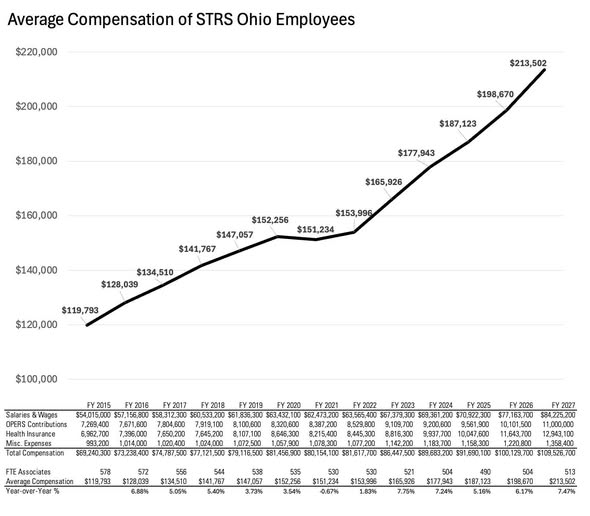
From our 2024 numbers it has gotten worse with higher excessive salaries many who now work from home
- 4 employees earned over $600,000.
- 20 employees earned over $400,000.
- 49 employees earned over $300,000.
- 85 employees earned over $200,000
- That’s a 90% increase in six-figure employees in just five years — during a period when teachers’ COLAs were frozen. https://commonsense401kproject.com/2025/10/31/columbus-the-highest-public-salaries-in-america-and-ohio-teachers-are-paying-for-it/
It Also Reinforces the CFA-versus-CPA Power Imbalance
The earlier CommonSense Ohio report described a structural imbalance inside public pensions: https://commonsense401kproject.com/2026/05/02/ohio-strs-investment-staff-paid-excessively-to-look-the-other-way/
- highly compensated investment personnel control private-market allocations, valuation inputs, benchmarks and performance narratives;
- lower-paid accounting and financial-control personnel are expected to verify the resulting numbers;
- boards generally rely more heavily on the investment staff than on the accountants.
That report argued that Ohio had created a system in which “the dealmakers are rewarded for growth and complexity” while “the watchdogs are underpaid and outgunned.”
Mendenhall and Sutter provide a concrete example of the consequences. The externally audited financial information and the investment office’s reported performance existed in the same annual reports, but they apparently did not produce the same result. The investment office’s preferred result was then used for compensation.
Thus, the problem is not simply that CFA-type investment personnel make more money than CPA-type accounting personnel. The deeper problem is that the better-paid side controls the performance number on which its own bonuses depend.
The CalPERS Parallel Is Even Larger
The CalPERS investigation identified a similar structure, although CalPERS accomplishes it primarily through engineered benchmarks and private-asset valuation conventions rather than the exact STRS calculation examined in the new paper.
CalPERS pays some of the highest public-pension compensation in the country despite chronic underperformance. The investigation found:
- four executives receiving more than $1 million;
- another four receiving more than $900,000;
- 26 employees between $500,000 and $900,000;
- 52 employees between $300,000 and $500,000;
- CEO compensation rising from approximately $406,000 in 2018 to more than $1.24 million in 2024. https://commonsense401kproject.com/2026/05/22/calpers-sets-its-own-excessive-pay-off-the-charts/
The report concluded that compensation was supported by internally constructed policy benchmarks and discretionary organizational measures rather than straightforward comparisons with investable, low-cost alternatives.
Only 15 percent of the CalPERS CEO incentive award was tied to total-fund investment performance, and even that portion was measured against CalPERS’ own policy benchmark. A five-basis-point advantage over that engineered benchmark could reportedly produce the full performance payout.
The CalPERS report describes a closed validation loop:
- Staff help construct the strategy and benchmark.
- Performance is measured against the internally designed benchmark.
- Consultants validate the benchmark and compare compensation with selected peers.
- The board approves bonuses based on the consultant-supported results.
- No one tests compensation against the simple investable portfolio beneficiaries could actually have owned.
Private-market valuation lag adds another layer. CalPERS benchmarks include quarter-lagged private-market indexes, appraisal-based valuations and assumed illiquidity premiums. During market declines, those features defer recognition of losses, making interim performance appear better and allowing bonuses to be paid before economic deterioration becomes visible.
Ohio STRS chose the same Goverance Consultant as CALPERS to reinforce the same excessive pay for false performance system.
Two Systems, the Same Basic Trick
The STRS and CalPERS mechanisms are not identical, but the governing principle is the same.
| External economic reality | Compensation reality |
| Audited financial position | Internally reported return |
| Observable public-market alternatives | Custom policy benchmark |
| Current market losses | Lagged private-market valuations |
| Net returns and opportunity cost | Consultant-approved “value added” |
| Long-term beneficiary outcome | Annual bonus eligibility |
At STRS, the new research calls this effectively two performance records: one exposed to external audit discipline and another used for internal evaluation and compensation.
At CalPERS, the second record is constructed through benchmarks, appraisal-based valuations, discretionary metrics and consultant certification.
In both cases, the staff are not necessarily falsifying a formal general ledger. Therefore, “two sets of books” should be understood as a description of two systems of performance measurement, not a claim that auditors discovered criminal double-entry accounting. But the economic result can be similar: the official number presented for compensation is more favorable than the measure stakeholders would use to evaluate the pension’s real opportunity cost.
The Real Scandal Is the Incentive Design
The report’s proposed minimum reform is straightforward: performance compensation should be based exclusively on independently verified results derived from audited financial information.
That is a start, but the CalPERS findings show that merely calling something “audited” may not be sufficient when private assets remain dependent on manager marks and lagged appraisals. A serious reform should require:
- Compensation based on long-term net performance after all fees and expenses.
- Comparison with transparent, investable opportunity-cost benchmarks.
- Independent valuation authority outside the investment department.
- Multi-year deferral and clawbacks when private-market values are subsequently reduced.
- Public reconciliation of every performance figure to the audited financial statements.
- An independent inspector general with access to valuation records, contracts, benchmark histories and compensation calculations.
Bottom Line
The new report strongly reinforces the Ohio and CalPERS investigations.
The May CommonSense articles on Ohio argued that opaque valuations, artificial benchmarks and excessive pension-staff compensation form a single system. The STRS study provides evidence of that system in operation: the performance number used to pay investment bonuses was systematically more favorable than the result the authors calculated from audited financial information.
The CalPERS investigation demonstrates the same underlying practice on a much larger scale. Staff and consultants construct the benchmarks, private-market marks soften or postpone losses, the internally generated result is declared successful, and enormous compensation follows.
Public pension staff do not need to beat the market when they are permitted to choose the accounting lens, design the measuring stick and collect bonuses from the version of reality that makes them look best.
—————————————————————–


Pingback: Pension Staff Are Entering Football Coach Pay Territory While Helping Set Their Own Scoreboard | The CommonSense 401k Project