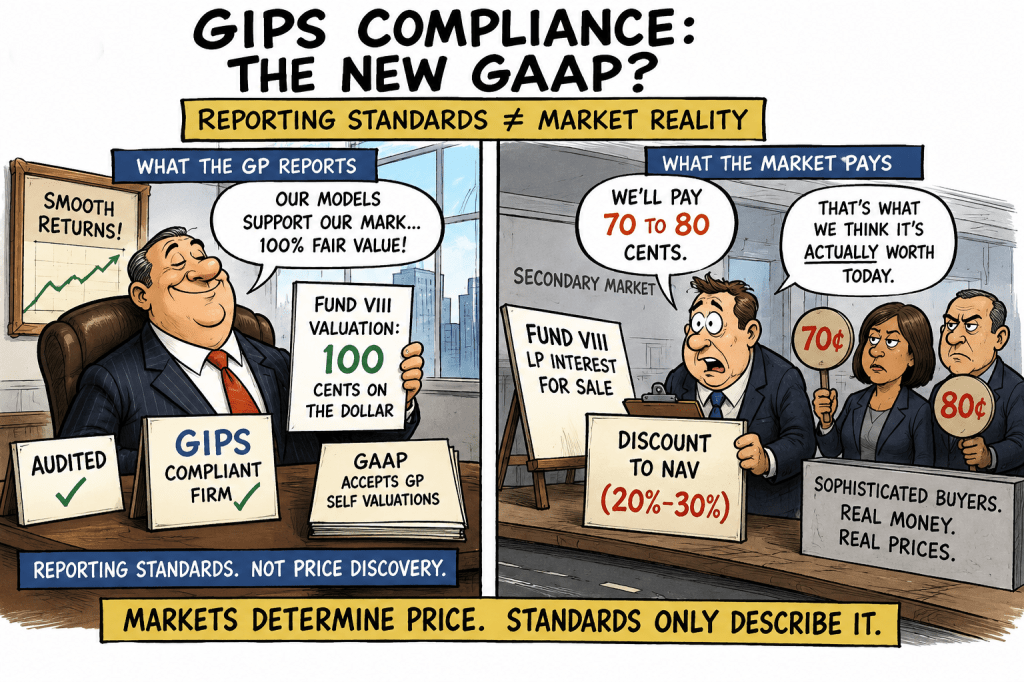
For years, I have argued that private equity performance rests on a simple premise: the manager gets to decide what the investment is worth. Increasingly, I see the same problem developing with the industry’s use of GIPS compliance.
GIPS—the Global Investment Performance Standards—has become a powerful marketing tool. Pension trustees hear the words “GIPS compliant” and assume that means the reported performance has been independently validated. It has not.
The comparison reminds me of another accounting convention that investors have learned to question: GAAP accounting.
GAAP often permits firms to carry assets at management’s estimate of fair value. Likewise, GIPS generally accepts the valuation methodology used by the private equity manager. Neither asks the harder question:
What would someone actually pay for this partnership today?
That distinction matters enormously.
The 100-Cent Myth
A private equity general partner may report that a limited partnership is worth 100 cents on the dollar. The valuation follows accepted accounting policies. Auditors review the process. Performance statistics are calculated from those values. The investment manager may even claim GIPS compliance at the firm level.
Yet when investors attempt to sell the very same limited partnership interest on the secondary market, buyers frequently demand substantial discounts.
In many periods, secondary-market transactions have occurred at 70 to 80 cents on the reported NAV for certain private equity or private credit interests. Discounts vary widely by market conditions, asset quality, strategy, and liquidity, but the secondary market often provides the closest observable evidence of what sophisticated buyers are actually willing to pay.
That should raise an uncomfortable question.
If sophisticated institutional buyers consistently pay substantially less than reported NAV, which number better reflects economic reality?
The GP’s valuation?
Or the market’s?
GIPS Is About Presentation, Not Price Discovery
This is not a criticism of GIPS itself.
GIPS was designed to standardize how investment firms present performance, not to determine whether every underlying private asset has been perfectly valued.
Likewise, auditors generally evaluate whether managers have followed accepted valuation procedures—not whether the reported value equals the price that would clear in an arm’s-length market transaction.
Those are fundamentally different questions.
A valuation process can satisfy accounting standards and still materially differ from what an actual buyer would pay.
Pension Fiduciaries Should Care
This distinction becomes critical for ERISA plans and public pension systems.
Trustees often receive quarterly reports showing smooth, steadily rising returns supported by audited financial statements and references to GIPS-compliant reporting.
That combination creates an aura of certainty.
But if the underlying assets could only be sold at a significant discount, then reported returns may overstate the economic value available to beneficiaries.
Unlike publicly traded securities, private partnerships rarely face continuous market pricing. Instead, they rely heavily on manager judgment, valuation models, comparable-company multiples, projected cash flows, and periodic appraisals.
None of those substitutes for an active market.
The Missing Benchmark
Public securities face an unforgiving daily test.
Every trading day, thousands of independent buyers and sellers establish a market price.
Private equity generally does not.
Instead, the industry largely benchmarks itself against its own reported valuations.
That is a remarkably circular process.
Imagine if publicly traded stocks could report performance based primarily on management’s opinion of what the shares should be worth rather than where they actually traded.
No regulator would tolerate it.
Yet pension systems increasingly accept exactly that framework for trillions of dollars of private assets.
What Trustees Should Ask
Every pension board investing in private markets should ask straightforward questions:
- What percentage of reported NAV has similar partnerships sold for in recent secondary-market transactions?
- How often have our reported valuations exceeded realizable market prices?
- How sensitive are our reported returns to changes in valuation assumptions?
- Why are we relying primarily on GP marks instead of observable market evidence when it exists?
Those questions go to the heart of fiduciary oversight.
The Bottom Line
GIPS compliance should not become the private-market equivalent of a “seal of approval.”
It is a reporting framework—not an independent market valuation.
Nor should audited financial statements lull fiduciaries into believing that reported NAV necessarily equals realizable value.
Markets ultimately determine prices.
Accounting standards and performance reporting standards merely describe them.
When a partnership is carried at 100 but consistently changes hands in the secondary market at 70 or 80, fiduciaries should not simply celebrate the reported return.
They should ask why the market disagrees.
For retirement plans entrusted with workers’ lifetime savings, that may be the single most important valuation question of all.
Appendix: The New STRS Performance Video Asks the Right Question — But the Problem Goes Deeper
A new video circulating among Ohio teachers questions the investment-performance story being presented by the State Teachers Retirement System of Ohio. https://www.youtube.com/watch?v=3ItC4lkDSqQ
That is exactly the question trustees and beneficiaries should be asking.
But there is an even more fundamental problem than whether STRS beat or trailed a particular benchmark:
Before comparing performance, we need to know whether the performance number itself represents economic reality.
That distinction becomes especially important at STRS because billions of dollars are invested in private equity, private credit and other alternative investments for which there is no continuously observable market price.
STRS Can Report Excellent Private-Market Returns — On Paper
STRS itself has presented extraordinarily strong historical results for its alternative-investment portfolio.
For example, an STRS investment presentation reported a 10-year annualized alternatives return of 11.45% through September 30, 2023, compared with an 8.04% return for the total STRS fund. STRS also reported substantially lower measured volatility for alternatives.
Those numbers look terrific.
But there is a huge difference between a publicly traded stock returning 11% and a private-equity partnership reporting an 11% return.
A stock has to face the market every day.
Private equity generally does not.
The private-equity GP estimates what its portfolio companies are worth. Those valuations flow into the partnership’s NAV. The NAV flows into the pension’s performance calculation. The resulting performance then gets compared with benchmarks and may ultimately help justify investment-staff bonuses.
That creates a circular system:
The private manager helps determine the valuation → the valuation determines the return → the return demonstrates apparent investment skill → the apparent investment skill helps justify fees and bonuses.
GIPS Does Not Solve This Problem
STRS and its defenders frequently point to sophisticated performance measurement, consultants and GIPS compliance as evidence that the reported numbers can be trusted.
That misses the point.
As I explained in my August 5 CommonSense piece, GIPS is fundamentally a performance-reporting framework, not an independent price-discovery mechanism.
A calculation can be perfectly performed under an accepted methodology while the underlying asset value remains questionable.
That is the private-market equivalent of saying:
“The math is correct. We haven’t established that the starting number is.”
If a private-equity partnership is reported at $100 million and the return calculation correctly uses $100 million, compliance with a performance standard does not independently establish that an unrelated buyer would actually pay $100 million for the partnership.
The $100 NAV Versus the $70–$80 Market Question
This is why trustees should stop beginning their analysis with:
“Did STRS beat its benchmark?”
The first question should be:
“What could STRS actually sell these investments for?”
Suppose a private-equity partnership is carried at $100.
The GP’s valuation methodology supports $100.
The accountant accepts the valuation process.
STRS reports performance using $100.
The consultant calculates the return using $100.
The performance presentation follows accepted standards.
But suppose sophisticated secondary-market buyers will only pay $75.
Economically, that $25 difference matters far more to an Ohio teacher than whether the performance calculation complied with GIPS.
As my earlier piece argued, discounts on some private-equity and private-credit interests can be substantial, although they vary greatly by strategy, vintage, quality and market conditions.
That does not mean every STRS private investment is worth 70 or 80 cents on its reported dollar.
It means trustees should demand evidence showing how reported NAV compares with observable transaction values whenever such evidence exists.
Ohio STRS Has Another Performance Problem: Two Numbers
There is an additional reason to scrutinize STRS performance carefully.
Allen Mendenhall and Dan Sutter independently reconstructed STRS investment returns from audited financial information and found that STRS’s reported investment return exceeded their independently calculated figure in 19 of 20 years from 2003 through 2022.
They calculated an average annual difference of approximately 0.33 percentage points.
Even more troubling, STRS reportedly used the higher internally reported performance measure in determining investment-staff incentive compensation.
That doesn’t prove fraud.
Different legitimate performance methodologies can produce different numbers.
But 19 favorable differences out of 20 years deserves an explanation, particularly when compensation is connected to the more favorable measure.
It also makes the current debate over GIPS much more important.
“Independent” Verification Can Verify the Wrong Thing
The pension industry repeatedly answers criticism with words that sound reassuring:
Audited.
GIPS compliant.
Independently verified.
Consultant reviewed.
Institutional quality.
Trustees need to ask what each term actually means.
An accountant can verify that an accepted valuation process was followed without independently establishing the price at which an asset could actually be sold.
A GIPS verifier can examine compliance with performance-presentation requirements without independently auctioning STRS’s private-equity partnerships.
An investment consultant can report that STRS beat its policy benchmark without establishing that the benchmark represents the opportunity cost available to teachers.
Indeed, STRS’s consultant Meketa reported that for the five years ending March 31, 2025, STRS returned 10.98% annually versus its total-fund benchmark of 10.54%.
That may be an entirely accurate calculation.
The question is what lies underneath the calculation.
Mark the Private Portfolio to Something Resembling a Market
There is a simple stress test STRS could perform.
Take every material private-equity and private-credit partnership and estimate its current secondary-market liquidation value using actual bids, comparable secondary transactions or independent market indications.
Then recalculate:
STRS total-fund NAV.
Private-market performance.
Five- and ten-year total-fund returns.
Performance versus investable public-market alternatives.
Investment-staff incentive compensation.
Then show Ohio teachers both numbers side by side:
| Pension Accounting View | Economic/Market Stress Test |
|---|---|
| Reported private-market NAV | Estimated secondary-market value |
| Reported PE/private-credit return | Return using market-adjusted NAV |
| STRS policy benchmark | Transparent investable benchmark |
| Reported staff value-added | Value-added after market adjustment |
| Bonus calculation | Bonus calculation using adjusted returns |
That would be real transparency.
The Video Is Asking the Question Trustees Should Have Asked Years Ago
The importance of the new STRS performance video is not whether every number or conclusion in it ultimately proves correct.
Its importance is that Ohio teachers are beginning to challenge the performance architecture itself.
That is healthy.
STRS has recently publicly promoted the claim that independent benchmarking shows “strong investment performance at a lower cost,” while pointing to long-term peer rankings and internal-management savings.
Fine.
Then STRS should welcome an even tougher test.
Don’t merely show teachers the return.
Show them the price.
Show the original cost of every major private investment.
Show the GP-reported NAV.
Show subsequent cash distributions.
Show secondary-market indications.
Show actual secondary sales.
Show every write-down following a realization.
And reconcile those numbers with the performance figures used to compensate investment staff.
Bottom Line
The debate over Ohio STRS performance should no longer be reduced to competing charts showing whether STRS ranked in the top quartile, second quartile or bottom quartile against some consultant universe.
The deeper issue is whether pension performance based partly on manager-estimated private-market values should be treated as equivalent to performance produced by securities continuously priced by independent buyers and sellers.
GIPS compliance does not answer that question.
An audit does not necessarily answer that question.
Beating a consultant-designed benchmark does not answer that question.
There is one test that cuts through all of them:
What would an independent buyer pay today?
If STRS reports a private partnership at 100 and the market says 75, Ohio teachers deserve to see both numbers.
And if marking private assets closer to observable market values materially changes STRS’s reported performance, benchmark comparisons or staff bonuses, then the controversy is much larger than whether somebody used the wrong performance chart.
The real question becomes whether Ohio teachers have been shown investment performance—or merely professionally standardized estimates of investment performance.

