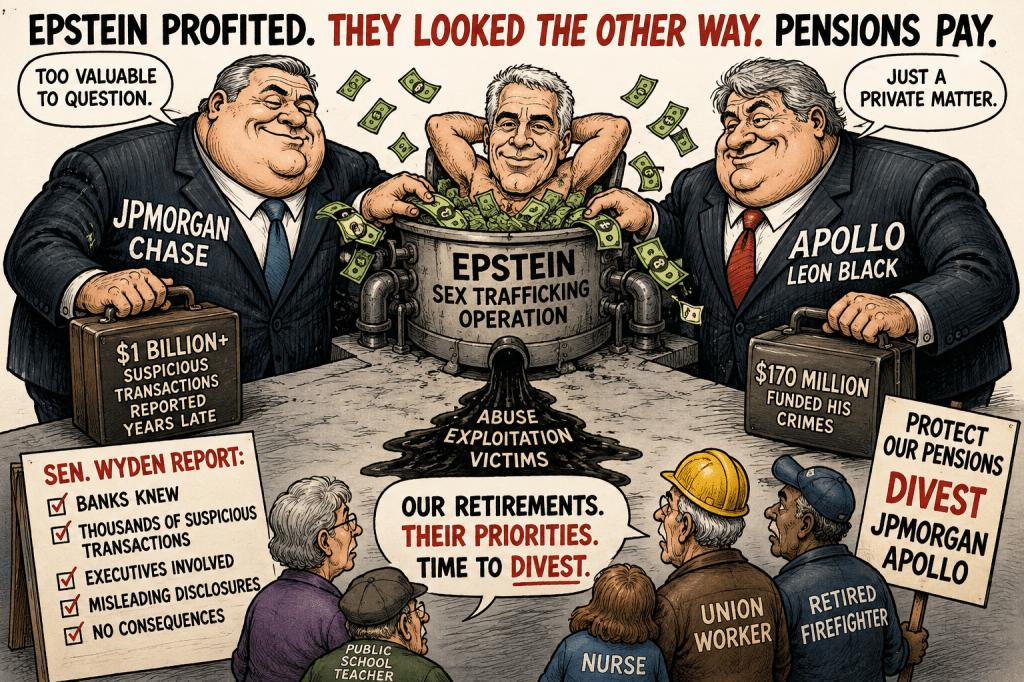
Senator Ron Wyden’s new report on Jeffrey Epstein’s financial network should end the excuses from pension boards, endowments, and unions that continue investing with JPMorgan and Apollo. https://www.finance.senate.gov/imo/media/doc/wyden_wall_street_epstein_report.pdf
This is no longer just a scandal about bad judgment or embarrassing associations. It is a financial-governance scandal involving suspicious transactions, senior executives, misleading disclosures, regulatory failures, and billions of dollars in institutional assets.
Wyden’s report concludes that Leon Black, Apollo’s co-founder and longtime chief executive, was Epstein’s largest source of funding. Black paid Epstein roughly $170 million, providing as much as 90% of Epstein’s income during key years. The report also states that Epstein used money paid by Black to finance his operations.
Apollo has spent years portraying Epstein as Black’s private problem. That defense is collapsing.
New litigation alleges that Epstein communicated with Apollo leaders about Apollo tax strategies, corporate structure, Athene, and other company matters. The Mississippi Public Employees’ Retirement System is already involved in litigation accusing Apollo and its executives of misleading investors about the extent of the relationship. https://www.levernews.com/pension-fund-sues-financial-giant-over-epstein/
Other pension funds should ask why they are still writing Apollo new checks.
The case against JPMorgan is just as serious.
According to Wyden’s report, JPMorgan knew for years that Epstein presented extraordinary criminal, compliance, and reputational risks. Yet the bank continued serving him, processing suspicious transactions, and treating him as a gateway to wealthy clients.
After supposedly terminating Epstein in 2013, JPMorgan executives allegedly continued working through him to pursue business from Leon Black and others. Internal communications described Epstein as Black’s primary adviser and as someone who would be “calling the shots.”
That is not a minor compliance failure. It is evidence that revenue may have repeatedly defeated risk controls at one of the world’s largest banks.
JPMorgan later reported thousands of suspicious transactions totaling more than $1 billion—but only after Epstein’s 2019 arrest. Wyden also says JPMorgan refused to answer his detailed questions or produce the internal documents he requested.
Pension trustees should not wait for another settlement, indictment, leaked email, or stock drop.
They should act now.
At a minimum, pensions should freeze new investments and mandates involving JPMorgan, Apollo, and Athene; disclose all direct and indirect exposure; demand the full internal investigations; and review potential securities and contractual claims.
Divestment should not be framed as political punishment. It should be framed as ordinary fiduciary risk management.
JPMorgan faces unresolved compliance, regulatory, litigation, and governance risks. Apollo faces serious questions about disclosure, board oversight, leadership credibility, and whether its institutional investors were told the full truth.
Comparable banks, asset managers, custodians, private-credit firms, and public securities are readily available. No pension needs to accept uncompensated governance risk merely because JPMorgan and Apollo are powerful.
Pension funds control trillions of dollars. They are not powerless victims of Wall Street. They are Wall Street’s clients, shareholders, lenders, and source of permanent capital.
Wyden’s report gives them more than enough reason to use that power.
Freeze the money. Demand the records. Preserve the claims. And begin divesting from JPMorgan and Apollo.


Pingback: My SEC Comment Opposing Repeal of the Pay-to-Play Rule for Public Pensions | The CommonSense 401k Project
Pingback: The Market Has Put a Price on Apollo’s Conduct with Jeffrey Epstein. Public Pensions Should Finally Divest. | The CommonSense 401k Project
Pingback: Ohio’s Epstein Election Has a Second Money Trail: Follow the Pensions and Data Centers- Divestment? | The CommonSense 401k Project