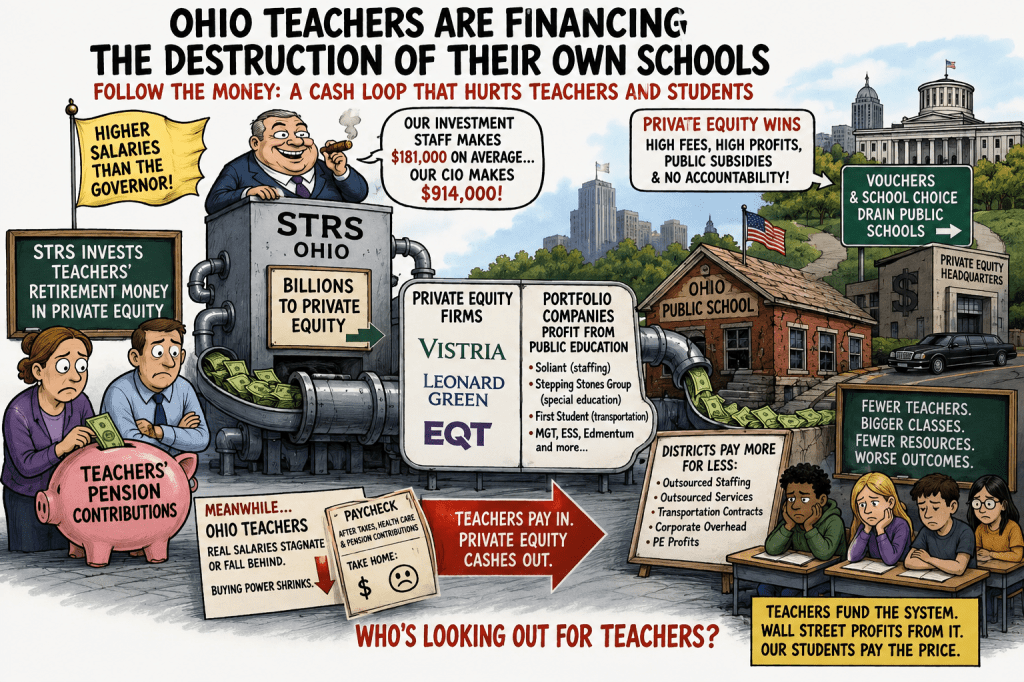
STRS sends teachers’ pension money to private equity. Private equity makes money privatizing education. Ohio teachers get squeezed at both ends.
A new August 2026 report on Private Equity in Michigan Childcare and K-12 Education should be required reading for every Ohio teacher and every STRS trustee.
Its lesson is brutally simple:
Private equity doesn’t just invest teachers’ pension money. It increasingly makes money extracting dollars from the institutions that employ those teachers.
The Michigan report documents private-equity ownership of childcare companies and contractors providing teaching, special education, behavioral health, transportation and other school services. It argues that outsourcing can transfer money that once paid public employees into contracts carrying corporate overhead and investor returns.
Ohio teachers should recognize the business model.
STRS Helps Supply the Ammunition
STRS Ohio has poured billions into private equity, private credit and other alternatives.
At the same time, Ohio educators are watching the public-school ecosystem become increasingly privatized.
That creates one of the strangest circular money flows in American education:
Teacher contributions → STRS → private equity → education companies → contracts and public subsidies → private-equity profits.
Then teachers are told there isn’t enough money for salaries, benefits or reliable COLAs.
STRS isn’t merely an innocent investor standing outside this process. Its capital helps finance the industry doing the consolidating.
And the people administering this system can be paid extraordinary amounts.
According to STRS compensation data I previously analyzed, its investment staff averaged about $181,000, while its CIO received approximately $914,000—several times what Ohio pays its governor and far above the compensation of most Ohio educators.
Think about that incentive structure:
Teachers provide the capital.
Wall Street gets the fees.
STRS investment staff get Wall Street-style compensation.
Teachers get the pension risk.
And now teachers can also face the economic consequences of privatization in their workplaces.
Michigan Shows What the End Game Can Look Like
The Michigan report describes private-equity-backed contractors supplying critical K-12 positions including teachers, healthcare workers, transportation, food service and special-education personnel.
Detroit alone approved more than $22.5 million for four private-equity- or venture-backed special-education contractors for FY2026.
One company, Stepping Stones Group, grew through repeated acquisitions after its creation by Shore Capital and subsequent acquisition by Leonard Green & Partners. The Michigan report describes 20 additional acquisitions and a 2024 $4.25 million settlement of wage-and-hour claims, which the company denied.
This is important for Ohio because the same outsourcing model already operates here.
Soliant, for example, currently advertises contract special-education positions in the Cleveland and Mentor areas.
The economic question is obvious:
Why should a school district pay enough money to support a teacher plus a corporate staffing company plus private-equity investors when it may be able to employ the teacher directly?
The Michigan report cites previous PESP research estimating that one California district could have saved $6 million by bringing PE-backed special-education staffing positions back in-house.
Ohio should run the same calculation.
Ohio Has Another Privatization Accelerator: Vouchers
This is where the Michigan report becomes even more relevant.
Its final section argues that voucher-type programs can subsidize private providers and outsourced educational services, including transportation and before- and after-school programs.
Ohio is already far down this road.
Ohio spent approximately $1.09 billion on its five private-school voucher programs in FY2025.
The pro-school-choice organization EdChoice estimates Ohio private-school-choice spending at roughly $1.12 billion, or about 4.2% of combined choice-program and public K-12 current expenditures, ranking Ohio fifth nationally by that measure.
And there is another downstream expense rarely discussed.
As voucher enrollment expanded, Ohio public districts remained responsible for transporting many private-school students. AP reported in 2025 that the combination of driver shortages and expanded school choice left some districts struggling to provide transportation even to their own high-school students.
So public schools can lose students and funding while retaining infrastructure obligations.
That’s a remarkably attractive environment for outsourcing.
Enter Vivek Ramaswamy
Ramaswamy’s own gubernatorial platform says he wants to give parents more “meaningful choices over where and how their children learn.” It also says he wants Ohio to pay excellent teachers more.
Those goals aren’t inherently contradictory.
But there is a question his campaign should have to answer:
Where does the money come from?
If Ohio simultaneously expands school-choice subsidies, encourages privatization and outsourcing, and maintains enormous public-pension allocations to private equity, then “pay teachers more” runs into a financial system taking money out at several other points.
Ramaswamy is particularly relevant because his business career sits comfortably inside the broader private-capital ecosystem rather than outside it. As I have previously documented, his companies and investments intersect with private equity, data infrastructure and financial networks that depend heavily on institutional capital.
So don’t expect an Ohio governor from that ecosystem automatically to ask:
Why are Ohio teachers financing private equity in the first place?
The Epstein Issue Needs to Be Framed Correctly
Ramaswamy should not be accused of having a personal Jeffrey Epstein relationship without evidence. I have seen none.
That isn’t the argument.
The more defensible point is that Ramaswamy operates within the modern elite private-capital ecosystem in which many institutions and financiers overlap with firms touched by the Epstein scandal.
Apollo illustrates why this matters.
Ohio teacher retirement assets have been invested with Apollo-related strategies. Apollo co-founder Leon Black’s enormous payments to Epstein are documented, and the controversy has generated renewed scrutiny of Apollo governance.
That does not make every Apollo investor, executive, politician or business associate an Epstein associate.
It does create a legitimate fiduciary question:
At what point does a governance scandal become serious enough that a public pension reexamines the manager?
Ohio STRS appears much more comfortable asking teachers to bear private-market opacity than asking Wall Street managers uncomfortable questions.
The Great Ohio Irony
Ohio teachers are effectively participating in two different labor markets.
In one:
A teacher is a public employee whose compensation must be restrained because taxpayers supposedly can’t afford more.
In the other:
An STRS investment professional overseeing that teacher’s money can receive hundreds of thousands of dollars annually because STRS says it must compete with Wall Street for talent.
Meanwhile the actual Wall Street firms can take pension management fees and invest in companies positioned to take additional dollars out of education.
That isn’t capitalism versus socialism.
It is something much simpler:
The people closest to the financial plumbing get paid first.
Teachers Should Follow Their Own Money
The Michigan report gives Ohio teachers a roadmap.
STRS should publish a cross-reference showing:
Every STRS private-equity manager → every education, childcare, transportation, staffing, special-education and ed-tech company owned by that manager → every contract those companies have with Ohio public schools.
Then add:
STRS capital committed.
Fees paid to the private-equity manager.
Ohio school dollars paid to its portfolio companies.
Number of public positions outsourced.
Difference between contractor billing rates and employee compensation.
That would reveal something pension reports never show:
Teachers may be financing the companies replacing teachers.
And that is where pension policy becomes education policy.
The Bottom Line
The old argument about STRS private equity was:
Does private equity earn enough after fees to justify its risk and secrecy?
The Michigan study raises a bigger question for Ohio:
What if teachers’ retirement money is helping finance the privatization of the very public-school system that generates their salaries and pensions?
Ohio teachers could then lose three times:
Lower salaries and weaker public-school finances.
Hundreds of millions in opaque investment fees.
And retirement assets exposed to the same private-equity machine extracting money from education.
Meanwhile, some STRS investment employees make multiples of the governor’s compensation to keep that machine running.
That’s not diversification.
That’s teachers financing both sides of their own economic squeeze.
Table 1 — The clearest STRS → Private Equity → Ohio Education loop
| STRS Ohio PE manager | Education portfolio company | What company sells to schools | Evidence of Ohio activity | Why it matters |
| Vistria Group | Soliant | Special-ed teachers, intervention specialists, school psychologists, SLPs and other outsourced personnel | Soliant is advertising 2026–27 contract intervention-specialist positions in Columbus and Cleveland | STRS teacher capital is invested with a PE manager whose portfolio company recruits licensed Ohio educators to work as contractors rather than district employees |
| Leonard Green & Partners | The Stepping Stones Group | Special-ed teachers, psychologists, therapists, nurses, behavioral specialists | Stepping Stones markets these contract services nationwide to school systems; Ohio district-by-district contract search should be next | Same basic model documented in Michigan: PE-owned middleman inserted between public schools and educators |
| Leonard Green & Partners | Invo Healthcare via Stepping Stones | Behavioral, autism and special-ed services | National school operations; Ohio contracts require district-record search | More consolidation under the same PE owner |
| EQT Partners | First Student | Outsourced school buses and special-needs transportation | Headquartered in Cincinnati; Ohio operating locations include the Germantown area | STRS invests with the owner of the largest outsourced school-transportation company in North America |
| Vistria Group | MGT | Outsourced technology, education and operational consulting | National school-market company; Ohio contracts need procurement search | Moves functions traditionally performed inside school systems to a PE-backed contractor |
| Vistria Group | ESS | Substitute teachers and school staffing | National K-12 staffing company; Ohio footprint needs contract-level verification | Another channel through which teacher shortages become a private-equity revenue opportunity |
The ownership relationships are unusually easy to document. Vistria itself describes Soliant as a provider of outsourced workforce solutions to K-12 school districts, and its education portfolio also includes MGT, ESS and other education businesses. Leonard Green lists Stepping Stones as a current buyout investment providing therapy, autism and behavioral-health services for children. EQT identifies First Student as a current portfolio company headquartered in Cincinnati and focused on contracted school transportation.
Table 2 — Vistria may be the most important Ohio/STRS education cross-match
| Vistria education investment | Business model | Potential Ohio public-school impact |
| Soliant | Outsourced teachers, intervention specialists, psychologists and healthcare professionals | Converts vacant district positions into contractor revenue |
| ESS | Substitute-teacher and school staffing | Takes a recurring function of school employment and monetizes staffing shortages |
| MGT Consulting | Technology, education and operational outsourcing | Turns school administrative/IT functions into outside contracts |
| Really Great Reading | Curriculum/literacy products | Public-school instructional spending becomes portfolio-company revenue |
| Edmentum | Digital curriculum and educational technology | District technology/curriculum appropriations become PE revenue |
| The Gardner School | Private early-childhood education | Competes in the broader publicly subsidized education/childcare market |
This isn’t an inference about Vistria’s strategy. Vistria calls the area “Knowledge & Learning” and says one senior partner has directed about $4 billion across 14 investments in the sector, including Soliant, ESS, MGT and FullBloom.
And Soliant’s Ohio presence is concrete. It is currently advertising a 2026–27 full-time contract Intervention Specialist in Columbus and similar contract special-education positions in Cleveland.
That allows a very punchy formulation:
STRS gives Vistria teachers’ retirement capital. Vistria owns a company recruiting Ohio teachers out as contractors to schools.
We still need to determine whether any particular Ohio district paying Soliant is simultaneously contributing employer pension dollars to STRS for workers whose vacancies Soliant is filling. That requires district contract records before making the strongest version of that claim.
Table 3 — Leonard Green and outsourced special education
| Company | PE owner | Education service | Michigan study evidence | Ohio question |
| Stepping Stones Group | Leonard Green & Partners | Special-ed teachers, speech therapists, occupational therapists, psychologists, nurses and behavioral services | Detroit FY26: $8.71 million | Which Ohio districts pay Stepping Stones and how much? |
| Invo Healthcare | Leonard Green/Stepping Stones | Behavioral and special-ed staffing | Detroit FY26: $680,000 | Identify Ohio contracts and staffing rates |
| Other acquired providers | Leonard Green/Stepping Stones | Related therapy and behavioral services | Michigan report says Stepping Stones completed numerous acquisitions | Determine acquired companies operating under different names in Ohio |
The Michigan report says Stepping Stones was acquired by Leonard Green in 2021 and describes a rapid acquisition strategy; Detroit alone budgeted about $8.7 million for Stepping Stones and another $680,000 for Invo. It further reports that Stepping Stones agreed to a $4.25 million wage-and-hour settlement in 2024 while denying the allegations.
Stepping Stones’ own school-services page says it provides districts with special-ed teachers, school psychologists, therapists, nurses and other contracted personnel.
The Ohio audit question should therefore be: What is an Ohio district paying Stepping Stones per hour versus what the individual educator receives?
That is potentially a much more compelling number than the pension investment itself.
Table 4 — EQT/First Student: probably the cleanest Ohio example
| Item | Ohio connection |
| STRS investment manager | EQT Partners appears on STRS’s 2023 alternative-investment manager schedule |
| PE portfolio company | First Student |
| Headquarters | Cincinnati, Ohio |
| Business | Outsourced K-12 transportation |
| Scale | Approximately 1,000 school districts when EQT acquired it |
| PE acquisition | EQT announced a $4.6 billion acquisition of First Student and First Transit in 2021 |
| Public subsidy angle | EQT says First Student’s fleet electrification has received roughly $400 million in EPA grants/rebates nationally |
| Ohio education connection | Ohio law expressly provides for both board-owned and contractor-owned and operated school buses |
| Pension loop | Ohio teacher pension capital → EQT → Ohio-based school contractor → public education spending |
EQT explicitly says First Student benefits from increasing demand for outsourcing. Its 2021 acquisition announcement described First Student as serving roughly 1,000 districts and valued the combined acquisition of First Student and First Transit at $4.6 billion.
There is another Ohio twist. Ohio’s transportation rules explicitly recognize contractor-operated school buses as part of the state reimbursement structure.
Meanwhile, First Student is not some distant portfolio company. It is headquartered in Cincinnati. EQT also says its electrification program has attracted hundreds of millions of dollars of federal grants and rebates.
So this is a nearly perfect illustration of the circular capital flow:
Ohio teachers → STRS → EQT → First Student → Ohio school transportation spending + federal subsidies.
Table 5 — Ohio childcare: PE penetration comparable to Michigan
The Michigan report found at least 160 PE-controlled childcare centers in Michigan and emphasized KinderCare, Learning Care Group, Goddard, The Learning Experience and Primrose.
Ohio clearly has substantial exposure to several of the same chains:
| Childcare chain | PE owner/backer identified by CRS | Ohio footprint | STRS 2023 manager match presently verified? |
| KinderCare | Partners Group | Numerous Ohio centers including Akron, Cincinnati, Cleveland, Columbus, Dayton and others | Not yet established from STRS list |
| Learning Care Group | American Securities | Ohio operations need facility count | Not yet established |
| Goddard School | Sycamore Partners | Locations across 40+ Ohio communities/cities | Not yet established |
| Primrose Schools | Roark Capital | Ohio presence | Not yet established |
| Cadence Education | Apax Partners | Ohio presence needs count | Not yet established |
The Congressional Research Service identified PE control of eight of the ten largest for-profit childcare organizations, including KinderCare, Learning Care Group, Primrose and Goddard.
KinderCare’s own locator shows a very large Ohio footprint stretching across the Cincinnati, Columbus, Cleveland, Akron, Canton and Dayton markets. Goddard lists Ohio schools in cities ranging from Akron and Cleveland to Cincinnati, Columbus, Dublin, Mason, Westerville and numerous suburbs.
Important distinction: I would not yet put those childcare companies in the direct STRS money-loop table because I have not verified their PE owners on the STRS manager schedule you supplied. They belong in a separate “PE in Ohio Education, but direct STRS LP connection not yet established” table.
Table 6 — Michigan findings applied to Ohio
| Michigan report finding | Ohio analogue | Evidence level |
| PE-owned companies replace/increasingly supply school employees | Soliant is recruiting Ohio intervention specialists and special-ed staff on contract | Verified |
| Teacher/therapy outsourcing generates PE revenue | Vistria owns Soliant; Leonard Green owns Stepping Stones | Verified |
| Pension systems can invest with firms that own education contractors | STRS lists Vistria, Leonard Green and EQT | Verified from STRS document |
| PE transportation company profits from public-school transportation | EQT owns Cincinnati-based First Student | Verified |
| Privatization can interact with vouchers and nonpublic-school expansion | Ohio districts face major transportation obligations for nonpublic/voucher students | Verified |
| Public districts can carry costs while education dollars migrate outside district payrolls | Dayton/Columbus transportation dispute demonstrates the structural issue | Verified, though causation needs careful wording |
| PE staffing can cost more than direct employment | Michigan report cites a California study estimating $6m savings from insourcing | Michigan evidence; Ohio calculation not yet done |
The transportation angle deserves special attention. AP reported that Ohio’s expansion of private-school choice has added nearly 90,000 voucher students in four years, while public districts remain responsible for significant transportation obligations. Dayton reportedly operates more routes for nonpublic pupils than for its own students, while Columbus transports more than 3,000 nonpublic students.
That means the Ohio version can go beyond the Michigan report:
Voucher expansion creates transportation obligations → transportation shortages encourage outsourcing → EQT’s First Student sells outsourced transportation → STRS invests with EQT.
The last arrow is documented; what we still need is a district-by-district First Student contract list to quantify the dollars.
The table I would put at the center of your Commonsense article
| Ohio teachers provide… | Money flows to… | Which owns… | Which earns money from… |
| STRS pension contributions | Vistria | Soliant | Contract teachers and special-ed staffing |
| STRS pension contributions | Leonard Green | Stepping Stones | Special-ed/therapy outsourcing |
| STRS pension contributions | EQT | First Student | Outsourced school transportation |
| STRS pension contributions | Vistria | MGT / ESS / Edmentum | Technology, substitute staffing and education services |
| Ohio tax dollars | School districts | PE-backed contractors | Staffing, transportation and services |
| Ohio tax dollars | Voucher/nonpublic education system | Private providers | Education and ancillary services |
That’s the self-cannibalization story:
Ohio teachers’ retirement money is financing private-equity firms whose portfolio companies can make more money when school districts outsource work traditionally performed by public employees.
The evidence supports that formulation. I would avoid saying STRS investments caused layoffs or lower teacher salaries until we quantify individual Ohio district contracts and compare contractor rates with employee compensation.
The next level is worth doing: mine Columbus, Cleveland, Cincinnati, Dayton, Akron, Toledo and 20–30 other Ohio school districts’ board packets/check registers for Soliant, Stepping Stones/Invo and First Student, then add actual contract dollars and cross-match each payment back to STRS’s PE manager. That could produce a very damaging table with columns for District | PE contractor | STRS manager | Contract $ | Service | Estimated worker pay | PE/contractor spread.

