
Great investigative work by Bloomberg’s Noah Buhayar and Jeff Kao.
The Trump Labor Department has been trying to make it easier for private equity, private credit, crypto and other alternative assets to enter ordinary Americans’ 401(k) plans. The Department’s March proposal would create a new framework—and importantly, a safe harbor for fiduciaries—when alternatives are included in participant-directed retirement plans.
Now Bloomberg has uncovered something remarkable about the supposed public support for that effort:
Some of the people supporting it were dead.
Nearly 12,000 Suspicious Pro-Private-Equity Comments
Bloomberg examined almost 12,000 comments supporting the DOL proposal and found evidence suggesting that a large block may have been manufactured to look like grassroots support.
The contrast is striking.
More than 30,000 comments opposed the proposal. Those submissions generally contained identifying or individualized information—cities, states, email addresses, signatures or other variations.
The roughly 12,000 supportive comments were different. They were concentrated into five virtually identical templates, with essentially identical wording, punctuation, formatting and even line breaks. The five batches arrived in remarkably similar daily quantities between April 29 and May 5—and then stopped.
That looks less like spontaneous public enthusiasm for private equity and more like what Washington calls astroturfing: manufactured grassroots support.
One Problem: Some of the “Supporters” Were Dead
Bloomberg reporters contacted dozens of people whose names appeared on the comments.
They found five cases in which individuals or relatives said the comments had not been submitted by the named person.
One was Danna Oderman, whose name appeared on a May 3 comment supporting the proposal.
There was a rather substantial problem.
She had died the previous December.
Her son Heath Oderman told Bloomberg that the comment was not from his mother and that its language wasn’t language she would have used.
Another supposed supporter was Lyngrid Rawlings, a former educator and U.S. Foreign Service officer who died in 2024. Her daughter told Bloomberg that using her mother’s name this way was deeply disrespectful.
Bloomberg deliberately investigated unusually distinctive names that could be matched with confidence against public records. That means finding five apparent false submissions does not establish that only five of the 12,000 were bogus. It raises the obvious question:
How many of the other 12,000 are real?
Who Created the Campaign?
That may be the most important unanswered question.
Bloomberg contacted more than two dozen investment firms, trade associations and advocacy organizations that publicly supported the DOL initiative.
According to the investigation, none acknowledged knowing who created the five supportive form-letter campaigns.
Bloomberg’s Silla Brush summed up the finding: big money managers have spent more than a year pushing a receptive Trump Labor Department to open 401(k)s further to private equity, private credit and alternatives, while Bloomberg’s examination found evidence that thousands of supportive comments may have been astroturfed.
That deserves considerably more investigation.
Who wrote the five templates?
Who assembled the names?
Who submitted them?
Who paid for it?
And perhaps most importantly: Did any private-equity manager, asset manager, trade association, lobbying firm, public-relations firm or political organization finance or participate in the campaign?
Follow the Money
There is an enormous economic incentive here.
Private-equity and private-credit managers oversee trillions of dollars, but their traditional institutional market—public pensions, endowments and other sophisticated investors—is increasingly questioning fees, valuations, liquidity and performance.
The American defined-contribution system represents an enormous new pool of capital.
Better Markets has made essentially this point in opposing the DOL proposal: private-market investments bring high fees, illiquidity and limited transparency, while the industry has a huge financial incentive to gain access to America’s retirement accounts.
Private credit provides a particularly awkward backdrop. Investors have recently requested redemptions well above quarterly limits at funds associated with BlackRock, Apollo, Ares, Carlyle and Blue Owl.
In other words:
Some sophisticated investors are trying to get money OUT of private markets at precisely the moment Washington is working to put ordinary 401(k) investors IN.
Academics Aren’t Exactly Clamoring for This Either
This also reinforces what we recently wrote in “More Academics Oppose Private Equity in 401(k)s — Clayton and de Fontenay.”
The intellectual case for putting private equity into ordinary participant-directed retirement accounts is far weaker than the industry’s marketing campaign would suggest.
Private equity brings higher fees, illiquidity, valuation problems, leverage, opaque related-party transactions and extraordinarily complicated benchmarking.
And after all that additional risk and expense, the incremental return to the 401(k) participant may be puny at best.
The incremental revenue opportunity for Wall Street?
Enormous.
That asymmetry is what should concern fiduciaries.
CommonSense Bottom Line
The Bloomberg investigation doesn’t prove who manufactured these comments or how many are fraudulent. It establishes something important enough on its own:
The supposed grassroots support for putting private equity into Americans’ 401(k)s is sufficiently questionable that Bloomberg found comments attributed to people who were already dead.
That should trigger scrutiny by DOL’s Inspector General, Congress and anyone reviewing the administrative record supporting this rule.
Before DOL relies upon these comments, it should determine who actually submitted them and who financed the campaign.
And until that happens, DOL certainly shouldn’t cite 12,000 supportive comments as evidence that American workers are clamoring for private equity in their retirement plans.
We aren’t dead.
Our opposition is real.
Our comment is legitimate, publicly available, and backed by years of research on fees, conflicts, valuations, liquidity and fiduciary risk.
As for the dead people supposedly supporting private equity?
One wonders who they voted for.
Credit where it is due: outstanding investigative reporting by Noah Buhayar and Jeff Kao of Bloomberg News, with Bloomberg’s Silla Brush highlighting the findings today.
Bloomberg investigation: Trump’s 401(k) Proposal Shows Evidence of Phony Public Support
Related CommonSense: More Academics Oppose Private Equity in 401(k): Clayton and de Fontenay — August 3, 2026.
APPENDIX A: NBC — Private Equity Needs Your 401(k) Money
A timely new NBC News investigation provides important context for the private-equity industry’s push into 401(k)s:
“Private equity needs new investors. It’s targeting your 401(k).”
That may be the most important sentence in the entire debate.
NBC’s reporting focuses on something largely missing from Wall Street’s sales pitch: private equity needs new sources of capital.
The industry’s traditional institutional market is under pressure. Fundraising has slowed, distributions to investors have been weak, portfolio companies have remained trapped in funds longer, and institutional investors increasingly face their own liquidity and allocation constraints.
Enter the American 401(k).
The defined-contribution system represents trillions of dollars of potential new capital—much of it arriving automatically every two weeks through payroll deductions.
For private-equity managers, that’s an extraordinarily attractive new market.
Is This About Helping Workers—or Helping Private Equity?
The industry presents private assets in 401(k)s as “democratizing” investments previously available primarily to institutions and wealthy investors.
NBC’s framing suggests another way to look at it:
Private equity needs investors. 401(k)s contain an enormous pool of investors.
That distinction matters.
The traditional institutional investors private equity has served for decades have professional staffs, investment consultants, attorneys and substantial negotiating power. Even they have struggled with private-equity fees, valuations, liquidity, transparency and complicated partnership agreements.
Individual 401(k) participants have none of those advantages.
Yet the Trump Labor Department is working to make it easier to move these investments downstream into participant-directed retirement plans.
Wall Street’s Dream Customer: Automatic Contributions and Limited Liquidity
There is another reason 401(k)s could be especially valuable to private markets.
401(k) contributions are remarkably sticky.
Workers contribute paycheck after paycheck. Employers frequently contribute matching dollars. Participants often remain invested for decades.
That potentially gives private-equity and private-credit managers something they badly want:
a huge, recurring and relatively stable source of capital.
And the fee opportunity is dramatically larger than in today’s low-cost 401(k) marketplace.
A participant can buy broad public-market exposure for only a few basis points. Private-market investments can involve management fees, carried interest, underlying fund expenses, transaction costs and layers of intermediary expenses that are difficult for participants—and sometimes even fiduciaries—to see.
The question isn’t merely whether private equity can be placed inside a 401(k).
The fiduciary question is:
Why does the participant need it?
If an inexpensive diversified public-market portfolio already provides liquidity, daily pricing, transparency and strong long-term returns, the burden should be on Wall Street to demonstrate that the additional fees, leverage, illiquidity and valuation risk produce a meaningful net benefit to participants.
Not merely a new revenue stream for asset managers.
NBC Makes the Bloomberg Story More Important
That’s the connection to the Bloomberg investigation discussed above.
Bloomberg raises serious questions about whether some of the apparent public enthusiasm for private equity in 401(k)s was real.
NBC helps explain why generating enthusiasm would be so valuable.
The potential prize isn’t a small new investment product.
It’s access to trillions of dollars of American retirement savings.
That doesn’t prove who was responsible for the suspicious comments Bloomberg identified. It does make determining who organized and financed those comments considerably more important.
CommonSense Bottom Line
NBC has identified the issue that 401(k) fiduciaries should keep front and center:
Private equity needs new investors.
That is very different from saying:
401(k) participants need private equity.
Before Washington transforms America’s retirement system to solve Wall Street’s fundraising problem, fiduciaries should demand evidence that private equity actually improves participant outcomes after fees, after illiquidity, after leverage and after risk.
Until then, perhaps the simplest question is the best one:
Is private equity being brought into 401(k)s because workers need private equity—or because private equity needs workers’ money?
Read: NBC News, Private equity needs new investors. It’s targeting your 401(k). https://www.nbcnews.com/business/personal-finance/private-equity-needs-new-investors-s-targeting-401k-rcna588334
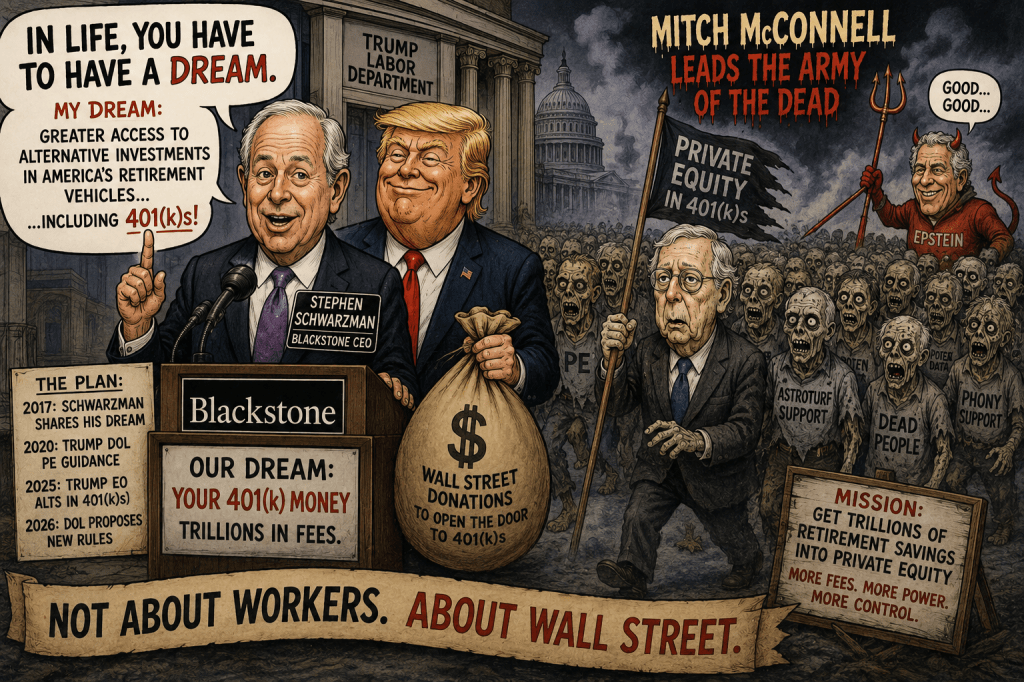
APPENDIX B: Follow the Money — Schwarzman’s 401(k) “Dream,” Trump and McConnell
There is another name worth adding to the story of Washington’s sudden enthusiasm for putting private equity into workers’ 401(k)s:
Stephen Schwarzman.
The billionaire co-founder and CEO of Blackstone didn’t recently discover the 401(k) market.
He has apparently been dreaming about it for years.
Back in 2017, Schwarzman told investors:
“In life, you have to have a dream.” He then described that dream as greater retail access to alternative investments and said many people were not permitted to put them into “retirement vehicles. He concluded that a regulatory change (from the new Trump Administration) would be a “huge opportunity for the firm.
That dream is now remarkably close to becoming government policy.
From Schwarzman’s Dream to Trump’s DOL
The chronology deserves attention.
2017: Schwarzman publicly describes access to retirement assets as a private-equity industry “dream.”
2020: The first Trump Labor Department issues guidance making it easier for professionally managed 401(k) investment options to contain private equity.
2025: President Trump signs an executive order directing regulators to facilitate alternative investments—including private equity—in defined-contribution retirement plans.
2026: Trump’s Labor Department proposes a regulatory framework providing additional protection for fiduciaries incorporating alternatives into participant-directed plans.
Meanwhile, Blackstone has moved from dreaming to building the infrastructure.
In October 2025, Blackstone created an entire Defined Contribution business unit specifically devoted to expanding private-market investments in retirement plans.
And in January 2026, Blackstone joined Empower’s private-markets retirement program, designed to put private equity, private credit, infrastructure and private real estate into defined-contribution plans through CIT structures.
This isn’t some theoretical policy debate anymore.
There is an enormous business being built around it.
Schwarzman and Trump
Schwarzman hasn’t merely been another Wall Street executive watching Trump from a distance.
After Trump’s 2016 election, Trump selected Schwarzman to chair his Strategic and Policy Forum, putting the Blackstone CEO at the center of a group of corporate advisers to the new administration.
The Washington Post subsequently described Schwarzman as one of Trump’s most generous donors and a key adviser with unusually regular access to the president.
Their social relationship went back even further.
Donald and Melania Trump attended Schwarzman’s infamous 60th birthday celebration in 2007.
Reported estimates put the cost at roughly $3 million to $5 million.
The Park Avenue Armory was transformed to resemble Schwarzman’s enormous apartment.
There were hundreds of guests.
Rod Stewart and Patti LaBelle performed.
If anyone ever needed a visual representation of how different the private-equity economy is from the world of the average 401(k) participant, this party might be difficult to beat.
Then There Was the Hitler Analogy
Schwarzman’s political rhetoric has occasionally been as extravagant as his parties.
When the Obama administration proposed changing the favorable tax treatment enjoyed by private-equity executives in 2010, Schwarzman compared the fight over taxes to war and invoked Hitler’s invasion of Poland in 1939.
He later apologized for the analogy.
But the episode illustrates something important about private equity’s relationship with Washington:
The industry takes government policies affecting its economics extremely seriously.
Carried interest matters.
Tax policy matters.
Regulation matters.
And gaining access to trillions of dollars sitting inside America’s defined-contribution retirement system matters enormously.
And Then There Is Mitch McConnell
This is where the Kentucky connection gets especially interesting.
Schwarzman became one of the biggest financiers of the Senate Leadership Fund, the powerful super PAC closely associated with Mitch McConnell’s Senate political operation.
In the 2018 election cycle, Schwarzman contributed $5 million to SLF.
His support subsequently became much larger.
By the 2020 election, Schwarzman’s contributions to the McConnell-aligned Senate Leadership Fund ultimately reached approximately:
$35 MILLION
That isn’t a typo.
Thirty-five million dollars.
Blackstone executives also showed up prominently among contributors to McConnell’s own campaign operation. The Louisville Courier Journal reported in 2019 that 29 Blackstone employees contributed $95,400 during a single fundraising quarter, one of the largest blocks of Wall Street money flowing into McConnell’s campaign.
Private equity wasn’t merely another industry contributing to Washington.
It had become a major source of political money.
Consider what has happened:
A private-equity billionaire publicly says accessing retirement assets is an industry “dream.”
He becomes a major Trump adviser and donor.
He pours tens of millions of dollars into the political operation associated with Mitch McConnell and the Republican Senate majority.
Trump subsequently directs his administration to open 401(k)s further to private equity.
Blackstone establishes a dedicated business unit to capitalize on the defined-contribution market.
And now Trump’s Labor Department is proposing rules designed to make it easier for fiduciaries to put alternatives into those plans.
Then, during the public-comment process, Bloomberg discovers thousands of suspiciously similar comments supporting the policy—including comments attributed to people who were already dead.
Stephen Schwarzman told us years ago what private equity wanted.
Your 401(k).
He called access to these retirement assets a “dream.”
Blackstone and the rest of the alternatives industry potentially stand to gain access to trillions of dollars of retirement savings—and the fees that come with managing them.
Schwarzman simultaneously became an extraordinarily important financial supporter of the political establishment capable of helping make that dream possible.
Now Washington is opening the door.
The relevant fiduciary question therefore isn’t:
Does Stephen Schwarzman’s dream benefit Blackstone?
That’s pretty easy.
The question is:
. The Washington Post documents Schwarzman’s access to Trump, Trump’s attendance at the lavish 2007 party, and Schwarzman’s $250,000 inaugural contribution.
For the McConnell money, FactCheck puts Schwarzman’s 2020 Senate Leadership Fund contributions at $35 million, while the Courier Journal reporting is independently quoted in a Kentucky pension-litigation filing identifying $95,400 from 29 Blackstone people to McConnell’s campaign in one 2019 quarter.
Blackstone’s Defined Contribution announcement · PBS/AP on Schwarzman’s 401(k) “dream” · Washington Post on Schwarzman and Trump · FactCheck on the McConnell-aligned Senate Leadership Fund


Pingback: The Smart Money Told Trump’s Labor Department That Private Equity Does Not Belong in Your 401(k) | The CommonSense 401k Project