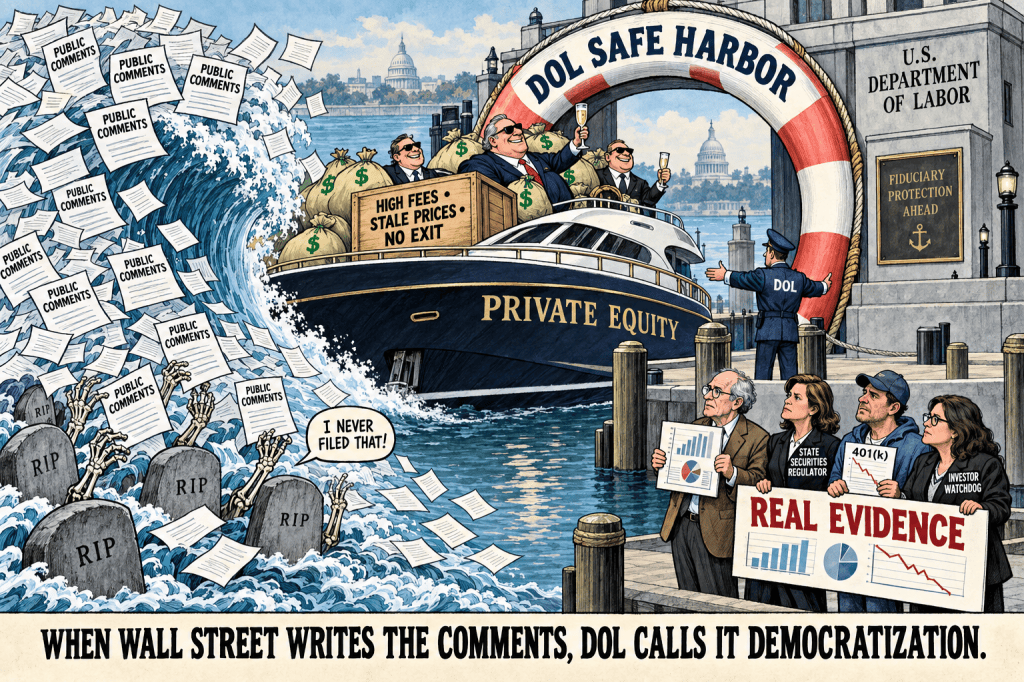
Behind tens of thousands of suspicious form letters, serious academics, regulators and investor advocates exposed the fatal weaknesses in the Department of Labor’s private-equity safe harbor
By Christopher Tobe
The Department of Labor received more than 46,000 public submissions on its proposal to help Wall Street push private equity, private credit, cryptocurrency and other alternative investments into 401(k) plans.
That sounds like an extraordinary public debate. It was not.
The docket was flooded with mass-produced letters—including supposedly pro-private-equity comments attributed to dead people and people who said they never submitted them. Bloomberg data scientists helped expose what appears to be one of the ugliest astroturfing campaigns ever directed at a retirement regulation.
I previously wrote about that scandal in “Dead People for Private Equity?”.
But underneath this contaminated mountain of manufactured support was a much smaller group of serious comments from academics, researchers, securities regulators, investor advocates and investment professionals.
I reviewed those comments in a new 55-page report. The most important conclusion is simple:
The people who actually understand private-market valuation, liquidity, fees and fiduciary law gave the Labor Department powerful reasons not to create this private-equity safe harbor.
Their objections go far beyond the usual warnings about high fees and illiquidity. They show that the Department’s proposed six-factor fiduciary test can be manipulated into a compliance exercise that looks rigorous on paper while relying on numbers supplied by the private-equity industry itself.
A Safe Harbor for Wall Street
The Labor Department’s March 2026 proposal is misleadingly presented as “asset neutral.”
The proposed rule says fiduciaries should examine six factors when selecting investment alternatives:
- Performance
- Fees
- Liquidity
- Valuation
- Benchmarks
- Complexity
Those are sensible words. The problem is what DOL attaches to them.
A fiduciary that documents an “objective, thorough, and analytical” consideration of the factors could receive a presumption of prudence and substantial deference in court.
That is not neutrality. It changes the legal terrain in favor of plan sponsors, consultants, recordkeepers and investment managers.
DOL openly says one purpose of the rule is to reduce fiduciary litigation. Its economic analysis estimates hundreds of millions of dollars in purported savings from reducing the time plans and service providers spend discussing litigation risk.
But DOL treats litigation almost entirely as a cost. It does not adequately count the benefits of litigation:
- Recovery of excessive fees and investment losses
- Deterrence of self-dealing
- Removal of imprudent investments
- Improved investment menus
- Exposure of hidden compensation
- Better fiduciary monitoring
- Discovery of documents that participants could never obtain independently
The proposal effectively assigns a dollar value to protecting fiduciaries from lawsuits while assigning little or no value to protecting workers from fiduciary misconduct.
That is not a serious cost-benefit analysis. It is a Wall Street wish list dressed up as economics.
Six Factors—But Often Only One Bad Number
The most important technical comment may have come from the EDHEC Infrastructure & Private Assets Research Institute.
EDHEC exposed a fundamental weakness in DOL’s six-factor framework: the factors are not independent.
Private-equity managers typically value their own holdings through periodic appraisals. Those manager-controlled net asset values, or NAVs, then flow through several parts of the fiduciary analysis.
The same smoothed NAVs can be used to claim:
- Low volatility
- Small drawdowns
- Low correlation with public stocks
- Attractive risk-adjusted returns
- Diversification benefits
- Stable valuations
- Superior performance against private-market benchmarks
Six supposedly separate tests may therefore depend on one stale and potentially biased valuation stream.
That is not six-factor due diligence. It is the same questionable number wearing six different costumes.
EDHEC pointed out that appraisal smoothing can make private assets appear much safer than publicly traded investments. Public stocks are repriced every trading day. Private assets may retain old valuations for months, even when comparable public companies are collapsing.
During a market crisis, a public-equity index may immediately show a 20% decline while private equity reports a much smaller loss. That does not necessarily mean private equity protected investors. It may mean that private-equity managers did not mark their holdings down quickly enough.
The Labor Department nevertheless presents comparisons of public-market and private-market drawdowns that could lead fiduciaries to confuse stale prices with safety.
A low reported standard deviation is not proof of low economic risk. A high Sharpe ratio calculated from smoothed returns is not proof of superior risk-adjusted performance. A low correlation created by delayed valuations is not true diversification.
Sometimes the apparent stability of private equity is simply the absence of an honest market price.
Valuation “Independence” Is Not Enough
DOL emphasizes independent valuation processes. EDHEC correctly explained why that is inadequate.
A valuation can be procedurally independent and still be economically wrong.
Fiduciaries need more than a representation that somebody followed an ASC 820 process. At a minimum, they should receive:
- The important valuation assumptions
- The discount rates and exit multiples
- The comparable companies used
- A sensitivity analysis
- A reasonable valuation range
- Explanations for manager overrides
- Comparisons between prior valuations and realized sale prices
- Secondary-market bids or discounts when available
A valuation of $100 million is not meaningful if a modest change in the discount rate produces a value of $75 million.
Private-equity valuations should not be treated as single, precise numbers. They are estimates with uncertainty ranges. That uncertainty affects performance, risk, fees, participant transactions and every benchmark built from NAVs.
The Benchmark Can Repeat the Same Lie
The proposed rule requires a “meaningful benchmark,” but private-equity benchmarking is notoriously vulnerable to manipulation.
A manager can choose among:
- The S&P 500
- The Russell 2000
- The S&P 600
- MSCI ACWI
- A private-equity peer index
- A custom blended benchmark
- One of several public-market-equivalent methodologies
Each choice can produce a materially different answer.
A private-equity benchmark derived from other private-equity NAVs may simply compare one set of questionable valuations with another. It can tell a fiduciary that the manager is marking assets consistently with its peers. It cannot necessarily tell the fiduciary whether those marks reflect economic reality.
Fiduciaries should be required to calculate public-market equivalents using multiple disclosed, investable indices. They should also explain why the selected benchmark reflects the size, geography, leverage and industry exposure of the underlying portfolio.
A custom benchmark should never qualify as “meaningful” merely because a consultant helped construct it.
As I have repeatedly documented in public pensions, custom benchmarks can become slow rabbits designed to be beaten.
NASAA Questions Whether DOL Can Invent a Presumption of Prudence
The North American Securities Administrators Association, representing state and provincial securities regulators, raised an equally important legal objection.
NASAA questioned whether a regulatory presumption of prudence is consistent with ERISA.
The Supreme Court rejected a special presumption of prudence for employee-stock-ownership-plan fiduciaries in Fifth Third Bancorp v. Dudenhoeffer. ERISA did not contain that presumption, so the Court refused to create it.
DOL now appears to be attempting something similar through regulation.
NASAA also correctly warned that merely considering the six factors cannot guarantee a prudent decision. A fiduciary could review all six, misunderstand the evidence and still select an imprudent investment.
Process matters, but ERISA does not say that any decision reached after completing a checklist must be presumed prudent.
If DOL retains any safe harbor, it should require contemporaneous written records showing:
- The actual information reviewed
- The alternatives considered
- Contradictory evidence
- The fiduciary’s independent analysis
- Quantitative acceptance and rejection thresholds
- The reason the final decision followed from the evidence
Consultant presentations and manager representations should not be enough.
Any presumption must also be explicitly rebuttable. Otherwise, DOL could immunize a facially unreasonable decision simply because the fiduciary assembled the right paperwork.
Participants Are Not Institutional Investors
The CFA Institute attacked the false “democratization” narrative from another direction.
Large institutions can negotiate lower fees, obtain side letters, demand reporting, select experienced managers, control commitment pacing and sometimes obtain seats on advisory committees.
Ordinary 401(k) participants control none of those things.
They cannot choose:
- The private-equity manager
- The underlying partnerships
- The individual deals
- The valuation methodology
- The liquidity terms
- The fee offsets
- The leverage
- The continuation-vehicle transactions
- The timing of capital commitments
- The investment’s eventual exit
Workers may not even know that private equity has been placed inside their target-date fund.
The correct comparison is therefore not between an institutional private-equity index and the S&P 500.
The fiduciary must examine the actual product offered to the plan after every additional layer:
- Underlying partnership fees
- Carried interest
- Fund-of-funds expenses
- CIT or pooled-fund charges
- Valuation expenses
- Liquidity-reserve drag
- Adviser fees
- Recordkeeping fees
- Borrowing costs
- Related-party charges
By the time a private-equity product reaches a 401(k), workers may receive second-tier access at first-class prices.
That is not democratization. It is distribution.
Fake Liquidity Can Become a Run on the Fund
Several commenters focused on interval funds and evergreen vehicles that offer periodic redemptions while holding assets that may take years to sell.
A quarterly redemption window does not make private equity liquid.
Withdrawals may be funded through:
- Cash reserves
- New participant contributions
- Borrowing
- Sales of the most liquid investments
- Delayed redemptions
- Gates
- Queues
- Manager discretion
Early redeemers may leave remaining participants with more leverage, fewer liquid assets and a weaker portfolio.
This is especially dangerous in 401(k) plans because participant cash flows are not optional. Workers retire, change jobs, take hardship withdrawals and roll over their accounts. Employers conduct layoffs. Plans terminate. Recordkeepers change.
Liquidity analysis must examine what happens when market stress and participant withdrawals occur simultaneously.
It must also address how a plan removes an imprudent private-equity option. If the investment cannot be sold for years, the fiduciary may discover that it has no practical ability to satisfy its continuing duty to monitor and remove the investment.
The exit plan must be written before the investment is made.
Target-Date Funds Can Hide the Risk
Wall Street’s preferred route into 401(k) plans is not likely to be a stand-alone private-equity fund. It will be a private-equity sleeve buried inside a target-date fund, managed account or white-label allocation fund.
That makes the problem more serious.
Target-date funds are frequently the plan’s qualified default investment alternative. Participants can be placed into them without affirmatively selecting the investment.
The wrapper does not eliminate the underlying opacity. It can hide it behind a simple year—2035, 2045 or 2055.
The private-equity industry will argue that professional management solves the complexity problem. In reality, professional management can transfer the decision away from the participant while preserving every underlying fee, valuation and liquidity problem.
A professionally managed black box is still a black box.
The DOL Should Listen to the Real Comments
The serious opposition came from people and organizations worth hearing:
- Boston College Law Professor Renee Jones
- MIT finance professor Haoxiang Zhu
- EDHEC’s private-assets researchers
- The Economic Policy Institute
- NASAA
- CFA Institute
- Americans for Financial Reform
- Roosevelt Institute
- Experienced financial advisers warning about liquidity mismatches
- Members of Congress concerned about retirement security
These commenters did not all demand an absolute prohibition on private equity. They approached the issue from different legal, economic and investor-protection perspectives.
Together, however, they demolished the idea that DOL’s current safe harbor protects workers.
Before any private-equity product receives safe-harbor treatment, the fiduciary should have to demonstrate:
- Independently verified valuations
- Valuation sensitivity ranges
- Reported and unsmoothed risk measures
- Multiple public-market-equivalent comparisons
- Look-through disclosure of every fee and expense
- Look-through leverage and refinancing stress tests
- Liquidity stress tests based on actual participant behavior
- Protections against stale-price transfers among participants
- Analysis of continuation vehicles and cross-fund conflicts
- Proof that the plan receives institutional-quality access
- A written termination and mapping strategy
- Contemporaneous records showing independent fiduciary judgment
- A rebuttable—not conclusive—legal presumption
- Full preservation of participants’ rights to discovery and relief
Anything less is not a safe harbor for workers.
It is a safe harbor for Wall Street.
The private-equity industry does not need 401(k) participants because workers have been unfairly denied a proven investment opportunity. It needs them because retirement plans represent trillions of dollars in patient capital, steady contributions and investors who cannot easily see—or escape—what is happening inside the product.
The authentic comments in this rulemaking warned DOL about that danger.
The dead people and manufactured form letters apparently told DOL what Wall Street wanted it to hear.
The question now is which group the Department intends to serve.
Appendix: Congress Demands Criminal and Labor Department Investigations of the Fake Pro–Private Equity Comments
Update for “The Smart Money Told Trump’s Labor Department That Private Equity Does Not Belong in Your 401(k)”
By Christopher Tobe
The scandal surrounding the Labor Department’s proposed private-equity safe harbor has now moved beyond suspicious statistics and embarrassing press coverage. Congressional leaders are demanding criminal and administrative investigations into whether stolen or fabricated identities were used to manufacture public support for opening workers’ 401(k) accounts to private equity, private credit, cryptocurrency and other alternative assets.
On September 18, 2026, Senator Bernie Sanders, Representative Robert C. “Bobby” Scott and Representative Jamie Raskin sent a joint letter to Attorney General Todd Blanche and FBI Director Kash Patel requesting a criminal investigation. Scott separately wrote Acting Labor Secretary Keith Sonderling, while Scott and Sanders asked Department of Labor Inspector General Anthony D’Esposito to audit the matter.
The official congressional announcement and links to all three letters should be read together with Bloomberg’s data analysis. They establish that this is no longer merely a debate over whether the comments looked suspicious. Members of Congress with jurisdiction over labor policy, federal investigations and the judiciary are asking who submitted them, whose identities were used, whether federal law was broken and whether the integrity of DOL’s rulemaking process has been corrupted.
The Numbers Do Not Resemble Genuine Grassroots Support
DOL’s docket received more than 47,000 submissions. According to the lawmakers, nearly 12,000 comments supporting the proposed rule showed signs of being manufactured. Bloomberg reporters located purported commenters who said they had never submitted a comment. In other cases, relatives said the named individuals could not have submitted the comments because they were dead.
The contrast identified in the congressional letter is devastating. More than 30,000 comments opposing the rule generally contained the normal identifying details expected from real members of the public. The suspicious supportive comments omitted the commenter’s city, state and email address.
Those omissions matter. They made independent verification harder while allowing thousands of nearly identical voices to appear in the docket as public support. A rulemaking record is supposed to help an agency test evidence and understand the public’s views. It is not supposed to become a landfill for anonymous political marketing.
The Attorney General and FBI Letter Raises Possible Criminal Conduct
In their letter to Attorney General Blanche and FBI Director Patel, Sanders, Scott and Raskin ask for an investigation into the use of unverifiable or stolen identities.
The lawmakers point specifically to the federal prohibition against knowingly making materially false statements or representations in matters within federal jurisdiction. They do not claim that a crime has already been proved. They argue—correctly—that the evidence is serious enough to require investigators with subpoena power to determine who generated the comments, who supplied the names, who financed the operation and whether anyone knowingly transmitted false information to the government.
That chain of responsibility is essential. The public deserves to know whether the campaign originated with a public-relations firm, a trade association, an asset manager, a cryptocurrency promoter, a political organization or some combination of them. If contractors or vendors were used, investigators should follow both the data trail and the money trail to the ultimate client.
The investigation should seek, at minimum:
- Submission IP addresses, timestamps, user-agent data and other available technical records;
- The source of every name, address and other personal identifier used;
- Templates, mail-merge files, scripts, application-programming tools and automated submission systems;
- Contracts, invoices, payments and communications involving sponsors, trade groups, public-relations firms and vendors;
- Evidence showing whether the supposed commenters consented to the use of their identities;
- Communications identifying the campaign’s intended regulatory or political objective; and
- Any coordination with parties that stood to profit from the proposed safe harbor.
DOL Was Told to Investigate Its Own Compromised Rulemaking
Scott’s letter to Acting Secretary Sonderling goes directly to the integrity of the rulemaking. He warns that the reporting raises legitimate questions about whether DOL’s public-comment process was corrupted and argues that the lack of verifiable public support is another reason to withdraw the proposal.
Withdrawal is the minimum responsible response. DOL should not finalize a rule while a material part of the record is under suspicion. Nor should it quietly count, summarize or cite the suspect submissions as evidence of public support.
The Department should segregate the questioned comments, preserve every associated electronic record and publicly explain whether any of them influenced the proposal’s development, its regulatory-impact analysis or the Department’s understanding of public sentiment. If DOL cannot establish that comments came from the people whose names appear on them, it should not treat those comments as independent public submissions.
Most importantly, DOL must not pretend that deleting fraudulent comments would cure the substantive defects in the rule. The authentic, technically serious comments still warn that private-market valuations are stale and manager-controlled; fees are layered and opaque; liquidity can disappear under stress; benchmarks can be selected to flatter performance; and a regulatory presumption of prudence may improperly weaken ERISA’s participant protections.
Removing fake support would clean the docket. It would not make the proposed safe harbor prudent.
The DOL Inspector General Was Asked for an Independent Audit
Scott and Sanders also sent a letter to DOL Inspector General D’Esposito requesting an immediate audit. Their concern is institutional as well as criminal: Americans must be able to trust that a DOL rulemaking record reflects actual public participation.
An Inspector General review should examine more than the identities behind individual comments. It should determine whether DOL had adequate controls to detect mass-produced or identity-based submissions, whether officials recognized warning signs, whether suspect comments were included in internal tallies or summaries, and whether political appointees or career staff communicated with organizers of the campaign.
The audit should also recommend permanent protections. At a minimum, agencies considering economically consequential retirement rules should retain technical submission data, flag high-volume template campaigns, distinguish unique comments from mass forms, publish methodology for counting duplicates and provide a way for people to report unauthorized use of their identities.
The Rule Has Lost Any Claim to Democratic Legitimacy
Private equity’s sales pitch is “democratization.” The public-comment scandal shows a darker version of that word: manufactured consent used to justify transferring workers’ retirement savings into products that are expensive, illiquid, difficult to value and extraordinarily profitable for Wall Street.
The supposedly unsophisticated public opposition was real enough to provide names, locations and contact information. A large block of the purportedly pro-industry public could not be readily verified—and reportedly included people who were dead or denied participating.
The genuine record remains clear. Serious academics, securities regulators, investor advocates and retirement-policy experts gave DOL detailed reasons why the proposed six-factor safe harbor would not protect participants. The suspicious form letters supplied political volume without comparable analysis.
DOL should preserve the evidence, cooperate fully with DOJ, the FBI and its Inspector General, disclose how the suspect comments were handled, and withdraw the proposed rule. Until investigators identify who created the questionable submissions and whether they affected the agency’s work, finalizing the rule would reward the very conduct now under investigation.
The smart money told DOL that private equity does not belong in ordinary workers’ 401(k) accounts. Congress is now asking whether someone tried to drown out that warning with borrowed names, stolen identities and dead people.
Primary Sources
- September 18, 2026 congressional announcement, with links to all three investigative letters
- Letter to Attorney General Todd Blanche and FBI Director Kash Patel
- Letter to Acting Labor Secretary Keith Sonderling
- Letter to DOL Inspector General Anthony D’Esposito
- DOL rulemaking docket, EBSA-2026-0166
- Bloomberg Law report on the lawmakers’ investigation requests


Pingback: 401(k): Who Is Your Regulator—DOL, SEC, Iowa, Nevada, or the Caymans? | The CommonSense 401k Project