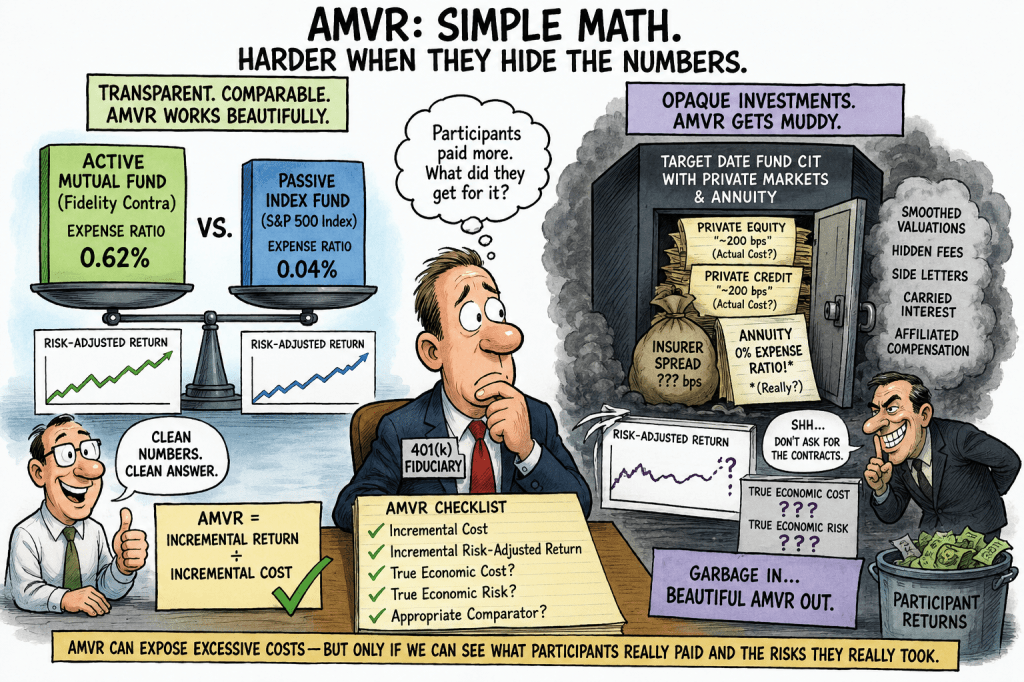
I am a big fan of Jim Watkins’ Active Management Value Ratio (AMVR). https://investsense.com/category/amvr/
Watkins describes AMVR as essentially a cost-benefit test: compare the incremental cost of active management with the incremental risk-adjusted return produced by that active management. His formulation asks two wonderfully simple questions:
- Did active management produce a positive incremental return?
- If it did, was that incremental return sufficient to justify the incremental cost?
Watkins calls it persuasive “third grade math.” That simplicity could make AMVR particularly useful in ERISA litigation. Watkins has also presented the concept to the Department of Labor’s ERISA Advisory Council.
But there is a problem.
AMVR works best when the numbers going into it are real.
And an increasing portion of the 401(k) marketplace is moving toward investments where fees, valuations, volatility and even the definition of “return” can become much harder to measure.
The Easy AMVR Case: Active Mutual Fund vs. Index Fund
Take an old-fashioned domestic equity option.
Suppose a plan offers an actively managed large-cap fund such as Fidelity Contrafund when substantially similar market exposure could have been obtained through a low-cost index fund.
That is fertile territory for AMVR.
You have:
Active fund expense
minus
passive alternative expense
compared with:
Active fund risk-adjusted return
minus
passive alternative risk-adjusted return
Both investments are SEC-registered securities. Both have observable market prices. Expenses are disclosed. Returns are calculated using essentially the same accounting framework.
If the fiduciary paid substantially more for active management but received no corresponding incremental benefit, AMVR gives plaintiffs and courts an intuitively understandable way of asking:
What did the participants get for the extra money?
That may be a much more useful question than simply arguing that one fund had a higher expense ratio.
But the 401(k) Litigation Market Has Changed
The problem is that the classic high-fee standalone active mutual fund is becoming less important in the largest plans.
Large plans have spent years replacing expensive standalone active mutual funds with institutional shares, index funds, CITs and target-date funds.
Meanwhile, target-date funds have become the center of gravity of the modern 401(k).
That changes the litigation opportunity.
Instead of asking whether Fidelity Contrafund justified its additional expense over an index fund, the increasingly important question may be whether an actively managed target-date strategy justified its additional cost over a passive target-date strategy.
And that may be one of AMVR’s best applications.
Fidelity Active TDF vs. Fidelity Passive TDF
This is potentially a very clean comparison.
Fidelity operates target-date strategies using active management as well as index-oriented strategies.
The active Fidelity Freedom funds can carry meaningful expenses. For example, Fidelity currently reports a 0.68% gross expense ratio for Fidelity Freedom 2055.
That creates a natural AMVR question:
Did participants actually receive enough incremental risk-adjusted return from the active target-date management to compensate them for its incremental cost?
This is much cleaner than comparing completely unrelated target-date managers.
The closer the comparator, the stronger the economic argument.
Same provider.
Same retirement year.
Similar glidepath objective.
Similar participant population.
But different implementation costs.
That is exactly the kind of comparison AMVR was designed to illuminate.
Vanguard Can Be a Comparator — But Be Careful
A Vanguard target-date fund can also provide a low-cost benchmark.
But plaintiffs should not simply compare a Fidelity 2040 fund with a Vanguard 2040 fund and declare the difference to be active-management value.
Target dates do not guarantee identical portfolios.
One 2040 TDF might hold 60% equities while another holds 70%. They may have different international allocations, duration, small-cap exposure and glidepaths.
Those differences matter.
A better AMVR analysis would decompose the TDF.
For example:
| Component | Active TDF | Passive Comparator |
| U.S. equity | Active funds | Comparable U.S. index |
| International equity | Active funds | International index |
| Fixed income | Active bonds | Comparable bond index |
| Real estate | Active exposure | Appropriate public benchmark |
| Cash/short-term | Active | Comparable index |
Then apply AMVR to the economically relevant components.
That avoids turning AMVR into another crude performance-comparison lawsuit.
Then Come Private Equity, Private Credit and Annuities
This is where things get much more difficult.
The new generation of target-date CITs increasingly can contain investments that don’t have the transparency of ordinary SEC mutual funds.
That includes:
- private equity;
- private credit;
- private real estate;
- fixed annuities;
- lifetime-income contracts; and
- other insurance-company products.
The AMVR equation may still look simple.
The inputs aren’t.
Private Equity: What Is the Actual Cost?
Imagine that a target-date CIT reports approximately 200 basis points of private-equity expenses.
But the actual economic drag—including management fees, carried interest, portfolio-company fees, financing expenses, fund-of-funds expenses and other embedded costs—is closer to 600 basis points.
Which number belongs in AMVR?
Obviously, it should be the economic cost.
But a participant, fiduciary—or plaintiff’s attorney—may not have access to the contracts necessary to calculate it.
That is why I have argued that the underlying contracts are becoming one of the most important documents in 401(k) litigation.
The Contracts Private Equity Doesn’t Want 401(k) Participants to See
The Return Side Can Be Just as Distorted
Private-market valuations create another AMVR problem.
Public stocks are priced continuously.
Private assets generally aren’t.
Appraisal-based and manager-reported valuations can smooth the return series. That can make private assets appear to have lower volatility and lower correlation with public markets than their true economic exposure would suggest.
I recently discussed precisely this problem:
Private Equity’s New 401(k) Sales Pitch: Fake Diversification From Smoothed Numbers
If the risk-adjusted-return calculation uses artificially smoothed volatility, AMVR can inadvertently reward the very accounting convention that makes the investment appear safer.
Garbage risk numbers in can produce a beautiful AMVR number out.
Annuities Create an Even Bigger Problem: The Invisible Expense Ratio
Now consider a fixed annuity.
An insurer may say:
Expense ratio: 0.00%.
That doesn’t mean the insurer works for free.
The insurer earns investment returns on its general-account assets and credits participants a lower contractual rate.
The difference—the spread—is part of the economics of the product.
Yet that spread doesn’t appear as a conventional mutual-fund expense ratio.
I have previously discussed this problem with TIAA Traditional. TIAA’s target-date modeling can present the annuity as having no conventional investment fee even though the insurer economically benefits from the spread between its assets and the rate credited to participants.
So imagine running an AMVR comparison using:
Index bond fund: 5 basis points
versus
Fixed annuity: 0 basis points
The annuity wins before the calculation even starts.
But if the insurer is economically retaining, say, 150–300 basis points of spread, the comparison changes dramatically.
The problem isn’t AMVR.
The problem is defining cost honestly.
AMVR May Therefore Become a Discovery Tool
This is where I think Watkins’ concept could become particularly powerful for plaintiff lawyers.
AMVR doesn’t merely provide a damages calculation.
It tells you what documents you need.
To calculate the numerator and denominator properly for a modern TDF, plaintiffs may need:
Cost documents: LPAs, side letters, annuity contracts, investment-management agreements, carried-interest provisions, underlying fund expenses, insurance spread analyses and affiliated compensation.
Risk documents: valuation policies, appraisal procedures, liquidity restrictions, leverage, insurer credit exposure and internal risk assumptions.
Comparator documents: investment committee analyses showing what passive or lower-cost alternatives were actually considered.
In other words:
AMVR can become a roadmap for discovery.
The fiduciary should be able to answer the question Watkins’ framework raises:
What additional economic benefit did participants receive for every additional dollar they paid?
If defendants cannot answer because they don’t know the real fees, don’t possess the underlying contracts, or relied upon smoothed private-market volatility, that may be more damaging than an unfavorable AMVR calculation.
CITs Make This Problem More Important
This also helps explain why the industry’s movement away from SEC mutual funds toward CIT structures deserves scrutiny.
SEC mutual funds impose comparatively standardized disclosure, valuation and liquidity requirements.
Private-market and insurance products are much harder to squeeze into that framework.
State-regulated CITs potentially provide substantially greater structural flexibility.
That is why I have called the development two roads into your 401(k):
The litigation consequence is important.
Yesterday’s excessive-fee case might have involved:
60-basis-point active mutual fund
vs.
5-basis-point index fund.
Tomorrow’s case could involve:
40-basis-point TDF CIT
that contains an investment supposedly charging:
0 basis points
but whose insurer retains a large spread,
plus private equity supposedly costing:
200 basis points
whose true economic cost may be multiples of the disclosed number.
The fund wrapper looks inexpensive.
The underlying economics may be anything but.
AMVR 2.0: Follow the Economic Cost
That suggests an important refinement when applying AMVR to modern 401(k) litigation.
Don’t merely use the disclosed expense ratio.
Use the total economic cost.
That means asking:
AMVR numerator =
disclosed fees
- embedded fees
- spreads
- carried interest
- underlying fund expenses
- affiliated compensation
- material transaction costs
relative to the appropriate passive or lower-cost alternative.
And the denominator must receive the same scrutiny.
Don’t accept artificially low volatility simply because an asset isn’t marked to market every day.
Risk-adjusted returns should account for economically meaningful differences in:
liquidity, leverage, credit risk, valuation smoothing and asset allocation.
Otherwise the calculation risks comparing transparent market-priced securities against opaque contracts whose apparent stability results partly from the absence of market pricing.
The Litigation Question Is Beautifully Simple
AMVR’s greatest contribution may ultimately be the simplicity of the question it forces fiduciaries to answer:
Participants paid more. What did they get for it?
For an active SEC mutual fund, we can usually calculate the answer.
For an active target-date fund, we can still calculate it, although we may need to control carefully for glidepath and asset allocation.
For a target-date CIT containing private equity, private credit and annuities, however, plaintiffs may first have to determine what participants actually paid and what risks they actually assumed.
That isn’t a weakness of AMVR.
It exposes a much larger weakness in today’s 401(k) marketplace.
The more difficult Wall Street makes it to calculate AMVR, the more important the underlying contracts, valuation methods and hidden compensation become.
And that may point toward the next generation of 401(k) litigation.
Appendix: AMVR 401(k) Litigation Matrix — From Cleanest Case to the Opaque Frontier
AMVR gets more complicated as 401(k) investments move from transparent, market-priced SEC mutual funds toward target-date CITs containing private equity, private credit and insurance contracts.
The key distinction is between reported cost and true economic cost, and between reported risk and true economic risk.
| Litigation Scenario | Example | AMVR Difficulty | Fee Transparency | Risk/Return Comparability | Best Comparator | Principal Litigation Issue |
| 1. Active domestic equity mutual fund | Fidelity Contrafund vs. comparable index | 1 — Very Easy | Excellent | Excellent | Same-style passive index | Did active management earn enough incremental return to justify incremental fees? |
| 2. Same-manager active vs. passive TDF | Fidelity active Freedom 2040 vs. Fidelity index 2040 | 2 — Easy | Excellent/Good | Very Good | Same-manager passive TDF | Particularly clean AMVR test because manager, target year and general objective can be closely matched. |
| 3. Different-manager TDFs | Fidelity active 2040 vs. Vanguard 2040 | 3 — Moderate | Good | Moderate | Low-cost TDF adjusted for allocation | Must control for glidepath, equity allocation, international exposure, duration and other differences before attributing results to active management. |
| 4. TDF containing private equity/private credit | New-generation TDF CIT | 4 — Difficult | Poor | Poor | Public-market equivalents plus liquidity/leverage adjustments | Disclosed fees may materially understate total economic costs; reported volatility may be artificially reduced by appraisal-based valuations. |
| 5. TDF containing fixed/lifetime-income annuity | TDF CIT with embedded insurer contract | 5 — Very Difficult | Very Poor | Poor | Comparable bonds/stable value plus credit and liquidity adjustments | A reported 0% expense ratio can ignore a potentially substantial insurer spread and contractual restrictions. |
| 6. TDF combining PE + private credit + annuity | State-regulated multi-asset TDF CIT | 6 — Litigation Frontier | Potentially Very Poor | Potentially Very Poor | Component-by-component reconstruction | AMVR may require discovery of contracts, LPAs, spreads, valuation methodology, leverage, underlying expenses and affiliated compensation before it can even be calculated properly. |
What Plaintiffs Need to Calculate AMVR
| AMVR Component | Traditional Mutual Fund | Modern TDF/CIT Problem | Potential Discovery |
| Management fee | Prospectus | CIT disclosures may be less complete | Trust documents; investment-management agreements |
| Underlying fund fees | Generally disclosed | Fund-of-funds layering | Underlying fund agreements and expense schedules |
| Private-equity cost | N/A | Management fees + carry + portfolio/underlying costs | LPAs; side letters; capital-account statements |
| Private-credit cost | N/A | Management/incentive fees plus leverage and financing costs | LPAs; credit agreements; fund financial statements |
| Annuity cost | N/A | Spread may not appear as an expense ratio | Insurance contract; investment guidelines; credited-rate methodology |
| Affiliated compensation | Generally identifiable | Multiple related entities may participate | Affiliate agreements; revenue-sharing records |
| Return | Daily NAV | Private valuations may be appraisal/manager based | Valuation policies; valuation committee materials |
| Volatility | Market observed | Smoothing can suppress measured volatility | Unsmoothing analysis; valuation history |
| Liquidity | Usually daily | Gates, lockups and contract restrictions | Redemption provisions; side letters; annuity termination provisions |
| Credit risk | Portfolio observable | Insurance-company general-account exposure | Ratings; CDS spreads; statutory filings; downgrade provisions |
| Benchmark | Straightforward | Private assets may use inappropriate benchmarks | Investment committee and consultant benchmarking materials |
The AMVR Litigation Ladder
The progression is important.
Level 1 — The numbers are disclosed.
The fight is over whether the fiduciary paid too much for active management.
Level 2 — The numbers are disclosed, but the portfolios differ.
The fight becomes whether the plaintiff selected a genuinely comparable alternative.
Level 3 — The fees aren’t completely disclosed.
The plaintiff must reconstruct the investment’s total economic cost.
Level 4 — The risk isn’t completely observable.
The plaintiff must adjust for valuation smoothing, leverage, illiquidity and credit exposure.
Level 5 — Neither cost nor risk is readily observable.
The underlying contracts themselves become central evidence.
That last category may produce the most interesting litigation.
A defendant might respond to an excessive-fee allegation by saying:
“The CIT only costs 40 basis points.”
The AMVR response should be:
“Show us everything underneath the 40 basis points.”
A Better AMVR for Modern 401(k)s
For traditional mutual funds:
AMVR = Incremental Active-Management Cost ÷ Incremental Risk-Adjusted Benefit
For modern TDF CIT litigation, the numerator may need to become:
Total Economic Cost =
Management fees
- underlying fund expenses
- carried interest
- insurance spreads
- financing costs
- affiliated compensation
- other embedded economic costs.
And the return side needs adjustment for:
asset allocation + leverage + liquidity + credit risk + valuation smoothing.
That produces an important litigation principle:
You cannot prove that an investment was cheap by hiding its compensation outside the expense ratio, and you cannot prove that it reduced risk by hiding volatility inside appraisal-based valuations.
The Discovery Trap for Defendants
AMVR could therefore create an uncomfortable fork for defendants.
If defendants argue that the sophisticated private-market or insurance investment provided superior value, plaintiffs can ask for the documents necessary to verify that proposition.
Private equity: Produce the LPAs, side letters, carried-interest calculations and underlying expenses.
Private credit: Produce leverage, financing expenses, valuation procedures and affiliated transactions.
Annuities: Produce the actual contract, investment guidelines, credited-rate methodology, termination provisions, insurer portfolio information and spread analysis.
TDF CIT: Produce the trustee agreements, underlying investment contracts, valuation methodology and the investment committee’s analysis comparing the structure against transparent alternatives.
If those documents were never obtained or analyzed by the fiduciary, the case potentially becomes more important than a simple excessive-fee claim.
The question becomes:
How could the fiduciary determine that participants received adequate value for the additional cost and risk if the fiduciary itself never determined what the investment actually cost or how much risk participants were actually assuming?
That is where AMVR potentially moves from a performance metric to a fiduciary-process test.
Appendix: Watkins Takes AMVR One Step Further — If Fiduciaries Can Measure Prudence, Why Aren’t They?
Since this article was published, ERISA attorney and investment fiduciary expert James Watkins has taken the AMVR concept an important step further.
In an August 20 article, Watkins proposes combining AI, AMVR, the Terminal Wealth Breakeven Value Index (TWBVI), and what he calls the “Fiduciary Prudence Trinity”—cost efficiency, risk management and commensurate return—to make fiduciary prudence more measurable and auditable.
That matters.
Watkins is not arguing that AMVR is a new legal safe harbor or that a bad AMVR number automatically proves an ERISA violation. Quite the opposite. He argues that quantitative metrics provide evidence about whether the fiduciary actually investigated the economic tradeoffs it was making. His framework is essentially:
Investigate → Compare → Quantify → Evaluate → Monitor → Act.
That is remarkably close to what investment professionals should already be doing.
AI Changes the Excuse
Twenty years ago, a fiduciary might plausibly argue that performing hundreds of comparative cost, correlation, risk and return calculations was cumbersome and expensive.
AI and modern computing increasingly destroy that excuse.
A fiduciary committee overseeing billions of dollars should be capable of asking relatively straightforward questions:
What additional cost are participants paying?
What additional risk are they taking?
What additional economic benefit are they expected to receive?
What reasonably available alternative was considered?
Watkins’ AMVR and TWBVI framework provides quantitative tools for answering those questions. As Watkins puts it, the objective is not to substitute a formula for ERISA’s prudence standard, but to make fiduciary judgment subject to disciplined investigation, comparison, measurement and explanation.
And That Brings Us Right Back to Wall Street’s Missing Numbers
There is an irony here.
Just as AI makes sophisticated fiduciary analysis dramatically easier, Wall Street is moving retirement assets toward products in which the inputs needed to perform that analysis can become dramatically harder to obtain.
AMVR works beautifully when we can see:
- actual fees;
- actual returns;
- an economically meaningful comparator;
- volatility;
- correlations; and
- the underlying investments.
But what happens when the investment is private equity, private credit, an insurance-company separate account, a proprietary real-estate vehicle or a complicated target-date CIT containing those products?
The problem stops being computational power.
The problem becomes disclosure.
A computer cannot calculate the economic value of a fee it cannot see. AI cannot independently test a valuation that is not disclosed. AMVR cannot reliably measure incremental value when the manager controls the marks used to manufacture the return and volatility history.
And a fiduciary cannot meaningfully document a prudent comparison if the investment manufacturer refuses to provide the information necessary to perform one.
That Could Become a Litigation Question
Watkins makes perhaps his most important observation near the end of his analysis: where a fiduciary could have investigated a material economic tradeoff but failed to do so, the absence of quantification itself may become evidence that the fiduciary process was inadequate.
That turns the traditional defense on its head.
The question may increasingly become not merely:
“Did the committee discuss the investment?”
but:
“Show us the numbers.”
What were the incremental costs?
What was the expected incremental return?
What additional risks were assumed?
What alternatives were modeled?
What did AMVR—or an economically equivalent analysis—show?
And if the fiduciary could not perform those calculations because the manager would not disclose the necessary information, there is an even simpler question:
Why did an ERISA fiduciary invest participants’ retirement money in a product it could not independently analyze?
AI May Be Wall Street’s Transparency Problem
This is ultimately why AI could become much more important to ERISA litigation than simply making lawyers and investment experts faster.
AI dramatically reduces the cost of examining thousands of Form 5500s, investment disclosures, contracts, benchmarks, fees and performance histories and identifying economic inconsistencies that previously required enormous amounts of manual work.
Watkins’ framework provides the complementary analytical structure: cost, risk and commensurate return, supported by AMVR and TWBVI.
Put the two together and fiduciary prudence becomes increasingly testable.
Which means Wall Street’s next competitive advantage may not be producing better investments.
It may be making sure nobody can obtain the numbers necessary to test them.
That is exactly why transparency itself is becoming an ERISA fiduciary issue.

