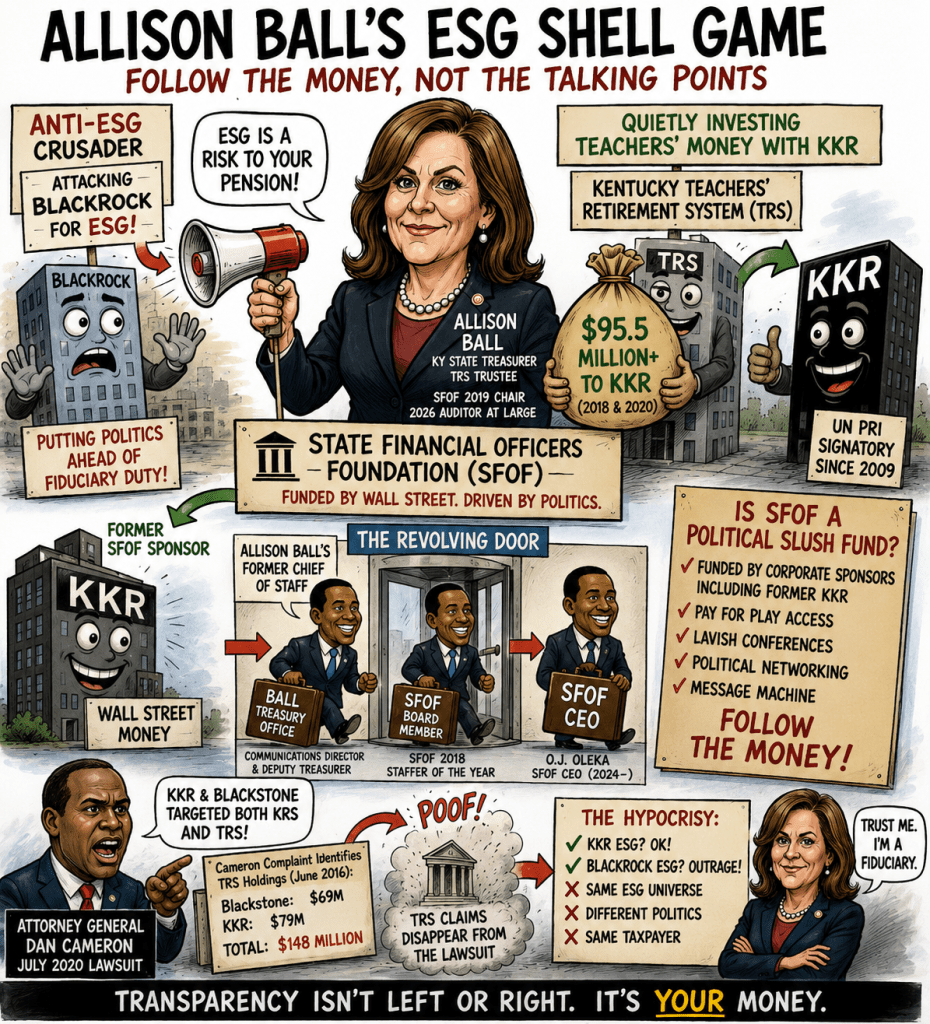
Allison Ball has spent years telling Kentucky taxpayers that ESG creates conflicts for public pension fiduciaries.
Maybe somebody should audit Allison Ball.
Because when you follow the money from Kentucky’s pension funds to KKR, and then from KKR into the State Financial Officers Foundation orbit, the anti-ESG crusade starts looking considerably less principled. KKR is also a major funder of Data Centers.
Ball isn’t some casual SFOF member.
She was SFOF national vice chair in 2018, national chair in 2019, and is now SFOF’s 2026 Auditor at Large. SFOF itself currently lists Ball in that position.
And the relationship became even more personal.
Meet O.J. Oleka: From Allison Ball’s Office to Running SFOF
O.J. Oleka wasn’t merely another Kentucky Republican who happened to end up at SFOF.
He worked for Allison Ball.
Oleka joined Ball’s Kentucky Treasury staff, served as communications director and was promoted to chief of staff and assistant/deputy state treasurer.
Ball explained the promotion by saying Oleka had spent the previous year shaping the message coming from her office and helping develop its policy goals.
SFOF liked him too.
While working in Ball’s Treasury, Oleka was named SFOF’s 2018 State Staffer of the Year.
He later joined SFOF’s board.
Then Oleka ran for Kentucky state treasurer in 2023.
Guess who endorsed him?
Allison Ball.
Oleka lost the Republican primary to Mark Metcalf.
But politics provided another landing spot.
In October 2024, Oleka became CEO of SFOF.
So the organizational family tree isn’t complicated:
Allison Ball → Kentucky Treasury → O.J. Oleka → SFOF.
Ball herself remains a SFOF officer.
And the relationship remains remarkably close. In April 2026, Ball and Oleka appeared together as witnesses before the House Oversight Committee at a hearing on fraud prevention.
You couldn’t invent a better illustration of the revolving door.
Now Add KKR
Here is where this gets interesting.
KKR has been identified as a former “Friends of SFOF” sponsor.
Think about that.
SFOF became one of the loudest organizations in America attacking Wall Street firms for ESG.
Yet KKR—one of the world’s largest private-equity firms—was itself inside SFOF’s sponsorship ecosystem.
And KKR is hardly an anti-ESG firm.
KKR has been a signatory to the UN Principles for Responsible Investment since 2009 and has embraced sustainability programs, climate initiatives, ESG integration and other commitments designed in part to satisfy institutional investors in Europe and blue states.
So apparently ESG wasn’t inherently disqualifying.
It depended on which Wall Street firm was practicing it.
Ball’s Bigger KKR Problem: Kentucky Teachers
Ball’s hypocrisy becomes much harder to explain when you look at her actual fiduciary responsibilities.
As Kentucky state treasurer, Ball sat on the Kentucky Teachers’ Retirement System Board of Trustees.
She wasn’t commenting on pensions from Fox News.
She was a pension fiduciary.
During Ball’s tenure, Teachers approved major new commitments to KKR, including as much as:
$55.5 million to KKR European Fund V in 2018.
Then:
$40 million to KKR Health Care Strategic Growth Fund II in 2020.
That’s as much as $95.5 million of additional KKR commitments during Ball’s tenure.
I have not found evidence that Ball personally made or seconded those investment motions, so let’s not pretend otherwise.
But she was sitting on the governing board.
And KKR’s ESG credentials weren’t secret.
KKR had already been a UN PRI signatory for nearly a decade when Teachers approved the 2018 commitment.
Apparently that wasn’t an ESG emergency.
Then Kentucky’s Attorney General Put KKR’s Teachers Business Into a Lawsuit
This is where the story becomes extraordinary.
In July 2020, Republican Kentucky Attorney General Daniel Cameron revived the massive Kentucky pension litigation against KKR/Prisma, Blackstone and others.
Cameron didn’t limit his allegations to Kentucky Retirement Systems.
He explicitly brought Kentucky Teachers’ Retirement System into his factual case.
Cameron’s complaint identified approximately:
$79 million of KKR investments at Teachers
and
$69 million of Blackstone investments.
That’s $148 million.
The attorney general alleged that KKR/Prisma and Blackstone had sold alternative investments to both Kentucky pension systems and characterized the products as similarly risky and expensive.
Those were allegations, not judicial findings, and KKR and Blackstone denied wrongdoing.
But think about what happened next.
Ball was sitting on the Teachers board.
Kentucky’s own Republican attorney general had just put Teachers’ KKR and Blackstone relationships into a major pension lawsuit.
And Teachers subsequently approved another KKR commitment.
Yet somewhere as Cameron’s litigation progressed, Teachers essentially disappeared from the surviving case.
The later litigation and proposed settlement became a KPPA/KRS affair.
Where did the Teachers claims go?
That deserves an answer.
And Then Ball Discovered the Dangers of ESG
By 2022, Ball had become one of America’s prominent anti-ESG financial officers.
Ball and Cameron demanded information about ESG practices in Kentucky’s public retirement systems.
Ball argued that pension managers must focus on beneficiaries rather than political objectives.
Excellent principle.
Let’s apply it retroactively.
Where was that aggressive fiduciary scrutiny when Teachers was committing money to KKR?
Where was it after Cameron’s own lawsuit put KKR’s relationship with Teachers under a spotlight?
And why did KKR’s membership in the same ESG universe that SFOF would use against BlackRock apparently cause so little concern?
The obvious comparison is devastating.
BlackRock ESG = fiduciary crisis. These are primarily low fee low risk investments
KKR ESG = apparently compatible with tens of millions of dollars of Kentucky Teachers commitments. These are high fee high risk assets with big budgets to give to organizations.
Even more remarkably:
KKR itself was once a sponsor of SFOF.
Did KKR Pay Oleka’s Salary?
We don’t know.
And that distinction matters.
SFOF is a nonprofit organization funded overwhelmingly by contributions. Its 2024 Form 990 reported approximately $2.84 million in contributions out of $2.92 million in total revenue.
Its 2024 return reported about $559,000 in executive compensation.
Oleka didn’t become CEO until late 2024, so the publicly available 2024 Form 990 still principally identifies predecessor Derek Kreifels’s compensation rather than giving us a clean annual Oleka salary figure.
More importantly, SFOF does not publicly disclose every donor.
We know KKR was formerly identified as a SFOF sponsor.
We do not currently have evidence showing that a particular KKR contribution paid a particular dollar of Oleka’s compensation.
That shouldn’t end the inquiry.
It should start it.
Is SFOF Allison Ball’s Political Slush Fund?
“Slush fund” is too strong without evidence that money was diverted or improperly used.
But there is a perfectly legitimate question underneath it:
Has SFOF become a privately financed political infrastructure for elected state financial officers?
Look at the structure.
Private organizations and financial companies fund SFOF.
SFOF provides elected treasurers and auditors with national meetings, policy infrastructure, messaging, networking, media exposure and an organized platform for coordinated campaigns.
Ball rose through SFOF’s leadership while holding statewide office.
Her own senior government aide received an SFOF award while working for her.
That aide later joined SFOF’s board, ran for Ball’s old statewide office with Ball’s endorsement, and ultimately became SFOF’s CEO.
Ball remains an SFOF officer.
And Ball and her former staffer now appear together before Congress—Ball as Kentucky’s elected auditor and Oleka as CEO of the organization in which Ball holds a leadership position.
Maybe everything about that arrangement is perfectly proper.
But taxpayers are entitled to ask:
Who is paying for it?
Follow the Money, Not the ESG Talking Points
The biggest irony is that SFOF says its mission includes protecting taxpayer dollars and responsible financial management.
Fine.
Open the books.
Publish every corporate sponsor and contribution.
Publish sponsorship levels.
Publish payments for conferences attended by elected officials.
Publish travel, lodging and entertainment provided to officials or their staffs.
Publish compensation of senior executives.
Publish communications between sponsors and SFOF officials involving state investments.
And most importantly, disclose whether financial firms sponsoring SFOF were simultaneously seeking or maintaining investment-management business from pension systems overseen by SFOF members.
KKR makes that question impossible to dismiss.
KKR was a SFOF sponsor.
KKR was managing Kentucky pension money.
KKR was being sued by Kentucky’s attorney general over pension investments.
KKR had extensive ESG commitments.
And Allison Ball was simultaneously a Kentucky pension fiduciary and a major SFOF figure.
Yet the political villain somehow became BlackRock.
The $64 Billion Question
This isn’t really an argument about whether ESG is good or bad.
It is about consistency.
If ESG affiliations create an unacceptable fiduciary conflict, apply the standard to KKR.
If UN PRI membership makes BlackRock suspect, apply the standard to KKR.
If financial firms influencing public officials create conflicts, disclose KKR’s SFOF sponsorship.
If pension fiduciaries must put beneficiaries first, explain why Kentucky Teachers continued doing business with KKR while Kentucky’s own attorney general was raising serious allegations concerning KKR’s Kentucky pension business.
And explain why Teachers subsequently disappeared from that litigation.
Allison Ball wants Kentucky taxpayers to believe the big threat to their pensions is ESG.
Maybe Kentucky taxpayers should ask a simpler question:
Who funded the people telling them that—and who got the pension money?
That isn’t left-wing ESG.
That isn’t right-wing anti-ESG.
That’s just following the money.
———————————————————————————–
d-black-box-still-hasnt-been-opened/


Pingback: Kentucky Auditor Allison Ball Supports Data Centers by Not Auditing Them—and Pushing Pensions Toward Them | The CommonSense 401k Project
Pingback: Trump’s 401(k) “Woke” Shell Game: Ban ESG—Then Funnel Workers’ Money to Private Equity Firms That Pledged to Practice It | The CommonSense 401k Project
Pingback: G in ESG Is for Governance—and Both Parties Keep Ignoring It | The CommonSense 401k Project