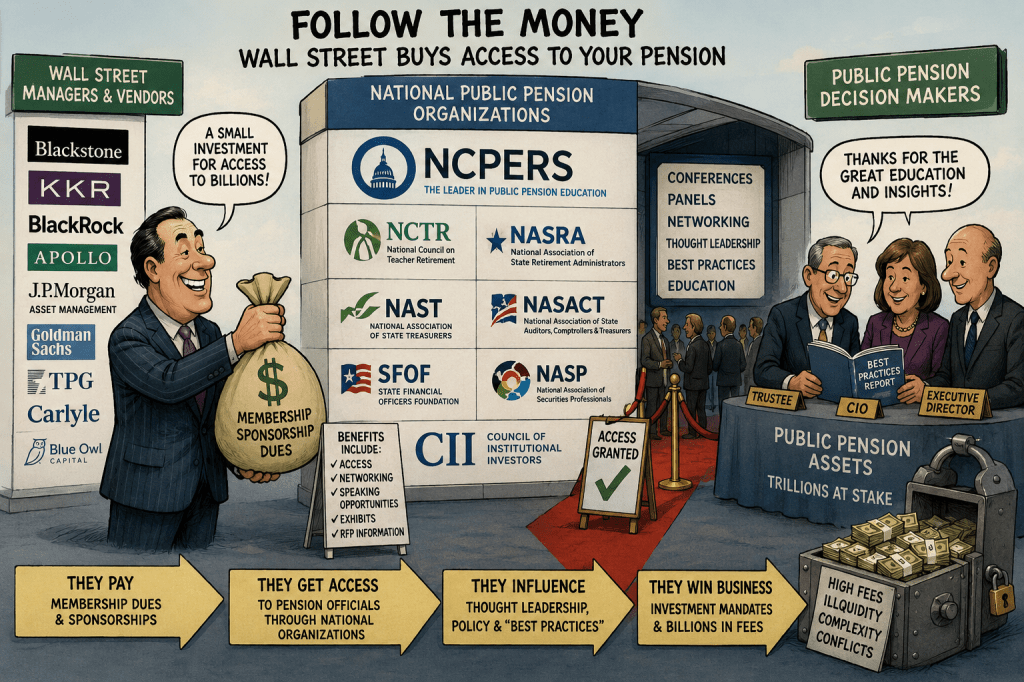
Public pension pay-to-play does not have to look like an envelope of cash handed to a trustee.
There is a much more respectable-looking system.
Investment managers, private-equity firms, consultants, insurers, custodians and other Wall Street vendors provide money to the national organizations that educate, convene and influence the public officials responsible for trillions of dollars of retirement assets.
The organizations call it membership, sponsorship, education, partnership and networking.
Wall Street might call it something simpler:
Business development.
And public pension participants should start asking a basic question:
Who is paying the organizations that are educating and influencing the people investing our retirement money?
The issue is not that accepting corporate sponsorship automatically creates corruption. Trade associations routinely have commercial members and sponsors. The more serious problem arises when an organization financially dependent on an industry also becomes an influential voice on issues where that industry’s interests may diverge from pension participants, taxpayers, investigators or regulators.
That is the structural conflict.
NCPERS Says the Quiet Part Out Loud: Sponsors Get Access
The National Conference on Public Employee Retirement Systems may provide the clearest illustration.
NCPERS doesn’t merely say sponsors support pension education.
Its current marketing materials tell prospective sponsors that partnering with NCPERS provides “direct access to leaders and decision makers within the public pension community.”
Benefits include access to trustees, administrators and pension staff, opportunities to develop relationships, conference visibility, exhibits and—in appropriate cases—speaking and panel participation. NCPERS even acknowledges that sponsorship is one of the factors considered when evaluating speaking proposals.
That is remarkably important.
The attached analysis puts the economics in perspective. A manager paying $10,000 or $25,000 for access may be competing for a $500 million mandate. At only 50 basis points, that mandate generates $2.5 million in management fees every year.
The conference sponsorship is rounding error.
The pension mandate is the prize.
This Is a National Ecosystem
NCPERS isn’t alone.
A surprisingly small collection of national organizations sits between Wall Street and many of the trustees, administrators, treasurers and other officials controlling America’s public retirement money.
| Organization | Who Wall Street can reach | Financial-industry connection worth examining |
| NCPERS | Public pension trustees, administrators and staff | Corporate membership, sponsorship, exhibits, networking and potential speaking opportunities |
| NCTR | Teacher retirement systems | Commercial members include investment managers, consultants and private-market firms |
| NASRA | State retirement-system administrators and CEOs | Associate and Premium Associate memberships for private-sector firms |
| NAST | State treasurers | Corporate affiliates receive networking, conference and other access |
| NASACT | State auditors, comptrollers and treasurers | Corporate Associates Program explicitly facilitates private-sector interaction |
| SFOF | Primarily conservative state financial officers | Historical financial-industry sponsorship and extensive political-financial networking |
| NASP | Minority managers, institutional investors and financial professionals | Major managers and pension consultants appear among sponsors |
| CII | Large institutional investors, including major public pensions | Money-manager associate membership and conference sponsorship |
The relationships differ. Membership should not automatically be described as sponsorship, and neither proves that an investment mandate resulted from the relationship.
But taken together, they reveal a national infrastructure through which financial companies can repeatedly interact with the officials controlling public money.
NCTR: Wall Street Inside the Teacher-Retirement Network
The National Council on Teacher Retirement is especially interesting because its pension members include many of America’s largest teacher retirement systems.
Its current commercial-member roster includes BlackRock, Blue Owl, Clearlake Capital, HarbourVest, Adams Street, Bridgewater, Fidelity, Callan, Meketa, Guggenheim, Franklin Templeton and many others.
Commercial membership costs $4,530 in 2026.
Again, $4,530 is virtually meaningless to a large asset manager.
Access to executives and trustees controlling tens or hundreds of billions of dollars isn’t.
This becomes particularly sensitive because public-pension organizations don’t merely organize cocktail receptions. They conduct trustee education, legislative programs, workshops and conferences and help establish what the public-pension community regards as accepted professional practice.
Whose consensus is it?
An industry-supported organization can produce reports, conferences, surveys and policy positions that eventually become accepted as “the position of the public-pension community.” But pension administrators and Wall Street vendors do not necessarily have interests identical to retirees and taxpayers.
NASRA: The People Who Actually Run the Systems
NASRA may be even more strategically valuable.
Its members include retirement-system executives. Its private-sector Associate Members participate through an Associate Advisory Committee that provides insight and guidance on association activities.
Premium Associates receive enhanced engagement, conference visibility and exclusive networking opportunities.
Current Premium Associates include BlackRock, Nuveen, PGIM, Principal Asset Management, Lazard, T. Rowe Price and others.
Think about that structure.
The organization represents public retirement administrators.
Private firms seeking business from public retirement systems financially participate in the organization.
Those firms can participate in an advisory committee providing input concerning association activities.
And Premium Associates obtain enhanced access and networking.
None of this demonstrates an improper investment decision.
But it certainly warrants disclosure.
NAST: Treasurers, RFPs and Wall Street
The National Association of State Treasurers provides another unusually clear example.
Its current Corporate Affiliates include KKR, TPG, State Street, Vanguard, Prudential, TIAA, Wells Fargo, UBS and numerous other financial firms.
And NAST explains what Corporate Affiliate membership provides.
Affiliates can submit conference topics and speaker suggestions, serve as speakers or panelists, participate in members-only networking, access member information and even access selected RFPs.
That doesn’t mean NAST is selling investment mandates.
It does mean Wall Street considers proximity to state treasurers sufficiently valuable to pay for participation in the ecosystem surrounding them.
SFOF Shows How the Network Can Become Political
SFOF takes the issue one step further.
The State Financial Officers Foundation brings together conservative state treasurers, auditors and other financial officials. SFOF itself describes its national gatherings as opportunities for discussions between financial officers, the financial industry and political leaders.
Historical sponsor records identify Fidelity and Invesco as Silver sponsors, Wells Fargo as Bronze, JPMorgan as a Friend of SFOF and KKR as a former Friend of SFOF.
That makes SFOF’s anti-ESG campaign particularly interesting.
As discussed in the attached SFOF analysis, SFOF challenged BlackRock over ESG affiliations including UN Principles for Responsible Investment. Yet KKR—the private-equity giant historically connected to SFOF—has itself participated extensively in ESG and sustainability initiatives, including becoming a PRI signatory in 2009.
That creates an obvious fiduciary question.
If ESG affiliation makes a cheap, liquid BlackRock index mandate objectionable, why doesn’t the same standard apply to an expensive, illiquid private-market manager with similar ESG commitments?
The attached analysis identifies the economic distinction: replacing a low-cost, liquid and transparent index mandate with private equity, private credit, infrastructure or real estate can introduce management fees, carried interest, partnership expenses, leverage, illiquidity and manager-controlled valuations.
Follow the money, not the political label.
Ohio STRS Shows Why Access Matters
The Ohio STRS controversy provides a remarkable case study.
Ohio’s attention centered on QED and reform trustees Rudy Fichtenbaum and Wade Steen.
But QED received $0 from STRS.
Meanwhile, STRS had billions invested in private markets.
And one of the central QED figures, Seth Metcalf, had previously been an Ohio deputy treasurer, OPERS trustee and Ohio Deferred Compensation trustee before becoming president of SFOF’s board. Historical records identify KKR among SFOF’s former financial supporters.
Even more interesting, Alaska Permanent Fund travel records discussed in the Ohio analysis show its executive director attending SFOF’s 2017 annual meeting and meeting with KKR during the same trip.
And the SFOF network subsequently supplied another revealing example. The Ohio article describes SFOF connections between state officials and Vivek Ramaswamy, whose Strive later obtained public-pension advisory business.
The pathway matters:
Financial firm → national organization → public financial official → pension access → potential business.
That pathway deserves the same scrutiny we give campaign contributions.
The Real Conflict May Be Over Transparency
The biggest danger isn’t necessarily that a manager buys a mandate.
It may be that industry-funded organizations gradually influence what public pensions consider normal.
Private-market firms generally benefit from broad investment discretion, long-duration partnerships, complex fee structures and confidentiality.
Participants and taxpayers may instead prefer lower costs, maximum transparency, independent valuation and competitive procurement.
Those interests can collide over:
- private-equity fees and carried interest;
- LP agreements and side letters;
- manager selection;
- consultant conflicts;
- private-asset valuations;
- benchmarks;
- placement agents;
- investigations and forensic audits.
The State Organizations Are the Next Layer Down
There is also a smaller but important state-level network.
Among the organizations worth tracking are MAPERS in Michigan, Missouri MAPERS, MACRS in Massachusetts, SACRS in California, FPPTA in Florida, TEXPERS in Texas and GAPPT in Georgia.
They should be viewed as the second layer of the same ecosystem.
But the national organizations deserve priority because they can connect a Wall Street firm with pension decision-makers across many states through a single relationship.
Don’t Call It Corruption. Call for Disclosure.
Ordinary trade-association sponsorship should not automatically be labeled pay-to-play.
There may be no quid pro quo at all.
But the public-policy concern is remarkably similar to the problem underlying investment-adviser pay-to-play rules:
Can financial firms obtain privileged relationships or access to officials controlling public assets outside the ordinary competitive procurement process?
This is a structural-conflict question rather than an accusation requiring proof of a bribe.
The solution is straightforward.
Every national public-pension organization should annually disclose:
Who paid it. How much they paid. What sponsorship or membership tier they purchased. What conferences they attended. What speaking opportunities they received. What advisory committees they served on. And which public pension systems and officials participated in those events.
Then pension systems should disclose whether those firms subsequently competed for or received investment mandates.
 The CommonSense 401k Project
Pingback: My SEC Comment Opposing Repeal of the Pay-to-Play Rule for Public Pensions | The CommonSense 401k Project