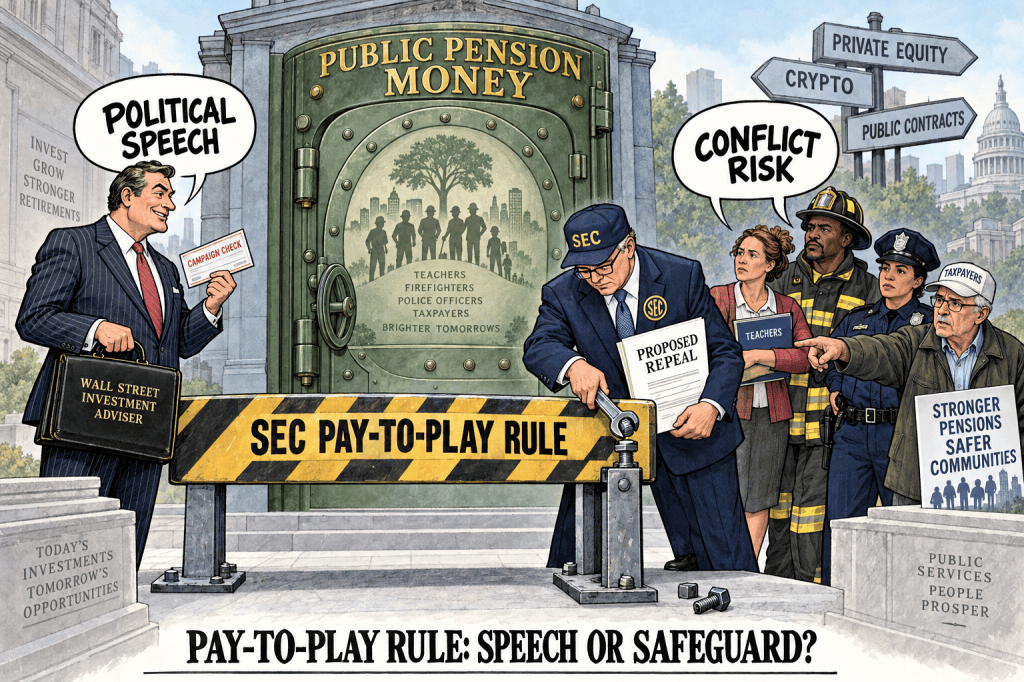
My comment connects the federal rulemaking to recurring transparency, access, fee, valuation and governance problems in public pensions
By Christopher Tobe, CFA, CAIA | The Commonsense 401k Project
I have submitted a formal comment to the Securities and Exchange Commission opposing the proposed rescission of Investment Advisers Act Rule 206(4)-5, the federal pay-to-play rule governing investment advisers that seek or hold state and local government business.
The SEC’s September 3, 2026 proposal would remove the rule’s two-year compensation timeout following certain covered political contributions. It would also eliminate Rule 204-2(a)(18), which requires covered registered advisers to preserve specified records concerning associates, government clients, contributions, political action committees and paid solicitors. SEC Chair Paul Atkins has said the current rule is overly prescriptive, burdensome and capable of imposing disproportionate consequences for small or unrelated contributions. The proposal states that antifraud law, fiduciary duties, compliance programs and codes of ethics are likely sufficient to address pay-to-play risk.
I dispute that assessment. In my submitted comment, I explain that general antifraud authority operates mainly after misconduct and harm have occurred, whereas Rule 206(4)-5 provides an objective preventive restraint. I also argue that deleting the associated records would make later detection and investigation more difficult.
What Pension Fight Club shows across party lines
The public-pension documentary Pension Fight Club provides broader context for my submission. I appear in the film alongside current and former trustees, elected officials, union leaders, teachers, journalists, academics and forensic investigators from multiple states and political backgrounds. Again and again, the film returns to the same governance failures: limited access to investment contracts, difficult-to-measure fees, private-market valuation, customized benchmarks, consultant conflicts and resistance encountered by trustees and beneficiaries seeking information.
While no one can prove pay to play due to the lack of Transparency around Citizens United there is a consensus that this Dark Money has a significant influence in the background.
Its relevance to the SEC proceeding is evidentiary and structural: public-pension decisions can involve enormous financial mandates, complex chains of influence, confidential contracts and limited transparency. Those features make an explicit exchange of money for business difficult to prove—and make preventive records more important.
The people highlighted in the film ask the questions I have been asking for years: What is the pension paying? What is it receiving? Who selected the manager? Who evaluates the consultant? Can trustees see the governing contract? Are performance and risk being measured against credible standards? My SEC comment places those questions within the narrower framework of political contributions and adviser selection.
Influence can operate outside a direct campaign contribution
In a separate Commonsense 401k Project analysis, I described financial-industry participation in organizations serving pension trustees, administrators, treasurers, auditors and other public financial officials. I identified sponsorships, commercial memberships, conference access, speaking opportunities, advisory roles and networking benefits offered by organizations including NCPERS, NCTR, NASRA, NAST, NASACT, SFOF, NASP and CII.
I expressly stated that ordinary membership or sponsorship does not prove corruption, a quid pro quo or an improper mandate. My point is that paid access can create a structural conflict when firms competing for public assets also help finance the organizations that educate and convene the officials overseeing those assets. I called for disclosure of payers, amounts, sponsorship tiers, conference participation, speaking opportunities and subsequent public-pension business.
That distinction matters for the SEC debate. Rule 206(4)-5 addresses specified political contributions and solicitation practices; it does not regulate every form of commercial access. The surrounding ecosystem nevertheless affects the economic baseline against which the Commission is evaluating repeal. Political contributions are one channel within a much larger market for proximity to decision-makers.
Ohio and Kentucky: access, appointments and infrastructure investing
My recent Ohio and Kentucky articles examine relationships among public officials, pension governance, financial networks and data-center investment policy. I discuss SFOF connections, the roles of state treasurers and auditors, the Ohio STRS dispute, and public incentives or pension capital associated with data-center development. The conclusions in those articles are mine.
For this SEC rulemaking, I focus on narrower factual questions: Which officials can appoint or influence pension decision-makers? Which financial firms or affiliated organizations fund conferences, policy networks or campaigns involving those officials? Which firms later seek advisory, investment or infrastructure mandates? What records permit regulators and the public to reconstruct the sequence?
My submitted comment argues that a federal recordkeeping floor is valuable because state systems differ in their definitions, disclosure rules, procurement practices and enforcement resources. I offer the Ohio and Kentucky material as a reason to examine those gaps, not as proof that every identified relationship violated Rule 206(4)-5.
Private equity, Apollo and the transparency problem
In several Commonsense articles, I address Apollo, its public-pension relationships, Leon Black’s documented financial relationship with Jeffrey Epstein, and calls for pension systems to reconsider or disclose their exposure. I also discuss Senator Ron Wyden’s investigations and the transparency of financial relationships involving Epstein.
In my opinion, these materials raise serious reputational, due-diligence and governance questions. They do not, standing alone without full transparency, establish that Apollo obtained a particular public-pension mandate through a covered political contribution. Their relevance here is that large private-market mandates combine valuable fees, confidential partnership structures, long lockups and limited public visibility. In my view, removing a preventive federal rule and standardized contribution records would reduce accountability in a market already difficult to examine.
I have also criticized the absence of some public pension funds from securities cases involving Apollo-related losses and questioned whether pension fiduciaries investigated or disclosed their decisions adequately.
Crypto supplies a documented warning about concealed political money
The SEC comment cites the FTX experience as evidence that sophisticated financial actors can route political money through intermediaries. The U.S. Department of Justice stated when Samuel Bankman-Fried was sentenced that he had used customer funds, among other purposes, to make millions of dollars in political contributions to candidates from both major parties. Former FTX executive Ryan Salame was separately sentenced after admitting participation in contributions intended to obscure Bankman-Fried’s association and curry political favor.
Those criminal cases did not concern selection of a public-pension adviser. Their relevance is limited but concrete: campaign-finance records may not reveal the true economic source of a contribution without additional records, investigation and anti-circumvention rules. In my Indiana crypto article, I extend that concern to state retirement policy; the political characterizations there are my opinion.
Fees, consultants, benchmarks and staff incentives
My other articles address public-pension consultants, private-market fees, performance reporting, customized benchmarks and staff incentive compensation. My Ohio STRS work alleges that competing performance measures were used and that the more favorable number affected bonuses. I have called for consistent, investable and independently verifiable benchmarks.
These issues are not themselves pay-to-play violations. They are relevant because they affect the consequences of manager selection. If a politically connected or otherwise favored manager receives a mandate, opaque fee reporting, subjective valuation and slow or customized benchmarks may make it harder to determine whether the decision harmed beneficiaries. Consultant conflicts can further weaken the independence of the selection and monitoring process.
What the submitted SEC comment requests
My filing asks the SEC to retain Rule 206(4)-5 and Rule 204-2(a)(18). I also offer narrower alternatives if the Commission concludes that the current rule imposes excessive consequences in technical cases. Those alternatives include increasing de minimis thresholds, improving the cure process, tailoring the lookback for non-supervisory employees, using tiered sanctions and creating clearer guidance concerning which public offices are covered.
My central claim is straightforward: the Commission should compare targeted amendments with complete rescission before removing both the preventive rule and its records. The SEC proposal is subject to public comment under File No. S7-2026-31.
Sources and related reading
SEC proposing release, IA-6994, File No. S7-2026-31
SEC Chair Paul Atkins statement on the proposed rescission
Pension Fight Club is now streaming
Wall Street’s public-pension influence machine
Ohio STRS: Follow the money and the SFOF/Ramaswamy connections
Wyden’s Epstein report and pension exposure to JPMorgan and Apollo
Public-pension performance standards and benchmarks
Consultants, conflicts and public-pension performance
Indiana crypto and retirement-plan legislation
The culture of redactions in pensions and private markets

