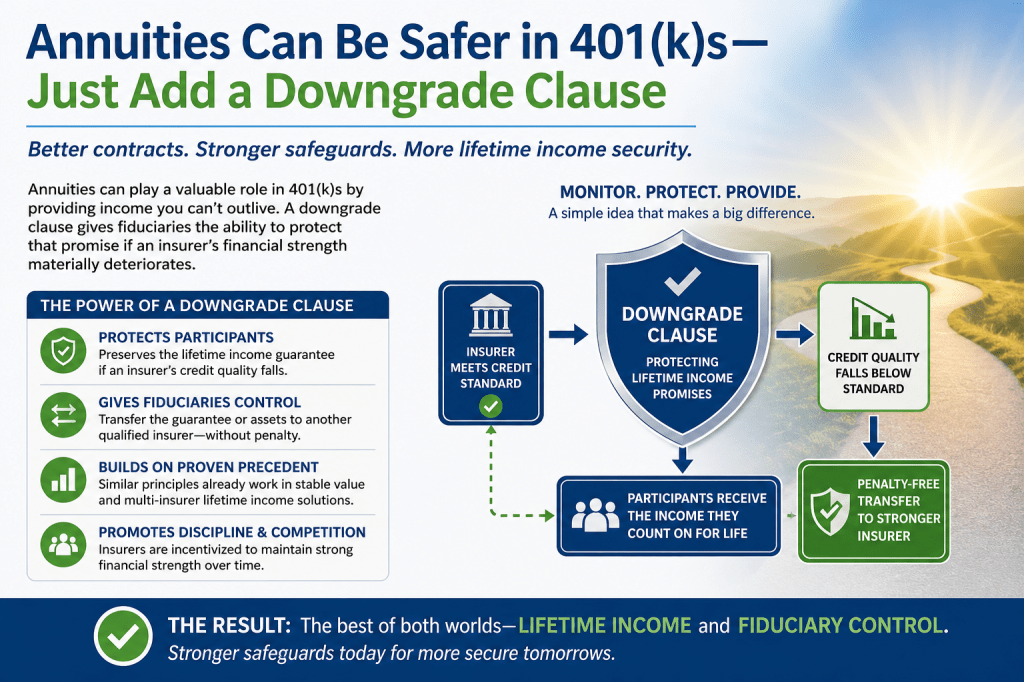
Annuities can play a useful role in 401(k) plans. Retirees face a real problem converting a retirement account into income they cannot outlive, and insurance companies are uniquely positioned to provide that guarantee. The challenge is making sure that a decision that looks prudent when an annuity is purchased remains prudent 10, 20 or 30 years later.
One relatively simple improvement is a downgrade clause. A fiduciary may select an insurance company partly because it has strong financial ratings—perhaps AA or better. But ratings change. If that insurer later falls below the credit standard that justified its selection, the plan should have a contractual right to transfer the guarantee or assets to another financially strong insurer without a surrender charge, market-value adjustment or other participant penalty. As I argued in my earlier article, if the insurer’s credit quality was important enough to justify buying the annuity, deterioration in that credit quality should give the fiduciary a meaningful ability to act.
There is precedent for this approach. Stable-value products have long used multiple insurance counterparties to diversify risk, and multi-insurer lifetime-income structures have also been developed. A well-designed 401(k) annuity could combine those concepts: diversify guarantees among several strong insurers and provide a mechanism to replace an insurer that falls below predetermined financial-strength standards. That would allow fiduciaries to monitor credit risk rather than simply accept it for decades.
A downgrade provision could also improve competition. An insurer would know that maintaining the plan’s business depends not merely on winning the initial contract, but on continuing to meet the plan’s financial-strength requirements. Fiduciaries could supplement ratings with monitoring of capital strength, bond spreads, CDS spreads and other indicators of deterioration. The objective isn’t to predict an insurance-company failure. It is to give the fiduciary the ability to respond before a serious credit problem becomes a participant problem.
Lifetime-income annuities therefore don’t have to be an all-or-nothing proposition for 401(k) plans. Better contracts can make them safer. Strong initial credit standards, ongoing monitoring, multiple insurers where practical, and a penalty-free downgrade clause could preserve the valuable lifetime-income feature while substantially improving fiduciary control over long-term insurer risk. The goal should be straightforward: give participants the benefit of an insurance guarantee while giving their fiduciaries a reasonable exit if the financial strength behind that guarantee materially deteriorates.

