The Documents Fiduciaries Will Wish They Had When the Lawsuits Begin
By Christopher Tobe CFA, CAIA.
The CommonSense 401k Project
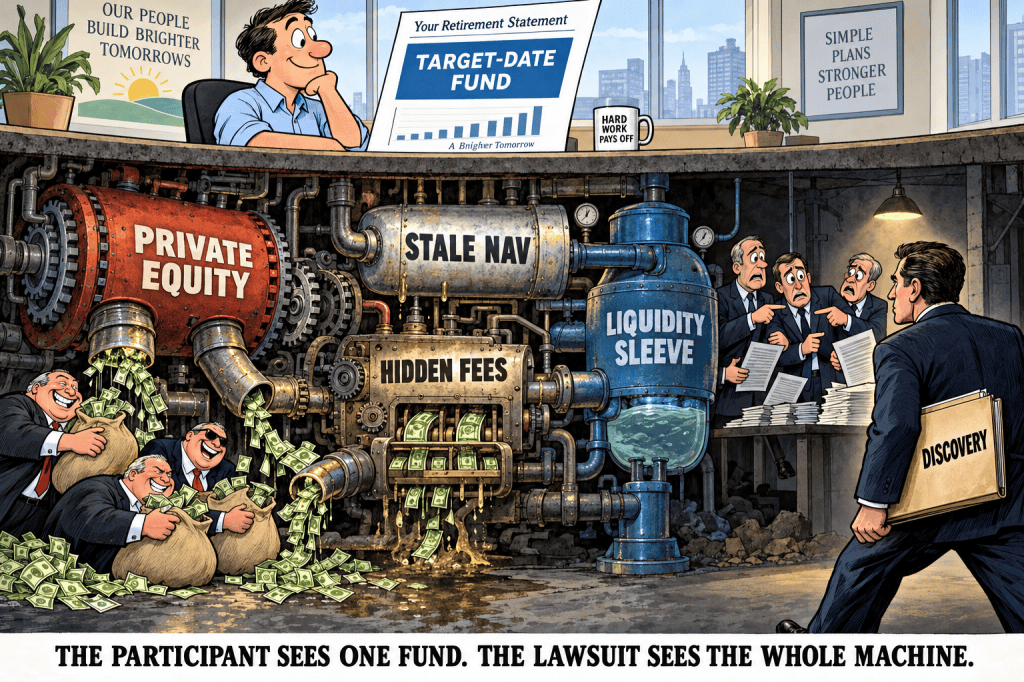
Dr. Brian Leite has performed an important service by showing what private equity inside a 401(k) really looks like. The participant may see one target-date fund or collective investment trust (CIT), but underneath that single line on the participant statement is an ecosystem: the plan sponsor, investment committee, CIT trustee, asset-allocation manager, private-market manager, underlying funds, valuation process, liquidity sleeve and recordkeeper.
That delivery chain is also a potential litigation chain.
My earlier private-equity due-diligence checklist focused on performance, fees, valuation, liquidity, complexity, conflicts and prohibited transactions. Leite’s new article, “Private Equity Has Entered the 401(k): Who Is Actually Responsible for What?”, adds the implementation question that fiduciaries cannot avoid: Who actually controls each function, who gets paid at each layer, and who bears the loss when the machinery fails?
The Department of Labor’s 2026 proposed rule may be advertised as a safe harbor, but it is not a free pass. It emphasizes that ERISA prudence remains a process-based obligation and identifies performance, fees, liquidity, valuation, benchmarking and complexity as relevant considerations. The Department also repeats the longstanding requirement that a fiduciary consider relevant facts and circumstances and then act accordingly. A committee that checks six boxes without understanding how those risks interact may be creating a plaintiff’s exhibit, not a defense. (DOL proposed rule, 91 Fed. Reg. 16088).
This new checklist is written from the perspective of the questions plaintiffs, regulators and forensic experts are likely to ask after losses, gates, stale valuations or excessive fees become visible.
I. Map the Entire Delivery Chain—and the Fiduciary Gaps
□ 1. Identify every entity and every discretionary function
Prepare a written responsibility map identifying:
- the named plan fiduciary and investment committee;
- the appointing fiduciary;
- the target-date or asset-allocation manager;
- the CIT trustee; and what state regulates them
- the private-equity manager and submanagers;
- each underlying or feeder fund;
- the valuation agent and anyone with override authority;
- the recordkeeper and transaction processor;
- the party controlling the liquidity sleeve; and
- every affiliate receiving direct or indirect compensation.
Litigation questions
- Who selected and can remove each manager?
- Who sets the private-equity allocation?
- Who approves or challenges valuations?
- Who can impose a gate, delay a transfer or alter the liquidity sleeve?
- Which decisions were delegated, in what document and to whom?
- Did any important function fall into a gap where every provider disclaimed responsibility?
Documents to retain: trust documents, participation agreements, investment-management agreements, delegation resolutions, service-provider contracts, side letters, committee charters, responsibility matrices and all fiduciary-status representations or disclaimers.
□ 2. Test substance, not titles
Calling an entity a “trustee,” “consultant,” “platform,” or “non-fiduciary service provider” does not answer who exercised discretion or control. Determine what each party actually did.
Red flag: The private-market manager selects the underlying funds, supplies the marks, earns fees from those funds and disclaims fiduciary status, while the nominal trustee lacks the staff or data to challenge it.
□ 3. Document the selection and monitoring of delegates
Delegating investment authority does not erase the appointing fiduciary’s duty to select and monitor the delegate. Minutes should show the delegate’s qualifications, independence, resources, conflicts, valuation capability, liquidity expertise and actual monitoring standards—not merely its brand name or assets under management.
Red flag: Minutes recite “institutional quality” or “best in class,” but contain no independent analysis and no measurable removal criteria.
II. Prove That the Committee Understood the Product
□ 4. Require a plain-English structure memorandum
Before approval, every voting fiduciary should be able to explain:
- what the plan owns at every layer;
- which assets are publicly priced and which are manager-marked;
- how and when participants can enter or leave;
- how capital calls and distributions are handled;
- where leverage exists;
- how many layers of fees apply; and
- what happens in a plan termination, recordkeeper conversion or market crisis.
Litigation question: If committee members cannot explain the structure in deposition, what evidence shows they understood it when they voted?
□ 5. Make expertise a threshold issue
The threshold question is not whether private equity is fashionable or available. It is whether this committee has the information, skill and monitoring capacity to oversee the complete arrangement. If outside expertise is required, document how the adviser was selected, paid and independently tested.
Red flag: The same consultant that recommended the product, receives revenue connected to it, operates an affiliated product or is owned by a private-equity firm.
III. Daily Pricing Is Not Daily Liquidity
□ 6. Separate the daily unit price from the age of the underlying marks
For each private asset, disclose the valuation date, reporting lag, valuation method and whether the daily CIT value is carrying forward an older manager estimate. A daily calculated number is not necessarily a current market-clearing price.
Litigation questions
- How old were the private marks used in each day’s participant transactions?
- Were public assets marked down immediately while private assets remained stale?
- Did participants buy, sell or receive distributions at values later written down?
- Who gained and who lost from the valuation lag?
□ 7. Require genuinely independent valuation controls
Determine who provides the initial valuation, who tests it, who can override it, how conflicts are handled and whether an unaffiliated party performs meaningful review. Obtain the valuation policy and override history—not merely a statement that “independent valuation procedures exist.”
Red flag: The manager whose compensation increases with NAV supplies the valuation and the trustee almost never challenges it.
□ 8. Quantify participant-to-participant wealth transfers
Model whether stale marks allow exiting participants to receive more than the realizable value of their share, leaving remaining participants with the loss. Test the reverse problem for new contributions. This is especially serious in a default fund, where participants did not affirmatively choose the exposure.
Documents to retain: dated asset marks, override logs, subsequent write-downs, participant-level cash flows, NAV files, pricing-error reports and restitution decisions.
IV. Stress the Liquidity Sleeve Until It Breaks
□ 9. Demand the assumptions behind the liquidity sleeve
Identify the sleeve’s size, composition, expected return, rebalancing rules and reliance on contributions, withdrawals, transfers, retirements and the behavior of investors from other plans in the same CIT.
Red flag: The liquidity model assumes normal participant flows, stable markets and uncorrelated withdrawals—the exact assumptions most likely to fail together.
□ 10. Test simultaneous market and participant stress
At minimum, model:
- a major public-market decline;
- elevated retirements and withdrawals;
- employer layoffs or bankruptcy;
- termination of one or more participating plans;
- a recordkeeper change;
- a freeze in private realizations;
- capital calls continuing while distributions stop; and
- other large CIT investors redeeming at the same time.
Document results, remediation triggers and the individual authorized to act.
□ 11. Identify the first-mover advantage
Determine whether liquid public assets are sold first to meet withdrawals, leaving remaining participants with a more concentrated, leveraged and illiquid portfolio. Specify who absorbs dilution, transaction costs and later write-downs.
□ 12. Put every gate and restriction in front of the committee
List all contractual or discretionary authority to delay, limit, suspend or price-adjust transfers and redemptions. Explain how restrictions interact with participant distributions, QDROs, hardship withdrawals, required minimum distributions, plan termination and mapping during a provider change.
Litigation question: Were participants promised ordinary daily access while material gate authority was buried several contractual layers below the fund description?
V. Find Every Dollar of Fees and Compensation
□ 13. Calculate the total economic cost through every layer
Do not stop at the stated expense ratio of the top-level CIT or target-date fund. Include:
- trustee and CIT expenses;
- target-date or allocation-management fees;
- private-market management and performance fees;
- underlying-fund and feeder-fund expenses;
- transaction, monitoring, financing and broken-deal fees;
- subscription-line and leverage costs;
- recordkeeping, platform and distribution compensation;
- consultant, OCIO and placement payments;
- affiliate compensation; and
- the opportunity cost and management cost of the liquidity sleeve.
Report costs in dollars, basis points and as a percentage of gross investment gain retained by intermediaries.
□ 14. Reconcile disclosures against actual cash flows
Compare 408(b)(2) disclosures, Form 5500 reporting, audited financial statements, fund documents, capital-account statements, invoices and portfolio-company payments. Identify fees embedded in NAV rather than separately reported.
Red flag: The plan says it relied on a disclosed expense ratio but cannot produce a reconciliation of total compensation across the structure.
□ 15. Trace party-in-interest and affiliate payments
Build a payment map for the recordkeeper, consultant, trustee, managers, affiliates and placement agents. Determine whether an allocation, retention or removal decision affected any fiduciary’s or service provider’s compensation.
Prohibited-transaction questions
- Did plan assets flow to a party in interest or its affiliate?
- Did a fiduciary act on both sides, use its authority for its own account or receive consideration connected to a plan transaction?
- What exemption is claimed?
- Can the defendants prove every condition of that exemption—including reasonable compensation and required disclosure?
After Cunningham v. Cornell University, fiduciaries should assume that prohibited-transaction exemptions will matter in litigation rather than treating them as an afterthought.
VI. Reject Performance Theater
□ 16. Do not compare IRR directly with public-market returns
Require PME and participant-wealth analyses based on actual cash flows. Identify the effect of subscription lines, dividend recapitalizations, leverage, NAV smoothing and the timing of exits. All comparisons must be net of every fee and the cost of liquidity support.
□ 17. Benchmark the participant’s entire product
The relevant comparison is not whether a selectively measured private sleeve beat a chosen benchmark. Compare the entire target-date fund, CIT or managed account against reasonably available, investable alternatives after fees, liquidity drag, leverage and valuation risk.
Use multiple reference points where appropriate, but do not let a “mosaic” of benchmarks become a device for avoiding a clear comparison to a low-cost public implementation.
□ 18. Preserve rejected alternatives and the ex ante analysis
Document the products considered, bids obtained, assumptions used and reasons less expensive and more liquid alternatives were rejected. Benchmarks and success criteria should be selected before results are known.
Red flag: The benchmark, peer group or time period changes after underperformance.
VII. Test Portability, Defaults and Participant Harm
□ 19. Analyze recordkeeper dependence and exit costs
Determine whether the investment can move to another recordkeeper in kind, must be liquidated, can be gated, or gives the incumbent recordkeeper bargaining power. Price the expected and stressed cost of an exit before entry.
□ 20. Apply a higher practical standard to defaulted participants
Private equity placed inside a target-date QDIA reaches participants who may never have chosen it, understood it or known it was there. Evaluate the plan’s actual population: age, turnover, withdrawal patterns, loan usage, retirements, layoffs and concentration in the default. Do not substitute a generic industry demographic study for plan-specific data.
□ 21. Require understandable participant disclosure
Disclosure should plainly state the private allocation, valuation lag, liquidity mechanism, possible gates, leverage, total layered cost and conflicts. A glossy description of “institutional access” is not a risk disclosure.
Litigation question: Would a reasonable participant understand that a daily displayed value may include old private marks and that daily operation depends on a finite liquidity sleeve?
VIII. Build a Monitoring and Exit Record Before Trouble Arrives
□ 22. Adopt measurable watch-list and removal triggers
Triggers should include:
- valuation exceptions or widening secondary-market discounts;
- liquidity-sleeve breaches;
- gates or delayed transactions in any underlying vehicle;
- leverage increases;
- fee or affiliate changes;
- manager turnover;
- regulatory, litigation or audit findings;
- persistent PME underperformance; and
- deterioration in portability or recordkeeper support.
Assign the person responsible, the reporting frequency and the required response.
□ 23. Monitor the interaction of all six risk factors
Fees, performance, liquidity, valuation, benchmarking and complexity are not independent boxes. A larger liquidity sleeve may reduce returns and increase cost. Stale valuation may suppress reported volatility and distort benchmark comparisons. More provider layers may raise both fees and monitoring risk. Minutes must show that the committee analyzed these interactions.
□ 24. Pre-negotiate the exit
Before investing, document who can terminate each provider, notice periods, redemption queues, gates, in-kind distribution rights, secondary-sale procedures, valuation adjustments, participant communication duties and responsibility for losses or pricing errors.
Red flag: The entry presentation is detailed; the exit plan is a sentence saying liquidity is “expected” to be available.
IX. The Litigation File: Minimum Documents Fiduciaries Should Be Able to Produce
A fiduciary that approves private equity in a 401(k) should expect a request for at least the following:
- all committee minutes, decks, notes and emails concerning selection and monitoring;
- the complete provider and fiduciary responsibility map;
- every contract, trust document, side letter and fiduciary disclaimer;
- requests for proposals, bids and rejected alternatives;
- all fee disclosures and actual compensation reconciliations;
- valuation policies, dated marks, override logs and pricing-error records;
- liquidity models, assumptions, stress tests and breach reports;
- participant demographic and transaction-flow analysis;
- performance files, PME calculations and benchmark-change history;
- conflict questionnaires and affiliate/payment maps;
- 408(b)(2), Form 5500 and audit materials;
- recordkeeper portability and conversion analyses;
- watch-list reports and evidence of action taken; and
- the written exit plan.
If those documents do not exist, generic minutes drafted by counsel after a quarterly presentation will not recreate the investigation.
Conclusion: One Fund on the Statement, Many Defendants in the Complaint
Leite is right that fiduciary governance must cover the complete arrangement. My additional point is blunt: every unexplained handoff in that arrangement can become a litigation theory.
Who controlled the allocation? Who supplied the valuation? Who tested it? Who controlled liquidity? Who got paid? Who could remove the manager? Who knew the assumptions were failing? Who documented the reasonably available alternatives? And who was supposedly responsible when every provider’s contract pointed somewhere else?
Private equity does not become liquid, transparent, cheap or objectively valued because it is placed inside a poorly regulated state bank CIT and wrapped in a target-date fund. Nor does product availability establish fiduciary prudence. A platform’s willingness to process the product is not a legal opinion, a valuation audit, a liquidity guarantee or an exemption from ERISA’s prohibited-transaction rules.
The sales pitch will emphasize access. The lawsuit will emphasize process, conflicts, documents and losses. Fiduciaries should complete this checklist before participants’ retirement money becomes the test case.
This checklist is for fiduciary-governance and educational purposes and is not legal advice. The application of ERISA depends on the facts, governing documents, parties, transactions and available exemptions.

