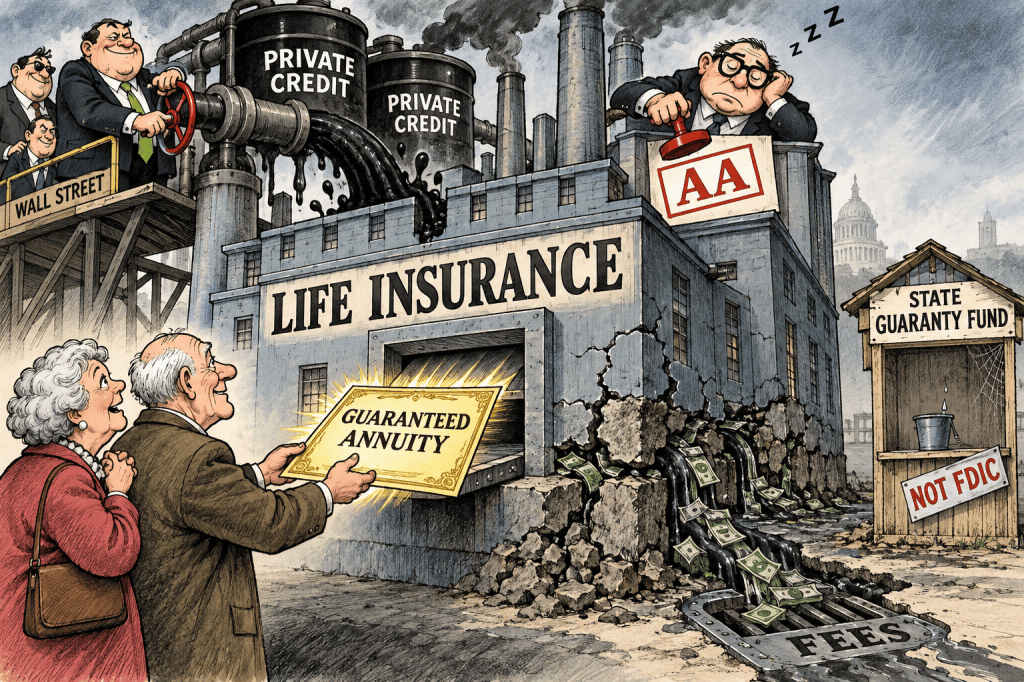
Private equity firms can originate the loans, own the borrowers, value the assets, collect the fees—and leave retirement savers holding the insurance-company promise
A major new paper by George Washington University Law School’s Michael Rand and New England Law’s Melinda Roth helps expose what I believe is one of the most dangerous developments in American retirement finance: life insurers are being turned into captive funding machines for private credit.
Their paper, “Private Credit’s Private Conflicts: Agency Costs, Conflicts of Interest, and the Convergence of Private Equity and Private Credit,” describes giant alternative-asset managers that simultaneously operate:
- private-equity funds;
- private-credit funds;
- direct-lending vehicles;
- Business Development Companies;
- insurance subsidiaries; and
- affiliated financing and valuation platforms.
The historical separation between owner, lender, investment manager and fiduciary is disappearing. In its place is a vertically integrated Wall Street machine that may originate a loan, own the borrower, finance the borrower, restructure the debt, determine the loan’s value and collect fees at every level.
Then the resulting private-credit assets are deposited into a life insurer whose annuities are sold to workers and retirees as “guaranteed.”
That is not diversification.
That is not independent underwriting.
That is not transparent price discovery.
In my opinion, it is a giant conflict-of-interest machine resting on the backs of annuity owners, 401(k) participants, teachers in 403(b) plans and retirees whose pensions have been transferred to insurance companies.
Life insurance has become the cheap-money engine for private credit
Rand and Roth describe how private-capital mega-firms have acquired or partnered with insurers to obtain what they call stable, low-cost insurance float. They specifically point to Apollo and Athene, KKR and Global Atlantic, and Blackstone’s insurance partnerships.
This is the heart of the business model.
The insurer collects billions of dollars from annuity owners. Those long-term promises provide affiliated asset managers with an enormous pool of comparatively cheap and predictable money. The asset manager then puts that money into private loans, structured securities, collateral loans and other assets that it may originate, manage and value itself.
The private-capital firm collects the fees and spreads today.
The insurance company makes promises lasting for decades.
The annuity owner bears the ultimate credit and liquidity risk.
Rand and Roth cite an IMF warning that an increasing share of insurers’ private-credit exposure is being sourced through affiliated managers or private-credit partnerships. The IMF says these arrangements require special attention because of conflicts of interest and lack of transparency.
I would put it more bluntly: When the same financial organization effectively sits on both sides of the transaction, the word “affiliate” may matter more than the credit rating printed on the investment.
The manager may be paid to avoid admitting the loan is bad
Rand and Roth identify a fundamental private-credit valuation conflict.
Unlike a publicly traded bond, a private loan does not trade every day. There may be no observable market price forcing the manager or insurer to recognize deterioration immediately. The manager often determines the value of the very assets on which its fees are calculated.
That creates an obvious incentive to delay write-downs.
The paper explains how payment-in-kind interest, covenant-lite lending and “amend-and-extend” restructurings can postpone default recognition. A borrower that cannot pay cash may be allowed to add more debt to the loan balance. The manager can record income it has not actually received, maintain the loan near its previous reported value and continue collecting fees.
This is Wall Street’s version of extend and pretend.
The loan may look like 100 cents on the financial statement while an actual buyer might pay only 70 or 80 cents—or perhaps far less during a crisis. As I previously wrote, some private-credit investors would rather remain trapped and hide a 26% loss than sell and reveal the cash value of the investment.
That accounting game becomes much more dangerous inside an insurance company.
An insurer must eventually produce cash to pay death benefits, annuity withdrawals, pension benefits and contract surrenders. It cannot pay a retiree with a manager’s estimated NAV. It cannot meet a cash obligation with PIK interest that was never received.
When withdrawals rise or confidence falls, the difference between reported value and cash value stops being theoretical.
Ratings agencies can remain behind the curve
The insurance industry’s standard response is that its private-credit holdings are investment grade and that the insurer itself has a strong financial-strength rating.
That response gives me little comfort.
Private assets do not generate the constant price signals produced by public markets. Ratings agencies frequently depend upon information supplied by issuers, asset managers and modeling firms. A structured private asset may receive a high rating based upon assumptions that have never been tested through a severe liquidity crisis.
Ratings may therefore confirm the accounting model instead of challenging it.
If the asset remains near par on the insurer’s books, the borrower has not formally defaulted, PIK interest is still being accrued and the manager has amended the loan to avoid recognizing trouble, what exactly forces an immediate downgrade?
Usually nothing.
The downgrade may arrive only after the economic deterioration has already occurred. By then, a retirement plan holding an annuity may be trapped by surrender restrictions, market-value adjustments, transfer limitations or regulatory orders.
This is why I have repeatedly argued that annuities used in retirement plans need enforceable downgrade provisions. Participants must be allowed to exit before rehabilitation or insolvency—not years afterward when a regulator finally announces that the insurer is in trouble.
A rating is not liquidity. A rating is not a market price. And a rating issued after the exits have closed is not participant protection.
Annuities in ERISA plans multiply the conflicts
These dangers are especially serious when an insurer’s annuity is placed inside a 401(k) or 403(b) plan.
The participant is not receiving a diversified portfolio of bonds. In a general-account annuity, the participant is receiving the unsecured promise of one insurance company. The insurer controls the assets, selects the affiliated managers, determines the investment strategy and generally keeps the spread between its investment earnings and the amount credited to participants.
The participant commonly receives little meaningful disclosure concerning:
- the insurer’s actual investment spread;
- private-credit origination and management fees;
- affiliate transactions;
- internal valuation methods;
- PIK income;
- offshore reinsurance;
- collateral-loan concentration;
- the cash value of illiquid assets;
- surrender restrictions; or
- what happens after a financial-strength downgrade.
In my opinion, this is not merely a prudence problem. It raises ERISA prohibited-transaction questions.
ERISA does not simply ask whether an investment produced an acceptable return. Section 406 addresses transactions between plans and parties in interest, the use of plan assets for a party in interest, fiduciary self-dealing, divided loyalties and compensation received from parties dealing with a plan.
When an insurer or affiliated manager is already providing services to the plan, controls the investment assets, directs money into affiliated private-credit structures, values those assets and receives compensation from the arrangement, fiduciaries should not assume this is an ordinary investment purchase.
The prohibited-transaction analysis should come first.
The industry should have to identify every relevant party in interest, every affiliate, every layer of compensation and every exemption on which it relies. It should not be allowed to hide behind the word “spread” or bury the conflicts inside an insurance-company general account.
Rand and Roth recommend that ERISA’s procedural protections should not cover private-market investments managed by integrated private-equity and private-credit platforms unless there is genuine structural separation, independent valuation oversight and an audit confirming that affiliated credit and equity funds do not hold opposing positions in the same borrower.
That is a minimum safeguard. I would go further for annuities: no adequate disclosure, no independent valuation, no downgrade exit and no demonstrated prohibited-transaction exemption should mean no place in an ERISA plan.
Security Benefit demonstrates why this is not academic
I recently wrote that Security Benefit may be the greatest major-carrier annuity risk since AIG.
Security Benefit reported nearly $67 billion in admitted assets and an extraordinary concentration in collateral loans. It reportedly held 47% of all collateral loans held by the entire U.S. life-insurance industry in 2024.
A relatively modest reduction in the value of a portfolio that large could consume billions of dollars of apparent balance-sheet protection. A 10% reduction in Security Benefit’s reported assets would be approximately $6.7 billion.
Private-credit accounting can postpone the recognition of such losses. It cannot eliminate them.
The broader federal investigation involving Mark Walter’s insurance empire has already shown why affiliations matter. Delaware Life reportedly reclassified its affiliated investments from less than 5% to approximately 42% of assets. Investigators are examining whether intermediary structures obscured connections between insurance-funded loans and Walter-related businesses.
That does not prove Security Benefit is insolvent. It does prove that regulators, ratings agencies, fiduciaries and annuity purchasers should stop accepting “unaffiliated” as though it were a self-proving fact.
Rand and Roth’s paper explains the underlying architecture: overlapping private-equity, private-credit, insurance and financing entities can create conflicts that existing securities, fiduciary, corporate and contract law were never designed to handle.
State guaranty associations will not repair a private-credit valuation hole overnight
The final sales pitch is always the same:
Don’t worry. The annuity is protected by a state guaranty association.
As I explained in “State Guaranty Associations Behind Annuities Are Still a Joke”, this is not remotely equivalent to FDIC insurance.
State guaranty associations are primarily post-funded. They generally obtain money by assessing surviving insurers after a failure. Coverage is capped, divided among different states and dependent upon lengthy rehabilitation or liquidation proceedings.
The system does not maintain an enormous national pool of cash ready to replace a multibillion-dollar hole immediately.
A rescue is also much harder when the failed insurer’s assets consist of private loans, affiliated investments, structured securities and offshore reinsurance recoverables that cannot be independently valued or sold without a substantial discount.
An assuming insurer is not going to accept questionable private assets at the failed company’s claimed value. It will demand cash, additional assets or protection against future losses.
Where will that money come from?
Eventually it may come from assessments against other insurers—many of which may own the same kinds of private-credit assets and may be suffering from the same market conditions. The guaranty system could therefore extract liquidity from surviving insurers at precisely the worst moment.
Private equity collects the fees in good times. Other insurers, policyholders and potentially taxpayers inherit the bill when the strategy collapses.
A “guaranteed” annuity is only as good as the hidden assets and conflicted institutions behind it
My earlier analysis found that a supposedly “guaranteed” annuity may have an economic value of only 70 or 80 cents on the dollar. Rand and Roth help explain why that discount may not appear on an insurer’s financial statements until it is too late.
They expose a system in which:
- private-equity owners control borrowers;
- affiliated credit funds finance those borrowers;
- managers restructure their own loans;
- valuation agents price illiquid assets;
- PIK interest substitutes for cash;
- fees are calculated from those valuations;
- insurers provide the cheap funding; and
- annuity owners receive the final promise.
Calling the resulting product “guaranteed” does not make these conflicts disappear.
It merely moves them behind the insurance-company curtain.
Retirement fiduciaries must look through the annuity contract and examine the actual assets, affiliates, compensation, valuation methods, reinsurance arrangements and liquidity supporting the promise. They must demand an enforceable right to exit after material deterioration or downgrade. They must also conduct a real ERISA prohibited-transaction analysis instead of accepting the insurer’s assurance that everything has been bundled into an undisclosed spread.
Rand and Roth have provided an important legal map of the conflicts. Now retirement regulators and fiduciaries must stop pretending those conflicts end when private credit enters an insurance company.
They do not end.
They become the annuity owner’s problem.


Pingback: Congress Finally Asks Whether America Needs a Federal Insurance Regulator. The Answer Is Yes. | The CommonSense 401k Project