By Chris Tobe
Louisville residents are being told that WAVE and WDRB are “merging.” That harmless-sounding word conceals what is really happening.
WAVE’s corporate parent, Gray Media, purchased WDRB and WBKI from Block Communications as part of an $80 million acquisition. Gray now controls Louisville’s NBC, Fox and CW television operations. Two of the city’s most important competing newsrooms are being brought under one highly leveraged corporate owner.
I went looking for the usual private-equity fingerprints. I expected to find Blackstone, Apollo, KKR or another Wall Street giant financing a familiar consolidation scheme: buy competing businesses, load the company with debt, eliminate supposedly duplicative workers and extract the savings.
I found something even stranger.
The enormous preferred investor sitting above Gray’s ordinary shareholders is not a conventional private-equity fund. It is the Retirement Systems of Alabama—the pension system for Alabama teachers, state employees and judges.
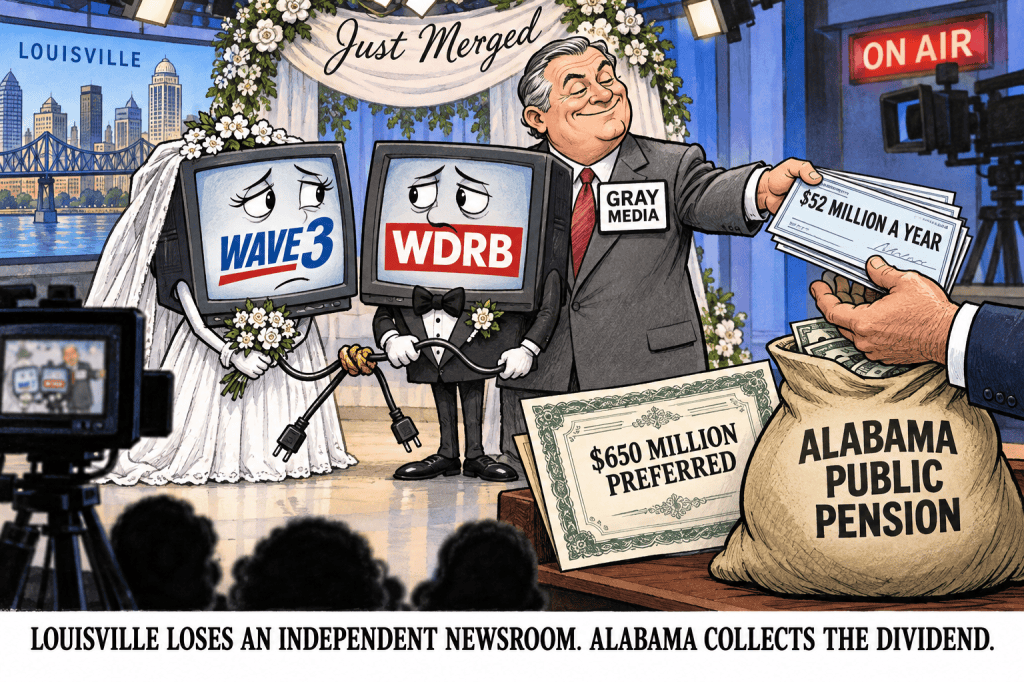
Louisville is losing an independent source of local news while an out-of-state public pension system holds a $650 million senior preferred position in the company doing the consolidating.
This is public-pension capitalism behaving remarkably like private equity.
This Is Not Just a Merger of Television Brands
Gray Media already owned WAVE. In August 2025, it agreed to purchase Block Communications’ broadcast television stations for $80 million. The package included WDRB and WBKI in Louisville, WAND in Illinois and WLIO in Ohio.
The FCC approved the transfers on May 6, 2026, and the acquisition was completed. Gray now owns WAVE, WDRB and WBKI in the Louisville market.
Block Communications was a family-controlled media company—not a private-equity firm. Gray is publicly traded. Therefore, it would be inaccurate to call this a traditional private-equity buyout.
But legal labels do not tell us everything about the economic reality.
When one highly indebted corporation owns two previously competing local newsrooms, the financial incentives are obvious. Gray can combine management, studios, reporters, photographers, producers, engineering, weather operations, graphics, digital platforms and back-office functions.
Corporate management calls these savings “synergies.” Employees generally call them layoffs.
Louisville residents should call it what it is: the elimination of an independent local-news competitor.
The FCC Door Was Conveniently Opened
This transaction would once have faced a serious regulatory obstacle.
The FCC’s Top-Four Prohibition generally prevented one company from owning two of the four highest-rated television stations in the same market. WAVE and WDRB were exactly the kind of important competing stations the rule was intended to keep under separate ownership.
But in July 2025, the Eighth Circuit Court of Appeals vacated the Top-Four Prohibition. The mandate took effect while Gray’s acquisitions were pending. The FCC subsequently approved Gray’s purchase of the Block stations.
Gray did not have to persuade regulators that Louisville desperately needed less competition between WAVE and WDRB. A court had removed the principal ownership barrier.
The result is a Louisville television triopoly: NBC, Fox and CW operations under one corporate roof.
The public deserves to know whether the FCC seriously examined the probable effect on newsroom employment, editorial independence, investigative reporting and the number of distinct local voices. Ownership rules are not merely technical restrictions affecting broadcast licenses. They determine how many separate organizations decide what Louisville residents see, hear and never learn about.
Follow WAVE Back to Alabama’s Pension Fund
The public-pension connection begins with WAVE’s previous parent, Raycom Media.
Before Gray purchased Raycom in 2019, Raycom was controlled and financially backed by the Retirement Systems of Alabama, commonly called RSA. RSA encompasses the Teachers’ Retirement System of Alabama, the Employees’ Retirement System of Alabama and the Judicial Retirement Fund.
RSA behaved less like a conventional pension investor and more like a private-equity sponsor. It backed and controlled a privately held media conglomerate, financed acquisitions, held the investment for years and eventually sold the company to a strategic buyer.
Gray acquired Raycom in a transaction valued at approximately $3.6 billion. The consideration included roughly $2.85 billion in cash, $650 million in newly issued Gray preferred stock and millions of Gray common shares.
Alabama’s pension fund did not simply cash out. It rolled a very large investment into Gray.
At the end of 2019, an RSA filing with the SEC showed that the pension system beneficially owned 7,126,750 Gray common shares, representing 7.6% of the outstanding common stock at the time. Alabama’s teachers’ pension held 4,158,670 shares, while the employees’ system held 2,968,080 shares.
RSA no longer appears among the greater-than-5% common shareholders listed in Gray’s March 2026 proxy statement. That suggests RSA sold enough common stock to fall below the SEC reporting threshold.
But Alabama’s pension system retained the much more interesting security: $650 million of Gray Series A perpetual preferred stock.
Alabama Pensioners Sit Ahead of Ordinary Gray Shareholders
Gray’s 2025 annual report confirms that all 650,000 Series A preferred shares—with a face and liquidation value of $1,000 apiece—remained outstanding on December 31, 2025.
Fitch identified the holder of this $650 million preferred position as the Retirement Systems of Alabama.
These are not ordinary shares that rise and fall alongside everyone else’s investment. They carry powerful financial protections:
- Mandatory cumulative dividends of 8% annually when paid in cash
- An 8.5% rate if Gray elects to pay dividends with additional preferred shares
- Priority over every class of Gray common stock
- Restrictions on Gray’s ability to issue securities ranking equal or senior to RSA’s position
- Special consent rights protecting the preferred shareholders
- Redemption protections involving certain changes of control
An 8% dividend on $650 million equals approximately $52 million annually.
That does not necessarily mean RSA receives exactly $52 million in cash every year because Gray has a payment-in-kind option under specified conditions. But the economic obligation continues either way. If Gray pays cash, RSA receives roughly $52 million annually. If Gray pays in additional preferred stock, the obligation grows at 8.5%.
This preferred position is larger than Gray’s recent stock-market value. It is also senior to the BlackRock, Vanguard and other investment-fund holdings that appear on ordinary shareholder lists.
Therefore, the most important pension investor in this story is not a state plan holding a few thousand Gray shares through an index portfolio. It is RSA holding a bespoke, senior $650 million security created as part of a multibillion-dollar media transaction.
That is much closer to a private-equity-style negotiated investment than to normal pension-fund indexing.
Gray Is Carrying a Mountain of Debt
Gray’s finances make the Louisville consolidation more concerning.
At the end of 2025, Gray reported approximately:
- $5.8 billion of outstanding long-term debt
- $650 million of Series A preferred stock
- $474 million of annual interest expense
- A 7.5% average interest rate on its debt
- Only $289 million of operating cash flow during 2025
Some of Gray’s debt carries interest rates of 9.625% and 10.5%.
The $80 million Block acquisition is relatively small beside this balance sheet. But that is exactly the point. Gray is not buying WDRB because it suddenly became sentimental about Louisville journalism. It is assembling more broadcast properties within a highly leveraged corporate structure.
Debt and preferred dividends must be paid before ordinary shareholders receive what remains. That creates relentless pressure to increase revenue and reduce expenses.
Once Gray owns both WAVE and WDRB, running two completely separate news operations may look wasteful to corporate accountants. Two sets of reporters, producers, assignment editors, meteorologists, managers, studios and technical employees may represent journalistic competition to viewers—but they represent duplicate expenses on a spreadsheet.
The financial incentive is not difficult to understand:
- Buy a competitor.
- Combine operations.
- Eliminate overlapping jobs.
- Preserve two separate station brands.
- Sell advertisers and viewers the appearance of competition.
- Direct the savings toward interest, preferred dividends and corporate cash flow.
We need not wait for Gray to announce that exact plan before asking questions. Louisville has watched enough corporate consolidations to recognize the pattern.
Alabama’s pension system built and controlled Raycom, sold it to Gray and retained a $650 million preferred interest senior to Gray’s ordinary shareholders.
This is not private equity secretly owning WDRB. It is a public pension system employing a private-equity-style strategy in the company that now controls three Louisville television stations.
The pension fund with the clear, direct and economically important connection is Alabama’s.
That creates a perverse interstate arrangement. Louisville bears the potential loss of newsroom jobs, editorial independence and media competition. Gray receives the consolidation savings. Alabama’s pension system continues to hold a senior security entitled to an 8% cash dividend or an 8.5% payment-in-kind return.
Louisville loses a watchdog. Alabama’s pension fund collects the dividend.
What Gray Needs to Disclose
WAVE and WDRB should not be allowed to cover their own consolidation with public-relations language and vague assurances.
Gray should disclose:
- How many WAVE and WDRB employees have been or will be terminated
- Whether the stations will retain separate news directors and assignment desks
- Whether reporters will be shared across both brands
- Whether WAVE and WDRB will compete on investigative stories
- Whether either studio or newsroom will close
- Whether weather, sports, editing, production and digital operations will be combined
- Whether local newscasts will eventually be simulcast or repackaged
- What cost “synergies” Gray projected from the Louisville acquisition
- Whether those savings were disclosed to banks, bondholders, preferred shareholders or rating agencies
- Whether RSA was consulted about or informed of the acquisition
- How much Gray has paid RSA in cash and payment-in-kind dividends since 2019
- Whether Gray plans to redeem RSA’s $650 million preferred position—and how it would finance that redemption
Louisville’s remaining independent broadcasters should also investigate this story aggressively. Unfortunately, corporate television ownership has become so concentrated nationally that one conglomerate may be reluctant to expose another’s consolidation playbook.
Public Pensions Should Not Be Media Barons
Pension systems exist to provide retirement security—not to function as secretive media holding companies.
RSA’s defenders will say the investment is profitable and that Alabama retirees benefit from the dividends. That is not a complete fiduciary defense. A public pension investment must be evaluated for concentration, liquidity, governance, transparency and political risk—not merely whether it produces an attractive contractual yield.
RSA is no ordinary public pension fund. Under longtime CEO David Bronner, it has operated almost like a state-owned private-equity and economic-development empire: taking a major position in US Airways—with Bronner briefly serving as its chairman—building Alabama’s 26-course Robert Trent Jones Golf Trail and adjoining resorts, owning hotels and office towers that transformed the Montgomery and Mobile skylines, and controlling television and newspaper chains. RSA also ventured into riskier industrial projects, including a $350 million railcar-manufacturing loan and a 47% interest in the subsequently bankrupt Signal International shipbuilder. Whatever one thinks of individual results, Alabama teachers’ and public employees’ retirement money has been used for an extraordinary collection of airlines, golf courses, skyscrapers, hotels, factories and media companies—investments far removed from the diversified, arm’s-length portfolios normally associated with public pensions.
The larger democratic question is even more troubling.
Should one state’s pension official control major news organizations serving residents of other states? Should public pension capital help eliminate competing local newsrooms? Who holds the pension system accountable when the investment may influence what journalists investigate—or decide not to investigate?
There is a running 20 year joke in Alabama. A trooper pulls over the Governor, and the Governor says “do you know who I am?” the trooper says “I do not care if you are David Bronner you are getting a ticket.”
Alabama is frequently criticized for the opacity of RSA’s investment and proxy-voting practices. That lack of transparency becomes more consequential when its investments touch the infrastructure of local democracy.
Louisville residents should not have to trace SEC preferred-stock provisions to discover that Alabama public pension money occupies one of the most powerful financial positions in the company controlling their local television news.
The Bottom Line
The WAVE-WDRB combination is not a classic Apollo or Blackstone private-equity takeover. Calling it one would give Gray an easy way to dismiss legitimate criticism.
The truth is more precise and more revealing.
A heavily leveraged national broadcaster has acquired a leading Louisville competitor after the principal FCC ownership restriction disappeared. That broadcaster owes approximately $5.8 billion to creditors and has $650 million of senior preferred stock outstanding to Alabama’s public pension system. That preferred position carries an 8% cash dividend—approximately $52 million annually—or an 8.5% payment-in-kind alternative.
These financial obligations create enormous pressure to extract savings from supposedly duplicative local operations.
WAVE and WDRB may continue to display different logos. They may retain different anchors and sets. Corporate management may repeatedly promise that both brands remain committed to Louisville.
But different logos do not create independent journalism when the same corporation controls the budgets, employment decisions and editorial resources behind both broadcasts.
Louisville is not merely witnessing a television merger. We are watching one more independent local institution disappear into a leveraged national conglomerate—with Alabama’s public pension system sitting near the front of the financial line.
That deserves far more scrutiny than WAVE or WDRB is likely to give it.
Sources

