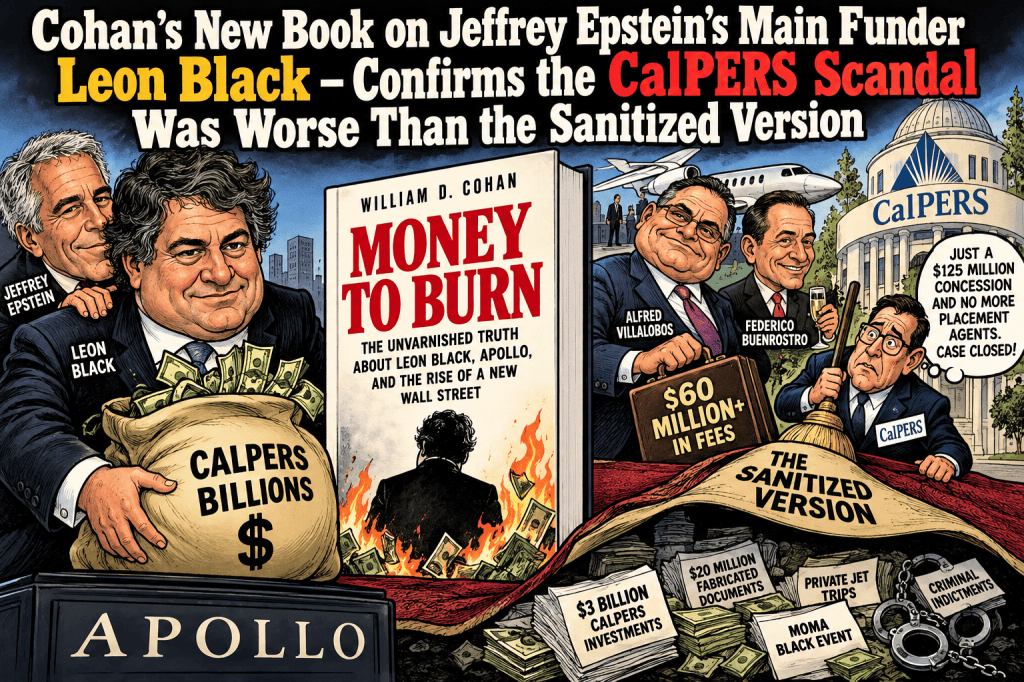
In May, I published a detailed history of what I called CalPERS’ “sick, twisted relationship” with Jeffrey Epstein linked Apollo. The piece documented decades of investments, placement-agent payments, conflicts, criminal conduct by former CalPERS officials, and the remarkable fact that Apollo continued to receive CalPERS business long after the scandal exploded. https://commonsense401kproject.com/2026/05/22/calpers-sick-twisted-relationship-with-jeffrey-epstein-linked-apollo-private-equity/
William D. Cohan’s new 688-page book, Money to Burn: The Unvarnished Truth About Leon Black, Apollo, and the Rise of a New Wall Street, now provides an important independent confirmation of many of those facts. See pages 319-321
And in some respects, Cohan’s telling makes the old CalPERS public-relations narrative look even weaker.
My original article documented a relationship in which CalPERS committed billions to Apollo, bought an ownership stake in Apollo itself, and saw former CalPERS board member Alfred Villalobos receive more than $35 million in Apollo-related commissions across multiple transactions. The article also detailed former CalPERS CEO Federico Buenrostro’s criminal conduct, Villalobos’s role as Apollo’s placement agent, Leon Shahinian’s private-jet trip to New York, and Apollo’s continued relationship with CalPERS afterward. The CommonSense 401k Project
Cohan independently walks through much of this history on pages 319–321 of his book.
Cohan confirms the scale of Apollo’s dependence on CalPERS
Cohan describes CalPERS at the time as both a strategic investor in Apollo’s management company and an approximately $5 billion investor in Apollo funds.
That matters because the placement-agent scandal is sometimes treated as though Apollo were merely one investment manager among hundreds that happened to get caught near a corrupt intermediary.
That framing misses the scale of the relationship.
CalPERS was an extraordinarily important Apollo client.
My earlier investigation identified at least $6.55 billion of documented CalPERS commitments to Apollo vehicles and transactions over time, including commitments after the scandal. The CommonSense 401k Project
Cohan therefore reinforces the core point: this was not some trivial side relationship.
Cohan confirms the extraordinary Villalobos payments
Cohan recounts the investigation into former CalPERS trustee Alfred Villalobos and former CalPERS CEO Federico Buenrostro.
He notes that Villalobos and his firm received more than $60 million in placement-related compensation involving CalPERS business generally.
More specifically, the SEC later alleged that Buenrostro and Villalobos fabricated disclosure documents that induced Apollo to pay placement-agent fees it otherwise would not have paid. The SEC described a $20 million placement-agent fee scheme. SEC
The Justice Department later stated that Villalobos’s ARVCO acted as Apollo’s placement agent in securing approximately $3 billion of CalPERS investments in Apollo-managed funds. DOJ said Apollo ultimately paid ARVCO approximately $14 million after receiving fraudulent disclosure letters. Department of Justice
Those numbers differ because the government proceedings addressed somewhat different transactions and theories. What does not change is the core fact:
Apollo paid Villalobos millions of dollars to help obtain CalPERS money.
The Shahinian episode may be the ugliest part
Cohan devotes substantial attention to Leon Shahinian, the senior CalPERS investment officer responsible for billions of dollars of private-equity investments.
According to Cohan, Shahinian already knew Leon Black and had a good relationship with him.
Cohan makes the obvious point:
“No intermediary was necessary.”
Yet Apollo nevertheless hired Villalobos in connection with the CalPERS transaction.
Villalobos then invited Shahinian to New York for a black-tie Museum of Modern Art event honoring Leon and Debra Black.
Shahinian traveled with Villalobos by private jet.
Villalobos paid the expenses and then billed Apollo approximately:
- $50,000 for the private jet,
- $8,000 for hotel expenses, and
- $1,500 for car services.
Apollo reimbursed those expenses.
About a month later, Shahinian recommended that CalPERS proceed with the Apollo investment.
Cohan says Shahinian did not tell the CalPERS Investment Committee about the New York trip.
This substantially reconfirms the account in my May article. The CommonSense 401k Project
And it raises the same question today that it should have raised then:
Why was a placement agent being paid millions when Apollo already had direct access to the CalPERS official evaluating its investment?
The supposed $125 million “concession” needs to be put in perspective
One element of Cohan’s account deserves more skepticism.
In April 2010, Apollo agreed to reduce fees charged to CalPERS by $125 million over five years and agreed not to use placement agents for future CalPERS commitments. Apollo disclosed the arrangement publicly in its SEC filings. SEC
Contemporary press coverage presented this as a significant concession. CalPERS eventually announced roughly $215 million in fee reductions across multiple managers, with Apollo accounting for $125 million of the total. Los Angeles Times
I don’t view the $125 million in the same way.
Apollo had already made enormous amounts of money from CalPERS before 2010 and would continue making enormous amounts afterward.
CalPERS did not terminate Apollo.
It did not blacklist Apollo.
It did not liquidate every Apollo relationship.
It did not permanently prohibit new Apollo commitments.
Instead, it negotiated a five-year fee reduction while preserving one of CalPERS’ largest private-equity relationships.
That looks much less like punishment when viewed against the economic value of keeping CalPERS as a long-term client.
A useful way to describe it is:
CalPERS recovered $125 million while preserving a relationship worth potentially billions of dollars to Apollo.
That may have been a rational settlement from Apollo’s perspective.
It was also a tremendous public-relations asset for CalPERS.
Management could point to a nine-figure number and say it had forced concessions from Wall Street.
Meanwhile, Apollo remained inside the tent.
The placement-agent promise was even less impressive
Apollo also promised not to use placement agents to obtain future CalPERS commitments.
Again, this sounds stronger in a press release than it does in historical context.
By 2010, the public-pension placement-agent model was already politically radioactive.
CalPERS itself reported in January 2010 that approximately 80% of investment managers had not used placement agents in seeking CalPERS business. Its disclosures showed that ten placement-agent firms nevertheless had received more than $125 million from managers. CalPERS
The scandals were spreading well beyond California. Public-pension placement-agent arrangements became the subject of investigations, enforcement actions, disclosure reforms, bans, and intense press scrutiny around the country.
So Apollo’s promise essentially amounted to:
We will stop using a practice that had just become enormously controversial and increasingly difficult to use anyway.
That is not much of a penalty.
It is certainly not equivalent to disgorgement of Apollo’s historical profits, a ban from managing CalPERS assets, or a fundamental reconsideration of whether Apollo should remain a trusted fiduciary counterparty.
The real winners were CalPERS and Apollo’s public-relations departments
This is the part of the episode that deserves more attention.
Apollo could say:
- it had not been charged with wrongdoing;
- it had cooperated;
- it had voluntarily reduced fees; and
- it would stop using placement agents with CalPERS.
CalPERS could say:
- it launched an investigation;
- it recovered $125 million from Apollo;
- it imposed reforms; and
- corrupt individuals were prosecuted.
Both institutions could declare the matter addressed.
The relationship survived.
That is why I do not regard the $125 million fee reduction as dispositive evidence of tough enforcement.
It may instead have functioned as a very inexpensive price for preserving an enormously lucrative institutional relationship.
Apollo had already earned substantial fees from CalPERS and other public pensions. It would earn vastly more in subsequent years.
CalPERS subsequently committed still more money to Apollo vehicles, including hundreds of millions to Apollo Investment Fund VIII, later Apollo Fund IX, Fund X and other strategies. My earlier timeline documents those subsequent commitments. The CommonSense 401k Project
The scandal therefore did not end the relationship.
It appears to have reset it.
Cohan’s book nevertheless deserves credit
This is an important point because before seeing the actual book, I worried that this history might have been omitted or minimized.
It wasn’t.
Cohan devotes several pages to it and includes details that are devastating to the sanitized version of events.
He specifically emphasizes that no intermediary appeared necessary.
He recounts Apollo reimbursing the private-jet and hotel expenses.
He recounts the millions paid to Villalobos.
He recounts the subsequent CalPERS investment recommendation.
He recounts the $125 million fee reduction.
And he notes that Apollo and the other private-equity firms “got off relatively easily” compared with Villalobos and Buenrostro.
That may be the most important judgment in these pages.
Because it is exactly what happened.
Buenrostro went to prison.
Villalobos faced decades in prison before dying prior to trial.
Apollo kept CalPERS.
The larger question remains unanswered
My May article was not simply about events from 2007–2011.
It asked why a relationship engulfed by this history was allowed to continue largely uninterrupted for another decade and a half.
CalPERS went on investing in Apollo.
Apollo became vastly larger.
Public pensions remained central to Apollo’s capital base.
And later controversies—including Leon Black’s extraordinary financial relationship with Jeffrey Epstein—again failed to cause CalPERS to meaningfully sever its Apollo relationship. The CommonSense 401k Project
Cohan’s book reinforces the historical foundation of that question.
It does not answer the question CalPERS still owes its beneficiaries and California taxpayers:
After everything CalPERS learned about this relationship, why did Apollo remain one of its favored private-market partners?
The $125 million did not answer that question.
Ending placement agents did not answer it.
Sending Buenrostro to prison did not answer it.
And fifteen years of additional Apollo business certainly does not answer it.
The scandal wasn’t merely that corruption occurred. The larger scandal may be how successfully the institutions involved survived it.


Pingback: Kentucky Epstein Connections – James Comer had a unique role in hiding Epstein Files | The CommonSense 401k Project