By Chris Tobe | The CommonSense 401k Project
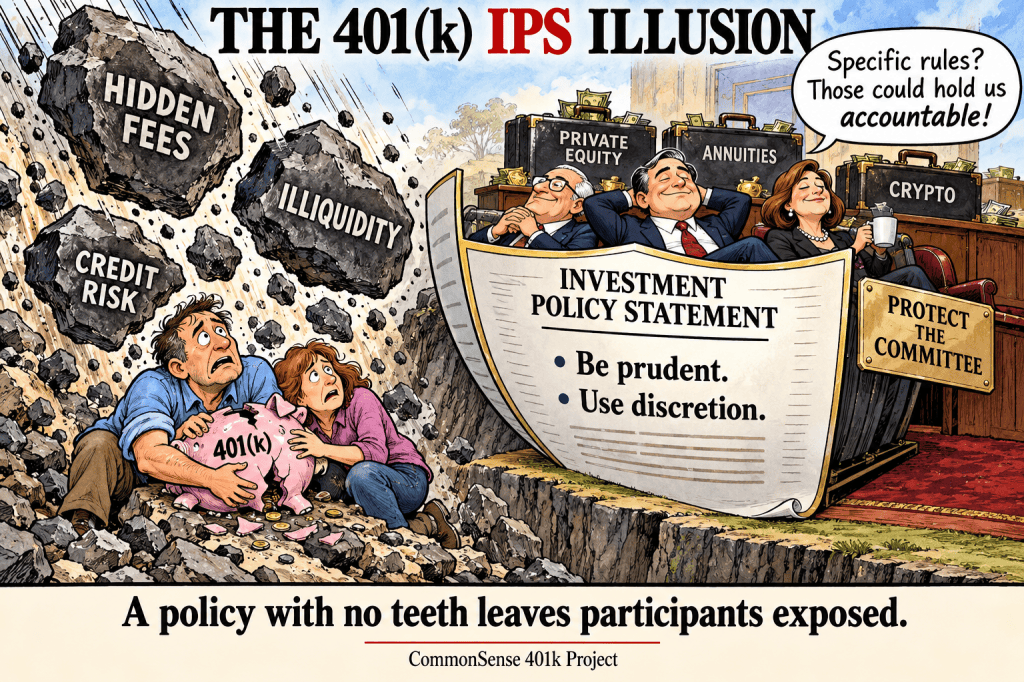
Many workers assume that their 401(k) operates under a serious Investment Policy Statement: written rules that control fees, identify risks, expose conflicts, and hold the investment committee accountable.
That assumption is dangerously optimistic.
An IPS can impose real discipline. It can also consist of reassuring language that leaves nearly every important decision to the committee’s discretion. A document promising “prudent investments” and “periodic review” tells participants little unless it explains what must be investigated, what information must be obtained, and what happens when an investment fails the review.
My concern is that the industry has an incentive to keep these policies weak. Specific standards create a record against which decisions can be judged. Vague standards leave more room to defend almost any decision after the fact.
As I argued in my April 30 Commonsense article, weak policies are especially troubling when retirement products contain opaque fees, contractual restrictions, or underlying investments that participants cannot readily examine. The arrival or proposed expansion of private equity, insurance products, and crypto makes meaningful investment governance more urgent.
Honeywell: A disclosure right can be difficult to enforce
Bloomberg Law reported on October 1, 2026, that participants in the CAES Systems LLC 401(k) plan, associated with a company acquired by Honeywell, lost their remaining claim over failure to provide the plan’s IPS. According to the report, Judge Eumi K. Lee concluded that participants lacked standing because they failed to demonstrate injury from the alleged nondisclosure.
That is a standing ruling. It should not be presented as a blanket decision that plans need no IPS or can always withhold one.
The earlier September 19, 2025, order makes the outcome particularly revealing. Participants alleged that the plan charter required the committee to adopt an investment policy, periodically review it, and oversee compliance. The judge concluded that they plausibly alleged a disclosure obligation under ERISA because a formally adopted policy governing investment decisions could be an instrument under which the plan operated. The disclosure claim survived that motion to dismiss.
Yet the later standing ruling, as reported, prevented participants from pursuing it.
This illustrates a serious accountability problem: participants may face a demand to demonstrate concrete injury from being denied information that could help them understand how their retirement money was managed. A disclosure obligation offers limited practical protection if the people it is supposed to benefit cannot enforce it.
Goldman Sachs: No IPS does not automatically mean a breach
In Falberg v. Goldman Sachs, the district court rejected the argument that failure to adopt an IPS established imprudence. The Second Circuit affirmed in a February 14, 2024, summary order.
The appellate court emphasized that the record showed a deliberative investment process, including independent advice and detailed investment reports. It did not establish that investment committees can dispense with investigation, monitoring, or fiduciary responsibility.
Nevertheless, the practical message available to the industry is clear: a written IPS is not a universal prerequisite to defending a plan’s investment process.
Honeywell and Goldman address different legal questions, but together they expose the weakness in the public’s assumption. Workers cannot simply presume that a meaningful written policy exists, or that they will obtain an effective remedy when access is denied.
Why an empty policy can be attractive
A strong IPS forces difficult questions before a contract is signed.
Who receives compensation? What restrictions apply if the committee wants to leave? Who determines asset values? What happens if an insurer deteriorates? What evidence supports selecting this product over available alternatives?
A superficial IPS can avoid those questions by promising to consider “appropriate factors” without identifying the factors or requiring a documented answer.
I suspect that some sponsors and advisers prefer this flexibility because it reduces the number of specific commitments that participants can test. That is an assessment of the incentives, not a finding that Honeywell or Goldman deliberately weakened policies to conceal misconduct.
The distinction matters. Avoiding a specific written commitment may narrow one avenue of challenge. It does not erase ERISA’s underlying fiduciary duties.
Complex products need specific scrutiny
Private equity demands scrutiny of total fees, carried interest, valuation methods, leverage, capital commitments, and liquidity. A smooth reported return should never substitute for examining how the assets were priced and whether the plan can obtain cash when needed.
General account and separate account fixed annuities demand scrutiny of insurer credit exposure, crediting-rate discretion, embedded spreads, compensation arrangements, surrender charges, market-value adjustments, and restrictions on plan-level withdrawals. A policy that treats “principal protection” as the complete analysis leaves the contractual risks largely unanswered.
Crypto exposure demands scrutiny of volatility, custody, trading costs, valuation, and the precise exposure being purchased. A cryptocurrency holding and an investment in a crypto-related business present different questions.
These are proposed oversight standards. Neither cited case establishes that its plan held private equity, annuities, or crypto.
The same scrutiny should extend inside target-date funds and collective investment trusts. Reviewing the outer wrapper cannot substitute for understanding material underlying exposures and contractual terms.
What participants should demand
A useful IPS should require:
- A complete accounting of direct and indirect compensation, with reasonable estimates and explanations where exact amounts cannot be obtained.
- Written review of material contract terms before signing, including exit costs and liquidity under stress.
- Examination of underlying holdings, valuation methods, leverage, and credit exposure.
- Identification of conflicts, parties in interest, and applicable prohibited-transaction exemptions and their conditions.
- Clear monitoring responsibilities, review triggers, and documented reasons for retaining an investment after concerns arise.
- Participant access to the policy and meaningful explanations of material revisions.
Flexibility can be appropriate. It should come with reasons, records, and accountability.
An IPS cannot guarantee prudent decisions. But a policy that never requires the committee to confront fees, credit risk, liquidity, valuation, or conflicts offers little protection to the people financing the plan.
Workers deserve investment rules that help protect their retirement money. They should not have to mistake a sponsor’s carefully preserved discretion for fiduciary discipline.
Sources
- Prior Commonsense article: https://commonsense401kproject.com/2026/04/30/investment-policy-statements-ips-are-avoided-in-401ks-to-hide-fees-and-risks/
- Bloomberg Law, October 1, 2026: https://news.bloomberglaw.com/employee-benefits/honeywell-unit-free-from-401k-fund-policy-disclosure-lawsuit
- Phillips/Cobham, September 19, 2025 order: https://docs.justia.com/cases/federal/district-courts/california/candce/5:2023cv03785/416085/93
- Falberg district court opinion: https://law.justia.com/cases/federal/district-courts/new-york/nysdce/1:2019cv09910/525303/256/
- Falberg appellate summary order: https://benefitslink.com/src/ctop/falberg-v-goldman-sachs-2dcir-02142024.pdf


Pingback: Target-Date Fund Risk Games: Change the Accounting, Declare the Portfolio Safer | The CommonSense 401k Project