By Christopher B. Tobe | The CommonSense 401k Project
Some accountability has survived in the AT&T pension risk transfer litigation.
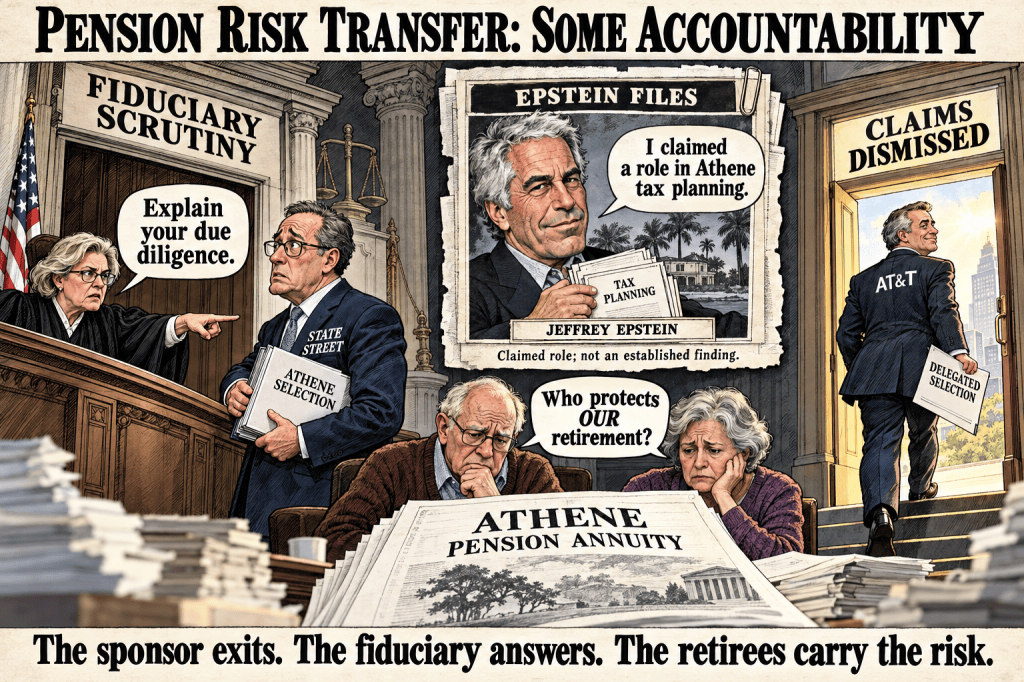
On September 28, 2026, Judge Nathaniel Gorton dismissed the claims against AT&T while allowing a prudence claim against State Street to proceed. The litigation concerns AT&T’s $8.05 billion transfer of pension obligations to Athene in 2023. State Street had been given responsibility for selecting the annuity provider. This is a chance to examine that selection—. [1]
For retirees concerned about being moved into an insurer’s fixed annuity, that opening matters. The question is whether the fiduciary adequately protected the people whose lifetime income would depend on the selected insurer.
Hiring a Consultant Is Not the Same as Delegating the Decision
The dismissal of AT&T raises an understandable question: In 401(k) litigation, hiring a consultant generally does not eliminate the plan committee’s responsibility. Why did AT&T get out here?
The distinction is decision-making authority.
When a consultant recommends investments and a committee makes the decisions, the committee remains responsible for those decisions. A valid delegation of discretionary authority can change who is responsible for the delegated function. That principle can apply in a 401(k) plan as well as a pension risk transfer.
ERISA nevertheless preserves responsibility for a fiduciary’s own conduct in establishing and continuing a delegation, and for specified forms of participation in another fiduciary’s breach. Delegation is not blanket immunity. [3]
Here, the court found insufficient allegations that AT&T influenced the selection, ignored warning signs, failed to monitor State Street, or knew of a breach. That is a conclusion about the allegations in this case—not a rule that employers can escape all fiduciary responsibility by hiring an outside firm. [1,2]
My concern is practical: How much can retirees know about the sponsor’s role before they obtain the internal documents? The appointment agreement, instructions, communications and oversight records may reveal far more than a public announcement saying an “independent fiduciary” selected the insurer.
A Pension Promise Has Value Before a Check Is Missed
The surviving claim also carries an important recognition: A pension annuity can allegedly be less valuable because it is riskier, even while payments continue.
The court maintained its standing determination and allowed State Street’s prudence claim to advance. It left disputes over insurer comparisons and the protection afforded by Athene’s separate account for later factual examination. Only Count IV survives; the other claims were dismissed. [2]
That approach is more sensible than requiring retirees to wait for an insurer’s failure.
In my earlier article on the Lumen litigation, I criticized the idea that retirees have suffered no injury because the Athene “time bomb” has not exploded. The economic question is the value of the replacement promise when it is received—not merely whether this month’s payment arrives. [5]
A pension risk transfer requires scrutiny of the protections surrendered and the protections received. Retirees deserve an explanation of who now owes their benefits, which assets support them, what happens under financial stress, and what recourse remains.
State Street’s Selection Deserves Examination
The Department of Labor’s annuity-selection framework calls for examining the insurer’s portfolio quality and diversification, capital, size relative to the transaction, other liabilities, contract structure and guaranty protections. It directs fiduciaries toward the safest available annuity, subject to a participant-interest qualification. [4]
Those considerations support concrete questions for discovery:
- Which insurers were realistically available, and how did their bids compare?
- What did State Street examine concerning affiliated investments, private credit, reinsurance and liquidity?
- What legal protection does the separate account actually provide?
- What happens after a serious downgrade, and are there enforceable remedies?
- What information did State Street provide to AT&T, and what oversight followed?
A separate-account label should lead to examination of enforceable contract rights. It should not end the inquiry.
My policy position remains that retirees need meaningful downgrade protections before insurer distress becomes insolvency. Whether this particular contract contains adequate protections must be established from the contract and supporting evidence.
The Epstein Files Add Questions About Candor
The Epstein disclosures deserve mention, with precise attribution.
The Financial Times reported that Jeffrey Epstein proposed an Athene-related tax plan he claimed could save Apollo’s co-founders as much as $300 million, seeking a 25 percent success fee.. [6]
In February 2026, the AFT and AAUP asked the SEC to investigate whether Apollo’s disclosures accurately described its executives’ dealings with Epstein. Their letter cited released documents concerning Athene and tax matters. These are concerns raised in a request for investigation, not findings of wrongdoing. [7]
These later disclosures cannot automatically establish what State Street should have known in 2023. They do, however, reinforce the need to examine the reliability of representations, governance and due diligence involving the Apollo-Athene organization.
Some Accountability Is Better Than a Closed Courthouse Door
AT&T’s dismissal is disappointing. But State Street must still defend the prudence of its insurer selection.
The surviving claim offers an opportunity to examine whether retirees received the protection a prudent fiduciary should have obtained. Discovery should establish the available alternatives, the risks examined, the contractual safeguards and the actual decision process.
Retirees should not have to experience an insurer failure before the fiduciary’s work can be scrutinized.
Sources
[1] PLANSPONSOR, September 30, 2026: https://www.plansponsor.com/judge-allows-prt-claims-against-state-street-dismisses-counts-against-att/
[2] Your ERISA Watch, September 30, 2026, summary of Piercy v. AT&T Inc., No. 24-10608-NMG, 2026 WL 2905359 (D. Mass. Sept. 28, 2026): https://www.yourerisawatch.com/2026/09/your-erisa-watch-week-of-september-30-2026/
[3] ERISA §405, 29 U.S.C. §1105: https://www.law.cornell.edu/uscode/text/29/1105
[4] DOL report to Congress on Interpretive Bulletin 95-1: https://www.dol.gov/sites/dolgov/files/EBSA/laws-and-regulations/laws/secure-2.0/report-to-congress-on-interpretive-bulletin-95-1.pdf
[5] Prior CommonSense articles:
[6] Financial Times, “Apollo chief Marc Rowan consulted Epstein on firm’s tax affairs”: https://www.ft.com/content/092d9e44-ec17-4da7-8b58-e43bf09113ab
[7] AFT/AAUP letter to the SEC, February 17, 2026: https://www.aft.org/sites/default/files/media/documents/2026/Letter_to_SEC_re_Apollo_Global_Management_February_17_2026.pdf


Pingback: Annuity Derisking in Retirement Plans | The CommonSense 401k Project
Pingback: Wharton Exposes the Private Equity Insurance Risk Machine — And Why the Entire Annuity Industry May Be Forced to Follow | The CommonSense 401k Project