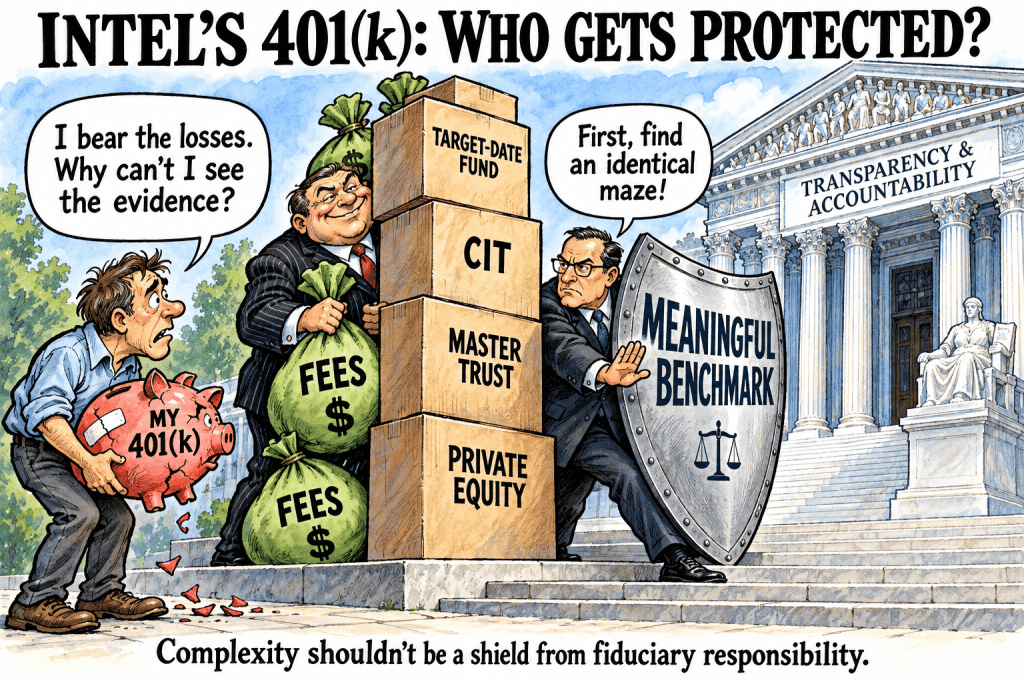
By Christopher B. Tobe — The CommonSense 401k Project
On Tuesday, October 6, the Supreme Court will hear oral argument in Anderson v. Intel Corporation Investment Policy Committee. The immediate question concerns what workers must allege before a lawsuit challenging imprudent retirement investments can proceed. The practical stakes reach much further: can fiduciaries place workers’ savings in complicated private investment structures, then use those structures’ uniqueness to make accountability harder?
Tuesday is the argument, not the decision. But the choice taking shape deserves public attention. Supreme Court docket
Private equity’s representatives understand the stakes. The American Investment Council and Managed Funds Association filed a brief supporting Intel. They argue that affirming the meaningful-benchmark standard would reduce litigation risk and encourage alternative investments in 401(k)s. They portray litigation as an obstacle to workers receiving better returns and diversification. I see a different danger: making accountability harder can make expensive products easier to sell. Industry brief
The retirement industry’s sales opportunity is clear. The participant’s benefit still needs to be demonstrated.
The Court already explained who bears the loss
In Thole v. U.S. Bank in 2020, the Court’s majority denied standing to DB pensioners whose fixed benefits had been paid and would remain the same regardless of the lawsuit’s outcome. Justice Kavanaugh expressly contrasted those benefits with 401(k) accounts, whose value depends on investment decisions.
Your employer generally bears the funding obligation for a traditional DB pension. In a DC plan, investment losses and excessive investment costs reduce the account supporting your retirement.
Justice Sotomayor’s dissent, joined by Justices Ginsburg, Breyer and Kagan, argued that beneficiaries had an enforceable interest in their retirement trust’s financial integrity. She warned against preventing pensioners from challenging mismanagement until pensions approached default. The dissent emphasized trust protections, fiduciary duties and participants’ ability to enforce them. Majority and dissent
Thole did not grant automatic standing for every DC claim, and it was not a ruling specifically about private equity losses. But its economic distinction matters: a worker whose own account suffers investment harm presents a different situation from a pensioner whose fixed payment is unaffected.
Intel shows how the pension structure reaches the 401(k)
Intel’s filings provide a concrete example. Its 2015 401(k) report described a master trust containing assets of the 401(k), Retirement Contribution Plan and Minimum Pension Plan. Automatically enrolled participants’ deferrals went into target-date funds investing in master trust accounts. The underlying investments included hedge funds and private equity, venture capital, private credit and other private assets. Some closed-end holdings could not be redeemed on a presently determinable date. Intel’s 2015 filing
The structure later changed. Intel’s 2019 report states that investments moved into units of proprietary collective investment trust funds in January 2018. The master trust was dissolved in January 2019, with the 401(k)’s interests transferred to a separate trust. The report identified all three plans as participating in the CIT trust. Intel’s 2019 filing
That history matters. A participant can hold an interest in a target-date fund, which holds pooled investment interests, which ultimately expose the worker to private funds and their contractual terms.
These filings disclose the structures; they do not prove intentional concealment. My concern is that reporting an investment as units in a pooled vehicle can leave the underlying economics several layers away from the worker trying to understand them.
Pooling DB and DC investments does not pool the employer’s promise to pay a fixed pension. The 401(k) participant still bears the account’s investment results.
A benchmark can help—or protect the decision being challenged
Intel defended its strategy as a way to reduce volatility and downside risk. The Ninth Circuit found the plaintiffs’ comparisons inadequate because the proposed comparator funds had different objectives and risks. Judge Berzon’s concurrence nevertheless stressed that an empirical comparator is not universally required to plead imprudence. Ninth Circuit opinion
Fair comparisons matter. A stock-heavy fund’s higher return during a bull market does not, by itself, establish that a more conservative portfolio was imprudent.
But a benchmark built around the challenged allocation answers a limited question: how did the selected allocation perform against a representation of itself? It does not necessarily answer whether choosing that allocation was prudent for participants in the first place.
If the complaint challenges substantial private equity exposure, requiring a comparator with substantially the same exposure risks assuming the wisdom of the decision under challenge.
A custom strategy should face meaningful evaluation of its total costs, liquidity, valuation practices, conflicts and expected benefits. Its uniqueness should not become a shield.
Workers need a fair path to the evidence
Committee records, manager agreements, fee arrangements and the analysis supporting a private investment allocation can be essential to evaluating prudence. Workers ordinarily have far less access to those materials than fiduciaries and their advisers.
A pleading rule should require facts supporting a plausible claim. It should also recognize where the evidence resides. Demanding a near duplicate investment before discovery can make the most complicated arrangements the hardest to challenge.
My earlier CommonSense articles warned about secrecy and benchmarks and corporate relationships that can compete with participants’ interests. Intel brings those concerns to the courthouse door.
The Court should preserve a realistic path for workers to challenge plausibly imprudent decisions and obtain the evidence needed to evaluate them. That would not predetermine Intel’s liability. It would preserve accountability.
Private equity managers want access to workers’ retirement savings. Workers deserve access to an effective process for protecting those savings.
The Supreme Court already recognized in Thole that 401(k) participants bear the investment consequences. It should ensure that they also have a fair opportunity to enforce the fiduciary protections that accompany them.
Intel Update: A “Meaningful Benchmark” Must Not Become a Shield for 600-Basis-Point Fees
By Christopher B. Tobe | The CommonSense 401k Project | October 6, 2026
Tuesday’s Supreme Court argument in Anderson v. Intel Corporation Investment Policy Committee sharpened the concern raised in my October 5 article: can a retirement investment become so customized that its design protects it from meaningful accountability?
Bloomberg Law reports that the justices appeared receptive to requiring meaningful comparisons for claims based on investment underperformance, while debating how precisely to define that requirement. Justice Amy Coney Barrett raised the danger that language requiring similar aims and strategies could lead lower courts to demand an investment “twin.” These are signals from oral argument, not a ruling. [1]
That distinction could determine whether workers obtain the evidence needed to examine expensive investments inside their 401(k)s.
My concern about target-date funds is that their varying allocations create a convenient barrier to comparison. Different retirement dates, glide paths, stock-bond mixes and alternative investments allow providers to argue that almost any competing fund is insufficiently similar.
I believe the industry has incentives to design and promote structures that make transparency and accountability harder. I believe that blocking transparency to protect fees was the original purpose of target-date funds. The immediate problem is their potential use today: each additional layer of customization can become another reason to reject a participant’s comparison.
Workers should not have to find a duplicate of a disputed investment decision before they can question that decision.
Fees provide a particularly revealing example. Morningstar’s research identifies expense ratios as a strong predictor of future fund success. In its 2016 study, the cheapest U.S. equity funds had a 62% success rate, compared with 20% for the most expensive group; success meant surviving and outperforming their category. That evidence concerns the funds studied, rather than every private equity investment, but it reinforces why costs deserve serious scrutiny. [2]
Future gross returns are uncertain. Fees reduce what participants keep.
Consider a simplified hypothetical allocation within a target-date fund—not an assertion about Intel’s actual holdings or charges:
| Component | Allocation | Annual component cost | Contribution to portfolio cost |
| Large-cap equity index fund | 90% | 10 basis points (0.10%) | 9 basis points |
| Private equity | 10% | 600 basis points (6.00%) | 60 basis points |
| Total | 100% | — | 69 basis points (0.69%) |
The 10% private equity sleeve produces approximately 87% of the combined investment cost. On $100 million, these assumed costs equal $690,000 annually: $90,000 for the index allocation and $600,000 for private equity.
An allocation entirely to the 10-basis-point index fund would cost $100,000 annually. The difference is $590,000. That comparison isolates the cost burden; it does not establish that the two portfolios have identical risks or that the all-index portfolio is the appropriate retirement allocation.
The private equity sleeve would need to earn 5.9 percentage points more annually before fees than the index sleeve simply to offset its additional assumed cost, holding the other 90% unchanged. Whether it can justify that hurdle, its risks and its liquidity restrictions deserves examination.
The assumed 600 basis points represent the sleeve’s annual economic cost for this illustration. Actual private equity costs must be examined from the agreements and accounts: management fees, carried interest, fund expenses, offsets and additional layers of charges. A headline expense ratio may not answer every economic-cost question, and overlapping charges must not be counted twice.
Now consider how a rigid benchmark rule could frustrate that examination.
Participants identify a lower-cost target-date alternative. The defense responds that it lacks the same private equity allocation. Participants identify a low-cost public equity alternative for the expensive sleeve. The defense responds that public equity follows a different strategy.
If those differences end the case before discovery, the expensive allocation becomes part of its own protection. Workers are effectively told to accept the disputed design before they can challenge its economics.
A benchmark matching the private equity allocation may help evaluate implementation. It cannot, by itself, establish that choosing the allocation was prudent. Nor does a different overall allocation make component fees impossible to examine.
The Supreme Court should preserve that distinction. Comparing realized performance requires attention to risk, objectives and investment exposure. A plausible challenge to excessive costs, conflicts or the process used to approve an allocation presents additional questions. Plaintiffs still need supporting facts, but a search for an identical portfolio should not automatically displace those questions.
Discovery can establish what fiduciaries actually reviewed: the complete compensation arrangements, expected net benefits, available alternatives, liquidity terms and reasons for selecting expensive private investments. Those records can support or undermine a claim. A customized portfolio should remain open to that examination.
My October 5 article warned that uniqueness could become a shield. Tuesday’s argument makes the danger more concrete.
The Court should ensure that “meaningful benchmark” means a useful tool for evaluating a claim. If it becomes a requirement to reproduce the very allocation being challenged, it can protect high fees and discourage scrutiny.
Workers deserve to know what each investment costs, why it was selected and what evidence justified paying more. A target-date label should not make those questions harder to ask.
Sources
[1] Bloomberg Law, Jacklyn Wille, “Justices Debate How Much 401(k) Benchmark Guidance to Give,” October 6, 2026.
[2] Morningstar, “Study by Morningstar’s Russel Kinnel Shows Fund Fees are Proven Predictors of Future Success,” May 5, 2016.
Prior article:


Pingback: 401(k): Who Is Your Regulator—DOL, SEC, Iowa, Nevada, or the Caymans? | The CommonSense 401k Project