By Christopher Tobe, CFA, CAIA
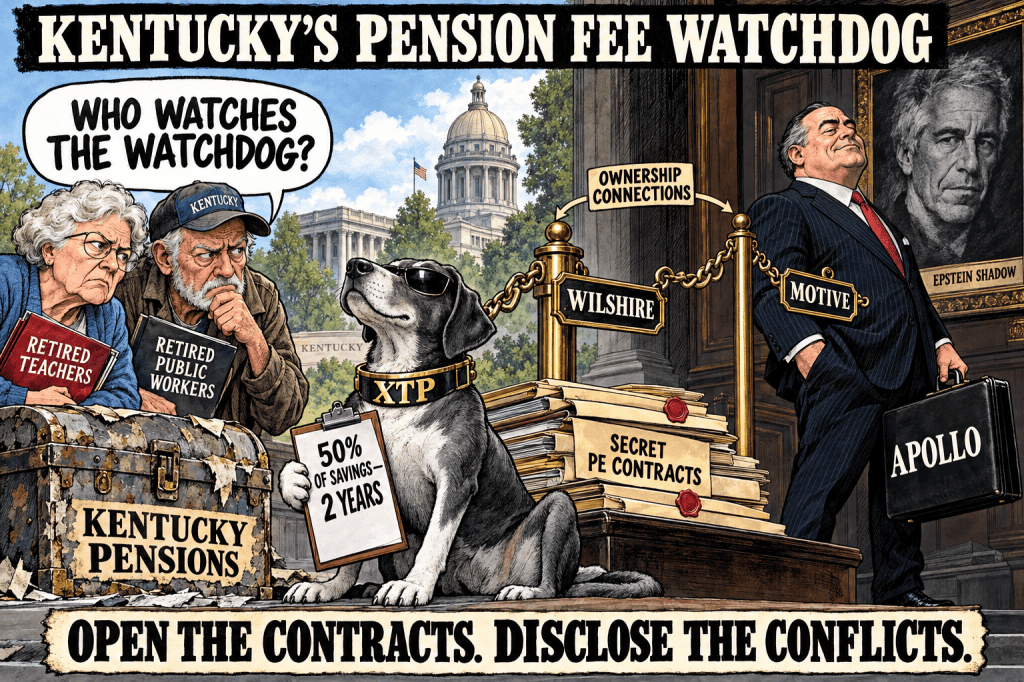
Kentucky’s public pensions need a comprehensive investigation of excessive investment fees. They also need to make sure the investigation does not become another way for Wall Street to profit from pension secrecy. Especially putting this into the hands of Apollo with its extensive connections to Jeffrey Epstein.
I have publicly estimated that CERS and related pension plans administered by the Kentucky Public Pensions Authority are burdened with more than $200 million a year in excessive fees, primarily associated with private equity firms operating through secret, no-bid contracts.
Now CERS has hired XTP Implementation Services to examine investment contracts and share in the savings.
Recovering pension money sounds attractive. But the ownership relationships behind the investigator raise an unavoidable question:
Could Kentucky’s fee investigation become a tool for selectively pressuring some private equity firms while protecting others?
The public deserves an answer before a savings announcement becomes an excuse to stop asking questions.
The 50% bounty is real
In his September 14, 2026, report to the CERS board, CEO Ed Owens announced that CERS had finalized its agreement with XTP. The assignment includes reviewing existing investment manager and contractual service agreements for compliance. CERS and XTP will split savings equally for the first two years; subsequent savings belong entirely to the trust.
That is a substantial financial incentive.
For illustration, $20 million in qualifying savings during the sharing period would mean $10 million for XTP. Whether that price is reasonable depends on the work performed, the alternatives available, and precisely how “savings” are calculated.
The board memorandum establishes a two-year sharing period. It does not establish that the bounty continues forever. Nor does that summary tell us whether there is a dollar cap, how recoveries are distinguished from future discounts, or who independently verifies the calculation.
Publish the executed contract. Kentucky should not need another secret agreement to investigate the costs of existing secret agreements.
Follow the ownership chain
Wilshire acquired XTP in August 2024. Wilshire itself was acquired by CC Capital and Motive Partners in January 2021. Later in 2021, Apollo announced a strategic partnership that included acquiring up to a 24.9% minority interest in Motive’s management company and investing through Motive-managed vehicles.
Gretchen Morgenson’s May 2026 reporting on the CalPERS investigation highlighted the Apollo–Motive–Wilshire connection. My accompanying CalPERS analysis examined the broader history of Apollo’s relationship with the pension fund.
Kentucky trustees should demand a current ownership chart, economic-interest disclosures, and an explanation of every party’s governance and information rights.
“Independent” should describe enforceable protections, not simply appear in the sales presentation.
Selective scrutiny could turn oversight into a competitive weapon
Consider how this arrangement could be misused.
An investigator examines one private equity manager aggressively, demands extensive documentation, challenges expense allocations and presses for concessions. Another manager receives a narrower review. A third is deferred.
Even when all contracts are nominally within scope, the depth, timing and consequences of scrutiny can differ dramatically.
If Apollo competitors received aggressive treatment while Apollo-related interests received favorable treatment, Kentucky’s pension oversight could become a competitive weapon.
A targeted firm might face pressure to make concessions while a connected competitor preserved its economics. A few visible savings could then provide political cover for leaving much larger costs untouched.
Who decides which fees deserve a fight?
A percentage-of-savings arrangement rewards recoveries that qualify for compensation. It does not automatically reward a complete accounting of every excessive cost.
An investigator could pursue easy discounts, avoid difficult managers, and produce a profitable engagement without confronting the largest problems.
A pension board could announce millions saved while leaving the basic system of secret contracts untouched.
The public therefore needs to see more than a total savings figure. It needs a manager-by-manager accounting of what was examined, what was challenged, what was recovered and what remains unresolved.
Every exclusion should have a written explanation. Every refusal to provide records should reach the trustees. Every material finding should survive the end of a negotiation.
A manager’s willingness to offer a discount must not buy silence about the underlying conduct.
A compliant contract can still be an outrageous bargain
CERS’s description emphasizes checking whether contracts are being followed. That is useful work. It is also an inadequate stopping point.
A private equity manager can follow an agreement perfectly while collecting excessive compensation under its terms.
If Kentucky agreed to an overpriced arrangement, confirming that the manager charged the agreed price does not establish that the price was prudent.
The review must distinguish among billing errors, unauthorized expenses, contractually permitted but excessive charges, and the total economic cost of the investment.
Otherwise, “the contract was followed” could become the latest defense of a terrible contract.
Pension data must stay out of competitors’ hands
XTP says it obtains detailed investment cost information, investigates contractual compliance and negotiates with service providers. Its website also claims that it has no conflicts because it works exclusively for asset owners.
That claim deserves scrutiny across the ownership structure.
An investigator could obtain information about competitors’ fee concessions, side letters, expense practices and negotiating positions. Those records can have substantial commercial value.
Kentucky should require explicit restrictions preventing identifiable manager information from reaching Apollo, other investment managers, or unauthorized affiliates and owners. Those restrictions should be independently tested.
Access to public pension contracts must never become a private intelligence service for a connected investment business.
Kentucky needs public rules and an independent referee
The legislature, trustees and state oversight officials should require:
- Full disclosure of the XTP agreement, including compensation definitions, caps, exclusions, termination provisions and confidentiality terms.
- A published review plan identifying covered managers, priorities and objective standards for scrutiny.
- Independent examination of connected firms, including any Apollo or Wilshire-related relationships within the assignment.
- Independent verification of savings, excluding automatic fee step-downs, reductions caused by declining assets, and concessions already secured by others.
- Separate treatment of recovered overcharges, so money already owed to retirees is not casually treated like a newly negotiated discount.
- Public reporting of findings and unresolved problems, with protections against settlements that conceal misconduct or unnecessarily waive claims.
Trustees must also compare the bounty with competitively priced alternatives. A contingent fee may reduce upfront spending, but half the recovery can still be an extraordinary price.
Retirees deserve the whole investigation
I have written about Kentucky’s pension funding problems and shrinking purchasing power, and questioned the priorities of politically directed pension examinations.
The same standard applies here: follow the money, disclose the conflicts and examine every manager under consistent rules.
XTP may identify meaningful savings. Kentucky should recover every dollar it can. But successful recoveries would not erase ownership conflicts, justify selective scrutiny, or establish that the remaining fees are reasonable.
Kentucky retirees should not have to wonder whether the firm investigating Wall Street’s fees is protecting a financially connected Wall Street interest.
Open the contracts. Publish the targets and the findings. Put connected firms under an independent examiner. Make every dollar of the bounty auditable.
A fee investigation that leaves the secrecy intact risks becoming one more profitable layer of the pension problem.

