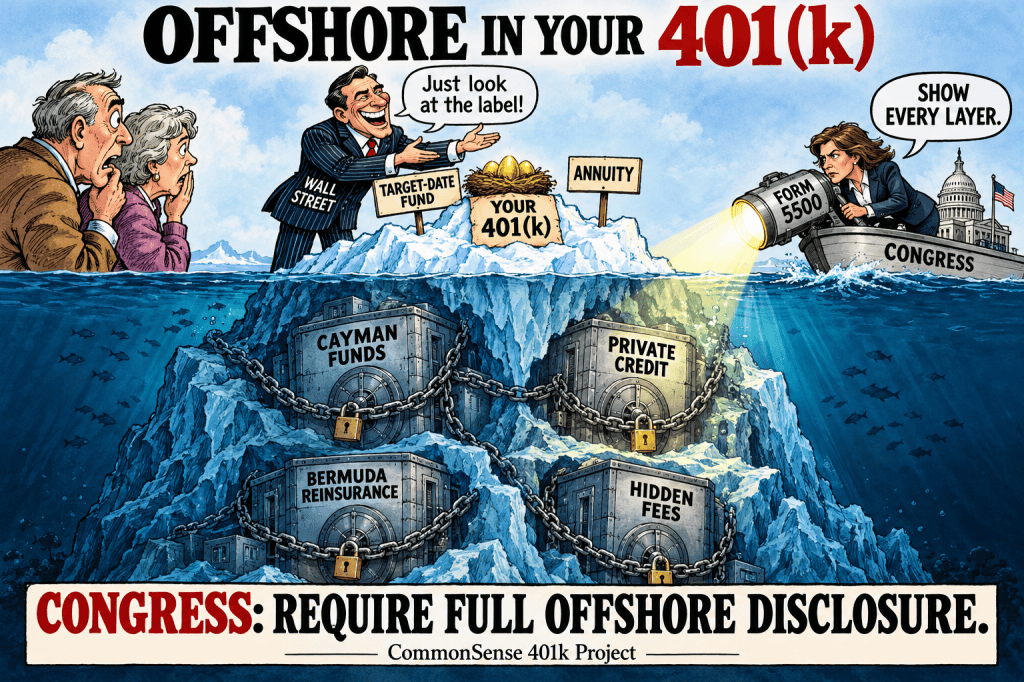
By Chris Tobe, CFA, CAIA | The CommonSense 401k Project
Your 401(k) statement may show a familiar American investment company, a target-date fund, or an insurance company promising safety. That label does not tell you whether your retirement savings depend on a Cayman partnership, a Luxembourg credit fund, a Bermuda reinsurer, or several of them. 401(k)s in SEC registered mutual funds do not have to worry nearly as much about these issues, but as these assets go under 50% of 401ks, CITs and other more non-transparent vehicles need more scrutiny.
Congress should require the annual Form 5500 filing to show that entire chain. Workers should be able to discover where their retirement investments are legally organized, who controls the money, how fees are collected, and what happens when they want it back.
Offshore is already a major part of private finance
The SEC’s Private Fund Statistics for the fourth quarter of 2025 show that 45.4% of reported private-fund net asset value was domiciled outside the United States. Cayman alone accounted for 29.7%.
The differences across categories matter. Cayman represented 53.7% of qualifying hedge-fund NAV and 23.8% of the Section 4 private-equity-fund population. These are asset shares within SEC reporting populations, not percentages of all limited partnerships worldwide. www.sec.gov
Private credit has a substantial offshore infrastructure too. An Alternative Credit Council/Dechert survey found that approximately 59% of responding managers used Cayman for private credit funds, and approximately 59% used Luxembourg. Managers could select multiple domiciles; these figures measure managers’ use of jurisdictions, not global market shares. www.dechert.com
Offshore structures are part of the machinery that can stand behind retirement products marketed to American workers.
Follow legal ownership and follow the money
A Cayman domicile does not prove that a plan wired its contribution to a bank in Cayman. The fund could use a U.S. bank account and invest in American businesses. A domestic fund can also invest through offshore entities.
That complexity strengthens the case for disclosure.
A bank address answers one question. The partnership agreement answers another. Neither alone reveals the complete investment.
Tax planning is often part of the design. Offshore corporate blockers can address unrelated business taxable income for tax-exempt investors. Other structures address foreign investors’ exposure to U.S. taxation. Legal form and tax classification matter: an offshore partnership is not automatically a corporate blocker. www.sec.gov
Workers deserve to know whose tax problem the structure solves, who benefits, what it costs, and whether it changes their recovery rights.
“Tax efficient” should begin an explanation. It should never end the inquiry.
Target-date funds can conceal the chain behind a retirement year
In “401(k): Who Is Your Regulator—DOL, SEC, Iowa, Nevada, or the Caymans?”, I described the accountability problem created by layers of trusts, insurance contracts, and private investments.
In “Target-Date Fund Risk Games: Change the Accounting, Declare the Portfolio Safer,” I examined a related problem: portfolios can combine publicly priced investments with private assets whose changing values appear on a different timetable.
Together, those issues create a dangerous disclosure gap.
An investment can sit several layers below the option named on a participant’s statement. Its fees, borrowing, withdrawal restrictions, and valuation practices can become difficult to identify. Meanwhile, delayed recognition of changing values can make reported volatility and correlation look reassuring.
An offshore address does not establish valuation abuse. But neither does a daily target-date-fund price establish that every underlying investment was independently repriced that day. The CommonSense 401k Project
Congress should require disclosure that connects legal structure to economic exposure and the methods used to measure it.
Annuities bring a second offshore route
Fixed annuities deserve particular scrutiny because the insurance promise can obscure the assets and counterparties supporting it.
Life insurers increasingly rely on private credit. A Chicago Federal Reserve working paper, revised in April 2026, identified $849 billion of private-placement credit on life insurers’ balance sheets in 2024, representing 14% of general-account assets. The authors found private-equity-owned insurers were important drivers of the growth. chicagofed.org
Private credit can involve offshore funds, financing vehicles, and securitization issuers. Separately, insurers can transfer economic exposure through offshore reinsurance. These channels can overlap. Neither should disappear from retirement-plan disclosure.
Treasury’s 2025 insurance report described reserves ceded to offshore jurisdictions as nearly quadrupling between 2019 and 2023, to more than $450 billion. It identified offshore reinsurance as a potential blind spot in conventional leverage measures. home.treasury.gov
An annuity’s U.S. issuer therefore does not supply a complete map of its financial backing.
Nor does “reserves offshore” necessarily mean a corresponding pile of cash moved overseas. Under funds-withheld and modified-coinsurance arrangements, backing assets can remain on the originating insurer’s books while contractual arrangements transfer economic exposure. www.federalreserve.gov
That raises concrete questions. Who selects the assets? Can an affiliated manager collect fees? What collateral supports the reinsurer’s obligation? What happens if the insurer must recapture the business during a crisis?
A “guaranteed” label answers none of them.
Congress should mandate a Form 5500 investment-chain schedule
Form 5500 already has insurance, service-provider, financial, and pooled-investment reporting components. Congress should build on that system and require standardized disclosure through every material layer. Naming the outer fund is inadequate. dol.gov
The legislation should require:
- The complete entity chain. Identify each feeder, master fund, partnership, blocker, holding company, insurer, and reinsurer creating material exposure. Report domicile, controlling owner, legal form, relevant regulator, and unique identifier. Cover direct holdings and material indirect exposures.
- The dollars exposed. State the plan’s investment and its attributable exposure by jurisdiction, asset class, and counterparty. Distinguish legal domicile, custody location, and the location of underlying borrowers or assets. Reconcile totals to prevent double counting.
- The purpose and cost of offshore entities. Explain tax, financing, marketing, or regulatory reasons for each material offshore layer. Identify beneficiaries and associated expenses.
- Every layer of compensation. Disclose management fees, carried interest, financing costs, affiliate payments, commissions, revenue sharing, and insurance compensation. For fixed annuities, report portfolio yield, participant crediting rates, and retained spread on a defined, consistent basis, identifying estimates and allocation limits.
- Liquidity and control. Disclose gates, capital calls, surrender charges, market-value adjustments, borrowing, collateral pledges, and rights to suspend payments. Identify who controls the assets and who can change those terms.
- Valuation and risk methods. Identify valuation frequency, independent pricing, manager estimates, and adjustments for stale prices. Explain how volatility, correlation, and diversification claims account for differing valuation schedules.
- An insurance-specific offshore supplement. Identify relevant reinsurance arrangements, ceded exposure, affiliate relationships, assets retained or transferred, collateral, recapture provisions, and applicable solvency regimes. Where general-account assets are pooled, require issuer-level disclosures and explain any allocation to the plan; do not invent contract-specific ownership of backing assets.
- Public, usable reporting. Require searchable, machine-readable filings and a plain-English participant summary. Protect account numbers and personal information while making material structures, fees, and risks public.
Secrecy cannot be the price of admission
Congress should place a direct information-supply obligation on providers seeking access to ERISA retirement money. Plan fiduciaries should have to obtain and evaluate the disclosures. Providers should certify their submissions, and material omissions should carry enforceable penalties and correction requirements.
“Proprietary” should not excuse withholding material fees, offshore counterparties, or withdrawal restrictions.
The legislation should establish that adding a feeder, CIT, insurance contract, or offshore affiliate does not extinguish the disclosure obligation. Exposure must remain traceable through the structure.
Workers receive tax benefits to save for retirement. Financial firms receive access to those savings. Congress should make access conditional on accountability.
If Wall Street wants offshore structures in America’s 401(k)s, it should have to explain every material layer in a public Form 5500 filing.
Workers should not need a subpoena to learn what stands behind their retirement savings.

