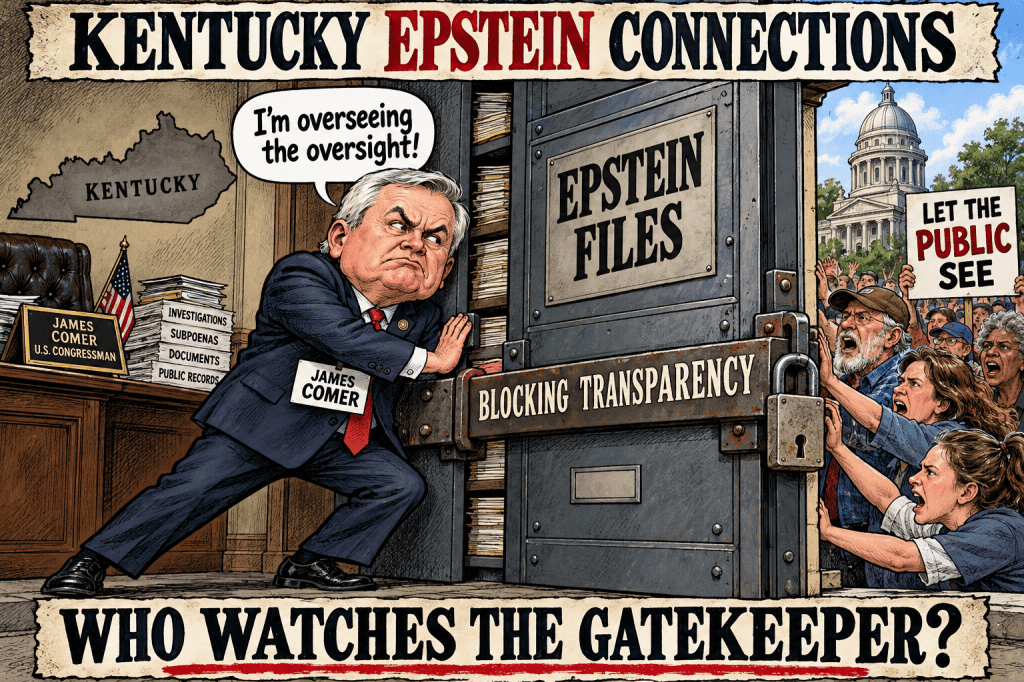
Comer should welcome every effective avenue for obtaining evidence. Instead, Comer publicly argued against the need for the very mechanism that ultimately helped produce the Epstein Files Transparency Act.
Comer eventually voted for that legislation when it passed the House 427–1 on November 18, 2025. That vote belongs in the record. It does not erase his earlier effort to persuade Americans that the pressure campaign was unnecessary.
A document dump is not the same as disclosure
Comer’s committee released more than 33,000 pages in September 2025. The number sounded impressive. But committee Democrats said approximately 97% of the material was already public. Louisville Public Media reported that the release largely contained information already known—and that the White House supported Comer’s process while fiercely attacking Massie’s effort.
When CNN confronted Comer with the 97% criticism, he pivoted to a comparison with Joe Biden and praised Trump’s cooperation.
That response exposed the political problem. Survivors needed an accounting of missing evidence. Comer offered a partisan comparison.
The proper measure of transparency is whether previously concealed evidence becomes available, whether withholding is justified and whether the public can determine what remains missing. Recycling thousands of pages cannot substitute for answering those questions.
Follow the money—after another delay
The financial records were central to understanding how Epstein operated.
On September 8, 2025, Comer’s committee promised to pursue additional bank records. On October 31, Khanna and other committee Democrats wrote to Comer pointing out that 53 days had passed without bank-record subpoenas being issued. Their letter demanded action and included a proposed document schedule covering financial transactions, communications and due diligence.
Comer subsequently subpoenaed JPMorgan Chase and Deutsche Bank on November 18. That was necessary investigative work. It also came more than two months after the committee publicly promised to pursue those records.
For anyone concerned about Wall Street’s role, that delay deserves scrutiny. Financial evidence should have been a priority from the outset.
The chairman repeatedly stepped into Trump’s defense
On August 18, 2025, Comer publicly praised the administration’s commitment to transparency as DOJ prepared to begin producing records.
On September 8, his official statement accused Democrats of politicizing the estate’s documents and emphasized that Trump was not accused of wrongdoing.
An investigator must distinguish evidence from insinuation. But the chairman’s job is to establish the facts wherever they lead. Repeatedly making the president’s political defense part of the committee’s message undermines confidence in that independence.
The committee’s own November release went further, describing testimony as having defeated Democrats’ allegations against Trump. The public-facing emphasis was unmistakable: protecting the president’s reputation had become part of the investigation’s presentation.
Massie and Khanna kept demanding enforcement
By January 2026, Massie and Khanna were asking a federal judge to appoint an independent monitor. They alleged missed deadlines, improper withholding and excessive redactions, alongside failures to protect survivors’ information.
In July, they introduced the Epstein Files Transparency Act II to provide additional avenues for challenging DOJ noncompliance in court.
Their persistence illustrates why assurances from committee leadership were inadequate. A transparency promise needs enforceable consequences.
Comer also took substantive steps that deserve acknowledgment. He subpoenaed banks and witnesses, issued a subpoena to Pam Bondi following a committee vote, and pursued Leon Black’s noncompliance. In September 2026, the House held Black in contempt after the committee unanimously recommended that action.
Those actions demonstrate that the committee possessed meaningful tools. They strengthen the case for demanding consistent, aggressive use of them.
The strongest case against Comer rests on his documented conduct: dismissing the need for the Massie–Khanna petition, defending the administration’s cooperation, delaying pursuit of banking evidence and repeatedly framing disclosures around Trump’s political defense.
Kentuckians should demand a public accounting of outstanding records, explanations for withheld material, equal treatment of witnesses and consequences for noncompliance.
Comer held the chairman’s gavel. He should be judged by how forcefully he used it to break secrecy—and by the occasions when he used his platform to tell Americans that the process they distrusted was working.
Kentucky Epstein Connections – As far as Donors – Andy Barr is clear winner
Kentucky Epstein Connections – Alvarado accuses Dembo, but has many of his own.
In the 6th District Congressional race Republican Ralph Alvarado accuses Democrat Zach Denbo of taking Epstein related donations from Reid Hoffman of LinkedIN. I applaud him for bringing out these facts. I think it is important to point out Alvarado’s far more serious Epstein ties.
There is no more serious connection to Epstein than Apollo and its founder/CEO Leon Black. From his conviction in 2008 to his death in 2019 Leon Black provided Epstein with over $158 million for “tax advice”, despite Epstein having no qualifications in that area. There are over 8000 mentions of Black in the Epstein Files. Current Apollo CEO Marc Rowan is also prominently featured in the Epstein files. Apollo owned Lifepoint Health gave a $10,000 donation to Alvarado.
Alvarado received substantial funding from the MAGA Inc. Superpac, whose donors include many Epstein buddies and those broadly in the Epstein Class. Howard Lutnick current Commerce Secretary, and Epstein neighbor gave MAGA Inc. $8.75mm and lied about visiting Epstein Island in 2012 claiming he cut ties in 2005. Ron Lauder a $5mm donor to MAGA Inc. who is best known for pushing Trumps “Greenland” initiative but files show that Epstein helped him establish an entity for him and Leon Black to jointly purchase a valuable painting which got 961 mentions in the Epstein files. . Stephen Schwatzman another $5mm MAGA donor has only 179 mentions in the Epstein file. Marc Rowan of Apollo gave $1mm to MAGA as well.
Documents show Epstein helped establish an entity through which Lauder and Black jointly acquired a valuable painting
As head of Kentucky Epstein Justice, I want to look at every congressional race the US Senate Race and the Louisville Mayor Race for Epstein related donations.
6th District Congressional race Ralph Alvarado accuses Denbo of taking https://www.facebook.com/RalphAlvaradoMD/posts/we-now-know-who-has-been-paying-for-the-zach-dembo-for-congress-tv-attack-adsjef/1489849429632674/
We now know who has been paying for the Zach Dembo for Congress TV attack ads:
Jeffrey Epstein pal, billionaire Reid Hoffman gave $500K to the Dembo superPAC- almost half of the cash raised.
Hoffman once sent Epstein ice cream with a note that it was “for the girls”
So every time you see an ad meant to help Zach Dembo, it was probably paid for by the billionaire who sadistically sent ice cream to Jeffrey Epstein’s victims. Dembo wants power so bad he doesn’t care where the money came from.
This is dirty Epstein Class money fueling Zach Dembo’s campaign and it’s offensive that it’s taken this long for Kentucky to learn the truth.
Here is the first filing:


Pingback: Kentucky Epstein Connections – Andy Barr Leads the Way | The CommonSense 401k Project