By Christopher B. Tobe | Commonsense401kProject | November 5, 2026
Elon Musk is getting much of the attention as one of the biggest political losers in Texas’s November 3 elections. But another billionaire financial empire deserves scrutiny: Apollo Global Management and its insurance subsidiary, Athene.
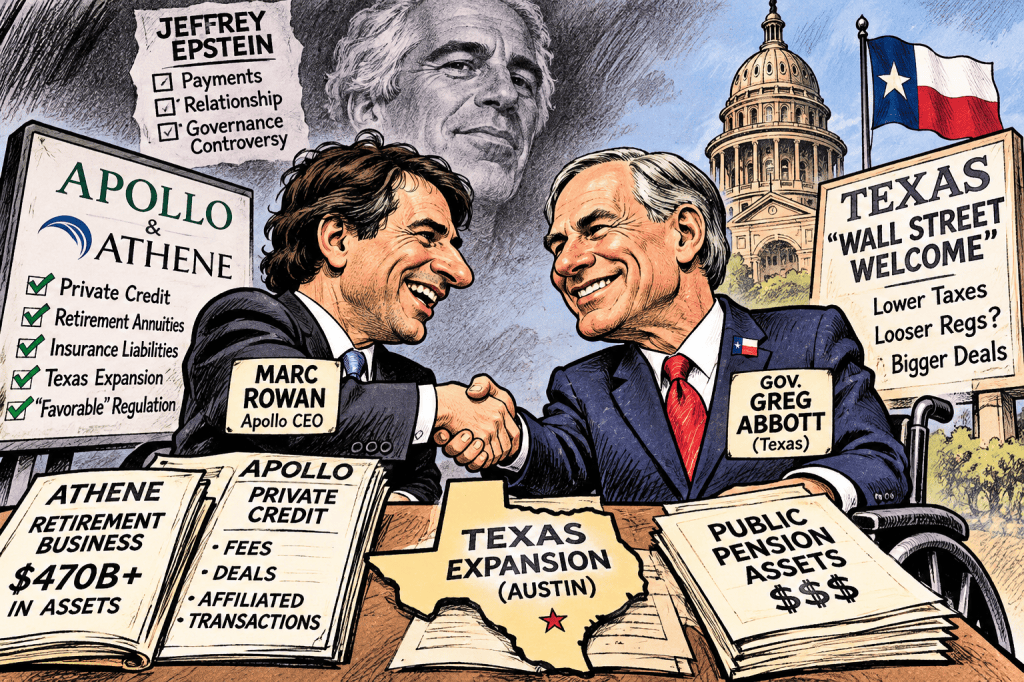
On August 3, 2026, Apollo CEO Marc Rowan announced that Austin, Texas, would become a major new strategic hub for Apollo and Athene.
Texas Governor Greg Abbott enthusiastically welcomed the announcement, proclaiming Texas the new financial capital of America.
Exactly three months later, Texas voters rejected Abbott and elected Democrat Gina Hinojosa governor. Democrats also won the lieutenant governorship, attorney general’s office, and comptroller’s office.
For Apollo, the timing could hardly be more interesting.
The firm had just selected Texas as an important center for expanding its investment management, private-credit, financial-market, and retirement insurance businesses. It praised the state’s favorable business environment.
Now the politicians responsible for that environment are being replaced.
The question is whether Texas will continue competing to attract Wall Street firms by offering favorable conditions—or start demanding something more valuable: transparency, accountability, and genuine protection for retirees and taxpayers.
Apollo’s August Announcement: More Than Another Corporate Office
Apollo’s August 3 announcement was not simply about relocating employees from expensive New York offices to cheaper Texas real estate.
It was about building the next generation of Apollo and Athene.
The company described an Austin operation that would develop new investment products, distribution systems, infrastructure, market-making capabilities, and retirement solutions.
Apollo selected two important executives to lead the expansion:
- Eric Needleman, Apollo’s head of capital solutions.
- Mike Downing, a senior Athene executive.
Bloomberg reported that the new operation would include substantial market-making functions and business lines supporting Apollo and Athene.
This matters because Apollo is not merely another private-equity firm.
Through Athene, it operates one of the world’s largest retirement insurance businesses. Athene reported more than $470 billion in total assets as of June 30, 2026.
Apollo manages investments, including private credit. Athene sells retirement products and assumes long-term insurance obligations. Together, they form an enormously powerful financial structure connecting insurance liabilities to Apollo’s investment-management business.
In its official announcement, Rowan praised Austin’s talent, technology, and business environment.
Abbott celebrated Apollo’s decision as further evidence of Texas’s attractiveness to financial institutions.
What neither announcement adequately addressed was the question that should concern every pension trustee, insurance regulator, and retiree:
What happens when an increasingly complex financial empire combines private-credit investments, insurance guarantees, affiliated transactions, and long-term retirement obligations?
Why Did Apollo Choose Texas?
Texas has spent years advertising itself as an alternative to New York, California, and Delaware.
Its attractions include no individual state income tax, a relatively favorable business climate, expanding corporate-law infrastructure, and political leadership eager to recruit financial institutions.
The state has also become a major center for data centers, artificial intelligence infrastructure, energy development, semiconductor manufacturing, and other capital-intensive businesses.
These industries need enormous amounts of financing.
Apollo wants to provide that financing.
The combination is commercially attractive: Apollo can arrange and manage loans and other investments, while Athene’s retirement business provides a source of long-duration capital that can be invested subject to applicable insurance requirements.
But the advantages of this arrangement for Apollo’s shareholders and investment managers are not necessarily identical to the interests of annuity holders.
There is an important distinction here. Apollo has not established that its decision to expand in Texas involved relocating Athene’s insurance-company domicile or escaping an existing regulator. Athene maintains substantial insurance operations regulated through Iowa and Bermuda, among other jurisdictions.
Nevertheless, the Austin expansion raises a legitimate question about whether Texas’s broader regulatory philosophy influenced Apollo’s choice.
Did Apollo choose Texas merely for talent and taxes, or did it also expect a political and regulatory environment sympathetic to increasingly complex financial products?
Apollo should be asked directly.
The Apollo-Athene Machine: Private Credit Meets Retirement Savings
The relationship between Apollo and Athene illustrates one of the most important structural developments in American retirement finance.
Traditional insurance companies collect premiums, invest the proceeds, and promise future payments.
Apollo and Athene have expanded that model by integrating a major alternative asset manager with a major retirement insurer.
The arrangement creates several potential conflicts that deserve much closer examination.
First, affiliated investment management.
When an insurance company uses an affiliated investment manager, regulators and policyholders need to know how fees are determined, how investments are selected, and whether affiliated transactions are conducted on fair terms.
Second, private-credit valuations.
Private loans and other illiquid assets generally lack the continuous market pricing available for publicly traded bonds.
Their reported values can depend heavily on models, assumptions, and appraisals.
This creates opportunities for valuation smoothing and potentially delayed recognition of losses.
Third, liquidity mismatches.
Annuity liabilities can extend for decades. Private-credit assets may also be long-term and illiquid, but their cash flows, credit risks, and liquidity characteristics do not necessarily match the insurer’s obligations.
Fourth, offshore reinsurance and regulatory arbitrage.
Complex insurance groups may use offshore reinsurers and affiliated entities to allocate liabilities and capital across jurisdictions.
Such structures are not inherently improper. But they deserve consolidated supervision, transparent disclosures, and credible stress testing.
Fifth, the concentration of retirement risk.
A pension plan transferring billions of dollars in liabilities to one insurer is replacing a diversified pension investment portfolio and federal pension insurance protections with a long-term contractual obligation dependent on the insurer’s financial strength and applicable state guaranty arrangements.
The relevant question is not whether Athene currently satisfies regulatory capital requirements.
It is whether those requirements, together with existing disclosure and supervisory practices, adequately capture the risks of an increasingly interconnected private-credit and insurance system.
What the Wharton Research and the 2008 Financial Crisis Tell Us
In my October 20 article, Wharton Exposes the Private Equity Insurance Risk Machine—and Why the Entire Annuity Industry May Be Forced to Follow, I examined research raising concerns about the changing investment practices of life insurers.
The problem is not confined to private-equity-controlled insurance companies.
As insurers pursue higher investment returns, competitors may face pressure to increase allocations to private credit, structured investments, and other less-liquid assets.
That can transform a firm-specific investment strategy into an industry-wide financial stability concern.
The 2008 experience of AIG should remain a warning.
AIG’s near-collapse demonstrated how quickly confidence in a highly rated financial institution can deteriorate when complex obligations, collateral demands, and liquidity pressures converge.
Athene’s business model is not identical to AIG’s pre-crisis financial-products business, and the two should not be treated as interchangeable.
But the broader lesson is unmistakable:
An insurance guarantee is only as reliable as the insurer’s capacity to honor it under severe financial stress.
A high credit rating, favorable accounting presentation, or reassuring statement from management is not a substitute for transparent risk analysis.
Texas’s Insurance Regulators Should Be Asking Tougher Questions
Texas has actively competed to attract insurance companies.
That strategy may create jobs and economic activity, but it also raises questions about regulatory capacity.
The Texas Department of Insurance has acknowledged growing demands associated with its expanding domestic insurance industry.
If increasingly complex insurers, reinsurers, and financial groups are operating in or entering Texas, the state must ensure that examination staffing, actuarial expertise, investment oversight, and enforcement resources keep pace.
For Apollo and Athene, the most important regulatory questions involve their actual insurance entities and transactions, including those supervised outside Texas.
A Texas governor or attorney general cannot simply rewrite Iowa insurance law or Bermuda reinsurance requirements.
But Texas officials can examine transactions within their jurisdiction, strengthen oversight of Texas-regulated insurers, investigate potential violations of applicable law, and advocate for broader reforms through national regulatory organizations.
They can also demand much greater transparency when public pension money is entrusted to alternative asset managers.
That is where the election may become particularly consequential.
Texas Public Pension Funds: Follow the Money
Texas controls or oversees an enormous ecosystem of public retirement assets.
Major systems include the Teacher Retirement System of Texas, Employees Retirement System of Texas, Texas Municipal Retirement System, and Texas County & District Retirement System.
These systems invest substantial sums through private-market managers.
The public deserves to know the precise extent of their relationships with Apollo, Athene, and affiliated investment vehicles.
A comprehensive investigation should disclose:
- Every Apollo-managed private-equity, private-credit, real-estate, infrastructure, and insurance-linked investment held by major Texas pension systems.
- Total capital commitments, invested amounts, distributions, and remaining unfunded commitments.
- Management fees, performance fees, carried interest, transaction charges, and expenses paid directly or indirectly to Apollo and related parties.
- Valuation methodologies, including the frequency of independent valuations and any secondary-market transactions that reveal discounts to reported net asset values.
- Placement-agent arrangements, pension consultant relationships, political contributions, and potential conflicts of interest.
- Whether Apollo or Athene has financed major Texas infrastructure or data-center projects in which public pension funds are investors, directly or indirectly.
These are investigative priorities, not allegations that every such relationship exists or that particular transactions were improper.
Texas pension trustees have a duty to act in beneficiaries’ interests.
They should not be permitted to hide behind claims of trade secrecy when billions of dollars of public retirement money are at stake.
The Epstein and Leon Black Questions Have Not Disappeared
Apollo’s history adds another reason why independent scrutiny matters.
Apollo co-founder Leon Black’s financial relationship with Jeffrey Epstein paying him $148mm for tax advice has became a major corporate governance controversy.
Apollo commissioned a review of those payments, and Black subsequently left his leadership positions.
The existence of that relationship does not establish wrongdoing by every Apollo executive or by Athene. Nor does it establish that current Texas pension investments are connected to Epstein.
But the episode demonstrates why private financial relationships, governance arrangements, and conflicts of interest must be examined rather than accepted on management’s assurances.
In my earlier investigation, CalPERS’ Sick, Twisted Relationship with Jeffrey Epstein-Linked Apollo Private Equity, I questioned whether California’s public pension system had sufficiently addressed the implications of its relationship with Apollo.
The broader concern is whether public pension boards have the independence and determination to challenge powerful financial managers when uncomfortable facts emerge.
Texas should not repeat California’s mistakes and consider divestiture.
Governor Hinojosa and Attorney General Johnson Have an Opportunity
The election of Gina Hinojosa as governor, Nathan Johnson as attorney general, and Sarah Eckhardt as comptroller creates an opportunity for a different approach to financial accountability.
The new leadership should not assume that every policy associated with Abbott was improper.
Nor should it automatically treat every financial institution that expanded into Texas as suspect.
Instead, it should establish an evidence-based review of whether Texas’s economic-development and financial-regulatory policies have adequately protected the public.
Governor Hinojosa should direct an independent review of the state’s insurance regulatory capacity, appointments, economic-development incentives, and relationships with major financial institutions.
Attorney General Johnson should examine potential violations of Texas law involving public contracting, consumer protection, conflicts of interest, and financial representations, using the office’s lawful investigative and enforcement authority.
Comptroller Eckhardt should examine relevant state expenditures, economic-development incentives, and transparency requirements within the comptroller’s statutory jurisdiction.
The legislature should strengthen public pension disclosure laws, including requirements for underlying private-market holdings, valuation methodologies, fees, affiliated transactions, and political spending disclosures.
Independent pension boards would retain their legal investment authority, but secrecy should not be confused with fiduciary independence.
Seven Reforms Texas Should Pursue
1. Full private-market investment transparency. Public pension systems should disclose underlying investments, fees, valuation methods, and material conflicts, with carefully limited protections for genuinely sensitive information.
2. Independent private-credit valuation reviews. Large private-market investments should undergo independent valuation testing, including comparisons with actual secondary-market transactions.
3. Insurance-company stress testing. Regulators should examine how major credit losses, liquidity shocks, rating downgrades, and reinsurance counterparty failures could affect annuity obligations.
4. Transparency for affiliated transactions. Insurers should disclose material related-party investment management fees, financing arrangements, reinsurance transactions, and potential conflicts.
5. Stronger protections for pension risk transfers. Contracts should incorporate meaningful downgrade protections, enhanced disclosure, and enforceable remedies where legally and commercially feasible.
6. Political spending and placement-agent disclosure. Investment managers seeking public pension business should disclose relevant direct political contributions, intermediaries, and legally reportable indirect political spending. Legislators should examine additional disclosure requirements that can survive constitutional scrutiny.
7. Federal life insurance oversight. Texas should support stronger federal transparency and systemic-risk oversight of major life insurance groups while preserving appropriate state regulatory responsibilities.
These proposals would not prevent Apollo, Athene, or any other financial institution from operating in Texas.
They would require firms benefiting from access to retirement savings and public pension assets to meet higher standards of accountability.
The Real Question: Who Benefits from Texas Becoming a Financial Capital?
Apollo’s Texas expansion may prove economically successful.
It may generate well-paid jobs, attract investment, and strengthen the state’s financial-services sector.
None of those outcomes should be dismissed.
But the benefits to Texas taxpayers, pension participants, and insurance policyholders must be evaluated separately from the benefits to Apollo’s executives and shareholders.
There is nothing inherently wrong with a financial firm choosing a state with favorable taxes and an attractive business environment.
There is something profoundly wrong if regulatory competition becomes a race to provide the least scrutiny of complex financial risks.
Texas should compete on the quality of its workforce, infrastructure, universities, and economic opportunities.
It should not compete by weakening protections for retirees.
Conclusion: Apollo’s Texas Gamble Just Became More Interesting
On August 3, Marc Rowan and Greg Abbott celebrated Apollo’s decision to make Austin a major center for the future of Apollo and Athene.
On November 3, Texas voters rejected Abbott.
Texas’s new leadership can investigate whether the state’s financial-sector growth has been accompanied by adequate transparency, regulatory resources, and protections for retirement assets.
The most important questions are straightforward:
How much Texas pension money is invested with Apollo? What fees and risks are embedded in those investments? How are Athene’s insurance obligations supported? And who independently verifies the answers?

