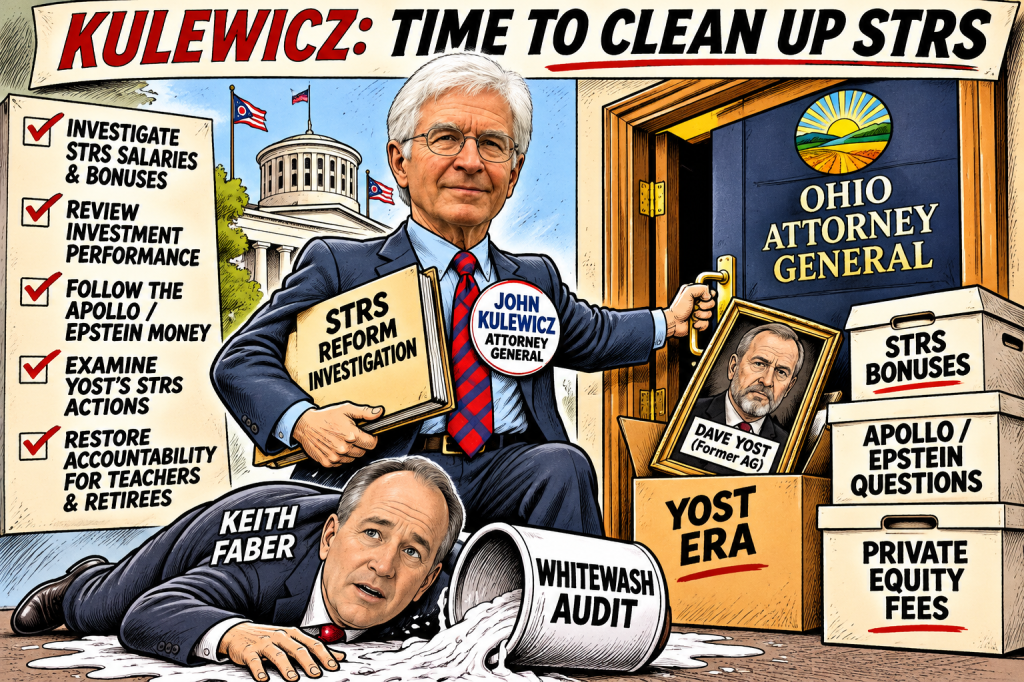
By Christopher B. Tobe, CFA
The CommonSense 401k Project | November 5, 2026
Ohio’s New Attorney General Could Be Even More Important to Pension Reform Than Its New Governor
Ohio voters have given their state an extraordinary opportunity.
Amy Acton defeated Vivek Ramaswamy for governor. John Kulewicz defeated Keith Faber for attorney general. Sherrod Brown defeated Jon Husted for the United States Senate.
These election results open the door to a serious examination of Ohio’s public pension establishment and its relationships with politically connected Wall Street firms.
Yesterday, I explained how Governor-elect Amy Acton can expose Ohio’s pension, private equity and data-center money machine.
But Kulewicz may have an even more direct route to pension accountability.
Ohio’s attorney general is the statutory lawyer for the State Teachers Retirement System of Ohio (STRS).
That means Kulewicz will inherit not only the power to investigate potential wrongdoing but also an office that helped shape the state’s legal response to years of controversy at STRS.
Former Attorney General Dave Yost pursued an aggressive case against reform-oriented trustees Wade Steen and Rudy Fichtenbaum over their involvement with QED, a proposed investment firm with $0 assets and paid $0 fees. Ohio’s next attorney general should investigate why the state devoted substantial legal resources to pursuing pension reformers while retirees spent their own money seeking transparency.
Meanwhile, questions about private equity fees, pension investment performance, extraordinarily high staff compensation and Apollo’s connections to Jeffrey Epstein remained unresolved.
Now a new attorney general can review both sides of that history.
The first question Kulewicz should ask is simple:
Was Ohio’s legal machinery used primarily to protect teachers’ retirement savings—or to protect the existing pension establishment from its critics?
That question deserves an independent, evidence-based investigation.
1. Yost Pursued the Reform Trustees. Who Investigated the Pension Money Machine?
In May 2024, Dave Yost launched a sham investigation into what he described as an attempted takeover of STRS by private interests.
The investigation centered on QED and allegations involving trustees Wade Steen and Rudy Fichtenbaum.
Why did the state’s most visible pension enforcement effort focus on a proposed investment arrangement with $0 assets and paid $0 fees.while enormous existing private equity investments in $billions in secret no-bid contracts and excessive staff compensation received comparatively little public scrutiny?
QED was not even a real investment firm while the AG helped block the transparency of secret no-bid contracts in the $billions
Ohio Media’s Complicity: How a Fake Scandal Hid the Real Teacher Retirement System Corruption
The new attorney general should determine whether the state’s enforcement priorities were fair, consistent and focused on the greatest financial risks to beneficiaries.
2. The Attorney General Is STRS’s Lawyer. That Changes Everything.
Ohio Revised Code §109.02 designates the attorney general as the state’s chief law officer.
The attorney general’s office represents state agencies, boards and retirement systems, subject to statutory exceptions and provisions governing outside counsel.
Yost’s own office acknowledged this relationship in November 2023 when announcing an outside investigation of allegations involving STRS Executive Director Bill Neville.
This is an extraordinary institutional relationship.
The attorney general’s office can advise the pension system, participate in litigation affecting its trustees and appoint outside lawyers for specialized matters.
That means Kulewicz should not have to approach STRS as a stranger requesting voluntary cooperation.
His office already possesses a legal relationship with the institution.
However, being STRS’s lawyer does not make the attorney general its investment manager, and it does not automatically give him unrestricted access to every privileged document for an adversarial investigation.
The attorney general must identify the client, resolve conflicts, respect attorney-client privilege and use appropriate statutory investigative powers.
Those legal boundaries make an independent review essential.
Kulewicz should immediately commission a comprehensive examination of the attorney general’s historical relationship with STRS, including legal advice, special-counsel appointments, enforcement decisions and potential conflicts.
The investigation should be conducted by lawyers who were not involved in the challenged decisions.
3. The Salary Scandal: STRS Investment Employees Earned Far More Than the People Checking Their Numbers
One of the most troubling findings in my Ohio pension research concerns compensation.
In May 2026, I published:
Ohio STRS Investment Staff: Paid Excessively to Look the Other Way
The compensation data examined in that article revealed a remarkable imbalance.
| Position | Reported annual compensation |
| Chief investment officer | $913,909 |
| Chief financial officer | $193,933 |
| Average investment employee | $180,693 |
| Average accounting employee | $89,686 |
The chief investment officer received approximately 4.7 times the compensation of the chief financial officer.
The average investment employee earned approximately twice as much as the average accounting employee.
As a CFA charterholder who has worked in institutional investment management, I recognize that investment professionals often earn more than accountants.
But compensation differences of this magnitude demand scrutiny, especially when the highest-paid personnel control opaque private market investments and influence the performance measures used to calculate their bonuses.
The issue is not simply how much money they make.
It is who verifies the numbers.
Investment professionals influence private equity allocations, investment assumptions, manager selection and performance reporting.
Accounting professionals are responsible for financial controls, reconciliation and audited financial reporting.
When the investment side is paid dramatically more than the control side, boards should examine whether independent financial oversight has sufficient authority and resources.
Kulewicz should request a comprehensive compensation review, including salary surveys, bonus formulas, employment contracts and the underlying data supporting claims that such compensation is necessary to retain talent.
The review should also examine whether STRS paid employees for performance that did not actually benefit retirees.
4. The Academic Evidence: STRS Used a More Favorable Performance Number for Bonuses
This may be the strongest reason for an independent attorney general investigation.
In July, I discussed academic research by Allen Mendenhall and Dan Sutter:
New Academic Paper: Ohio STRS Had Two Performance Numbers—And Used the Better One to Pay Bonuses
The researchers examined STRS investment reporting from 2003 through 2022.
Their findings were extraordinary.
In 19 of the 20 fiscal years examined, STRS’s reported investment return exceeded the return the researchers independently calculated from audited financial information.
The average difference was approximately 33 basis points annually.
The researchers estimated that the differences represented approximately $4.8 billion when added across the years, or $9.3 billion on a compounded basis.
These figures are not established investment losses or amounts of improperly paid bonuses. They measure the differences produced by the researchers’ methodology.
But the compensation connection is particularly troubling.
The research reported that STRS used the more favorable internally reported performance figures in determining investment staff bonuses.
Ohio’s Public Employees Retirement System, used as a comparison, exhibited much smaller and more balanced discrepancies.
The research does not prove criminal falsification of accounting records. Different investment-return methodologies can produce legitimate differences.
Nevertheless, the persistent direction of the discrepancies and their relationship to compensation justify independent forensic examination.
Kulewicz should demand a year-by-year reconciliation between the investment performance figures, audited financial information and bonus calculations.
He should ask whether any material representations concerning performance or compensation were misleading, and whether pension assets could be recovered if legal violations are established.
If STRS employees were paid bonuses using performance figures that materially overstated results, Ohio’s attorney general should determine whether those payments were lawful and recoverable.
5. Four Employees Above $600,000. Twenty Above $400,000. What Were Teachers Getting?
My earlier research identified the following compensation distribution in the STRS payroll data examined:
- 4 employees earning more than $600,000.
- 20 earning more than $400,000.
- 49 earning more than $300,000.
- 85 earning more than $200,000.
Such compensation levels double to triple being paid in the private sector for similar investments professionals in Ohio are difficult to justify especially when they rig their own bonuses.
For years, Ohio teachers and retirees experienced restrictions on cost-of-living adjustments while the pension system maintained substantial investment-staff compensation.
Kulewicz should investigate the entire compensation system, including the consultants who helped design and justify it.
Global Governance Advisors was selected because they justified excessive salaries at many other plans.
Were compensation comparisons adjusted for Columbus’s cost of living, job security and public employment benefits?
Did STRS use transparent, investable benchmarks when calculating investment performance?
And did employees receive bonuses despite underperforming simple, lower-cost investment alternatives?
The answers could reveal whether the compensation system served beneficiaries or the employees and consultants who benefited from it.
6. Apollo and Jeffrey Epstein: The Investment Manager Ohio Should Investigate First
The Epstein scandal became a major issue in Ohio’s 2026 Senate election.
Leslie Wexner’s relationship with Epstein attracted substantial attention.
But another financial relationship deserves examination.
Apollo co-founder Leon Black paid Jeffrey Epstein more than $150 million for purported tax and estate-related services, including payments made after Epstein’s 2008 conviction.
Nevertheless, the payments raise serious questions about judgment and governance involving the former leader of a major investment manager.
STRS Ohio has maintained investment relationships with Apollo-managed funds.
I documented these concerns in:
Epstein, Apollo and Ohio Teachers’ Billions
Kulewicz should ask whether STRS and its investment advisers conducted adequate due diligence concerning Apollo’s governance and the Epstein revelations.
He should also investigate Apollo’s investment fees, valuations, returns, conflicts and representations to pension investors.
The immediate objective should be a complete accounting of Ohio pension exposure to Apollo.
The next step should be a moratorium on new commitments while the review proceeds, followed by an orderly divestiture analysis where continued investment cannot be justified under applicable fiduciary standards.
7. The FirstEnergy Lesson: Follow the Money, Not the Political Narrative
Ohio has already experienced a major corruption scandal involving FirstEnergy and House Bill 6.
That scandal demonstrated how corporate money, political influence and weak accountability can intersect.
Public pensions present a different legal and financial structure, but the same basic warning applies.
When billions of dollars move through complicated financial relationships, transparency cannot depend on assurances from the people collecting the fees.
Kulewicz should examine pension-related political contributions, lobbying, placement agents, consultant relationships and charitable contributions that may create conflicts.
The inquiry should also extend to Ohio’s data-center and infrastructure investments where public subsidies and pension capital intersect.
But the investigation must distinguish legitimate commercial relationships from actual misconduct.
The existence of a political donation, private equity investment or professional relationship is not itself evidence of corruption.
The objective should be to identify undisclosed conflicts, misleading representations, violations of fiduciary duties and recoverable financial harm.
8. A First 180-Day Plan for Attorney General Kulewicz
Kulewicz will take office in January 2027.
He should make public pension accountability one of his first priorities.
First 30 days: Establish an independent STRS legal and fiduciary review.
Identify conflicts within the attorney general’s office, appoint independent counsel where necessary and preserve relevant records.
Request the complete QED litigation and investigative record, special-counsel engagement agreements, compensation policies and major investment contracts.
Days 31–90: Investigate salaries, bonuses and performance calculations.
Commission a forensic reconciliation of the Mendenhall–Sutter findings.
Examine investment-staff compensation, consultant benchmarking, valuation policies and bonus formulas.
Identify any legal basis for recovering improper payments.
Days 91–120: Follow Apollo and the private equity money.
Compile Ohio pension commitments, fees, distributions, valuations and reported returns involving Apollo and other major alternative managers.
Review Epstein-related due diligence and material disclosures.
Examine whether the state has potential contractual, fiduciary or other legal claims.
Days 121–180: Publish findings and pursue appropriate legal remedies.
Release a public report separating verified facts, disputed allegations, legal conclusions and matters requiring additional investigation.
Refer potential criminal violations to the appropriate authorities when warranted.
Recommend legislation creating an independent pension inspector general, stronger private investment disclosure, compensation controls and meaningful beneficiary enforcement rights.
9. Kulewicz and Acton Can Work Together—but Their Powers Are Different
Governor-elect Amy Acton can promote pension transparency through appointments, executive leadership, public advocacy and proposed legislation.
Attorney General-elect John Kulewicz has a different set of tools.
His office can provide legal representation, review existing litigation, appoint special counsel and pursue civil enforcement within the limits of Ohio law.
Neither official controls every pension board decision.
But together they can make it substantially harder for questionable compensation arrangements, conflicted investments and inadequate disclosures to escape examination.
The governor can demand political accountability.
The attorney general can demand legal accountability where the law permits.
And both can ask Ohio’s pension systems to demonstrate that they are acting for teachers and retirees rather than for investment managers, consultants or their own employees.
Conclusion: Ohio Needs an Attorney General for Teachers, Not a Lawyer for the Pension Establishment and their Donors in Private Equity
For years, Ohio teachers have watched their retirement system pay enormous salaries, defend opaque private equity investments and resist demands for greater transparency.
Dave Yost’s office pursued reform trustees over the QED controversy.
Why did STRS’s performance numbers differ from independently calculated returns?
Why were investment employees paid so much more than the accountants responsible for financial controls?
Who benefited from private equity fees and opaque valuations?
What did STRS know about Apollo’s governance problems and Leon Black’s extraordinary payments to Jeffrey Epstein?
And did Ohio’s legal establishment devote sufficient attention to those issues?
John Kulewicz should make answering those questions a defining responsibility of his administration.

