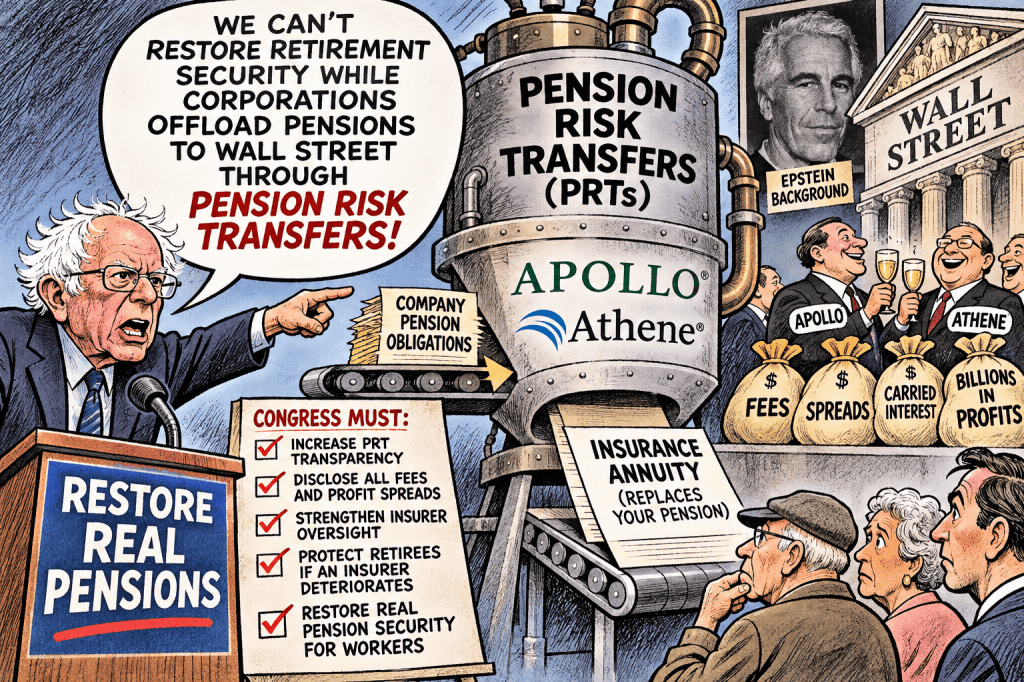
A new GAO report documents the devastating decline of traditional pensions. But without strong federal transparency legislation, proposed reforms could simply create more opportunities for private equity firms, insurance companies and Wall Street to extract fees while shifting financial risks onto American workers and retirees.
By Christopher B. Tobe, CFA, CAIA | The CommonSense 401(k) Project | November 24, 2026
Senator Bernie Sanders deserves considerable credit for commissioning a new Government Accountability Office (GAO) report documenting the collapse of traditional defined benefit (DB) pension plans in America.
As Brian Anderson reports in 401(k) Specialist, Sanders is renewing his efforts to provide American workers with the type of retirement security that members of Congress themselves enjoy.
The new GAO report, GAO-27-107628, provides valuable historical data. However, many of the policy options discussed are sufficiently broad that they could be manipulated to serve employers, Wall Street and the insurance industry rather than workers.
Even the title of the GAO report emphasizes mitigating employer risks. But who is looking at mitigating the risks to employees and retirees?
Congress should combine Sanders’ efforts to restore traditional pensions with comprehensive legislation addressing hidden investment fees, pension risk transfers, private equity valuations, insurance company solvency and fiduciary accountability.
The devastating decline of American pensions
The GAO and Sanders have highlighted several disturbing statistics.
The disappearance of traditional pensions
Private-sector workers participating in single-employer defined benefit plans
1975
27%
2023
5%
81.5% decline
Relative decline in participation between 1975 and 2023.
Even surviving pensions are increasingly frozen
Share of active participants in partially or completely frozen single-employer DB plans
2008
18%
2022
43%
Source: GAO-27-107628 and 401(k) Specialist, November 24, 2026.
The relationship between unionization and pension coverage is particularly striking. In 2025, 55% of unionized private-sector workers participated in DB plans, compared with only 5% of nonunion private-sector workers.
Government Accountability Office+1
Sanders’ proposed Pensions for All Act would seek to provide American workers with retirement benefits comparable to those available to members of Congress.
That is a worthy objective. However, the financial services industry should not be allowed to define what constitutes an equivalent pension.
Pension risk transfers: Congress must address the dismantling of existing pensions
One of my biggest criticisms of the GAO report is its failure to adequately address the consumer protection risks associated with Pension Risk Transfers (PRTs).
The GAO acknowledges PRT activity on printed pages 27–28, including its contribution to declining pension coverage. Nevertheless, it does not provide a comprehensive analysis of the financial security of retirees following transfers to insurance companies.
Government Accountability Office
How can Congress seriously discuss restoring traditional pensions without addressing one of the principal mechanisms corporations now use to remove retirees from the existing pension system?
When a corporation transfers its pension obligations to a life insurance company, affected retirees typically lose the protections of the Pension Benefit Guaranty Corporation (PBGC) and become dependent upon an insurance contract and the applicable state insurance guaranty system.
The corporation reduces its financial exposure. The insurance company acquires billions of dollars in assets. Investment bankers, consultants, actuaries and affiliated asset managers may generate additional revenue.
But has the financial security of the retiree actually improved?
What changes in a pension risk transfer?
Traditional pension
Employer-sponsored DB plan
Pension trust
Diversified investment portfolio
Federal PBGC protection
Subject to statutory limits
Transferred pension
Insurance company obligation
Insurer balance sheet
General or separate account structure
State guaranty system
Coverage varies by state and contract
The employer’s reduction in risk does not necessarily translate into a reduction in the retiree’s risk.
The rapid expansion of private equity-affiliated insurance companies, including Apollo’s Athene, creates additional questions about related-party transactions, private credit exposure, offshore reinsurance, capital adequacy and asset valuations. Jeffery Epstein himself in 2026 released files claimed to have come up with the concept to create Athene in his emails with Apollo executives Marc Rowan and Leon Black. Athene has become one of the major players in Pension Risk Transfers.
My previous research has questioned whether a single-insurer general account obligation can provide the same level of financial security as a diversified pension portfolio backed by a corporate sponsor and PBGC protection.
See my earlier analysis:
Pension Risk Transfer Annuities — Updated Litigation Risk
My proposed pension risk transfer reforms would require Congress to evaluate these risks before permitting corporations to permanently transfer their pension obligations.
Congress should not subsidize the creation of new pensions while allowing existing pensions to be stripped of federal protections without adequate safeguards.
The GAO report opens the door to more insurance industry products
Perhaps the most troubling policy option appears on printed page 48 of the GAO report, where a stakeholder proposes expanding the use of insurance annuities as qualified default investment alternatives (QDIAs) in defined contribution plans.
This is not a formal GAO recommendation. Nevertheless, its inclusion illustrates how a discussion about restoring traditional pensions can become a discussion about expanding the market for insurance products inside 401(k) plans.
These are two very different objectives.
Insurance companies have spent $billons promoting concepts such as:
- Guaranteed lifetime income.
- Retirement income solutions.
- Pension-like benefits.
- Retirement income security.
- Annuities embedded in target-date funds.
- Employer de-risking and retirement income modernization.
Their motivation has been to make $billions in secret fees in high risk products, not to help consumers.
Where are the fee disclosures? Where are the insurer profit spreads? Where are the independent comparisons of contract prices? Where are the disclosures of affiliated asset management compensation?
A retirement product does not become economically equivalent to a traditional pension merely because an insurance company markets it as providing lifetime income.
Follow the fees: 20 basis points versus 200 basis points
At The Capitol Forum’s recent Washington conference on the life and annuity industry, I discussed why the insurance business has become so attractive to private equity.
Drawing on my seven years as an insurance company officer at Transamerica/AEGON, I explained the dramatic difference between the relatively transparent fees of registered mutual funds and the embedded spreads within insurance contracts.
See my November 18 article:
Consider the following illustrative comparison.
The economics of retirement assets
Illustrative annual amounts on $100 million in assets
Mutual fund fee differential
$200,000
20 basis points
Insurance contract gross spread
$2 million
200 basis points
Higher insurance contract gross spread
$3 million
300 basis points
Higher insurance contract gross spread
$4 million
400 basis points
Illustrative figures based on the author’s industry experience, not a measurement of every insurer or PRT contract. Gross spreads include costs and risk compensation as well as potential profits.
The insurance industry will argue that its spreads compensate it for guarantees, capital requirements, administrative expenses and investment risks.
Then disclose those components.
There is no justification for Congress expanding the use of insurance products in retirement plans without requiring an independent accounting of their economic costs.
Pension risk transfer annuities, are priced differently from ongoing fixed annuity accumulation products but still excessively and secretly with similar spreads. ongress should require disclosure of transaction pricing, embedded profit margins, commissions, affiliated fees and the assumptions used to calculate the premium.
The GAO report does not meaningfully address these issues.
Risk sharing or risk shifting?
Another major theme of the GAO report is the development of alternative pension structures designed to reduce employer financial exposure.
These include variable benefit formulas, potential changes to PBGC premiums and pension structures that allow benefits to respond to investment performance.
On printed page 39, the GAO even discusses a proposed composite pension model that would operate without PBGC insurance.
These proposals deserve scrutiny because reducing employer risk does not necessarily reduce the total risk in the retirement system. It may simply transfer that risk to employees.
| Risk | Traditional DB pension | Potential risk-sharing alternative |
| Investment underperformance | Primarily sponsor responsibility | Workers may absorb losses |
| Funding shortfalls | Sponsor funding obligations | Potential benefit adjustments |
| Longevity | Primarily pooled and sponsor-supported | Depends on contract or plan design |
| Insolvency protection | PBGC for covered plans | Potentially reduced or eliminated |
| Investment management fees | Reduce plan assets | May more directly affect worker benefits |
Risk-sharing designs can have legitimate advantages, particularly if they preserve coverage that would otherwise disappear. But Congress must distinguish between equitable risk sharing and the systematic transfer of financial risks from corporations to workers.
Without enforceable fee and valuation disclosures, these new structures could allow Wall Street to collect substantial compensation regardless of whether retirees receive their expected benefits.
Private equity: A major omission from the GAO report
Remarkably, a text search of the GAO report does not produce a single reference to private equity.
How can policymakers develop comprehensive solutions for the future of defined benefit pensions without examining the expensive and increasingly complex private-market investments held by many pension funds?
Private equity and private credit investments can introduce significant challenges involving excessive fees, leverage, liquidity restrictions, subjective valuations, performance measurement and conflicts of interest.
In my November 24 article, I examined important new research from the EDHEC Infra & Private Assets Research Institute.
The EDHEC analysis illustrates how private-market investments can contribute disproportionately to pension portfolio risk.
CalPERS private-market investments
EDHEC analysis of June 30, 2026 portfolio data
Share of portfolio assets
36%
Share of portfolio volatility
44%
Share of active risk
75%
Active risk measures deviation from a reference portfolio, not the probability of pension losses.
EDHEC also demonstrated that changing certain private equity correlation assumptions could increase estimated active risk by approximately 42%, without changing the underlying investments.
Although CalPERS is a public pension fund, the underlying valuation, fee and risk measurement problems can also occur within private-sector ERISA defined benefit plans.
Why should these problems be ignored in legislation seeking to expand traditional pensions?
Expand my proposed 401(k) Private Equity Transparency Act to all ERISA pension plans
I have already proposed comprehensive federal legislation to address the expansion of private equity, private credit, insurance products and opaque investment structures within 401(k) plans.
See:
New Target Date Products Prove the Need for Federal 401(k) Transparency Legislation
Congress should expand the applicable disclosure and enforcement provisions of this legislation to cover all ERISA retirement plans, including single-employer and multiemployer defined benefit plans.
It could be renamed the ERISA Retirement Investment Transparency Act.
The expanded legislation should require:
| Proposed protection | Application to DB pension plans |
| Complete fee disclosure | Management fees, carried interest, expenses, commissions and related-party compensation |
| Look-through reporting | Identification of underlying investments and affiliated entities |
| Independent valuations | Verification of manager-supplied private-market investment values |
| Performance transparency | Net-of-fee returns, appropriate benchmarks and risk-adjusted comparisons |
| Liquidity disclosures | Lockups, unfunded commitments, exit restrictions and potential secondary-market discounts |
| Offshore transparency | Identification of underlying entities domiciled in offshore jurisdictions |
| Investment policy disclosure | Investment policy statements attached to applicable Form 5500 filings |
| Independent stress testing | Market declines, private credit defaults, valuation adjustments and liquidity crises |
| Strong enforcement | Regulatory investigations, penalties and appropriate whistleblower protections |
Provisions designed specifically for participant-directed investments and QDIAs would remain applicable to defined contribution plans, while the broader investment transparency requirements would cover both pension systems.
Pension beneficiaries should not have fewer rights to understand investment costs and risks simply because they participate in a defined benefit plan.
Three proposed federal bills could strengthen Sanders’ pension legislation
The three legislative initiatives I discussed at The Capitol Forum conference provide a framework for protecting workers while expanding retirement security.
1. Private Equity and ERISA Retirement Investment Transparency Act
Expand my proposed 401(k) legislation to include ERISA defined benefit plans, requiring comprehensive investment, fee, valuation and conflict-of-interest disclosures.
2. Pension Risk Transfer Transparency and Federal Life Insurance Oversight
Require stronger safeguards for pension transfers, federal oversight of life insurers, disclosure of embedded compensation and mechanisms to protect retirees if insurers experience financial deterioration.
3. Public Pension Private Equity Transparency Act
Establish comparable nationwide transparency standards for state and local government pension plans, which are generally exempt from ERISA’s private-sector fiduciary framework.
Together, these reforms could protect workers across the private and public retirement systems.
Pension risk transfers need downgrade protections and a pathway back to PBGC
My proposed pension risk transfer reforms would go beyond disclosure.
Congress should require independent assessments of insurer financial strength, including the quality and liquidity of the underlying assets, affiliated investment management arrangements and offshore reinsurance exposure.
Congress should also establish a mechanism under which pension obligations could receive renewed PBGC protection if an insurer experiences serious financial deterioration, subject to appropriate funding and insurance requirements.
A mandatory downgrade provision could require additional collateral, replacement coverage or another protective action before an insurer becomes insolvent.
Why should retirees have to wait for an insurance company to fail before meaningful protections become available?
The current system relies heavily on the financial strength of individual insurers and the fragmented state insurance regulatory structure.
That is insufficient for a national retirement system increasingly intertwined with global private equity and private credit markets.
Congress needs a federal life insurance regulator
In September, I discussed a Congressional Research Service report examining private investments in insurance companies and potential federal regulatory responses.
Congress Finally Asks Whether America Needs a Federal Insurance Regulator. The Answer Is Yes.
My proposed federal insurance oversight legislation would establish a consumer-oriented federal watchdog with genuine financial examination and enforcement authority.
State insurance regulation could continue, but federal regulators should have the authority to examine large life insurers and their affiliated financial entities, particularly those receiving substantial amounts of ERISA retirement assets.
It makes little sense for Congress to mandate or encourage lifetime retirement income products without establishing sufficient federal oversight of the institutions promising that income.
We should not expand the insurance industry’s role in the American retirement system while leaving its regulatory weaknesses unaddressed.
What Senator Sanders and the Senate HELP Committee should do next
Senator Sanders has an opportunity to expand the national pension debate beyond the number of workers covered by defined benefit plans.
The Senate HELP Committee should commission a supplemental GAO investigation specifically examining:
- The financial security of retirees following pension risk transfers.
- Comparative protections under PBGC and state insurance guaranty systems.
- The compensation and profit margins embedded in pension annuity transactions.
- Private equity and private credit investment expenses in ERISA defined benefit plans.
- The reliability of private-market valuations and performance benchmarks.
- The use of affiliated investment managers and offshore reinsurance by pension risk transfer insurers.
- Whether expanded annuity defaults and risk-sharing pension designs disproportionately benefit employers and financial service providers.
- The feasibility of statutory downgrade protections and renewed PBGC coverage.
Any comprehensive pension legislation should address both pension coverage and the quality of the financial protections delivered to workers.
Restore pensions — not Wall Street’s profit margins
Senator Sanders is absolutely right that America needs to restore retirement security.
Traditional defined benefit pensions can provide an efficient means of pooling investment and longevity risks and delivering predictable retirement income.
But Congress should not allow the financial services industry to redefine traditional pensions into expensive insurance contracts, opaque private equity investment vehicles or variable benefit arrangements that leave workers absorbing an increasing share of the risks.
Wall Street does not need another government-supported market for high-fee retirement products.
American workers need affordable, transparent and financially secure retirement benefits.
The new GAO report provides an important starting point. My proposed federal transparency and insurance oversight legislation would provide the consumer protections necessary to build upon it.
Let us restore traditional pensions — but first, follow the fees, follow the risks and follow the money.

