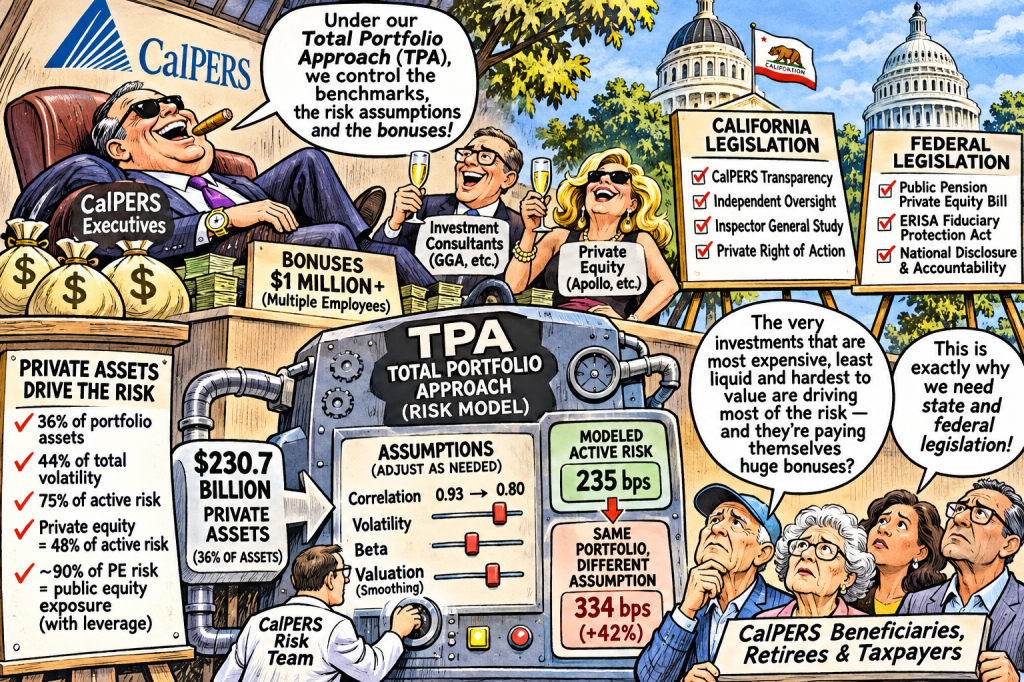
Private assets represent just 36% of CalPERS’ portfolio but account for 75% of its active risk. Who verifies the risk assumptions, who measures the performance, and who determines the bonuses?
The new November 23, 2026, research article by Evan Clark of the EDHEC Infra & Private Assets Research Institute, TPA and Private Assets: Why Risk Disclosures Matter, provides important quantitative evidence supporting the need for both state and federal public pension transparency legislation.
In June, I published Total Portfolio Approach (TPA) by CalPERS a Ruse to Reduce Transparency and Accountability and Protect Bonuses.
My concern was that eliminating traditional asset-class performance benchmarks would make it increasingly difficult for beneficiaries, taxpayers, trustees and independent investigators to determine whether expensive private-market investments were actually adding value.
The new EDHEC analysis adds another dimension to that problem: the extraordinary sensitivity of pension risk measurements to subjective private-market modeling assumptions.
EDHEC is considerably more complimentary than I am about CalPERS’ recent risk disclosures. That distinction is important. Nevertheless, its findings strengthen the argument that detailed, independently verifiable disclosure should be a statutory requirement rather than something left to the discretion of pension executives.
$230 billion in private assets generating 75% of active risk
EDHEC examined the CalPERS Trust Level Review as of June 30, 2026, and calculated the contribution of private investments to the pension system’s overall risk.
CalPERS private-market exposure — June 30, 2026
$230.7 billion
Private equity, private debt, real estate and infrastructure
Share of portfolio assets
36%
Share of total portfolio volatility
44%
Share of active risk
75%
Source: EDHEC analysis of CalPERS Trust Level Review.
Private equity alone represents approximately 19.5% of the portfolio but accounts for 48% of its active risk.
EDHEC Infra & Private Assets
Where CalPERS’ active risk comes from
Private equity
48%
Real estate
17%
Private debt
7%
Infrastructure
3%
Other investments
25%
Active risk measures deviation from the reference portfolio, not the probability of a financial loss.
These figures should get the attention of every public pension trustee and state legislator in America.
The investments that are among the most expensive, least liquid and most difficult to value are also driving most of the pension fund’s modeled risk relative to its benchmark.
The risk-modeling game: Change an assumption and risk increases 42%
Perhaps the most troubling finding in the EDHEC analysis is how sensitive CalPERS’ risk calculations are to assumptions about the correlation between private equity and publicly traded stocks.
EDHEC derived the following assumptions from CalPERS’ disclosures:
| Investment strategy | Forecast volatility | Implied equity correlation | Implied equity beta |
| Public equities | 19.3% | 1.00 | 1.00 |
| Private equity buyouts | 22.6% | 0.95 | 1.11 |
| Growth equity | 25.1% | 0.94 | 1.22 |
| Venture capital | 26.9% | 0.93 | 1.29 |
These figures suggest that private equity behaves substantially like leveraged public equity, with additional risks and expenses.
EDHEC then conducted a sensitivity analysis using a correlation assumption of 0.80 rather than approximately 0.93–0.95 for private equity.
The results were dramatic.
CalPERS modeled active risk
Changing private equity correlation assumptions
Original estimate
235 bps
Alternative estimate
334 bps
42.1% increase in modeled active risk
CalPERS’ maximum active risk budget: 400 basis points. Alternative scenario calculated by EDHEC using simplifying assumptions.
Nobody bought or sold a single investment in this hypothetical exercise. No private equity company failed. No additional investment commitment was made.
Only a modeling assumption changed.
This does not establish that CalPERS deliberately understates risk. But it demonstrates the enormous discretion embedded in the risk model and why independent verification is essential.
EDHEC Infra & Private Assets
If an investment staff can influence the assumptions used to measure its own risk-taking, and those risk measurements subsequently influence compensation, the potential for conflicts of interest should be obvious.
Private equity: Expensive leveraged stock market exposure?
Another important finding is that EDHEC estimates approximately 90% of the modeled variance of private equity buyouts is explained by public equity exposure.
Under its analysis:
- $100 invested in buyout private equity behaves approximately like $111 in publicly traded equities, plus residual risk.
- $100 invested in growth equity has approximately $122 of public equity exposure.
- $100 invested in venture capital has approximately $129 of public equity exposure.
This raises a fundamental question that public pension trustees should have been asking for decades:
How much of the supposed superior performance of private equity is simply compensation for additional market exposure and leverage, rather than investment management skill?
If CalPERS earns higher returns by assuming higher systematic risk, that does not necessarily constitute alpha.
It certainly should not automatically justify billions in private equity fees or millions in investment staff bonuses.
Independent performance evaluation must distinguish genuine investment skill from market exposure, leverage, illiquidity premiums and other systematic risks.
Valuation smoothing makes independent verification even more important
Unlike publicly traded stocks and bonds, private equity, private credit and private real estate frequently rely on periodic manager-provided valuations.
EDHEC recognizes that appraisal smoothing can obscure volatility, while reporting delays complicate comparisons with public-market investments.
This creates a dangerous situation in which the same pension system may rely upon:
- Private asset managers to determine investment values.
- Internal investment staff to establish risk assumptions.
- Investment consultants to evaluate those assumptions.
- Compensation consultants to determine appropriate rewards.
- Pension executives and trustees to approve the resulting bonuses.
The beneficiaries and taxpayers ultimately responsible for the pension system may have little ability to independently reproduce any of these calculations.
TPA does not eliminate these problems. It potentially concentrates them within a more complicated total-fund measurement system.
The Total Portfolio Approach and the CalPERS compensation machine
In my September article, The Consultant Behind the Public-Pension Pay Machine – GGA Helped Legitimize Excessive Pay at CalPERS, STRS Ohio & Ontario OMERS, I examined the role of compensation consultants in supporting increasingly extravagant public pension compensation.
Global Governance Advisors has advised CalPERS on compensation and incentive arrangements. My prior reporting documented the dramatic escalation in executive pay, despite longstanding questions about relative investment performance.
In CalPERS: Sets Its Own Excessive Pay – Off the Charts, I highlighted reported compensation figures including four employees earning more than $1 million annually and 34 earning more than $500,000.
Now introduce TPA into that compensation system.
CalPERS began evaluating total-fund performance against a reference portfolio in July 2026 consisting of:
| Reference investment | Weight |
| Global public equities | 75% |
| U.S. Treasury bonds | 25% |
A simple, investable reference portfolio is potentially an improvement over the custom benchmarks previously employed by many public pensions.
The problem is not the existence of a total-fund reference portfolio. The problem is allowing it to replace meaningful asset-class accountability.
A total-fund benchmark should supplement, not eliminate, the ability to evaluate individual investment programs.
Otherwise, beneficiaries may find it increasingly difficult to determine whether the private equity department, private credit department or real estate department earned its compensation.
Furthermore, any bonuses calculated from private-market valuations that have not been independently verified should be subject to appropriate deferrals and clawbacks.
The EDHEC findings make the case for these safeguards even stronger.
Why CalPERS’ history with Apollo makes voluntary oversight insufficient
CalPERS does not deserve an unlimited presumption of institutional credibility when it comes to private equity governance.
The 255-page forensic investigation that Edward Siedle and I produced, CalPERS: America’s Misled and Misleading Pension Leader, raised extensive concerns regarding investment costs, conflicts, performance reporting and institutional accountability.
In October, I published Cohan’s New Book on Jeffrey Epstein’s Main Funder Leon Black – Confirms the CalPERS Scandal Was Worse Than the Sanitized Version.
William D. Cohan’s book provided additional reporting on the historic relationship between CalPERS, Apollo, former CalPERS board member Alfred Villalobos and former CalPERS CEO Federico Buenrostro.
My earlier investigation of CalPERS’ relationship with Apollo identified more than $6.5 billion in documented commitments over time and approximately $35 million in associated placement-agent commissions across multiple transactions.
The criminal conduct of a former CalPERS CEO and the placement-agent scandal demonstrated that institutional oversight mechanisms can fail spectacularly.
That history should inform the debate over TPA.
The more discretion pension executives are given over investment decisions, performance measurements and risk assumptions, the stronger the independent oversight mechanisms must become.
CalPERS’ historical governance failures do not prove that its current TPA risk model is manipulated. They do, however, provide compelling reasons not to rely exclusively on internal or management-selected oversight.
The California legislative solution: Two complementary reforms
The new EDHEC findings reinforce the need for the California legislative reforms I have proposed for the 2027–2028 legislative session.
1. CalPERS Good Government Transparency and Independent Oversight Study Act
My proposed California transparency legislation directly addresses many of the weaknesses identified in the EDHEC research.
Section 6 of the proposed legislation requires public reporting of:
- Total-fund and individual asset-class performance, gross and net of identified expenses.
- A low-cost, investable public-market reference portfolio.
- Historical benchmarks and overlapping performance under old and new benchmarks.
- Private-market cash flows and public-market-equivalent analyses.
- Valuation discretion, appraisal delays and investment leverage.
- Risk calculations that combine market prices with private-market appraisals.
- The assumptions underlying adjusted or unsmoothed investment returns.
Crucially, changes to benchmarks could not retroactively alter previously applicable compensation targets.
Section 7 requires disclosure of executive compensation, bonus calculations, consultant reports, consultant ownership and financial conflicts.
Other provisions require disclosure of underlying investment costs, contractual terms, political payments connected to pension business and prospective contractual audit rights.
The legislation would also give California taxpayers, participants and beneficiaries express rights to enforce its transparency requirements, including qualifying class actions, recovery of proven losses and reasonable attorney and expert fees.
CalPERS_Transparency_BillwithPayPlay(2).docx
CalPERS_Transparency_BillwithPayPlay(2).docx
CalPERS should not be permitted to decide unilaterally how much information the people financing the pension system are entitled to receive.
2. An independent CalPERS Inspector General
The transparency bill also appropriates a proposed $750,000 for an independent California State Auditor study examining the establishment of a permanent CalPERS Inspector General.
The study would consider an office funded through CalPERS’ administrative expenses at a minimum of $8 million annually, alongside alternative funding arrangements.
Such an office should possess the necessary expertise and authority to independently investigate private-market valuations, investment fees, compensation arrangements, consultant conflicts and risk modeling.
Importantly, the State Auditor—not CalPERS management—would control the study and its findings.
CalPERS_Transparency_BillwithPayPlay(2).docx
My broader objective remains the creation of a permanent independent Inspector General. The attached transparency bill is an immediate step toward that objective.
Given the hundreds of billions of dollars invested in private markets, the potential savings from identifying even relatively small investment-cost or governance problems could dwarf the cost of independent oversight.
The federal legislative solution: National standards for public pensions
California alone cannot solve this problem.
TPA is spreading across institutional investment organizations. Without federal standards, public pensions may increasingly adopt proprietary risk models and compensation systems with widely varying levels of disclosure.
Two federal legislative proposals I have developed would address these problems.
3. Federal Public Pension Private Equity Bill
This proposal would establish a new annual public IRS reporting requirement for state and local pension systems modeled conceptually on the reporting obligations of private-sector retirement plans.
Currently, governmental retirement plans generally do not have to file the publicly available annual Form 5500 required of most ERISA-covered pension plans.
The proposed legislation would establish a new Form PPPE — Public Pension Private Equity and Governance Return.
This would require national disclosure of underlying investment holdings, offshore structures, private investment fees, carried interest, liquidity restrictions, leverage, valuation methodologies and material conflicts.
Section 6 specifically addresses performance and benchmark integrity, including asset-class returns, public-market-equivalent calculations and disclosure of the distortions introduced by combining private-market appraisals with market prices.
Public_Pension_Private_Equity_Bill(2).docx
Public_Pension_Private_Equity_Bill(2).docx
The legislation also establishes enhanced compensation reporting for employees with total annual compensation or compensation opportunities exceeding $200,000.
That threshold is a disclosure requirement, not a compensation cap.
The legislation would require public justification of compensation, disclosure of the consultants and peer groups used to establish it, and safeguards for recovering bonuses materially inflated by fraud, knowing misstatements or valuation errors.
Public_Pension_Private_Equity_Bill(2).docx
Additional provisions address pay-to-play arrangements, political and charitable intermediaries, data center investments, ESG representations and documented material relationships with Jeffrey Epstein, subject to meaningful evidentiary safeguards.
The legislation would connect substantial compliance with transparency requirements to favorable federal tax treatment, while prioritizing correction and protecting previously accrued retirement benefits.
Public pension officials should not have access to the advantages of federal retirement tax law without meaningful public accountability.
4. Public Pension ERISA Fiduciary Protection Act of 2026
My second federal proposal would address the broader fiduciary accountability problem by extending selected ERISA protections to state and local public retirement systems.
Public pension trustees should be subject to enforceable federal standards comparable to those that protect private-sector retirement savers.
The proposed legislation would extend selected ERISA provisions governing:
- Fiduciary prudence and loyalty.
- Diversification and protection of beneficiaries’ interests.
- Prohibited transactions and fiduciary self-dealing.
- Fiduciary liability and restoration of plan losses.
- Investment expense and compensation disclosure.
- Federal investigations and civil enforcement.
It would give the U.S. Department of Labor authority to investigate and pursue appropriate remedies, while establishing participant enforcement rights subject to applicable constitutional standing and immunity limitations.
It would not impose federal control over state pension benefit formulas, contribution rates or funding requirements, nor would it extend PBGC insurance to governmental pensions.
Public_Pension_ERISA_Congressional_Staff_Draft_2026(1).docx
Public_Pension_ERISA_Congressional_Staff_Draft_2026(1).docx
Public_Pension_ERISA_Congressional_Staff_Draft_2026(1).docx
The states would retain control over their pension systems while federal law would establish a minimum level of fiduciary protection.
EDHEC research suggests additional provisions for both state and federal legislation
The EDHEC article provides a strong basis for strengthening the existing legislative drafts with requirements specifically addressing TPA.
I would propose adding the following statutory requirements to both the California and federal transparency bills.
| Proposed requirement | Purpose |
| Public disclosure of risk-model assumptions | Expose the assumptions underlying reported investment risk. |
| Private-market correlation and beta disclosures | Identify exposure to public-market risk and leverage. |
| Mandatory sensitivity testing | Show how alternative assumptions affect total-fund risk. |
| Asset-class risk attribution | Prevent individual investment programs from disappearing inside total-fund reporting. |
| Independent risk-model validation | Reduce dependence on management-selected assumptions and conflicted consultants. |
| Risk-adjusted performance attribution | Distinguish investment skill from systematic risk premiums. |
| Liquidity stress testing | Evaluate capital calls, distribution shortfalls and forced asset sales. |
| Compensation deferrals and clawbacks | Prevent unverified private-market gains from immediately generating permanent bonuses. |
| Historical risk-model archives | Prevent changes in assumptions from erasing previous performance and risk records. |
For example, pension systems using TPA should be required to publish how their risk budgets change under multiple reasonable private equity correlation assumptions.
Illustrative mandatory risk sensitivity disclosure
| Private equity correlation assumption | Modeled active risk | Share of 400 bps risk limit |
| 0.93–0.95 | 235 bps | 58.8% |
| 0.80 | 334 bps | 83.5% |
Based on EDHEC’s published scenario estimates and CalPERS’ reported maximum active risk limit.
Under EDHEC’s alternative scenario, approximately 60% of the previously available capacity under the maximum active risk limit disappears simply because a correlation assumption changes.
That is material information for trustees, beneficiaries and taxpayers.
It should be disclosed as a matter of law.
Pension consultants should not be allowed to police themselves
EDHEC recognizes the importance of independent validation of private asset risk assumptions and discusses the role that external consultants can play.
That is a reasonable recommendation in theory.
But what happens when those consultants have their own financial relationships with the private equity industry?
What happens when the investment consultant helps validate the investment assumptions, while the compensation consultant helps justify the bonuses generated by the investment program?
My proposed legislation would require disclosure of consultant ownership, affiliations, compensation arrangements and material financial relationships with investment organizations they evaluate or recommend.
For a pension system with CalPERS’ history, however, disclosure alone is insufficient.
Independent validation should be performed by professionals who have no material financial incentive to perpetuate the pension system’s existing investment practices or compensation arrangements.
That is another reason why a permanent, independent Inspector General is so important.
Conclusion: Greater investment discretion requires greater accountability
The new EDHEC research deserves considerable praise for quantifying risks that are rarely explained adequately to public pension beneficiaries.
It also demonstrates why the growing adoption of TPA must be accompanied by stronger—not weaker—statutory transparency requirements.
I remain concerned that the transition to TPA could protect expensive investment programs, obscure poor relative performance and insulate excessive compensation from meaningful scrutiny.
The solution is not necessarily to prohibit TPA.
The solution is to prohibit TPA without transparency and accountability.
California legislators and members of Congress should insist that every public pension system adopting this approach disclose the information necessary to independently evaluate its fees, performance, leverage, valuations, risk assumptions and compensation.
Pension executives should not be allowed to select their own benchmarks, determine their own risk assumptions, obscure underlying investment expenses and then reward themselves based on calculations that beneficiaries cannot independently verify.
Public pension assets belong to the retirement trusts established for workers and retirees.
They are not a vehicle for enriching Wall Street investment managers, pension consultants or public pension executives.
If private equity managers and public pension executives are confident in the superiority of their investments, they should welcome independent verification.
California and Congress should make that verification mandatory.


Pingback: Bernie Sanders Is Right About America’s Disappearing Pensions — But Congress Must Stop Wall Street and the Insurance Industry From Hijacking Pension Reform | The CommonSense 401k Project