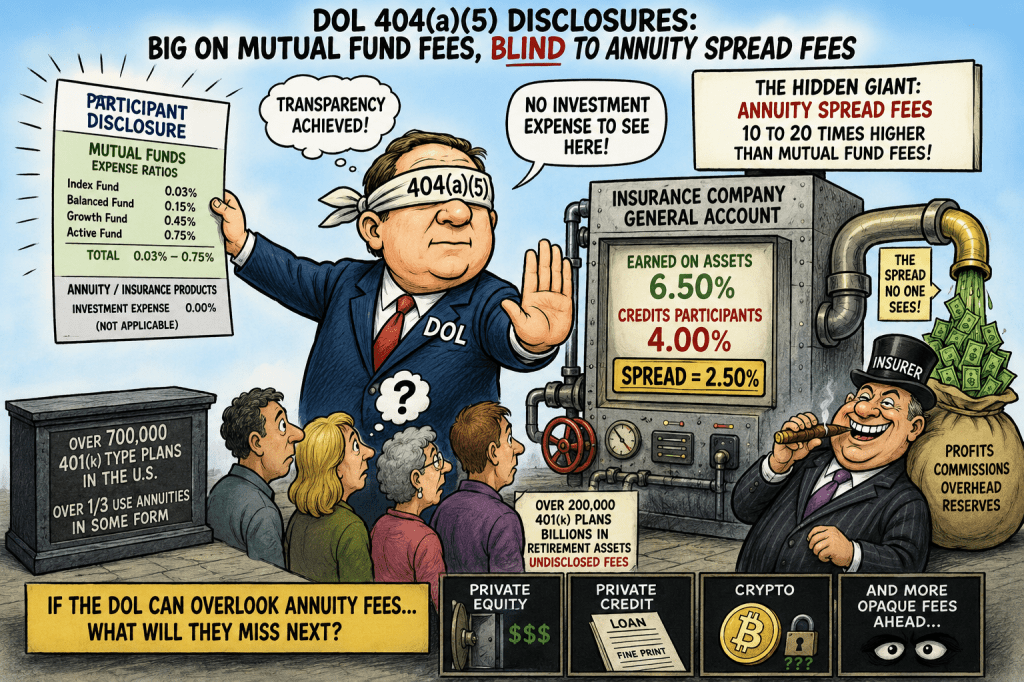
For more than a decade, the Department of Labor’s participant fee disclosure regulation under ERISA Section 404(a)(5) has been promoted as the cornerstone of transparency in defined contribution plans. Participants receive tables showing mutual fund expense ratios to the nearest one-hundredth of a percent. Plan fiduciaries compare investment expenses in basis points. Plaintiffs’ attorneys routinely sue over a few basis points of excessive mutual fund fees.
Yet the regulation ignores what may be the largest investment fee in more than 200,000 retirement plans: insurance annuity spread fees.
That omission is not an accident of accounting. It is a structural failure that has distorted competition, misled participants, and given insurance products a disclosure advantage over SEC-registered mutual funds.
My recent articles on the Four-Tier Structure of the U.S. 401(k) Marketplace and Annuities Break ERISA’s Disclosure Rules examined how insurance companies built a separate business model around opaque compensation rather than transparent asset-management fees. The DOL’s disclosure rules effectively bless that distinction.
The result is a two-tier disclosure system. Mutual funds disclose virtually every expense ratio. Insurance products disclose almost none of their economic profit. Participants are left believing the annuity has little or no investment fee because none appears on the required disclosure. Nothing could be further from the truth.
Consider how these products actually work. Traditional mutual funds generally charge explicit expense ratios ranging from roughly 0.03% for index funds to perhaps 0.75% or more for actively managed funds. Those fees appear directly on participant disclosures. Insurance general account products, stable value annuities, fixed annuities, indexed annuities, and many lifetime income products operate differently. The insurance company earns money through an interest-rate spread.
Suppose the insurer earns 6.5% on its investment portfolio but credits participants only 4.0%. The 2.5% difference is not merely an investment result. It is the insurer’s gross economic spread, from which profits, reserves, commissions, overhead, and capital costs are funded. Participants never see this number. The 404(a)(5) disclosure usually reports no investment expense ratio at all.
Imagine requiring Vanguard to report zero fees while Fidelity disclosed every basis point of its mutual fund expenses. That is essentially how today’s disclosure rules treat insurance products. The economic consequences are enormous. Across much of today’s marketplace, low-cost index funds cost between 5 and 25 basis points annually. Insurance spreads frequently exceed 200 basis points and can exceed 400 basis points.
That means the hidden economic cost can easily be ten to twenty times larger than the mutual fund fees receiving all of the regulatory attention. The litigation landscape reflects this imbalance. ERISA lawsuits increasingly focus on whether a mutual fund charged 45 basis points instead of 20.
Meanwhile, annuity products generating spreads measured in full percentage points often escape meaningful scrutiny because the fee is never disclosed in the first place. Disclosure drives governance. What is invisible rarely receives attention. This is particularly significant because insurance products remain deeply embedded throughout the defined contribution marketplace. Thankfully, litigation is starting with the largest plans
More than one-third of America’s roughly 700,000 defined contribution retirement plans continue to utilize insurance products in some form, representing well over 200,000 plans and trillions of dollars in retirement assets. Many of these arrangements date back decades and are primarily fixed annuities. The newest fad is “lifetime income.” Insurance products also enable secret commissions paid to advisors/consultants to the plan. Most advisor/consultants disclose in their ADV2’s an affiliation with an insurance compay which allows them to take secret commissions from recommending insurance products.
Congress, regulators, and industry groups increasingly promote lifetime income solutions as the next evolution of defined contribution plans. Yet very few proposals require participants to receive a standardized disclosure of the insurer’s actual economic spread. Without that disclosure, participants cannot compare an insurance product against a mutual fund or collective investment trust on an apples-to-apples basis. Nor can fiduciaries demonstrate that they have satisfied ERISA’s duty to understand and monitor total compensation.
This matters far beyond annuities. Private equity, private credit, and crypto products are now seeking broader access to participant-directed retirement plans. Each promises higher returns through structures that are significantly less transparent than traditional mutual funds. Each contains layers of embedded compensation that often cannot be observed through conventional expense ratios.
If regulators repeat the mistake made with insurance annuities, participants will once again receive disclosures that appear complete while omitting the largest sources of compensation. History suggests that once an opaque fee structure becomes embedded in retirement plans, reversing course becomes extraordinarily difficult. The annuity market demonstrates precisely how that happens. For decades, spread compensation remained largely outside both participant disclosures and fiduciary discussions. Entire generations of plan committees accepted products without ever seeing the insurer’s primary source of revenue.
The same pattern could emerge for private equity carried interest, private credit financing structures, crypto custody arrangements, valuation costs, affiliated transactions, securities lending revenues, and numerous other indirect forms of compensation.
ERISA’s disclosure philosophy should be straightforward. If compensation comes from participant assets, participants should know about it. If fiduciaries are expected to monitor compensation, they must first be able to measure it. The DOL’s current regulations fall well short of that standard.
Real reform would require insurers offering retirement products to disclose standardized annual economic spread information alongside credited interest rates. Participants should see not only what they earned, but what the insurance company earned on the assets supporting their contract. Only then can meaningful comparisons be made with mutual funds, collective investment trusts, and other investment alternatives.
Transparency should not depend on legal structure. Whether compensation is called an expense ratio, an interest spread, carried interest, performance allocation, servicing fee, or something else entirely, the principle should remain identical. Economic compensation is economic compensation.
The next generation of retirement products should not inherit the disclosure failures of the last. If the Department of Labor could overlook annuity spread fees affecting hundreds of thousands of retirement plans, it is reasonable to ask whether private equity, private credit, and crypto products are headed toward the same regulatory blind spot.
Participants deserve better than another generation of invisible fees.
———————————————–


Thanks for setting me up for an upcoming post on using AI to expose in-plan annuities, although it applies to any annuities annuities and exposes the truth about mortality credits. I’m going to disclose the prompt I use and recommend to our clients to investigate and evaluate in-plan annuities I am working with attorneys on 8 fiduciary breach cases involving RIAs recommending advisory annuities for the sole purpose of creating income by offering to manage the annuities. Clear breach of FINRA Rules. Several judges have commented on the AI prompt and the issues it umcovers.
Yahoo Mail: Search, Organize, Conquer
LikeLike