A Complaint-Style ERISA Analysis of Blackstone, Apollo, Carlyle, Vista, Oak Hill, New Mountain and KKR Partnership Agreements
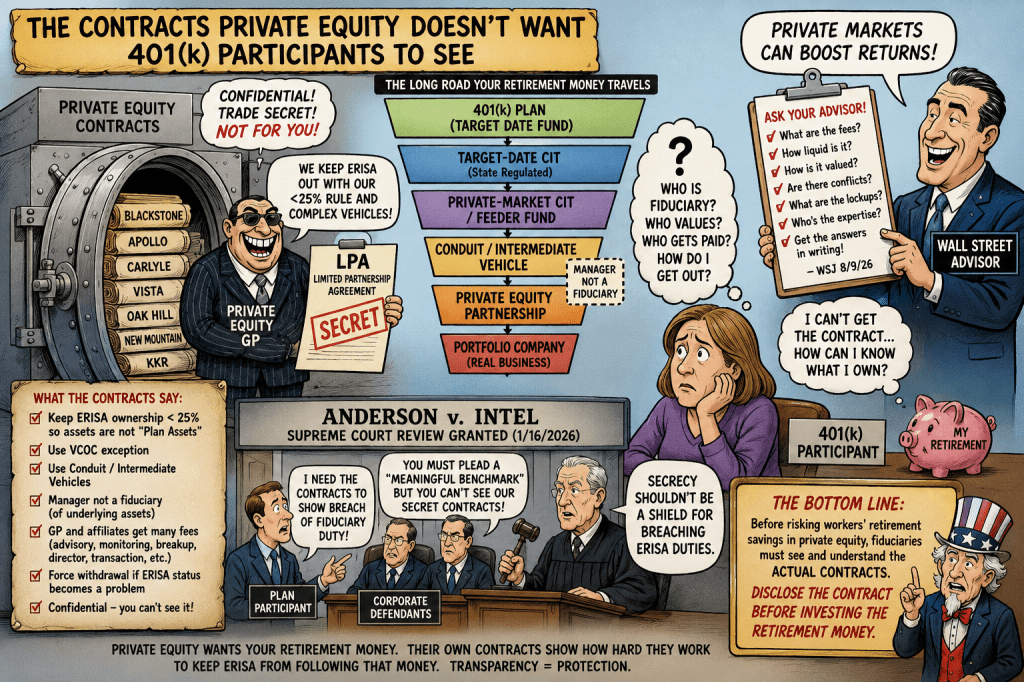
Preliminary Statement
- Private equity’s campaign to enter America’s 401(k) plans is commonly presented as a debate about asset allocation. It is not.
- The more important question is contractual:
What exactly is the retirement plan buying?
- Private-equity managers can argue that the products eventually sold through 401(k) target-date funds will be different from the institutional private-equity partnerships that have historically been sold to public pension funds.
- There is a simple way to test that assertion.
Produce the contracts.
- The historical contracts reviewed here include limited partnership agreements involving Blackstone, Apollo, Carlyle, Vista Equity Partners, Oak Hill, New Mountain and KKR. They are not hypothetical contracts reconstructed by critics. They are actual institutional private-equity agreements.
- Many have been publicly available through the Naked Capitalism Document Trove for roughly a decade. The Trove describes its collection as including agreements obtained from Pennsylvania’s public contracting records, Kentucky public pensions and other authorized sources and notes the industry’s extraordinary efforts to maintain LPA confidentiality. https://trove.nakedcapitalism.com/
- The contracts themselves demonstrate that secrecy is not incidental. Vista’s agreement, for example, says the agreement is confidential, may not be reproduced or transmitted, and may not be disclosed without Vista’s prior written consent.
- Blackstone Capital Partners V goes even further on its cover: “HIGHLY CONFIDENTIAL & TRADE SECRET.”
- Carlyle Partners V similarly labels its agreement “TRADE SECRET AND STRICTLY CONFIDENTIAL.”
- Yet these agreements have been available for public inspection for years.
- That history raises an obvious question as private equity seeks access to trillions of dollars of ERISA retirement savings:
If the contracts are suitable for workers’ retirement money, why shouldn’t the workers whose money is invested be allowed to read them?
COUNT I
PRIVATE EQUITY’S CONTRACTS EXPRESSLY CONTEMPLATE AVOIDING ERISA PLAN-ASSET STATUS
- The most important provisions in these documents may be the provisions discussing ERISA itself.
- Apollo Investment Fund VIII defines “Significant Benefit Plan Investment” as ownership by ERISA investors of 25% or more of the value of any class of equity interests in the partnership or certain conduit vehicles.
- Apollo then states its objective expressly. The General Partner will use reasonable best efforts to conduct the partnership so its assets will not be treated as Plan Assets, including by:
- qualifying for the VCOC exception;
- limiting ERISA investors to avoid “Significant Benefit Plan Investment”; or
- using another statutory or regulatory exception.
- Carlyle’s agreement is equally revealing. Where benefit-plan investors own less than 25% of each equity class, the GP may certify that the partnership’s assets should not constitute ERISA plan assets.
- Blackstone defines a benefit-plan-investor entity by reference to the same 25% threshold.
- Blackstone also promises to use reasonable best efforts to maintain VCOC treatment and to structure alternative investment vehicles so that their assets do not constitute the plan assets of ERISA investors.
- This distinction is critical.
- Keeping ERISA investment below the relevant threshold does not mean the ERISA plan fiduciary that purchases the investment ceases to owe fiduciary duties.
- Rather, the structure seeks to prevent ERISA from “looking through” the partnership interest and treating the partnership’s underlying assets as plan assets—with the resulting fiduciary and prohibited-transaction consequences for persons exercising authority over those assets.
- In other words:
ERISA money can enter the front door while the private-equity manager seeks to keep ERISA’s fiduciary rules from following that money through the door.
COUNT II
THE CONTRACTS SHOW THAT THIS IS AN INTENTIONAL STRUCTURAL OBJECTIVE, NOT AN ACCIDENT
- These are not boilerplate references buried in definitions.
- The agreements contain elaborate mechanisms for dealing with the possibility that ERISA might apply.
- Vista permits a Limited Partner to be forced to withdraw if its participation could cause partnership assets to be characterized as employee-benefit-plan assets.
- New Mountain similarly provides mechanisms for disposing of an ERISA investor’s interest to prevent the fund’s assets from becoming “plan assets.”
- Blackstone restricts transfers that could cause partnership assets to become plan assets or cause the General Partner to become an ERISA fiduciary.
- Apollo goes further still.
- Its agreement permits an ERISA investor to opt out where participation could constitute a prohibited transaction under ERISA §406 or Code §4975 or cause partnership assets to become Plan Assets.
- These provisions constitute powerful evidence of something that is often missing from the public discussion about “democratizing” private equity:
The private-equity industry knows exactly where the ERISA line is and drafts sophisticated contractual machinery around it.
COUNT III
THE CONTRACTS CREATE MULTIPLE VEHICLES BETWEEN THE RETIREMENT INVESTOR AND THE ACTUAL ASSETS
- The agreements also demonstrate why the structure of a future 401(k) private-equity product matters as much as its label.
- Carlyle expressly authorizes parallel investment entities and feeder funds.
- Apollo authorizes Alternative Investment Vehicles and still another category called a “Conduit Vehicle.”
- Most strikingly, Apollo says that a Conduit Vehicle need not be structured to meet the VCOC exception or avoid Significant Benefit Plan Investment. Instead, the arrangement can deem the ERISA investor to have directed the investment and deem the vehicle’s manager a custodian rather than an ERISA fiduciary.
- Blackstone contains a comparable concept involving an “Intermediate Entity.” It acknowledges that the intermediate entity’s assets may themselves constitute plan assets while stating that its manager is nevertheless “not intended to be a fiduciary” with respect to those assets.
- These provisions deserve enormous scrutiny before analogous structures are placed beneath a 401(k) target-date fund.
- A participant may see:
Target Date 2050
- Underneath it may sit:
Target-Date CIT → Private-Market CIT/Feeder → Conduit/Intermediate Vehicle → PE Partnership → Portfolio Company.
- That complexity isn’t merely operational. Each additional entity can affect regulatory status, valuation, liquidity, disclosure and who is—or is not—treated as exercising fiduciary authority.
- This is why the current movement toward state-regulated CIT structures deserves examination. SEC mutual funds still face federal liquidity, valuation, disclosure and governance constraints. More complicated private-market arrangements can instead be layered beneath CITs that participants may find extraordinarily difficult to penetrate.
COUNT IV
THE CONTRACTS CONTAIN THE VERY CONFLICTS AND AFFILIATED PAYMENTS ERISA IS SUPPOSED TO POLICE
- These agreements aren’t simply passive investment mandates.
- Blackstone VI expressly recognizes that Blackstone and its affiliates may receive financial-advisory fees, monitoring fees, organization and financing fees, divestment fees, directors’ fees and other compensation involving companies in which the partnership invests.
- Another Blackstone VI provision says its adviser or affiliates may receive break-up and topping fees, monitoring and director fees, organization, financing and divestment fees and similar compensation.
- Apollo’s definition of “Special Fees” is almost a catalog of potential conflicts:
consulting fees, monitoring fees, investment-banking fees, advisory fees, breakup fees, directors’ fees, closing fees, transaction fees and Bridge Fees, including noncash consideration such as options and warrants.
- Oak Hill’s agreement expressly contemplates transactions involving partners and affiliates, subject to contractual protections and Advisory Board approval for material transactions.
- None of those clauses standing alone proves an ERISA violation in a particular future 401(k) investment.
- They prove something different and highly relevant:
Affiliated transactions and multiple streams of compensation are built into the contractual architecture of institutional private equity.
- A prudent ERISA fiduciary therefore cannot responsibly approve a private-equity allocation by reviewing only the headline management fee.
- The fiduciary must understand the entire economic relationship among the fund, GP, affiliates, portfolio companies, intermediaries, consultant, trustee and plan.
COUNT V
CUNNINGHAM v. CORNELL MAKES THOSE TRANSACTIONS MORE IMPORTANT, NOT LESS
- In Cunningham v. Cornell University, the Supreme Court unanimously held in 2025 that ERISA §406(a)(1)(C) defines the prohibited transaction and that the §408 exemptions operate as affirmative defenses rather than additional elements participants must plead.
- That does not automatically make every private-equity fee or affiliated transaction prohibited.
- But it makes contractual transparency extraordinarily important.
- If plan assets are used in transactions involving parties in interest, the fiduciary must understand the transaction sufficiently to determine whether ERISA’s prohibited-transaction rules are implicated and, where relevant, whether an exemption can be established.
- A fiduciary cannot perform that analysis from a marketing presentation saying:
“Private Equity — 10% Allocation.”
- The contract matters.
- The affiliates matter.
- The fees matter.
- The compensation flowing from portfolio companies matters.
- The intermediate entities matter.
- And the actual legal relationships matter.
COUNT VI
THE CONTRACTS THEMSELVES UNDERMINE THE ARGUMENT THAT PARTICIPANTS DON’T NEED THEM
- Private equity traditionally insists that LPAs are confidential.
- KKR’s agreement provides a particularly revealing compromise.
- A governmental plan may publicly disclose certain high-level information—commitments, capital drawn, distributions, reported value, IRRs, multiples and management fees—but the agreement still separately maintains confidentiality restrictions over broader partnership information.
- That distinction matters.
- Knowing that a pension invested $100 million and paid a reported management fee is not the same as knowing:
- what affiliated transactions are permitted;
- who controls valuation;
- what additional fees affiliates receive;
- what leverage is permitted;
- what side arrangements exist;
- what withdrawal rights exist;
- what indemnification protects the GP;
- what happens if ERISA plan-asset status arises; and
- what vehicles can be inserted between investor and asset.
- Those questions require the governing documents.
COUNT VII
ANDERSON v. INTEL EXPOSES THE PLEADING TRAP CREATED BY PRIVATE-EQUITY SECRECY
- This becomes particularly important in Anderson v. Intel Corporation Investment Policy Committee, now before the Supreme Court.
- Intel’s retirement funds invested in hedge funds and private equity. The Ninth Circuit nevertheless rejected Anderson’s prudence claim, reasoning that he had not identified an adequate “meaningful benchmark” and emphasizing that he supposedly had sufficient information about Intel’s underlying investments to develop comparators.
- The Supreme Court granted review on January 16, 2026.
- The case presents a potentially perverse result when applied to the next generation of private-market 401(k) products.
- Wall Street could construct an investment whose underlying contracts are:
private, bespoke, illiquid, model-valued, layered through multiple vehicles and protected by confidentiality provisions.
- Then, when a participant challenges the investment, defendants could demand that the participant identify a nearly identical “meaningful benchmark” before discovery.
- But the information necessary to identify the benchmark—or to show why the investment was imprudent—may reside in documents the participant isn’t permitted to see.
- That risks turning opacity itself into a pleading defense.
- The Ninth Circuit said plaintiffs shouldn’t be required to plead facts “solely” in defendants’ possession, but simultaneously concluded that Anderson had enough information to identify comparators.
- Private-equity LPAs expose why that assumption becomes increasingly problematic.
- Knowing the name of the PE fund isn’t knowing the investment.
- The investment is the contract.
COUNT VIII
THE WALL STREET JOURNAL HAS NOW ASKED RETAIL INVESTORS TO DEMAND INFORMATION 401(k) PARTICIPANTS MAY NEVER RECEIVE
- The irony became even sharper in August 2026.
- Jason Zweig’s recent Wall Street Journal article warns individual investors considering private funds to investigate fees, liquidity restrictions, valuation reliability, adviser incentives, distributions and the adviser’s expertise—and recommends getting answers in writing.
- Zweig reports that advisers could move approximately $2 trillion of client money into private funds through 2030 and describes the investments as complex and opaque, with high and variable fees, potentially questionable valuations and restricted liquidity.
- That creates an extraordinary double standard.
- The Wall Street Journal is effectively telling an individual investor:
Ask what you’re buying.
Ask what it costs.
Ask who gets paid.
Ask how it is valued.
Ask how you get out.
Get the answers in writing.
- Yet a 401(k) participant whose fiduciary invests retirement savings through a target-date CIT may receive considerably less information about the underlying private-equity contract.
- If those questions are appropriate before an individual puts $50,000 into a private fund, they are indispensable before an ERISA fiduciary places $500 million of workers’ retirement savings into one.
COUNT IX
“OUR 401(k) CONTRACT WILL BE DIFFERENT” IS NOT AN ANSWER
- Private-equity managers will undoubtedly respond that these agreements are old institutional contracts and that future 401(k) products will contain different protections.
- Good.
- Show us the new contracts.
- The existence of historical LPAs does not prove that every future 401(k) PE agreement will contain identical provisions.
- It does establish the appropriate baseline for due diligence.
- A fiduciary considering a new PE vehicle should compare the proposed 401(k) contract provision-by-provision against the manager’s traditional institutional LPA.
- The fiduciary should identify exactly what changed:
| Historical PE provision | Required 401(k) inquiry |
| Keep benefit-plan ownership below plan-asset threshold | Has this survived? |
| VCOC exemption | Is the manager still avoiding look-through ERISA fiduciary status? |
| Alternative investment vehicles | What entities can participant money be moved into? |
| Feeder/conduit vehicles | Who is fiduciary at each level? |
| GP-controlled valuation | Who independently verifies NAV? |
| Monitoring/transaction/advisory fees | Who receives them and what offsets exist? |
| Affiliate transactions | Are they permitted? Under what safeguards? |
| Borrowing/guarantees | What leverage exists at every level? |
| Long lockups/transfer restrictions | How does the TDF provide daily participant liquidity? |
| Confidentiality | Can participants obtain the actual governing agreement? |
| ERISA withdrawal provisions | What happens if plan-asset status changes? |
| Indemnification/exculpation | Who bears the economic cost of misconduct? |
- If the industry says those provisions have disappeared, disclosure will establish that fact.
- If it refuses to disclose the agreement, the fiduciary should not simply assume they disappeared.
COUNT X
COMPLEX CIT STRUCTURES CAN MAKE THE CONTRACT HARDER TO FIND—THEY DO NOT MAKE THE CONTRACT DISAPPEAR
- The emerging 401(k) structure may create several levels between participant and PE manager.
- As discussed in the CommonSense analysis of the two emerging roads into 401(k)s, SEC mutual funds face public filings, liquidity regulation, valuation requirements and Investment Company Act governance. Some emerging private-market products instead use CITs and underlying vehicles. CommonSense: “SEC Mutual Fund Standards Are Slipping — But Not Fast Enough for Private Equity”
- The critical question is therefore not merely:
“Does the TDF contain private equity?”
- It is:
“Show us every contract underneath the TDF.”
- Follow the participant’s dollar:
401(k) Plan
↓
Target-Date CIT
↓
Private-Market CIT / Feeder
↓
Conduit / Alternative Investment Vehicle
↓
Private-Equity Partnership
↓
Portfolio Company
- Then identify at every level:
Who is the fiduciary?
Who values the asset?
Who receives compensation?
Who can transact with affiliates?
Who controls liquidity?
Who can borrow?
Who can pledge assets?
Who can change the structure?
And which entity is deliberately structured so that ERISA does not look through to its assets?
PRAYER FOR RELIEF
DISCLOSE THE CONTRACT BEFORE INVESTING THE RETIREMENT MONEY
- These historical agreements do not establish that private equity can never be prudently included in an ERISA plan.
- They establish why no ERISA fiduciary should be permitted to rely on the words “private equity” as though they describe a standardized investment product.
- They do not.
- The economic investment is inseparable from its contractual terms.
- Before investing participant assets, an ERISA fiduciary should obtain and analyze the complete LPA, subscription agreement, side letters, advisory agreement, fee-offset provisions, valuation provisions, credit arrangements, affiliated-transaction provisions, alternative-vehicle documents and ERISA provisions.
- And participants challenging that decision should not be placed in the impossible position of having to plead what those secret contracts contain before they are allowed to obtain them.
- The documents reviewed here reveal the fundamental contradiction in the private-equity industry’s push into defined-contribution retirement plans:
Private equity wants ERISA money.
Its own contracts show how carefully it has historically structured itself to prevent ERISA from following that money into the fund.
- That does not by itself make the investment illegal.
- But it makes disclosure, fiduciary due diligence and discovery indispensable.
- And after Cunningham, with Anderson now before the Supreme Court, the governing contracts may become some of the most important documents in the next generation of ERISA private-equity litigation.
The simplest fiduciary test
Don’t tell participants the new 401(k) private-equity contract is different.
Show them.


Pingback: Private Equity Wants Your 401(k)—And Somebody Manufactured 12,000 “Grassroots” Comments to Help It Get There | The CommonSense 401k Project
Pingback: 401(k): Who Is Your Regulator—DOL, SEC, Iowa, Nevada, or the Caymans? | The CommonSense 401k Project